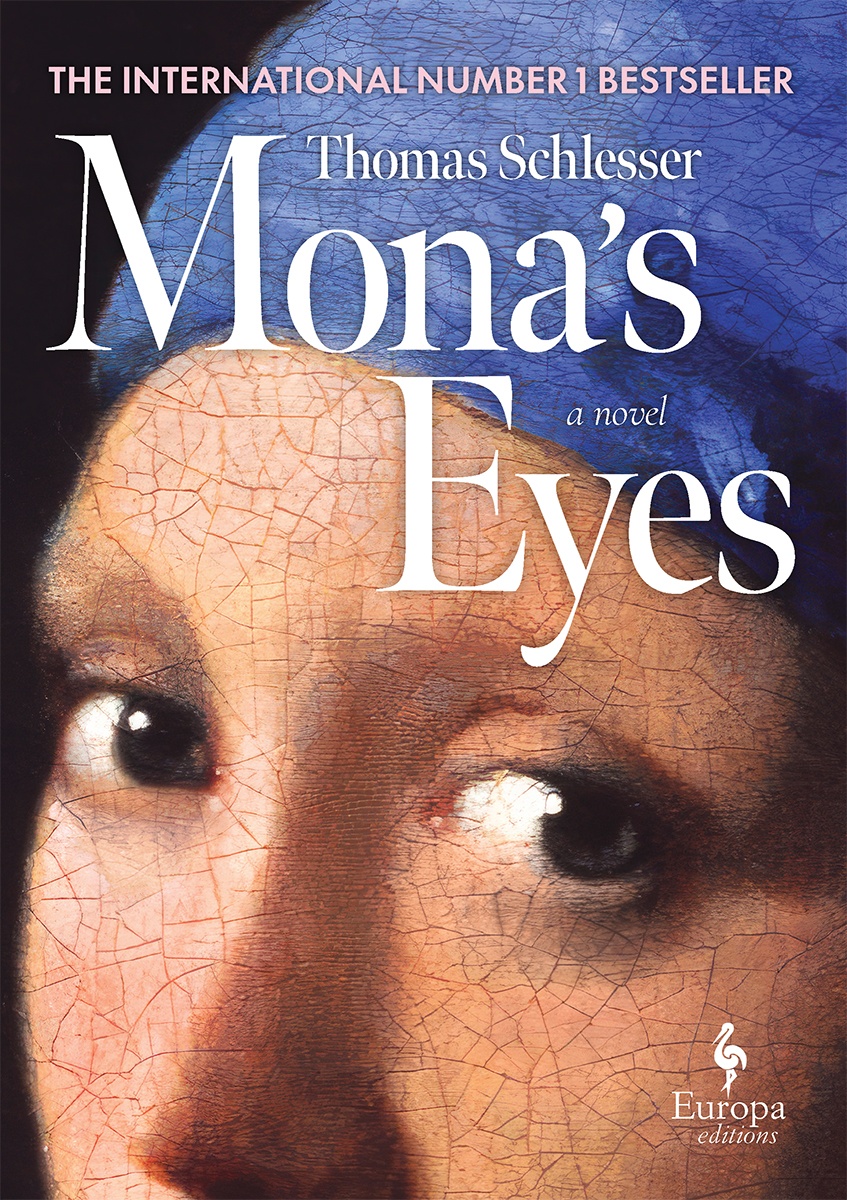
Mona's Eyes
About this book
After a sudden episode of blindness, Mona's doctors cannot promise that her sight will remain. Her grandfather Henry responds with a private curriculum: once a week for a year, he takes her to a Paris museum so that she can store a work of beauty in memory.
Their route passes through the Louvre, the Musée d'Orsay, and the Centre Pompidou, moving across centuries and styles rather than following a single school. Henry explains composition, colour, biography, and historical context, but asks Mona to decide what the images mean in her own life.
The visits unfold beside school, family strain, medical uncertainty, and the changing intimacy between a child and an older relative. Art history remains concrete—one artist and one object at a time—while the novel tests whether attention can become a form of courage.
Mona's Eyes, translated from French by Hildegarde Serle, is a novel and an accessible course in looking. Thomas Schlesser treats museums as places of conversation rather than reverence, making each artwork useful without pretending that beauty can cure illness.
Read a sample
5,119 words
Plain text
From the opening
PROLOGUE Seeing nothing anymore
Everything went dark. As funeral garb. Then, here and there, some flashes, like those bright spots that appear when you vainly stare at the sun from behind eyelids that are as tightly clenched as fists fighting pain or emotion.
Of course, she hadn’t described it like that at all. A child of ten, startled and anxious, expresses distress bluntly, without embellishment or lyricism.
“Mommy, it’s gone all black!”
Mona had cried these words in a strangled voice. A moan? Yes, but not only. There was an involuntary note of shame to them that her mother, whenever she detected it, took seriously. Because if there was one thing Mona never feigned, it was shame. No sooner did shame creep into a word, an attitude, an intonation than the die was cast: some unpleasant truth got through.
“Mommy, it’s gone all black!”
Mona was blind.
The effect seemed to have no cause. Nothing out of the ordinary had occurred; she was quietly doing her math homework, pen in right hand, exercise book under left palm, at the corner of the table on which her mother was studding a plump joint with garlic. Mona was carefully removing a pendant from around her neck because it kept swinging over her page of exercises, and she’d gotten into the bad habit of hunching to write. She felt a dark shadow fall on both her eyes, as if they were being punished for being so blue, so big, so clear. The darkness didn’t come from the outside, like it usually does, when night falls or the lights in a theater go down; it snatched her sight from within her own body. An opaque screen had sprung up inside her, cutting her off from the polygons drawn on her exercise book, from the brown wooden table, from the joint sitting a bit further along, from her mother in a white apron, from the tiled kitchen, from her father sitting in the adjacent room, from the Montreuil apartment, from the gray autumn sky louring over the streets, from the whole world. The child, by the casting of some spell, was plunged into darkness.
Mona’s mother frantically phoned the family doctor. She described, confusedly, her daughter’s glazed eyes, and confirmed, because the doctor asked her to, that she didn’t seem to be experiencing any speech problems or paralysis.
“It sounds like a TIA,” he said, not wishing to give any firmer opinion.
He insisted that Mona be given a high dose of aspirin right away, and, most importantly, be taken urgently to the Hôtel-Dieu hospital, where he would phone a colleague to take immediate care of her. The name in question was not merely the first that came to mind—this colleague was a wonderful pediatrician; reputed, furthermore, to be a very fine ophthalmologist; and, incidentally, a talented hypnotherapist. Normally, he concluded, the blindness shouldn’t last longer than ten minutes, and he hung up. A good quarter of an hour had already gone by since the first cry of alarm.
In the car, the little girl was crying and hitting her temples. Her mother held her elbows, but deep down, she, too, felt an urge to hit that round, fragile little head, the way one hits a machine that’s not working, foolishly hoping to make it start up again. The father, at the wheel of his juddery old Volkswagen, wished he could catch whatever had struck his little girl instead of her. He was angry, convinced that something had happened in the kitchen and they were hiding it from him. He kept going through the list of all the possible causes, from a burst of steam to a bad fall. But no. Mona repeated a hundred times: “It happened on its own!”
And he believed none of it: “People don’t go blind just like that!”
And yet, yes: people can also go blind “just like that,” as this proved. And today, people was Mona, with her ten years of age and her tears of fear flooding down—tears she perhaps thought would wash away the soot that had stuck to her eyes, on that Sunday in October, as night was falling. When they arrived outside the hospital beside Notre-Dame, on the Île de la Cité, she suddenly stopped sobbing and froze:
“Mommy, Daddy, it’s coming back!”
Standing in the street, in a chill wind, she threw her head back to hasten the return of her vision. Like a blind rolling up, the veil over her eyes was lifting. Outlines reappeared, then the forms of faces, the contours of nearby objects, the texture of the walls, and all the variations of color, from brightest to darkest. The child saw once again the slight figure of her mother, her long, swan-like neck and her skinny arms, and the much sturdier figure of her father. Finally, she glimpsed, in the distance, a gray pigeon taking flight, which filled her with joy. Blindness had seized Mona, and then let her go. It had passed through her, the way a bullet can pierce the skin and exit on the other side of the body, causing pain, certainly, but still allowing that body to heal. “A miracle,” her father thought, carefully noting how long the crisis had lasted: sixty-three minutes.
At the Hôtel-Dieu’s ophthalmology department, there was no question of letting the little girl leave before carrying out a battery of tests, making a diagnosis, and providing a prescription. The family’s anxiety was undoubtedly eased, but not entirely dispelled. A nurse directed them to the first floor, for the office of the pediatrician who’d already been alerted by their family doctor. Dr. Van Orst was of mixed race, and afflicted with premature baldness. His big white coat was dazzling, a stark contrast to the sickly green of the walls. His huge smile, furrowing his face with jovial little wrinkles, made him likeable; but it belied the many grave cases entrusted to him. He approached Mona:
Continue reading the sampleClose the sample
“How old are you?” he asked, his voice gravelly from smoking.
Mona was ten. She was the only child of two parents who loved each other. Camille, her mother, was nearing forty. She was slight, wore her hair short and messy, and there was a distant trace of the Parisian twang in her voice. Her charm lay in her “slightly shambolic” side, according to her husband, but underlying it was a formidable determination: in her, anarchy was forever intertwined with authority. She worked at a temping agency, and was the model employee, committed and zealous. In the morning, that is. The afternoon was quite different. She exhausted herself doing voluntary work. All causes were good causes, from isolated old folks to abused animals. As for Paul, he was now fifty-seven. Camille was his second wife. The first one had disappeared with his best friend. He wore a tie to distract from the frayed collars of his shirts, and toiled away as a small-time vintage-goods dealer, with a particular passion for Fifties Americana: jukeboxes, pinball machines, posters . . . And since it had all started in his adolescence with a collection of heart-shaped keyrings, he now owned an impressive array of them, which he didn’t wish to sell and which, anyhow, wouldn’t have interested anyone. With the increased use of the Internet, his store, tucked away in Montreuil, had almost had to close its doors. So, he’d taken to the Net himself, showcasing his expertise on a website that he was forever updating and translating into English. Despite an almost non-existent business sense, he could count on a clientele of attentive collectors, who regularly saved him from ruin. The previous summer, he had repaired a 1955 edition of the Gottlieb “Wishing Well” pinball machine and had sold it for the tidy sum of ten thousand euros. A timely deal after barely a sale for months . . . And then, once again, the void. It’s the financial crisis, he was told. Paul would down a bottle of red wine every day in the store, and then stick the empty, like a trophy, on one of those hedgehog-like bottle-drying racks that had been the making of Marcel Duchamp. He would raise his glass on his own, unable to blame anyone else. In his head, he was drinking to Mona. To her good health.
While the nurse led the child through the maze-like hospital to undergo various tests, Dr. Van Orst, ensconced in a huge armchair, presented his initial diagnosis to Paul and Camille:
“TIA—a transient ischemic attack.”
It meant there had been a brief blockage of blood flow to the brain, and now they must discover the cause of this dysfunction. But Mona’s case, he continued, perplexed him: on the one hand, the attack—very rare in a girl of her age—seemed severe to him, since both eyes had been affected and it had lasted more than an hour; on the other, it had spared entirely her ability to move and speak. The MRI would doubtless tell them more. They must, he added, seeming ill-at-ease, prepare for the worst.
Mona had to lie on a platform inside a horrid machine, and relax quietly without moving. They asked her to take off her pendant. She refused. It was a fine chain made of fishing line carrying a tiny cornet seashell, which had belonged to her grandmother and brought Mona good luck. She had always had it, and her adored Dadé wore the same pendant himself. The two charms connected them to each other, she thought, and she didn’t want to feel torn apart from her grandfather. Since the pendant contained no metal, they let her keep it on. And so her head, her pretty head, with its halo of shoulder-length tawny-brown hair, and its adorable round mouth, was engulfed by an ogreish cavity that was noisy as a factory. During the fifteen minutes the torture lasted, Mona sang songs to herself non-stop, in defiance, to inject a little cheer and life into this coffin. She sang a rather soppy lullaby that her mother would hum to her when tucking her in; she sang a pop song, a tune played on a loop in supermarkets, because she liked the video full of young boys with gelled hair; she sang some catchy ad jingles; she also sang “Une souris verte,” that nursery rhyme about a green mouse, to remember the day when she’d yelled the words to drive her daddy mad, to no avail.
The MRI results came through. Dr. Van Orst summoned Camille and Paul, and was quick to reassure them. There was nothing there. Absolutely nothing. In the cross-section images, the brain showed only homogenous zones. No tumor there. Other tests were carried out, interminably. All through the night: from the depths of the pupils to the inner ear, with blood, bones, muscles, and arteries in between. Nothing there, either. The calm after the storm. Had the storm ever even happened?
The hands of a clock lost in a corridor of the Hôtel-Dieu showed it was five in the morning. An image from a fairy tale came to Camille’s exhausted mind: it was as if, she told her husband, some evil being had snatched away Mona’s eyes and then given them back to her. As if he’d picked the wrong victim, Paul added. Or as if he had sent a sign, a warning, and was preparing to repeat his crime, they each thought, silently.
In the schoolyard, the bell rang. The stream of children, herded by Madame Hadji, made its way up to the second floor. The teacher alerted her fifth-grade pupils that they wouldn’t be seeing their classmate Mona until they all got back from the November All Saints’ break. She herself had just been told this over the phone by Camille, who had explained everything—or almost—about the hellish night, without hiding the gravity of what had occurred. Naturally, the children asked questions. Had Mona been allowed to go on holiday a week before everyone else?
“She’s a bit poorly,” the teacher limited herself to saying, while not being entirely happy with the formula.
“A bit poorly: what luck!” Diego exclaimed, from the third row, and his high-pitched voice prompted agreement from the whole class.
Because most children see illness as the “open sesame” to freedom . . .
At the back of the classroom, beside the chalk-dusty curtains, Lili and Jade, Mona’s two best friends, who knew every nook and cranny of her bedroom, were even more jealous. Oh, how they’d have loved to be with her! “A bit poorly”? Yes, sure, thought Lili, but no question, she’d be spending her days in her daddy’s store. And Jade, gazing at Mona’s empty seat, pictured herself with delight in her company, inventing all kinds of games and stories in the modest store, crammed with old things that smelt of America—a whole bric-a-brac of shiny, fun, and mysterious objects that children found entrancing. But Lili protested:
“No, no, when she’s ill, it’s her granddad, Dadé, who comes to look after her, and he scares me.”
Jade let out a mocking laugh to show that nothing scared her, especially not Mona’s grandfather. And yet, deep down, the little girl had to admit: in front of this old man, towering, thin and scar-faced, with his deep, stony voice, she was pretty spooked, too.
“Hello, Dad, it’s me.”
It was midday when Camille, numb all over, decided to phone her father. Henry Vuillemin, refusing to use a mobile phone, would invariably answer landline calls with a brief “yes,” curt and scalding, which allowed little room for enthusiasm. His daughter loathed this ritual and, each time, would long for the days when her late mother would pick up the phone. She stressed each syllable.
“Dad, I need to tell you: something awful happened last night.”
She told the whole story, in sequence, while trying to keep her emotions in check.
“And?” Henry asked, with a hint of impatience.
But Camille had stifled her tears so much while telling her tale that, now, a massive sob convulsed her body and choked her: she was unable to reply.
“And, darling?” her father pressed her.
This unexpected “darling” gave her a burst of oxygen; she started breathing again and whispered:
“Nothing! For now, nothing! All fine, I think.”
At which Henry let out a long sigh of relief, then threw his head back and gazed up at the cheery moldings on his ceiling, of plump fruit, foliage, and spring flowers.
“Let me have a word with her.”
But Mona, curled up in an armchair in the living room under a russet throw, had dozed off.
The poet Ovid described the phase when consciousness slips away as like entering a giant cave sheltering the languid, indolent god, Sleep. He imagined a cavern that was inaccessible to Phoebus, master of the Sun. Mona had learnt from her grandfather that, on a human scale, there existed no journey more regular than that towards these mysterious and changing lands . . . So, it was right, throughout our lives, never to neglect these realms to which we endlessly wend our way.
In the days that followed, Dr. Van Orst ran some new tests at the Hôtel-Dieu. They still revealed no particular anomaly. The explanation for those sixty-three minutes of blindness just couldn’t be found, making the doctor now balk at using the term “transient ischemic attack,” which implied a vascular deficiency of which he was no longer entirely certain. In the absence of a clear diagnosis, he suggested to Mona—and to her parents—that she try hypnosis. Paul was dumbfounded by this idea. As for the little girl, she wasn’t really sure she knew what it meant. She associated the term with the “scarf game” she’d vaguely heard mentioned at school, which terrified her. To correct this false impression, Van Orst explained that by putting Mona under hypnosis, he could place her, temporarily, under his influence. Such an experience would allow him to go back in time and lead her to that original moment when her sight had gone, make her relive it, and, potentially, identify what caused it. Paul put his foot down. There was no question of doing this, it was dangerous. Van Orst didn’t insist: to be hypnotized effectively, a child must let go with total trust. But, between Mona’s prejudice and her father’s angry overreaction, the procedure was now compromised. As for Camille, she’d said nothing.
So, Van Orst prescribed a conventional medical treatment for the young patient: weekly blood and arterial tests, visits to the ophthalmologist, ten days’ convalescence. He instructed Paul and Camille to look out for “any appearance of subjective signs of a symptomatic nature,” which meant that they must be extremely attentive to their daughter’s feelings. On this score, he suggested they consult a child psychiatrist.
“It’s for everyday prevention rather than actual therapy,” he assured them.
Paul and Camille took in his recommendations, more or less, but, basically, there was just one question on their mind: does Mona risk, eventually, losing her sight? Curiously, at no time had Dr. Van Orst mentioned the threat of a definitive relapse, and, despite their dread, the parents preferred to avoid the subject. They even told themselves that, if the doctor hadn’t tackled it, it meant there was no need for it to be broached.
Henry Vuillemin broached it head-on with his daughter. He wasn’t the sort to run away from questions, however dreadful they might be. Usually very sparing with phone calls, unless it was to hear Mona’s voice, that week he made them repeatedly. In a fierce and impassioned voice, he harried Camille: yes or no, was his darling granddaughter, the treasure of his life, going to go blind? Henry also kept asking, insistently, to see Mona, and it wouldn’t have been right for Camille to deny him that. She suggested that he come over on the Sunday of the All Saints’ holiday, one week exactly since the attack of blindness. Paul, who knew how the conversation would go, secretly resigned himself and downed a glass of rough burgundy almost in one. In front of his father-in-law, he felt wretchedly stupid. Mona, on the other hand, upon hearing the news, stamped her feet with impatience.
This grandfather, full of years and strength, she loved him. She also enjoyed watching how all those who encountered him let themselves be charmed by his lofty height and heavy glasses, with their large, almost square frames. In his company, she felt protected. And uplifted. Henry had always tried to speak to her the way he would to an adult. It was she who wanted this treatment, and relished it, found it fun. She never feared not understanding, and laughed at any mistakes and misunderstandings. Because she watched her own language in return, and it was clearly more of a game than an issue.
Henry had no desire to turn her into a little performing monkey. He didn’t want to be one of those parodies of grandfathers, always looking out for youthful errors just to be able to correct them and sound smart. It wasn’t in his nature. He’d never made her do her homework, didn’t get involved in report cards. Besides, he loved the way Mona expressed herself. Even more, he was fascinated by her turns of phrase. Why? He hadn’t a clue. Failed to understand it. He had always been obsessed, haunted by something in her childish language. Was there something more to it, or a certain something that was missing? A quality or a defect? This impression was all the more troubling because it wasn’t recent: Mona’s particular little “tune” had always concealed a mystery that Henry was determined to solve one day, just by listening.
Camille sometimes admitted her surprise at a relationship she deemed “too lovely to be true,” but she recognized that it worked brilliantly and made her daughter happy. And Henry, who readily quoted Victor Hugo’s The Art of Being a Grandfather, would remind anyone willing to listen of one of the cardinal principles of communication: it matters little if you don’t instantly understand all that someone says, as though each new word had to be an already leafy tree in the vast orchard of the brain. Buds would be sure to open when the time was right, as long as furrows have been dug and seeds sown.
These furrows and seeds, in Henry Vuillemin’s case, were a flow of rich and sure words, which gripped you from their first use, never to let you go; it was a perfectly simple way of speaking, but of such range that it was exhilarating; the scansion was that of a storyteller, often accelerating, before slowing back down and then being tinged with gentle emotion. It was a steamroller of worldly experience and quiet erudition.
And so the relationship with this Dadé was one of a kind. Sometimes, an extraordinary bond is created between grandparents and grandchildren, and vice versa, stemming from the fact that, by some kind of existential curve, the elders return, from the heights of their great age, to the feelings of their earliest youth, and understand, better than anyone, the springtime of life.
Henry Vuillemin lived in a fine apartment on Avenue Ledru-Rollin, right above the Bistrot du Peintre, a narrow establishment with lashings of Art Nouveau-style woodwork. He would go down there every morning and follow his own little routine: a coffee and a croissant, a perusal of the national newspapers, an exchange now and then with the odd client and any waiters on their break. He felt part of an old world and, ritually, would walk very slowly to Place de la Bastille, examining the furniture in the store windows of Rue du Faubourg-Saint-Antoine on the way, would continue up towards Place de la République along the park-like median strip of Boulevard Ricard-Lenoir, and then turn back along Boulevard Voltaire. In the late afternoon, at home, he would consult the art books that were piled right up to the ceiling. Henry, who was one centimeter taller than General de Gaulle, could get hold of the least accessible without library steps or ladder, and, by curious chance, it was regularly those that most appealed to him. He had a phenomenal memory, although he had a propensity to talk about things he knew as opposed to more personal, intimate recollections, which he protected under layers of modesty. Mona knew the rule. The only thing her grandfather forbade was any mention of Colette Vuillemin, who had left him a widower seven years ago. Camille, like her father, never mentioned her mother, either. The child might try to breach that wall from time to time, but would be met with a deathly silence. Colette was not to be spoken of. Ever. The only exception to this taboo was Henry wearing that charm around his neck in memory of his late wife. It was a pretty little cornet seashell attached to some fishing line. He’d picked up the shell while with her on the Côte d’Azur in the summer of 1963—he no longer knew exactly which day anymore, but he remembered the scorching heat and having sworn a good many things to Colette. Mona, as mentioned, wore the same pendant, inherited from her grandmother.
We all have our own ways of swearing. Henry Vuillemin, well, he would swear on “what’s beautiful on earth.” The expression surprised Mona, and whenever she heard it, she always shrugged her shoulders with a puzzled little laugh: what’s beautiful on earth—that was a bit everything and nothing at the same time. And then she would wonder whether he, her revered grandfather, was included. Henry had, evidently, been an attractive young man, and remained imposing, charming, spectacular. His octogenarian face, gaunt and chiseled, radiated a wonderfully alluring vigor and intelligence. But he was blemished. A scar tore through the right side of his face, from under the cheekbone right up to the eyebrow. The wound must have been very painful. It had made a furrow in his skin, but had also torn away a piece of his cornea. It was a war souvenir. A terrible souvenir: on September 17, 1982, while Henry was doing some photojournalism in Lebanon for Agence France-Presse, a Phalangist had lashed out at him with a knife to stop him from going any further. He was just approaching the Shatila camp. Rumor had it that massacres were taking place there, that Palestinian refugees were being arbitrarily executed, without trial, in retaliation for the assassination of President Bachir Gemayel. He had wanted to verify this, to bear witness. His way had been barred with inhumane violence. Henry had lost a lot of blood and the use of his eye. This disability, combined with his great height and, as the years went by, increasingly extreme thinness, had given his appearance a supernatural aura. The handsome reporter, who looked like the movie star Eddie Constantine, had turned into a legendary character.
On All Saints’ Day, Mona was in great form. Her parents had done everything to cheer up the dreariness of November. Jade and Lili, her two friends, had come over to watch some of Toy Story, the animated film in which toys come to life. They had messed around a bit, amiably. Especially Jade. She was a mischievous and pretty little girl, a dark complexion, and impeccably neat hair. And yet she had a surprising passion: pulling faces. She could transform her harmonious face into a mobile and deranged theater, where bizarre, burlesque expressions would appear, like demented actors. Mona always begged her for more, delighted.
At 7 P.M., the entry phone rang. Paul pursed his lips and raised his eyebrows. Camille pressed the button:
“Dad?”
It was just like him, arriving on the dot. Paul, after greeting him, left to return Jade and Lili to their respective parents, and during that time, Mona, her mother, and her grandfather were all reunited in the apartment. After an irrepressible outburst of joy, the little girl, having been careful not to tell her two friends of her woes, launched into a detailed account of her sixty-three-minute ordeal and all the tests she’d endured at the hospital. Camille didn’t interrupt her.
Henry, however, while listening to Mona talk, and talk some more, was surveying, with clinical objectivity, the child’s surroundings. Even her bedroom, despite the enchanting kitsch of the décor, seemed extremely sad to him. That wallpaper with its garlands of flowers, those glittery knickknacks in the form of hearts or animals, those pink and brown cuddly toys, those grotesque posters of stars barely out of adolescence, all that plastic jewelry, that cartoon-princess-style furniture . . . The acidic colors of all this clutter choked him. In this whole scenario, oozing bad taste, there were but two exceptions of a kind of beauty. A sturdy American industrial lamp from the Fifties, with an articulated arm, that Paul had unearthed, given to Mona, and fixed onto her little desk. And then, above the bed, under glass, a poster for an exhibition featuring a painting. It shimmered with some sublimely subtle colors, cool in tone. They depicted a naked woman, in profile and leaning forward, seated on a stool covered in a white cloth, with left ankle resting on right knee. In one corner it read: “Musée d’Orsay Paris—Georges Seurat (1859-1891).”
Despite these two exceptions, Henry came to the painful conclusion that, for convenience’s sake, childhood is mainly crammed with frivolous and ugly objects. And Mona’s was no exception. Beauty, true artistic beauty, entered her everyday life stealthily. It was entirely normal, Henry reflected: the refinement of taste, the development of sensibility came later. If it weren’t for the fact—and this thought suffocated him—that Mona had almost lost her sight, and that, if her eyes stopped working permanently in the days, weeks, or months to come, she would be left, inside her head, with only the memory of tawdry and futile things. An entire life in the dark, with only the worst the world produces to draw on mentally, with nowhere for those memories to go? It was unthinkable. It was terrifying.
Much to his daughter’s annoyance, Henry was taciturn and distant all through supper. When Mona finally went off to bed, Camille purposefully turned up the volume of Coltrane’s saxophone, coming from an old chrome juke box, to drown out their voices and ensure that the little one would hear nothing.
“Dad. For now, Mona seems to be dealing well with . . . (she hesitated over terms) . . . what just happened. But the doctor recommends the support of a child psychiatrist. It might seem strange to her, and I wondered if you might take her to the appointment, just so she feels reassured . . . ”
“A shrink? Will that really stop her from going blind?”
“That’s not what it’s about, Dad!”
“I believe it is, and it will be, as long as you don’t dare ask the doctor that question! What’s his name again?”
“He’s called Van Orst and he’s very good,” Paul butted in, clumsily, just to be part of the conversation.
“Dad, wait,” Camille continued. “Listen to me. Paul and I will do everything we can to avoid anything happening to Mona, d’you hear me? But she’s ten years old and we can’t just act as if she hadn’t been through anything. The doctor says her mental stability is a priority. So, I’m asking you, just to see whether you’d like to take care of that, because I know Mona will trust you. D’you hear me, Dad?”
Henry heard perfectly well. But right then, in a split second, an Apollonian idea had ignited in his head, one that he kept jealously to himself. He wouldn’t take his granddaughter to see a child psychiatrist, no! Instead, he would administer a therapy of a totally different kind, a therapy capable of compensating for the ugliness inundating her childhood.
Mona, who trusted him totally, had faith in him as in no other adult, would accompany him to the repositories of what the world has produced of greatest beauty, of greatest humanity: she’d accompany him to the museums. If one sad day Mona became permanently blind, she would at least have the benefit of a kind of reservoir, deep in her brain, from which to draw some visual splendors. The grandfather’s plan went like this: once a week, according to an unchanging ritual, he would go with Mona to contemplate a work of art—just one—first in prolonged silence, so the infinite delights of color and line penetrated his granddaughter’s mind, and then with words, so she went beyond visual rapture to understand how artists speak to us of life, how they illuminate it.