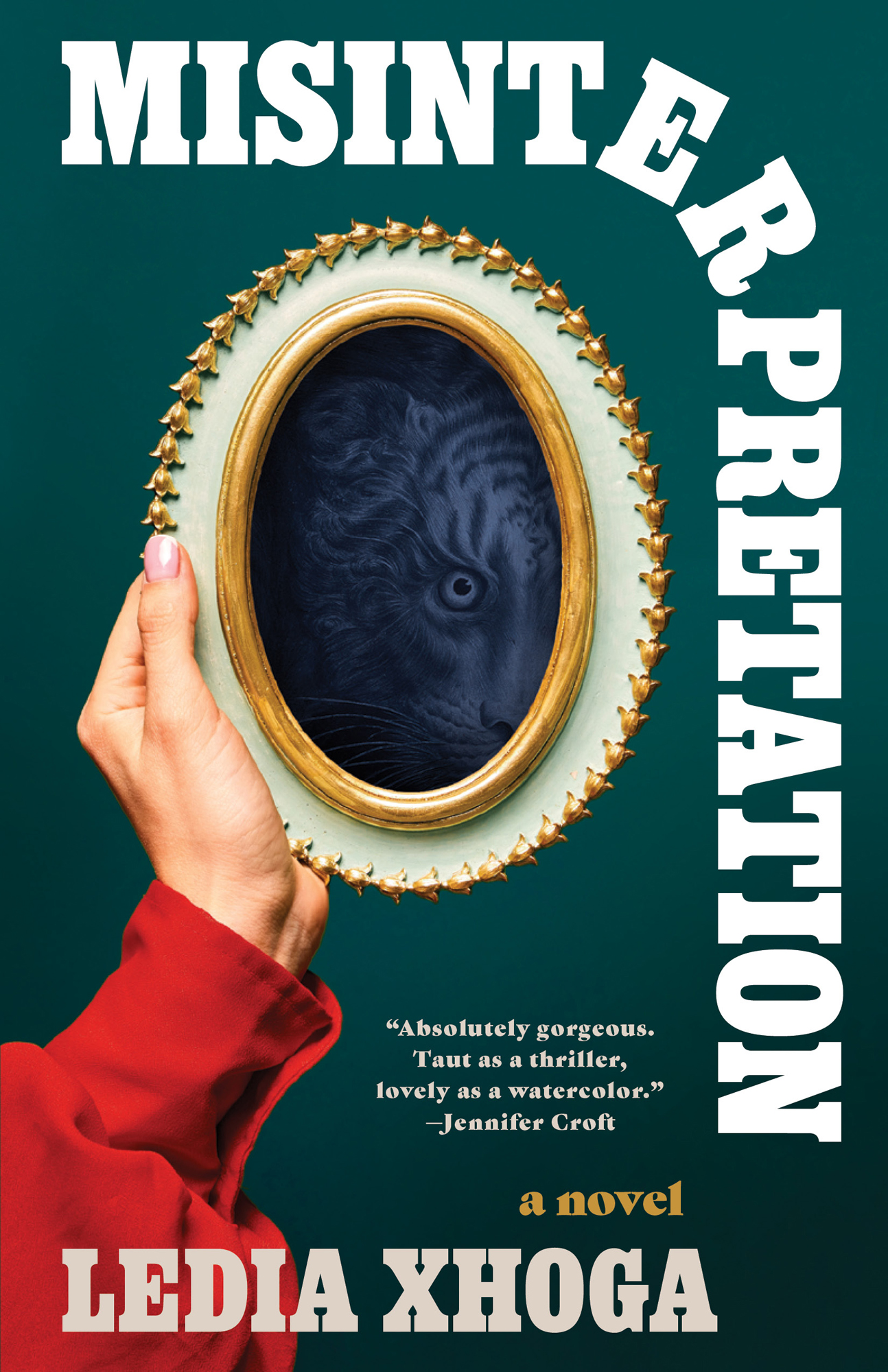
Misinterpretation
About this book
The unnamed narrator agrees to interpret therapy sessions for Alfred, a Kosovar survivor of torture. His nightmares activate memories she has buried, despite her husband’s warnings about carrying clients’ lives beyond the work.
An impulsive effort to help a Kurdish poet leads to a risky encounter and another plan she cannot control. As obligations accumulate, her marriage and mental health deteriorate, and a sudden trip to Albania places her American life against the family history she left.
Ledia Xhoga treats interpretation as emotional labour and unstable authority. The narrator controls access between languages but cannot guarantee that meaning, testimony, or her own motives will remain intact through the transfer.
Misinterpretation is a taut first-person novel about migration, secondary trauma, and the dangerous wish to convert professional understanding into personal rescue.
Read a sample
5,065 words
Plain text
From the opening
1.
I WAS FIFTEEN MINUTES LATE AND HIS PHONE NUMBER was out of service.
Even in late January, Washington Square Park pulsed with the energy of summer. The chess players were fretting over their moves to the sound of Gershwin. The saxophonist’s Great Dane was pining for the dog run. It was Alfred who had suggested meeting here, next to the statute of Garibaldi, a name that brought to mind fragmented pieces of Italy glued together. It was an old mnemonic from high school; Garibaldi was responsible for Italy’s unification.
But Alfred was nowhere to be seen. Two men on a nearby bench didn’t match his description. He’d be alone. The agency sent photo attachments, which I rarely bothered opening. It was easy to recognize my clients from the look of expectancy, the humble bearing, the wear and tear that showed on their faces and bodies. That his phone was out of service was odd. Had they sent me the wrong phone number? The sound of footsteps. A toddler with squeaky shoes bumped into me, followed by her father and an excessive apology. Two boys holding a minidrone scurried toward the empty fountain. An elderly man was checking his watch. Could he be Alfred? He was far from the statue. Had he given up on waiting for me at our meeting spot? The man looked in his sixties. According to his file, Alfred was only in his early forties, just a few years older than me. Was it his preoccupation with his watch that made him look older? He hunched over it the same way my grandfather used to while winding up his Volna, a watch he’d bought in Moscow in the fifties. I walked toward him. Where was his phone, anyway?
“Alfred?” I said, relieved that I managed to put the accent on the second vowel, the Albanian way. “I’m sorry for being late.”
He straightened his back and waved his arm forgivingly. He did look younger from up close. His face seemed stuck in between expressions. It reminded me of an unfinished Rubik’s Cube we kept around the house, which I could never resist trying to solve.
“I was worried you were waiting somewhere else,” he said, rubbing his sunken eyes. “I saw another woman over there and thought it was you.”
“Is your phone out of service?”
“It stopped working this morning. I don’t know why.”
“Is your dentist around here? Shouldn’t we get going?”
His answer sounded muddled. The translation agency that employed me had been sending Kosovar Albanians my way. Their accent was different from mine. It took me a few seconds to get used to it, for me to understand the words immediately. We walked under the Arch and headed toward the street. I was hoping the dentist would still be willing to see him—we were late for our 6:00 PM appointment. While looking for their number on my phone, I felt a tug on my arm. Alfred was holding on to my elbow.
“Be careful.”
An SUV had run a red light. It was speeding away now, only a few steps from us. That he was a survivor of torture flashed in my mind again. I didn’t know what kind of torture it had been and was not allowed to ask for details. When his hand slid down my arm, the goose bumps surprised me.
The dentist was only a ten-minute walk from the park. We walked there silently and at some distance from each other, like a couple who had just quarreled. In no time at all, we were filling out paperwork. On a scale of 1 to 10, with 10 being the highest rating, how would you rate your dental health? On a scale of 1 to 10, with 10 being the highest rating, where would you like your dental health to be? The questions struck Alfred as ridiculous. He opened his eyes incredulously and shook his head in disbelief. He then jutted his chin toward the papers, giving me full power of attorney over his dental history. Judging from his reaction, I opted for the lower numbers. He nodded in approval. Still hoping that some questions might resonate with him, I kept reading aloud.
“Do you brush your teeth in the morning or at night? Or both?”
He was indifferent, eager to dismiss such useless formalities to deal with a toothache that had kept him up all night. He gave a deep sigh as if to say, It’s true that my dental hygiene and genetics have contributed to the state of my teeth, but do they need every single detail? Realizing there were many more pages to go through—the pile on my lap did look intimidating—he glanced around with doubt. What kind of dentist would make us do all this?
“What would you change about your smile?” I asked.
The answer consisted of several options. I had trouble interpreting the last one. Smile makeover.
“Smile transformation,” I fumbled. “Changing your smile completely.”
“Pick that one,” Alfred said without hesitation.
It was the only answer that he chose on his own. Afterward, he smiled, which frightened me. His features widened but didn’t soften, as if he were smiling against his will. He had chosen the right option after all.
“Are you ready, lovebirds?” said the receptionist, who looked tired and was massaging her shoulder.
When we stood up, she smiled in a forced way, like Alfred had earlier. Show less gum, one of the options from before, sprang to mind. She didn’t ask about insurance or payment information. We were an after-hours charity case. She led him to the back, ignoring me. She didn’t find me necessary now. The dentist would have his answers by looking at Alfred’s teeth, presumably, or at the paperwork I had completed. Waiting around random offices was the least favorite part of my assignments. Not knowing what to do, I sat back down. In the aquarium tank to my left there were no fish but several odd creatures; they were translucent with a hint of hazy gray, and long antennas.
Continue reading the sampleClose the sample
“They’re ghost shrimp,” said a young woman sitting on the other side of the aquarium. I hadn’t noticed her till she spoke. “When they’re about to die, they turn white.”
She pressed her finger to the glass, pointing at a half-white creature. “He’s on his way out.”
She wore soft curls under an olive beret and a velveteen cape jacket in chartreuse. A long skirt of a faded material hid her knees and feet. Her appearance clashed with the bland surroundings. I had the impression that, in some mix-up of fact and fiction, she had stepped out of one of those thirties films my husband was always watching. Finding the office underwhelming, she had then zeroed in on the underwater world of the aquarium.
“It’s kind of creepy,” she said and pouted.
The receptionist tapped me on the shoulder.
“Your husband wants to see you.”
“He’s not my husband,” I said quickly. “I’m only his interpreter.”
“Oh, sorry. Could you come in the back?”
The back room was small and crowded with gleaming white machines, rather enormous for repairing such small objects as teeth. Alfred and the dentist were standing motionless to the side of the chair. The dentist looked like a late teen, but she had to be older—she was a practicing graduate student. She kept her hands in her scrubs’ pockets and threw puzzled glances at the patient whose language she didn’t understand.
“He doesn’t want to sit,” she told me, her face taut. “Can you please tell him to sit in Armenian?”
“Albanian.”
“Yeah.”
“What’s going on, Alfred?”
“I’ve never liked these machines.”
“It won’t last long.”
“These machines scare me. My father used to have to force me to sit.”
“Look, they’ll numb you. It won’t hurt.”
He didn’t move.
“I promise,” I said. “They do the work, but you won’t feel it. It’s amazing.”
It took a few seconds, but Alfred did sit down in the end.
“If he’s in any pain,” said the dentist, “tell him to raise his hand. I will numb him soon.”
I explained that to him, but when the drilling started, Alfred did nothing, even though his left hand kept trembling.
In Tirana, when I was a kid, they used to do our fillings and root canals without numbing. The dental office was inside our elementary school. The school dentists were two attractive women, who, in my memories, didn’t wear scrubs but blue, flowing dresses. They’d pop in and out of our classroom, calling out our names like Odysseus’s mermaids, charming us into an adventure, away from our tedious lessons. It was only later, when the drill touched a nerve and my screams echoed through the school’s hallways, that their appeal waned. Despite all that, I had never feared the dentist. Among all types of pain, physical pain was the easiest to forget.
“I’m sorry,” said the dental student to Alfred. “I touched a nerve.”
Alfred’s body slithered on the chair, but he didn’t make a peep. Then he sort of shriveled, reminding me of an Albanian expression I hadn’t thought of in some time—U bë sa një grusht—He became small as a fist.
THERE WAS, AT TIMES, an unnatural intimacy that developed between myself and some of the people I interpreted for. Disclosing personal and confidential information in front of someone played a trick on the brain, making us both believe we were more than acquaintances. But the amount of time we knew each other, and the context of our meeting, didn’t justify such closeness. When Alfred’s filling was over and we were walking toward the reception desk, he reached for and held my hand. It was an ordinary gesture, a substitute for saying thank you, or thank God, it’s finally over. His hand was chilly. I warmed it with mine. Holding hands with my clients wasn’t allowed. Still, when it came to most rules, one had to use judgment.
The vintage girl was still in the reception area. I admired her meticulous makeup, her hairstyle, her unique clothes. How long did it take her to transform herself into a movie star from the thirties? I, too, often longed to escape my ordinary look, to disguise myself behind a colorful façade, or to try out a personality. But it was all a fleeting fantasy. I didn’t enjoy making a fuss over my appearance, not even occasionally. I took less time than my husband to get ready. People assumed I was athletic, an erroneous impression suggested by the sporty, no-fuss clothes I preferred. The girl sighed in an exaggerated manner, then twirled her hair. She really did resemble one of the stars in the movies my husband watched.
“Do you speak any English?” I said to Alfred when we were outside.
“Where would I learn it? Everyone around me in the Bronx is Albanian.”
We walked back toward Washington Square Park, now at the mercy of a cutting wind. Even from a distance, I could make out the green benches under the hooded lanterns, where Billy and I used to sit many years ago. I hadn’t been in that park in years, since we first started dating. As Alfred and I passed the old Hangman’s Elm, my younger self flitted away to an alley on Crosby Street, ending at a bar with latticed windows and flickering candles. There used to be a French singer inside, wearing an off-the-shoulder evening gown with a daring front slit. She sang melancholy songs and played an old-school accordion. The most unusual aspect of her attire was a headlight hat she shone over the audience. Was she still there? Was the bar?
“I need an interpreter for my visits at the psychiatrist,” Alfred said. “I haven’t found anyone I trust.”
I hesitated. Sitting through his therapy sessions wouldn’t be easy.
“I know we just met,” he went on. “But I trust you. I don’t trust many people.”
Alfred had brown eyes. They were comforting and kind. I had never, till my husband, dated anyone with light eyes. Billy’s eyes were green. They could be clear, as a flowing river. At times they were turbulent, with darker shades of hazel.
“I need to talk to someone. I haven’t been well.”
“I’ll do it,” I said.
He flashed his smile again. His face was an acquired taste, and I was getting used to it.
“Do you want to get a beer? I know a good place in the Bronx.”
It had been a long time since I’d been out alone with a man who wasn’t my husband or even with one who was. The past was suddenly at an arm’s reach—a casual invitation followed by a feeling of lightness, curiosity.
“I should go home.”
Then Alfred shook my hand, thanked me, and left. What would his night be like? He’d take the stairs up to his silent apartment. Open the door in the darkness. Cut vegetables on a wooden board before sliding them into a boiling pot. I saw myself sitting at his table, as his guest. He put on some music. Focused as he was on cooking, he ignored me for a while. He then turned around, refilling my wineglass while fixing me with his gaze.
I walked toward the subway, only then realizing we were going in the same direction. He was a few steps ahead of me. My feet halted, if only momentarily, on his elongated shadow.
OUR ELDERLY NEIGHBOR HELEN, who lived across the hall, entered the elevator barefoot, standing on her tiptoes. For the duration of the ride, she kept one hand on a wooden wall panel and the other on a straw hat topped with a peacock feather. Helen always wore ridiculous hats. It wasn’t entirely her fault, for our neighbors humored her by complimenting them. Cool hat, Helen. Truly unusual. But what could they do? She’d tell anyone who’d listen that she decorated them herself. Her stance was making me nervous. Standing on her toes while leaning on the wall was an unnatural pose. Would her body crack and break in front of me? We reached the fifth floor without incident. Displaying extraordinary balance, she scampered toward her apartment. But she didn’t go in. She waited for me on her doorstep. Then she handed me a flyer from a pile she was carrying. She was inviting me to a Draw and Sip party. The $20 fee included the materials and a cup of wine.
“How was your day?” she asked, her eyes glistening. There was a strange intensity in our simple greetings.
I answered politely and even asked her back the same but didn’t stop. Our interactions were unsettling. I didn’t know much about her at all, except what other neighbors had told me. She used to be a soap opera actress in the eighties, a fact that had impressed me, even though the writers had killed off her character by the time the show became popular in Albania.
It turned out Billy was home. The hallway was dark, but there were no scattered and mismatched shoes on the floor, a dead giveaway of his presence. He couldn’t help picking up my shoes and slippers and tucking them away. My tendency to drop things anywhere except where they belonged had at first startled, then annoyed, then amused him. He still cleaned up after me without complaints, joking at times that growing up in Albania must have conditioned me to get by without household conveniences. It was mostly a matter of temperament.
He was sitting on the sofa in the darkness, watching a black-and-white movie projected onto our wall. A cool white light had spilled onto his face and shoulder, leaving the rest of him in the shadows. The project he was working on, a book of essays about book-to-film adaptations, was giving him an excuse to indulge in the films he loved. He was a film professor at NYU.
It was Love Affair he was watching, a 1939 romance film with Irene Dunne and Charles Boyer. The couple were sitting at a bar, aboard a transatlantic ocean liner. In gem-studded jewelry and a black coat dress, Dunne was raising her glass toward the ever-dapper Boyer. They sipped on pink champagne.
Dead people, running around playing house, we had once joked.
“I didn’t know you’d be back,” I said.
“I texted you in the morning.”
I tapped on my inbox. There was his message, saying he was on his way home.
He pressed forward until Boyer appeared on the screen alone. In a dark suit, holding his fedora hat, his coat hanging over his arm, he was wandering around an apartment. Then he froze in place. The camera panned to the left, across a mirror showing a painting, then back at his face.
“Look at his reaction,” Billy said. “He’s realizing she’s the woman who bought the painting.”
His willingness to pay attention to the unspoken had always impressed me. He was fond of discussing at length the implications of a gesture or the meaning of a smile.
He flipped on the light switch. To our left, the slab of dark walnut that was our dinner table appeared, along with a forgotten plate, and two murky glasses. Behind his curls hovered a Polish circus poster featuring a cartoonish lion soaring through flames.
“Blue suits you,” he said, pointing at my blouse. He said that about every color I wore. “Did you work today?”
“I interpreted for a Kosovar Albanian. Took him to the dentist.”
He paused the movie. He took off his glasses and cleaned them with his T-shirt. His eyes seemed smaller, but shinier, two pieces of cut green marble.
“Was it a one-time thing?”
“Yes. A one-time thing.”
“That’s good,” he said, nodding. “I’m glad.”
He worried needlessly, fearing that my interpreting sessions would wear me out. I turned toward the wall. Dunne and Boyer were silent. I remembered that Terry, the character played by Dunne, would later conceal the truth about her accident and that she was in a wheelchair.
“That woman’s kid drew on our hallway wall,” he said with a hint of annoyance. It took me a second to realize that he was now talking about an Albanian family who had stayed with us that past weekend. “And her husband was so loud on the phone. He never knocked. He’d call our names at the same time he barged into the room.”
“Knocking is sort of an American thing.”
“Since when?”
“He considered us like family, so he felt close enough to do that. Take it as a compliment.”
“I just don’t like strangers using my bathroom. Or, say, what if I walk around in my underwear?”
“It was only for a weekend. And you never walk around in your underwear.”
He sighed, but a smile spread over his face.
He was softer than he let on. His eyes would often tear up during an emotional scene in a movie or some argument we’d have. He even balked at killing a cockroach, clenching his jaw as it crawled over our kitchen counter. All I felt, while pressing on a cockroach with a paper towel, was a dim discomfort at my power over its existence.
IT WAS BILLY WHO suggested I should attend the poetry reading in Manhattan. He frequently forwarded literary events to me, hoping they’d be helpful for networking and finding translation work. He believed that the quiet company of dictionaries would be better for my mental health.
The invite had a creative subject—A Kurd, an Albanian, and a Bulgarian walk into a bar.
I got there late. The Albanian and the Bulgarian had already done their readings. A waifish brunette stood behind a wooden podium in the corner, reading plaintive poems in a trembling voice. The poems revealed glimpses of a fragmented life—she had lived in Italy and France before coming to the US. Honey-bursting grapes, cracked wooden cradles, red blots on the snow—the images flowed in quick succession, then hovered over the gleaming candles on the tables, the beer dispenser, the tip-counting bartender. Other phrases, like dressed in sorrow, or suffused with the smell of blood, heavily alliterated, took a nosedive into the beer-soaked floor. Then they lay there, as if wounded.
I had always enjoyed readings in the red room of the KGB bar, awash in Soviet memorabilia. There was a Lenin poster on the wall, a photograph of the famous cosmonaut Valentina Tereshkova, a draping hammer-and-sickle banner, period art from World War II and the Cold War. Despite the theme, the atmosphere felt decadent, a hangout for aristocrats.
The Kurdish woman’s voice was making me lightheaded. She talked of ugly and repulsive things in such a gentle, almost hypnotic manner. Feeling dizzy, I had to lean back against the bar. Sometimes words affected me physically, causing as much nausea as motion sickness. If it happened while I was interpreting, I held tightly to the chair or pressed my feet on the floor. Repeating some quote from Buddha or Thich Nhat Hanh, or simply counting, usually helped.
Leyla, the Kurdish woman, thanked everyone, gathered her papers, and bowed to the long applause. There was a confessional quality to her writing. As she sauntered around the bar, many were friendly to her, believing, perhaps erroneously, that they already knew her. She had opened a curtain, and we couldn’t help but peek inside. The reading’s emcee offered to buy her a drink. I complimented her work, joining a group of people who had circled her.
We talked about her poetry. Some asked her questions about her life and how she came to New York City. She had hinted at domestic abuse in her poems. She had described her terror when a man had followed her in the streets and underground. But while her poetry had been fluid and revelatory, she spoke little about her circumstances. The conversation soon swerved toward the most recent election. Months had passed since November, but people still wallowed in indignation. Leyla didn’t seem perturbed in the least by the exasperation around us. She must have been tested, I thought, by worse disasters.
“What do you do for money?” she asked me.
“I’m an interpreter and translator,” I said. “I speak Russian, Spanish, and Italian. And Albanian, of course.”
“I’ve been looking for work everywhere—in restaurants, babysitting, anything. Maybe I can do translating also. I’m fluent in Italian and French, well, besides Kurdish and English.”
“Do you have a green card?”
“I’m waiting for my political asylum papers to come through. I’m applying as a domestic abuse case.”
“They might no longer approve them.”
“I know.”
She then told us she was working on a book of poetry but wasn’t making as much progress as she wanted. She shared a studio with four other women in Crown Heights.
“It’s a tiny space. The TV is constantly blaring. I walk around the city for hours, not wanting to go home.”
I left the bar with Leyla and Sanaz, a friend of hers who was visiting from out of town. As we walked toward the train, Leyla kept looking behind us. We were almost at the station when she swerved us toward a side street.
“It’s less windy this way,” she said. It was obviously an excuse, for the gusts continued to bite our faces just the same.
“I don’t see anyone behind us,” Sanaz said with a hint of defiance. “Nobody is following us.”
Leyla pretended not to hear her. Her habit of looking back was contagious. I started glancing behind us also, remembering her poems and their atmospheric dread. But besides an overfed rat playing behind the recycling bins, the narrow side road we were in was deserted. On that cold night, most people kept to the main street, the shortest way to the subway.
We made it to the station. Leyla didn’t come down to the platform.
“I’ll go home later,” she said, pushing down her woolen hat. “After my roommates go to sleep.”
She wound her shawl around her neck, getting ready for another walk in that thirty-degree weather.
“You two go home,” she said. “I’ll be fine.”
I remembered that Billy would be in LA that upcoming weekend for a friend’s book party.
“Do you want to come for dinner to my place next Friday?” I asked them. “You can even spend the weekend. My husband won’t be home.”
“You don’t have to do that.”
“Why not? It will be fun.”
“I’ll bring wine,” said Sanaz.
“I’ll make byrek,” I said.
“I love byrek,” said Leyla.
On my way home, I wondered if Billy would mind going to LA alone. He wanted us to attend his friend’s book launch party together. I wasn’t going but hadn’t told him yet. His friends and acquaintances on the West Coast were pleasant and buoyant, but their attention was spread thin. They thought of me as some kind of obscure Eastern European character, drawing on whatever that meant to them. Used to classifying people, they treated me as peripheral. Billy contradicted my impressions, calling them self-involved extroverts, saying they were like that with all new people, nice enough, but hard to get to know. Still, I often left the parties in a strange mood, with a vague discomfort in my chest. I’d comb over various encounters, linger on some word or remark, telling myself that forgetting that evening was the best thing to do. They lived so far away that we barely saw them. The only friend of Billy’s I truly liked was Anna Cruz, a violinist who lived in Brooklyn, but who traveled all over the world to give concerts. We had been friendly from the start, and met up for drinks whenever she was in town.
“Would it be okay if I don’t go to LA?” I asked Billy when I got home.
“I get it,” he said. “A six-hour flight, and for only two days. We can use my companion pass another time. Maybe for a short vacation?”
“I wish Miles great success with his novel,” I said, even though Miles’s fiction had always given me the sensation of walking through kelp.
“He really likes you,” Billy said, bringing me close. “He does.”
Miles came from a wealthy family but had no compunction about acting penniless on social media. When he wanted to attend some writing residency in Paris or on a Greek island, he’d set up a GoFundMe campaign in which he portrayed himself as a starving artist.
Don’t your parents own a house in Tuscany? I wrote under one such post on Facebook, a comment for which he never forgave me, though he humored it with a laughing emoji and, outwardly, was much nicer to me. Still, Miles did love Billy, I knew that. They’d known each other since childhood.
“He called me a week ago,” Billy said. “Asked me to go to Thailand for a full moon party. He even had miles.”
“Miles had miles. Ha!”
“By the way,” he said, in a lower voice, his eyes burrowing into mine. “What happened with that guy you took to the dentist? The one from Kosovo.”
The doorbell rang twice. It sounded more jarring than usual. All that could be seen at first through the peephole was a felt cowboy hat. Some dried herbs (basil, thyme?) stuck up from a red hatband. Helen’s face, confined by a tight chin strap, appeared next. She had painted her cheekbones a vibrant lilac. She stared straight at me. Had she heard my footsteps? Did she know I was there, watching her?
She waited for a while, then took a step back. She adjusted her hat with her bony hands, like some paparazzi was about to take her picture. She rang the bell again. There was no reason not to open the door; she was my neighbor. But she’d never visited me before. Her look of expectancy made me uneasy. She had the same flyers with her, the invitation to the draw and sip party. I tiptoed back to the living room hoping she wouldn’t hear the creaking floor.
“It was Helen,” I told Billy. “From across the hall.”
“You know who she reminds me of?” he said. “Norma Desmond, from Sunset Boulevard. The way she sashays around the hallways in those hats and long dresses. Didn’t she used to be an actor?”
“In a soap opera.”
Like Norma Desmond, Helen had probably made a fortune in her youth. She now spent her days in idleness, chatting up neighbors and drawing.
“So, the guy you took to the dentist,” Billy said. “What happened to him?”
“I never heard from him again.”
“Just checking,” he said.
He left the room, but a mild apprehension stayed behind. He thought of me as more fragile than I was. Had he seen through me earlier? It was true that I hadn’t talked to Alfred since that night. He could have already found someone else to interpret for him.
2.
ALFRED REACHED OUT VIA EMAIL.
My psychiatrist said that your psychological training for interpreters is about to expire. You need to take a refresher course, she says. An imposition on your time, clearly. Will you do it? You are someone I trust. Isn’t it funny how it goes? You can spend years with someone but never trust them. Or you can, in a second. They are strict about rules in America. Too many people here. Do you remember how the dentist wouldn’t even look at my teeth without having us sign a hundred pages? Another thing is that I’m married. My wife’s name is Vilma, a woman from Tirana, like you. Our baby, a girl, will be born in one month.
I used to be afraid of my father. Children know everything. He loved me, he did, but things never worked out for him. I had vowed never to be a father. Yet, here I am. Vilma, my wife, can’t wait for the baby. The psychiatrist says that having my wife interpret during the therapy sessions is not an option. Relatives are not allowed. The training is only forty hours. Would you prefer to take it all in one week or in two weeks? Here’s a link to the registration. Can you go ahead and register?