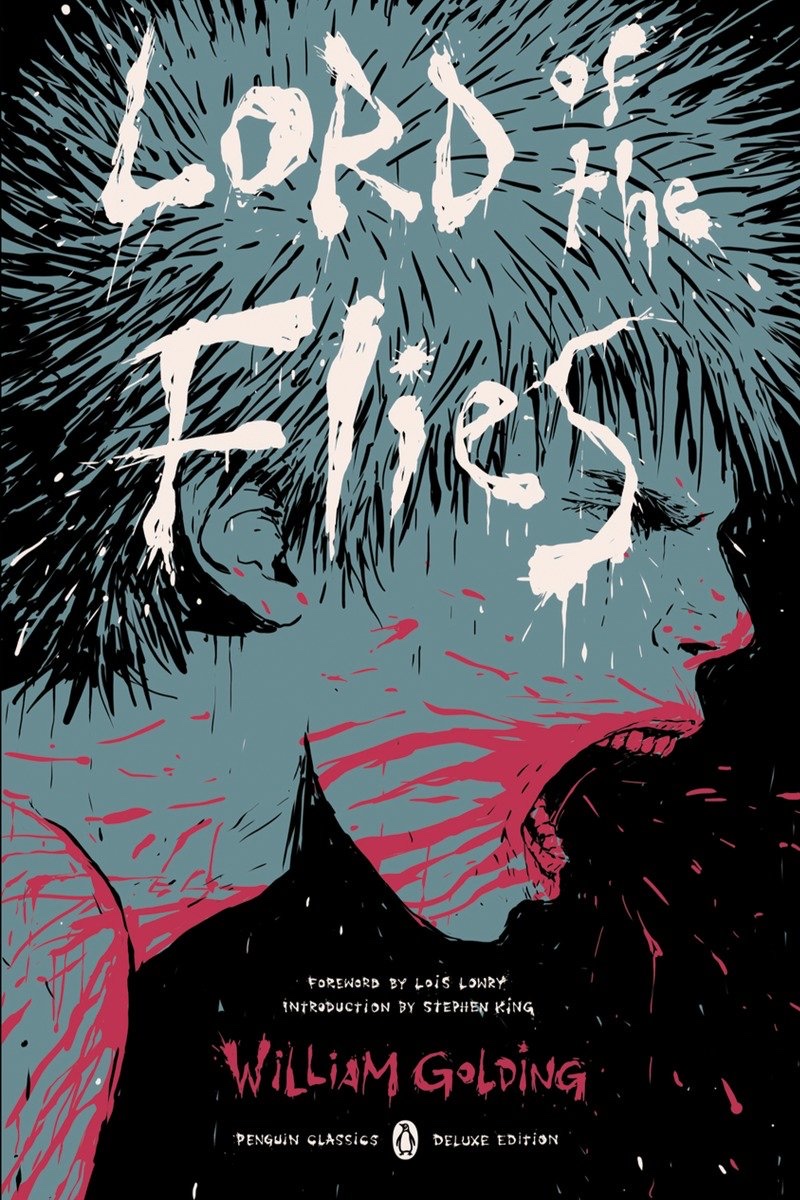
Lord of the Flies
About this book
A plane evacuating schoolboys during a war crashes on an uninhabited island, and the survivors are entirely on their own. At first it looks like an adventure: Ralph is elected chief, Piggy's glasses start the signal fire, the conch shell gives everyone a turn to speak. The rules hold for about a week.
The unraveling comes from within. Jack, the choir leader, discovers that hunting is more fun than keeping the fire alive, and that face paint frees him from embarrassment. Fear of a beast on the mountain does the rest. Golding tracks the slide from assembly to tribe to something worse with the inevitability of a proof — each step is small, and each is chosen.
The novel was written against the comforting myth of the innocent child, and against the generation that had just watched civilized Europe build the camps. The island is not an exception; it is a demonstration. The naval officer who finally arrives sees it instantly, and his arrival is the book's bleakest joke.
Published in 1954 after multiple rejections, Lord of the Flies became a fixture of classrooms and controversies alike — a short, pitiless novel about how thin the varnish of civilization is.
Read a sample
5,009 words
Plain text
From the opening
PENGUIN CLASSICS DELUXE EDITION
LORD OF THE FLIES
WILLIAM GERALD GOLDING was born in Cornwall, England, in 1911 and educated at Oxford University. His first book, Poems, was published in 1934. Following a stint in the Royal Navy and other diversions during and after World War II, Golding wrote his first novel, Lord of the Flies (1954), while teaching school. Many novels followed, including The Inheritors (1955), Pincher Martin (1956), and Free Fall (1959), as well as a play, The Brass Butterfly (1958), and a collection of shorter works, The Hot Gates and Other Occasional Pieces (1965). He received the James Tait Black Memorial Prize for Darkness Visible (1979) and the Booker Prize for Rites of Passage (1980). In 1983, he was awarded the Nobel Prize in Literature “for his novels which, with the perspicuity of realistic narrative art and the diversity and universality of myth, illuminate the human condition in the world of today.” He was a member of the Royal Society of Literature and was knighted by Queen Elizabeth II in 1988. William Golding died in June 1993 and is buried in Holy Trinity churchyard in Bowerchalke, Wiltshire, in England.
LOIS LOWRY is the two-time Newbery Medal–winning author of Number the Stars, The Giver Quartet, and numerous other books for young adults.
STEPHEN KING is the author of more than fifty books, all of them worldwide bestsellers. He is the recipient of the 2003 National Book Foundation’s Medal for Distinguished Contribution to American Letters and the 2014 National Medal of Arts.
JENNIFER BUEHLER is an associate professor of English education at Saint Louis University and the author of Teaching Reading with YA Literature: Complex Texts, Complex Lives, published by the National Council of Teachers of English (NCTE). She served as president of the Assembly on Literature for Adolescents of NCTE (ALAN) in 2016.
E. M. FORSTER (1879–1970) is an English writer best remembered for his novels A Passage to India, Howards End, and A Room with a View.
E. L. EPSTEIN (1931–2012) is a literary scholar and book editor who published the first American paperback edition of Lord of the Flies in 1959.
PENGUIN BOOKS
An imprint of Penguin Random House LLC
375 Hudson Street
New York, New York 10014
penguin.com
First published in Great Britain by Faber & Faber, Ltd. 1954
First published in the United States of America by Coward-McCann, Inc. 1955
Published in Penguin Books 2006
This edition with a foreword by Lois Lowry and “On Reading and Teaching Lord of the Flies” and Suggestions for Further Exploration by Jennifer Buehler published 2016
Copyright 1954 by William Gerald Golding
Copyright renewed © 1982 by William Gerald Golding
Foreword copyright © 2016 by Lois Lowry
Introduction copyright © 2011 by Stephen King
“On Reading and Teaching Lord of the Flies” and Suggestions for Further Exploration copyright © 2016 by Jennifer Buehler
Penguin supports copyright. Copyright fuels creativity, encourages diverse voices, promotes free speech, and creates a vibrant culture. Thank you for buying an authorized edition of this book and for complying with copyright laws by not reproducing, scanning, or distributing any part of it in any form without permission. You are supporting writers and allowing Penguin to continue to publish books for every reader.
E. L. Epstein’s notes appeared in the 1959 Capricorn edition of Lord of the Flies.
E. M. Forster’s introduction appeared in the 1962 Coward-McCann edition.
Stephen King’s introduction appeared in the 2011 Faber & Faber edition.
Ebook ISBN 9781101993224
Cover art & design: Adams Carvalho
Cover art direction: Paul Buckley
Version_1
For my mother and father
Contents
Praise for Lord of the Flies
About the Author
Title Page
Copyright
Dedication
Foreword by LOIS LOWRY
Introduction by STEPHEN KING
LORD OF THE FLIES
1. The Sound of the Shell
2. Fire on the Mountain
3. Huts on the Beach
4. Painted Faces and Long Hair
5. Beast from Water
6. Beast from Air
7. Shadows and Tall Trees
8. Gift for the Darkness
9. A View to a Death
10. The Shell and the Glasses
11. Castle Rock
12. Cry of the Hunters
On Reading and Teaching Lord of the Flies by JENNIFER BUEHLER
Suggestions for Further Exploration by JENNIFER BUEHLER
Introduction to the 1962 Edition by E. M. FORSTER
Notes on Lord of the Flies from the 1959 Edition by E. L. EPSTEIN
Foreword
Lord of the Flies was published in 1954, the year that I turned seventeen, and I read it not long after. I was in the habit then (as I still am today) of finding, in each book I read, the fictional character with whom I identified—the one with whom I would travel, as it were, throughout the book’s journey. I came to Lord of the Flies with no prior knowledge; it was like entering a room full of strangers, being introduced to them, trying to perceive which ones might become friends. Which one might be my best friend. Which one was most like me.
If you are new to this book, as I was then, you will meet Ralph right up front. I felt a kinship with Ralph right away, even before I knew his name. He is the first character introduced in chapter one, and for a few pages he is called only by his description: “the fair boy.” I could relate to that. I was also a “fair” one . . . which I took to mean blond . . . and, though I wouldn’t have thought this through at the time, while reading, I was also “fair” . . . I played fair. I followed the rules. It seemed that Ralph did, too. Yes, Ralph: now, by the fourth page, he had a name. And very soon thereafter, he began to have a personality, and it was one that I found likable; he had a sense of humor, chortling with laughter as he blew farting sounds into the conch to amuse his awkward, overweight companion. And then—yes, this appealed to me greatly—he took charge. He organized things, established order, made rules, saw to everyone’s well-being, and, with very little opposition, was chosen to be chief. Me? I was a follower, always, not a leader; but I secretly yearned to be the kind of kid who would be chosen as chief.
Continue reading the sampleClose the sample
Next you will meet Piggy. Piggy made me squirm a little with discomfort. I sympathized with him; he was clearly bright, and well-intentioned, but too needy, I thought. And in some ways he was uncomfortably like the parts of me that I thought needed changing. No, I wasn’t overweight, like Piggy, nor asthmatic, and I didn’t wear thick glasses. But I was skinny and had recently had the braces removed from my teeth; and, too, like Piggy, I was something of an outsider, always. In the previous four years I had attended four different schools and the process of learning to fit in was too familiar to me; now, at just-turned-seventeen, I was suddenly a very young student in a very large university. I felt as bewildered and vulnerable as Piggy and disliked him for that reason—because he revealed too much about my own self.
As for Jack? It was clear to me right off that Jack Merridew was not to be trusted; for one thing, the black cloak he wore gave me the creeps. And he was described as ugly, with a “crumpled and freckled” face and eyes that could turn angry.
If Jack was scary, and Piggy was pitiful, what about Simon? You may not notice Simon at first. I myself found that there was an intriguing but mysterious quality to Simon, who seemed so quiet—something of a loner, as I was, and still am—and who had, without any explanation, fainted briefly and then revived with a smile. What was up with Simon? I could tell he was probably someone worth paying attention to. But no, I had chosen Ralph. I stuck with Ralph. Ralph was my guy.
And oh my: the island was my place. As a twelve-year-old, living then in Tokyo, I had seen a romantic film called Blue Lagoon in which two children marooned on a lush desert island grow up in paradise and—surprise!—fall in love. (Hollywood was to do a misbegotten remake of this later. What I had seen, though, was the original British film.) Five years later I was still awash in the memory of that idyllic location, and here it was again, in Lord of the Flies: the waterfalls and butterflies, the endless edible fruit, the soft sand, the clear blue ponds, and the pink cliffs. I settled in comfortably. I was in a New England college dorm room in winter, but I might have been smeared with sunscreen and lying on a towel; it felt that luxurious, that comfortable.
Until.
I have not been as jolted, before or since, by a shift in a book’s tone. By the ominous awareness that things are going to turn very, very bad. Thinking about it now, I try to identify (as sometimes readers of The Giver have written and told me the exact moment when) the passage that first brought me up short, that made me think: Whoa. It happens early. It happens when Jack, he of the crumpled face and angry eyes, fails to kill a piglet.
He snatched his knife out of the sheath and slammed it into a tree trunk. Next time there would be no mercy.
Of course. A piglet would eventually die.
And others would, as well. No mercy.
As the boys in the book deteriorated further and further into chaos and violence, I began to notice Simon more and more. Furtive, quiet, he seemed to be trying to alert my guy, Ralph . . . and by extension, me, the reader . . . to something. “Maybe there is a beast,” Simon suggested. “What I mean is . . . maybe it’s only us.”
“We could be sort of . . .”
Sort of what?
Beasts? All of us?
* * *
Today’s young readers, inundated as they have been recently by violent apocalyptic books, probably cannot imagine the effect William Golding’s novel had on the innocent and introspective girl that I was then. Looking down from my dormitory room window onto a campus dominated by fraternities with their obscure, occasionally cruel, rituals, Golding’s fable began to take on a more complicated meaning for me. I was shocked. Stunned.
And rereading it today, more than sixty years later, in the midst of political debates and global saber rattling, I still am. I no longer identify with Ralph and his helpless attempts at order and civility. I no longer even pity Piggy, clutching his broken “specs” and blindly following the nearest leader. I have little sympathy now for the smallest boys—the “littluns”—who march and prance behind whoever promises most. I can still muster up a little hatred for Jack Merridew, the soulless dictator, as he sharpens a stick at both ends in anticipation of impaling his next victim.
I am left with only one character whom I loathe, and will always. He appears only briefly—I leave you to find him on your own—and he above all the others makes me question what is representative of civilization: a spotless uniform, a dignified posture, and a set of elaborate rules? How dare he?
But as for the children, I find myself if not forgiving them, at least despairing that circumstances led them to such a hell. I see all of them too often today—posturing for the cameras. And my heart goes out now to Simon, who knew, who tried to say, of the Beast: “it’s only us” and no one would listen.
LOIS LOWRY
Introduction
I grew up in a small northern New England farming community where most of the roads were dirt, there were more cows than people, and the school housing grades one through eight was a single room heated by a woodstove. Kids who were bad didn’t get detention; they had to stay after school and either chop stove lengths or sprinkle lime in the privies.
Of course there was no town library, but in the deserted Methodist parsonage about a quarter of a mile from the house where my brother, David, and I grew up, there was one room piled high with moldering books, many of them swelled to the size of telephone directories. A good percentage of them were boys’ books of the sort our British cousins call “ripping yarns.” David and I were voracious readers, a habit we got from our mother, and we fell upon this trove like hungry men on a chicken dinner.
There were dozens concerning the brilliant boy inventor Tom Swift (we used to joke that sooner or later we’d surely come across one titled Tom Swift and His Electric Grandmother); there were almost as many about a heroic World War II RAF pilot named Dave Dawson (whose Spitfire was always “prop-clawing for altitude”). We fought the evil Scorpion with Don Winslow, detected with the Hardy Boys, roved with the Rover Boys.
Eventually—around the time John F. Kennedy became president, I think—we came to feel something was missing. These stories were exciting enough, but something about them was . . . off. Part of it might have been the fact that most of the stories were set in the 1920s and ’30s, decades before David and I were born, but that was not the greater part of it. Something about those books was just wrong. The kids in them were wrong.
There was no library, but in the early 1960s, the library came to us. Once a month a lumbering green van pulled up in front of our tiny school. Written on the side in large gold letters was “State of Maine Bookmobile.” The driver-librarian was a hefty lady who liked kids almost as much as she liked books, and she was always willing to make a suggestion. One day, after I’d spent twenty minutes pulling books from the shelves in the section marked “Young Readers” and then replacing them again, she asked me what sort of book I was looking for.
I thought about it then asked a question—perhaps by accident, perhaps as a result of divine intervention—that unlocked the rest of my life. “Do you have any stories about how kids really are?”
She thought about it, then went to the section of the bookmobile marked “Adult Fiction” and pulled out a slim hardcover volume. “Try this, Stevie,” she said. “And if anyone asks, tell them you found it yourself. Otherwise, I might get into trouble.”
The book, of course, was the one you are now about to reread or perhaps (oh, lucky you) to experience for the first time.
Imagine my surprise (shock might be closer) when, half a century after that visit to the bookmobile parked in the dusty dooryard of the Methodist Corners School, I downloaded the audio version of Lord of the Flies and heard William Golding articulating, in the charmingly casual introduction to his brilliant reading, exactly what had been troubling me. “One day I was sitting on one side of the fireplace and my wife was sitting on the other, and I suddenly said to her, ‘Wouldn’t it be a good idea to write a story about some boys on an island, showing how they would really behave, being boys and not little saints as they usually are in children’s books?’ And she said, ‘That’s a first-class idea! You write it!’ So I went ahead and wrote it.”
I had read adult novels before, or what passed for them (the room of water-dampened books in the Methodist parsonage was full of Hercule Poirots and Miss Marples as well as Tom Swifts), but nothing that had been written about children, for adults. I was thus unprepared for what I found between the covers of Lord of the Flies: a perfect understanding of the sort of beings my friends and I were at twelve or thirteen, untouched by the usual soft soap and deodorant. Could we be good? Yes. Could we be kind? Yes again. Could we, at the turn of a moment, become little monsters? Indeed we could. And did. At least twice a day and far more frequently on summer vacations, when we were often left to our own devices.
Golding harnessed his unsentimental view of boyhood to a story of adventure and swiftly mounting suspense. To the twelve-year-old boy I was, the idea of roaming an uninhabited tropical island without parental supervision at first seemed liberating, almost heavenly. By the time the boy with the birthmark on his face (the first littlun to raise the possibility of a beast on the island) disappeared, my sense of liberation had become tinged with unease. And by the time the badly ill—and perhaps visionary—Simon confronts the severed and fly-blown head of the sow, which has been stuck on a pole, I was in terror. “The half-shut eyes were dim with the infinite cynicism of adult life,” Golding writes. “They assured Simon that everything was a bad business.” That line resonated with me then, and continues to resonate all these years later. I used it as one of the epigraphs to my book of interrelated novellas, Hearts in Atlantis.
This is the farthest thing from a scholarly introduction, because there was nothing scholarly or analytical about my first reading of Lord of the Flies. It was, so far as I can remember, the first book with hands—strong ones that reached out of the pages and seized me by the throat. It said to me, “This is not just entertainment; it’s life-or-death.”
Flies wasn’t a bit like the boys’ books in the parsonage; in fact, it rendered those books obsolete. In the parsonage books, the Hardy Boys might get tied up, but you knew they’d get free. A German Messerschmitt might get on Dave Dawson’s tail, but you knew he’d get away (by putting his Spitfire in prop-clawing mode, no doubt). By the time I reached the last seventy pages of Lord of the Flies, I understood not only that some of the boys might die but that some would die. It was inevitable. I only hoped it wouldn’t be Ralph, with whom I identified so passionately that I was in a cold sweat as I turned the pages. No teacher needed to tell me that Ralph embodied the values of civilization and that Jack’s embrace of savagery and sacrifice represented the ease with which those values could be swept away; it was evident even to a child. Especially to a child, who had witnessed (and participated in) many acts of casual schoolyard bullyragging. My relief at the last-minute intervention of the adult world was immense, although I was angry at the naval officer’s almost offhand dismissal of the ragtag survivors (“I should have thought that a pack of British boys . . . would have been able to put up a better show than that.”).
I stayed angry about that until I remembered—this was weeks later, but I still thought about the book every day—that the boys were on the island in the first place because a bunch of idiotic adults had started a nuclear war. And years later (by then I was on my fourth or fifth reading of the novel), I came across an edition with an afterword by Golding. In it he said (I’m paraphrasing): “The adults save the children . . . but who will save the adults?”
To me, Lord of the Flies has always represented what novels are for, what makes them indispensable. Should we expect to be entertained when we read a story? Of course. An act of the imagination that doesn’t entertain is a poor act indeed. But there should be more. A successful novel should erase the boundary line between writer and reader, so they can unite. When that happens, the novel becomes a part of life—the main course, not the dessert. A successful novel should interrupt the reader’s life, make him or her miss appointments, skip meals, forget to walk the dog. In the best novels, the writer’s imagination becomes the reader’s reality. It glows, incandescent and furious. I’ve been espousing these ideas for most of my life as a writer, and not without being criticized for them. If the novel is strictly about emotion and imagination, the most potent of these criticisms go, then analysis is swept away and discussion of the book becomes irrelevant.
I agree that “This blew me away” is pretty much a nonstarter when it comes to class discussion of a novel (or a short story, or a poem), but I would argue it’s still the beating heart of fiction. “This blew me away” is what every reader wants to say when he closes a book, isn’t it? And isn’t it exactly the sort of experience most writers want to provide?
Nor does a visceral, emotional reaction to a novel preclude analysis. I finished the last half of Lord of the Flies in a single afternoon, my eyes wide, my heart pounding, not thinking, just inhaling. But I’ve been thinking about it ever since, for fifty years and more. My rule of thumb as a writer and a reader—largely formed by Lord of the Flies—is Feel it first, think about it later. Analyze all you want, but first dig the experience.
What I keep coming back to is Golding saying, “Wouldn’t it be a good idea to write a story about some boys . . . showing how they would really behave?”
It was a good idea. A very good idea that produced a very good novel, one as exciting, relevant, and thought provoking now as it was when Golding published it in 1954.
STEPHEN KING
Sarasota, Florida
November 2011
ONE
THE SOUND OF THE SHELL
The boy with fair hair lowered himself down the last few feet of rock and began to pick his way toward the lagoon. Though he had taken off his school sweater and trailed it now from one hand, his grey shirt stuck to him and his hair was plastered to his forehead. All round him the long scar smashed into the jungle was a bath of heat. He was clambering heavily among the creepers and broken trunks when a bird, a vision of red and yellow, flashed upwards with a witch-like cry; and this cry was echoed by another.
“Hi!” it said. “Wait a minute!”
The undergrowth at the side of the scar was shaken and a multitude of raindrops fell pattering.
“Wait a minute,” the voice said. “I got caught up.”
The fair boy stopped and jerked his stockings with an automatic gesture that made the jungle seem for a moment like the Home Counties.
The voice spoke again.
“I can’t hardly move with all these creeper things.”
The owner of the voice came backing out of the undergrowth so that twigs scratched on a greasy wind-breaker. The naked crooks of his knees were plump, caught and scratched by thorns. He bent down, removed the thorns carefully, and turned around. He was shorter than the fair boy and very fat. He came forward, searching out safe lodgments for his feet, and then looked up through thick spectacles.
“Where’s the man with the megaphone?”
The fair boy shook his head.
“This is an island. At least I think it’s an island. That’s a reef out in the sea. Perhaps there aren’t any grownups anywhere.”
The fat boy looked startled.
“There was that pilot. But he wasn’t in the passenger cabin, he was up in front.”
The fair boy was peering at the reef through screwed-up eyes.
“All them other kids,” the fat boy went on. “Some of them must have got out. They must have, mustn’t they?”
The fair boy began to pick his way as casually as possible toward the water. He tried to be offhand and not too obviously uninterested, but the fat boy hurried after him.
“Aren’t there any grownups at all?”
“I don’t think so.”
The fair boy said this solemnly; but then the delight of a realized ambition overcame him. In the middle of the scar he stood on his head and grinned at the reversed fat boy.
“No grownups!”
The fat boy thought for a moment.
“That pilot.”
The fair boy allowed his feet to come down and sat on the steamy earth.
“He must have flown off after he dropped us. He couldn’t land here. Not in a plane with wheels.”
“We was attacked!”
“He’ll be back all right.”
The fat boy shook his head.
“When we was coming down I looked through one of them windows. I saw the other part of the plane. There were flames coming out of it.”
He looked up and down the scar.
“And this is what the cabin done.”
The fair boy reached out and touched the jagged end of a trunk. For a moment he looked interested.
“What happened to it?” he asked. “Where’s it got to now?”
“That storm dragged it out to sea. It wasn’t half dangerous with all them tree trunks falling. There must have been some kids still in it.”
He hesitated for a moment, then spoke again.
“What’s your name?”
“Ralph.”
The fat boy waited to be asked his name in turn but this proffer of acquaintance was not made; the fair boy called Ralph smiled vaguely, stood up, and began to make his way once more toward the lagoon. The fat boy hung steadily at his shoulder.
“I expect there’s a lot more of us scattered about. You haven’t seen any others, have you?”
Ralph shook his head and increased his speed. Then he tripped over a branch and came down with a crash.
The fat boy stood by him, breathing hard.
“My auntie told me not to run,” he explained, “on account of my asthma.”
“Ass-mar?”
“That’s right. Can’t catch my breath. I was the only boy in our school what had asthma,” said the fat boy with a touch of pride. “And I’ve been wearing specs since I was three.”
He took off his glasses and held them out to Ralph, blinking and smiling, and then started to wipe them against his grubby wind-breaker. An expression of pain and inward concentration altered the pale contours of his face. He smeared the sweat from his cheeks and quickly adjusted the spectacles on his nose.
“Them fruit.”
He glanced round the scar.
“Them fruit,” he said, “I expect—”
He put on his glasses, waded away from Ralph, and crouched down among the tangled foliage.
“I’ll be out again in just a minute—”
Ralph disentangled himself cautiously and stole away through the branches. In a few seconds the fat boy’s grunts were behind him and he was hurrying toward the screen that still lay between him and the lagoon. He climbed over a broken trunk and was out of the jungle.
The shore was fledged with palm trees. These stood or leaned or reclined against the light and their green feathers were a hundred feet up in the air. The ground beneath them was a bank covered with coarse grass, torn everywhere by the upheavals of fallen trees, scattered with decaying coconuts and palm saplings. Behind this was the darkness of the forest proper and the open space of the scar. Ralph stood, one hand against a grey trunk, and screwed up his eyes against the shimmering water. Out there, perhaps a mile away, the white surf flinked on a coral reef, and beyond that the open sea was dark blue. Within the irregular arc of coral the lagoon was still as a mountain lake—blue of all shades and shadowy green and purple. The beach between the palm terrace and the water was a thin stick, endless apparently, for to Ralph’s left the perspectives of palm and beach and water drew to a point at infinity; and always, almost visible, was the heat.
He jumped down from the terrace. The sand was thick over his black shoes and the heat hit him. He became conscious of the weight of clothes, kicked his shoes off fiercely and ripped off each stocking with its elastic garter in a single movement. Then he leapt back on the terrace, pulled off his shirt, and stood there among the skull-like coconuts with green shadows from the palms and the forest sliding over his skin. He undid the snake-clasp of his belt, lugged off his shorts and pants, and stood there naked, looking at the dazzling beach and the water.
He was old enough, twelve years and a few months, to have lost the prominent tummy of childhood and not yet old enough for adolescence to have made him awkward. You could see now that he might make a boxer, as far as width and heaviness of shoulders went, but there was a mildness about his mouth and eyes that proclaimed no devil. He patted the palm trunk softly, and, forced at last to believe in the reality of the island, laughed delightedly again and stood on his head. He turned neatly on to his feet, jumped down to the beach, knelt and swept a double armful of sand into a pile against his chest. Then he sat back and looked at the water with bright, excited eyes.
“Ralph—”
The fat boy lowered himself over the terrace and sat down carefully, using the edge as a seat.
“I’m sorry I been such a time. Them fruit—”
He wiped his glasses and adjusted them on his button nose. The frame had made a deep, pink “V” on the bridge. He looked critically at Ralph’s golden body and then down at his own clothes. He laid a hand on the end of a zipper that extended down his chest.
“My auntie—”
Then he opened the zipper with decision and pulled the whole wind-breaker over his head.
“There!”
Ralph looked at him sidelong and said nothing.
“I expect we’ll want to know all their names,” said the fat boy, “and make a list. We ought to have a meeting.”
Ralph did not take the hint so the fat boy was forced to continue.