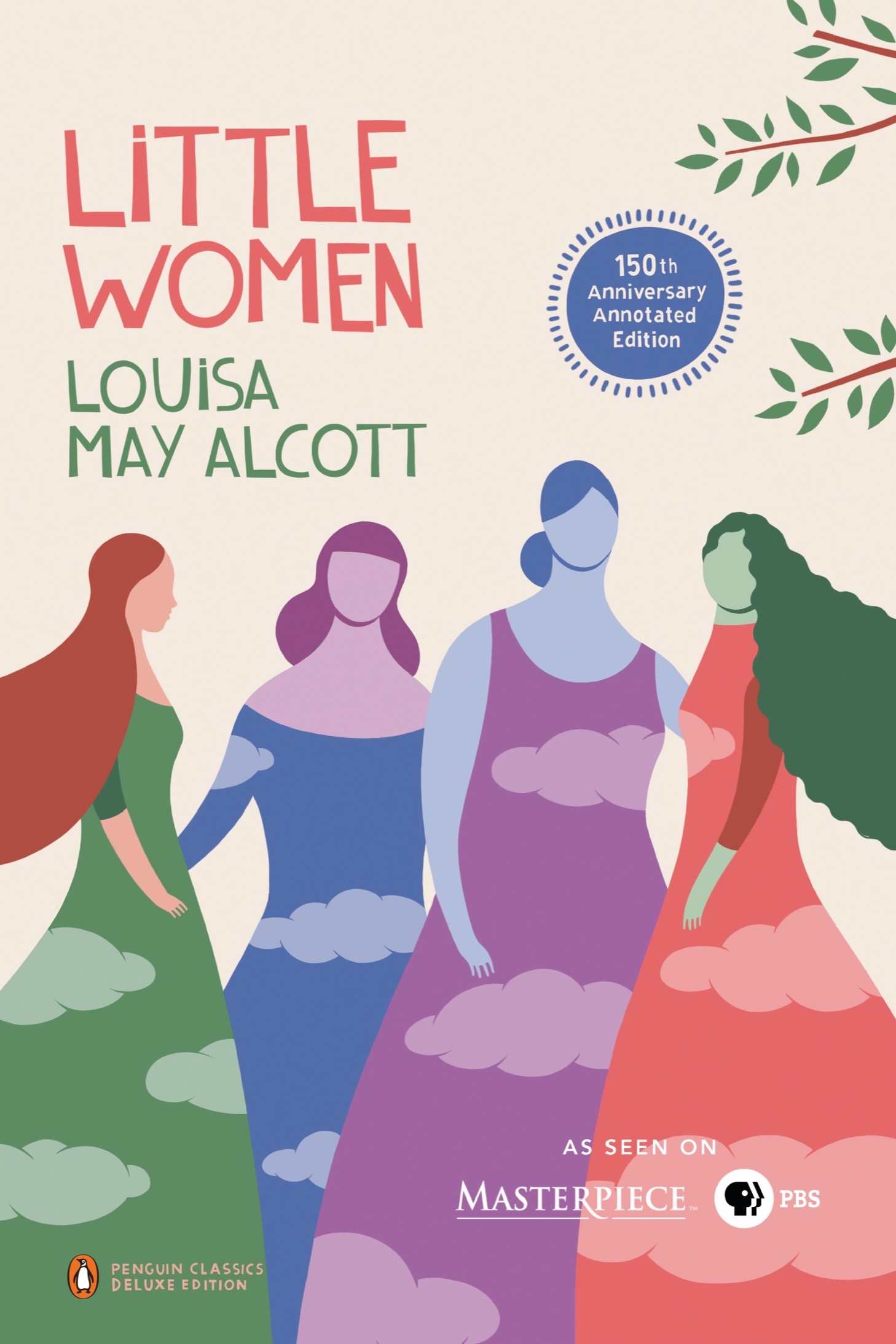
Little Women
About this book
The March household is short on money and long on personality. With their father away as a chaplain in the war, the four sisters run their own small world: Meg, sensible and vain in equal measure; Jo, who writes sensational stories and refuses to be ladylike; Beth, quiet and musical; and Amy, the youngest, artistic and magnificently self-important.
The novel follows them through a year and then through the years — theatricals in the parlor, scarlet fever, first jobs, first loves, and the friendship with Laurie, the rich boy next door who becomes part of the family. Alcott wrote from her own life, and the domestic detail gives the book its warmth: these are people who enjoy one another.
Underneath the coziness there is a harder theme. Each sister has to decide what kind of woman to become, and the answers do not all look the same. Jo's ambition, in particular, drives the book — she wants to write and to matter, and the compromises she makes and refuses to make give Little Women its enduring spine.
Published in 1868, it was an instant success and has never been out of print. It remains the book generations of readers have grown up with — and, often, grown up alongside.
Read a sample
5,079 words
Plain text
From the opening
PENGUIN CLASSICS DELUXE EDITION
LITTLE WOMEN
LOUISA MAY ALCOTT was born in Germantown, Pennsylvania, in 1832, the second of four daughters of Abigail May Alcott and Bronson Alcott, the prominent Transcendentalist thinker and social reformer. Raised in Concord, Massachusetts, and educated by her father, Alcott early on came under the influence of the great men of his circle: Emerson, Hawthorne, the preacher Theodore Parker, and Thoreau. From her youth, Louisa worked at various tasks to help support her family: sewing, teaching, domestic service, and writing. In 1862, she volunteered to serve as an army nurse in a Union hospital during the Civil War—an experience that provided her material for her first successful book, Hospital Sketches (1863). Between 1863 and 1869, she published several anonymous and pseudonymous Gothic romances and lurid thrillers. But fame came with the publication of her Little Women (1868–69), a novel based on the childhood adventures of the four Alcott sisters, which received immense popular acclaim and brought her financial security as well as the conviction to continue her career as a writer. In the wake of Little Women’s popularity, she brought out An Old-Fashioned Girl (1870), Little Men (1871), Eight Cousins (1875), Rose in Bloom (1876), Jo’s Boys (1886), and other books for children, as well as two adult novels, Moods (1864) and Work (1873). An active participant in the women’s suffrage and temperance movements during the last decade of her life, Alcott died in Boston in 1888, on the day her father was buried.
PATTI SMITH is a writer, performer, and visual artist. She gained recognition in the 1970s for her revolutionary merging of poetry and rock. She has released twelve albums, including Horses, which has been hailed as one of the top one hundred albums of all time by Rolling Stone. Her books include M Train, Just Kids (winner of the National Book Award in 2010), Wītt, Babel, Woolgathering, The Coral Sea, and Auguries of Innocence. In 2005, the French Ministry of Culture awarded Smith the title of Commandeur de l’Ordre des Arts et des Lettres, the highest honor given to an artist by the French Republic. She was inducted into the Rock and Roll Hall of Fame in 2007. Smith married the musician Fred Sonic Smith in Detroit in 1980. They had a son, Jackson, and a daughter, Jesse. Smith resides in New York City.
ANNE BOYD RIOUX is a professor of English at the University of New Orleans and the author or editor of several books, including Meg, Jo, Beth, Amy: The Story of Little Women and Why It Still Matters (Norton, 2018). The recipient of two National Endowment for the Humanities fellowships, one for public scholarship, she writes reviews and essays for general and academic audiences, specializing in women writers.
PENGUIN BOOKS
An imprint of Penguin Random House LLC
375 Hudson Street
New York, New York 10014
penguinrandomhouse.com
First published in the United States of America in two volumes by Roberts Brothers 1868 and 1869
Published in Penguin Books 1989
This edition with a foreword by Patti Smith and an introduction and essays by Anne Boyd Rioux published in Penguin Books 2018
Foreword copyright © 2018 by Patti Smith
Introduction and essays copyright © 2018 by Anne Boyd Rioux
Penguin supports copyright. Copyright fuels creativity, encourages diverse voices, promotes free speech, and creates a vibrant culture. Thank you for buying an authorized edition of this book and for complying with copyright laws by not reproducing, scanning, or distributing any part of it in any form without permission. You are supporting writers and allowing Penguin to continue to publish books for every reader.
Letters from the collection of the Concord Free Public Library.
Little Women is available on Blu-ray and DVD. To purchase, visit shopPBS.org.
MasterpieceTM is a trademark of the WGBH Educational Foundation. Used with permission.
The PBS Logo is a registered trademark of the Public Broadcasting Service and used with permission.
A Playground Entertainment production for BBC and MASTERPIECE
LIBRARY OF CONGRESS CATALOGING-IN-PUBLICATION DATA
Names: Alcott, Louisa May, 1832-1888, author. | Rioux, Anne Boyd, editor.
Title: Little women / Louisa May Alcott ; foreword by Patti Smith ; edited with an introduction and notes by Anne Boyd Rioux.
Description: 150th-anniversary annotated edition. | New York, New York : Penguin Books, 2018. | Includes bibliographical references.
Identifiers: LCCN 2018003142 (print) | LCCN 2018011542 (ebook) | ISBN 9781524704735 (ebook) | ISBN 9780143106654
Subjects: LCSH: March family (Fictitious characters)—Juvenile fiction. | Families—New England—Juvenile fiction. | Sisters—Fiction. | New England—Fiction. | Domestic fiction. | GSAFD: Autobiographical fiction. | Bildungsromans.
Classification: LCC PS1017 (ebook) | LCC PS1017 .L5 2018 (print) | DDC 813/.4—dc23
LC record available at https://lccn.loc.gov/2018003142
Cover art and design: Carole Hénaff
Version_1
Continue reading the sampleClose the sample
Contents
About the Authors
Title Page
Copyright
Foreword by PATTI SMITH
About This Edition
Introduction by ANNE BOYD RIOUX
Tips for Reading Little Women
LITTLE WOMEN
Preface
Part I
Part II
Appendix
“Our Foreign Correspondent”
“Heartache”
Glossary
Contextual Essays
The Civil War and the Northern Home Front
Growing Up Female
Health and Medicine
Money and Work
Religion and Morality
Women and Authorship
Letters
Illustrations from Early Editions of Little Women
Suggestions for Further Exploration
Foreword: A Responsible Freedom
Perhaps no other book provided a greater guide, as I set out on my youthful path, than Louisa May Alcott’s most beloved novel, Little Women. I was a wiry daydreamer, just ten years old. Life was already presenting challenges for an awkward tomboy growing up in the gender-defined 1950s. Uninterested in preordained activities, I would take off on my blue bicycle, to a secluded place in the woods, and read the books I had checked out, often over and over again, from the local library. I could hardly be found without book in hand and sacrificed sleep and hours at play to enter wholeheartedly each of their unique worlds.
Many wonderful books captured my imagination, but in Little Women something extraordinary happened. I recognized myself, as if in a mirror, the lanky headstrong girl, who raced on foot, ripped her skirts climbing trees, spoke in common slang, and denounced social pretensions. A girl who could be found leaning against a great oak with a book, or at her desk in the attic bowed over a manuscript. She was Josephine March. Even her name breathed freedom, a girl called Jo. Louisa May Alcott had wrapped herself in her glory cloak, labored at her own desk, and penned a new kind of heroine. A stubbornly modern nineteenth-century American girl. A girl who wrote.
Like countless girls before me, I found a model in one who was not like everyone else, who possessed a revolutionary soul yet also a sense of responsibility. Her dedication to her craft provided my first window into the process of the writer and I was moved with the desire to embrace this vocation as my own. Her missteps, comic to bold, were enviable, giving permission for my own.
Set in New England in the mid-nineteenth century, in the throes of the Civil War, Little Women is not a sweeping epic. Instead we are drawn into the lively, combative, and caring atmosphere of the March family parlor. There we are introduced to the four young sisters, each with intriguing personalities, processing an energy specifically their own. We become privy to their dreams and disappointments, their squabbles and collective imagination, the immediate world they learn to maneuver. Each struggling with their lot, but accountable to the expectations placed upon them.
The March family is of the genteel poor, beneath the middle class, somewhat deprived, scoffed at for not having the proper attire. In the opening pages, the four young girls huddle about the fire, mourning a Christmas alone, no presents beneath the tree, their father away at war, their charitable mother serving the poor. Yet in the absence of the comforts they wish for, they follow their mother’s example and further deny themselves by donating the little they have to their less fortunate neighbors. Jo writes gothic tales for a penny a word to raise money for the family. She sells, at the horror of all, her one source of vanity—her long chestnut hair—to help support the war effort. Beth, painfully shy, goes out in all weathers, compromising her own frail health, to tend to the sick children of those poorer than herself. The oldest, beautiful and controlling Meg, struggles with a consuming desire for fine things and a higher station. Yet she provides a stable, concerned, and principled center for her sisters. And the youngest, the somewhat self-centered and artistic Amy, evolves into a graceful and forward-thinking young woman.
Louisa May Alcott loosely based Little Women on her own family. Like Jo, who can easily be traced to the author, Alcott was the second of four sisters. Her mother, placing duty and charity above all, was the inspiration for Mrs. March. Her own idealistic father, though vigorous and open-minded, does not surface. Perhaps to avoid his dire impracticality in regards to the wants of his family. The Alcotts moved some thirty times before they settled into a dilapidated farm in Concord, Massachusetts, the birthplace of transcendentalism. Ralph Waldo Emerson arranged for the purchase of the land, surrounded by apple orchards. Henry David Thoreau helped her father repair the house. Alcott grew up amid a swirl of continual discourse by some of the most expansive minds of the time: Emerson, Thoreau, Hawthorne, and Whitman. On the banks of Walden Pond, Thoreau joined her father in tutoring her, answering the barrage of questions burning in the mind of an impetuous young girl.
Her childhood may seem to have its idyllic ring, growing up in a spirited household, being liberally educated, and moving freely among the great minds of the nineteenth century. But common reality was extremely harsh—the family slept in a house with little heat in winter, straw mats on the floor and often an empty table at suppertime.
Alcott vowed to find a way to support her family, draw them out of poverty, just as Jo strived to support hers. A vow I also uttered, privy to my own family’s postwar financial struggles.
Louisa desired and eventually insisted on a room of her own, and her father built an oval desk, with an inkstand, that stood between two windows. It is here she penned her first attempts at pulp fiction under the pseudonym A. M. Barnard, providing bread for the family. Like Walt Whitman, she had risked her life volunteering as a nurse during the Civil War and published Hospital Sketches, receiving popular acclaim. But it was the publication of Little Women that provided, almost instantly, national success, financial security, and a legion of devoted readers.
The success of Little Women cleared the course she had set for herself for the rest of her life. Alcott refused to marry and embrace the social conventions of the day. She wrote and traveled extensively in Europe. As did her character Jo, she found her method for following her creative path while still attentive to crucial domestic matters, remaining the breadwinner, ever responsible for the needs of her family. And as Jo, within her work, she conveyed the joy of her wild imagination, her terrible longing, and ultimately the tragedy of loss.
Through the March girls I came to know extreme poverty and the cost of war. I learned from Jo’s example that art is not produced solely by dreaming but through discipline, steadfast and confident application, and the willingness to accept and grow from astute criticism. Jo, as her creator, was always scribing, littering the floor with her failures, until such skins were shed and she connected with the core of self-expression.
Touched by want in childhood, I learned to look beyond, to others less fortunate. Touched by the death of my own young friend, I was given the example of how to negotiate loss. When Beth becomes gravely ill, she implores the inconsolable Jo not to grieve too deeply. Determined to match Beth’s stoic courage, Jo finds the words to assure and comfort her gentle, favored sister. Words that have stayed with me always.
“More than anyone in the world, Beth. I used to think I couldn’t let you go, but I’m learning to feel that I don’t lose you, that you’ll be more to me than ever, and death can’t part us, though it seems to.”
There are some moments within literature when a new character is born, one who sits at the summit with others, emblematic of an age, or steps ahead of it. There have been many high-spirited characters before Jo March, but none like her, who wrote, remained herself. Creating Jo at a time when women had yet to gain the right to vote was an unflinching move. She was an activist by example. And standing apart to extend a sister’s hand, she has always been there to greet maverick girls like me, with a toss of her cropped hair and a playful wink to say come along. To guide us, provide encouragement, lay her footprints on a path she beckons us to follow.
One can imagine Louisa sitting at the desk her father built, before the arc of that white half-moon, creating new scenarios to inspire and incite her readers. But none would resonate more than Little Women, an elemental guidebook for the evolution of consciousness and the value of conscience. A chronicle of four unforgettable girls, each offering something of their own. And Jo March, like her creator, a comprehension of sacrifice, as well as the responsibility to one’s self, one’s art. Louisa May Alcott infused life, laughter, and unremittent hope and determination to the March girls and, thus, to the little women of her time, and time to come.
PATTI SMITH
About This Edition
Little Women has always been a book that appealed to both children and adults. It can be profitably read by children as young as ten or eleven but will make more sense to adolescents, particularly those in their late teens. As a novel about growing up and figuring out one’s path in life, Little Women would today probably be classified as a Young Adult book. Adults will also find much for them in Alcott’s novel, whether they read the book as children or not. Many readers who return to the book as adults are surprised to find how much Alcott has to say not just about growing up but also about parenthood.
This edition of Little Women is designed to help make the novel accessible to young readers as well as adults. It reproduces Alcott’s original text, which was written for readers of her day and thus contains many words and allusions with which we are no longer familiar. A glossary in the back, instead of disruptive footnotes, helps bring the text nearer. There you will also learn many interesting facts about the common language of the mid-nineteenth century as well as how people lived then.
An introduction, free of spoilers, provides some context in which to understand the significance of Little Women. A series of contextual essays are also designed to make the world Alcott was writing about more familiar. They cover the Civil War, health and medicine, growing up female, money and work, religion and morality, and women and authorship. These do contain some spoilers.
Introduction
This introduction provides an overview of Little Women’s publication, reception, and influence. It contains no spoilers and can be safely read before reading the novel.
The book we know today as Little Women was originally published in two parts in two different countries. In the United States, Louisa May Alcott’s Little Women; or, Meg, Jo, Beth and Amy was first published by Roberts Brothers on September 30, 1868. It included four illustrations by May Alcott, the author’s sister (two are included in this volume). In England, the publisher Sampson Low published the book in December 1868 under the title Four Little Women. Meanwhile, Alcott’s publisher, Thomas Niles of Roberts Brothers, pleased that the book had sold two thousand copies in the first two weeks alone, contracted her to write a sequel that would follow the March sisters into adulthood. She wrote it rapidly and sent it to him on New Year’s Day, 1869.
Readers couldn’t get hold of the sequel fast enough, though. “The curiosity to learn the denouement of ‘Little Women’ amounts to an epidemic,” one newspaper declared. By then, fifty-five thousand copies of part 1 had been sold, and three thousand advance orders for part 2 had already been taken.1 On April 14, 1869, part 2 appeared under the simple title Little Women; or, Meg, Jo, Beth and Amy, Part Second with four illustrations by Hammatt Billings (two are included in this volume). Within a month, Sampson Low published the book in England as Little Women Wedded.
The two parts of the novel were sold as a two-volume set by both publishers throughout the 1870s. The only change was in part 1, where two new illustrations by Billings replaced the original ones by May. She appears not to have been happy with her drawings, and perhaps the publisher was striving for uniformity. But in 1880, Roberts Brothers decided to publish a one-volume, newly revised and illustrated edition. Niles wanted Little Women preserved as a treasured book for families, something that could become an heirloom even. Its green and gold cover with gilded edges and two hundred illustrations by Frank T. Merrill gave Little Women the air of a classic.
In keeping with its new status, the text was also standardized, ridding it of the slang Alcott loved but which some critics had complained about. They feared the effect of such informal language on young readers. As Alcott explained in her next novel, An Old-Fashioned Girl, published in 1870, she didn’t care if she “shock[ed] the eyes and ears of such of my readers as have a prejudice in favor of pure English . . . , but, having rashly undertaken to write a little story about Young America, for Young America, I feel bound to depict my honored patrons as faithfully as my limited powers permit.”2 She wanted her novels to reflect the lives of young people of the day, but by 1880 her publisher was more concerned with making sure her works were acceptable to posterity. As a result, dozens of changes were made, apparently by copyeditors with Alcott’s tacit approval. For instance, “ain’t” is changed to “am not” or “are not,” “spandy” to “new,” “grub” to “work,” and “I guess not” to “I think not.” And Jo no longer says she feels like “box[ing]” Aunt March’s ears but that she feels like “cry[ing].”3 In 1881, Roberts Brothers came out with a smaller and cheaper edition with only four of Merrill’s illustrations. This was the standard Little Women read for generations until the twenty-first century, when some publishers restored Alcott’s original text, as it is in this edition.
In England, the 1880 version also became the standard, modified only by British spelling (“colour” instead of “color,” “grey” instead of “gray,” etc.). However, because there was no international copyright agreement, many British publishers produced pirated editions. Sampson Low, who had paid Roberts Brothers for the right to publish the two parts of Little Women in England in 1868 and 1869, had merged them into one volume as early as 1871. But their competitors did not follow suit, so Sampson Low went back to two volumes, using the titles Little Women and Little Women Wedded. Other publishers also used Little Women for part 1 but gave many other titles to part 2, such as Little Women Married, Little Wives, Nice Wives, and, the one most common today, Good Wives. Readers in the UK, Ireland, Canada, and Australia know Little Women as part 1 of the story and Good Wives as a separate sequel sometimes read with Little Women and sometimes not. As a result, readers in the US, where the two books are now always published in one volume, have had a different reading experience of the book than readers elsewhere in the world.
When Thomas Niles first approached Alcott in September 1867 about writing a girls’ book, she was already a seasoned author. She had earned good money for sensation stories published under the pseudonym A. M. Barnard, as well as respect for her stories published in the revered magazine the Atlantic Monthly. In December 1864, she had published her first novel, Moods, a serious book for adults with Transcendentalist themes, which had received many positive reviews but also condemnations for its discussion of marriage and divorce. But it was Alcott’s success with Hospital Sketches, about her experiences as a nurse in the Civil War, published in 1863, that showed her how to gain readers’ appreciation. Her most successful works grew out of her own life, as would Little Women.
When Niles broached the idea of a book for girls, she wasn’t wild about the idea. She didn’t think she could do it, she wrote to a friend, “knowing little about any [girls] but my own sisters & always preferring boys.”4 But it was becoming clear that children’s literature was a lucrative new market she couldn’t avoid. At about the same time, she was also offered five hundred dollars a year to edit the children’s magazine Merry’s Museum, and soon the editor of the Youth’s Companion asked her to contribute two stories a month. It wasn’t until May the following year that she started writing the book for Niles, calling it at first “The Pathetic Family,” the name she had often used for her own family. She had talked to her sisters and Marmee, as they called their mother, Abigail Alcott, about basing the book on them. They had agreed it was worth a try. “[O]ur queer plays and experiences may prove interesting,” Alcott decided.5
However, when she sent the first twelve chapters to Niles, he thought them “dull,” and she agreed. Keeping in mind that he was not the intended audience, Niles sent the chapters to his niece, who laughed until she cried over scenes such as Jo burning Meg’s hair and the teacher’s discovery of Amy’s pickled limes. Upon hearing the news, Alcott began to feel differently about her story, convinced that “lively, simple books are very much needed for girls.” She finished the 402-page manuscript in ten weeks. After receiving it, Niles began predicting it would be a hit and generously advised Alcott to accept a contract paying her royalties based on sales instead of a lump sum in advance without royalties. (That advice would make her one of the richest women in America.)6
Reviewers were enthusiastic about Little Women, viewing it as a welcome departure from the vast majority of books for children, which, as one reviewer wrote, “consist of puling, do-me-good copy-book morality, calculated to turn the stomach of any sensible child.”7 Characters in such books tended to be either very good or very bad with the predictable ending being reward for the former and punishment, sometimes even death, for the latter. Such stories were told by wise adult narrators talking down to their young readers, warning them to be obedient and virtuous, or else. Little Women was entirely different—“fresh, sparkling, natural, and full of soul,” as one critic wrote.8 Little Women taught its lessons through a compassionate mother figure, Marmee, or sometimes one of the March sisters themselves. Alcott’s narrator didn’t talk down to children but seemed to be one of them herself, or, at times, a former child looking back kindly on her younger self. There was something a bit radical about a narrator who spoke directly to girls without correcting or admonishing them. As the young critic Henry James, Jr., observed, Alcott had “a private understanding with the youngsters she depicts, at the expense of their pastors and masters.”9 Indeed, Christian authorities objected to the book, as I discuss in the contextual essay on religion. However, most readers didn’t mind its apparent lack of Christianity.
What readers most responded to was the sense that the characters were real people and that the four girls, in particular, were not paragons of perfection but flawed individuals like themselves. Alcott encouraged this perception within the book itself, writing of even the most seemingly idealized of the novel’s characters, Beth, that she was “not . . . an angel, but a very human little girl.” After reading through the proofs of the first part of the novel, Alcott wrote in her journal, “It reads better than I expected. Not a bit sensational, but simple and true, for we really lived most of it.”10
It is true that many of the scenes, particularly in the first part, can be traced back to events described by Alcott or others in journals or letters, but it is safe to say that the members of the March family are, at best, partial portraits of their real-life counterparts. In a book for girls, Alcott could hardly portray her family’s impoverishment, her father’s radical beliefs, or her parents’ marital discord. Louisa lived a much harder life than Jo ever did, having to leave home to help support her family at a young age, even living apart from them for months at a time, while her older sister did so for years. Most remarkably, in contrast to Little Women’s image as the embodiment of idyllic home and family life, the Alcott family was constantly moving in search of more affordable accommodations or more remunerative work. The Alcotts moved over thirty times before resettling in Concord, Massachusetts, in 1857. They also often lived apart temporarily, and at least once considered splitting up permanently.
Louisa’s father, Bronson Alcott, was a controversial figure with unpopular ideas about education and religion. (His religious views are discussed in the contextual essay on religion.) His family loved him dearly but also often resented him for his inability to help support them. Louisa decided to keep him in the background of her family portrait, even sending Mr. March off to war as a chaplain. In real life, Bronson was often away from home on extended lecture tours. Her mother, whom Louisa revered as a kind of martyr who had given everything to her family, is idealized in the portrait of Marmee. Mrs. March reveals her struggles with her anger but doesn’t actually display the frustration and anger that Abigail Alcott couldn’t help but show in the face of her family’s poverty, except in one key passage. There Marmee explains to Jo that during her early marriage she experienced few trials and was able to contain her temper. “But by and by, when I had four little daughters round me, and we were poor, then the old trouble began again; for I am not patient by nature, and it tried me very much to see my children wanting anything.”11
Meg, Jo, Beth, and Amy were based on Louisa and her sisters. The oldest, Anna, became Meg, the sister who embodies the traditionally feminine qualities of docility and domesticity. Although Anna wanted to be an actress, Louisa left out this aspect of her character in Meg, as women performing in public were considered scandalous. In reality, none of the girls were thought to be beautiful in a conventional sense, but Louisa felt she had to make at least one of the March sisters pretty, so she gave that distinction to Meg.
Jo, or Josephine, was an autobiographical portrait of the author, who was often called Lu or Louie by her family. Just as Jo did, Louisa thought of herself as more of a brother to her sisters, the rowdy and boisterous one compared to their calm demeanors. As one family friend recalled, “[s]he was continually shocking people, just as Jo does in the book, by her tomboyish, natural, and independent ways.”12 We also see in her portrait of Jo Louisa’s literary ambitions and interest in the theater, including writing and acting in plays performed at home. Her volatile moods, which she spent much of her adolescence and young adulthood trying to control, are also an important part of Jo’s character.
Beth was based on the third Alcott daughter, Elizabeth, or Lizzie, as her family called her. She did not have much of a presence in her family’s diaries and letters and appears to have hidden herself behind a veil of shyness and tranquility. Much like Beth in the novel, Lizzie was painfully shy, and there are indications that she also suffered from depression and anxiety. Lizzie refused to perform in her sister’s plays, contributing only to the props and stage scenery. She loved to play the piano but only at home. Like Beth, Lizzie possessed none of the ambitious spirit of her sisters. (I have more to say about her in the contextual essay on health and medicine.)
The youngest Alcott daughter, May, was named Amy, and like her fictional counterpart she had many friends, was popular with boys, and loved to be surrounded by beautiful things. She was also an avid art student and was allowed by her family to draw and paint on the walls of their home (her art is still visible at Orchard House, the Alcott home in Concord, today). Like Amy, she wanted very badly to study art in Europe, which May was finally able to do after her sister’s success with Little Women, the proceeds funding their trip. Louisa both admired and resented May’s winning demeanor and good fortune. Years later, Louisa wrote of May, “She always had the cream of things.”13
After the initial success of Little Women, parts 1 and 2, readers still wanted more. In addition to other books for children, Alcott also published two sequels: Little Men: Life at Plumfield with Jo’s Boys in 1871 and Jo’s Boys: And How They Turned Out in 1886. These books focused on the next generation of children, made up of more boys than girls, allowing Alcott to indulge her preference for writing about boys. With such successes, Alcott became a celebrity, hounded for autographs and forced to sneak out a back window when strange visitors arrived at Orchard House, demanding to see her. The fan mail became so voluminous she couldn’t respond to it all. Although she wrote fourteen more books for children, Little Women remained readers’ favorite. The diaries of late-nineteenth-century young women are riddled with references to it. Girls and young women, including students at Vassar, started Alcott or Little Women clubs and took on the identities of the March sisters.