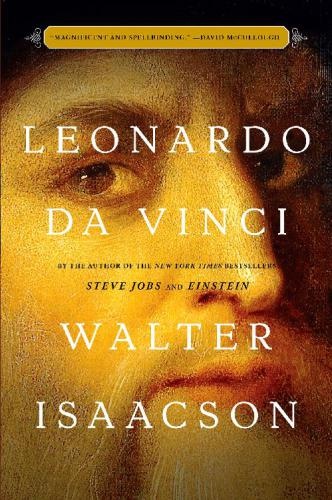
Leonardo da Vinci
About this book
The biography follows Leonardo from an out-of-wedlock childhood in Vinci through Florence, Milan, Rome, and his final years in France. Workshop life, patrons, court politics, unfinished commissions, and friendships give practical context to the image of solitary genius.
Isaacson returns repeatedly to thousands of notebook pages in which drawings and mirrored writing move between observation and invention. Anatomy informs painting, the study of water informs hair and drapery, and theatrical engineering trains an imagination capable of making ideas visible.
The Last Supper, Mona Lisa, Vitruvian Man, flying machines, dissections, and abandoned projects are treated as parts of one method rather than separate careers. Curiosity and revision explain as much as rare talent, though they also contribute to Leonardo's famous difficulty finishing work.
Leonardo da Vinci is a full-length illustrated biography for general readers. Walter Isaacson's central claim is that the boundary between art and science was productive for Leonardo, and that careful looking was the skill from which his other achievements grew.
Read a sample
5,008 words
Plain text
From the opening
INTRODUCTION
I Can Also Paint
Around the time that he reached the unnerving milestone of turning thirty, Leonardo da Vinci wrote a letter to the ruler of Milan listing the reasons he should be given a job. He had been moderately successful as a painter in Florence, but he had trouble finishing his commissions and was searching for new horizons. In the first ten paragraphs, he touted his engineering skills, including his ability to design bridges, waterways, cannons, armored vehicles, and public buildings. Only in the eleventh paragraph, at the end, did he add that he was also an artist. “Likewise in painting, I can do everything possible,” he wrote.1
Yes, he could. He would go on to create the two most famous paintings in history, The Last Supper and the Mona Lisa. But in his own mind, he was just as much a man of science and engineering. With a passion that was both playful and obsessive, he pursued innovative studies of anatomy, fossils, birds, the heart, flying machines, optics, botany, geology, water flows, and weaponry. Thus he became the archetype of the Renaissance Man, an inspiration to all who believe that the “infinite works of nature,” as he put it, are woven together in a unity filled with marvelous patterns.2 His ability to combine art and science, made iconic by his drawing of a perfectly proportioned man spread-eagle inside a circle and square, known as Vitruvian Man, made him history’s most creative genius.
His scientific explorations informed his art. He peeled flesh off the faces of cadavers, delineated the muscles that move the lips, and then painted the world’s most memorable smile. He studied human skulls, made layered drawings of the bones and teeth, and conveyed the skeletal agony of Saint Jerome in the Wilderness. He explored the mathematics of optics, showed how light rays strike the cornea, and produced magical illusions of changing visual perspectives in The Last Supper.
By connecting his studies of light and optics to his art, he mastered the use of shading and perspective to model objects on a two-dimensional surface so they look three-dimensional. This ability to “make a flat surface display a body as if modeled and separated from this plane,” Leonardo said, was “the first intention of the painter.”3 Largely due to his work, dimensionality became the supreme innovation of Renaissance art.
As he aged, he pursued his scientific inquiries not just to serve his art but out of a joyful instinct to fathom the profound beauties of creation. When he groped for a theory of why the sky appears blue, it was not simply to inform his paintings. His curiosity was pure, personal, and delightfully obsessive.
But even when he was engaged in blue-sky thinking, his science was not a separate endeavor from his art. Together they served his driving passion, which was nothing less than knowing everything there was to know about the world, including how we fit into it. He had a reverence for the wholeness of nature and a feel for the harmony of its patterns, which he saw replicated in phenomena large and small. In his notebooks he would record curls of hair, eddies of water, and whirls of air, along with some stabs at the math that might underlie such spirals. While at Windsor Castle looking at the swirling power of the “Deluge drawings” that he made near the end of his life, I asked the curator, Martin Clayton, whether he thought Leonardo had done them as works of art or of science. Even as I spoke, I realized it was a dumb question. “I do not think that Leonardo would have made that distinction,” he replied.
I embarked on this book because Leonardo da Vinci is the ultimate example of the main theme of my previous biographies: how the ability to make connections across disciplines—arts and sciences, humanities and technology—is a key to innovation, imagination, and genius. Benjamin Franklin, a previous subject of mine, was a Leonardo of his era: with no formal education, he taught himself to become an imaginative polymath who was Enlightenment America’s best scientist, inventor, diplomat, writer, and business strategist. He proved by flying a kite that lightning is electricity, and he invented a rod to tame it. He devised bifocal glasses, enchanting musical instruments, clean-burning stoves, charts of the Gulf Stream, and America’s unique style of homespun humor. Albert Einstein, when he was stymied in his pursuit of his theory of relativity, would pull out his violin and play Mozart, which helped him reconnect with the harmonies of the cosmos. Ada Lovelace, whom I profiled in a book on innovators, combined the poetic sensibility of her father, Lord Byron, with her mother’s love of the beauty of math to envision a general-purpose computer. And Steve Jobs climaxed his product launches with an image of street signs showing the intersection of the liberal arts and technology. Leonardo was his hero. “He saw beauty in both art and engineering,” Jobs said, “and his ability to combine them was what made him a genius.”4
Yes, he was a genius: wildly imaginative, passionately curious, and creative across multiple disciplines. But we should be wary of that word. Slapping the “genius” label on Leonardo oddly minimizes him by making it seem as if he were touched by lightning. His early biographer, Giorgio Vasari, a sixteenth-century artist, made this mistake: “Sometimes, in supernatural fashion, a single person is marvelously endowed by heaven with beauty, grace, and talent in such abundance that his every act is divine and everything he does clearly comes from God rather than from human art.”5 In fact, Leonardo’s genius was a human one, wrought by his own will and ambition. It did not come from being the divine recipient, like Newton or Einstein, of a mind with so much processing power that we mere mortals cannot fathom it. Leonardo had almost no schooling and could barely read Latin or do long division. His genius was of the type we can understand, even take lessons from. It was based on skills we can aspire to improve in ourselves, such as curiosity and intense observation. He had an imagination so excitable that it flirted with the edges of fantasy, which is also something we can try to preserve in ourselves and indulge in our children.
Continue reading the sampleClose the sample
Leonardo’s fantasies pervaded everything he touched: his theatrical productions, plans to divert rivers, designs for ideal cities, schemes for flying machines, and almost every aspect of his art as well as engineering. His letter to the ruler of Milan is an example, since his military engineering skills then existed mainly in his mind. His initial role at the court was not building weapons but conjuring up festivals and pageants. Even at the height of his career, most of his fighting and flying contraptions were more visionary than practical.
At first I thought that his susceptibility to fantasia was a failing, revealing a lack of discipline and diligence that was related to his propensity to abandon artworks and treatises unfinished. To some extent, that is true. Vision without execution is hallucination. But I also came to believe that his ability to blur the line between reality and fantasy, just like his sfumato techniques for blurring the lines of a painting, was a key to his creativity. Skill without imagination is barren. Leonardo knew how to marry observation and imagination, which made him history’s consummate innovator.
My starting point for this book was not Leonardo’s art masterpieces but his notebooks. His mind, I think, is best revealed in the more than 7,200 pages of his notes and scribbles that, miraculously, survive to this day. Paper turns out to be a superb information-storage technology, still readable after five hundred years, which our own tweets likely won’t be.
Fortunately, Leonardo could not afford to waste paper, so he crammed every inch of his pages with miscellaneous drawings and looking-glass jottings that seem random but provide intimations of his mental leaps. Scribbled alongside each other, with rhyme if not reason, are math calculations, sketches of his devilish young boyfriend, birds, flying machines, theater props, eddies of water, blood valves, grotesque heads, angels, siphons, plant stems, sawed-apart skulls, tips for painters, notes on the eye and optics, weapons of war, fables, riddles, and studies for paintings. The cross-disciplinary brilliance whirls across every page, providing a delightful display of a mind dancing with nature. His notebooks are the greatest record of curiosity ever created, a wondrous guide to the person whom the eminent art historian Kenneth Clark called “the most relentlessly curious man in history.”6
My favorite gems in his notebooks are his to-do lists, which sparkle with his curiosity. One of them, dating from the 1490s in Milan, is that day’s list of things he wants to learn. “The measurement of Milan and its suburbs,” is the first entry. This has a practical purpose, as revealed by an item later in the list: “Draw Milan.” Others show him relentlessly seeking out people whose brains he could pick: “Get the master of arithmetic to show you how to square a triangle. . . . Ask Giannino the Bombardier about how the tower of Ferrara is walled. . . . Ask Benedetto Protinari by what means they walk on ice in Flanders. . . . Get a master of hydraulics to tell you how to repair a lock, canal and mill in the Lombard manner. . . . Get the measurement of the sun promised me by Maestro Giovanni Francese, the Frenchman.”7 He is insatiable.
Over and over again, year after year, Leonardo lists things he must do and learn. Some involve the type of close observation most of us rarely pause to do. “Observe the goose’s foot: if it were always open or always closed the creature would not be able to make any kind of movement.” Others involve why-is-the-sky-blue questions about phenomena so commonplace that we rarely pause to wonder about them. “Why is the fish in the water swifter than the bird in the air when it ought to be the contrary since the water is heavier and thicker than the air?”8
Best of all are the questions that seem completely random. “Describe the tongue of the woodpecker,” he instructs himself.9 Who on earth would decide one day, for no apparent reason, that he wanted to know what the tongue of a woodpecker looks like? How would you even find out? It’s not information Leonardo needed to paint a picture or even to understand the flight of birds. But there it is, and, as we shall see, there are fascinating things to learn about the tongue of the woodpecker. The reason he wanted to know was because he was Leonardo: curious, passionate, and always filled with wonder.
Oddest of all, there is this entry: “Go every Saturday to the hot bath where you will see naked men.”10 We can imagine Leonardo wanting to do that, for reasons both anatomical and aesthetic. But did he really need to remind himself to do it? The next item on the list is “Inflate the lungs of a pig and observe whether they increase in width and in length, or only in width.” As the New Yorker art critic Adam Gopnik once wrote, “Leonardo remains weird, matchlessly weird, and nothing to be done about it.”11
To wrestle with these issues, I decided to write a book that used these notebooks as its foundation. I started by making pilgrimages to see the originals in Milan, Florence, Paris, Seattle, Madrid, London, and Windsor Castle. That followed Leonardo’s injunction to begin any investigation by going to the source: “He who can go to the fountain does not go to the water-jar.”12 I also immersed myself in the little-tapped trove of academic articles and doctoral dissertations on Leonardo, each of which represents years of diligent work on very specific topics. In the past few decades, especially since the rediscovery of his Codices Madrid in 1965, there have been great advances in the analysis and interpretation of his writings. Likewise, modern technology has revealed new information about his painting and techniques.
After immersing myself in Leonardo, I did the best I could to be more observant of phenomena that I used to ignore, making a special effort to notice things the way he did. When I saw sunlight hitting drapes, I pushed myself to pause and look at the way the shadows caressed the folds. I tried to see how light that was reflected from one object subtly colored the shadows of another object. I noticed how the glint of a lustrous spot on a shiny surface moved when I tilted my head. When I looked at a distant tree and a near one, I tried to visualize the lines of perspective. When I saw an eddy of water, I compared it to a ringlet of hair. When I couldn’t understand a math concept, I did the best I was able to visualize it. When I saw people at a supper, I studied the relationship of their motions to their emotions. When I saw the hint of a smile come across someone’s lips, I tried to fathom her inner mysteries.
No, I did not come anywhere close to being Leonardo, mastering his insights, or mustering a modicum of his talents. I did not get a millimeter closer to being able to design a glider, invent a new way to draw maps, or paint the Mona Lisa. I had to push myself to be truly curious about the tongue of the woodpecker. But I did learn from Leonardo how a desire to marvel about the world that we encounter each day can make each moment of our lives richer.
There are three major early accounts of Leonardo by writers who were almost contemporaries. The painter Giorgio Vasari, born in 1511 (eight years before Leonardo died), wrote the first real art history book, Lives of the Most Eminent Painters, Sculptors, and Architects, in 1550 and came out with a revised version in 1568 that included corrections based on further interviews with people who knew Leonardo, including his pupil Francesco Melzi.13 A Florentine chauvinist, Vasari gave Leonardo and especially Michelangelo the most fulsome treatments for creating what he dubbed, for the first time in print, a “renaissance” in art.14 As Huckleberry Finn said of Mark Twain, there were things that Vasari stretched, but he told the truth, mainly. The remainder is a mix of gossip, embellishments, inventions, and unintentional errors. The problem is knowing which picturesque anecdotes—such as Leonardo’s teacher throwing down his own brush in awe of his pupil—fall into which category.
An anonymous manuscript written in the 1540s, known as the “Anonimo Gaddiano” after the family that once owned it, contains colorful details about Leonardo and other Florentines. Once again, some of the assertions, such as that Leonardo lived and worked with Lorenzo de’ Medici, may be embellished, but it provides colorful details that ring true, such as that Leonardo liked to wear rose-colored tunics that reached only to his knee even though others wore long garments.15
A third early source is by Gian Paolo Lomazzo, a painter who became a writer when he went blind. He wrote an unpublished manuscript called Dreams and Arguments in about 1560 and then published a voluminous treatise on art in 1584. He was the student of a painter who had known Leonardo, and he interviewed Leonardo’s pupil Melzi, so he had access to some firsthand stories. Lomazzo is especially revealing about Leonardo’s sexual proclivities. In addition, there are shorter accounts contained in writings by two Leonardo contemporaries, Antonio Billi, a Florentine merchant, and Paolo Giovio, an Italian physician and historian.
Many of these early accounts mention Leonardo’s looks and personality. He is described as a man of eye-catching beauty and grace. He had flowing golden curls, a muscular build, remarkable physical strength, and an elegance of bearing when he was walking through town in his colorful garb or riding on a horse. “Beautiful in person and aspect, Leonardo was well-proportioned and graceful,” according to the Anonimo. In addition, he was a charming conversationalist and a lover of nature, renowned for being sweet and gentle to both people and animals.
There is less agreement about certain specifics. In the course of my research I discovered that many facts about Leonardo’s life, from the site of his birth to the scene at his death, have been the subject of debate, mythology, and mystery. I try to give my best assessment and then describe the controversies and counterarguments in the notes.
I also discovered, at first to my consternation and then to my pleasure, that Leonardo was not always a giant. He made mistakes. He went off on tangents, literally, pursuing math problems that became time-sucking diversions. Notoriously, he left many of his paintings unfinished, most notably the Adoration of the Magi, Saint Jerome in the Wilderness, and the Battle of Anghiari. As a result, there exist now at most fifteen paintings fully or mainly attributable to him.16
Although generally considered by his contemporaries to be friendly and gentle, Leonardo was at times dark and troubled. His notebooks and drawings are a window into his fevered, imaginative, manic, and sometimes elated mind. Had he been a student at the outset of the twenty-first century, he may have been put on a pharmaceutical regimen to alleviate his mood swings and attention-deficit disorder. One need not subscribe to the artist-as-troubled-genius trope to believe we are fortunate that Leonardo was left to his own devices to slay his demons while conjuring up his dragons.
In one of the quirky riddles in his notebooks is this clue: “Huge figures will appear in human shape, and the nearer you get to them, the more their immense size will diminish.” The answer: “The shadow cast by a man at night with a light.”17 Although the same may be said of Leonardo, I believe he is, in fact, not diminished by being discovered to be human. Both his shadow and his reality deserve to loom large. His lapses and oddities allow us to relate to him, to feel that we might emulate him, and to appreciate his moments of triumph even more.
The fifteenth century of Leonardo and Columbus and Gutenberg was a time of invention, exploration, and the spread of knowledge by new technologies. In short, it was a time like our own. That is why we have much to learn from Leonardo. His ability to combine art, science, technology, the humanities, and imagination remains an enduring recipe for creativity. So, too, was his ease at being a bit of a misfit: illegitimate, gay, vegetarian, left-handed, easily distracted, and at times heretical. Florence flourished in the fifteenth century because it was comfortable with such people. Above all, Leonardo’s relentless curiosity and experimentation should remind us of the importance of instilling, in both ourselves and our children, not just received knowledge but a willingness to question it—to be imaginative and, like talented misfits and rebels in any era, to think different.
The town of Vinci and the church where Leonardo was baptized.
CHAPTER 1
Childhood
Vinci, 1452–1464
DA VINCI
Leonardo da Vinci had the good luck to be born out of wedlock. Otherwise, he would have been expected to become a notary, like the firstborn legitimate sons in his family stretching back at least five generations.
His family roots can be traced to the early 1300s, when his great-great-great-grandfather, Michele, practiced as a notary in the Tuscan hill town of Vinci, about seventeen miles west of Florence.I With the rise of Italy’s mercantile economy, notaries played an important role drawing up commercial contracts, land sales, wills, and other legal documents in Latin, often garnishing them with historical references and literary flourishes.
Because Michele was a notary, he was entitled to the honorific “Ser” and thus became known as Ser Michele da Vinci. His son and grandson were even more successful notaries, the latter becoming a chancellor of Florence. The next in line, Antonio, was an anomaly. He used the honorific Ser and married the daughter of a notary, but he seems to have lacked the da Vinci ambition. He mostly spent his life living off the proceeds from family lands, tilled by sharecroppers, that produced a modest amount of wine, olive oil, and wheat.
Antonio’s son Piero made up for the lassitude by ambitiously pursuing success in Pistola and Pisa, and then by about 1451, when he was twenty-five, establishing himself in Florence. A contract he notarized that year gave his work address as “at the Palazzo del Podestà,” the magistrates’ building (now the Bargello Museum) facing the Palazzo della Signoria, the seat of government. He became a notary for many of the city’s monasteries and religious orders, the town’s Jewish community, and on at least one occasion the Medici family.1
On one of his visits back to Vinci, Piero had a relationship with an unmarried local peasant girl, and in the spring of 1452 they had a son. Exercising his little-used notarial handwriting, the boy’s grandfather Antonio recorded the birth on the bottom of the last page of a notebook that had belonged to his own grandfather. “1452: There was born to me a grandson, the son of Ser Piero my son, on the 15th day of April, a Saturday, at the third hour of the night [about 10 p.m.]. He bears the name Leonardo.”2
Leonardo’s mother was not considered worth mentioning in Antonio’s birth notation nor in any other birth or baptism record. From a tax document five years later, we learn only her first name, Caterina. Her identity was long a mystery to modern scholars. She was thought to be in her mid-twenties, and some researchers speculated that she was an Arab slave, or perhaps a Chinese slave.3
In fact, she was an orphaned and impoverished sixteen-year-old from the Vinci area named Caterina Lippi. Proving that there are still things to be rediscovered about Leonardo, the art historian Martin Kemp of Oxford and the archival researcher Giuseppe Pallanti of Florence produced evidence in 2017 documenting her background.4 Born in 1436 to a poor farmer, Caterina was orphaned when she was fourteen. She and her infant brother moved in with their grandmother, who died a year later, in 1451. Left to fend for herself and her brother, Caterina had a relationship in July of that year with Piero da Vinci, then twenty-four, who was prominent and prosperous.
There was little likelihood they would marry. Although described by one earlier biographer as “of good blood,”5 Caterina was of a different social class, and Piero was probably already betrothed to his future wife, an appropriate match: a sixteen-year-old named Albiera who was the daughter of a prominent Florentine shoemaker. He and Albiera were wed within eight months of Leonardo’s birth. The marriage, socially and professionally advantageous to both sides, had likely been arranged, and the dowry contracted, before Leonardo was born.
Keeping things tidy and convenient, shortly after Leonardo was born Piero helped to set up a marriage for Caterina to a local farmer and kiln worker who had ties to the da Vinci family. Named Antonio di Piero del Vaccha, he was called Accattabriga, which means “Troublemaker,” though fortunately he does not seem to have been one.
Leonardo’s paternal grandparents and his father had a family house with a small garden right next to the walls of the castle in the heart of the village of Vinci. That is where Leonardo may have been born, though there are reasons to think not. It might not have been convenient or appropriate to have a pregnant and then breast-feeding peasant woman living in the crowded da Vinci family home, especially as Ser Piero was negotiating a dowry from the prominent family whose daughter he was planning to marry.
Instead, according to legend and the local tourist industry, Leonardo’s birthplace may have been a gray stone tenant cottage next to a farmhouse two miles up the road from Vinci in the adjacent hamlet of Anchiano, which is now the site of a small Leonardo museum. Some of this property had been owned since 1412 by the family of Piero di Malvolto, a close friend of the da Vincis. He was the godfather of Piero da Vinci and, in 1452, would be a godfather of Piero’s newborn son, Leonardo—which would have made sense if Leonardo had been born on his property. The families were very close. Leonardo’s grandfather Antonio had served as a witness to a contract involving some parts of Piero di Malvoto’s property. The notes describing the exchange say that Antonio was at a nearby house playing backgammon when he was asked to come over for that task. Piero da Vinci would buy some of the property in the 1480s.
At the time of Leonardo’s birth, Piero di Malvoto’s seventy-year-old widowed mother lived on the property. So here in the hamlet of Anchiano, an easy two-mile walk from the village of Vinci, living alone in a farmhouse that had a run-down cottage next door, was a widow who was a trusted friend to at least two generations of the da Vinci family. Her dilapidated cottage (for tax purposes the family claimed it as uninhabitable) may have been the ideal place to shelter Caterina while she was pregnant, as per local lore.6
Leonardo was born on a Saturday, and the following day he was baptized by the local priest at the parish church of Vinci. The baptismal font is still there. Despite the circumstances of his birth, it was a large and public event. There were ten godparents giving witness, including Piero di Malvoto, far more than the average at the church, and the guests included prominent local gentry. A week later, Piero da Vinci left Caterina and their infant son behind and returned to Florence, where that Monday he was in his office notarizing papers for clients.7
Leonardo left us no comment on the circumstances of his birth, but there is one tantalizing allusion in his notebooks to the favors that nature bestows upon a love child. “The man who has intercourse aggressively and uneasily will produce children who are irritable and untrustworthy,” he wrote, “but if the intercourse is done with great love and desire on both sides, the child will be of great intellect, witty, lively, and lovable.”8 One assumes, or at least hopes, that he considered himself in the latter category.
He split his childhood between two homes. Caterina and Accattabriga settled on a small farm on the outskirts of Vinci, and they remained friendly with Piero da Vinci. Twenty years later, Accattabriga was working in a kiln that was rented by Piero, and they served as witnesses for each other on a few contracts and deeds over the years. In the years following Leonardo’s birth, Caterina and Accattabriga had four girls and a boy. Piero and Albiera, however, remained childless. In fact, until Leonardo was twenty-four, his father had no other children. (Piero would make up for it during his third and fourth marriages, having at least eleven children.)
With his father living mainly in Florence and his mother nurturing a growing family of her own, Leonardo by age five was primarily living in the da Vinci family home with his leisure-loving grandfather Antonio and his wife. In the 1457 tax census, Antonio listed the dependents residing with him, including his grandson: “Leonardo, son of the said Ser Piero, non legittimo, born of him and of Caterina, who is now the woman of Achattabriga.”
Also living in the household was Piero’s youngest brother, Francesco, who was only fifteen years older than his nephew Leonardo. Francesco inherited a love of country leisure and was described in a tax document by his own father, in a pot-calling-the-kettle way, as “one who hangs around the villa and does nothing.”9 He became Leonardo’s beloved uncle and at times surrogate father. In the first edition of his biography, Vasari makes the telling mistake, later corrected, of identifying Piero as Leonardo’s uncle.
“A GOLDEN AGE FOR BASTARDS”
As Leonardo’s well-attended baptism attests, being born out of wedlock was not a cause for public shame. The nineteenth-century cultural historian Jacob Burckhardt went so far as to label Renaissance Italy “a golden age for bastards.”10 Especially among the ruling and aristocratic classes, being illegitimate was no hindrance. Pius II, who was the pope when Leonardo was born, wrote about visiting Ferrara, where his welcoming party included seven princes from the ruling Este family, among them the reigning duke, all born out of wedlock. “It is an extraordinary thing about that family,” Pius wrote, “that no legitimate heir has ever inherited the principate; the sons of their mistresses have been so much more fortunate than those of their wives.”11 (Pius himself fathered at least two illegitimate children.) Pope Alexander VI, also during Leonardo’s lifetime, had multiple mistresses and illegitimate children, one of whom was Cesare Borgia, who became a cardinal, commander of the papal armies, an employer of Leonardo, and the subject of Machiavelli’s The Prince.
For members of the middle classes, however, illegitimacy was not as readily accepted. Protective of their new status, merchants and professionals formed guilds that enforced moral strictures. Although some of the guilds accepted the illegitimate sons of their members, that was not the case with the Arte dei Giuduci e Notai, the venerable (founded in 1197) guild of judges and notaries to which Leonardo’s father belonged. “The notary was a certified witness and scribe,” Thomas Kuehn wrote in Illegitimacy in Renaissance Florence. “His trustworthiness had to be above reproach. He had to be someone fully in the mainstream of society.”12
These strictures had an upside. Illegitimacy freed some imaginative and free-spirited young men to be creative at a time when creativity was increasingly rewarded. Among the poets, artists, and artisans born out of wedlock were Petrarch, Boccaccio, Lorenzo Ghiberti, Filippo Lippi, his son Filippino, Leon Battista Alberti, and of course Leonardo.