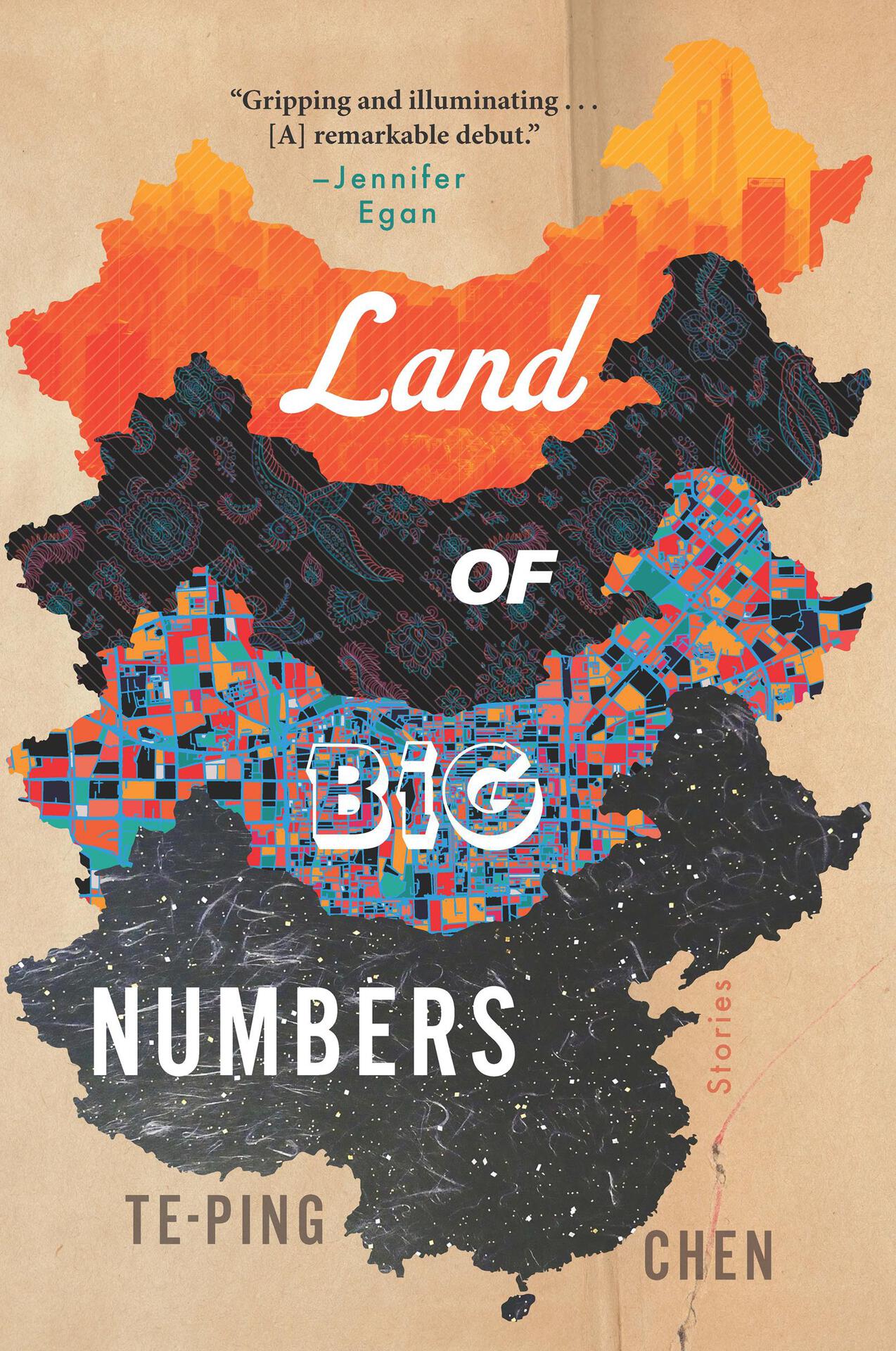
Land of Big Numbers: Stories
About this book
The ten stories in Te-Ping Chen's collection move through villages, factories, call centers, train stations, city apartments, and immigrant lives in the United States. Their characters want recognizably modest things — a job, a home, a marriage, a chance to travel — and find those wishes caught in larger systems.
In the opening story, a brother watches his twin sister's political commitments draw the attention of the authorities. Elsewhere, a farmer tries to build an airplane, a young woman works a government hotline, and a promising investment spreads through the logic of rumor and hope.
Chen writes with a reporter's eye for work, money, bureaucracy, and the telling object in a room. Several stories remain firmly realistic; others allow a fruit, a machine, or a national mood to become strange without announcing the border between observation and fable.
Published in 2021, Land of Big Numbers resists treating China as a single subject. The stories share pressures and echoes, but each person gets a separate life, with motives that do not collapse into a lesson about the country around them.
Read a sample
5,033 words
Plain text
From the opening
Lulu
The hour of our birth had been carefully forecast, a winter’s day cesarean timed to coincide with Dr. Feng’s lunch break. The doctor pulled me out first, indignant, squalling, like a hotel guest inexpertly roused and tossed before checkout. She came next, and was so perfectly quiet that at first they worried she wasn’t breathing at all. Then they thwacked her on the back and her cries joined mine and they laid us side by side, boy and girl, two underwater creatures suddenly forced to fill our lungs with cold, dry air .
Dr. Feng had operated on my mother as a favor to my uncle, his old classmate. Otherwise we would have been born in the hospital down the street, where a woman had bled to death after a botched cesarean the previous year. The family had been in the waiting room for hours, and at last the father-to-be pounded on the doors of the operating room. When no one responded, the family pushed them open to find the lifeless woman on the table, blood pooling on the ground. She was alone: the staff had stripped the medical certificates that bore their names from the wall and fled as soon as the surgery went wrong.
From the start we were lucky, not least because we had each other. As twins we’d been spared the reach of the government’s family-planning policies, two winking fetuses floating in utero. For the first few weeks of our life, our skulls had matching indentations from where they’d been pressed against each other in the womb, like two interlocking puzzle pieces. Later in life when we were apart, I’d sometimes touch my hand to the back of my skull when I thought of her, as if seeking a phantom limb.
We weren’t in any way an extraordinary family. My mother worked as a warehouse clerk, my father a government sanitation planner. When my father was forty-seven, his division chief—a fanciful man who had once dreamed of being an artist—decided to build a public toilet in the shape of a European clock tower. He’d been to Europe and had been impressed by the cleanliness of the toilets and the loveliness of the architecture and wanted to combine the two. Like most artists, the division chief had a fragile ego, and shortly after my father balked at the project’s expense, he was fired. It was the sole act of independence he’d committed in his life, and it cost him his career.
The toilet still stands there today, its vaulting concrete walls stained and ridiculous, the inside chilly and damp like the inside of a pipe, a bird of poured concrete plunging from the tower’s top as if being defenestrated by rival birds inside, and indeed the whole structure smells like a foul aviary. You wouldn’t think it cost 200,000 yuan to build, and probably it didn’t, Lulu said; most of it likely ended up in the division head’s pocket, art corrupting life, life corrupting art.
From the time she was ten, my parents worshipped at Lulu’s altar. Her precocity was evident early on; it was like a flag being waved energetically from a mountaintop. Neither of our parents had much education, and it stunned them to find themselves in possession of such a daughter.
When we were small, we played devotedly together. Lulu was a great inventor of games, which often incorporated whatever she’d read most recently: one day we were stinkbugs, looking for the right leaf on which to lay our eggs, another we were herdsmen fleeing Mongolian invaders. She was braver than me: once, when the elderly woman who lived opposite us had left her door ajar while retrieving the mail downstairs, my sister even snuck into her apartment.
“It’s full of newspapers, stacked as high as your head,” Lulu said excitedly, her eyes glowing as she dashed back. “There’s a giant orange cross-stitch on her couch, with a peony and six fishes.”
As a child she was always reading. Even at meals she would sit and scan the back of the juice box. She must have read it a million times: aspartame and xanthan gum and red no. 9. It wasn’t a conscious thing; she just seemed to feel uncomfortable when her eyes weren’t fastened to a page. She had a mania for lists, too. By age eleven she’d memorized every bone in the human body, and she used to recite their names to me at night in an eerie voice as I held a pillow over my head: sternum, tibia, floating rib.
In high school, I rebelled against her brilliance by playing video games, lots of them, spending hours whipping a gun back and forth across dusty landscapes empty of people, except for those who wanted to kill you. Usually there were six or seven of us at my friend Xingjian’s apartment, and we would take turns and cheer one another on. We were an army, invincible, or if we weren’t invincible we could hit replay at any time, which was pretty close to the same thing.
Lulu, meanwhile, was a model among model students. She studied so intensely that it left her physically bowed and exhausted, like an athlete running a daily marathon, and at night she dropped off to sleep without a word. My mother fed her stewed mushrooms that looked like tiny brains when their stems fell off; they would be good for Lulu’s studies, she said. She gave me some as well, though by then it was plain that any hopes for academic glory resided with her daughter, not her son, constructive effects of mushrooms be damned.
Continue reading the sampleClose the sample
When we sat for the college entrance exam, it surprised no one that Lulu scored high enough to earn a place at a university in the nation’s capital, a bus and a train and a plane ride away. My mother wept with what she said was happiness. “A scholar,” she kept saying. “A scholar.” She and my father, she liked to remind us, hadn’t studied long before going to work in the factories.
“We are so proud,” my father told Lulu. There was an intensity to his expression that unnerved me. One of our schoolbooks had a black-and-white illustration of a long-ago eunuch serving a feast, staring hungrily at the food on the emperor’s table, and there was something of that look on my father’s face.
The night Lulu flew out was overcast, the twilight that preceded it a peculiar mix of orange and ocher. Earlier that day, my father had given her a gift: her very own laptop. It was thick with promise, like a fat slice of cake, sheathed in blue plastic. It wasn’t like the old computer that we all shared, which stuttered and stalled, keys sticky with grease and crumbs and bits of hair. This one had keys that yielded obediently when you touched them. I’d stared at it enviously, too filled with longing for words. “Don’t worry—you’ll get one, too, when you leave, the exact same,” my father said.
At the airport, our parents assumed expressions appropriate for refugees being abandoned at a border. “Lulu, be good,” our father said. I stood there awkwardly, a little resentfully. Lulu turned and flashed a peace sign as she went through security, and we watched her pink hoodie and striped zebra baseball hat retreat into the crowd until she was gone.
I departed for college a week later, with considerably less fanfare. The school was just an hour’s drive away and had an empty feel to it, as though it had been erected with much ambition years ago and then forgotten. In the winter the dorms were freezing, as if their concrete walls held in all the damp, cold air and kept it close to your skin; it looked like a convincing enough building, but felt like a tent.
The best thing about college, I decided, was that the dorms were wired for the internet. There were five other boys in my room on the second floor, sharing rickety metal bunk beds draped with mosquito nets, which afforded both a thin sense of privacy and protection from bites in the summer. At night when we sat in front of our computers, you could hear the same tinny chirping of chat alerts all around us, emanating from the floorboards, the ceilings, and the walls, as though hordes of invisible, electronic crickets had stormed the building.
I wasn’t old enough to miss Lulu. Anyway, I could see her chat statuses whenever I logged in on my new laptop, smooth and shiny and housed in a blue plastic sleeve that matched my sister’s. Studying, they might say. Going to class. At some point they got more fanciful. Floating down the green river, one read. Digging into a stone with no edges. Sometimes I tried looking them up while waiting for my gamer teammates to log on. A few belonged to old poets, but the rest, I suspected, she was inventing herself.
I died repeatedly that semester, but amassed several hundred gold coins and was first made a warlock, then a mage. The other boys in my dorm were addicts, too, and we played fiercely into the evening, cussing, headphones on, until midnight, when the power was cut. Classes were a negligible affair: what mattered were your grades on the final exams, and those could be readily crammed for by memorizing ten or fifteen photocopied pages of notes sold by upperclassmen. Honestly, I had no idea who actually went to class: I pictured teachers sitting with their laptops in front of empty rooms, one eye on the clock, maybe playing video games of their own, maybe taking a nap.
In our second year of school, I searched idly for one of Lulu’s statuses and found just one result: a public microblog with a profile photo of a yawning yellow cat. There were several dozen posts, mostly the same kinds of snippets of poetry Lulu had been posting to her statuses, and by the time I finished scrolling through them, I was sure the account was hers. For the bio she’d written qiushi, a reference to the old Communist maxim “to seek truth from facts,” but the name of her account was qiu zhushi, “to seek carbohydrates,” which made me laugh. You wouldn’t have suspected it to look at her, but Lulu was a glutton—she could eat reams of noodles or fried crullers without missing a beat.
One day in the dorm, I answered a knock at our door to find a classmate grinning at me. “Your sister’s here,” he said. I gaped and went downstairs. There she was, wearing an old-fashioned padded blue coat, the kind common in the fifties. Lulu had her hair in two braids, carried a knapsack slung over one shoulder, and was smiling. She’d joined the college debate club, she said, and they were traveling for a competition. “Big Brother,” she said—it was an old joke of hers, since I was born only a minute or so before her—“want to buy me dinner?”
I suggested the cafeteria. She said she had something nicer in mind, and took me by the arm to a coffee shop by the campus entrance. The place called itself Pretty O.J.; its sign advertised Italian noodles. I’d walked by dozens of times and never gone in. Inside, the tables were topped with glass and the seats were an uncomfortable white wicker that crackled when you shifted, and there were white vases to match, filled with plastic flowers. Lulu took hold of the menu and confidently ordered a pizza and tomato pasta for us as though she’d done it many times before. “With coffee, please,” she added, “and bring us some bread.”
I stared at her. “You look happy,” I said. She was. She was debating at a college an hour’s drive south, she said, and had taken a bus to come to see me. I asked her if our parents knew, if she was planning to see them as well.
“No,” she said, smiling. “We fly back tomorrow night, but I wanted to come see you.”
Beside her I felt very young in my rubber sandals and T-shirt and shorts. She asked me about my classes and my friends. I told her that I was watching a lot of television on my laptop and playing even more video games. Lately I’d been playing with a team of Russian teenagers who were pretty good. We didn’t speak the same language, so we communicated in a kind of pidgin English: Don’t worry guys I got phantom princess no no no, you NOOB, dafuq.
“I know you think it’s a waste of time,” I said.
“A lot of kids play it at my school, too,” she said, not contradicting me.
“It’s a profession now, you know,” I said. “They have competitions, you can win big prize money.”
It embarrasses me now to realize that up until that point, we’d spent the whole evening talking about my life. I don’t think I asked her anything about her own, and it was only at the end that she volunteered a few facts. She was pregnant, she said, two months along, and very much in love with the baby’s father .
I choked on the coffee. Lulu waited for me to compose myself, and then she told me the rest of the story. The father, an upperclassman studying accounting, was from a poor county in the northeast. No, they weren’t keeping the baby, though she and Zhangwei would likely get pregnant again in a few years, “after we’re married,” Lulu said, with a calm matter-of-factness that astounded me. Someday, the two of them hoped to travel abroad.
She told me more about him, choosing her words carefully. “He’s not like other people,” she said. “He’s very noble.” It was a strange word, an old-fashioned word. I just stared at her.
“You’re sure about all this, Lulu?”
“I’m sure.”
I envied her for a moment, sitting there, looking so certain. When had I ever been sure of anything? For Lulu, everything had always come so easily and confidently: homework, answers on tests, college, and now, it seemed, love as well.
When the bill arrived, I didn’t have enough money with me, so she paid. “Thanks, Big Brother,” she said when we left, and at first I thought she was being sarcastic, but she looked glad when she said it. “I haven’t told anyone else,” she confessed as we walked out into the blue twilight, the boxy concrete façades of campus around us. “I knew I could trust you.”
It was the first time it had occurred to me that I was trustworthy, and it was a relief to hear that I had been evaluated and not found wanting. “Of course,” I said.
In the following months, I checked her account more often. I got flashes of insight into her life that way: photos of the yellow shocks of forsythia that blossomed in the spring, more odd bits of poetry. I pictured her tapping away at her identical blue-sheathed laptop across the country, clicking send.
That fall, she started posting daily about someone named Xu Lei. It was a name that even I’d heard by then, enough people were talking about him. He was a college student who’d been picked up by the police outside a karaoke joint, and been beaten, and died while in custody. Photos of him before his death had circulated online: skinny legs in shorts, glasses, a purple T-shirt that read LET’S GO. He and his friends had been standing outside after singing karaoke, a little drunk, and when police had told them to move along, Xu Lei got caustic and the officers took offense. His friends had filmed them beating him and then loading him into a police van. As quickly as censors took down the footage, it was uploaded again.
Mostly Lulu was just recirculating other people’s messages, adding her own hashtag, #justiceforXuLei, or an indignant, frowning face. At some point she added her own commentary: This country, these police, are simply too dark.
When the police autopsy came out, it found that Xu Lei had died of a heart attack. The conclusion was promptly met with scorn—he was only eighteen. The coroner’s report said that prior to his death, he’d been working hard and not sleeping well. “It was a young person’s heart attack,” it concluded, a phrase that quickly trended online until censors snuffed it out. Lulu was not impressed. I have studied hard all my life and I don’t sleep well, she wrote. Will I, too, be made to have a heart attack?
After that, Lulu’s account became more active. At first she was just reposting news from other accounts: the tainted-formula scandal that killed three babies, the college admissions administrator found to be taking cash bribes—the kinds of things we all knew and groused about.
A few months later, though, she began to flood her account with images and videos that were genuinely surprising. I had no idea where she was getting them. They were of scattered street protests from around the country, some just stills, others clips of perhaps a few seconds, rarely more than a minute long. Hubei, Luzhou City, Tianbei County, Mengshan Village: 10 villagers protest outside government offices over death of local woman, one might say. Or: Shandong, Caiguang City, Taining County, Huaqi Village: 500 workers strike for three days, protesting over unpaid wages.
There were dozens of these posts, and they usually looked similar: police in pale blue shirts, lots of shouting, crowds massing in the streets, occasionally someone on the ground being beaten. In one video, several men were attempting to tip over a police van. In another, a group of villagers was shouting as something that looked horribly like a human figure smoldered on the ground.
They were like dispatches from a country I had never seen, and they disturbed and confused me.
After seeing the video of the self-immolation, I messaged her. Are you okay? I asked.
The reply came a few hours later: Hi, Big Brother! I’m doing fine.
Are you in Beijing?
Of course I’m in Beijing.
I stared at the blinking cursor. I’d never told her that I knew her identity online, and I worried that if I said something, she’d see me as somehow untrustworthy, as though I’d been spying on her .
Beijing must be very cold now, I wrote at last. Make sure you wear warm clothes.
That February, we both went home to see our parents and celebrate the Spring Festival. I took charge of the dumplings, chopping the fennel and leeks, cracking an egg and swirling it about with gusto. I was happy. The week before, our team had entered into a local competition and had won a month’s supply of instant noodles and certain bragging rights. Replay, replay: my fingers knew the commands so instinctively that sometimes I’d wake in the dark with fingers twitching.
Lulu, though, seemed only partly present; often you had to call her name twice to get a response. Sometimes I’d get up to use the bathroom in the middle of the night and see a glow in the living room, which meant she was awake, and online.
One night we gathered around the television watching the Spring Festival gala. It was an annual tradition put on by the state broadcaster: cheesy skits, patriotic odes, terrible slapstick—the whole country watched. I excused myself and logged on to check Lulu’s account. The most recent post was from that evening, just before we had sat down to dinner. It was a line of text in quotation marks: “If you want to understand your own country, then you’ve already stepped on the path to criminality,” it read. And then: Happy Spring Festival, comrades!
A shiver ran through me. I logged off and walked back into the living room. Our parents sat on the couch, with Lulu on a stool beside them, their faces pallid in the television’s flickering light as I joined them, stealing glances at this strange person, my twin sister.
The next day, the two of us went out to buy some ingredients for my mother: flour, fermented bean paste, ground pork. It felt odd to walk the half-mile to the supermarket together, the first time we’d been alone since she had visited me at college.
On the way, we passed a park where we used to play as children, and we could hear the sound of children there now. It was sunny, and the warmth lulled my skin.
“Where did that quote come from?” I said. “The one from last night.”
She kept walking. “What do you mean?”
“I’ve been reading your account.”
“I don’t know what you’re talking about.” A man was walking by with a small dog, its face scrunched like the heel of a sausage, and Lulu nickered at it as it passed.
“Come on, Lulu.” I stopped walking. “I’m worried about you.”
She stopped a few feet ahead of me and stood there, not looking at me, arms crossed. “How did you know?”
I explained about the poetry. “Do other people know it’s you?”
She shrugged. “A professor. Some other students.” When I pressed her, she said reluctantly that a classmate had reported her to the department head, and that one of her professors had taken her aside and gently warned her that she should stop her activities online, lest it “influence” her future.
“They’re right, you know,” I said. “Don’t you worry about how this might affect you?” One of the videos she’d posted, I remembered, showed a woman kneeling on the ground and wailing, “The government are traitors! The government doesn’t serve the people!”
Lulu just stood there, staring at the little shopping complex opposite us as if she were trying to memorize it. There was a bilious orange fast-food restaurant, three test-prep centers, and two real estate agents’ offices.
“Or our parents?” I said. They’d both retired by now, but each had a modest pension that I imagined could be taken away, and anyway, the ruining of Lulu’s prospects would be the greatest loss of all. When I thought of having to support them on my own in their old age, my stomach creaked unhappily.
She nodded. “Of course,” she said, finally. “I’m not stupid.”
“So you’ll stop, then?”
She looked at me for a moment, a little dreamily. “Did you know in the Song Dynasty it was illegal to throw away any pieces of paper with writing on them?” she said. “People had to go to certain temples with sacred fires set up where they could burn them instead. That’s how much they revered the written word.”
I wanted to shake her, but I didn’t. “I don’t see how that’s relevant.”
She started walking again.
“Where are you getting all this stuff?” I asked. She unbent slightly and explained that she had downloaded a tool that unblocked overseas websites. “It’s not hard,” she said. “But things get deleted quickly, so I have to keep reposting them.”
“I had no idea these kinds of things went on,” she added soberly. “We were lucky.”
“We weren’t rich.”
“Dad worked for the government. We were comfortable.”
Of course we were, I told her, but so were lots of people, and it didn’t mean that she had to expose herself to trouble .
“It’s better than just playing video games all day,” she shot back, suddenly angry with me. “What’s the point of that?”
I stuck my hands in my pockets and shrugged, taking a few extra breaths to calm myself. It was strange to see Lulu angry; she was usually so even-keeled. “Fair enough,” I said. We kept walking, not looking at each other. Inside the supermarket we parted, as though with relief.
Back on campus, spring brought translucent white buds to the trees, like the tiny cores of onions. The birds grew noisy and self-righteous, clacking and clamoring at all hours outside my window, making it hard to sleep. Lulu had stopped posting, I was pleased to see. I began working part-time at a restaurant downtown that served large, expensive banquets, helping to prepare plates of cold chopped meats, glassy collagen, and frilly slices of cucumber dolled up to look like miniature peacocks. There was a rhythm and a repetition to the work that I liked, a sense of contentment in washing up at the night’s end and putting things back where they belonged.
One day in May, just before graduation, I checked back in on my sister’s account. Lulu had stopped updating her chat status: for several weeks, it had read simply out, and I’d grown worried.
It was as it had been months before: she’d gone back to posting frenetically, as though she’d lost control; in one day alone she had posted forty-three times. There were the same postcards of protests around the country, the videos and photographs she’d been sharing before, and a lot of simple text posts, too, one after another: 3:34 a.m.: If this country were a vegetable, it would be a rotten, bitter melon. 3:36 a.m.: I am the daughter of a government sanitation worker. I know the smell of s—. 3:37 a.m.: I’m sorry, friends, just a little tired today after so many posts. There are many beautiful things, too, in this life. And then she’d shared a series of pictures of small goats leaping in the air, tiny hoofs aloft against green grass. 3:41 a.m.: Okay, I am sufficiently soothed to go to sleep. Good night, comrades, until tomorrow.
The posts went on and on—thousands of them had accumulated in the time since I’d stopped checking. I scrolled through them with a mounting sense of horror, and then paged back up and felt my stomach flip: somehow she’d amassed 800,000 followers.
I messaged her frantically, fingers scrabbling at the keys. Goats?
A few hours later, she answered me. Did you like them?
They’re okay.
I’m sorry, Big Brother. I couldn’t stop.
I sat and watched the cursor blink, like a slow pulse.
A lot of people are paying attention to you. I couldn’t tell if I should be proud of her, worried for her, or angry with her; I supposed I was all three.
Yes, they are. Another long silence. Don’t be upset, Big Brother. I just felt this was something I had to do. Don’t you agree?
I’m working now, I wrote her, hoping she could sense my anger. Running late, got to go.
After she graduated, Lulu moved in with her boyfriend, Zhangwei, in Beijing. She started her own anonymous website, a constant stream of news about protests and human rights abuses around the country. There was the story of a woman, beaten to death by police, whose daughter had paid to keep her body frozen in a morgue for six years, unwilling to inter the evidence. There was the story of the village where officials had torn down an elderly grandmother’s home in the middle of the night to make way for a shopping mall; she’d been given no warning and had died in her bed as the roof collapsed. Each post carried its own mordant title: THE MOTHER POPSICLE; THE FRUSTRATED SLEEPER.
They came for her one night, to the third-floor apartment that she and Zhangwei were renting. They burst in through the door without warning and informed her, politely, that she should go with them. “The landlord must have given them the key,” she told me later, stunned. It was that particular detail, oddly, that seemed to haunt her.
It was midnight when Lulu called me from the police van to say that she was being taken away. “Tell our parents,” she said. “Please. I’m sorry.” Her voice broke, and I barely recognized it. She sounded like a child in a blizzard who’d lost her scarf. It was easier to think of that than to think of the alternative: Lulu, cuffed into a van and taken away by four men who sneered at her for being unmarried and living with her boyfriend, for trying to stir up trouble, for spreading rumors—a crime punishable by seven years’ imprisonment.
When they began interrogating her, it was worse. “Did you go to any of these places?” they kept asking. “Did you confirm any of these things yourself before spreading these rumors online?”
No, Lulu said. No.
“So you didn’t know if they were true, then.”
Later, they laid her on the ground and kicked and beat her. They didn’t fracture any bones, but I pictured her bones anyway, each individually absorbing every blow. Lulu would have known all of them by heart: sternum, tibia, floating rib.
I called my mother, who, on receiving the news, still half asleep, went blank. “You must be mistaken,” she told me sharply. “Let me call Lulu to straighten things out.” It was an old reflex of hers, this instinct to turn to her daughter.
“You can call; she won’t answer,” I said, but she’d already hung up. When I called back, my father took in the news helplessly, as though he’d been expecting it. I tried to explain the kinds of things Lulu had been writing, but he cut me off.
“Lulu is my daughter. I can imagine,” he said. There was a particular heaviness in his voice that surprised me, and it made me think that maybe he’d known her better than the rest of us had.
Lulu was freed after six days and went back to her apartment to convalesce. We flew to Beijing the next day to see her. It was the first time I had been in her apartment, whose living-room wall bore a giant decal from a previous tenant, featuring silver and pink trees and a striped pink kitten. YOU ARE MY HAPPY SURPRISE, FRIENDS ARE BETTER IN AUTUMN, it read. Lulu’s skin looked yellow and darkly bruised, and there was a dart of something red in her right eye that peeked out when she looked in certain directions.