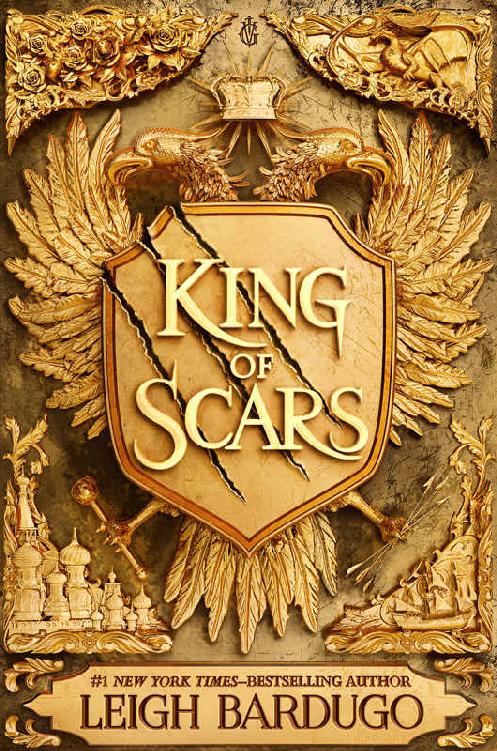
King of Scars
About this book
Nikolai has survived civil war and taken Ravka's throne, but the country is short of money, surrounded by enemies, and dependent on alliances he cannot secure by charm alone. At night, the monster left inside him escapes its chains and threatens the kingdom he is trying to rebuild.
Zoya Nazyalensky helps hunt for a cure while commanding a Grisha force that has lost people, resources, and certainty. Far inside Fjerda, Nina Zenik works undercover among those who persecute Grisha and discovers that the campaign against them is taking a new and dangerous form.
The three strands turn private damage into political pressure. Nikolai's secret can be used against the crown, Zoya's power carries memories of war, and Nina must decide how much of herself an effective disguise can consume.
King of Scars opens its own duology within the Grishaverse and follows events from both the Shadow and Bone and Six of Crows books. It is best read with that background, since returning loyalties and losses drive as much of the story as the new threat.
Read a sample
5,054 words
Plain text
From the opening
DIMA HEARD THE BARN DOORS slam before anyone else did. Inside the little farmhouse, the kitchen bubbled like a pot on the stove, its windows shut tight against the storm, the air in the room warm and moist. The walls rattled with the rowdy din of Dima’s brothers talking over one another, as his mother hummed and thumped her foot to a song Dima didn’t know. She held the torn sleeve of one of his father’s shirts taut in her lap, her needle pecking at the fabric in the uneven rhythm of an eager sparrow, a skein of wool thread trailing between her fingers like a choice worm.
Dima was the youngest of six boys, the baby who had arrived late to his mother, long after the doctor who came through their village every summer had told her there would be no more children. An unexpected blessing, Mama liked to say, holding Dima close and fussing over him when the others had gone off to their chores. An unwanted mouth to feed, his older brother Pyotr would sneer.
Because Dima was so small, he was often left out of his brothers’ jokes, forgotten in the noisy arguments of the household, and that was why, on that autumn night, standing by the basin, soaping the last of the pots that his brothers had made sure to leave for him, only he heard the damning thunk of the barn doors. Dima set to scrubbing harder, determined to finish his work and get to bed before anyone could think to send him out into the dark. He could hear their dog, Molniya, whining on the kitchen stoop, begging for scraps and a warm place to sleep as the wind rose on an angry howl.
Branches lashed the windows. Mama lifted her head, the grim furrows around her mouth deepening. She scowled as if she could send the wind to bed without supper. “Winter comes early and stays too long.”
“Hmm,” said Papa, “like your mother.” Mama gave him a kick with her boot.
She’d left a little glass of kvas behind the stove that night, a gift for the household ghosts who watched over the farm and who slept behind the old iron stove to keep warm. Or so Mama said. Papa only rolled his eyes and complained it was a waste of good kvas.
Dima knew that when everyone had gone to bed, Pyotr would slurp it down and eat the slice of honey cake Mama left wrapped in cloth. “Great-grandma’s ghost will haunt you,” Dima sometimes warned. But Pyotr would just wipe his sleeve across his chin and say, “There is no ghost, you little idiot. Baba Galina was lunch for the cemetery worms, and the same thing will happen to you if you don’t keep your mouth shut.”
Now Pyotr leaned down and gave Dima a hard jab. Dima often wondered if Pyotr did special exercises to make his elbows more pointy. “Do you hear that?” his brother asked.
“There’s nothing to hear,” said Dima as his heart sank. The barn door …
“Something is out there, riding the storm.”
So his brother was just trying to scare him. “Don’t be stupid,” Dima said, but he was relieved.
“Listen,” said Pyotr, and as the wind shook the roof of the house and the fire sputtered in the grate, Dima thought he heard something more than the storm—a high, distant cry, like the yowl of a hungry animal or the wailing of a child. “When the wind blows through the graveyard, it wakes the spirits of all the babies who died before they could be given their Saints’ names. Malenchki. They go looking for souls to steal so they can barter their way into heaven.” Pyotr leaned down and poked his finger into Dima’s shoulder. “They always take the youngest.”
Dima was eight now, old enough to know better, but still his eyes strayed to the dark windows, out to the moonlit yard, where the trees bowed and shook in the wind. He flinched. He could have sworn—just for a moment, he could have sworn he saw a shadow streak across the yard, the dark blot of something much larger than a bird.
Pyotr laughed and splashed him with soapy water. “I swear you get more witless with every passing day. Who would want your little nothing of a soul?”
Pyotr is only angry because, before you, he was the baby, Mama always told Dima. You must try to be kind to your brother even when he is older but not wiser. Dima tried. He truly did. But sometimes he just wanted to knock Pyotr on his bottom and see how he liked feeling small.
The wind dropped, and in the sudden gust of silence, there was no disguising the sharp slam that echoed across the yard.
“Who left the barn doors open?” Papa asked.
“It was Dima’s job to see to the stalls tonight,” Pyotr said virtuously, and his brothers, gathered around the table, clucked like flustered hens.
“I closed it,” protested Dima. “I set the bar fast!”
Papa leaned back in his chair. “Then do I imagine that sound?”
“He probably thinks a ghost did it,” said Pyotr.
Mama looked up from her mending. “Dima, you must go close and bar the doors.”
“I will do it,” said Pyotr with a resigned sigh. “We all know Dima is afraid of the dark.”
Continue reading the sampleClose the sample
But Dima sensed this was a test. Papa would expect him to take responsibility. “I am not afraid,” he said. “Of course I will go close the doors.”
Dima ignored Pyotr’s smug look; he wiped his hands and put on his coat and hat. Mama handed him a tin lantern. “Hurry now,” she said, pushing up his collar to keep his neck warm. “Scurry back and I’ll tuck you in and tell you a story.”
“A new one?”
“Yes, and a good one, about the mermaids of the north.”
“Does it have magic in it?”
“Plenty. Go on, now.”
Dima cast his eyes once to the icon of Sankt Feliks on the wall by the door, candlelight flickering over his sorrowful face, his gaze full of sympathy as if he knew just how cold it was outside. Feliks had been impaled on a spit of apple boughs and cooked alive just hours after he’d performed the miracle of the orchards. He hadn’t screamed or cried, only suggested that the villagers turn him so the flames could reach his other side. Feliks wouldn’t be afraid of a storm.
As soon as Dima opened the kitchen door, the wind tried to snatch it from his grip. He slammed it behind him and heard the latch turn from the other side. He knew it was temporary, a necessity, but it still felt like he was being punished. He looked back at the glowing windows as he forced his feet down the steps to the dry scrabble of the yard, and had the awful thought that as soon as he’d left the warmth of the kitchen his family had forgotten him, that if he never returned, no one would cry out or raise the alarm. The wind would wipe Dima from their memory.
He considered the long moonlit stretch he would have to traverse past the chicken coops and the goose shed to the barn, where they sheltered their old horse, Gerasim, and their cow, Mathilde.
“Faced with steel saw blades,” he whispered, brushing his hand over the new plow as he passed, as if it were a lucky talisman. He wasn’t sure why the blades were better, but when the plow had arrived, those were the words his father had proudly repeated to their neighbors, and Dima liked the strong sound of them. There had been long arguments at the kitchen table about the plow, along with all the king’s agricultural reforms and what trouble or hope they might bring.
“We’re on our way to another civil war,” Mama had grumbled. “The king is too rash.”
But Papa was pleased. “How can you worry with your belly full and the roof patched with fresh tar? This was the first year we were able to harvest enough of our crops to sell at market instead of just keeping ourselves fed.”
“Because the king cut Duke Radimov’s tithe to a scrap of what it was!” Mama exclaimed.
“And we should be sorry?”
“We will be when the duke and his noble friends murder the king in his bed.”
“King Nikolai is a war hero!” said Papa, waving his hand through the air as if trouble could be banished like pipe smoke. “There will be no coup without the army to back it.”
They talked in circles, debating the same things night after night. Dima didn’t understand much of it, only that he was to keep the young king in his prayers.
The geese honked and rustled in their shed, riled by the weather or Dima’s nervous footsteps as he passed. Ahead, he saw the big wooden barn doors swaying open and shut as if the building were sighing, as if the doorway were a mouth that might suck him in with a single breath. He liked the barn in the daytime, when sunlight fell through the slats of the roof and everything was hay smells, Gerasim’s snorting, Mathilde’s disapproving moo. But at night, the barn became a hollow shell, waiting for some terrible creature to fill it—some cunning thing that might let the doors blow open to lure a foolish boy outside. Because Dima knew he had closed those doors. He felt certain of it, and he could not help but think of Pyotr’s malenchki, little ghosts hunting for a soul to steal.
Stop it, Dima scolded himself. Pyotr unbarred the doors himself just so you would have to go out in the cold or shame yourself by refusing. But Dima had shown his brothers and his father he could be brave, and that thought warmed him even as he yanked his collar up around his ears and shivered at the bite of the wind. Only then did he realize he couldn’t hear Molniya barking anymore. She hadn’t been by the door, trying to nose her way into the kitchen, when Dima ventured outside.
“Molniya?” he said, and the wind seized his voice, casting it away. “Molniya!” he called—but only a bit louder. In case something other than his dog was out there listening.
Step by step he crossed the yard, the shadows from the trees leaping and shuddering over the ground. Beyond the woods he could see the wide ribbon of the road. It led all the way to the town, all the way to the churchyard. Dima did not let his eyes follow it. It was too easy to imagine some shambling body dressed in ragged clothes traveling that road, trailing clods of cemetery earth behind it.
He heard a soft whine from somewhere in the trees. Dima shrieked. Yellow eyes stared back at him from the dark. The glow from his lantern fell on black paws, ruffled fur, bared teeth.
“Molniya!” he said on a relieved sigh. He was grateful for the loud moan of the storm. The thought of his brothers hearing his high, shameful yelp and running outside just to find their poor dog cowering in the brush was too horrible to contemplate. “Come here, girl,” he coaxed. Molniya had pressed her belly to the ground, her ears flat against her head. She did not move.
Dima looked back at the barn. The plank that should have lain across the doors and kept them in place lay smashed to bits in the brush. From somewhere inside, he heard a soft, wet snuffling. Had a wounded animal found its way into the barn? Or a wolf?
The golden light of the farmhouse windows seemed impossibly far away. Maybe he should go back and get help. Surely he couldn’t be expected to face a wolf by himself. But what if there was nothing inside? Or some harmless cat that Molniya had gotten a piece of? Then all his brothers would laugh, not just Pyotr.
Dima shuffled forward, keeping his lantern far out in front of him. He waited for the storm to quiet and grabbed the heavy door by its edge so it would not strike him as he entered.
The barn was dark, barely touched by slats of moonlight. Dima edged a little deeper into the blackness. He thought of Sankt Feliks’ gentle eyes, the thorny apple bough piercing his heart. Then, as if the storm had just been catching its breath, the wind leapt. The doors behind Dima slammed shut, and the weak light of his lantern sputtered to nothing.
Outside, he could hear the storm raging, but the barn was quiet. The animals had gone silent as if waiting, and he could smell their sour fear over the sweetness of the hay—and something else. Dima knew that smell from when they slaughtered the geese for the holiday table: the hot copper tang of blood.
Go back, he told himself.
In the darkness, something moved. Dima caught a glint of moonlight, the shine of what might have been eyes. And then it was as if a piece of shadow broke away and came sliding across the barn.
Dima took a step backward, clutching the useless lantern to his chest. The shadow wore the shredded remains of what might have once been fine clothes, and for a brief, hopeful moment, Dima thought a traveler had stumbled into the barn to sleep out the storm. But it did not move like a man. It was too graceful, too silent, its body unwinding in a low crouch. Dima whimpered as the shadow prowled closer. Its eyes were mirror black, and dark veins spread from its clawed fingertips as if its hands had been dipped in ink. The tendrils of shadow tracing its skin seemed to pulse.
Run, Dima told himself. Scream. He thought of the way the geese came to Pyotr so trustingly, how they made no sound of protest in the scant seconds before his brother broke their necks. Stupid, Dima had thought at the time, but now he understood.
The thing rose from its haunches, a black silhouette, and two vast wings unfurled from its back, their edges curling like smoke.
“Papa!” Dima tried to cry, but the word came out as little more than a puff of breath.
The thing paused as if the word was somehow familiar. It listened, head cocked to the side, and Dima took another step backward, then another.
The monster’s eyes snapped to Dima, and the creature was suddenly bare inches away, looming over him. With the gray moonlight falling over its body, Dima could see that the dark stains around its mouth and on its chest were blood.
The creature leaned forward, inhaling deeply. Up close it had the features of a young man—until its lips parted, the corners of its mouth pulling back to reveal long black fangs.
It was smiling. The monster was smiling—because it knew it would soon be well fed. Dima felt something warm slide down his leg and realized he had wet himself.
The monster lunged.
The doors behind Dima blew open, the storm demanding entry. A loud crack sounded as the gust knocked the creature from its clawed feet and hurled its winged body against the far wall. The wooden beams splintered with the force, and the thing slumped to the floor in a heap.
A figure strode into the barn in a drab gray coat, a strange wind lifting her long black hair. The moon caught her features, and Dima cried harder, because she was too beautiful to be any ordinary person, and that meant she must be a Saint. He had died, and she had come to escort him to the bright lands.
But she did not stoop to take him in her arms or speak soft prayers or words of comfort. Instead she approached the monster, hands held out before her. She was a warrior Saint, then, like Sankt Juris, like Sankta Alina of the Fold.
“Be careful,” Dima managed to whisper, afraid she would be harmed. “It has … such teeth.”
But his Saint was unafraid. She nudged the monster with the toe of her boot and rolled it onto its side. The creature snarled as it came awake, and Dima clutched his lantern tighter as if it might become a shield.
In a few swift movements, the Saint had secured the creature’s clawed hands in heavy shackles. She yanked hard on the chain, forcing the monster to its feet. It snapped its teeth at her, but she did not scream or cringe. She swatted the creature on its nose as if it were a misbehaving pet.
The thing hissed, pulling futilely on its restraints. Its wings swept once, twice, trying to lift her off her feet, but she gripped the chain in her fist and thrust her other hand forward. Another gust of wind struck the monster, slamming it into the barn wall. It hit the ground, fell to its knees, stumbled back up, weaving and unsteady in a way that made it seem curiously human, like Papa when he had been out late at the tavern. The Saint tugged on the chain. She murmured something, and the creature hissed again as the wind eddied around them.
Not a Saint, Dima realized. Grisha. A soldier of the Second Army. A Squaller who could control wind.
She took the shawl from her shoulders and tossed it over the creature’s head and shoulders, leading her captured prey past Dima, the monster still struggling and snapping.
She tossed Dima a silver coin. “For the damage,” she said, her eyes bright as jewels in the moonlight. “You saw nothing tonight, understood? Hold your tongue or next time I won’t keep him on his leash.”
Dima nodded, feeling fresh tears spill down his cheeks. The Grisha raised a brow. He’d never seen a face like hers, more lovely than any painted icon, blue eyes like the deepest waters of the river. She tossed him another coin, and he just managed to snatch it from the air.
“That one’s for you. Don’t share it with your brothers.”
Dima watched as she sailed through the barn doors. He forced his feet to move. He wanted to return to the house, find his mother, and bury himself in her skirts, but he was desperate for one last look at the Grisha and her monster. He trailed after them as silently as he could. In the shadows of the moonlit road, a large coach waited, its driver cloaked in black. A coachman jumped down and seized the chain, helping to drag the creature inside.
Dima knew he must be dreaming, despite the cool weight of silver in his palm, because the coachman did not look at the monster and say Go on, you beast! or You’ll never trouble these people again! as a hero would in a story.
Instead, in the deep shadows cast by the swaying pines, Dima thought he heard the coachman say, “Watch your head, Your Highness.”
THE STINK OF BLOOD HUNG heavy in the coach. Zoya pressed her sleeve to her nose to ward off the smell, but the musty odor of dirty wool wasn’t much improvement.
Vile. It was bad enough that she had to go tearing off across the Ravkan countryside in the dead of night in a borrowed, badly sprung coach, but that she had to do so in a garment like this? Unacceptable. She stripped the coat from her body. The stench still clung to the silk of her embroidered blue kefta beneath, but she felt a bit more like herself now.
They were ten miles outside Ivets, nearly one hundred miles from the safety of the capital, racing along the narrow roads that would lead them back to the estate of their host for the trade summit, Duke Radimov. Zoya wasn’t much for praying, so she could only hope no one had seen Nikolai escape his chambers and take to the skies. If they’d been back home, back in Os Alta, this never would have happened. She’d thought they’d taken enough precautions. She couldn’t have been more wrong.
The horse’s hooves thundered, the wheels of the coach clattering and jouncing, as beside her the king of Ravka gnashed his needle-sharp teeth and pulled at his chains.
Zoya kept her distance. She’d seen what one of Nikolai’s bites could do when he was in this state, and she had no interest in losing a limb or worse. Part of her had wanted to ask Tolya or Tamar, the brother and sister who served as the king’s personal guards, to ride inside the carriage with her until Nikolai resumed his human form. Their father had been a Shu mercenary who had trained them to fight, their mother a Grisha from whom they’d both inherited Heartrender gifts. The presence of either twin would have been welcome. But her pride prevented it, and she also knew what it would cost the king. One witness to his misery was bad enough.
Outside, the wind howled. It was less the baying of a beast than the high, wild laugh of an old friend, driving them on. The wind did what she willed it, had since she was a child. Yet on nights like these, she couldn’t help but feel that it was not her servant but her ally: a storm that rose to mask a creature’s snarls, to hide the sounds of a fight in a rickety barn, to whip up trouble in streets and village taverns. This was the western wind, Adezku the mischief-maker, a worthy companion. Even if that farm boy told everyone in Ivets what he’d seen, the townspeople would chalk it up to Adezku, the rascal wind that drove women into their neighbors’ beds and made mad thoughts skitter in men’s heads like whorls of dead leaves.
A mile later, the snarls in the coach had quieted. The clanking of the chains dwindled as the creature seemed to sink farther and farther into the shadows of the seat. At last, a voice, hoarse and beleaguered, said, “I don’t suppose you brought me a fresh shirt?”
Zoya took the pack from the coach floor and pulled out a clean white shirt and fur-lined coat, both finely made but thoroughly rumpled—appropriate attire for a royal who had spent the night carousing.
Without a word, Nikolai held up his shackled wrists. The talons had retracted, but his hands were still scarred with the faint black lines he had borne since the end of the civil war three years ago. The king often wore gloves to hide them, and Zoya thought that was a mistake. The scars were a reminder of the torture he had endured at the hands of the Darkling—and the price he had paid alongside his country. Of course, that was only part of the story, but it was the part the Ravkan people were best equipped to handle.
Zoya unlocked the chains with the heavy key she wore around her neck. She hoped it was her imagination, but the scars on Nikolai’s hands seemed darker lately, as if determined not to fade.
Once his hands were free, the king peeled the ruined shirt from his body. He used the linen and water from the flask she handed him to wash the blood from his chest and mouth, then splashed more over his hands and ran them through his hair. The water trickled down his neck and shoulders. He was shaking badly, but he looked like Nikolai again—hazel eyes clear, the damp gold of his hair pushed back from his forehead.
“Where did you find me this time?” he asked, keeping most of the tremor from his voice.
Zoya wrinkled her nose at the memory. “A goose farm.”
“I hope it was one of the more fashionable goose farms.” He fumbled with the buttons of his clean shirt, fingers still shaking. “Do we know what I killed?”
Or who? The question hung unspoken in the air.
Zoya batted Nikolai’s quaking hands away from his buttons and took up the work herself. Through the thin cotton, she could feel the chill the night had left on his skin.
“What an excellent valet you make,” he murmured. But she knew he hated submitting to these small attentions, hated that he was weak enough to require them.
Sympathy would only make it worse, so she kept her voice brusque. “I presume you killed a great deal of geese. Possibly a shaggy pony.” But had that been all? Zoya had no way of knowing what the monster might have gotten into before they’d found him. “You remember nothing?”
“Only flashes.”
They would just have to wait for any reports of deaths or mutilations.
The trouble had begun six months earlier, when Nikolai had woken in a field nearly thirty miles from Os Alta, bloodied and covered in bruises, with no memory of how he’d gotten out of the palace or what he’d done in the night. I seem to have taken up sleepwalking, he’d declared to Zoya and the rest of the Grisha Triumvirate when he’d sauntered in late to their morning meeting, a long scratch down his cheek.
They’d been concerned but baffled. Tolya and Tamar were hardly the type to just let Nikolai slip by. How did you get past them? Zoya had asked as Genya tailored away the scratch and David carried on about somnambulism. But if Nikolai had been troubled, he hadn’t shown it. I excel at most things, he’d said. Why not unlikely escapes too? He’d had new locks placed on his bedroom doors and insisted they move on to the business of the day and the odd report of an earthquake in Ryevost that had released thousands of silver hummingbirds from a crack in the earth.
A little over a month later, Tolya had been reading in a chair outside the king’s bedchamber when he’d heard the sound of breaking glass and burst through the door to see Nikolai leap from the window ledge, his back split by wings of curling shadow. Tolya had woken Zoya and they’d tracked the king to the roof of a granary fifteen miles away.
After that, they had started chaining the king to his bed—an effective solution, workable only because Nikolai’s servants were not permitted inside his palace bedchamber. The king was a war hero, after all, and known to suffer nightmares. Zoya had locked him in every night since and released him every morning, and they’d kept Nikolai’s secret safe. Only Tolya, Tamar, and the Triumvirate knew the truth. If anyone discovered the king of Ravka spent his nights trussed up in chains, he’d be a perfect target for assassination or coup, not to mention a laughingstock.
That was what made travel so dangerous. But Nikolai couldn’t stay sequestered behind the walls of Os Alta forever.
“A king cannot remain locked up in his own castle,” he’d declared when he’d decided to resume travel away from the palace. “One risks looking less like a monarch and more like a hostage.”
“You have emissaries to manage these matters of state,” Zoya had argued, “ambassadors, underlings.”
“The public may forget how handsome I am.”
“I doubt it. Your face is on the money.”
Nikolai had refused to relent, and Zoya could admit he wasn’t entirely wrong. His father had made the mistake of letting others conduct the business of ruling, and it had cost him. There was a balance to be struck, she supposed, between caution and daring, tiresome as compromise tended to be. Life just ran more smoothly when she got her way.
Because Nikolai and Zoya couldn’t very well travel with a trunk full of chains for inquisitive servants to discover, whenever they were away from the safety of the palace, they relied on a powerful sedative to keep Nikolai tucked into bed and the monster at bay.
“Genya will have to mix my tonic stronger,” he said now, shrugging into his coat.
“Or you could stay in the capital and cease taking these foolish risks.”
So far the monster had been content with attacks on livestock, his casualties limited to gutted sheep and drained cattle. But they both knew it was only a question of time. Whatever the Darkling’s power had left seething within Nikolai hungered for more than animal flesh.
“The last incident was barely a week ago.” He scrubbed a hand over his face. “I thought I had more time.”
“It’s getting worse.”
“I like to keep you on your toes, Nazyalensky. Constant anxiety does wonders for the complexion.”
“I’ll send you a thank-you card.”
“Make sure of it. You’re positively glowing.”
He’s faring worse than he’s letting on, thought Zoya. Nikolai was always freer with compliments when he was fatigued. It was true, she did look splendid, even after a harrowing night, but Zoya knew the king couldn’t care less about her appearance.
They heard a sharp whistle from outside as the carriage slowed.
“We’re approaching the bridge,” Zoya said.
The trade summit in Ivets had been essential to their negotiations with the nations of Kerch and Novyi Zem, but the business of tariffs and taxes had also provided cover for their true mission: a visit to the site of Ravka’s latest supposed miracle.
A week ago, the villagers of Ivets had set out behind Duke Radimov’s ribbon-festooned cart to celebrate the Festival of Sankt Grigori, banging drums and playing little harps meant to mimic the instrument Grigori had fashioned to soothe the beasts of the forest before his martyrdom. But when they’d reached the Obol, the wooden bridge that spanned the river gorge had given way. Before the duke and his vassals could plummet to the raging whitewater below, another bridge had sprung up beneath them, seeming to bloom from the very walls of the chasm and the jagged rocks of the canyon floor. Or so the reports had claimed. Zoya had put little stock in the tales, chalked them up to exaggeration, maybe even mass delusion—until she’d seen the bridge for herself.