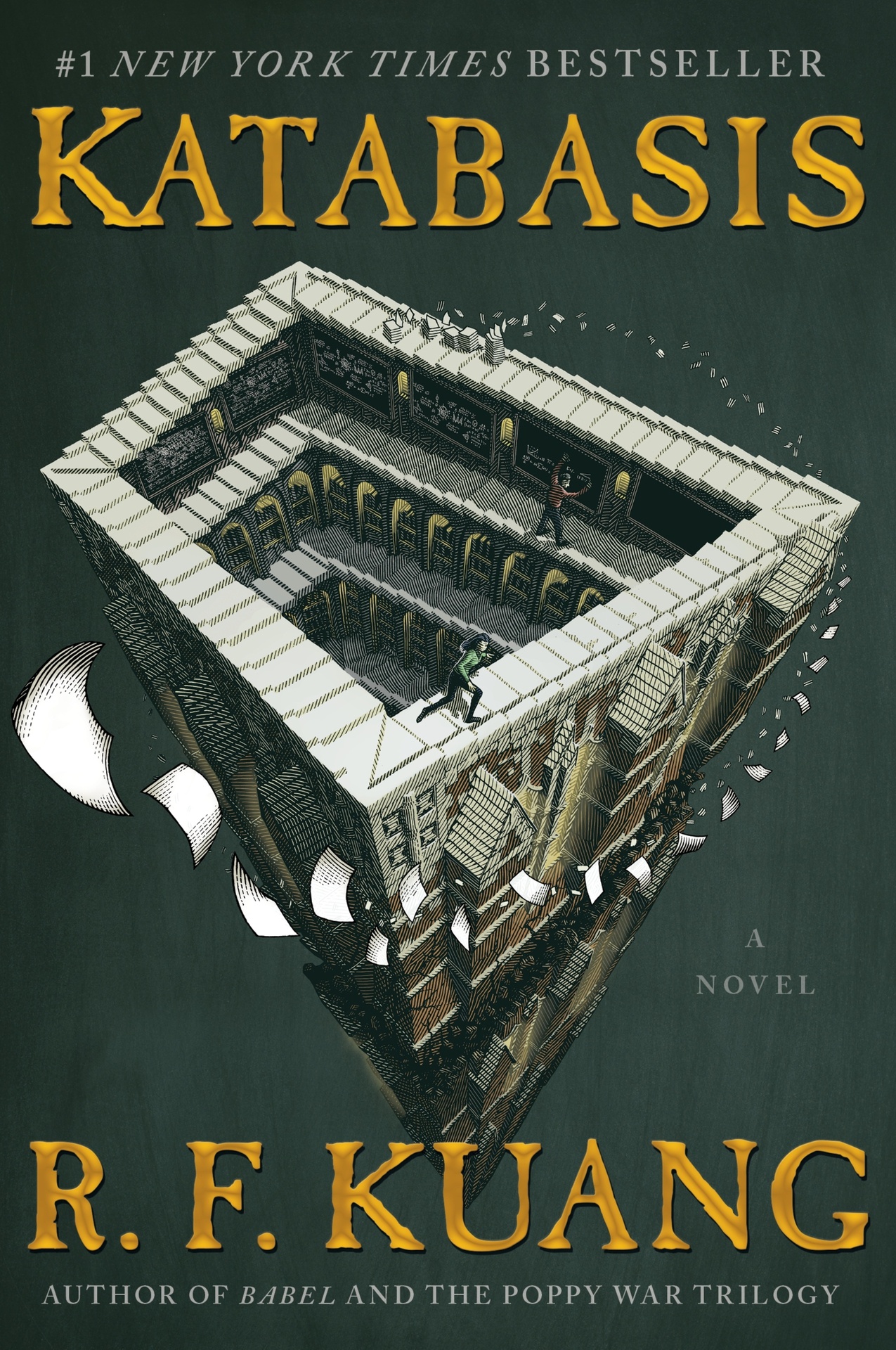
Katabasis
About this book
Alice Law has organised her life around becoming a great scholar of analytic magick under Professor Jacob Grimes. When Grimes dies in an accident for which she carries private responsibility, her career seems to die with him.
Alice decides to retrieve his soul from Hell and discovers that her rival Peter Murdoch has made the same calculation. Their expedition requires formal logic, magical theory, and cooperation from two students trained to treat each other as an obstacle.
Kuang builds the underworld from several philosophical and mythological traditions while keeping the cruelties of graduate education in view. The journey asks what mentorship means when admiration, exploitation, and professional dependence occupy the same relationship.
Katabasis is a dark-academia fantasy about ambition and institutional power. Its descent is both physical and intellectual: Alice and Peter must decide whether saving the professor who shaped them is the same as saving the work they wanted to do.
Read a sample
5,000 words
Plain text
From the opening
Chapter One
For I deem that the true votary of philosophy is likely to be misunderstood by other men; they do not perceive that he is always pursuing death and dying; and if this be so, and he has had the desire of death all his life long, why when his time comes should he repine at that which he has been always pursuing and desiring?
PLATO, PHAEDO
Cambridge, Michaelmas Term, October. The wind bit, the sun hid, and on the first day of class, when she ought to have been lecturing undergraduates about the dangers of using the Cartesian severance spell to revise without pee breaks, Alice Law set out to rescue her advisor’s soul from the Eight Courts of Hell.
It was a terrible gruesome accident that killed Professor Jacob Grimes, and from a certain point of view it was her fault, and so for reasons of both moral obligation and self-interest—for without Professor Grimes she had no committee chair, and without a committee chair she could not defend her dissertation, graduate, or apply successfully for a tenure-track job in analytic magick—Alice found it necessary to beg for his life back from King Yama the Merciful, Ruler of the Underworld.
This was no small undertaking. Over the past month she had become a self-taught expert in Tartarology, which was not one of her subfields. These days it was not anyone’s subfield, as Tartarologists rarely survived to publish their work. Since Professor Grimes’s demise she had spent her every waking moment reading every monograph, paper, and shred of correspondence she could find on the journey to Hell and back. At least a dozen scholars had made the trip and lived to credibly tell the tale, but very few in the past century. All existing sources were unreliable to different degrees and devilishly tricky to translate besides. Dante’s account was so distracted with spiteful potshots that the reportage got lost within. T. S. Eliot had supplied some of the more recent and detailed landscape descriptions on record, but The Waste Land was so self-referential that its status as a sojourner’s account was under serious dispute. Orpheus’s notes, already in archaic Greek, were largely in shreds like the rest of him. And Aeneas—well, that was all Roman propaganda. Possibly there were more accounts in lesser-known languages—Alice could have spent decades poring through the archives—but her funding clock could not wait. Her progress review loomed at the end of the term, and without a living and breathing advisor, the best Alice could hope for was an extension of funding sufficient to last until she transferred elsewhere and found a new advisor.
But she didn’t want to transfer elsewhere, she wanted a Cambridge degree. And she didn’t want any advisor, she wanted Professor Jacob Grimes, department chair, Nobel Prize laureate, and twice-elected president of the Royal Academy of Magick. She wanted the golden recommendation letter that opened every door. She wanted to be at the top of every pile. This meant Alice had to go to Hell, and she had to go today.
She checked and double-checked her chalk inscriptions. She always left the closing of the circle to the end, when she was absolutely sure that uttering, and thereby activating, the pentagram wouldn’t kill her. One always had to be sure. Magick demanded precision. She glared at the neat white lines until they swam before her eyes. It was, she concluded, as good as it ever was going to be. Human minds were fallible, but hers less than most, and hers was now the only mind she could trust.
She gripped her chalk. One smooth stroke and the pentagram was finished.
She took a deep breath and stepped inside.
There was of course a price. No one traveled to Hell unscathed. But she’d resolved at the outset to pay it, for it seemed so trivial in the grand scheme of things. She only hoped it wouldn’t hurt.
“What are you doing?”
She knew that voice. She knew, before she turned around, whom she would find at the door.
Peter Murdoch: coat unbuttoned; shirt untucked; papers flapping from his satchel, threatening to tear away in the wind. Alice had always resented how Peter, who every day presented like he’d barely scooped himself out of bed, had still managed to become the darling of the department. Though this was no surprise: academia respected discipline, rewarded effort, but even more, it adored genius that didn’t have to try. Peter Murdoch and his bird’s-nest hair, scarecrow limbs balanced atop a rickety bicycle, looked like he’d never tried at anything in his life. He was simply born brilliant, all that knowledge poured by gods without spillage into his brain.
Alice couldn’t stand him.
“Leave me alone,” she said.
Peter trudged into her circle, which was very rude. One should always ask before entering another magician’s pentagram. “I know what you’re planning.”
“No, you don’t.”
“Tsu’s Basic Transportative Pentagram, with Setiya’s Modifications,” he said, which impressed Alice, since he’d only glanced briefly at the ground, and from across the room besides. “Ramanujan’s Summation with implications for the Casimir Effect to establish a psychic link to the target. Eight bars for eight courts.” A grin split his face. “Alice Law, you naughty girl. You’re trying to go to Hell.”
“Well, if you know that much,” Alice sniped, “you know there’s only room for one of us.”
Continue reading the sampleClose the sample
Peter knelt, pushed his glasses up his nose, and with his own stick of chalk quickly etched some alterations into the pentagram. This was also very rude—one should always ask before altering another scholar’s work. But standards of etiquette did not apply to Peter Murdoch. Peter moved through life with an obliviousness that, again, was excused only by his genius. Alice had witnessed Peter spill chocolate syrup all over the master of the college’s robes at high table with no more rebuke than a shoulder clap and a laugh. When Peter erred it was cute. She had herself once spent all of dinner in the bathroom hyperventilating through her fingers because she’d knocked a bread basket onto the floor.
“One becomes two.” Peter waggled his fingers. “Abracadabra. Now there’s room.”
Alice double-checked his inscriptions and realized to her dismay that his work was perfect. She would have preferred he’d made an error that left him limbless. And she would have truly preferred that he did not then declare, “I’m coming with you.”
“No, you aren’t.”
Of all the people in Cambridge’s Department of Analytic Magick, Peter Murdoch was the last person with whom she wanted to sojourn in the underworld. Perfect, brilliant, infuriating Peter, who won the department’s top prizes at every milestone—Best First-Year Paper, Best Second-Year Paper, Dean’s Medals in logic and mathematics (which were Alice’s worst subfields, to be fair, but until she came to Cambridge she was not used to losing). Peter was one of those academics descended from a family of academics, a magician born to a physicist and a biologist, which meant he’d been steeped in the ivory tower’s unspoken rules since before he could walk. Peter already had every good thing in the world. He did not need Professor Grimes’s letter to get a job.
Worst of all was how Peter was so unfailingly nice. Always stumbling around with that blithe smile on his face, always offering to help his colleagues puzzle through hiccups in their research, always asking everyone else in seminar how their weekend had been when he knew very well they’d spent it sobbing over proofs that he could have done in his sleep. Peter never crowed or condescended, he was just guilelessly better than, and that made everyone feel so much worse.
No, Alice wanted to solve this problem herself. She did not want Peter Murdoch yapping over her shoulder the entire time, nitpicking her pentagrams because he was just trying to be helpful. And, should she return with Professor Grimes’s soul safely in tow, she especially did not want Peter sharing the credit.
“Hell’s lonely,” said Peter. “You’ll want company.”
“Hell is other people, I’ve heard.”
“Very funny. Come on. You’ll need help carrying supplies, at least.”
Alice had stashed in her bag a brand-new Perpetual Flask (an enchanted water bottle that wouldn’t run out for weeks) and Lembas Bread (stale, cardboard-y nutrition strips popular among graduate students because they took seconds to eat and kept one sated for hours. There was nothing enchanted about Lembas Bread; it was just the extracted protein of tons of peanuts and an ungodly percentage of sugar). She had flashlights, iodine, matches, rope, bandages, and a hypothermia blanket. She had a new, sparkling pack of Barkles’ Chalk and every reliable map of Hell she could find in the university library carefully reproduced in a laminated binder. (Alas, they all claimed different topographies—she figured she would get somewhere high up and choose a map when she arrived.) She had a switchblade and two sharp hunting knives. And she had a volume of Proust, in case at night she ever got bored. (To be honest she had never gotten round to trying Proust, but Cambridge had made her the kind of person who wanted to have read Proust, and she figured Hell was a good place to start.) “I’m all set.”
“You’ll still need help puzzling through the courts,” Peter said. “Hell’s very metaphysically tricky, you know. Anscombe claims the constant spatial reorientations alone—”
Alice rolled her eyes. “Please don’t insinuate I’m not clever enough to go to Hell.”
“Do you have a copy of Cleary’s?”
“Of course.” Alice wouldn’t forget Cleary’s Templates. She didn’t forget anything.
“Have you cross-checked all twelve authoritative versions of Orpheus’s journey?”
“Of course I did Orpheus, it’s the obvious place to start—”
“Do you know how to cross the Lethe?”
“Please, Murdoch.”
“Do you know how to tame Cerberus?”
Alice hesitated. She knew this was a possible obstruction—she’d seen the threat of Cerberus mentioned in a letter from Dante to Bernardo Canaccio, only she hadn’t seen it referenced in any other materials she found, and the one book that might have contained a clue—Vandick’s Dante and the Literal Inferno—was already missing from the stacks.
In fact, quite a few books she needed had kept disappearing from the library these past few months, often checked out on the very morning she’d gone in. Every translation of the Aeneid. All the medieval scholarship on Lazarus. It was like some poltergeist haunted the stacks, anticipating her project’s every turn.
Realization dawned. “You’ve—”
“Been researching the same thing,” said Peter. “We’re too far into these degrees, Alice. No one else could supervise our dissertations. No one else is clever enough. And there’s still so much he hasn’t taught us. We have to bring him back. And two minds are better than one here.”
Alice had to laugh. All this time. Every empty slot on the shelves, every missing puzzle piece. It was Peter all along.
“Tell me how to tame Cerberus, then.”
“Nice try, Law.” Lightly, Peter punched her shoulder. “Come on. You know we’re always better together.”
Now this, Alice thought, was really laying it on thick.
He didn’t mean it. She knew he didn’t mean it because it was not true. It had not been true in well over a year, and that had been entirely Peter’s choice. She recalled it well. So how could he act so chummy, toss those words out so casually, as if they were still first-years giggling in the lab, as if time had never passed?
But then, this was Peter’s modus operandi. He was like this with everyone. All warmth and cheer—but the moment you tried to step closer, solid ground gave way to empty space.
Two bad options, then. Imperfect knowledge, or Peter. She supposed she could demand the relevant books—Peter was annoying, but he didn’t hoard resources—and figure it all out on her own. But her funding clock was ticking, and certain body parts were rotting in a basement. There simply wasn’t time.
“Fine,” she said. “I hope you brought your own chalk.”
“Two new packs of Shropley’s,” he said happily.
Yes, she knew he preferred Shropley’s. Evidence of bad character. At least she wouldn’t have to share.
She arranged her rucksack next to her feet, checking that none of the straps lay outside the pentagram. “Then all that’s left is the incantation. Are you ready?”
“Hold on,” said Peter. “You do know the price?”
Of course Alice knew. This was why scholars rarely ever went to Hell. It wasn’t that getting there was so very hard. You only had to dig up all the right proofs and master them. It was that a trip down below rarely justified the price.
“Half my remaining lifespan,” she said. Entering Hell meant crashing through borders between worlds, and this demanded a kind of organic energy that mere chalk could not contain. “Thirty years or so, gone. I know.”
But she had hardly struggled with the choice. Would she rather graduate, produce brilliant research, and go out in a blaze of glory? Or would she rather live out her natural lifespan, gray haired and drooling, fading into irrelevance, consumed by regret? Had not Achilles chosen to die in battle? She had met professors emeriti at department receptions, those poor aphasic props, and she did not think old age an attractive prospect. She knew this choice would horrify anyone outside the academy. But no one outside the academy could possibly understand. She would sacrifice her firstborn for a professorial post. She would sever a limb. She would give anything, so long as she still had her mind, so long as she could still think.
“I want to be a magician,” she said. “It’s all I’ve ever wanted.”
“I know,” said Peter. “Me too. And I—I need to do this. I must.”
A taut silence. Alice considered asking, but she knew Peter would not tell her. Peter, when it came to the personal, was a stone wall. How easily he vanished behind a placid smile.
“That’s settled, then.” Peter cleared his throat. “So maybe I’ll do the Latin, and you’ll do the Greek and Chinese.” He peered down at a segment near his right toe. “Say, why isn’t this in Sanskrit?”
“I’m not comfortable with Sanskrit,” Alice said, peeved. This was just like Peter. Condescending, even when ostensibly just asking for clarification. “I’ve done all the Buddhist sutra references in Classical Chinese instead.”
“Oh.” Peter hummed. “Well, that probably works. If you’re sure.”
She rolled her eyes. “In three, on go.”
“Right on.”
She counted down. “Go.”
And they began their chant.
The dreadful, tragic death of Professor Jacob Grimes had been both foreseeable and avoidable. It was also, unknown to most, entirely Alice’s fault.
That day’s exercise was nothing more risky nor radical than the thousands of routine experiments Professor Grimes had conducted in that laboratory space for decades. He was only retracing some basic principles of set theory cited in a new article he had coming out in Arcana, the top journal in their field. It was all utterly routine, and no more dangerous than riding a bike, so long as one double-checked their pentagrams. Undergraduate-level stuff.
Professor Grimes did not double-check his pentagrams. He’d long reached the stage of his career where one left that sort of grunt work to graduate students. Professor Grimes’s days were devoted to profound, deep thinking. He saw above the mountains and clouds to discern the truth, and then he descended to utter pronouncements like Moses coming down Mount Sinai, and then his underlings hammered out the details. He never did his own arithmetic or translations anymore. And he was far above kneeling over tracing lines of chalk, straining his eyes, straining his back.
One might find it reckless, foolish even, for a magician to leave his life in the hands of underpaid and overworked graduate students. But for one thing, Professor Grimes’s graduate students were the best in the world. For another, even graduate students at bottom-rate American institutions could identify the most dangerous mistakes in a pentagram. And this was Cambridge. After so many years of practice they stood out to any competent scholar like glaring red flags: gaps in the outer circles, misspelled words, false equivalencies, parentheses left unclosed. Anyone in a sound state of mind could have done it.
But Alice was not in a sound state of mind that day.
She was of course underpaid and overworked, but this condition was common among graduate students and no one cared much about it. But she had also not slept properly in three months. She’d drunk so much caffeine that the world shimmered, and her chalk trembled in her grip. She felt, as she often did, that her body had no defined boundaries from the material world; that if she stopped holding herself together as a subject, she would dissolve like a sugar cube in tea. She was in no state to work, and she had not been for a very long time. What Alice needed most then was a nice long holiday, and then perhaps institutionalization at some remote facility near the sea.
But missing lab was not an option. Professor Grimes had not asked her to assist on a paper since last year, and though the work was beneath her, and though coauthorship was out of the question, Alice was desperate to get back in his good graces.
Anyhow, tired to the point of collapse was a default state. The expectation was simply that, through some combination of strong coffee and Lembas Bread, one pushed through until all deadlines were met and one could collapse into an indefinite coma without consequence. Alice had spent most of graduate school in this state, and it was not so bad.
But she was also angry that afternoon, and resentful, and confused, and such a turbid mess of frustration and fury that the very sound of Professor Grimes’s voice made her flinch. Perceiving his sheer physical proximity—sensing him move, kneeling in his shadow—made it hard to breathe. In the brief moments that their eyes met, her breath stopped, and she thought she might like to die.
It was very difficult to concentrate in such an environment.
So, when she drew the pentagrams, she did not close the requisite loops. With pentagrams, it was very important to close the requisite loops. Uttering incantations invoked the living-dead energy of chalk dust, and all that energy had an explosive effect unless contained properly within a defined space. Even the smallest hole could cause disaster. In fact, smaller holes were worse, as they concentrated all the energy to terrible effect. Therefore anyone who drew a pentagram performed what was known as the Ant Test: tracing a pencil tip from one point of the inscription all the way around to make sure any ant following the line would complete the journey.
Alice did not perform the Ant Test.
She did not, in effect, bother to ensure Professor Grimes’s body remained intact.
It was the kind of mistake that could end careers. It would have, if anyone had seen Alice’s name on the lab logs or known in any official capacity that she was assisting at all. There would have been an investigation. She would have been questioned before a board, forced to recount in painstaking detail her every last error while they deliberated over whether it was grounds for manslaughter or merely reckless endangerment. She would have lost her stipend, been booted from the program, been interrogated by the Royal Academy, and been barred from studying or practicing magick at any institution in the world, even the sketchy, nonaccredited ones overseas. All this if she did not go to prison.
But Professor Grimes did not generally credit his graduate students in his experiments. Assisting with his research, at the expense of their own, was simply an unspoken requirement of the program. No one knew, in any official capacity, that anyone was in that room on the day of the accident except for Professor Grimes. No one else saw when howling winds torn from infinite dimensions rushed into the pentagram. No one saw Professor Grimes’s eyeballs stretch out of his face before popping like grapes; his intestines spooling out and around his body like a jump rope, crisscross applesauce; his mouth twisting in a soundless scream. No one saw Professor Grimes’s body turn upside-down and spin for seven horrible cycles, exposed organs rippling, before flying apart in all directions, splattering every surface with blood and bone and guts. No one saw his brains on the chalkboard; the toothy jaw fragment landing plop into his afternoon cup of Darjeeling.
And no one saw Alice strip naked in the lab shower, scrub herself clean, throw her clothes in the incinerator, and hurry out the back door, dressed in clothes from the overnight bag she always kept at the lab. No one saw her flee in the early hours across campus back to her room in the college, where she stripped down for a second shower and alternated vomiting and crying until she fell asleep.
For all anyone knew, the first anyone heard of Professor Grimes’s death was the janitor’s screaming the next morning.
By then the blood and bits had ruined the pentagram, and all the chalk was smudged with gore, so that no one could discern precisely what had gone wrong. A piece of Professor Grimes later identified as his liver had, happily, landed square on that segment of the outer circle Alice had fudged. They could only conclude it was a terrible accident, one only waiting to befall the most brazen thinker of his time, and stop the investigations there.
Somehow, University Cleaning Services scooped together enough remains to fill a bucket, which were then transferred into a coffin. The college held a service. The department maintained a state of mourning for a week, during which all the students and faculty were forced to attend mandatory safety workshops run by colleagues bused in from Oxford, who with every sneering comment made it clear that they never would have been so foolish as to let a researcher explode himself all over a lab. Professor Grimes’s nameplate was removed from his office door. His graduate seminar was reassigned to a poor postdoc who understood less of the material than the students did. The city papers printed some stuff about what a great loss this was—to Cambridge, to the discipline, to the world. And then the summer ended and everyone moved on. Except Alice.
She could have kept her mouth shut and gotten on with it. The university would have supported her to the end of her studies. Cambridge’s Department of Analytic Magick was very proud of its high graduation rate, and the faculty would have dragged Alice across the finish line, one way or another, even if this meant lending her out for several years to their rivals at Oxford.
But Professor Grimes was the most influential analytic magician in England, and probably the world. Half the department chairs in the field were his close friends, and the other half were so frightened of him they would do anything he said. All of Professor Grimes’s previous advisees had gone on to tenured jobs at top-tier programs—the ones who graduated, anyhow. One recommendation letter from Professor Grimes as good as secured a post anywhere his students applied.
Good jobs were vanishingly rare in academia. Alice very much wanted one. She wouldn’t know what to do with herself otherwise. She had trained her entire life to do this one thing, and if she could not do it, then she had no reason to live.
So the next morning after Professor Grimes’s death, once his body was discovered and all the dust had settled, it seemed the most natural thing in the world to begin researching ways to go to Hell.
Peter had a very nice spell-binding voice. Alice had always resented this about him, how his voice made hers seem reedy in comparison. She found it particularly disgruntling given how incongruous it was with his stick-thin frame. It seemed unfair such a rich sound could come from that stubbly goose throat. Every now and then a research paper surfaced on why male voices were better suited for magick, citing reasons of pitch, depth, or steadiness, and they always sparked a big hubbub involving outraged statements from women-in-magick societies and apologetic statements from journal editorial boards. Alas, no one had managed to conclusively prove these studies false. Unfortunately, Alice suspected the papers were right, and at this moment she was grateful. Peter’s confidence made her confident in turn, and she found herself lulled along by his smooth, reassuring rumble.
“The target defined as Professor Jacob Grimes,” they intoned in unison. “The destination defined as Hell, or the afterlife, or the Eight Courts, or the domain of Lord Yama the Merciful.”
They finished. Nothing happened. A second passed, then several. Then a freeze suffused the room, a creeping chill from nowhere that cut straight into their bones. Alice shuddered.
“Hand?” Peter offered his palm.
She slapped it away. “Shush.”
“Sorry.” Peter’s hand hung in the air for a moment before he pulled it back, and Alice realized belatedly he might have been asking her to hold his.
But it was too late. White light flared up from the lines of chalk, forming a silo around them. The lab room vanished. A great rumbling filled the air. Alice reached for Peter’s arm—only for balance, mind—but the ground lurched violently, and she toppled over onto her bum. For a moment she could see nothing, hear nothing over the roaring column. She felt a hooking sensation in her chest—not painful, only sharp, like some ghostly hand had reached in and yanked her heart out from between her ribs. The pressure was overwhelming. She could not breathe. She curled in on herself, hoping desperately she hadn’t fallen out of the pentagram. The rumble grew and the light brightened to a blinding white, burning through her eyelids. Visions of apocalypse exploded in her mind’s eye, oceans of blood beneath tongues of fire, planets collapsing into black holes, and for a brief, terrifying moment she was lost in the eruption, she forgot who she was—
She scrambled for her catechisms.
I am Alice Law I am a postgraduate at Cambridge I study analytic magick—
The light faded. The rumbling ceased.
Blinking, Alice turned her hands over before her eyes. She felt fine. Her skin was coated with a thin layer of ash, so that she looked dyed in gray, but it brushed away easily enough. She patted her chest. Her heart was in place. Her limbs were intact. Her entrails still stacked neatly inside her. If the price was paid, she couldn’t feel it. All she felt then was a wild, burning elation. It had worked, she had done it, it worked. Chalk, dirt, hours of research—and then one world slipped into another. She had wrought this. A miracle.
Peter stood up, coughing. He brushed an ash-covered clump of hair out of his eyes. “So this is Hell.”
Alice peered about in wonder. All around them were gray fields, endless plains under a dark red sky. A sun—their sun? a shadow, a twin?—hung low and ponderous, its light maddeningly dim. She breathed in deep. She had brought a cloth mask, in case the air reeked. In Virgil’s Aeneid, the Greeks had named Hell Aornos, “the place that is birdless,” for none could fly over its foul breath. But the air smelled of nothing but dust, and the temperature was just this side of chilly. She’d expected more tortured screaming, sulfur, and brimstone, but it turned out that perhaps the American theologists had been exaggerating. Meteorologically, Hell didn’t seem much worse than an English spring.
She slung her rucksack over her shoulders. A faint dark mass loomed in the distance and there, she assumed, lay the Fields of Asphodel.
“You all right?” Peter asked.
“Never better.” Alice stepped out of the pentagram. “Shall we?”
On Magick
Magick, the most mysterious and capricious of disciplines, admired for its power, derided for its frivolity, is in brief the act of telling lies about the world.
What magicians of ancient civilizations discovered through accident and ingenuity, and what the English philosopher-magicians of the eighteenth century onward codified into the Euro-American received canon, was that the natural laws of the world were set but fragile. You could cleverly reinterpret them. For brief periods of time one could even bewilder and suspend them, so long as you spun the right web of untruths. Linguistic trickery, logical conundrums, it all worked. All you had to do was find a set of premises that, even if just for a split second, made the world seem other than what it really was. The chalk, and whatever remnants of living-dead magical energy lay in the pulverized shells of those sea creatures that perished millions of years ago, did the rest.
Now, magick had progressed a lot since, say, the primitive rituals suggested by the Uffington chalk inscriptions, and there had since been a proliferation of flashy subfields that in fact had nothing to do with chalk, but rather all sorts of arcane objects, enchanted music, and visual illusions. One could now study the archaeology of magick, the history of magick, the music of magick, and on and on. Over in America, visual illusions and flashy showmanship were all the rage. In Europe they were going on about things called postmodernist and poststructuralist magick, which seemed to involve lots of spells doing the opposite of what their inventors wanted, and spells that did nothing at all, which everyone claimed was very profound. But all the best magick was still done at Cambridge, and good, traditionalist Cambridge was dedicated to the bare bones of the art. Analytic magick. Chalk, surface, paradox.