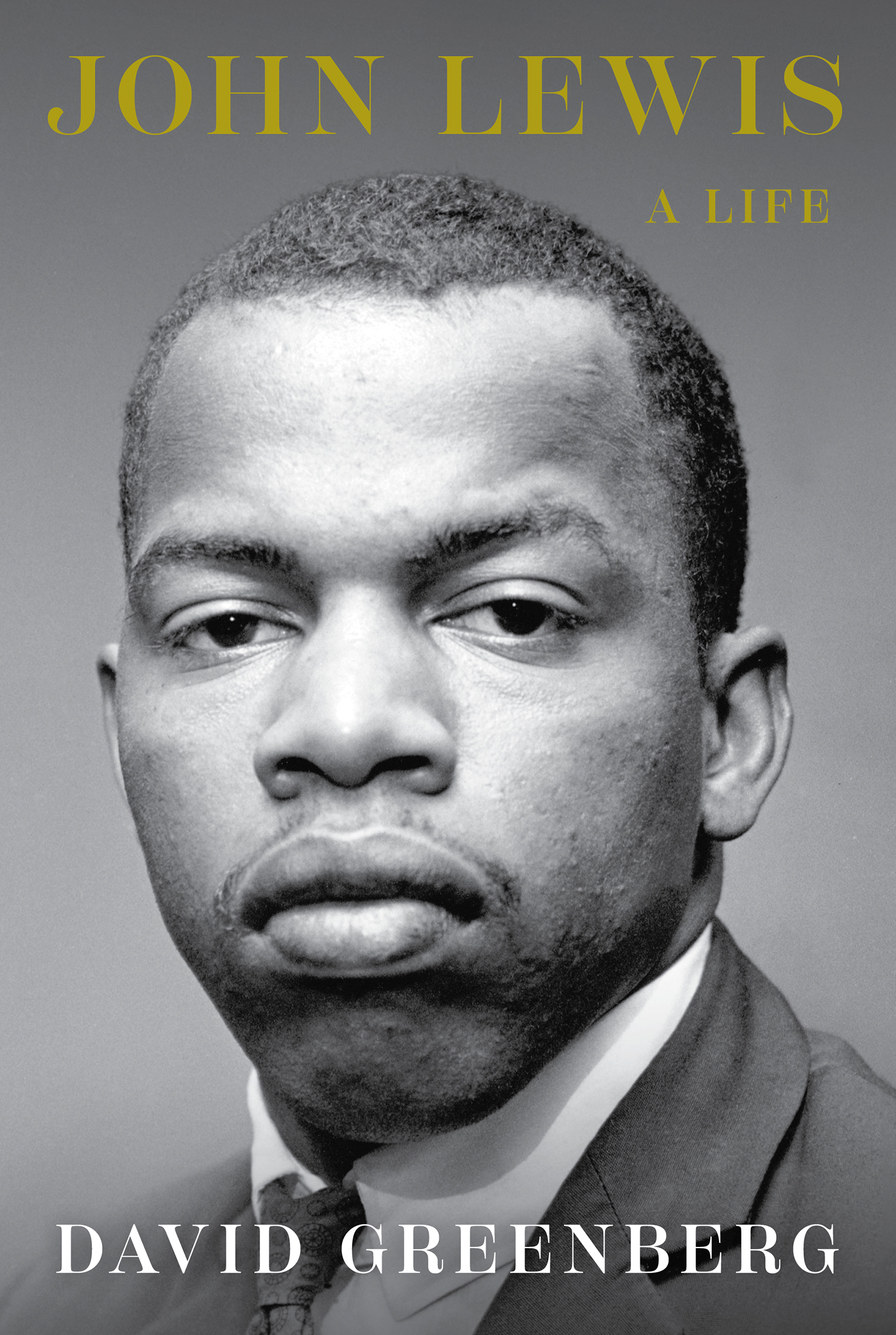
John Lewis: A Life
About this book
Lewis's early life, religious vocation, Nashville sit-ins, Freedom Rides, and leadership of SNCC placed him near the center of the civil-rights movement while still in his twenties. His injuries at Selma became one visible moment in years of organizing.
David Greenberg also examines conflict: Lewis's removal from SNCC leadership, his complicated relationship with movement colleagues, and the transition from direct action to electoral politics in Atlanta and Washington.
The congressional years show how a moral reputation operates inside negotiation, party politics, and changing national coalitions. Interviews and previously unused records allow the account to extend beyond Lewis's public image.
John Lewis: A Life is a comprehensive biography rather than a memoir or commemorative portrait. It covers the movement icon and the working politician as parts of one evolving career.
Read a sample
5,066 words
Plain text
From the opening
Chapter One THE BOY FROM TROY
As a child, John Lewis stood out among his siblings for his love of reading. “He was always kind of a peculiar boy,” his father, Eddie, said in a 1969 interview. “Now, you take a lot of times when the children would all be playing, he got some kind of book. And he would be messing with that book… reading, or doing something with it.” One of John’s sisters, Ethel Mae, known as Mimi, echoed her father’s observations. “He mostly read and he loved to go to school,” she said. “He’d pick up anything that he got to read.… Just a history book or something maybe my sister had when she was going to school.” An uncle who was a school principal gave John volumes of Robert Louis Stevenson and Charles Dickens to read, along with biographies of famous Black figures like George Washington Carver and Joe Louis. Booker T. Washington was a favorite. In later years, Washington’s reputation would suffer as his philosophy of Black self-improvement fell from favor among intellectuals. But Lewis remained an admirer. “After the Bible,” he told a reporter in 1961, “my favorite book is Up from Slavery”—Washington’s classic autobiography.1
Then there was poetry. “He had a poem” that he would recite, recalled Ethel Mae. “I don’t know the name of it, but it began, ‘Out of the night that covers me.…’ When my momma and daddy would go to town or something and leave us all here, then he would start.”
The poem was “Invictus,” a Victorian verse by William Ernest Henley, whose words eerily presaged Lewis’s trials later in life. John would recite its lines around the house:
Out of the night that covers me,
Black as the pit from pole to pole,
I thank whatever gods may be
For my unconquerable soul.
In the fell clutch of circumstance
I have not winced nor cried aloud.
Under the bludgeonings of chance
My head is bloody, but unbowed.
Beyond this place of wrath and tears
Looms but the Horror of the shade,
And yet the menace of the years
Finds and shall find me unafraid.
It matters not how strait the gate,
How charged with punishments the scroll,
I am the master of my fate,
I am the captain of my soul.2
John Lewis was born on February 21, 1940, in Pike County, a rural swatch of southeast Alabama, where his mother’s family had lived for generations. His great-great-grandparents, Elizabeth (Betz or Betty) and Tobias (Tobe), had been slaves, owned by a man named Joel Carter. Many years later, Joel’s granddaughter, Sarah Abernathy, wrote about the emancipation of Tobias and Elizabeth at the end of the Civil War:
Not being a secessionist at heart, Grandfather Carter didn’t answer Jefferson Davis’ call for cotton. He had expected his wealth to be grown in slaves; and too anxious for their health to allow his overseer to drive them, but allowed them to be worked enough to produce their upkeep and a little cotton which he stored. Before the onset of Federal Raiders, his negroes hid it among some difficult hills and gulches, all cotton grown by him after the Federal Blockade. His negroes were loyal to Old Marster. They refused to betray the place where they had cows, hogs, meat and lard hidden. Betz, the cook, armed herself with ax and stood by the door and defied the Yanks to pester Old Marster or the family, or to enter his home. For her loyal and militant protection, with her freedom she and her husband were given a piece of land, a cabin and supplies till they could grow more. Said my grandfather, “They have grown old in my service. My children are young and are able to get for themselves, what Betz and Tobe are too old and feeble to earn for themselves.”
Because Carter had given Tobias and Elizabeth a modest-sized plot, John Lewis’s ancestors possessed land of their own. Over the following decades they bought more of it—76 acres here, 228 acres there. Eventually, though, they were forced to sell the land, and when John was born, his parents were working as tenant farmers for a white man named Josh Copeland.3
Besides claiming their own property when freedom came, the Carters, then in their mid-forties, also claimed their right to marry—on December 16, 1865. Until then, the South’s chattel slavery system had barred slaves from legal unions, although many, like the Carters, were considered married in the eyes of their communities. Even though slaveholders often broke up families—selling a spouse or a child to a plantation or household far away—they could not extinguish the human desire to wed. Black couples took wedding vows and performed rituals like “jumping the broomstick,” a custom long associated with extralegal unions. Informal marriage thrived even as legal marriage was prohibited.4
When the Thirteenth Amendment, abolishing slavery, was ratified on December 6, 1865, Black couples hurried to consecrate their bonds. Some had children whom they wished to make “legitimate.” Others wished to qualify for soldiers’ pensions or land allotments. Others simply wanted to exercise their newly won rights. In some parts of the South, the demand for nuptials was so great that mass weddings took place: as many as seventy couples tied the knot at once. Among the first to obtain a wedding certificate were Tobias and Betty Carter.5
Continue reading the sampleClose the sample
Alabama archives also document yet another step that Tobias Carter took as a free man. In March 1867, three years before the Fifteenth Amendment was ratified, allowing Black men to vote, the U.S. Congress passed the Reconstruction Act, which required Confederate states, as a condition for rejoining the Union, to grant the vote to all men regardless of race. Under military direction, boards of registrars enrolled voters. That summer, Tobias Carter registered.6
Within a generation, however, Tobias and other Black men across Alabama were systematically stripped of their rights. In 1874, white supremacist Democrats took control of the state government and established a Redeemer regime. Through new laws and extralegal violence, they disenfranchised Black citizens. Thus began the Jim Crow era and the long deferral of full freedom for Tobias and Betty and their progeny.
When John Lewis was born, Tobias and Betty Carter’s son Frank—John’s great-grandfather—was still alive. He had been emancipated as a small boy. John was impressed by his great-grandfather’s reputation for immense strength; Frank was known to plow soil and pick crops as few men could. He was also a math whiz who performed financial calculations quickly, which he did on payday to make sure he wasn’t cheated.
John also remembered the old man as “lighter than any other Black person I had ever seen” and having “remarkably straight hair.” John’s mother, Willie Mae, never talked about her grandfather’s skin tone. The subject upset her. The implication was that Frank’s biological father may have been white and may have raped Betty. The silence about the subject always made John uneasy.7
John held more vivid memories of Frank’s wife, Betty Baxter Carter, or “Grandma Bessie,” the matriarch of the extended Carter clan, who was the midwife at his birth. John would endear himself to Grandma Bessie on his family’s Sunday visits to her house by shinnying up a chinaberry tree to retrieve eggs from a hollow where an eccentric hen would lay them.
Bessie and Frank lived near John in Pike County. So did John’s grandparents Dink and Della Carter. So, too, did many other aunts, uncles, and cousins. The area was called “Carter’s Quarters” because of all the family members that lived there. Holiday gatherings sometimes included hundreds of relatives, from Pike County and beyond.8
Although John grew up among Carters, his mother had become a Lewis. In 1931, at age sixteen, she met Eddie Lewis at the Macedonia Baptist Church. Nicknamed “Buddy” or “Shorty,” Eddie was a compact, stocky young man five years her senior. His family had moved to Troy in 1904, although in the subsequent decades the Lewises shuttled around Georgia and Alabama before returning to Pike County in 1928. Eddie’s grandfather, Carie Lewis, had been a sharecropper, and his father, Henry, had been a turpentine man, extracting pine resin from trees to make the solvent for construction projects. Eddie worked on bridges for several years before taking up farming.9
When she met Eddie, Willie Mae was smitten. “We just fell in love,” she told her son. Married in 1932, the couple would have ten children: Ora, a girl; then Edward, who was deaf; and then—on a cold, rainy night in 1940—John Robert, whom they called Robert or Bob. Seven more children followed, with Henry Grant, the youngest, arriving in 1952. They all lived in a shotgun house: three rooms including the kitchen. John recalled that you could stand in one room and see almost all the way through the interior—or fire a shotgun’s bullet from the front door straight through the back.10
All the Carters’ homes were small and ramshackle. Once, when fifteen of the cousins were gathered at the house of one aunt, a fierce storm blew in, dislodging the tin roof. John’s aunt had the children line up, clasp hands, and follow the wind from one room to another, so that each time the whipping blasts rocked the little house, the group would be there to provide ballast. “We just walked with the wind, backward and forward through the house until the storm was over,” Lewis recounted.11
By the time John was four, Eddie had saved $700. With a loan of $100 from the Copelands, it was enough to buy his own place.I The plot Eddie purchased was 110 acres, set on a red-clay hill near a swamp off a dirt road: Route 5, Box 225. “It was a good deal,” John reflected years later. “It was an unbelievable deal.” But it was no ticket to middle-class comfort. The road to the house was steep and rugged. When it rained, cars would get stuck in the mud or slide into ditches. Years later, the county paved its roads, but only up to the point where the Black-owned properties began.12
John remembered the day the Lewises moved. Excitement filled the air as they loaded up a wagon and a borrowed pickup truck, carting everything down the road a few miles. John sat in the back seat, wedged between an old radio and his dog, Riley. His father drove. Even then, John understood that his family was graduating from being sharecroppers—a plight he would compare to slavery—to being farmers. The new house was hardly palatial, but it had two large front rooms, a kitchen, high ceilings, a fireplace, front and back porches, and a tin roof. Near the front porch were pecan trees and a covered well.13
Owning land marked a triumph for Eddie. The plot was in the heart of the Black Belt—the wide, curved swath of fertile land stretching from Virginia through Louisiana, named not for its concentration of African Americans but for the dark soil that made the terrain arable. The Lewises eked out a living growing cotton, corn, and peanuts. They had to go into debt to buy feed or fertilizer, and they always feared losing their land. Eddie took on extra work driving a truck, while Willie Mae did domestic work outside the house.14
Farming required the whole family’s labor. When John was small, his mother would set out a blanket for him and his siblings in the field as she picked. Starting at age five or six, the children were expected to help. John despised the toil and decided at a young age that he wasn’t meant for the farm. “You’ve got to catch up,” his older brother, Edward, would say. “You’re not pulling your load.” John’s father could pick three hundred pounds of cotton a day, his mother two hundred pounds. John criticized his parents for accepting the grueling demands of farming. “I’ve got to raise you all,” his father replied. “I’ve got to do the best I can until I can do better.” John pushed back. “Daddy, you’re just working and you ain’t getting it. I ain’t going to do that. One day all of this is going to change.”15
Luxuries were few. The Lewis house had no running water, electric wiring, insulation, or telephone. To bathe, they boiled water in a kettle and washed themselves in a zinc tub. Or they would take what John called a “bird bath,” using a small basin. The outdoor toilets, noisome in the summer and frigid in the winter, were stocked with old newspapers, discarded Sears, Roebuck catalogs, or corncobs. Clothes were never thrown away, always patched up. Willie Mae could take two threadbare pairs of pants and fashion one good new pair. In later years, the Lewises’ hard work brought about some modest improvements. By 1953, they had saved enough to tear down the ramshackle house and build a bigger one. A few years later, they wired it for electricity. They were able to buy a tractor. After John went to college, they would get a television.16
Despite his frugality, Eddie didn’t want his children to feel deprived. He carried himself with poise and pride and wore crisp, clean shirts that were freshly ironed and starched. On Fridays and Saturdays, he bought fresh fish for dinner; he usually settled for mullet, the cheap fish, but he liked to splurge on red snapper when he could. “My father put a great deal of stress and emphasis on food,” John said. “It was his philosophy that if we died, we would die with a full stomach.… That was his whole thing.”
Eddie also resolved to keep his family safe, whether from the Ku Klux Klan or violent neighbors. “I grew up in a home with a shotgun over the door and a rifle in the corner,” John said. He remembered Willie Mae once remonstrating with Eddie not to charge out of the house with the gun. She also warned her children to avoid the rowdy nightlife of Troy, especially around Love Street. “On a Saturday night, you heard where people were being shot, where people were being cut and killed,” John recounted. It bred a hatred of violence. John avoided guns, even toy ones, and abstained from hunting. He never picked up a firearm until he was in his fifties.17
John also never played with—indeed, had no interaction with—white children. “The world I lived in was completely Black,” he remembered of his earliest years. “I cannot even recall seeing somebody white.” It was, he said, “two worlds—a Black world and a white world.” The extended Carter family provided a bounty of playmates for John, even if he had to walk a mile or two to meet them. Siblings and cousins played marbles, dodgeball, jump rope, and Cowboys and Indians. Other pastimes were games of make-believe, like “house” or “church,” where the only props needed were a few oak chairs from the house. John invested these games with his hopes for a better existence. One of his cousins, Della Mae, shared his fantasy life. “We had a dream,” John recounted in the final weeks of his life. “We were going to cut down the large pine trees near my house and make a bus. And we were going to leave Alabama. We would use the round part of the trunk to make wheels, and we would travel to Buffalo.” Two of Willie Mae’s brothers had moved there during World War II, and in John’s family, Buffalo had acquired a reputation as a faraway land of opportunity, a bustling big city of excitement and possibility. “We knew there was a better life,” he said, “a better place.”18
Another recreation was going into Troy on Saturdays to window-shop or see a movie. John enjoyed watching Superman, the Lone Ranger, Hopalong Cassidy, and Tarzan—during which he and his siblings would cheer for the African tribesmen. But at an early age, John realized that he and his family had to sit in the balcony because the theater was segregated. He felt humiliated. (“I don’t go to many movies today because of that,” he said decades later. “It’s a shame.”) He felt the same way at the segregated bathrooms and water fountains; or at Byrd’s Drugs, where he and other Black kids had to drink their Cokes outside; or at the Pike County Fair, which they could attend only on “Colored Day.” At first, John would mount little protests, drinking a lot of water before going into town so he wouldn’t have to use the segregated fountains. But mostly, he said, “I stopped going.”
Segregation intruded as well onto his favorite pursuit: reading. At a young age, he went to the county public library to check out some books, but was denied. The library, he was told, was for whites only. To protest, John gathered up some classmates to draft and sign a petition, but no one at the library ever replied to their request.
The steely determination that was evident in John from early on was always mixed with an unmistakable gentleness. The combination gave him his distinctive temperament. He could be insistent and stubborn when it came to boycotting the Jim Crow facilities in Troy or in resisting the toil of manual labor, but overall his family considered him a sweet and stoical child. Soft-spoken and even-tempered, he was, for all his vaunted courage later in life, easily frightened. The snakes he came across while farming scared him. So did a strange black fish that his mother once tossed his way while fishing. Thunder and lightning upset him so much that during rainstorms he would hide in a steamer trunk. He retained that fear his whole life.19
John’s religious devotion reinforced his serene temperament. He inherited that devotion mainly from Willie Mae, a godly woman and relentless optimist who believed in prayer and salvation. She went to church “all the time,” John said, and incorporated religious observance into the family’s daily life. The children memorized Bible passages; at meals someone always said grace and recited a verse.20
The Lewises attended the Macedonia Baptist Church, in Troy. But because their preacher made the rounds among many congregations in the region, he was in Troy only on the third Sunday of each month. On other Sundays they went to Dunn’s Chapel, a Methodist congregation near their farm, which also served as the children’s elementary and Sunday school. John loved the singing, which was conducted without any musical instruments, and learned all the hymns and spirituals. The congregation, he said, exhibited “some of the best singing that I’ve heard in my life.”
One evening in July 1949, John attended the church’s annual revival meeting. The minister was beseeching the congregation to come to Jesus and be saved. John decided it was time. One of his older cousins, called “T-Baby,” escorted him to the front. John and the minister clasped hands. At that moment the lights suddenly went out, filling John with a jolt of fear that he associated with accepting Christ as his savior. When the lights came back on a moment later, an old lady in the congregation hollered, “Thank you, Jesus!”21
As much as church services, Willie Mae recalled, “he loved the Bible.” John remembered opening a Bible his uncle had given him as a present, and his mother reading him the words “In the beginning God created the heavens and the earth.” He was reading by himself by age five, and perusing the Bible became his favorite pastime. Especially after he lost interest in the movies, he said, when others in the family went into Troy, “I would stay behind… reading the Bible someplace in a corner.”22
Christianity also provided grounding for John’s belief that race shouldn’t affect how anyone was treated. “Very early in Sunday school, we discussed the fact that the whole question of color according to the Trinity is not relevant,” he said. “If God is supposed to be the God of all Mankind and Jesus is the brother of all Mankind, color isn’t an issue.”23
His admiration for the church was not total. He saw that its strict moral codes could inculcate insensitivity or callousness. The church took a dim view of drinking, dancing, playing cards, going to the movies, and sex. Once, John remembered, T-Baby’s little sister, a high school student, became pregnant and was excommunicated. She begged the church to come back, in vain. “Because of human nature,” John sighed. “It was very sad. And I’ve never forgotten it.”24
John’s piety also led him to develop an unusual relationship with his family’s chickens—a story he would recount his whole life. From a young age, he preached to the chickens on the farm as if he were a minister and they were, literally, his flock.
At about eight years old, John was put in charge of the five dozen chickens his family owned. Each morning he would step into the henhouse and whisper to them before providing them food. He tended to their nests and the fencing of the yards. He would mark the eggs with a pencil, to indicate which should be left to hatch. Because of his family’s frugal habits, he also used a farmer’s trick to get a hen to “set” on more eggs than she had actually laid, surreptitiously swapping in extra eggs under the hen. This method was unfair and even cruel to the hens; sitting on eggs was actually arduous work that caused the birds to lose weight and feathers. He felt guilty about it, and each month when the Sears, Roebuck catalog came in the mail—John and his siblings called it “the Wish Book”—he would linger longingly over the photographs of an $18.95 incubator. If only he could buy it, he wouldn’t have to “cheat” the hens.25
Besides tending to the chickens, John also began preaching to them. For several years, with a Bible in hand, he would gather the fowl and settle them on their roosts before putting them into bed. He would read his favorite prayers or Bible verses as the chickens clucked and shook their heads. John gave each one a name—“Big Belle” or “Li’l Pullet”—and even baptized them. Once, he accidentally drowned a bird. The episode gave him nightmares, and one of his little brothers thereafter refused to be baptized. When a chicken died, John would hold a funeral, placing the bird in a lard can and rounding up his brothers and sisters by a pecan tree near a swing and benches. After John’s eulogy they would march off to a little cemetery. John would say prayers and cover the grave with fertilizer, flowers, and a cross.26
Sometimes Eddie had to cook a bird for dinner. Or he might trade one for sugar or flour to the “rollin’ store man,” a dry-goods merchant who came by the house in his truck. The loss of a chicken caused John no end of distress. He would become irate and refuse to eat or even to speak to anyone in the family for days. It was, he would later reflect, his first nonviolent protest.27
By age twelve, John had stopped preaching to the chickens. But by now his affinity for the ministry was obvious to all. Nicknamed “Preacher,” he decided to enter the clergy. At sixteen, at Macedonia, he preached his first trial sermon. He wore his best suit, dark blue, with a white shirt and blue tie. He chose an Old Testament passage about Hannah, a woman past childbearing age who prays for a son and is rewarded with Samuel, whose name in Hebrew means “God heard.” It was a simple message, one of keeping faith in God despite long odds, and the congregation rejoiced in John’s telling of it. Lewis later recalled that the Montgomery Advertiser ran a story about him, along with a picture of him in his Sunday suit, though no such story has been found.28
For the next two years John would preach at Methodist and Baptist churches around Pike County. In 1956, he was licensed as a minister and in 1957 was ordained—a higher honor that authorized him to perform weddings. He also began to teach at Sunday school and soon became its supervisor.29
Besides church, John’s other great love was school. His parents, who never graduated high school, saw education as the route to a better life. “Go to school and get an education so you won’t have to work as hard as we did,” his mother would tell him.30
John’s elementary school was at Dunn’s Chapel. It had been built and funded by Julius Rosenwald, the Sears, Roebuck mogul who, with Booker T. Washington, created five thousand schools for Black children around the South. Although the Rosenwald schools were better than most Black schools, the education at Dunn’s Chapel was mediocre. In one room, John recalled, students of all six grades massed together “like a herd,” with the teacher unable to give much attention to anyone. The “old, shaggy building,” John said, was beautiful in its simplicity, painted white with a green roof. A potbellied stove heated the school in winter, and kids would rest their lunches on top to heat them up. Drinking water was in another building. Each child had a glass with his name written on tape, and they had to take their own glass home now and then to wash them. “The glasses would stay there for a very, very long time,” John remembered, “and get very, very dirty.” Some of his happiest experiences were field trips, including one to the Tuskegee Institute, an hour north, to see where George Washington Carver had carried out his agricultural research.31
Just before seventh grade, in 1951, John’s uncle Otis offered to drive him to visit their family in Buffalo for the summer. The trip would be John’s first outside Alabama.
Early on a June morning, Otis pulled up to John’s house. They packed the car with fried chicken, sandwiches, and pound cake so they wouldn’t have to stop at restaurants in Alabama, Tennessee, or Kentucky. Neither John nor Otis had heard of the “Green Book,” the guide for African American travelers, but Otis had made the trip before and knew the gas stations where they could safely stop.32
When he arrived in Buffalo, John was enchanted. The city offered a glimpse of the better world outside Pike County he had always envisioned: tall buildings, fancy clothes, busy streets and shiny cars, sidewalks thrumming with activity. His aunts took him to Sattler’s, a department store, where John rode an escalator and took in the gleaming displays and candy counters. They went to Niagara Falls and to Crystal Beach in Canada.33
What struck John most was the simple fact of Blacks and whites living side by side. The North was hardly free of discrimination, but it was categorically different from the South. White neighbors lived next to the Carters, on both sides, without friction. Blacks and whites sat together at lunch counters, at the movies, and on city buses as if, John said, “it were the most natural thing in the world.” He missed his family, and when he arrived back home at the end of the summer, he cried with joy. But after Buffalo, Pike County never felt the same again. It was his first taste of independence—and of something close to racial equality.34
Coming back to Pike County meant coming back to second-class status. In the seventh grade John began attending Banks Junior High School, ten miles away. The dilapidated secondhand buses struggled to get John and other Black students there because of the rutted roads, which became impassable when it rained. John might leave his house at seven in the morning and not reach school until noon. Or troubles might come on the ride home, causing John to arrive after nightfall.35
John did reasonably well at school and continued to read avidly, his interest encouraged by a teacher and librarian named Coreen Harvey. “Over and over again, she would say, ‘Read, my child. Read.’… I tried to read everything,” he recalled. He was also now following current events. His grandfather got the Montgomery Advertiser and would pass on day-old copies to the Lewises. John pored over the papers, especially a section called “Colored Events,” written by a Black editor named E. P. Wallace.36
During harvest times—maybe twenty days a year—the Lewises would keep their children home from school, John said, “to pick cotton or pull corn or what we called ‘shake the peanuts.’ ” John would pout and cry, begging to go to school. His mother would tell him he was needed in the field, but one of his younger brothers would take his side. “Just let him go, Mama,” he would say. “All he’s going to do is complain.” John devised a ruse. He would dress for school and hide under the front porch with his books until the bus pulled up—and then dart aboard before his parents knew what was up.37
For high school, John went to the Pike County Training School in Brundidge, twenty minutes south by bus or car. The curriculum focused on vocational agriculture. John again spent his time in the school library, reading. He discovered racks of periodicals, including Black newspapers like the Baltimore Afro-American, the Pittsburgh Courier, and the Chicago Defender and the magazines Ebony and Jet.
John was too introverted and, in his word, “puritanical” to have any romantic life, though he went to the prom in eleventh and twelfth grades with dates. Once, he recounted, a girl wrote him a letter and another girl found it, leading them to fight over him on the bus ride home. But that was as exciting as his love life got. John chalked up his failure to date to his inability to drive (he didn’t get his license until he was forty-two). “The girls I knew,” he said, “lived halfway across the county.” In truth, he was shy and serious and not yet ready for the amorous pursuits of a young man.38