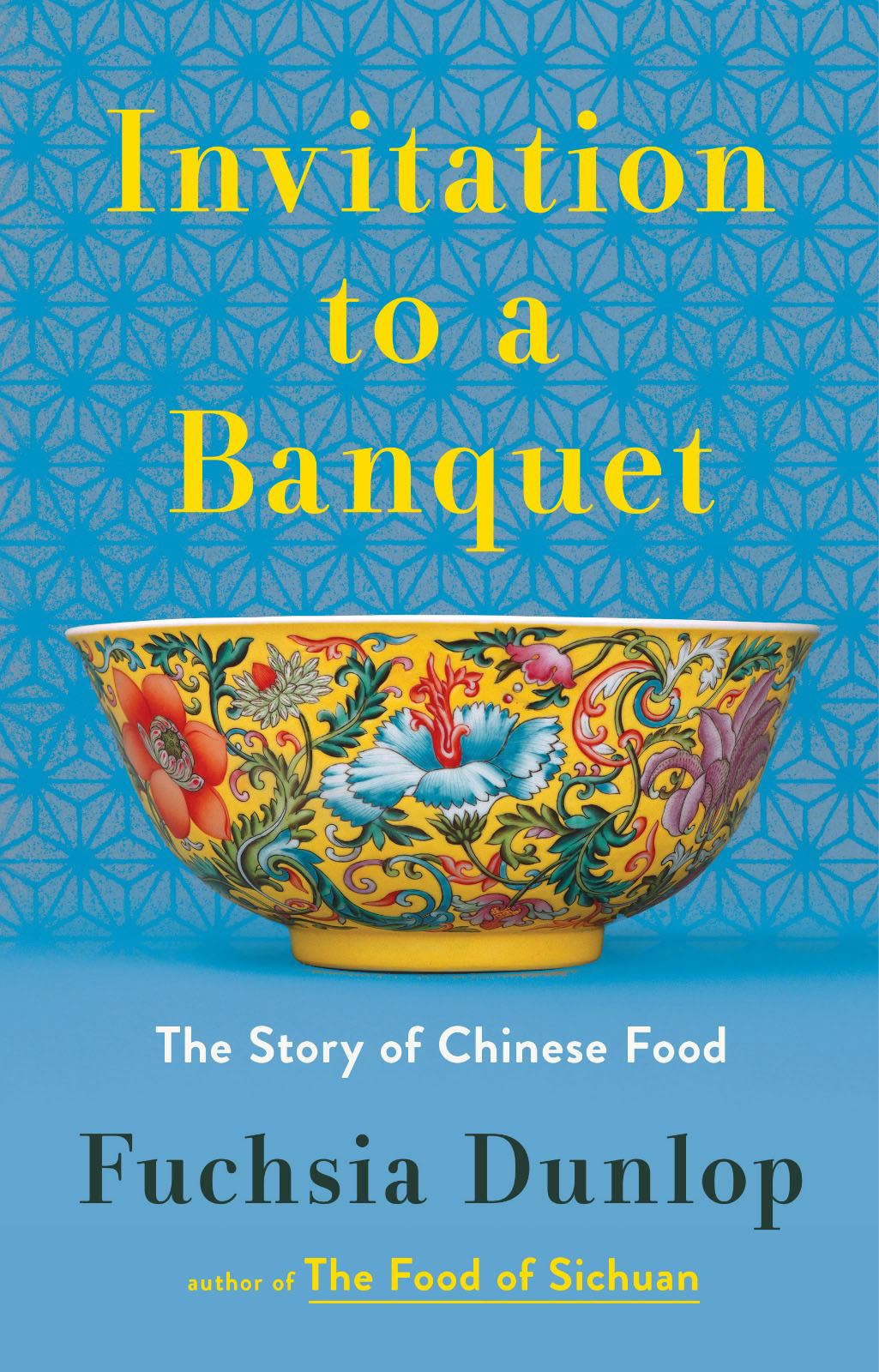
Invitation to a Banquet: The Story of Chinese Food
About this book
Fuchsia Dunlop first went to Chengdu as a student and stayed to train at the Sichuan Higher Institute of Cuisine. Here she draws on three decades of eating, cooking, travel, and conversation to describe Chinese food as a civilization rather than a list of familiar dishes.
The book is arranged like a banquet. Its courses move from the origins of cooking and staple grains to farming, fermentation, knife work, steam, fire, texture, vegetarian traditions, and the meanings attached to a shared table. Each chapter begins with a dish but rarely ends in the same place.
Cooks, farmers, food historians, restaurant owners, and home kitchens supply the evidence. Dunlop explains why categories that seem obvious in the West — dessert, meat, an ingredient, even a recipe — do not always map neatly onto Chinese practice.
Published in 2023, Invitation to a Banquet is not a conventional cookbook, though it is full of practical knowledge about how food is made. It is an argument for taking Chinese cuisine seriously on its own terms, written through appetite, close observation, and the pleasure of being fed.
Read a sample
5,081 words
Plain text
From the opening
PROLOGUE
A Kind of Chinese Food
sweet-and-sour pork balls / tangcu rouqiu
In 1994, I went to live in China as a scholarship student at Sichuan University. Ostensibly I was in Chengdu for academic purposes, but I had since early childhood been more interested in food and cooking than anything else, and I quickly abandoned my classes and threw myself into informal study of the local cuisine. After finishing my year at the university, I stayed on in Chengdu and was invited to enrol as a student at the famous local cooking school, the Sichuan Higher Institute of Cuisine – an invitation I readily accepted.
It’s funny how small, impulsive decisions can end up shaping one’s life and destiny. My original motivation for training as a Chinese chef had simply been a love of cooking, and a desire to spend longer in a city that had reeled me in like a fish. But my exploration of Sichuanese food, and of Chinese cuisine more generally, eventually consumed me and, unlikely though it would have seemed at the start, became a career.
Since those early days in Chengdu, I have travelled widely in China, spent time in kitchens and on farms, visited museums, read a great deal and talked to many Chinese people, both expert and amateur, about food and cooking. Equally importantly, I have eaten more extraordinary ingredients and dishes than I could ever have imagined possible. It is this that has been my real education – to taste, taste, and taste again, to sample the flavours of the different regions, to experience some of the infinite permutations of Chinese cuisine, to see what the theories and descriptions and legends and recipes mean in practice, in the mouth and on the tongue. A martial artist or a musician only learns through practice; it’s the same for a professional eater.
They say it takes three generations to become a Chinese gourmet. I have had only one life so far, as a neophyte who arrived in China in my early twenties, but I have been privileged to cram into the last two or three decades a greater gastronomic education than anyone could hope for in several lifetimes. This privilege is entirely thanks to the generosity of my Chinese friends and teachers, not to mention many strangers and casual acquaintances all over the country, who have patiently fed me and talked to me and ultimately transformed my barbarian palate.
Of course, when I first went to live in China, the idea of Chinese food wasn’t entirely new to me. The occasional Chinese meal had been a small but memorable part of my childhood. Like many other westerners of the last two or three generations, I grew up with Chinese food – after a fashion.
We open the brown paper bag with a rustle and tip out the golden spheres, still piping hot and alluringly fragrant, crisp batter enclosing nuggets of tender pork. With them comes a white polystyrene cup filled with a clear, bright-red syrup: sweet-and-sour sauce. My sister and I are beside ourselves with excitement. A Chinese takeaway is a rare treat, a change from our mother’s usual home-cooked food and a chance to mess around with chopsticks. Those stacked foil containers, exhaling the scents of soy sauce and ginger. A set of dishes: prawn chop suey, chicken with tinned bamboo shoots, chunky chow mein threaded with beansprouts, floppy pancake rolls stuffed with more beansprouts, egg-fried rice. It is all delicious, but no dish pleases us more than the sweet-and-sour pork balls, our eternal favourite. There are never enough.
My sister and I were not the only children growing up in 1970s Britain to be introduced to Chinese food through sweet-and-sour pork balls, which were then ubiquitous on Chinese menus. There was a Chinese takeaway in almost every town. They had proliferated in the post-war years as a new wave of Chinese immigrants from Hong Kong took over fish and chip shops, first in Liverpool, then in Manchester and beyond, moving into existing businesses, gradually adding their Chinese dishes to the original menus.1 In 1951 there had only been thirty-six Chinese restaurant proprietors and managers in the country;2 by the early 1970s, there were an estimated twelve thousand takeaways and three thousand eat-in restaurants.3
No one is sure where the takeaway took root: some say it started when customers who were unable to bag a table at the popular Lotus House in London’s Bayswater asked to take food home, others that it was invented in Limehouse, the original London Chinatown, at Charlie Cheung’s establishment, Local Friends.4 But as the early immigrants from Hong Kong, most of them men, were joined by their wives and children under the new rules of the 1962 Commonwealth Immigrants Act, Chinese restaurants became family affairs and takeaways began to sprout up across the country.5 Their food was a hotchpotch of ideas borrowed and adapted from Cantonese cooking, including chop suey, its name derived from the Cantonese for ‘a miscellany of chopped ingredients’ (tsap sui), and chow mein (fried noodles with beansprouts).
The ingredients were formulaic: a rotation of familiar, boneless proteins (pork, chicken, shrimp and beef) cooked with tinned Chinese vegetables like bamboo shoots, straw mushrooms and water chestnuts, along with fresh beansprouts, onions and peppers, all in a few standard sauces (chop suey, sweet-and-sour, tomato or curry) or stir-fried with noodles or rice. If even these toned-down offerings alarmed the punters, they could opt instead for English dishes like omelette, chips with curry sauce or even roast chicken. As far as the Chinese themselves were concerned, takeaway food was hardly Chinese food at all. As the Chen family in Timothy Mo’s Sour Sweet, a tale set in a London takeaway in the 1960s, put it, the dishes cooked for non-Chinese guests were ‘rubbish, total lupsup, fit only for foreign devils’.
Continue reading the sampleClose the sample
The foreign devils, however, adored the stuff. After the blandness and rationing of the war years, Chinese food blew into Britain like an exotic breeze from afar. It was not only excitingly different from mashed potatoes and toad-in-the-hole, but affordable. My mother remembers treating herself to the occasional Chinese lunch in London in the mid-1960s and taking her first, fumbling steps with chopsticks. It was always a set menu featuring a soup thickened with starch, afloat with shredded meat and beansprouts, a main course such as chop suey with rice and then a dessert, ever the same: tinned lychees in syrup. It was unbelievably cheap, five shillings for the meal, no more than a sandwich.
Over the subsequent decades, Chinese food became a treasured part of British life. After Chairman Mao’s communists defeated the former Nationalist regime in 1949, ending China’s civil war, stranded Nationalist diplomats in London became advocates for Chinese cuisine: one of them, Kenneth Lo, published his first cookbook in 1955 and went on to write thirty more; he also opened the esteemed London restaurant Memories of China. In the early 1980s, the BBC commissioned a pioneering cooking show fronted by the American Chinese chef Ken Hom, who introduced the British masses to the tastes and techniques of the Chinese kitchen; the cookbooks that accompanied his TV series sold more than 1.5 million copies.6 By 2001, according to a report by Market Intelligence, Chinese was the British people’s favourite foreign food and 65 per cent of British households owned a wok.7
In North America, Chinese food followed a similar trajectory from obscurity to ubiquity, but with an earlier timeline. After the discovery of gold in the Sacramento Valley in 1848, tens of thousands of migrants from southern China joined the rush, arriving in California and sowing the seeds of San Francisco’s Chinatown. Chinese restaurants began to pop up, many offering one-dollar ‘all-you-can-eat’ meals, a mix of Chinese and western dishes including, probably, the first American Chinese chop sueys, made from odds and ends of meat and vegetables and devoured by white miners and other labourers. This was just the beginning of a new food craze that would sweep the country, from coast to coast.
Over the course of the twentieth century, as Chinese food became more entrenched in the United States, early menu staples like chop suey, chow mein and egg foo-yong were overtaken by other dishes with an easy appeal for global palates: beef with broccoli, General Tso’s chicken, Kung Po chicken and the deep-fried, cheese-stuffed wontons known as crab rangoon, American equivalents of the sweet-and-sour pork balls of Britain. The fold-up Chinese takeaway carton and the fortune cookie became part of the American foodscape, like spaghetti with meatballs and the pastrami sandwich. By the early twenty-first century there were some forty thousand Chinese restaurants in America, more than McDonald’s, Burger King and KFC combined: as Jennifer 8 Lee wrote in her book The Fortune Cookie Chronicles, Chinese food, in fact, was now ‘more American than apple pie’.8
From one perspective, the global rise of Chinese food has been a remarkable success story. No other cuisine, powered in the main by small-time entrepreneurs rather than multinational corporations, has had such extraordinary influence or been so much loved, adopted and localized in so many countries. Chinese food is an inescapable cultural presence all over the world, from New York to Baghdad, Stockholm to Nairobi, Perth to Lima. Virtually every nation has its own ‘classic’ Chinese food, from my beloved sweet-and-sour pork balls to India’s chicken Manchurian, Sri Lanka’s hot butter cuttlefish and Sweden’s ‘four little dishes’. As a brand, ‘Chinese food’ has global recognition.
Yet, from another perspective, Chinese food has also been the victim of its own success. The resounding popularity of a simplified, adapted, even bastardized form of Cantonese cuisine, first developed in North America and then scattered like confetti all over the world, with its childish predictability and limited range, its bright colours, sweet-sour and salty flavours, deep-fried snacks and stir-fried noodles, has clouded appreciation of the diversity and sophistication of Chinese gastronomic culture. Chinese food may be popular, but it’s still widely seen abroad as cheap, low-status and junky. While western consumers are willing to pay exorbitant sums for sushi or European tasting menus, Chinese restaurateurs still struggle to persuade customers that fine Chinese food is worth its price.
It didn’t have to be this way. The first Chinese food to attract the attention of the British public was part of a Chinese exhibit at the London International Health Exhibition of 1884. Here, a gracefully decorated pop-up Chinese restaurant offered a menu of some thirty dishes, created by a team under the direction of an accomplished Hong Kong chef. This was no cheap chop suey, but, as a report in The Standard on 17 July 1884 put it, ‘a restaurant of the very first order of classical cuisine; and where the epicure may find in the dinners à la Chinoise a perfect illustration of extreme excellence in the preparation of food, but also equally perfect illustrations of the practical exercise of scientific pharmacy in the pleasantest and most agreeable of forms – palatable and enjoyable dishes.’9 The menu included some European dishes such as ‘Saucisson de Frankfort’, but also featured a giddy array of Chinese delicacies, including bird’s nest soup ‘even more delicious and more nutritious than the far-famed real turtle soup itself’, shark’s fins à la Pekinoise, pork meatballs with lychee, dried tofu, preserved duck eggs, hot Shaoxing wine, an assortment of Chinese pastries, and, finally, ‘a little cup of Imperial tea’.10
This glimpse of Chinese haute cuisine became the talk of London and, according to the contemporary writer Vincent Holt, the ‘quaint delicacies were eaten and well appreciated by crowds of fashionable people’.11 Such was the public curiosity stirred up by the menu that the guest chefs were invited to Windsor Castle to prepare lunch for Queen Victoria, who is said to have particularly enjoyed the bird’s nest soup.12 But this glamorous introduction of the British beau monde to the pleasures of Chinese eating turned out to be a flash in the pan. Outside the ‘Chinese court’ of the exhibition, the only other Chinese food available in Britain at the time was served in eating houses that weren’t aimed at local customers at all, but at the small communities of Chinese sailors who had settled around the docks in Liverpool, Glasgow, Cardiff and the Limehouse area of East London. And, over time, it was a less sophisticated form of Chinese cuisine that would eclipse almost everything else in the popular imagination.
In the early twentieth century, as a trickle of new arrivals joined the small Chinese population in Britain, Chinese restaurants started to open in central London and win the affections of customers who were not Chinese. The first in the West End seems to have been the Cathay in 1908; more appeared in the 1930s and 1940s, including the popular Ley On in Wardour Street.13 Over the next three decades, large numbers of Chinese immigrants streamed into the country from the New Territories of Hong Kong; the vast majority took jobs in the Chinese catering trade.14
While some of the restaurants, especially those in London’s emerging Chinatown in Soho, had trained chefs, most takeaways were staffed by erstwhile paddy farmers who knew little of the subtleties of Chinese cooking and were simply trying to scrape a living. As one proprietor told the British Sinologist Hugh Baker, for a new chef ‘half an hour’s training is enough. Tell them to use plenty of ginger, bean sprouts and dried citrus peel, give them a wok and a bottle of soy sauce and they know all there is to know about “Chinese cooking”.’15 Typically marooned in British towns, far from their compatriots, the new Chinese restaurateurs were catering for locals more accustomed to eating fish and chips. Their food needed to be accessible, cheap and only mildly exotic, which is probably why most of them ended up adopting the formula tried and tested in California a century earlier, which bore little resemblance to their native cuisine.
In America as in Britain, almost all the early Chinese cooks came from a single region: the Cantonese south. Moreover, just as the majority of Chinese cooks in Britain were farmers with little training in the culinary arts, the foot soldiers of American Chinese immigration were mostly not the accomplished chefs or discerning customers of the eating houses along the Pearl River in the Cantonese capital Guangzhou, a city known for its fine food, but people from a few rural counties who had been driven into exile by the pressures of overpopulation and poverty. Their knowledge of Cantonese cooking alone was limited, and they would have had little, if any, acquaintance with other regional cuisines. In both Britain and America, the new Chinese cuisine developed mostly as a tool for economic survival, not, like the restaurant at the International Health Exhibition of 1884, as a showcase for the glories of Chinese culinary culture.
As the twentieth century progressed, the Chinese populations in Britain and America grew and diversified. But while authentic Chinese food could be tracked down in the Chinatowns where Chinese people themselves congregated, elsewhere the norm was a simplified repertoire tailored to the tastes of westerners. Even in Chinatowns, real Chinese food could be tantalizingly out of reach for customers who weren’t Chinese. Restaurants often hid their more authentic dishes on Chinese-language menus, afraid that westerners would shy away from bony poultry, shell-on prawns and bitter melon – as, indeed, many of them did. When, in London in the 1990s, as a young restaurant reviewer recently returned from China, speaking fluent Mandarin and dying to eat real Chinese food, I tried to order anything more challenging than a boneless chicken stir-fry or sweet-and-sour pork, waiters would protest and urge me in the direction of the hackneyed set menus no Chinese person would ever choose.
Their fears were not irrational, because almost since their first encounters with Chinese food, westerners had viewed it with a complicated mixture of enthusiasm and suspicion. Some of the early western visitors to China were deeply impressed by the quality and variety of Chinese food. Among them was Marco Polo. Writing in his Travels around the year 1300, he lavished praise on the markets of ‘Kinsai’ (the city now known as Hangzhou), with their ‘abundance of victuals’ extending to ‘everything that could be desired to sustain life’. Vast were the numbers, he said, of those ‘accustomed to dainty living, to the point of eating fish and meat at one meal’.16
Many of the Jesuit missionaries who travelled to China in the seventeenth and eighteenth centuries made mention in their letters of gastronomic matters. A Description of the Empire of China and Chinese-Tartary, a translation from the French of Jean-Baptiste du Halde’s celebrated study of China compiled largely from Jesuit sources, did note some Chinese delicacies that were distasteful to Europeans, including stag’s penises and dog meat, but extolled the flavours of the fish and hams, and eulogized Chinese culinary skills: ‘The French cooks, who have refin’d so much in every thing which concerns the Palate, would be surpriz’d to find that the Chinese can outdo them far in this Branch of their Business, and at a great deal less Expence.’17
By the eighteenth and nineteenth centuries, however, as British and other western adventurers sought to worm their way into trading with a recalcritant Chinese empire, the tone of their commentary on Chinese food became more hostile. According to the author JAG Roberts, many observers described the Chinese as deceitful, slovenly and undiscriminating when it came to eating. ‘The Chinese eat any kind of Meat,’ wrote John Lockman in the late eighteenth century: ‘Beasts that die in Ditches, as willingly as those which died by the Butcher’s Hand … ’Tis said their Rats don’t eat amiss; and that Snake-Broth is in Reputation there.’18 Britain’s first envoy to China, Lord McCartney, wrote in his account of his embassy of 1793 that the Chinese were all ‘foul feeders and eaters of garlic and strong-scented vegetables’ who ‘drink mutually out of the same cup which, though sometimes rinsed, is never washed or wiped clean’. The portrayal of the Chinese as filthy eaters conveniently served the broader attempt to discredit them by depicting their country as a decaying empire ripe for exploitation by the more advanced west. Where once Europeans were intrigued by the wonders of Chinese civilization, now they were drawn by the lucrative potential of the Chinese market.
In the early days of Chinese food in America, tourists flocked to Chinatown in San Francisco for a taste of the exotic, but the suspicion that the Chinese themselves were tucking into rats, snakes, cats and lizards became a recurring trope in popular culture. Railroad workers and gold miners in California enjoyed their cheap chop sueys, but they also saw Chinese labourers as aliens who posed an economic threat; American perceptions of Chinese food became tainted by racialized fear and anxiety. By the 1870s, an American anti-Chinese movement had erupted: it would lead, in 1882 and 1892, to legislation that effectively put a stop to Chinese immigration. In Britain, the early Chinatown in London’s Limehouse was portrayed in novels and films as a den of iniquity, rife with opium and crime; Chinese villains were a familiar sight on the theatrical stage. Ignorance and prejudice about Chinese food were common.
Despite the world’s enduring love affair with Chinese food, such crass racial prejudice has never entirely died out. I’ve lost count of the number of people whose opening question to me, as a Chinese food specialist, has been, with an amused grin: ‘What’s the most disgusting thing you’ve ever eaten?’ Certain assumptions, explicit or implied, have become engrained: that ‘eating everything’ means a nation is slovenly, perverse or desperate; that preferring tofu to steaks is effeminate; that cooking in oil means that food is oily; that using MSG means you are a cheapskate; that food is cut into small pieces to make ingredients unrecognizable and cheat people; that Chinese is a poverty cuisine and that Chinese food should not be expensive. These are just some of the filters through which ‘Chinese food’ has been perceived in the west.
As recently as 2002, the Daily Mail published a piece denouncing Chinese food as ‘the dodgiest in the world, created by a nation that eats bats, snakes, monkeys, bears’ paws, birds’ nests, sharks’ fins, ducks’ tongues and chicken’s feet’.19 Was Chinese food everyone’s favourite neighbourhood staple, or a terrifying stew of vermin and wild animals? The western world has often seemed unable to decide. Never, perhaps, has a cuisine been simultaneously so deeply loved, and so much abused.
Disparaging myths about Chinese cuisine have long been a conduit for more general racial prejudice, used to depict Chinese people as alien, subversive, dishonest and uncivilized. In 2020, the suggestion that the coronavirus responsible for the global pandemic may have jumped into the human population from wild animals sold as food in a Chinese market unleashed a storm of vitriol aimed at the Chinese and their eating habits. Chinese produce markets, dubbed ‘wet markets’, were portrayed in the western media as revolting zoos full of exotic species. Few journalists pointed out that most were just neighbourhood markets selling fruit, vegetables and other fresh ingredients, including live fish and sometimes poultry but rarely wild animals. A video of an Asian woman eating bat soup went viral and was used to accuse the Chinese of uncouth and unsanitary eating habits, despite the fact that bat soup is not a Chinese delicacy and that the video was shot in the Pacific island nation of Palau.20 This maelstrom of erroneous and exaggerated media reports had horrific real-world consequences in the form of a wave of verbal and physical attacks on Asian-looking people in western cities.
Even the familiar food of British and American childhoods, the old-school sweet-and-sour pork and its ilk, is often beset by criticism. An infamous letter published in an obscure New England journal in 1968 suggested that monosodium glutamate (MSG) in Chinese food could cause palpitations and other symptoms that the author labelled ‘Chinese Restaurant Syndrome’.21 Though the letter seems to have been a hoax22 and the case against MSG has been totally debunked by scientists, its legacy remains in the widespread, but groundless, fear in the west that MSG is toxic. (Most westerners seem unaware that MSG is naturally present in Parmesan cheese and other ingredients commonly used in western cuisines.)
In recent years, the British media have pounced on studies that seem to suggest that Chinese food is dripping with fat or dangerously salty – without, apparently, noticing that the only ‘Chinese food’ surveyed in each case has been takeaway fare and supermarket ready meals aimed at western consumers.23 In New York in 2019, a white restaurateur tried to promote her new restaurant, Lucky Lee’s, by assuring customers that it offered a refined, ‘healthy’ version of Chinese cuisine that would not leave them ‘feeling icky and bloated the next day’24 – provoking outrage among Chinese Americans because of the suggestion that normal Chinese food was somehow unclean.
Since the early twentieth century, a number of writers, chefs and entrepreneurs have tried to dismantle these misleading stereotypes and introduce people in the west to real Chinese food. In Britain, TC Lai, Kenneth Lo, Yan-kit So, Ken Hom and Deh-ta Hsiung, and in the United States Buwei Yang Chao, Hsiang Ju Lin, Tsuifeng Lin, Barbara Tropp, Florence Lin, Martin Yan, Grace Young and Carolyn Phillips are among those who have tried to shine a light not only on the diversity of China’s regional cooking traditions, but on the richness of its gastronomic culture. In western cities, too, chefs and restaurateurs such as Peng Chang-kuei, Michael Tong and Ed Schoenfeld in New York, Cecilia Chiang and Brandon Jew in San Francisco and Michael Peng, Alan Yau and Andrew Wong in London have striven to elevate the status of Chinese cuisine beyond the milieu of beef with broccoli and sweet-and-sour pork.
More recently, China’s own dramatic entry on to the international stage, after decades of isolation, is encouraging greater awareness abroad of its culinary traditions. The country has shed its twentieth-century image as the ‘poor man of Asia’, a country where people were so desperate they would eat anything. A growing number of westerners have had the chance to live, work and travel in China, experiencing something of the prodigious diversity of Chinese food. Perhaps more importantly, a new generation of Chinese entrepreneurs is unleashing a revolution in the style and presentation of Chinese cuisine abroad. The old-fashioned model, with its roots in Cantonese cooking, has been shaken up by the electrifying spice of Sichuan and Hunan, along with the tastes of the Northeast (Dongbei), northern Xi’an and the eastern Jiangnan region that includes Shanghai. Old-school takeaways and Anglo-Canto restaurants have been joined by pop-ups, supper clubs and more glamorous contemporary establishments, many run by young, bilingual Chinese people raised in China and educated abroad. In addition, the internet hums with bloggers and social media stars who are showcasing real Chinese food. Finally, the door is ajar, offering a glimpse of some of the wealth of Chinese cuisine.
Many food phenomena that are widely assumed to be western inventions have precursors in China that date back hundreds – and in some cases thousands – of years. There were restaurants in twelfth-century Kaifeng, about six centuries before they appeared in Paris – and not merely restaurants, but restaurants specializing in particular cuisines and culinary styles.25 Concern for the provenance and terroir of ingredients, so important to modern western gourmets, was not the invention of the French or Californians, but has been a preoccupation in China for more than two thousand years, as has the ideal of obtaining every ingredient in its proper season – not only for practical but also for gastronomic reasons. The current fashion for imitation meats such as the Impossible Burger, made from soy and potato proteins, has ancient antecedents in China, where chefs have been concocting vegetarian ‘meat’ since at least the Tang Dynasty, more than a millennium ago.
Why only look to Italy for imaginative pasta techniques, when the northern Chinese have a highly developed culture of pasta-making that is still little known abroad? The flamboyantly hand-stretched noodles of Lanzhou and the smacked biang biang ribbons of Xi’an, both of which are gaining followings in the west, are only two of myriad varieties, including hand-rolled, knife-cut, scraped, grated, thumbed, stretched and extruded flour-foods made not just from wheat, but also oats, sorghum and other grains. If you’re interested in fermentation, China has innumerable vinegars, sauces, pickles and preserves, most of them still completely unknown outside the country.
Long before the western craze for the transformations of ‘molecular gastronomy’, Chinese chefs were transmuting fish into noodles and chicken breast into ‘tofu’ and composing culinary fugues from every part of the duck. Many of the core techniques and preparations of Japanese cuisine, now so esteemed abroad, originated in China, including sushi, tofu, tea, soy sauce and ramen. The subtlety of Chinese gastronomy, with its minute discernment in matters of cutting, cooking, flavour and mouthfeel, is unparalleled anywhere. And China is vast, with a rich and variegated geographical and culinary terrain. Chinese people have a habit of making crude generalizations about ‘western food’, collapsing the culinary traditions of the entire western world into one supposed cuisine; generalizations about ‘Chinese food’ can be just as reductive.
Chinese gastronomic culture offers many useful perspectives on contemporary debates about health and environmental issues. For centuries, there has been lively discussion in China about how to eat properly and in harmony with nature. The traditional Chinese diet was largely based on grains and vegetables, with meat and fish eaten in modest quantities for flavour and nourishment; Chinese cuisine is rich in ideas that could serve as inspiration for modern western societies as they try to rethink their unsustainable consumption of meat. The resourcefulness of Chinese chefs could be a model for making the most of ingredients and minimizing waste. Perhaps most impressively, Chinese cuisine shows how it is possible to combine healthy, sustainable and conscious eating with extraordinary pleasure.
This is a book that attempts to ask: what is Chinese food, how should we understand it, and – just as importantly – how should we eat it? These are not trivial questions. Aside from pertaining to some of our great ethical and environmental quandries, they are among the keys with which outsiders can begin to appreciate Chinese culture more generally – vitally important in an age of growing international tensions. They can also help us to live healthily and to enjoy, unabashedly, one of life’s most profound sensory and intellectual joys. Perhaps the greatest lesson I’ve learned from China is how to eat simultaneously for health and happiness.
Those sweet-and-sour pork balls of my childhood are certainly part of the story of Chinese food. They speak of the ways in which Chinese immigrants adapted to their new lives in the west, creating a simple, economical cuisine that would sustain them and their families and appeal to the palates of suspicious westerners. They are part of a story about how economic anxieties, the fallout of geopolitical events and racial prejudice conspired to muddy western appreciation of real Chinese food. They also highlight the irony of how westerners, over the course of more than a century, have shown an unerring preference for cheap, deep-fried Chinese foods in sweet, sour and salty sauces and then blamed the Chinese for their ‘unhealthy’ diet.
Now that’s enough about sweet-and-sour pork.
Let the real feast begin.
HEARTH
The origins of Chinese food
Naked Flame
cha siu pork / mizhi chashao
Chop, chop, chop goes the cleaver on the board, the halved duck, bones and all, cut neatly into pieces. Slice, slice, slice, through the cha siu pork and the roast pork belly. Behind the chef with his knife and block, the roasted meats hang magnificently in the window, suspended on long hooks from a few bars of shining steel. A slab of pork belly with a golden frizz of crackling skin; bundled strips of crimson cha siu, glistening with syrup, edges scorched and jagged. Whole, bronzed chickens gleam under the overhead lights; roast ducks hang at jaunty angles, their crumpled skin glossy as lacquer. The chef chops and slices, lays the cut meats on beds of steaming white rice, spoons over a trickle of treacly sauce, hands them to the waiters, who relay them to the customers, who, like me, wait, chopsticks poised, mouths watering.