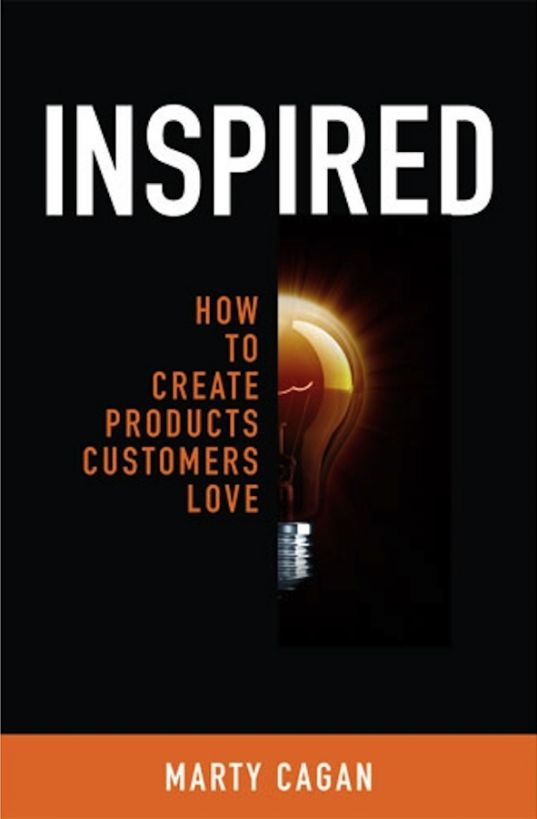
Inspired: How to Create Tech Products Customers Love
About this book
The book separates product discovery from product delivery without treating them as independent departments. A product manager, designer, and engineers work together to understand outcomes, risks, and possible solutions while maintaining the technical capacity to ship.
Cagan contrasts empowered teams with feature teams that receive roadmaps of predetermined output. Product vision, strategy, objectives, and leadership should provide context and constraints, leaving teams responsible for solving a customer and business problem.
Discovery techniques include prototypes, customer tests, feasibility spikes, data work, and rapid experiments. Their purpose is not to prove an idea good but to expose value, usability, feasibility, and business-viability risks while change is still inexpensive.
Inspired is the revised second edition, drawing examples from technology companies Cagan regards as strong product organisations. The practices are principles to adapt; the cases do not guarantee that copying a team structure will reproduce another company’s results.
Read a sample
5,017 words
Plain text
From the opening
PART I Lessons from Top Tech Companies
In the mid‐1980s, I was a young software engineer working for Hewlett Packard on a high‐profile product. It was a time (the first time) when artificial intelligence was all the rage, and I was fortunate enough to be working at what was then one of the industry's best technology companies, as part of a very strong software engineering team (several members of that team went on to substantial success in companies across the industry).
Our assignment was a difficult one: to deliver AI‐enabling technology on a low‐cost, general‐purpose workstation that, until then, required a special‐purpose hardware/software combination that cost more than $100,000 per user—a price few could afford.
We worked long and hard for well over a year, sacrificing countless nights and weekends. Along the way, we added several patents to HP's portfolio. We developed the software to meet HP's exacting quality standards. We internationalized the product and localized it for several languages. We trained the sales force. We previewed our technology with the press and received excellent reviews. We were ready. We released. We celebrated the release.
Just one problem: No one bought it.
The product was a complete failure in the marketplace. Yes, it was technically impressive, and the reviewers loved it, but it wasn't something people wanted or needed.
The team was of course extremely frustrated with this outcome. But soon we began to ask ourselves some very important questions: Who decides what products we should build? How do they decide? How do they know that what we build will be useful?
Our young team learned something very profound—something many teams have discovered the hard way: It doesn't matter how good your engineering team is if they are not given something worthwhile to build.
When trying to track down the root cause of our failure, I learned that the decisions about what to build came from a product manager—someone who generally resided in the marketing organization and who was responsible for defining the products we built. But I also learned that product management wasn't something HP was particularly good at. I later learned that most companies weren't good at this either, and, in fact, most still aren't.
I promised myself that never again would I work so hard on a product unless I knew the product would be something that users and customers wanted.
Over the next 30 years, I have had the very good fortune to work on some of the most successful high‐tech products of our time—first at HP during the rise of personal computers; then at Netscape Communications during the rise of the Internet, where I worked as vice president of platform and tools; later at eBay during the rise of e‐commerce and marketplaces, where I served as the senior vice president of product and design; and then as an adviser to startups working with many of what have become today's most successful technology product companies.
Not every product effort has been as successful as others, but I am happy to say that none were failures, and several became loved and used by millions of people around the world.
Soon after I left eBay, I started getting calls from product organizations wanting to improve how they produced products. As I began working with these companies, I discovered that there was a tremendous difference between how the best companies produced products and how most companies produced them.
I discovered that there was a tremendous difference between how the best companies produced products and how most companies produced them.
I realized that the state of the art was very different from the state of the practice.
Most companies were still using old and inefficient ways to discover and deliver products. I also learned that there was precious little help available, either from academia, including the best business school programs, or from industry organizations, which seemed hopelessly stuck in the failed models of the past—just like the one I worked in at HP.
I have had some great rides, and I am especially thankful that I have had the chance to work for and with some of the best product minds in the industry. The best ideas in this book are from these people. You will find a list of many of them in the acknowledgments. I have learned from them all, and I am grateful to each one of them.
I chose this career because I wanted to work on products that customers love—products that inspire and provide real value. I find that most product leaders also want to create inspiring and successful products. But most products are not inspiring, and life is too short for bad products.
My hope in writing this book is that it will help share the best practices of the most successful product companies and that the result will be truly inspiring products—products that customers love.
Continue reading the sampleClose the sample
CHAPTER 1 Behind Every Great Product
It is my strong belief, and the central concept driving this book, that behind every great product there is someone—usually someone behind the scenes, working tirelessly—who led the product team to combine technology and design to solve real customer problems in a way that met the needs of the business.
These people usually have the title product manager, but they might be a startup co‐founder or CEO, or they might be someone in another role on the team who stepped up because they saw the need.
Further, this product management role is very distinct from the design, engineering, marketing, or project manager roles.
This book is intended for these people.
Within modern technology product teams, the product manager has some very specific and very challenging responsibilities. It's a tremendously difficult job, and anyone who tries to tell you otherwise is not doing you any favors.
It is my strong belief, and the central concept driving this book, that behind every great product there is someone—usually someone behind the scenes, working tirelessly—who led the product team to combine technology and design to solve real customer problems in a way that met the needs of the business.
The product manager role is usually very much a full‐time assignment. I don't personally know many who are able to do what they need to do in less than 60 hours a week.
It's great if you're a designer or an engineer who also wants to serve as a product manager—there are some real advantages to that. But you'll find out pretty quickly that you're taking on an immense amount of work. If you're up for that, however, the results can be impressive.
A product team is comprised of at least a product manager and usually somewhere between 2 and 10 engineers. If you're creating a user‐facing product, you would expect to have a product designer on your team as well.
In this book, we explore the situation wherein you might have to use engineers or designers in a different location or from an agency or outsourcing firm. But regardless of how you assemble your team, this job and this book assume you have a team assigned to work with you to design, to build, and to deliver a product.
CHAPTER 2 Technology‐Powered Products and Services
There are many kinds of products out there, but in this book, I concentrate exclusively on products that are powered by technology.
Some of what we explore in this book may help you if you're building non‐tech products, but there are no guarantees in that case. Frankly, there are already a wide variety of readily accessible resources for non‐tech products such as most consumer packaged goods, and for product managers of these non‐tech products.
My focus is on the unique issues and challenges associated with building technology‐powered products, services, and experiences.
Some good examples of the sweet spot that we explore are consumer‐service products, such as e‐commerce sites or marketplaces (e.g., Netflix, Airbnb, or Etsy), social media (e.g., Facebook, LinkedIn, or Twitter), business services (e.g., Salesforce.com, Workday, or Workiva), consumer devices (e.g., Apple, Sonos, or Tesla), and mobile applications (e.g., Uber, Audible, or Instagram).
My focus is on the unique issues and challenges associated with building technology‐powered products, services, and experiences.
Technology‐powered products do not need to be purely digital. Many of the best examples today are blends of online and offline experiences—like finding a ride or a room for the night, getting a home loan, or sending an overnight package.
It's my belief that most products today are transforming into technology‐powered products, and the companies that don't realize this are rapidly being disrupted. But, again, I'm only focused here on technology‐powered products, and those companies that believe they must embrace technology and consistently innovate on behalf of their customers.
CHAPTER 3 Startups: Getting to Product/Market Fit
In the technology world, we generally have three stages of companies: startups, growth‐stage, and enterprise companies. Let's briefly consider how we characterize each one of these stages, and the challenges you are likely to face in each.
I loosely define startup as a new product company that has yet to achieve product/market fit. Product/market fit is an extremely important concept that I'll define in the pages that follow, but for now, let's just say that the startup is still trying to come up with a product that can power a viable business.
In a startup, the product manager role is usually covered by one of the co‐founders. Typically, there are fewer than 25 engineers, covering a range of from one product team up to maybe four or five.
The reality of startup life is that you're in a race to achieve product/market fit before you run out of money. Nothing else much matters until you can come up with a strong product that meets the needs of an initial market, so most of the focus of the young company is necessarily on the product.
Startups usually have a limited amount of early funding, intended to determine if the company can discover and deliver the necessary product. The closer you come to running out of money, the more frantic the pace and the more desperate the team and the leadership becomes.
While money and time are typically tight, good startups are optimized to learn and move quickly, and there's normally very little bureaucracy to slow them down. Yet the very high failure rate of technology startups is no secret. The few that succeed are usually those that are really good at product discovery, which is a major topic of this book.
Nothing else much matters until you can come up with a strong product that meets the needs of an initial market.
Working at a startup—racing toward product/market fit—is usually stressful, exhausting, and risky. But it can also be an amazingly positive experience, and if things go well, a financially rewarding one too.
CHAPTER 4 Growth‐Stage Companies: Scaling to Success
Those startups skilled and fortunate enough (it usually takes both) to get to product/market fit are ready to tackle another equally difficult challenge: how to effectively grow and scale.
There are many very significant challenges involved in growing and scaling a startup into a large, successful business. While it's an extremely difficult challenge, it is, as we say, a good problem to have.
In addition to hiring lots more people, we need to figure out how to replicate our earlier successes with new, adjacent products and services. At the same time, we need to grow the core business as fast as possible.
In growth stage, we typically have somewhere between about 25 and several hundred engineers, so there are many more people around to help, but the signs of organizational stress are everywhere.
Product teams complain that they don't understand the big picture—they don't see how their work contributes to the larger goals, and they're struggling with what it means to be an empowered, autonomous team.
While it's an extremely difficult challenge, it is, as we say, a good problem to have.
Sales and marketing often complain that the go‐to‐market strategies that worked for the first product are not so appropriate for some of the new products in the portfolio.
The technology infrastructure that was created to meet the needs of the initial product is often bursting at the seams, and you start to hear the term “technical debt” from every engineer you speak with.
This stage is also tough on leaders because the leadership style and mechanisms that worked while the company was a young startup often fail to scale. Leaders are forced to change their roles and, in many cases, their behaviors.
But the motivation to overcome these challenges is very strong. The company is often in pursuit of a public offering or, perhaps, becoming a major business unit of an existing company. As well as the very real possibility of having a significant and positive impact on the world can be very motivating.
CHAPTER 5 Enterprise Companies: Consistent Product Innovation
For those companies that succeed in scaling and that want to create a lasting business, some of the toughest challenges still lie ahead.
Strong tech‐product companies know they need to ensure consistent product innovation. This means constantly creating new value for their customers and for their business. Not just tweaking and optimizing existing products (referred to as value capture) but, rather, developing each product to reach its full potential.
Yet, many large, enterprise companies have already embarked on a slow death spiral. They become all about leveraging the value and the brand that was created many years or even decades earlier. The death of an enterprise company rarely happens overnight, and a large company can stay afloat for many years. But, make no mistake about it, the organization is sinking, and the end state is all but certain.
Strong tech‐product companies know they need to ensure consistent product innovation.
It's not intentional, of course, but once companies reach this size—often becoming a publicly traded company—there are a tremendous number of stakeholders throughout the business working hard to protect what the company has created. Unfortunately, this often means shutting down new initiatives or ventures that could re‐create the business (but potentially put the core business at risk), or putting up so many obstacles to new ideas that few people are willing or able to drive the company in a new direction.
The symptoms of this are hard to miss, starting with diminished morale, the lack of innovation, and how much slower it is for new product work to get into the hands of customers.
When the company was young, it likely had a clear and compelling vision. When it achieves enterprise stage, however, the company has largely achieved that original vision and now people aren't sure what's next. Product teams complain about the lack of vision, lack of empowerment, the fact that it takes forever to get a decision made, and product work is turning into design by committee.
Leadership is likely frustrated, too, with the lack of innovation from the product teams. All too often, they resort to acquisitions or creating separate “innovation centers” to incubate new businesses in a protected environment. Yet this rarely results in the innovation they're so desperate for.
And you'll also hear lots of talk about how it is that large, enterprise companies such as Adobe, Amazon, Apple, Facebook, Google, and Netflix have been able to avoid this fate. The organization's leadership team wonders why they can't do the same. The fact is they could do the same. But they'll need to make some pretty big changes, and that's what this book is about.
CHAPTER 6 The Root Causes of Failed Product Efforts
Let's start by exploring the root causes of why so many product efforts fail.
I see the same basic way of working at the vast majority of companies, of every size, in every corner of the globe, and I can't help but notice that this is not close to how the best companies actually work.
Let me warn you that this discussion can be a little depressing, especially if it hits too close to home, so if that's the case, I'll ask you to hang in there with me.
Figure 6.1 describes the process that most companies still use to create products. I'll try not to editorialize yet—let me first just describe the process:
FIGURE 6.1 Root Causes of Failed Product Efforts
As you can see, everything starts with ideas. In most companies, they're coming from inside (executives or key stakeholders or business owners) or outside (current or prospective customers). Wherever the ideas originate, there are always a whole bunch of things that different parts of the business need us to do.
Now, most companies want to prioritize those ideas into a roadmap, and they do this for two main reasons. First, they want us to work on the most important things first, and second, they want to be able to predict when things will be ready.
To accomplish this, there is usually some form of quarterly or annual planning session in which the leaders consider the ideas and negotiate a product roadmap. But in order to prioritize, they first need some form of a business case for each item.
Some companies do formal business cases, and some are informal, but either way it boils down to the need to know two things about each idea: (1) How much money or value will it make? and (2) How much money or time will it cost? This information is then used to come up with the roadmap, usually for the next quarter, but sometimes as much as a year out.
At this point, the product and technology organization has its marching orders, and they typically work the items from the highest priority on down.
Once an idea makes it to the top of the list, the first thing that's done is for a product manager to talk to the stakeholders to flesh out the idea and to come up with a set of “requirements.”
These requirements might be user stories, or they might be more like some form of a functional specification. Their purpose is to communicate with the designers and engineers what needs to be built.
Once the requirements are gathered up, the user experience design team (assuming the company has such a team), is asked to provide the interaction design, the visual design, and, in cases of physical devices, the industrial design.
Finally, the requirements and design specs make it to engineers. This is usually where Agile finally enters the picture.
Anyway, the engineers will typically break up the work into a set of iterations—called “sprints” in the Scrum process. So maybe it takes one to three sprints to build out the idea.
Hopefully the QA testing is part of those sprints, but if not, the QA team will follow this up with some testing to make sure the new idea works as advertised and doesn't introduce other problems (known as regressions).
Once we get the green light from QA, the new idea is finally deployed to actual customers.
In the majority of companies that I first meet, large and small, this is essentially how they work, and have worked, for many years. Yet these same companies consistently complain about the lack of innovation and the very long time it takes to make it from idea to customers' hands.
You might recognize that while I mentioned Agile, and while almost everyone today claims to be Agile, what I've just described is very much a waterfall process. In fairness to the engineers, they're typically doing about as much Agile as they can, given the broader waterfall context.
Okay, so that may be what most teams do, but why is that necessarily the reason for so many problems? Let's connect the dots now, so we can clearly see why this very common way of working is responsible for most failed product efforts.
In the list that follows, I'm going to share what I consider to be the top‐10 biggest problems with this way of working. Keep in mind that all 10 of these problems are very serious issues, any one of which could derail a team. But many companies have more than one or even all of these problems.
While almost everyone today claims to be Agile, what I've just described is very much a waterfall process.
We can't know how much money we'll make because that depends entirely on how good the solution turns out to be. If the team does an excellent job, this could be wildly successful and literally change the course of the company. The truth, however, is that many product ideas end up making absolutely nothing. And that's not an exaggeration for effect. Literally nothing (we know this from A/B testing).
In any case, one of the most critical lessons in product is knowing what we can't know, and we just can't know at this stage how much money we'll make.
Likewise, we have no idea what it will cost to build. Without knowing the actual solution, this is extremely hard for engineering to predict. Most experienced engineers will refuse to even give an estimate at this stage, but some are pressured into the old t‐shirt sizing compromise—just let us know if this is “small, medium, large, or extra large.”
But companies really want those prioritized roadmaps, and to get one, they need some kind of system to rate the ideas. So people play the business case game.
But here's the problem—maybe the biggest problem of all. It's what I call the two inconvenient truths about product.
The first truth is that at least half of our ideas are just not going to work.
The first truth is that at least half of our ideas are just not going to work. There are many reasons for an idea to not work out. The most common is that customers just aren't as excited about this idea as we are. So, they choose not to use it. Sometimes they want to use it and they try it out, but the product is so complicated that it's simply more trouble than it's worth, so users again choose not to use it. Sometimes the issue is that customers would love it, but it turns out to be much more involved to build than we thought, and we decide we simply can't afford the time and money required to deliver it.
So, I promise you that at least half the ideas on your roadmap are not going to deliver what you hope. (By the way, the really good teams assume that at least three quarters of the ideas won't perform like they hope.)
If that's not bad enough, the second inconvenient truth is that even with the ideas that do prove to have potential, it typically takes several iterations to get the implementation of this idea to the point where it delivers the necessary business value. We call that time to money.
One of the most important things about product that I've learned is that there is simply no escaping these inconvenient truths, no matter how smart you might be. And I've had the good fortune to work with many truly exceptional product teams. The real difference is how you deal with these truths.
The key principle in Lean methods is to reduce waste, and one of the biggest forms of waste is to design, build, test, and deploy a feature or product only to find out it is not what was needed. The irony is that many teams believe they're applying Lean principles; yet, they follow this basic process I've just described. And then I point out to them that they are trying out ideas in one of the most expensive, slowest ways we know.
It's no surprise that so many companies spend so much time and money and get so little in return. I warned you this could be depressing. But it's critical that you have a deep understanding of exactly why your company needs to change how it works, if, indeed, your company is working this way.
It's no surprise that so many companies spend so much time and money and get so little in return.
The good news is I promise you that the best teams operate nothing like what I've just described.
CHAPTER 7 Beyond Lean and Agile
People are always searching for a silver bullet to create products, and there is always a willing industry—ready and waiting to serve with books, coaching, training, and consulting. But there is no silver bullet, and inevitably people figure this out. That's when the backlash begins. As I write this, it's in vogue to criticize both Lean and Agile.
I have no doubt that many people and teams are in some measure disappointed with the results from their adoption of both Lean and Agile. And I understand the reasons for this. That said, I am convinced that Lean and Agile values and principles are here to stay. Not so much the particular manifestations of these methods that many teams use today, but the core principles behind them. I would argue that they both represent meaningful progress, and I would never want to go backward on those two fronts.
But as I said, they are not silver bullets either, and as with any tool, you have to be smart about how you use it. I meet countless teams that claim to be following Lean principles; yet, they work for months on what they call an MVP, and they really don't know what they have and whether it will sell until they've spent substantial time and money—hardly in the spirit of Lean. Or they go way overboard and think they have to test and validate everything, so they go nowhere fast.
And, as I just pointed out, the way Agile is practiced in most product companies is hardly Agile in any meaningful sense.
The best product teams I know have already moved past how most teams practice these methods—leveraging the core principles of Lean and Agile, but raising the bar on what they're trying to achieve and how they work.
When I see these teams, they may frame the issues a little differently, sometimes using different nomenclature, but at the heart, I see three overarching principles at work:
You will see that I keep these three overarching principles front and center throughout this book.
CHAPTER 8 Key Concepts
In this book, I refer to a set of concepts that form the foundation of modern product work. I'd like to briefly explain them here.
Holistic Product
I have already been using the term product pretty loosely. I did say I'm only talking about technology‐powered products. But, more generally, when I refer to product I mean a very holistic definition of product.
This certainly includes the functionality—the features.
But it also includes the technology that enables this functionality.
It also includes the user experience design that presents this functionality.
And it includes how we monetize this functionality.
It includes how we attract and acquire users and customers.
And it can also include offline experiences as well that are essential to delivering the product's value.
If, for example, your product is an e‐commerce site, then this would include the merchandise‐fulfillment experience and the merchandise‐return experience. In general, for e‐commerce businesses, product includes everything except the actual merchandise being sold.
Similarly, for a media company, we refer to the product as everything except the content.
The point is to have a very inclusive and holistic definition of product. You are not just concerned with implementing features.
Continuous Discovery and Delivery
I explained previously that most companies still have a process that is essentially waterfall at its core, and I told you that what we do in a modern team is very different.
We'll be going more into the product development process later, but I do need to introduce a high‐level concept about process at this point in our discussion. That is, there are two essential high‐level activities in all product teams. We need to discover the product to be built, and we need to deliver that product to market.
FIGURE 8.1 Continuous Discovery and Delivery
Discovery and delivery are our two main activities on a cross‐functional product team, and they are both typically ongoing and in parallel.
There are several ways to think about this and to visualize it, but the concept is fairly simple: We are always working in parallel to both discover the necessary product to be built—which is primarily what the product manager and designer work on every day—while the engineers work to deliver production‐quality product.
Now, as you'll soon see, it's a little more involved than that. For example, the engineers are also helping daily on discovery (and many of the best innovations come from that participation, so this is not a minor point), and the product manager and designer are also helping daily on delivery (mainly to clarify intended behavior). But this is what's going on at a high level.
We need to discover the product to be built, and we need to deliver that product to market.
Product Discovery
Discovery is very much about the intense collaboration of product management, user experience design, and engineering. In discovery, we are tackling the various risks before we write even one line of production software.
The purpose of product discovery is to quickly separate the good ideas from the bad. The output of product discovery is a validated product backlog.
Specifically, this means getting answers to four critical questions:
Prototypes
Product discovery involves running a series of very quick experiments, and to do these experiments quickly and inexpensively, we use prototypes rather than products. At this point, let me just say that there are several types of prototypes, each for different risks and situations, but they all require at least an order of magnitude of less time and effort than building a product.
To set your expectations, strong teams normally test many product ideas each week—on the order of 10 to 20 or more per week.