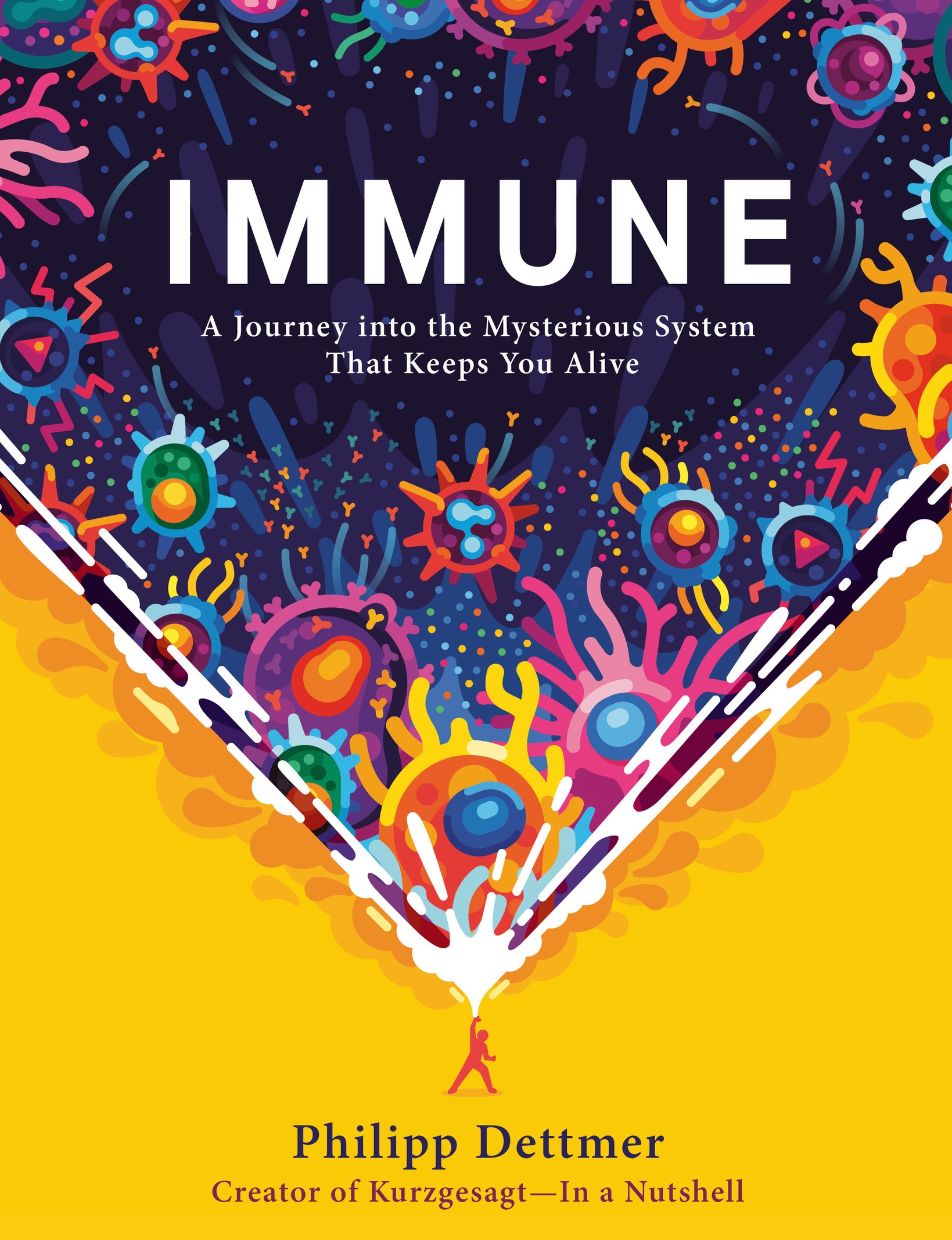
Immune: A Journey Into the Mysterious System That Keeps You Alive
About this book
The immune system is introduced as a layered network rather than a single army. Skin, mucus, complement, inflammation, specialist cells, and signalling molecules respond on different timescales and with different costs when the body detects damage or intrusion.
Later sections explain adaptive immunity, B cells, T cells, antibodies, memory, vaccination, allergy, autoimmunity, cancer, and the ways pathogens evade defence. Analogies make the sequence easier to follow while diagrams preserve the relationships among actors.
Dettmer repeatedly emphasises trade-offs: a stronger response is not always a better one, and many symptoms come from the body's own attempt to control danger. The book is educational rather than a guide to diagnosing or treating an individual's condition.
Immune: A Journey into the Mysterious System That Keeps You Alive is a visual introduction by the creator of Kurzgesagt. It is designed to give non-specialists a working map, useful for understanding why medicine often aims to regulate immunity rather than simply boost it.
Read a sample
5,130 words
Plain text
From the opening
Introduction
Imagine waking up tomorrow, feeling a bit under the weather. An annoying pain in your throat, your nose is runny, you cough a bit. All in all, not bad enough to skip work, you think, as you step into the shower, pretty annoyed about how hard your life is. While you are totally not being a whiny little baby, your immune system is not complaining. It is busy keeping you alive so you can live to whine another day. And so, while intruders roam your body, killing hundreds of thousands of your cells, your immune system is organizing complex defenses, communicating over vast distances, activating intricate defense networks, and dishing out a swift death to millions, if not billions, of enemies. All while you are standing in the shower, mildly annoyed.
But this complexity is largely hidden.
Which is a real shame because there are not many things that have such a crucial impact on the quality of your life as your immune system. It is all-embracing and all-encompassing, protecting you from bothersome nuisances like the common cold, scratches, and cuts, to life-threatening stuff from cancer and pneumonia to deadly infections like COVID-19. Your immune system is as indispensable as your heart or your lungs. And actually, it is one of the largest and most widespread organ systems throughout your body, although we don’t tend to think about it in these terms.
For most of us, the immune system is a vague and cloud-like entity that follows strange and untransparent rules, and which seems to sometimes work and sometimes not. It is a bit like the weather, extremely hard to predict and subject to endless speculations and opinions, resulting in actions that feel random to us. Unfortunately many people speak about the immune system with confidence but without actually understanding it, it can be hard to know which information to trust and why. But what even is the immune system and how does it actually work?
Understanding the mechanisms that are keeping you alive as you read this is not just a nice exercise in intellectual curiosity; it is desperately needed knowledge. If you know how the immune system works, you can understand and appreciate vaccines and how they can save your life or the lives of your children, and approach disease and sickness with a very different mindset and far less fear. You become less susceptible to snake oil salesmen who offer wonder drugs that are entirely devoid of logic. You get a better grasp on the kinds of medication that might actually help you when you are sick. You get to know what you can do to boost your immune system. You can protect your kids from dangerous microbes while also not being too stressed-out if they get dirty playing outside. And in the very unlikely case of, say, a global pandemic, knowing what a virus does to you and how your body fights it, might help you understand what the public health experts say.
Besides all these practical and useful things, the immune system is also simply beautiful, a wonder of nature like no other. The immune system is not a mere tool to make your cough go away. It is inextricably tied into almost all other processes in your body—and while it is centrally important to keeping you alive, it is likely that it may also be the part of your body that causes your untimely death, either by failing or by being too active.
I have been fascinated and obsessed by the incredible complexity of the human immune system for the better part of a decade now. It began in university where I was studying information design and was looking for a semester project and the immune system seemed like a good idea. So I got a large pile of books about immunology and began digging in, but no matter how much I read, things just did not get less complicated. The more I learned the more impossible it seemed to simplify the immune system as every layer revealed more mechanisms, more exceptions, more complexity.
And so a project that was supposed to last the spring took over the summer and then the fall and the winter. The interactions of the parts of the immune system were too elegant and the dance they danced was too beautiful to stop learning about them. This progress fundamentally changed how I experienced and felt about my body.
When I got the flu I could no longer just complain, but had to look at my body, touch my swollen lymph nodes, and visualize what my immune cells were doing right then, which part of the network was activated, and how T Cells killed millions of intruders to protect me. When I cut myself while being careless in the forest I felt gratitude for my Macrophages, large immune cells hunting scared bacteria and ripping them into pieces to protect the open wound from infection. After taking a bite of the wrong granola bar and suffering an allergic shock, while being rushed to the hospital, I thought about Mast Cells and IgE Antibodies and how they had almost killed me in a misguided attempt to protect me from scary foodstuffs!
When I was diagnosed with cancer at the age of thirty-two and had to undergo a couple of operations and then chemotherapy, my obsession with immunology became even more intense. One of the jobs of my immune system is to kill cancer. In this case, it had failed.
Continue reading the sampleClose the sample
But I somehow could not be angry or too upset as I had learned how hard of a job this was for my immune cells and how hard cancer had to work to keep them in check. And as the chemo melted the cancer my thoughts again went to my immune cells invading the dying tumors and eating them up one cell after another.
Disease and sickness are scary and unsettling and I’ve had plenty of that in my life. But knowing how my cells, my immune system, this integral and personal part of myself, defended the entity that is me, how it fought and died and healed and restored this body I inhabit, always gave me a lot of comfort. Learning about the immune system made my life better and more interesting and it alleviated a lot of the anxiety that comes with being sick. Knowing about the immune system always put things in perspective.
So because of this positive effect and just because of the fun of learning and reading about the immune system, it became an ongoing hobby, as I eventually became a science communicator and explaining complex things became my purpose in life. About eight years ago I started Kurzgesagt—In a Nutshell, a YouTube channel dedicated to making information easy to understand and beautiful, while trying to be as true to the science as possible. In early 2021 the Kurzgesagt team has grown to over forty people working on this vision, while the channel has attracted over fourteen million subscribers and reaches about thirty million viewers each month. So if this large platform exists, why go through the horrible process of writing this book? Well, while some of our most successful videos have been about the immune system, it has always bugged me that I could not explore this wonderful topic in the depth it deserves. A ten-minute video is simply not the right medium for that. So this book is a way to turn my decade-long love affair with the immune system into something tangible that will hopefully be a helpful and entertaining way to learn about the stunning and beautiful complexity that makes it possible for you to survive each day.
Unfortunately, the immune system is very complicated, although that is not strong enough a word. The immune system is complicated in the sense that climbing Mount Everest is a nice stroll through nature. It is intuitive like reading the Chinese translation of the tax code of Germany is a fun Sunday afternoon. The immune system is the most complex biological system known to humanity, other than the human brain.
The bigger the immunology textbook you read, the more layers of detail start piling on, the more exceptions to rules appear, the more intricate the system becomes, the more specific it seems to be for every possible eventuality. Every single one of its many parts has multiple jobs and functions and areas of expertise that overlap and influence each other. Even if you make it past these challenges and still want to understand the immune system, you will encounter another problem: The humans who described it.
Scientists have laid the foundation for the amazing modern world we get to enjoy today through hard work and endless curiosity and we owe them a great deal of gratitude. Unfortunately, though, many scientists are really bad at choosing good names and coming up with accessible language for the things they discover. The science of immunology is one of the worst culprits of any scientific discipline in this regard. An already breathtakingly complex field is spiked with words like Major Histocompatibility Complex class I and II, gamma delta T Cells, interferon alpha, beta, gamma, and kappa, and the complement system, with actors named C4b2a3b complex. None of this makes it a pleasure to pick up a textbook and learn about the immune system on your own. But even without this barrier, the complex relationships of the many different actors of the immune system, with countless exceptions and unintuitive rules, are a challenge all by themselves. Immunology is hard even for the people working in public health, even for the people studying immunology, even for the foremost experts in the field.
All of this makes the immune system horrible to explain. If you venture too far into simplification you deprive the learner of the beauty and wonder that lie in the evolutionary genius of the sheer endless complexity that deals with the most crucial problems of living beings. But if you include too much detail, it quickly becomes mind-numbingly hard to keep up with. Listing everything, every part of the immune system, is just too much. It would be like telling someone your whole life story on the first date: Overwhelming and very likely to make them less interested in dating you.
So my aim for this book is to try to carefully dance around all these problems. It will use human language and use complicated words only when necessary. Where appropriate, processes and interactions will be simplified while staying as true to the science as possible. Complexity between chapters will go up and down, so after you are fed a lot of information, there will be more chill parts to relax a bit. And we will summarize what we learned in regular intervals. I want this book to make it possible for everybody to understand their own immune system and have a bit of fun doing so. And since this complexity and beauty are deeply connected to your health and survival, you might actually learn something useful. And of course, the next time you are sick or have to deal with disease, you hopefully can look at your body from a different perspective.
Also, the obligatory disclaimer: I’m not an immunologist, but a science communicator and immune system enthusiast. This book will not make every immunologist happy—what became obvious right from the start of the research is that there are a lot of different ideas and concepts about the details of the immune system and there is a lot of disagreement between the scientists holding these ideas. (Which is how science is supposed to work!) For example, some immunologists consider certain cells useless fossils, while others think they are crucial for your defenses. So as much as possible this book is based on conversations with scientists, the current literature that is used to teach immunology, and peer-reviewed papers.
Still, at some point in the future, parts of this book will need an update. Which is a good thing! The science of immunology is a dynamic field where a lot of amazing things are happening and different theories and ideas are in flux with each other. The immune system is a living topic where great discoveries are still happening. Which is great, because it means we are learning more about ourselves and the world we live in.
OK! Before we jump in and explore what your immune system is doing, let us define the premise first, so we have solid ground to stand on. What is the immune system, what is the context it works in, and what are the tiny parts that do the actual work? After we have covered these basics we will explore what happens if you hurt yourself and how your immune system rushes in to defend you. Then we’ll explore your most vulnerable parts and see how your body scrambles to protect from a serious infection. And lastly, we’ll take a look at different immune disorders like allergies and autoimmune disease and discuss how you can boost your immune system. But now let us get to the very beginning of this story.
Part 1
Meet Your Immune System
1 What Is the Immune System?
The story of the immune system begins with the story of life itself, almost 3.5 billion years ago, in some strange puddle on a hostile and vastly empty planet. We don’t know what these first living beings did, or what their deal was, but we know they very soon started to be mean to each other. If you think life is hard because you need to get up early in the morning to get your kids ready for the day, or because your burger is only lukewarm, the first living cells on earth would like a word with you. As they figured out how to transform the chemistry around them into stuff they could use while also acquiring the energy needed to keep going, some of the first cells took a shortcut. Why bother with doing all the work yourself if you could just steal from someone else? Now, there were a number of different ways to do that, like swallowing someone else whole, or ripping holes into them and slurping out their insides. But this could be dangerous, and instead of getting a free meal, you could end up as the meal of your intended victim, especially if they were bigger and stronger than you. So another way to get the prize with less of the risk might be to just get inside them and make yourself comfortable. Eat what they eat and be protected by their warm embrace. Kind of beautiful, if it wasn’t so horrible to the host.
As it became a valid strategy to become good at leeching from others, it became an evolutionary necessity to be able to defend yourself against the leeches. And so microorganisms competed and fought each other with the weapons of equals for the next 2.9 billion years. If you had a time machine and went back to marvel at the wonders of this competition, you would be pretty bored, as there was nothing big enough to see other than a few faint films of bacteria on some wet rocks. Earth was a pretty dull place for the first few billion years. Until life made, arguably, the single largest jump in complexity in its history.
We don’t know what exactly started the shift from single cells that were mostly on their own to huge collectives working closely together and specializing.*
Around 541 million years ago, multicellular animal life suddenly exploded and became visible. And not only that, it became more and more diverse, extremely quickly. This, of course, created a problem for our newly evolved ancestors. For billions of years the microbes living in their tiny world had competed and fought for space and resources in every ecosystem available. And what are animals really to a bacteria and other critters if not a very nice ecosystem? An ecosystem filled top to bottom with free nutrients. So from the very start intruders and parasites were an existential danger to the existence of multicellular life.
Only multicellular beings that found ways to deal with this threat would survive and get the chance to become even more complex. Unfortunately, since cells and tissues do not really preserve well over hundreds of millions of years, we can’t look at immune system fossils. But through the magic of science we can look at the diverse tree of life and the animals that are still around today and study their immune systems. The farther separated two creatures are on the tree of life and still share a trait of the immune system, the older that trait must generally be.
So the great questions are: Where is the immune system different, and what are the common denominators between animals? Today virtually all living beings have some form of internal defense, and as living things become more complex, so do their immune systems. We can learn a lot about the age of the immune system by comparing the defenses in very distantly related animals.
Even on the smallest scale, bacteria possess ways to defend against viruses, as they can’t get taken over without a fight. In the animal world, sponges, the most basic and oldest of all animals, which have existed for more than half a billion years, possess something that probably was the first primitive immune response in animals. It is called humoral immunity. “Humor,” in this context, is an ancient Greek term that means “bodily fluids.” So humoral immunity is very tiny stuff, made out of proteins, that floats through the bodily fluids outside of the cells of an animal. These proteins hurt and kill microorganisms that have no business being there. This type of defense was so successful and useful that virtually all animals around today have it, including you, so evolution did not phase this system out, but rather, made it crucial to any immune defense. In principle, it hasn’t changed in half a billion years.
But this was only the start. Being a multicellular animal has the perk of being able to employ many different specialized cells. So it probably did not take animals too long, in evolutionary terms, to get cells that did just that: Specialize in defense. This new cell-mediated immunity was a success story right from the start. Even in worms and insects we find specialized soldier immune cells that move freely through the tiny critter bodies and can fight intruders head-on. The further up we climb the evolutionary tree, the more sophisticated the immune system becomes. But already, on the earliest branch of the vertebrate part of the tree of life, we see major innovations: The first dedicated immune organs and cell training centers, together with the emergence of one of the most powerful principles of immunity—the ability to recognize specific enemies and quickly produce a lot of dedicated weapons against them, and then to remember them in the future!
Even the most primitive vertebrates, jawless fish, who look ridiculous, have these mechanisms available to them. Over hundreds of millions of years, these defense systems got more and more sophisticated and refined. But in a nutshell, these are the basic principles, and they work well enough that they were probably around in some forms around half a billion years ago. So while the defenses you have at your disposal today are pretty great and developed, the underlying mechanisms are extremely widespread and their origins reach back hundreds of millions of years. Evolution did not have to reinvent the immune system over and over again—it found a great system and then refined it.
Which finally brings us to humanity. And to you. You get to enjoy the fruits of hundreds of millions of years of immune system refinement. You are the height of immune system development. Although, your immune system is not really inside of you. It is you. It is an expression of your biology protecting itself and making your life possible. So when we are talking about your immune system, we are talking about you.
But your immune system is also not a singular thing. It is a complex and interconnected collection of hundreds of bases and recruitment centers all over your body. They are connected by a superhighway, a network of vessels, similarly vast and omnipresent as your cardiovascular system. Even more, there is a dedicated immune organ in your chest, as big as a chicken wing, that gets less efficient as you age.
On top of organs and infrastructure, dozens of billions of immune cells patrol either these superhighways or your bloodstream and are ready to engage your enemies when called. Billions more sit guard in the tissue of your body that borders your outsides waiting for invaders to cross them. On top of these active defenses you have other defense systems made up of quintillions of protein weapons that you can think of as self-assembling, free-floating land mines. Your immune system also has dedicated universities where cells learn who to fight and how. It possesses something like the largest biological library in the universe, able to identify and remember every possible invader that you may ever encounter in your life.
At its very core, the immune system is a tool to distinguish the other from the self. It does not matter if the other means to harm you or not. If the other is not on a very exclusive guest list that grants free passage, it has to be attacked and destroyed because the other might harm you. In the world of the immune system, any “other” is not a risk worth taking. Without this commitment you would die within days. And as we will learn later, sadly, when your immune system under- or overcommits, death or suffering are the consequences.
While identifying what is self and what is other is the core, it is not technically the goal of your immune system. The goal above all things is maintaining and establishing homeostasis: the equilibrium between all the elements and cells in the body. Something that can’t be overemphasized enough about the immune system is how much it tries to be balanced and how much care it puts into calming itself down and not overreacting. Peace, if you so want. A stable order that makes being alive pleasant and easy. The thing that we call health. The basis for a good and free life where we can do what we desire, not held back by pain and disease.
How crucial health is becomes the most apparent when it is missing. Health is really an abstract concept because it describes the absence of something. The absence of suffering and pain, the absence of limitations. If you are healthy, you feel normal, you feel right. Once you witness your health go away, even for a brief time, it is hard to forget how fragile you are and how much you are living on borrowed time. Disease is an unavoidable fact of life. If you have been lucky, you have not had to face it up to this point. If you or one of your loved ones has had to deal with it already, you know that nothing is more elemental for a pleasant life than being healthy. To the immune system, this means homeostasis. While the battle to stay healthy is ultimately futile and will be lost in the end, we still fight it to carve out more years, months, days, and hours. Because, overall, it is pretty good to be a human and it is worth it to have this experience a little bit longer.
But health is a hard thing to maintain because every day of your life you are in contact with hundreds of millions of bacteria and viruses that would love to make your body their home, as we saw in those single-celled organisms billions of years ago. For a microorganism you are an ecosystem waiting to be conquered. An endless continent full of resources, breeding grounds, and opportunities to thrive, a really nice home. Arguably at some point they will succeed, as when you die, the decomposition of your body will be immensely sped up by an army of unhinged microbes no longer kept in check by your defenses.
And not only do you need to worry about the plethora of life trying to get inside, but also about your own misguided self that can cancel the social contract of the body: Cancer. Making sure that doesn’t happen is one of the most important jobs of your immune system. In fact, while you were reading the last few pages, somewhere inside you a young cancer cell was quietly eliminated by your immune cells.
But the part meant to protect you also can go wrong and be corrupted. When it is tricked, your immune system can help diseases spread or protect cancer cells from detection. Or if the system is out of tune or flawed, it can get confused and decide that the body itself is the enemy. It can decide that self is other and literally start attacking the cells it exists to protect, resulting in any number of autoimmune diseases that need constant calming by medication, sometimes with harsh side effects.
Or take allergies, which are a very intense reaction of your immune system against things it should not be concerned about. An allergic shock shows strikingly how truly powerful your defense system is and how horribly it can go wrong: it may take a disease days to kill you—your immune system can do so in minutes.
Oh, and even if your immune system works as intended, it can be as much of a burden as it is helpful: Many of the unpleasant symptoms you feel when you are sick are the consequences of your immune system doing its job when activated—in some diseases the most crushing damage or even death are caused by an unhinged response to an intrusion. For example, many deaths from COVID-19 come from the immune system doing its job with too much enthusiasm.
The collateral damage your defense networks dish out against you can build up over time and today it is thought that many deadly diseases start with your immune system working as intended. So as important as it is for your health to have an immune system that is fast and brutal, it is just as important to keep it in check and prevent it from becoming unhinged and destructive. Just like in the human world, if you need to go to war, you at least want your wars to be over quickly and end with a clean victory. You don’t want decades of occupation or conflict that eat up resources and leave destroyed infrastructure.
So in the hands of your immune system lies an enormous responsibility to keep you well for as long as possible. Even if the battle will certainly be lost in the end, it matters to you today, right now, that it is fought well and with the necessary responsibility.
To summarize, distinguishing between self and other is core, homeostasis is the goal, and there are seemingly infinite ways for it to all go wrong.
What makes the immune system so fascinating is that all of this complex work has to be done by parts that are mindless and, individually, pretty dumb. And yet they are able to coordinate and react to dynamic and quickly developing situations. Imagine the Second World War happening, but ten times as large and without generals. Only mindless immune soldiers on the ground trying to figure out if they need tanks or fighter jets and where they need to go. And it all happens within days. That’s what it is like for you to battle even a common cold.
So now let us discover your immune system, so the next time you step into the shower, annoyed about the cold symptoms you are feeling, you can at least pause for a moment to appreciate what is going on inside you before you go back to being annoyed.
Skip Notes
* Although funnily enough, it may actually have been a side effect of single-celled organisms being mean to each other. As at one point one cell swallowed another but did not devour it. Instead these two cells started arguably the most successful partnership on planet Earth that is still going strong today. The “inside cell” (that we know as “mitochondria” today) specialized in making energy available for the host, while the “outside cell” offered protection and delivered free food. This deal worked very well and enabled the new super cell to grow in complexity and become more and more sophisticated.
2 What Is There to Defend?
Before we can really learn about your intricate defense system, we should take a look at what needs to be defended: Your body. In a sense this seems pretty straightforward—it is the entire area under and including your skin. Simple enough, right? But just like looking at a planet in space, you will never see anything remotely approaching the full picture from orbit.
So before we do anything else, first we need to go on a journey together, into a strange and foreign world, stranger than the deep sea or an alien planet. A world where no living being therein even knows that it exists, where monsters are a daily reality but nobody cares. A world billions of years old, that exists within yourself, within everybody and everything, all around us, omnipresent but invisible. This is the world of the tiny, where the border between dead and alive becomes fuzzy. Where biochemistry becomes life for reasons we still do not understand. Let us zoom in to you and take a look—into your organs, through the tissue, to our most fundamental building blocks, your cells.
Cells are extremely tiny, living things, among the smallest units of life on earth. For a single cell, your body is a planet drifting through a hostile universe. To understand the enormous dimensions of your body we need to look at it from a cell’s perspective. At the scale of a cell, your body is an utterly gigantic structure of pipes as wide as mountains, filled with oceans of fluids, rapid torrents permeating intricate cave systems stretching as far as whole countries. With the exception of the crystallized and hard parts of your bones, all of the environment, all of the world, really, is, to a cell, alive. A cell can politely ask a wall to let it pass and then squeeze through a tiny gap that closes behind it. It can swim through channels and hike up mountains of meat to get anywhere it needs to go.