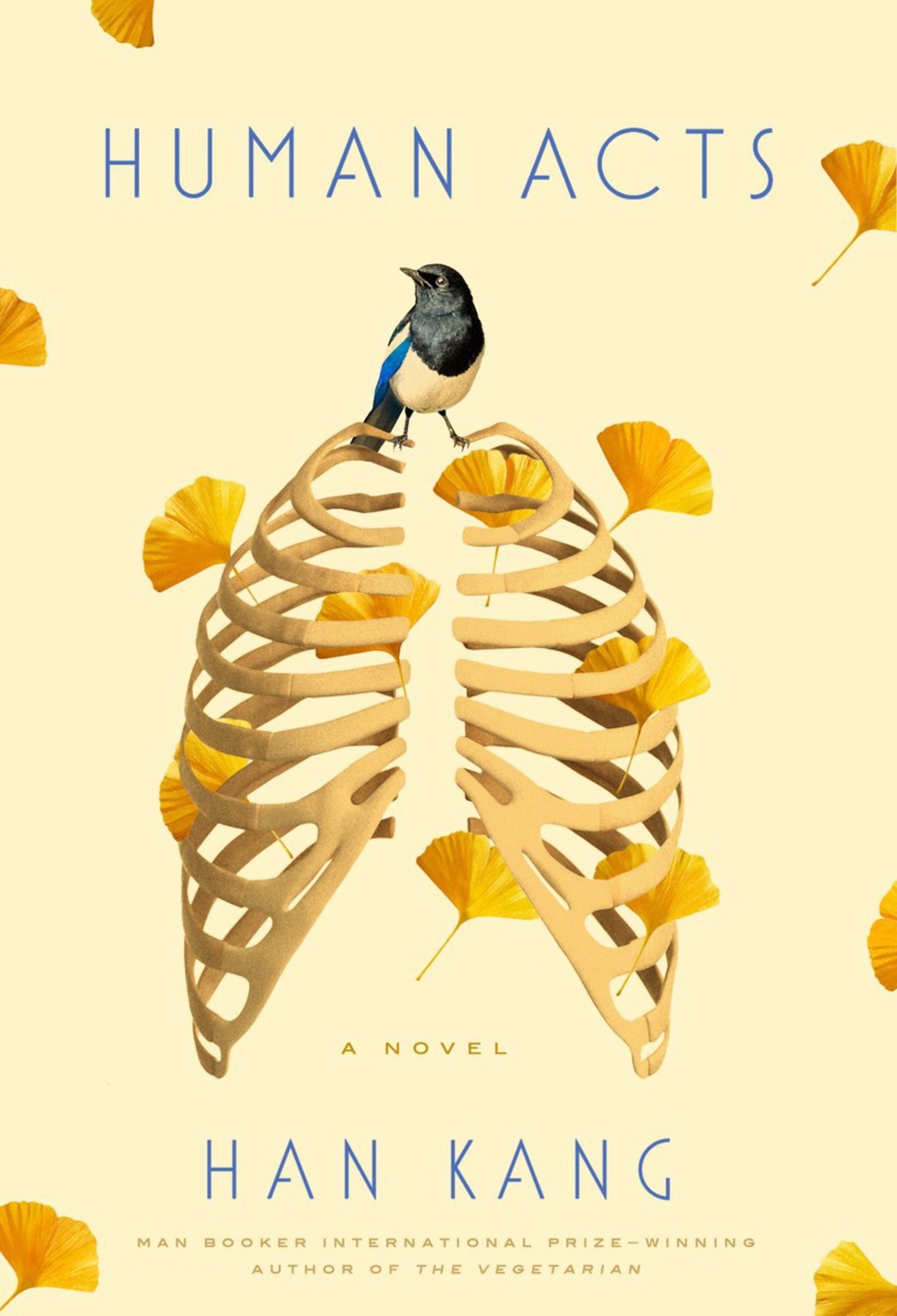
Human Acts
About this book
Dong-ho searches for a friend among corpses gathered in a provincial building while citizens resist military violence. His experience becomes one point in a sequence of voices that move beyond the uprising into imprisonment, censorship, work, mourning, and later life.
Some chapters address the dead directly; others follow survivors whose bodies remember what public history was forced to deny. The change in perspective prevents one witness from containing an event that altered thousands of lives differently.
Han Kang writes physical suffering without spectacle and political history without abstraction. The novel’s central question is how people remain capable of tenderness when a government has demonstrated how easily a body can be reduced to an object.
Human Acts is translated by Deborah Smith and draws on the Gwangju Democratization Movement. It is a short, demanding novel about collective courage, state violence, and the obligations of remembering another person’s pain.
Read a sample
5,037 words
Plain text
From the opening
“Looks like rain,” you mutter to yourself.
What’ll we do if it really chucks it down?
You open your eyes so that only a slender chink of light seeps in, and peer at the gingko trees in front of the Provincial Office. As though there, between those branches, the wind is about to take on visible form. As though the raindrops suspended in the air, held breath before the plunge, are on the cusp of trembling down, glittering like jewels.
When you open your eyes properly, the trees’ outlines dim and blur. You’re going to need glasses before long. This thought gets briefly disturbed by the whooping and applause that breaks out from the direction of the fountain. Perhaps your sight’s as bad now as it’s going to get, and you’ll be able to get away without glasses after all?
“Listen to me if you know what’s good for you: come back home, right this minute.”
You shake your head, trying to rid yourself of the memory, the anger lacing your brother’s voice. From the speakers in front of the fountain comes the clear, crisp voice of the young woman holding the microphone. You can’t see the fountain from where you’re sitting, on the steps leading up to the municipal gymnasium. You’d have to go around to the right of the building if you wanted to have even a distant view of the memorial service. Instead, you resolve to stay where you are, and simply listen.
“Brothers and sisters, our loved ones are being brought here today from the Red Cross hospital.”
The woman then leads the crowd gathered in the square in a chorus of the national anthem. Her voice is soon lost in the multitude, thousands of voices piling up on top of one another, a soaring tower of sound rearing up into the sky. The melody surges to a peak, only to swing down again like a pendulum. The low murmur of your own voice is barely audible.
This morning, when you asked how many dead were being transferred from the Red Cross hospital today, Jin-su’s reply was no more elaborate than it needed to be: thirty. While the leaden mass of the anthem’s refrain rises and falls, rises and falls, thirty coffins will be lifted down from the truck, one by one. They will be placed in a row next to the twenty-eight that you and Jin-su laid out this morning, the line stretching all the way from the gym to the fountain. Before yesterday evening, twenty-six of the eighty-three coffins hadn’t yet been brought out for a group memorial service; yesterday evening this number had grown to twenty-eight, when two families had appeared and each identified a corpse. These were then placed in coffins, with a necessarily hasty and improvised version of the usual rites. After making a note of their names and coffin numbers in your ledger, you added “group memorial service” in parentheses; Jin-su had asked you to make a clear record of which coffins had already gone through the service, to prevent the same ones being brought out twice. You’d wanted to go and watch, just this one time, but he told you to stay at the gym.
“Someone might come looking for a relative while the service is going on. We need someone manning the doors.”
The others you’ve been working with, all of them older than you, have gone to the service. Black ribbons pinned to the left-hand side of their chests, the bereaved who have kept vigil for several nights in front of the coffins now follow them in a slow, stiff procession, moving like scarecrows stuffed with sand or rags. Eun-sook had been hanging back, and when you told her, “It’s okay, go with them,” her laughter revealed a snaggle-tooth. Whenever an awkward situation forced a nervous laugh from her, that tooth couldn’t help but make her look somewhat mischievous.
“I’ll just watch the beginning, then, and come right back.”
Left on your own, you sit down on the steps that lead up to the gym, resting the ledger, an improvised thing whose cover is a piece of black strawboard bent down the middle, on your knee. The chill from the concrete steps leaches through your thin tracksuit bottoms. Your PE jacket is buttoned up to the top, and you keep your arms firmly folded across your chest.
Hibiscus and three thousand ri full of splendid mountains and rivers…
You stop singing along with the anthem. That phrase “splendid mountains and rivers” makes you think of the second character in “splendid,” “ryeo,” one of the ones you studied in your Chinese script lessons. It’s got an unusually high stroke count; you doubt you could remember how to write it now. Does it mean “mountains and rivers where the flowers are splendid,” or “mountains and rivers that are splendid as flowers”? In your mind, the image of the written character becomes overlaid with that of hollyhocks, the kind that grow in your parents’ yard, shooting up taller than you in summer. Long, stiff stems, their blossoms unfurling like little scraps of white cloth. You close your eyes to help you picture them more clearly. When you let your eyelids part just the tiniest fraction, the gingko trees in front of the Provincial Office are shaking in the wind. So far, not a single drop of rain has fallen.
The anthem is over, but there seems to be some delay with the coffins. Perhaps there are just too many. The sound of wailing sobs is faintly audible amid the general commotion. The woman holding the microphone suggests they all sing “Arirang” while they wait for the coffins to be got ready.
Continue reading the sampleClose the sample
You who abandoned me here
Your feet will pain you before you’ve gone even ten ri…
When the song subsides, the woman says, “Let us now hold a minute’s silence for the deceased.” The hubbub of a crowd of thousands dies down as instantaneously as if someone had pressed a mute button, and the silence it leaves in its wake seems shockingly stark. You get to your feet to observe the minute’s silence, then walk up the steps to the main doors, one half of which has been left open. You get your surgical mask out from your trouser pocket and put it on.
These candles are no use at all.
You step into the gym hall, fighting down the wave of nausea that hits you with the stench. It’s the middle of the day, but the dim interior is more like evening’s dusky half-light. The coffins that have already been through the memorial service have been grouped neatly near the door, while at the foot of the large window, each covered with a white cloth, lie the bodies of thirty-two people for whom no relatives have yet arrived to put them in their coffins. Next to each of their heads, a candle wedged into an empty drinks bottle flickers quietly.
You walk farther into the auditorium, toward the row of seven corpses that have been laid out to one side. Whereas the others have their cloths pulled up only to their throats, almost as though they are sleeping, these are all fully covered. Their faces are revealed only occasionally, when someone comes looking for a young girl or a baby. The sight of them is too cruel to be inflicted otherwise.
Even among these, there are differing degrees of horror, the worst being the corpse in the very farthest corner. When you first saw her, she was still recognizably a smallish woman in her late teens or early twenties; now, her decomposing body has bloated to the size of a grown man. Every time you pull back the cloth for someone who has come to find a daughter or younger sister, the sheer rate of decomposition stuns you. Stab wounds slash down from her forehead to her left eye, her cheekbone to her jaw, her left breast to her armpit, gaping gashes where the raw flesh shows through. The right side of her skull has completely caved in, seemingly the work of a club, and the meat of her brain is visible. These open wounds were the first to rot, followed by the many bruises on her battered corpse. Her toes, with their clear pedicure, were initially intact, with no external injuries, but as time passed they swelled up like thick tubers of ginger, turning black in the process. The pleated skirt with its pattern of water droplets, which used to come down to her shins, doesn’t even cover her swollen knees now.
You come back to the table by the door to get some new candles from the box, then return to the body in the corner. You light the cloth wicks of the new candle from the melted stub guttering by the corpse. Once the flame catches, you blow out the dying candle and remove it from the glass bottle, then insert the new one in its place, careful not to burn yourself.
Your fingers clutching the still-warm candle stub, you bend down. Fighting the putrid stink, you look deep into the heart of the new flame. Its translucent edges flicker in constant motion, supposedly burning up the smell of death that hangs like a pall in the room. There’s something bewitching about the bright orange glow at its heart, its heat evident to the eye. Narrowing your gaze even further, you center in on the tiny blue-tinged core that clasps the wick, its trembling shape recalling that of a heart, or perhaps an apple seed.
You straighten up, unable to stand the smell any longer. Looking around the dim interior, you drag your gaze lingeringly past each candle as it wavers by the side of a corpse, the pupils of quiet eyes.
Suddenly it occurs to you to wonder, when the body dies, what happens to the soul? How long does it linger by the side of its former home?
You give the room a thorough once-over, making sure there are no other candles that need to be changed, and walk toward the door.
When a living person looks at a dead person, mightn’t the person’s soul also be there by its body’s side, looking down at its own face?
Just before you step outside, you turn and look back over your shoulder. There are no souls here. There are only silenced corpses, and that horrific putrid stink.
At first, the bodies had been housed not in the gymnasium, but in the corridor of the complaints department in the Provincial Office. There were two women, both a few years older than you, one wearing a wide-collared school uniform and the other in ordinary clothes. You stared blankly, forgetting for a moment why you’d come, as they wiped the bloodied faces with a damp cloth and struggled to straighten the stiff arms, to force them down by the corpses’ sides.
“Can I help you?” the woman in school uniform asked, pulling her mask down below her mouth as she turned to face you. Her round eyes were her best feature, though ever-so-slightly protruding, and her hair was divided into two braids, from which a mass of short, frizzy hairs were escaping. Damp with sweat, her hair was plastered to her forehead and temples.
“I’m looking for a friend,” you said, holding out the hand that you’d been using to cover your nose, unused to the stench of blood.
“Did you arrange to meet here?”
“No, he’s one of those…”
“I see. You can come and have a look, if you like.”
You systematically examined the faces and bodies of the twenty-odd people lying against the corridor wall. You had to look closely if you wanted to be sure; your eyes soon started to feel the strain, and you had to keep blinking to try and refocus.
“Not here?” the other woman asked, straightening up. She had the sleeves of her pale green shirt rolled up to the elbows. You’d assumed she was a similar age to the young woman in school uniform; seeing her without the mask on, though, you could see she was older, more like twenty. Her skin was somewhat sallow, and she had a slender, delicate neck. Only the look in her eyes was tough and vigorous. And there was nothing feeble about her voice.
“No.”
“Have you tried the mortuary at Jeonnam, and the one at the Red Cross hospital?”
“Yes.”
“What about this friend’s parents?”
“His mother passed away, and his father works in Daejeon; he lives in our annex with his older sister.”
“They still won’t put long-distance calls through?”
“No, and I’ve tried a few times.”
“Well, what about your friend’s sister?”
“She hasn’t been home since Sunday; I came here to look for her, too. One of our neighbors said they saw my friend get hit yesterday, when the soldiers were shooting.”
“Mightn’t he just have been wounded and admitted to hospital?” the woman in school uniform interjected, without looking up.
You shook your head.
“In that case he would have found a way to call us. He’d know we were worrying about him.”
“Come by again tomorrow, and the next couple of days,” said the woman in the pale green shirt. “Apparently all the dead will be brought here from now on. They say there’s no room left in the morgues.”
The woman in school uniform wiped the face of a young man whose throat had been sliced open by a bayonet, his red uvula poking out. She brushed the palm of her hand down over his staring eyes, closing them, rinsed the cloth in a bucket of water, and wrung it out viciously. The water that came out was dark with blood, splattering outside the bucket. The woman in the green shirt stood up.
“How about you give us a hand, if you have time?” she asked. “Just for today. We don’t have enough people. It’s not difficult…you just need to cut up that cloth over there and use it to cover the bodies. And when someone comes looking for a friend, like you did, you uncover them again. The faces are badly injured, so they’ll need to get a good look at their bodies and clothes to decide whether it’s who they think it is.”
From that day on, you became one of the team. Eun-sook, as you’d guessed, was in her final year of high school. Seon-ju, the woman in the green shirt, was a machinist at a dressmaker’s on the main shopping street; she’d been left in the lurch when the boss had decided that he and his son, who’d been studying at one of the universities here, should go and stay with a relative outside the city. Both Eun-sook and Seon-ju had gone to give blood at Jeonnam University Hospital after hearing a street broadcast saying that people were dying of blood loss. There, hearing that the Provincial Office, now being run by civilians, was short of hands, and in the confusion of the moment, they’d taken on the task of dealing with the corpses.
In the classroom, where seats were assigned in order of height, you were always the one at the very front—in other words, the shortest. Since March, when you’d started your third year at middle school, you’d finally hit puberty, resulting in a slightly lower voice and a fair-to-middling growth spurt, but you still looked younger than your age. Jin-su’s work mostly kept him confined to the briefing room; the first time he saw you, he looked surprised.
“You’re a first-year, aren’t you? This is no place for you.” Jin-su’s deeply lidded eyes and long lashes were almost feminine; the university in Seoul he was attending was temporarily closed, so he’d come down to Gwangju.
“No,” you told him, “I’m a third-year. And I don’t have a problem with the work here.”
This wasn’t bravado; there was nothing technically difficult about the tasks you’d been assigned. Seon-ju and Eun-sook had already done most of the heavy work, which involved covering plywood or Styrofoam boards with plastic, then lifting the corpses on top of these boards. They also washed the necks and faces with a cloth, ran a comb through the matted hair to tidy it a bit, then wrapped the bodies in plastic in an effort to combat the smell. In the meantime, you made a note in your ledger of gender, approximate age, what clothes they were wearing and what brand of shoes, and assigned each corpse a number. You then wrote the same number on a scrap of paper, pinned it to the corpse’s chest, and covered them up to the neck with one of the white cloths. Eun-sook and Seon-ju would then help you pull them over to the wall. Jin-su, who seemed to be permanently rushed off his feet, would come striding up to you several times a day, wanting to transfer the information you’d recorded in your ledger onto posters, to put up at the main entrance to the building. A lot of the people who came looking for someone had either seen those posters themselves or been told about them by someone else. In cases of a positive identification, you would retreat to a respectful distance to wait for the sobbing and wailing to pass. As the corpses had been given only a cursory treatment, it was left to the bereaved to stop their noses and ears with cotton wool and give them a fresh change of clothing. Once they had been thus simply dressed and placed into a coffin, it was your job to oversee the transfer to the gym, and make a note of everything in your ledger.
The one stage in the process that you couldn’t quite get your head around was the singing of the national anthem, which took place at a brief, informal memorial service for the bereaved families, after their dead had been formally placed in the coffins. It was also strange to see the Taegukgi, the national flag, being spread over each coffin and tied tightly in place. Why would you sing the national anthem for people who’d been killed by soldiers? Why cover the coffin with the Taegukgi? As though it wasn’t the nation itself that had murdered them.
When you cautiously voiced these thoughts, Eun-sook’s round eyes grew even larger.
“But the generals are rebels, they seized power unlawfully. You must have seen it: people being beaten and stabbed in broad daylight, and even shot. The ordinary soldiers were following the orders of their superiors. How can you call them the nation?”
You found this confusing, as though it had answered an entirely different question to the one you’d wanted to ask. That afternoon there was a rush of positive identifications, and there ended up being several different shrouding ceremonies going on at the same time, at various places along the corridor. The national anthem rang out like a circular refrain, one verse clashing with another against the constant background of weeping, and you listened with bated breath to the subtle dissonance this created. As though this, finally, might help you understand what the nation really was.
The next morning, you and the two women carried several of the most putrid bodies out to the yard behind the Provincial Office. So many new bodies were arriving, there was no more space to lay them out inside. Jin-su came marching from the briefing room, brisk as always, and demanded to know what you were planning to do if it rained.
He frowned as he scanned the passageway, where the corpses had their feet jammed up against the wall. Seon-ju unhooked her mask.
“It’s too narrow here,” she said, “there’s just no way. There’ll probably be more corpses arriving in the evening, so what’ll we do then? How about the municipal gym? Isn’t there space there?”
Four men showed up less than an hour later, sent by Jin-su. They must have been standing guard somewhere, as they had rifles slung over their shoulders and were wearing visored helmets, which the riot police had left behind. While they loaded the bodies into a truck, you and the two women packed up the sundries. You followed the truck over to the gym, walking slowly in the balmy morning sunlight. Passing beneath the still-adolescent gingko trees, you reached up mechanically to tug at the branches, the lowest of which brushed against your forehead.
Eun-sook led the way, and was first to enter the gym. When you went inside, you saw that she’d been brought up short by the sight of the coffins filling the hall. The cotton gloves she was clutching were dappled with dark bloodstains. Seon-ju, who’d been bringing up the rear, stepped around you and tied up her shoulder-length hair with a handkerchief.
“I didn’t realize they’d been bringing them all here…seeing them all together like this, my God, there’s so many.”
You looked around at the bereaved, who were kneeling practically back-to-back. Each family had stood a framed portrait photograph on the coffin they were watching over. Some coffins also had a pair of glass Fanta bottles standing side by side at their head. One of the bottles held a bunch of white flowers, and the other, a candle.
That evening, when you asked Jin-su if he could get hold of a box of candles, he nodded eagerly.
“Of course, candles, that’ll get rid of the smell.”
Whenever you told Jin-su there was something you needed—whether it be cotton cloth, wooden coffins, scrap paper, flags—he would jot it down in his notebook and within the same day, seemingly out of nowhere, it would materialize. He told Seon-ju that every morning he went to either Daein or Yangdong Market, and if there was something that couldn’t be got there, he went and hunted it down in woodworking shops, funeral parlors, drapers, all across the city. There was still a lot of money left over from the donations that had been collected at the meetings, and when he said he was representing the Provincial Office, many people chose to give him a hefty discount on whatever it was he wanted, sometimes waiving the fee altogether. Money, then, wasn’t the issue. But now the city had run out of coffins, so he’d got hold of as much plywood as they thought they’d need and a new batch was currently being assembled at the carpenters’.
The morning Jin-su arrived with five boxes of fifty candles each, and matchboxes, you scoured every nook and cranny of the building, collecting any drinks bottles you spotted that could be used to hold the candles. The bereaved queued at the table by the entrance while you lit each candle and inserted it into one of the bottles. They then carried the bottle over to their coffin and set it down at the head. There was more than enough to go around. Enough even for the still-unidentified corpses, and those coffins that had no one to watch over them.
Every morning new coffins were brought to the gym, where a group memorial altar had been set up. The new arrivals were those who had breathed their last while undergoing treatment at the hospital. When the bereaved families brought in the coffins, pushing them in handcarts—was it sweat or tears that made their faces shine?—you had to move the existing coffins closer together to make room.
In the evenings, people were brought in who had been shot in the suburbs, in confrontations with the army. They had either died instantly, from the soldiers’ gunfire, or while being taken to hospital. Many of them hadn’t been dead long and still looked uncannily alive; Eun-sook would be trying to stuff a jumble of spilled, opaque intestines back inside a gaping stomach when she’d have to stop what she was doing and run out of the auditorium to throw up. Seon-ju, frequently plagued by nosebleeds, could often be seen with her head tipped back, pressing her mask over her nose.
Compared with what the two women were dealing with, your own work was hardly taxing. Just as you had at the Provincial Office, you recorded date, time, clothing, and physical characteristics in your ledger. The cloths had already been cut to the appropriate size, and each scrap of paper had been attached to a clothes peg, ready to be pinned straight to the corpse once the number had been written on it. As the need arose for new places, you pushed the still-unidentified closer together, followed by the coffins. On nights when the influx of new arrivals was especially overwhelming there was neither the time nor the floor space to neatly rearrange the existing order, so the coffins just had to be shoved together any old way, edge to edge. That night, looking around at all those dead bodies crammed into the gym hall, you thought to yourself how much like a convention it seemed, a mass rally of corpses who were all there by prearrangement, whose only action was the production of that horrible putrid smell. You moved swiftly among this silent congregation, clasping your ledger under your arm.
It really is going to chuck it down, you think, drawing in a deep breath as you emerge from the dim, twilit world of the gymnasium. You head for the backyard, wanting to drink in more of that clean air, but stop at the corner of the building, worried about straying too far from your post. Now the voice coming from the speakers is that of a young man.
“We cannot just hand in our weapons and surrender unconditionally. First they have to return our dead to us. They also have to release the hundreds they’ve thrown in prison. And more than that, we have to make them promise to admit the true facts about what happened here, so we can recover our honor in the eyes of the rest of the country. After that, there wouldn’t be any reason for us not to return their firearms, would there? What do you all say?”
You sense that the cheers and applause that follow are coming from a much smaller number of people than before. You remember the assembly that was convened the day after the soldiers withdrew. Then, there were so many people that the overflow crowded onto the roof of the Provincial Office and the clock tower. The streets were laid out like a paduk board, with no vehicles permitted entry, and what had been the only available space had been taken up by the buildings. A great mass of people, more than a hundred thousand strong, surged through those streets with the rippling motion of colossal waves. Their voices joined together for the national anthem, the swelling chorus rising up like a tower, a story for every voice. The sound of their clapping was like thousands of fireworks being let off in succession. Yesterday morning, you listened to Jin-su and Seon-ju discussing what was going to happen. Looking serious, Jin-su had said that there was a rumor going around that when the soldiers came back, those who were gathering in the streets would all be killed, and so the demonstration was being hastily scaled down. “We need there to be more of us, not less, if we’re to prevent the army from reentering the city…the mood’s not good. Every day there are more coffins; people are starting to think twice about venturing out of doors.”
“Hasn’t enough blood been shed? How can all that blood be simply covered up? The souls of the departed are watching us. Their eyes are wide open.”
The voice of the man conducting the ceremony cracks at the end. The repetition of that word, “blood,” gives you a tightening feeling in your chest, so you open your mouth wide and suck in another deep breath.
A soul doesn’t have a body, so how can it be watching us?
You recall your maternal grandmother’s death last winter. What started out as a mild cold soon turned into pneumonia, and she was admitted to the hospital. She’d been there around a fortnight when you and your mother went to visit her, one Saturday afternoon when you were basking in the relief of having got through the end-of-term exams. But then, without warning, your grandmother’s condition deteriorated. Your mother contacted her brother and told him to come as quickly as possible, but he was still stuck in traffic when the old woman breathed her last.
Your childhood visits to her home inevitably included a quiet “follow me” as the elderly woman, her back bent into the shape of the letter ㄱ, led the way to the dark room that was used as a pantry. Then, you knew, she would open the larder door and bring out the cakes that were stored there to use as ceremonial offerings on the anniversary of a relative’s death: pastries made from oil and honey, and block-shaped cakes of pounded glutinous rice. You would take an oil-and-honey pastry with a conspiratorial grin, and your grandmother would smile back at you, her eyes creasing into slits. Her death was every bit as quiet and understated as she herself had been. Something seemed to flutter up from her face, like a bird escaping from her shuttered eyes above the oxygen mask. You stood there gaping at her wrinkled face, suddenly that of a corpse, and wondered where that fluttering, winged thing had disappeared to.
What about those who are now in the gym hall—have their souls also escaped their bodies, flying away like birds? Where could they possibly be going? It surely wasn’t some alien place like heaven or hell, which you’d heard about the one time you ever went to Sunday school, when you and your friends were lured there by the prospect of chocolate Easter eggs. You’d never been convinced by the historical dramas on TV, where the spirits of the dead were supposed to be scary figures, dressed all in white and wandering around in an eerie fog, their disheveled hair the sign of an unquiet rest.