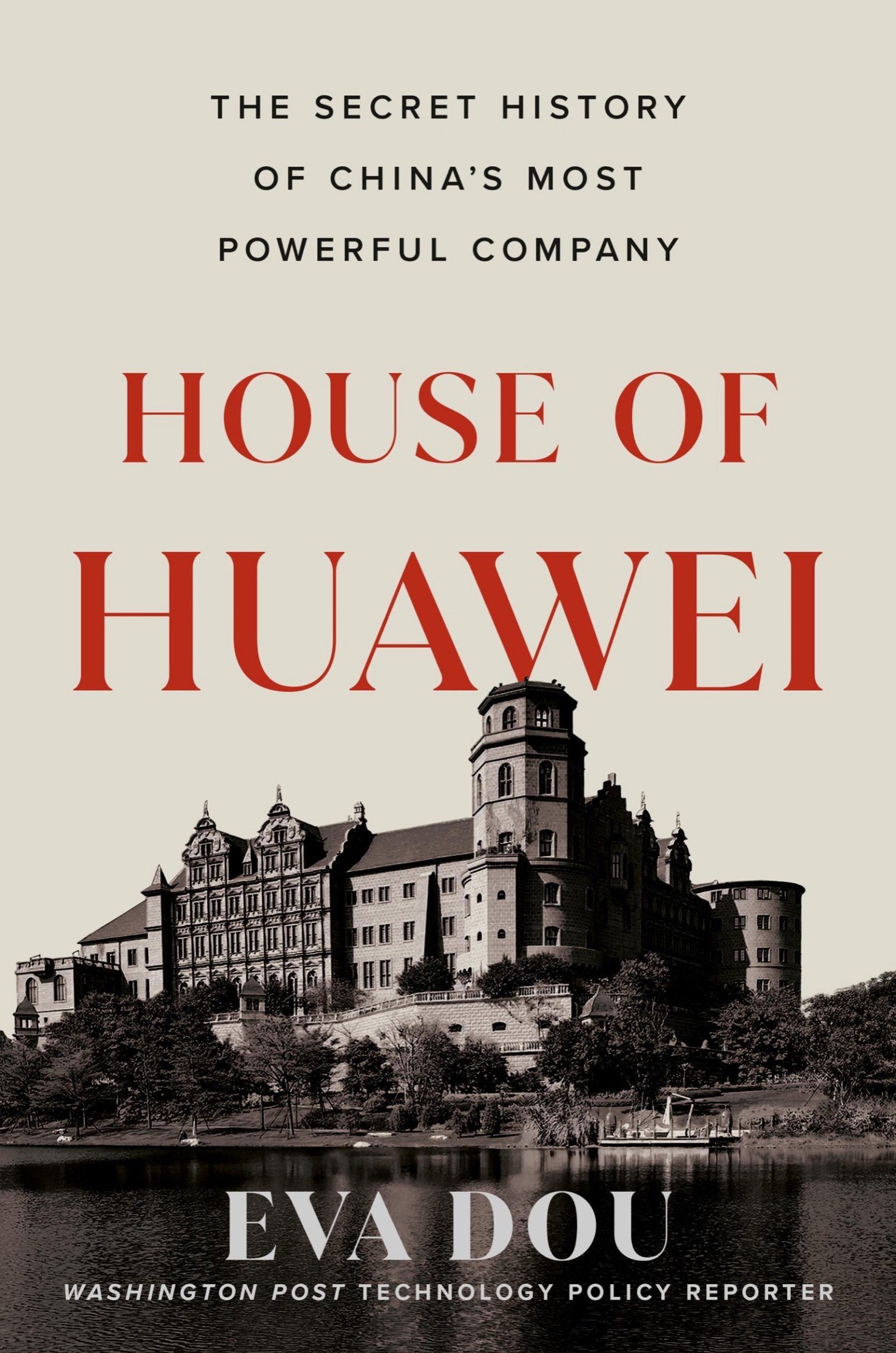
House of Huawei: The Secret History of China's Most Powerful Company
About this book
Eva Dou opens with the 2018 arrest of Huawei executive Meng Wanzhou in Vancouver, then steps back to the family history that preceded the company. Ren Zhengfei's childhood, military engineering work, and arrival in reform-era Shenzhen become the first pieces of Huawei's story.
From imported telephone switches, Huawei builds its own research organization, an aggressive sales culture, and a business able to compete across developing markets and European networks. Its growth brings it into increasingly close contact with Chinese industrial policy and increasingly sharp conflict with the United States.
The book follows the questions that have shadowed the company: its ownership, relations with the party-state, work on surveillance systems, expansion in Iran, and the security fears surrounding 5G. Dou distinguishes documentary evidence from claims that remain difficult to prove inside a private and secretive firm.
Published in 2025, House of Huawei is a reported corporate history rather than a biography of a single founder. It shows how a company built in the opening years of China's market reforms became inseparable from a geopolitical struggle over infrastructure, information, and technological power.
Read a sample
5,030 words
Plain text
From the opening
Introduction
The woman’s flight from Hong Kong arrived in Vancouver on December 1, 2018, at 11:10 a.m., a few minutes ahead of schedule.[1] Dressed comfortably in a dark hooded tracksuit and sneakers,[2] her shiny black hair hanging loose around her shoulders, she was planning a quick stop at one of her family homes, then heading on to Buenos Aires. As it happened, the most powerful men and women in the world were gathering just then in the Argentine capital for the G20 summit. It was—by her account—a coincidence.
As she stepped off the Cathay Pacific flight at the Vancouver International Airport, something was not quite right. An officer was checking passports as the passengers emerged from the jetway at gate 65. When she reached him, she showed him her Hong Kong passport, a fairly new one, her seventh in eleven years. The officer called over a colleague, who asked her to hand over her mobile phones. Her lawyers would later say she could have resisted. But she was jet-lagged and caught off guard, so it didn’t occur to her to resist. She handed over her iPhone and a red-cased smartphone made by her father’s company. The officers put them into a thick bag designed to block cell-phone signals and make it difficult for anyone to wipe them remotely.
After following her to baggage claim, the two officers rifled through her luggage, pulling out more electronics: a pink MacBook, a rose-gold iPad, a 256-gigabyte USB drive. One of them asked her for the phones’ passwords and scribbled the numbers on a loose sheet of paper. The questioning continued. One hour passed, then two. Finally, three hours after she’d gotten off the plane, a third man appeared and told her she was under arrest. She was facing charges of fraud in the United States.
“You’re saying you’re going to arrest me?”
“Right.”
“And then send me to the United States?”
“Right.”[3]
It was now undeniable that this was not a random airport check. This was a highly planned operation. As the officer explained that they were going to book her into jail and fingerprint her, he advised Huawei’s CFO, Meng Wanzhou, also known as Cathy Meng, also known as Sabrina Meng, to get a lawyer.
Huawei had been on Washington’s radar for some time. The company had emerged as China’s leading high-tech firm, trouncing its Western rivals in bids for major contracts on the strength of its sales team’s ferocious “wolf culture.” Huawei was now number one in the lucrative trade of building the “pipes” that made up the world’s phone and internet networks. Its pockets seemed endlessly deep, as it scooped up top engineers from across the globe.
Meng Wanzhou’s father—Huawei’s reclusive founder, Ren Zhengfei—was a corporate legend in China. He had a reputation as a long-term strategist, and his military-esque aphorisms were widely quoted. Starting from humble beginnings, Ren had worked his way up through the military before setting up a humble telephone switch venture that had shot straight to the top. It was either an astonishing feat of innovation or, as some people muttered, too good to be true. There were rumors about the company pursuing obscured projects in Iran and North Korea. There were fears that Huawei products might contain “back doors” that could let overseas spies burrow their way in. There were questions of whether the company was controlled by China’s government, despite Huawei’s protests that it was an independent, privately owned company. Some US officials, with a touch of melodrama, were calling Huawei no less than the greatest threat to American democracy.[4]
Ren protested that he couldn’t possibly be involved in such things. He was, he said, only a maker of pipes—a humble vocation not unlike that of a plumber. Not everyone saw things this way. Sure, Huawei might make pipes of a sort, but it was not water flowing through them. What flowed through these pipes was telephone calls, emails, internet traffic, text messages, video calls, corporate accounting, medical records, wills and testaments, love letters, family photographs, police intelligence, government secrets. In a word: data. The most valuable commodity of the information age. And Huawei was the largest supplier of these pipes—by a long shot.
And there was something else here. The question of Huawei wasn’t merely a question of business; it was also a question of belief. When the Soviets had sent Sputnik 1 into the skies in 1957, it had shaken Americans to the core. There was nationwide soul-searching: How could Moscow have gained the technological edge with its stodgy Communist methods? The collapse of the Soviet Union seemed to put that debate to rest, affirming the brittleness of Communist rule and the superiority of Western liberal democracy. As for China, it had been a technological leader centuries ago, inventing the compass, gunpowder, and paper. But it had fallen behind in the fifteenth century, and the prospect that it would ever catch up again seemed unlikely. Until now. The world was having another Sputnik moment. And this time the Sputnik was Huawei.
Huawei was filing more patent applications than any other company on earth. Huawei was number one in 5G. Huawei was number one in smartphones. It was breaking ground in artificial intelligence. It pulled in more in annual sales than Disney and Nike combined, and it employed more people than Apple. The rise of such an absolute corporate juggernaut was not supposed to be possible through Communism. But it had happened. It was the kind of thing that made people reconsider what they knew to be true. They were reconsidering if free trade really made everyone wealthier. They were reconsidering if history did end with Western-style democracy. They were reconsidering if the source of innovation really was college dropouts’ garages and not the state picking winners and losers. Because if so, then how did a company like Huawei exist?
Continue reading the sampleClose the sample
Days after Meng’s detention, Beijing struck back. Two Canadians, both named Michael, were detained in China, thrown into solitary detention, and accused of espionage. The simmering US-China trade war had exploded into full-fledged hostage diplomacy.
Amid the fear and uncertainty that followed, something strange happened. Invitations began trickling out to major news organizations: The New York Times, The Washington Post, CNN, BBC. They were all invited to come to China and meet Ren Zhengfei himself. It was the first time in his life that Huawei’s secretive founder had thrown open his doors to the foreign press. So it was with a great deal of intrigue, and a little trepidation, that the journalists arrived, one after another, in the megacity of Shenzhen on China’s southern coast.
As they drove through the smoggy outskirts of Shenzhen, the sea of factories must have seemed to go on forever. There was one assembly line after another, churning out yo-yos, ziplock bags, scuba wet suits, electric toothbrushes, ultrasonic plastic welders, arch-support insoles, and everything in between. This was the place called the world’s factory floor. Finally, the foreign reporters emerged at a lakeside hill. This was where Ren had built his Garden of Eden. There was a life-size replica of Versailles, with statues of white horses galloping around a fountain at its entrance. Nearby, the red turrets of Heidelberg Castle soared. A little red train chugged cheerfully from castle to castle. One hundred and fifty Russian painters had been hired to paint the walls and ceilings of the massive halls with Renaissance-style murals. In one hall, there was a re-creation of the caryatids from Delphi, the mysterious female figures holding up the sky with their heads. Exquisitely dressed young women playing the lute. There was also a sprawling vista of the Battle of Waterloo. Outside, black swans glided on a lake—a reminder from Ren to his employees to always be on the lookout for a “black-swan event,” a term for an extremely unlikely but disastrous occurrence.
“Welcome,” the Huawei staffers said, “to Huawei’s R&D campus.”
Now out walked Ren himself. If you believed some folks in Washington, he was one of the most dangerous men in the world. He didn’t look so standing before them: a wizened little old man in a blue leisure suit and pastel shirt, spouting aphorisms and jokes through a translator.
The visiting journalists were keen to ask Ren about his background, about Huawei’s ownership, about the psychedelic vision of the European castles, about Huawei’s business in Iran, about the detention of his daughter. But most of all, they wanted to ask him over and over, in every possible permutation, the unanswerable question: Did Huawei help the Chinese government spy?
“We are a company that sells water taps and pipes,” Ren said. “How can anyone ask for water from a hardware store like us?”[5]
Part I
A country without its own program-controlled switches is like one without an army.[1]
—Ren Zhengfei, July 20, 1994
1
The Bookseller
The Ren Family: 1937–1968
Ren Moxun[1] sold “good books.”[2] That was what he and his friends called patriotic literature. They were seeking to inspire their countrymen to heroism at a time when it was urgently needed. They’d considered names like Advancement Bookstore and Pioneering Bookstore before finally settling on July Seventh Bookstore. The reference was obvious: Earlier that year, on July 7, 1937, Japanese troops had crossed the Marco Polo Bridge, captured the capital, and continued their invasion of China. World War II would not come for Europe for another two years, when Adolf Hitler invaded Poland. But here in China, the war was already upon them. Ren Moxun opened up the bookstore in the small town of Rongxian,[3] in southern Guangxi Province, and threw himself into the war effort.
Ren Moxun was around twenty-seven at this time, and he had a high forehead, long cheeks, and bushy eyebrows.[4] The only one among his siblings to have attended university,[5] he cultivated a professorial air and wore horn-rimmed spectacles. He revered books, schooling, and the written word, a predisposition he would pass down to his seven children.[6] At the time he opened his bookstore, reading was still a hobby for the privileged elite. If you pulled five people off the street at random, you’d be lucky if one could read.[7] Chinese script was difficult to learn: it had no alphabet, and you had to memorize each word, one by one. Still, there was enough interest in Rongxian for a bookstore. Ren Moxun stocked revolutionary titles[8] from a supplier in Guilin: Karl Marx’s Das Kapital, Vladimir Lenin’s The Proletarian Revolution and the Renegade Kautsky, the complete works of the modern Chinese thinker Lu Xun. He and his colleagues placed a bench at the front so that frugal students could sit and read for free.[9] Outside the bookstore, they propped up a blackboard to scrawl news of the war, something of an unofficial village newspaper. They started a political reading club too, which gathered for spirited discussions.
In his day job, Ren Moxun served as an accountant for a Nationalist military factory supporting the fight against Japan. The Nationalists, China’s rulers at the time, were also embroiled in a civil war against Mao Zedong’s Communists, who were seeking to overthrow them with the help of the peasantry. As they fought Japan’s invasion, the two sides had brokered a delicate truce, an agreement Ren Moxun strongly endorsed. When one faction of Communist revolutionaries in his town began advocating to end the détente with the Nationalists, he denounced them as traitors.[10] These were tense times. People disagreed on what was the right path for the nation, on who was friend or foe, on whether a book was a “good book” or not. One day in March 1938, some Nationalist officers searched the bookstore and pulled out a big pile of books that they demanded not be sold. Ren Moxun and his colleagues found a clever workaround.[11] They piled the banned books into a vitrine and scrawled a sign on it: Inside This Cabinet Are Banned Books. As it turned out, the books inside the cabinet sold briskly.
The July Seventh Bookstore was shut down by the Nationalists in the second half of 1939. Its owners held a fire sale to get a last batch of good books out to the people.[12] Ren Moxun considered traveling to Yan’an to join Mao’s Communists but found the roads impassable. So he crossed to the rolling hills of the neighboring province, Guizhou, where he found work as a teacher.
Guizhou Province is a hilly region slightly smaller than Missouri, set inland from China’s southwestern border with Vietnam. Monsoons sweep the subtropical region each summer, watering the terraced paddies of sticky rice. Cold drizzles continue through the winter. The area’s indigenous people were the Bouyei, who spoke their own language and also inhabited northern Vietnam. For centuries, China’s emperors considered the area an impoverished borderland[13] where even cooking salt was sometimes in short supply.[14] Even in the modern day, Guizhou retains the reputation of a hardship posting for officials.
In Guizhou, Ren Moxun met a seventeen-year-old named Cheng Yuanzhao. With big brown eyes,[15] round cheeks, and a broad smile, she was also bright and good with numbers.[16] They married, and Cheng Yuanzhao soon became pregnant.
Their son was born in October 1944,[17] and they named him Ren Zhengfei. It was an ambiguous name. Zheng meant “correct,” and fei meant “not.” “Right or wrong” would be a fair translation. It wasn’t like the common, straightforward boys’ names. Jiabao meant “family treasure.” Jianguo meant “build the nation.” But what did a name like his mean?
Japan’s occupation of China ended abruptly the year after Ren Zhengfei’s birth, when the Americans dropped atomic bombs on Hiroshima and Nagasaki. For all the efforts of Ren Moxun and his compatriots, it was America’s superior bomb technology that ended the Japanese occupation. In China, there would not yet be peace. Civil war resumed between the Nationalists and Communists. Ren Moxun and Cheng Yuanzhao had six more children, all while both parents worked teaching local students in spare conditions, under the glow of kerosene lamps.[18] Cheng served for a period as an elementary school principal.[19]
In 1949, Mao Zedong emerged victorious. It was clear that Ren Moxun had picked the wrong side by working for the Nationalists during the war. It wasn’t yet clear how dire the consequences would be for his family.
On a foggy morning in 1950, Ren Moxun rode a horse-drawn carriage into the town of Zhenning.[20] The name Zhenning meant “town of peace,” but Ren Moxun, seated in the middle of the cart and surrounded by three armed men who kept their Mauser guns trained outward, arrived with some trepidation. The fog was so thick the men could see only a few meters ahead on the winding dirt road, and they feared that unfriendly locals might attack them. Officials had tasked Ren Moxun with launching a new middle school for Bouyei children in Zhenning, one that would teach them the Mandarin Chinese language and help integrate them into the nascent Communist republic. Mao’s new government was seeking to solidify its control over a sprawling territory that, for most of its history, had been not a unified whole but self-governing fiefdoms speaking different tongues. A unifying language was not just a linguistic issue but a political one.
Ren Moxun and his colleagues began setting up a new boarding school, going door-to-door to recruit students across the countryside. Fewer than half of the students spoke fluent Mandarin.[21] Many of the older residents didn’t speak Mandarin at all. Ren Moxun and his staff learned conversational Bouyei. Attendance was a challenge for students who had to travel a great distance.[22] Many families also couldn’t afford the school fees. Ren Moxun and his staff came up with a solution: the students and faculty would make up the budget shortfall through part-time farming.[23] He got the government to give them an acre of land, where the students planted crops and raised pigs. The labor of the students and teachers enabled the school to cover its costs, including meals and a free blue uniform for each student.
Mao’s officials believed they were extending a civilizing influence to the nation’s frontiers—Guizhou in the south, Inner Mongolia in the north, Tibet and Xinjiang in the west. The residents didn’t necessarily see it that way. They had lived for centuries with their own languages and customs, and they were now being compelled to assimilate. There were those who did not like Ren Moxun and his school either. After someone threatened to kill him with a hand grenade—the precise reasons are unclear—the school was issued four rifles to protect the staff and students.[24]
One of Ren Moxun’s objectives was to inculcate his students with the right beliefs. “Principal Ren, your guiding ideology must be clear,” a visiting official instructed him. “You must make clear who the enemies are, who we are, who are our friends.” Ren Moxun organized rallies for the students to denounce their enemies.[25] The enemies at home were the oppressive landlords. The enemies abroad were the Americans, who were waging war against North Korea, one of China’s allies. Ren Moxun reported that the “scoundrels” hidden among the teachers were successfully caught through these criticism sessions, which were often intense, with students bursting into tears. In the anti-America sessions, students offered up secondhand accounts of atrocities committed by US troops in the area, presumably when they had passed through during World War II. One student said a US soldier had shot a farmer for sport near the Yellow Fruit Waterfall. Another said a classmate’s sister had been dragged into a jeep and raped. It was hard to say what, exactly, had happened years ago with US soldiers, but the resentment against America was certainly real.
Ren Moxun was a man of quiet ambition, and by age forty-five, he was beginning to gain national attention for his work. In 1955, a prominent linguistic journal published a paper of his on teaching Mandarin Chinese to Bouyei children.[26] He outlined their successes in connecting with their pupils by learning their tongue. He noted that the Bouyei language had been changing rapidly since Mao came to power, with new terms like landlord and land reform added. His paper impressed officials at the Ministry of Education enough that they dispatched officials to visit his school. In the autumn of 1955, he was also invited to attend the landmark linguistic conference in Beijing where officials made the controversial decision to simplify the Chinese written language to boost literacy. Arriving in the nation’s capital, he posed proudly for a photo on a tree-lined walkway of Beihai Park.[27]
After returning home to Zhenning, Ren Moxun was promoted to dean of the new Duyun Normal College for Nationalities, a teachers’ school for local ethnic minority students. His son Ren Zhengfei, then a middle schooler, was astonished when they moved to the county seat and saw the department store. It was his first time seeing a two-story building.[28]
When Ren Moxun took up management of Duyun Normal College for Nationalities in 1958, Mao had just launched an ambitious national campaign dubbed the Great Leap Forward. The previous autumn, the Soviet Union had launched the world’s first artificial satellite, Sputnik 1, a technological feat that stunned the world. The Soviet Union’s leader, Nikita Khrushchev, set a goal of surpassing the US in industrial output in fifteen years. Mao was inspired to follow suit, declaring that China would catch up with the United Kingdom in fifteen years.
To meet such an astronomical goal, all of China would have to suspend business as usual for an emergency industrialization push. Duyun Normal College for Nationalities was no exception. Ren Moxun was ordered to halve the four-year curriculum to make time for steelmaking. His staff and students would work nights making steel while continuing their daytime classes, a grueling schedule.[29] The exhausted students could only catch up on sleep during the day, and their coursework suffered.
Some steel was produced in the nationwide drive, but a lot of the amateur efforts came to naught. As farmers neglected the fields and melted farming tools to try to meet steel quotas, the crops failed. By 1959, starvation was widespread across Guizhou Province and the nation. In some Guizhou towns, grain rations were reduced to several tablespoons per person per day.[30] Ren Moxun pleaded with local authorities to increase the students’ rations, arguing that they needed more food to complete their workloads. They stretched their rations by growing radishes in the schoolyard and gathering acorns to grind into meal. The dean had Communist Party members among the staff—seen as the most morally upstanding employees—take turns guarding the pantry from theft.[31]
Outside the schoolyard, the situation was even more dire. Local authorities across Guizhou were receiving reports of a swelling sickness.[32] Farmers’ abdomens were ballooning with fluid until it killed them. Investigations determined that the cause was starvation. By one historian’s estimate, 10 percent of Guizhou’s population died from the famine, one of the highest death rates in the country.[33] The famine coincided with local unrest: At one point, officials instructed Ren Moxun and his students to disperse a crowd of angry ethnic minority villagers, which they did with reluctance. It is not clear what the villagers were protesting.[34]
Ren Moxun’s own family was struggling to put enough food on the table for their seven children. The family foraged wild roots, tasting them gingerly, unsure if they were edible.[35] They ate wild castor beans, which gave them diarrhea. Ren Zhengfei had been an excellent student in middle school, but now he found it hard to concentrate. In his sophomore year of high school, he had to retake the final exams.
As Ren prepared for the grueling college entrance exam, the gaokao, his mother encouraged him by slipping him an extra corn cake now and then to ease his hunger pangs.
Excerpted from a 1959 booklet about the Chongqing Institute of Architecture and Engineering, this photo shows a campus building designed and constructed by students.
In 1963, Ren Zhengfei was accepted to the Chongqing Institute of Architecture and Engineering (later merged into Chongqing University).[36] This was not an elite school like Tsinghua or Peking University in the capital. But for a small-town student who had just survived a famine, it was good enough indeed. Chongqing was a major inland city in Sichuan Province, which was known for its mouth-numbingly spicy cuisine and its surrounding bamboo forests, where giant pandas roamed. As a temporary wartime capital for the Nationalists in the early 1940s, it had munitions factories, heavy industry, and engineering schools.
The Great Leap Forward and the famine had ended, but Ren’s college experience was still not a normal one. Mao thought young people were spending too much time with their noses in books. They should be learning by building things with their hands, with the peasantry as their tutors. In early 1964, Mao ordered universities to thin out curriculums, making room for students to learn through practical work.[37] The professors at the Chongqing Institute of Architecture and Engineering were obliged to turn lectures into reading handouts and allow students to take open-book tests. Teams of students were sent out for stints on construction sites.[38] Mao also ordered universities to participate in nationwide defense preparations, with students run through militia drills.[39]
On the morning of May 14, 1966, students awoke to find all classes suspended for three days.[40] Mao announced that class enemies had infiltrated the Communist Party and had to be rooted out. The Cultural Revolution had begun. At Ren’s university, students and teachers were told to write “big-character posters,” handwritten signs denouncing individuals as counterrevolutionaries. Before long, some four thousand posters papered the campus.[41] By the summer, the professors were in terror as growing numbers of them were denounced. More and more of Ren’s classmates wore the red armbands of the Red Guards, Mao’s youth paramilitary organization, which was spearheading the hunt for counterrevolutionaries.
As was happening elsewhere across the nation, Red Guards at Ren’s university overthrew the administration, forcing the professors to turn over the keys and official seal. They overthrew the Chongqing government as well. Teachers and students fled. Management of the college remained in chaos for the next two years. In February 1967, some fellow students at Ren’s university kidnapped Luo Guangbin, a local writer.[42] The Red Guards locked Luo up inside a room in the physics building on campus, denouncing him as a traitor who wrote reactionary novels, until he leaped from a window to his death.
Beyond the campus walls, Red Guards were staging deadly battles[43] in the streets of Chongqing as rival factions fought for dominance. The students had broken into the city’s military factories, seizing rifles, heavy artillery, and even tanks. Six middle schoolers and a college student were killed in a shootout on August 4, 1967.[44] Four days later, a Red Guard clash along a riverbank left 24 dead, 129 wounded. Chongqing was becoming one of the bloodiest sites of the Cultural Revolution. Some 1,700 Red Guards and civilians had been killed in the city by the time the violence receded in 1968, according to an independent historian’s estimate.[45]
Ren Zhengfei watched from the sidelines with fear and a little envy.[46] His father’s bad political background meant that he could not join the Red Guards even if he wanted to. Instead, he buried himself in books, reading deeply on math and philosophy, as well as self-studying three foreign languages. Ren received letters from his mother periodically; they were largely banal, repeating party slogans. Mail was not private, and people were careful about what they put to paper. It was only through a friend who had met a student from his father’s school that he heard his father, too, was enduring brutal persecution.
Principal Ren Moxun’s background was all wrong. He’d grown up in material comfort, his father a successful ham maker in coastal Zhejiang Province.[47] The family had lived in a sprawling 1820s estate that was sometimes called the “Thirteen Rooms of the Ren Family.”[48] On the outside, the two-story home looked simple, with whitewashed walls and a gray-tiled roof in the common style. But the interior betrayed the family’s wealth and status: there were intricately carved wooden beams and balconies that surrounded a central courtyard, or siheyuan.[49] This bourgeois background was now a problem for Ren Moxun, along with his work at a Nationalist factory during the war. He had joined the Communist Party in 1958, but that was far too late to expiate these other sins.[50]
Ren Moxun was hauled onto a platform in the school cafeteria, his hands tied, his face smeared with black ink, the tall hat of shame denoting a counterrevolutionary placed on his head.[51] “Studying is useless!” people shouted. “The more knowledge you possess, the more reactionary you are!”[52]
One of Ren Moxun’s students demanded the principal admit that he’d instilled feudalist thinking in the students, such as by quoting Confucius. According to a recollective essay by Feng Jugao, a different student, when Ren Moxun tried to deny the accusation, the accuser rushed forward with a wooden stick and beat him until the stick broke.[53] “I can’t say if the wooden stick was weak, or if Principal Ren’s backbone was strong,” Feng wrote. “But the wooden stick broke in two across Principal Ren’s back.” Feng recalled his mother being aghast, saying that the students who beat the principal would get their karmic punishment.
Ren Moxun was put on a truck with other “rightists” and driven around town with a sign looped around his neck as a warning.[54] One of his colleagues—the school’s party secretary, Huang Xuanqian—couldn’t endure the torments and committed suicide.[55] Ren Moxun also considered ending his life, but he didn’t want to die before his name was cleared, as it would leave his wife and children with a cloud over them. “If he died,” Ren Zhengfei explained, “his children would have to carry this political burden…. He endured a hundred tortures, but he would not kill himself.”[56] Ren Moxun was sent to a labor camp.[57]
“The Cultural Revolution was a disaster for the nation,” Ren Zhengfei later wrote. “But for us it was a baptism. It made me politically mature, so that I wasn’t just a simple bookworm.”[58]
Universities nationwide were banned from matriculating any new students between 1966 and 1976. Ren Zhengfei’s younger siblings were shut out, but through the random luck of his birth year, he’d been able to eke out a college education. In 1968, Ren graduated with a major in heating, gas supply, and ventilation engineering.[59]
The year of Ren’s graduation, Mao began his “rusticated youth” campaign, sending millions of urban youths to the countryside to be reeducated by laboring alongside the peasantry. Some of the young people were obliged to farm for years—planting corn, hoeing potatoes—before they were allowed to resume their lives back home. Many others never made it back, having put down roots in the countryside by the time they were allowed to return to the cities.
Ren was also assigned to rural labor, but he was luckier than many. Guizhou Province was a stone’s throw from the border with Vietnam, and for several years already, Mao had been funneling artillery, shells, tanks, radio transmitters, and telephones to Hanoi to aid Vietnam’s fight against the Americans. The hills of Guizhou provided good air cover, so the Chinese military had burrowed in there, building secret air bases and camouflaged factories. Whatever the political rhetoric against science, Mao needed an enormous number of trained engineers to keep the gears turning in the proxy war. And so as Ren left university, he found himself assigned to the familiar hills of Guizhou, not to hoe potatoes or to make steel but to help build a secret military production site code-named 011.[60]