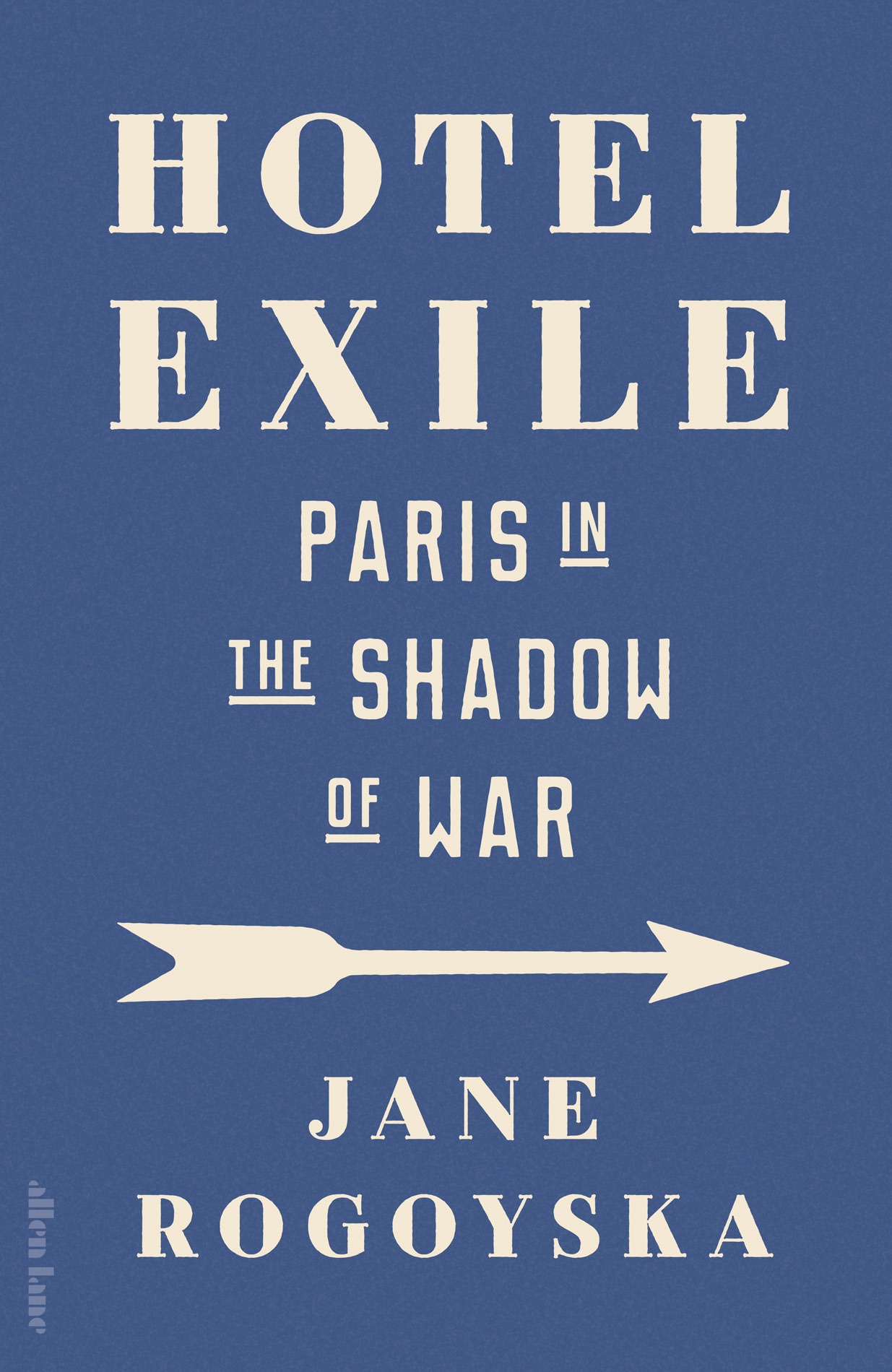
Hotel Exile: Paris in the Shadow of War
About this book
The Lutetia was the grand hotel of Paris's Left Bank, frequented by writers, artists, and politicians. In the 1930s it became a meeting place for intellectuals and activists forced out of Germany after Hitler took power.
During the occupation, the same building served German military intelligence and operations against enemies of the Reich. In 1945 it changed function again, becoming a reception center where families waited for deportees returning from concentration camps.
Jane Rogoyska structures the history around groups connected to the hotel and the choices imposed by war at its edges. Staff, exiles, occupiers, resistors, and relatives do not share one experience merely because they pass through the same rooms.
Hotel Exile is narrative history about a Paris institution during the Nazi era. Its concentrated setting makes visible how a prestigious civilian space can be repeatedly repurposed by displacement, state power, and the work of receiving survivors.
Read a sample
5,128 words
Plain text
From the opening
Prologue
A hotel, explains the former concierge in the elegantly leathered library of the Hotel Lutetia in Paris, is not an actor in a drama. It is simply the stage on which dramas are played out. We, the staff, are invisible, like stagehands who work behind the scenes to allow the performance to proceed without a hitch. We do not interfere. We do not speak of the triumphs or calamities of our guests. What we may witness we cannot share, for the reputation of a grand hotel is based, above all, on discretion. So if you want to find the stories, you have to look outside the hotel, he says. We have nothing here.
A hotel is like a train station in slow motion: a place for people who are passing through, a temporary stop on the way to somewhere else. It mimics home, offering comfort without love. Sometimes, it is a place to hide, to conceal a secret life.
A hotel is a neutral territory upon which friends and enemies may meet. It does not judge its clients so long as they behave with appropriate discretion and pay their bills. Exiled politicians may meet here to thrash out the blueprint for a future that will never happen. They can book the President Salon for conferences where delegates fight for control of an agenda that will never be realized. They can drink coffee and argue among themselves for as long as they wish so long as they pay for the hire of the room, observed by discreet staff and enemy spies.
But a hotel, like a country, can be invaded and occupied, made to serve a purpose other than luxury or commerce. Staff must act with the same professional consideration whether they serve artists, businessmen, eccentric aristocrats or enemy soldiers. James Joyce or Admiral Canaris, does it matter who is ordering the wine?
And yet, there is a sense of contamination: a sense that, by serving the enemy, however unwillingly, a moral compromise has been made. When the hotel is again occupied, this time by the victims of the former conquerors, there is an opportunity for the building, and its staff, to be purified.
Épuration. A potent term containing within it a very Catholic sentiment – the purification of sins, set in contrast to the ideology of racial purification which has created this horror.
At the Hotel Lutetia, purification comes in two forms: the moral purification gained from serving those who have been starved and beaten, allowing them a taste of the luxury ordinarily reserved for the wealthy. And the physical purification administered to these same victims, who arrive at the hotel clad in filthy striped pyjamas, riddled with lice, to be greeted with a puff of DDT, the swift removal of their tattered rags and a hot, cleansing shower.
The origins of the English word ‘hotel’ lie first in French, hôtel, meaning ‘a mansion, palace, large house’ which derives from Old French ostel / hostel, ‘a place where guests are received’ – a house, home, dwelling, inn, lodging, shelter. This in turn derives from medieval Latin hospitale, ‘inn, large house’. The words ‘hospital’ and ‘hotel’ therefore derive from the same origin, the Latin hospes, ‘guest, host’.
So a hotel and a hospital are not so far apart.
The Hotel Lutetia is a Paris institution, the only ‘grand’ hotel on the city’s bohemian Left Bank. Situated in the 6th arrondissement, planted elegantly between the Latin Quarter and the Champs de Mars, the Lutetia is close to the Senate, the elite École Normale Supérieure, the Jardin de Luxembourg and the famous cafés of boulevard Saint-Germain. Ever since it opened in 1910 the Lutetia has served as a meeting place for artists, intellectuals, musicians, politicians. André Gide took his lunch here, James Joyce lived in one of its rooms, Picasso and Matisse were regular guests. It has a darker history, too.
This is not the story of a famous Paris hotel. It is about three groups of people who are connected to a particular city, to that particular hotel, to one another, and to the grim ideology which dictates the course of their lives. These groups are linked – willingly or not –by race, nationality and language, and by their status as outsiders. They all live in exile, in profoundly different ways. They are displaced, dislocated, their lives disrupted. They are temporary beings who live out of suitcases, their drama playing out in many hotel rooms. The Hotel Lutetia is the prism through which we view their lives.
There are three phases in our relationship with the Lutetia: in the first, the hotel fulfils its normal function by accommodating guests in its bedrooms and banqueting halls, providing them with service, food, drinks, sometimes a bed for the night or a platform to speak from. We cross its threshold as temporary guests, one group among many, anonymous and unremarked except by the Nazi spies stationed in the lobby or waiting in the bar, alert for eavesdropping opportunities after the meeting’s end. In the second phase we take possession of the building and transform its function, changing it physically, inside and out. It is not ours; we have stolen it and imposed our will upon its staff. In the third, the hotel becomes a shelter, a place of healing – a hospital of sorts.
Continue reading the sampleClose the sample
Part I
BEFORE: 1933–1939
Not everyone’s life is like a house that belongs to him, and that he can go on decorating ever more richly with the furniture of his memory. Some people live in hotels, in many hotels. The years close behind them like hotel doors – and the only thing that remains is a little courage and no regrets.
Erich Maria Remarque – Arch of Triumph1
Flight
It is a cold night in the spring2 of 1933 when Gisela Freund arrives at Frankfurt station. A handful of travellers hurry through the rain to catch the Paris express, which is ready to leave. As she approaches the train she hears the sound of boots against the wet cobbles. Turning, she glimpses the silhouettes of two uniformed SS men. Her heart starts beating violently. What if they spot her?
She is twenty-four years old, wearing a simple skirt and a brown suede jacket. In her hand, a small suitcase. Round her neck, a Leica camera which her father gave her when she passed her school exams.
As she enters a third-class compartment, she notes one other passenger, a middle-aged man seated next to the window, his hat pulled down over his eyes. He appears to be dozing. Closing the door as quietly as she can, Gisela puts her suitcase in the rack then seats herself opposite him, clutching her camera. She checks her watch: the train is about to depart.
The silence seems to make time stretch. Then comes the sound she has been dreading: heavy footsteps, voices, doors opening and closing. The man opposite seems to be watching her attentively.
The compartment door opens and an SS officer enters, bringing with him a rush of cold night air. He holds out his hand.
‘Papers.’
He barely glances at the passport held out to him by the man. Turning toward the girl, he takes her passport and starts slowly leafing through it.
‘A student? Where are you going?’
‘Back to Paris for my studies.’ She forces herself to take a neutral, bland tone. ‘I’ll be back in three months.’
His large hands continue to flick indecisively through the pages. Suddenly he looks at her. ‘Are you Jewish?’
‘Have you ever met a Jew called Gisela?’
I almost shouted it, imitating the authoritative voice of my father who, with his big moustache and martial manner, had often been mistaken for a high-ranking officer. I, too, looked the Nazi right in the eyes. He was barely older than me. Surprised, he handed back my passport, clicked his heels, raised his right hand: ‘Heil Hitler!’ The door closed behind him; the footsteps receded.
A few moments later the train moves off. Gisela falls back into her seat, lost in thought.
That morning she had bumped into an acquaintance who worked for the local council. It was he who warned her to leave.
The student group to which she belonged had printed a magazine that they distributed clandestinely at the university. In it they wrote critically of the new regime, and in their latest issue they had published the names of professors who had been dismissed, and described the fate of their comrade Anne, the only other girl in the group, arrested by the Gestapo while handing out the student newspaper. A few days later she was returned to her parents in a coffin.
‘No doubt she had refused to give our names, because nobody came for us. I imagined with horror the torture she must have suffered. I admired her courage and wondered if in her place I would have had the strength to resist.’
Gisela, a keen photographer, had taken a powerful series of photographs of their comrades after they were beaten by the Nazis. The head of their group, a student named Karl, said she should think about leaving.
‘Your photos should be seen abroad,’ he told her. ‘People need to know what is happening here.’
So here she is, on a night train to Paris, the photographs hidden on her body. In her camera is a second, unfinished film. What if they open it? In a moment of panic she hurries to the train toilet, empties her camera, throws the film down the pan, places the empty Leica in her suitcase. She tries to sleep.
Outside, everything is dark. On the windows, drops of rain slide one after the other, disappearing like the tears she wished she could shed.
‘What was the point of our resistance? They had all the means to beat us. I felt suddenly exhausted and discouraged. It was cold in the train. Through my half-closed eyelids I could see the gaze of the man opposite me, silent and impenetrable.’
Prelude to Disaster
Across Europe this journey is being repeated, thousands of men and women clambering onto trains headed for Vienna, Prague, Amsterdam or Paris clutching a suitcase, each one engaged in a desperate performance aimed at convincing those who might be watching them that they are just normal passengers travelling to visit an elderly aunt, or taking a much-needed holiday, or making a journey on business. Shaking hands light up cigarettes, furtive glances dart toward the window as the whistle blows for departure. Acquaintances avert their eyes, pretending not to recognize their fellow travellers.
The author Heinrich Mann,3 elder brother of the now more famous Thomas, is a highly visible member of the anti-Nazi opposition. The countdown to his departure begins in early February 1933 with a public appeal, signed by him – along with Albert Einstein, the artist Käthe Kollwitz and many others – urging Socialists and Communists to form a united front against the Nazis. Shortly afterwards Mann is expelled from the Academy of Arts and his Berlin flat placed under surveillance.
On 19 February Mann attends a concert, then a dinner at which the host has already packed his bags and ordered the removal van for the following day. As he leaves the party the French Ambassador shakes the venerable author’s hand. ‘If you should cross Pariser Platz,’ he murmurs, ‘my door is always open.’
And now the moment has come. He takes only what he needs for his work. Since his partner, Nelly Kroeger, is not in any immediate danger they decide that she will stay behind to close up their apartments and settle their accounts. Having only recently taken out a lease on a new flat, Heinrich wonders at his own lack of foresight.
On 20 February, Nelly buys a train ticket to Frankfurt for the following day and checks in a small suitcase. On the morning of his departure Mann dresses with his usual attention to detail – bow tie, hat, gloves, scarf – and leaves for the station, carrying an umbrella and a briefcase. He and Nelly part as casually as possible – Goodbye, darling! Have a wonderful trip! – as if he is popping off to one of his conferences. Nelly waves him off on the platform, then she is left alone.
Two days later, Heinrich Mann crosses the Rhine into Strasbourg. On the same day, police arrive at his flat on Fasanenstrasse. They search the apartment, loot it and boast that the famous author has been arrested. Luckily, Mann’s friends have already removed his desk, chair, books and numerous other items. The rest will be claimed by his landlord in lieu of unpaid rent.
He travels on to Toulon, where he is met by a friend. The idea of exile in the south of France is not such a terrible one for an author who has just embarked on a historical novel about the sixteenth-century French monarch Henri IV. Mann is fluent in French, steeped in the country’s history and culture. If his long-suffering partner can sort out their finances, at least he will not have to worry too much about the practicalities of survival.
Poor Nelly: she is ill-equipped to deal with what her dearest Heinrich has left behind. After his departure she spends weeks fighting to extract money from a bank that will only recognize his name on the account; he rarely writes, and meanwhile she is fending off visits from the Gestapo from which she is saved only by the fact that her brother has recently joined the SS.
How to define the beginning of a cataclysm? Perhaps like this: a series of small, incremental changes that gradually creep up on complacent citizens, busy with lives that are at once so comfortable as to admit no possibility of change, and too filled with the personal dramas that distract us all to notice something worse. For a long time, the quotidian concerns that have been keeping the citizens of Germany awake at night have been accompanied by the steady thrum of an advancing force: boots marching on the streets of Berlin, brown-shirted men barging into bars to throw their weight around. Men who have never had power are now in charge, proud boys determined to take their revenge on those who have lorded it over them for so long. Not any more. Small men are now made big, their uniform giving them power. The street battles that have bedevilled German cities for so long are over. The Brownshirts stand victorious over the defeated Reds. Now is their moment, a time of virile strength, of the loud reclamation of true German values, simple and unsullied by the viruses of internationalism, liberalism and foreign influence. A businessman who for years has been undercut by a more successful rival now has the satisfaction of watching the fellow’s company sink; mediocre doctors stuck in the middle ranks of the medical hierarchy now seize their chance to rise on the basis not of talent but of racial purity; liberal intellectuals are no longer permitted to stuff the heads of young boys and girls with degenerate literature. You can throw a Jew off a moving train now and no one will intervene.
It is difficult to comprehend, from the vantage point of the future, the state of paralysed inertia in which vast numbers of German citizens existed in 1933. Unable to predict what is going to happen next, all human beings are apt to grasp at what they consider to be the solid foundations of their existence: their home, their job, their routines, their children’s schools, their club, their favourite park. Many Germans supported or adapted to the new regime, suppressed their reservations about its violence and mendacity, or swallowed its lies until they were confronted by evidence too compelling to ignore. But as the pressure builds, eventually a point is reached when it can be contained no longer. The explosion takes everybody by surprise, and yet in hindsight seems inevitable. History tells you that they should have seen it coming. Some will tell you that they did. The writing, for those who cared to read it, had long been on the wall.
So one must ask: what does it take to convince a previously comfortable citizen of Germany that the situation is so bad they must exchange everything they know and love for an uncertain future in a foreign country that, almost certainly, does not want them?
Thin Ice
The novelist Anna Seghers4 is working in her family flat in the leafy Berlin suburb of Charlottenberg when the police come to question her. Her Hungarian husband, László Radványi, is in Switzerland, her daughter Ruth has been sent to stay with her grandparents in Mainz to avoid infection from her older brother, seven-year-old Peter, who is in bed with scarlet fever. The flat is quiet; the child is sleeping. Anna has time to reflect on the events of recent days: this is February 1933; every Berlin newspaper carries the news of Hitler’s appointment as Chancellor.
The knock at the door breaks the silence but it comes as no surprise. The policeman, hovering on the threshold, sees before him a small, attractive woman with thick hair tied in a heavy knot at the nape of her neck. Her gaze is bright and somewhat unnerving. He is about to walk in to question her when she explains, politely, that there is a sick child inside. The police officer hesitates. It’s scarlet fever, Anna adds. The officer is a family man; he too has children. With a mumbled excuse he beats a hasty retreat and Anna is temporarily reprieved, much to the disappointment of her neighbour, whose son is a Brownshirt and who has been keeping a sharp watch through the spy hole in her door in the hope of seeing the young woman who keeps such dangerous company hauled away in handcuffs.
Anna believes the time to panic has not yet come. The political situation is worsening but normal life still seems possible, even desirable. The family doctor advises Anna that Peter needs time to recuperate and recommends a children’s convalescent home in the Black Forest. There will be snow in the Black Forest in February, fresh air and hearty food. László is still in Switzerland. Why not? Here is a chance for Anna to take a rare break from her writing, to spend some time with her child away from Berlin. So off they go, travelling south by train. On the journey she tells Peter that she will stay with him for a few days. What a joy for the young boy to have his mother all to himself!
As soon as they arrive, Anna takes Peter to a nearby ice rink to teach him how to skate. The winter scene is magical: tall conifers towering above them, a sky of cerulean blue, the ground covered in snow. Skaters glide across the ice, their feet swishing in time to the music that emerges from a loudspeaker – surely a Strauss waltz? The cold is exhilarating; Peter’s cheeks are pink. If this is convalescence, then maybe being ill is not so bad.
How long does it last, this rare moment for mother and son, before the urgent bulletin interrupts the musical programme? One has to hope, for Peter’s sake, that they managed an hour at least before the announcer conveys the shattering news.
The holiday is over before it has begun. Anna hurriedly deposits Peter back at the convalescent home, explaining that she must return urgently to Berlin. She leaves him with a promise that she will fetch him as soon as possible and departs on the night train.
Conflagration
At around 9 p.m. on the night of 27 February 1933, just three weeks after the appointment of Adolf Hitler as Chancellor of Germany, a passer-by walking near the Reichstag hears the sound of breaking glass. Looking over toward the deserted building he sees flames lighting up the inside. They leap up fiercely, breaking through the glass cupola to release plumes of black smoke which rise high into the sky. Behind the classical pillars of the front entrance a wall of orange illuminates the windows. The fire brigade and police arrive in haste, followed hotfoot by the politicians: the Prussian Interior Minister and President of the Reichstag, Hermann Göring, rushes to the scene, eager to seize this apparently heaven-sent opportunity. If this is no accidental fire, then it is arson. If arson, then someone is to blame. And Göring knows exactly who that will be.
Soon a crowd has gathered to watch the firemen battle to bring the blaze under control. Onlookers watch in horrified fascination as the great neo-Baroque building, the symbol of their democracy, burns. Constructed in the late nineteenth century shortly after the unification of Germany, the Reichstag was the seat of imperial, and then democratic, power. For the past twenty years an endless stream of coalition governments has been meeting there in an attempt to keep the youthful Weimar Republic alive. Above the main entrance is the famous inscription: Dem Deutschen Volke – To the German People. While the firemen eventually succeed in taming the flames it is too late to save the debating chamber or the cupola.
A young man is arrested at the scene, panting and sweaty, a flaming torch in one hand. Having entered the building at 9 p.m., by 9.25 he is in police custody. Marinus van der Lubbe is an unemployed bricklayer, an anarchist and former Communist whose eyesight was severely damaged in a work-related accident some years before. Van der Lubbe freely admits to his crime, informing the police that he came to Berlin to make a protest against the world capitalist system which oppresses workers. In the previous few days he has attempted, unsuccessfully, to set fire to three other Berlin buildings. He also claims, adamantly, that he acted alone.
Göring immediately telephones Hitler, who is dining with Joseph Goebbels, to inform the Führer that the Reichstag is on fire as a result of a Communist plot. Hitler, stunned by his good fortune, is said to have remarked, ‘Now I have them.’ He has long dreamed of provoking the Communists into an act so violent that it will allow him to crush them once and for all, while being hailed as the man who brings order to troubled Germany. Here is his dream made real.
Hitler and Goebbels speed to the scene5 ‘at sixty miles an hour’. After ‘clambering over fire hoses’ to reach the grand lobby of the Reichstag, they are met by Göring, who declares: ‘This is the beginning of the Communist uprising. Now they are going to strike. Not a minute must be lost!’ Göring’s associate, Rudolf Diels, later the first Gestapo chief, observes the three men standing together, their faces red from the reflected flames, sweat gleaming on their skin from the heat of the fire. Hitler begins to scream ‘in an utterly uncontrolled manner such as I had never before witnessed in him: “Now there can be no mercy. Whoever gets in our way will be cut down. The German people will not put up with leniency. Every Communist functionary will be shot wherever we find him. The Communist deputies must be hanged this very night. Everyone in alliance with the Communists is to be arrested. We are not going to spare the Social Democrats and members of the Reichsbanner either!”’
These are not idle words. By the end of the night of 27–28 February 1933 nearly four thousand KPD (German Communist Party) functionaries have been arrested, along with a random selection of intellectuals, lawyers and doctors whom the Nazis happen to particularly dislike, including Erich Mühsam, Egon Erwin Kisch and Carl von Ossietzky. The official version of events has already been perfected: the burning of the Reichstag is supposed to signal the beginning of a Communist uprising, the first in a series of ‘acts of terrorism’ planned against the German state and its people with the aim of unleashing civil war.
As word travels around Berlin the implications begin to dawn on those with most to fear from the new regime.
On the Run
As soon as she arrives back in Berlin Anna Seghers goes directly to their apartment to pack up a few belongings, but her zealous neighbour is on the watch again and calls the police. This time the woman is rewarded for her vigilance. The police arrive and, after a search of the flat, Anna is arrested. At the station she is interrogated about her political activities, her Communist connections, her radical Hungarian husband, László Radványi, who teaches at the Workers University of Berlin. After hours of questioning Anna finally manages to convince the officers that, since she is married to a Hungarian and has Hungarian citizenship, they have no right to keep her. Luckily it is the regular police she is dealing with, not the SA.fn1 They agree that she may go home, on condition that she remain there in case they need to call her again. Anna is no fool: as soon as she gets back she grabs a few personal items and escapes via the back garden at night. After a few days in hiding with friends she makes her way to Zurich, where she meets up with László. The immediate and urgent priority is to find a place of safety and then to fetch the children. Where to go? And how to get there without being caught?
A Lonely Place
Gustav Regler is a journalist,6 so naturally when he hears the news of the Reichstag fire on the radio he hurries immediately to be on the spot. It is morning, the fire engines have gone, the politicians have made their speeches. A cluster of people stand staring at the cupola, from which smoke is still rising. A man reads aloud from the morning paper. According to an official account, a Bulgarian set fire to the building, a Dutchman has been caught, and a German deputy arrested. Or perhaps, thinks Regler, a carrier-pigeon dropped a lighted torch on the roof, or it was a bat, or a Jewish buzzard!
As Berlin descends into chaos Regler wanders the streets in a futile search for the city he once knew and loved so much. A mood of hysteria appears to have gripped the German people. When he calls on an acquaintance, a doctor with whom he has always been on the best of terms, Regler finds the man drunk, declaring that the Communists are to blame for everything. The man launches himself at Regler – who is a member of the KPD – and attempts to strangle him with his leather belt. Later, Regler bumps into a fellow writer, who prevents him from entering a nearby café: ‘You aren’t going in there, are you? They comb the place three times a day!’
Regler scoffs at this exaggeration, but his friend leads him down the Tauentzienstrasse, informing Regler that the block of flats in the Fehrbelliner Platz, where he lives, has that very morning been surrounded and besieged by the new police. Dozens of their friends have been arrested. Regler’s own apartment has been looted, along with others.
‘“My books!” I exclaimed, more shaken by this than by anything else.’
The city, once full of comrades, is now a lonely place. After a sleepless night in a friend’s attic, the following morning Regler hurries to the train station, where he had previously taken the precaution of leaving a trunk in a locker, just in case. He collects the trunk and heads to his girlfriend Marie Louise’s home village in the countryside, hoping to find some respite from the madness. Instead, he is promptly denounced to the police by one of the previously friendly villagers. He is out of German options. It is time to leave. He takes the first available train to his home town of Merzig in the Saar, at that time still independent from the Reich.
Regler arrives at his father’s house in the middle of the night. He’s thirty-five, still agile. He climbs over the garden fence and knocks at the study window, where a light still shines.
‘He seemed not at all surprised to see me, and there was something wonderfully heartening in his calmness. He sat down at his desk again.
‘“I have another ten minutes’ work to do,” he said and looked steadfastly at me.
‘I mustn’t seem frightened, I thought, and I stared at the familiar objects on his table to steady myself. He pointed to a key lying beside the metal ink-pot.
‘“Go and fetch a bottle or two, and put them to cool.”
‘As we raised our glasses for the first time he said:
‘“You’ll survive him.”’
In the morning, Regler explains to his father that he has come up with a plan to try to expose the Reichstag Fire as a lie: if he can obtain the original blueprints to the building from the National Library in Strasbourg he can prove that it is not the Communists who are responsible for the conflagration but the Nazis themselves, using their inside knowledge of the building’s layout to allow the arsonists to enter. He asks his father for advice: should he go ahead?
‘“You want to try and prove that they’re the ones who set fire to the Reichstag. It may sound stupid and pointless. But nothing is pointless that helps expose great liars and deceivers. We must never give up, even if we’re no more than a finger plugging a single hole in the dam.”
‘“So I should go to Strasbourg?”
‘“Certainly, if that’s where you can find the plans of the Reichstag to support your theory.”
‘“But it will mean going into exile,” I said.
‘My father smiled.
‘“I’m fifty-five years old. I’ve been living in exile all my life.”’
The Writing on the Wall
The powers seized by the new German Chancellor in the wake of the Reichstag fire allow no doubt. Hitler convinces the elderly President Hindenburg that the danger to public order is so grave that Article 48 of the Weimar Constitution must be invoked for the safety of the German people. The decree, signed into law by Hindenburg with immediate effect, grants extensive powers to the state and revokes all civil liberties. No longer is it possible for those who have opposed the Nazi regime, or whose work falls foul of its critical eye, to convince themselves that somehow it will be possible for them to remain in Germany. No. The writing is written in the flames of the Reichstag, an absolute warning that allows for no ambiguity: PACK YOUR BAGS AND GET OUT NOW!