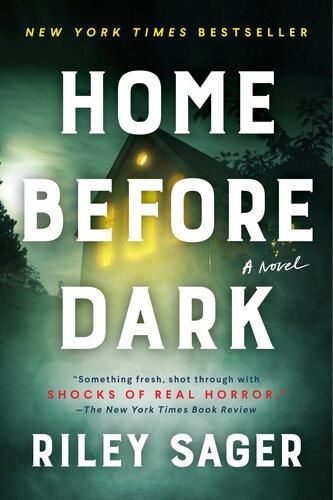
Home Before Dark
About this book
Maggie Holt spent only a few childhood weeks at Baneberry Hall before her parents fled. Her father turned that stay into House of Horrors, a bestselling account of supernatural terror that made Maggie publicly recognisable and privately skeptical.
After inheriting the Vermont estate, Maggie begins renovating and questioning neighbours who remember more than her parents admitted. The work exposes physical spaces and objects that do not fit the story she has spent years dismissing.
Chapters from the father's memoir alternate with Maggie's present investigation, creating two versions of the same rooms. Apparitions may be fiction, memory, manipulation, or warning, and the difference matters because a real disappearance remains attached to the property.
Home Before Dark is Riley Sager's haunted-house thriller about family authorship and the commercial afterlife of fear. Its paired narratives let the reader compare a polished horror story with the adult child who paid for its success.
Read a sample
5,002 words
Plain text
From the opening
PROLOGUE
JULY 1
“Daddy, you need to check for ghosts.”
I paused in the doorway of my daughter’s bedroom, startled in that way all parents get when their child says something truly confounding. Since Maggie was five, I suppose I should have been used to it. I wasn’t. Especially with a request so unexpectedly odd.
“I do?”
“Yes,” Maggie said, insistent. “I don’t want them in my room.”
Until that moment, I had no idea my daughter even knew what a ghost was, let alone feared one was occupying her bedroom. More than one, apparently. I noticed her word choice.
Them.
I blamed this new development on the house. We had been in Baneberry Hall almost a week by then—ample time to have noted its eccentricities but not long enough to have gotten used to them. The sudden shifting of the walls. The noises in the night. A ceiling fan that, when it spun at full speed, sounded like the clicking of teeth.
Maggie, as sensitive as any girl her age, was clearly having trouble adjusting to it all. At bedtime the night before, she’d asked me when we’d be returning to our old home, a sad and dim two-bedroom apartment in Burlington. Now there were ghosts to contend with.
“I suppose it can’t hurt,” I said, humoring her. “Where should I look first?”
“Under the bed.”
No surprise there. I had had the same fear when I was Maggie’s age, certain something awful hid in the darkness inches below where I slept. I dropped to my hands and knees and took a quick glance under the bed. All that lurked there was a thin coat of dust and a single pink sock.
“All clear,” I announced. “Where next?”
“The closet,” Maggie said.
I’d assumed as much and was already making my way to the bedroom closet. This section of the house—dubbed “Maggie’s wing” because it contained not just her bedroom but also an adjoining playroom—was located on the second floor, under the eaves of the sloped roof. Because of the room’s slanted ceiling, one half of the closet’s old oak door slanted as well. Opening it made me think of a storybook cottage, which was one of the reasons we decided the space should belong to Maggie.
“Nothing in the closet,” I said, making a show of yanking the chain dangling from the closet’s single lightbulb and peering between hangers draped with clothes. “Anywhere else?”
Maggie aimed a trembling index finger at the massive armoire that stood sentinel a few feet from the closet. It was a relic from the house’s past. An odd one. Over eight feet tall. Its narrow base gradually widened to a formidable midsection before suddenly tapering off again at the top. Crowning it were carvings of cherubs, birds, and strands of ivy that climbed the corners. I thought that, much like the closet door, it gave Maggie’s room a touch of literary magic. It brought to mind voyages to Narnia.
But when I cracked open the armoire’s double doors, Maggie sucked in a breath, steeling herself for whatever terror she thought waited inside.
“Are you sure you want me to open it?” I asked.
“No.” Maggie paused, and then changed her mind. “Yes.”
I pulled the armoire doors wide open, exposing a space occupied by only a few frilly dresses my wife had bought with the hopeful notion that our tomboy daughter might someday wear them.
“It’s empty,” I said. “See?”
From her spot in bed, Maggie peered into the armoire before letting out a relieved sigh.
“You know there’s no such thing as ghosts, right?” I said.
“You’re wrong.” Maggie slid deeper under the covers. “I’ve seen them.”
I looked at my daughter, trying not to appear startled, even though I was. I knew she had an active imagination, but I didn’t think it was that vivid. So vivid that she saw things that weren’t there and believed them to be real.
And she did believe. I could tell from the way she stared back at me, tears pooling in the corners of her wide eyes. She believed, and it terrified her.
I sat on the edge of her bed. “Ghosts aren’t real, Mags. If you don’t believe me, ask your mother. She’ll tell you the same thing.”
“But they are,” Maggie insisted. “I see them all the time. And one of them talks to me. Mister Shadow.”
A chill swept up my spine. “Mister Shadow?”
Maggie gave a single, fearful nod.
“What does Mister Shadow say?”
“He says—” Maggie gulped, trying hard to hold back her tears. “He says we’re going to die here.”
One
From the moment I enter the office, I know how things are going to go. It’s happened before. Too many times to count. And although each incident has its slight variations, the outcome is always the same. I expect nothing less this go-round, especially when the receptionist offers me a knowing smile as recognition flashes in her eyes. It’s clear she’s well-acquainted with the Book.
My family’s greatest blessing.
Also our biggest curse.
“I have an appointment with Arthur Rosenfeld,” I say. “The name is Maggie Holt.”
“Of course, Miss Holt.” The receptionist gives me a quick once-over, comparing and contrasting the little girl she’s read about with the woman standing before her in scuffed boots, green cargo pants, and a flannel shirt speckled with sawdust. “Mr. Rosenfeld is on a call right now. He’ll be with you in just a minute.”
Continue reading the sampleClose the sample
The receptionist—identified as Wendy Davenport by the nameplate on her desk—gestures to a chair by the wall. I sit as she continues to glance my way. I assume she’s checking out the scar on my left cheek—a pale slash about an inch long. It’s fairly famous, as scars go.
“I read your book,” she says, stating the obvious.
I can’t help but correct her. “You mean my father’s book.”
It’s a common misconception. Even though my father is credited as the sole author, everyone assumes we all had something to do with it. And while that may be true of my mother, I played absolutely no part in the Book, despite being one of its main characters.
“I loved it,” Wendy continues. “When I wasn’t scared out of my mind, of course.”
She pauses, and I cringe internally, knowing what’s about to come next. It always does. Every damn time.
“What was it like?” Wendy leans forward until her ample bosom is squished against the desk. “Living in that house?”
The question that’s inevitably asked whenever someone connects me to the Book. By now, I have a stock answer at the ready. I learned early on that one is necessary, and so I always keep it handy, like something carried in my toolbox.
“I don’t really remember anything about that time.”
The receptionist arches an overplucked brow. “Nothing at all?”
“I was five,” I say. “How much do you remember from that age?”
In my experience, this ends the conversation about 50 percent of the time. The merely curious get the hint and move on. The morbidly interested don’t give up so easily. I thought Wendy Davenport, with her apple cheeks and Banana Republic outfit, would be the former. Turns out I’m wrong.
“But the experience was so terrifying for your family,” she says. “I’d surely remember at least something about it.”
There are several ways I can go with this, depending on my mood. If I was at a party, relaxed and generous after a few drinks, I’d probably indulge her and say, “I remember being afraid all the time but not knowing why.”
Or, “I suppose it was so scary I blocked it all out.”
Or, a perennial favorite, “Some things are too frightening to remember.”
But I’m not at a party. Nor am I relaxed and generous. I’m in a lawyer’s office, about to be handed the estate of my recently dead father. My only choice is to be blunt.
“None of it happened,” I tell Wendy. “My father made it all up. And when I say all of it, I mean all of it. Everything in that book is a lie.”
Wendy’s expression switches from wide-eyed curiosity to something harder and darker. I’ve disappointed her, even though she should feel grateful I’m being honest with her. It’s something my father never felt was necessary.
His version of the truth differed greatly from mine, although he, too, had a stock answer, the script of which never wavered no matter who he was talking to.
“I’ve lied about a great many things in my life,” he would have told Wendy Davenport, oozing charm. “But what happened at Baneberry Hall isn’t one of them. Every word of that book is true. I swear to the Great Almighty.”
That’s in line with the public version of events, which goes something like this: Twenty-five years ago, my family lived in a house named Baneberry Hall, situated just outside the village of Bartleby, Vermont.
We moved in on June 26.
We fled in the dead of night on July 15.
Twenty days.
That’s how long we lived in that house before we became too terrified to stay a minute longer.
It wasn’t safe, my father told police. Something was wrong with Baneberry Hall. Unaccountable things had happened there. Dangerous things.
The house was, he reluctantly admitted, haunted by a malevolent spirit.
We vowed never to return.
Ever.
This admission—detailed in the official police report—was noticed by a reporter for the local newspaper, a glorified pamphlet known as the Bartleby Gazette. The ensuing article, including plenty of quotes from my father, was soon picked up by the state’s wire service and found its way into bigger newspapers in larger towns. Burlington and Essex and Colchester. From there it spread like a pernicious cold, hopping from town to town, city to city, state to state. Roughly two weeks after our retreat, an editor in New York called with an offer to tell our story in book form.
Since we were living in a motel room that smelled of stale smoke and lemon air freshener, my father jumped at the offer. He wrote the book in a month, turning the motel room’s tiny bathroom into a makeshift office. One of my earliest memories is of him seated sideways on the toilet, banging away at a typewriter perched atop the bathroom vanity.
The rest is publishing history.
Instant bestseller.
Worldwide phenomenon.
The most popular “real-life” account of the paranormal since The Amityville Horror.
For a time, Baneberry Hall was the most famous house in America. Magazines wrote about it. News shows did reports on it. Tourists gathered outside the estate’s wrought-iron gate, angling for a glimpse of rooftop or a glint of sunlight bouncing off the windows. It even made The New Yorker, in a cartoon that ran two months after the Book hit stores. It shows a couple standing with their Realtor outside a dilapidated house. “We love it,” the wife says. “But is it haunted enough for a book deal?”
As for me and my family, well, we were everywhere. In People magazine, the three of us looking somber in front of a house we refused to enter. In Time, my father seated in a veil of shadow, giving him a distinctly sinister look. On TV, my parents being either coddled or interrogated, depending on the interviewer.
Right now, anyone can go to YouTube and watch a clip of us being interviewed on 60 Minutes. There we are, a picture-perfect family. My father, shaggy but handsome, sporting the kind of beard that wouldn’t come back in style until a decade later. My mother, pretty but looking slightly severe, the tightness at the corners of her mouth hinting that she’s not completely on board with the situation. Then there’s me. Frilly blue dress. Patent leather shoes. A black headband and very regrettable bangs.
I didn’t say much during the interview. I merely nodded or shook my head or acted shy by shrinking close to my mother. I think my only words during the entire segment were “I was scared,” even though I can’t remember being scared. I can’t remember anything about our twenty days at Baneberry Hall. What I do recall is colored by what’s in the Book. Instead of memories, I have excerpts. It’s like looking at a photograph of a photograph. The framing is off. The colors are dulled. The image is slightly dark.
Murky.
That’s the perfect word to describe our time at Baneberry Hall.
It should come as no surprise that many people doubt my father’s story. Yes, there are those like Wendy Davenport who think the Book is real. They believe—or want to believe—that our time at Baneberry Hall unfolded exactly the way my father described it. But thousands more adamantly think it was all a hoax.
I’ve seen all the websites and Reddit threads debunking the Book. I’ve read all the theories. Most of them surmise my parents quickly realized they’d bought more house than they could afford and needed an excuse to get out of it. Others suggest they were con artists who purposefully bought a house where something tragic happened in order to exploit it.
The theory I’m even less inclined to believe is that my parents, knowing they had a money pit on their hands, wanted some way to increase the house’s value when it came time to sell. Rather than spend a fortune on renovations, they decided to give Baneberry Hall something else—a reputation. It’s not that easy. Houses that have been deemed haunted decrease in value, either because prospective buyers are afraid to live there or because they just don’t want to deal with the notoriety.
I still don’t know the real reason we left so suddenly. My parents refused to tell me. Maybe they really were afraid to stay. Maybe they truly and completely feared for their lives. But I know it wasn’t because Baneberry Hall was haunted. The big reason, of course, being that there’s no such thing as ghosts.
Sure, plenty of people believe in them, but people will believe anything. That Santa Claus is real. That we didn’t land on the moon. That Michael Jackson is alive and well and dealing blackjack in Las Vegas.
I believe science, which has concluded that when we die, we die. Our souls don’t stay behind, lingering like stray cats until someone notices us. We don’t become shadow versions of ourselves. We don’t haunt.
My complete lack of memories about Baneberry Hall is another reason why I think the Book is bullshit. Wendy Davenport was right to assume an experience that terrifying would leave some dark mark on my memory. I think I would have remembered being hauled to the ceiling by an invisible force, as the Book claims. I would have remembered being choked so hard by something that it left handprints on my neck.
I would have remembered Mister Shadow.
That I don’t recall any of this means only one thing—none of it happened.
Yet the Book has followed me for most of my life. I have always been the freaky girl who once lived in a haunted house. In grade school, I was an outcast and therefore had to be avoided at all costs. In high school, I was still an outcast, only by then it was somehow cool, which made me the most reluctantly popular girl in my class. Then came college, when I thought things would change, as if being away from my parents would somehow extricate me from the Book. Instead, I was treated as a curiosity. Not shunned, exactly, but either befriended warily or studied from afar.
Dating sucked. Most boys wouldn’t come near me. The majority of those who did were House of Horrors fanboys more interested in Baneberry Hall than in me. If a potential boyfriend showed an ounce of excitement about meeting my father, I knew the score.
Now I treat any potential friend or lover with a hearty dose of skepticism. After one too many sleepovers spent having a Ouija board thrust at me or “dates” that ended at a cemetery with me being asked if I saw any ghosts among the graves, I can’t help but doubt people’s intentions. The majority of my friends have been around for ages. For the most part, they pretend the Book doesn’t exist. And if a few of them are curious about my family’s time in Baneberry Hall, they know enough not to ask me about it.
All these years later, my reputation still precedes me, even though I don’t think of myself as famous. I’m notorious. I get emails from strangers calling my dad a liar or saying they’ll pray for me or seeking ways to get rid of the ghost they’re certain is trapped in their cellar. Occasionally I’ll be contacted by a paranormal podcast or one of those ghost-hunter shows, asking for an interview. A horror convention recently invited me to do a meet-and-greet alongside one of the kids from the Amityville house. I declined. I hope the Amityville kid did as well.
Now here I am, tucked into a squeaky chair in a Beacon Hill law office, still reeling from emotional whiplash weeks after my father’s death. My current mood is one part prickliness (Thanks, Wendy Davenport.) and two parts grief. Across the desk, an estate attorney details the many ways in which my father continued to profit off the Book. Sales had continued at an agreeably modest pace, with an annual spike in the weeks leading up to Halloween. Hollywood had continued to call on a semiregular basis, most recently with an option that my father never bothered to tell me about to turn it into a TV series.
“Your father was very smart with his money,” Arthur Rosenfeld says.
His use of the past tense brings a kick of sadness. It’s another reminder that my father is truly gone and not just on an extended trip somewhere. Grief is tricky like that. It can lie low for hours, long enough for magical thinking to take hold. Then, when you’re good and vulnerable, it will leap out at you like a fun-house skeleton, and all the pain you thought was gone comes roaring back. Yesterday, it was hearing my father’s favorite band on the radio. Today, it’s being told that, as my father’s sole beneficiary, I’ll be receiving roughly four hundred thousand dollars.
The amount isn’t a surprise. My father told me this in the weeks preceding his death. An awkward but necessary conversation, made more uncomfortable by the fact that my mother chose not to seek a share of profits from the Book when they got divorced. My father begged her to change her mind, saying she deserved half of everything. My mother disagreed.
“I don’t want any part of it,” she would snap during one of their many arguments about the matter. “I never did, from the very beginning.”
So I get it all. The money. The rights to the Book. The infamy. Like my mother, I wonder if I’d be better off with none of it.
“Then there’s the matter of the house,” Arthur Rosenfeld says.
“What house? My father had an apartment.”
“Baneberry Hall, of course.”
Surprise jolts my body. The chair I’m in squeaks.
“My father owned Baneberry Hall?”
“He did,” the lawyer says.
“He bought it again? When?”
Arthur places his hand on his desk, his fingers steepled. “As far as I know, he never sold it.”
I remain motionless, stilled by shock, letting everything sink in. Baneberry Hall, the place that allegedly so terrified my family that we had no choice but to leave, has been in my father’s possession for the past twenty-five years.
I assume he either couldn’t get rid of it—possible, considering the house’s reputation—or didn’t want to sell it. Which could mean any number of things, none of which makes sense. All I know for certain is that my father never told me he still owned it.
“Are you sure?” I say, hoping Arthur has made some terrible mistake.
“Positive. Baneberry Hall belonged to your father. Which means it’s now yours. Lock, stock, and barrel, as they say. I suppose I should give you these.”
Arthur places a set of keys on the desk and pushes them toward me. There are two of them, both attached to a plain key ring.
“One opens the front gate and the other the front door,” he says.
I stare at the keys, hesitant to pick them up. I’m uncertain about accepting this part of my inheritance. I was raised to fear Baneberry Hall, for reasons that are still unclear to me. Even though I don’t believe my father’s official story, owning the house doesn’t sit well with me.
Then there’s the matter of what my father said on his deathbed, when he pointedly chose not to tell me he still owned Baneberry Hall. What he did say now echoes through my memory, making me shiver.
It’s not safe there. Not for you.
When I finally grab the keys, they feel hot in my hand, as if Arthur had placed them atop a radiator. I curl my fingers around them, their teeth biting into my palm.
That’s when I’m hit with another wallop of grief. This time it’s tinged with frustration and more than a little disbelief.
My father’s dead.
He withheld the truth about Baneberry Hall for my whole life.
Now I own the place. Which means all its ghosts, whether real or imaginary, are mine as well.
MAY 20
The Tour
We knew what we were getting into. To claim otherwise would be an outright lie. Before we chose to buy Baneberry Hall, we had been told its history.
“The property has quite the past, believe you me,” said our Realtor, a birdlike woman in a black power suit named Janie June Jones. “There’s a lot of history there.”
We were in Janie June’s silver Cadillac, which she drove with the aggressiveness of someone steering a tank. At the mercy of her driving, all Jess, Maggie, and I could do was hang on and hope for the best.
“Good or bad?” I said as I tugged my seat belt, making sure it was secure.
“A little of both. The land was owned by William Garson. A lumber man. Richest man in town. He’s the one who built Baneberry Hall in 1875.”
Jess piped up from the back seat, where she sat with her arms wrapped protectively around our daughter. “Baneberry Hall. That’s an unusual name.”
“I suppose it is,” Janie June said as she steered the car out of town in a herky-jerky manner that made the Cadillac constantly veer from one side of the lane to the other. “Mr. Garson named it after the plant. The story goes that when he bought the land, the hillside was covered in red berries. Townsfolk said it looked like the entire hill was awash in blood.”
I glanced at Janie June from my spot in the front passenger seat, checking to confirm that she could indeed see over the steering wheel. “Isn’t baneberry poisonous?”
“It is. Both the red and the white kind.”
“So, not an ideal place for a child,” I said, picturing Maggie, rabidly curious and ravenously hungry, popping handfuls of red berries into her mouth when we weren’t looking.
“Many children have lived quite happily there over the years,” Janie June said. “The entire Garson clan lived in that house until the Great Depression, when they lost their money just like everyone else. The estate was bought by some Hollywood producer who used it as a vacation home for him and his movie star friends. Clark Gable stayed there. Carole Lombard, too.”
Janie June swerved the car off the main road and onto a gravel drive cutting between two cottages perched on the edge of an imposing Vermont woods. Compact and tidy, both were of similar size and shape. The cottage on the left had yellow siding, red shutters, and blue curtains in the windows. The one on the right was deep brown and more rustic, its cedar siding making it blend in with the forest.
“Those were also built by Mr. Garson,” Janie June informed us. “He did it about a year after the construction of the main house. One cottage for Baneberry Hall’s housekeeper and another for the caretaker. That’s still the case today, although neither of them exclusively works for the property. But they’re available on an as-needed basis, if you ever get overwhelmed.”
She drove us deeper into the forest of pines, maples, and stately oaks, not slowing until a wrought-iron gate blocking the road appeared up ahead. Seeing it, Janie June pounded the brakes. The Cadillac fishtailed to a stop.
“Here we are,” she said.
The gate rose before us, tall and imposing. Flanking it was a ten-foot stone wall that stretched into the woods in both directions. Jess eyed it all from the back seat with barely concealed concern.
“That’s a bit much, don’t you think?” she said. “Does that wall go around the entire property?”
“It does,” Janie June said as she put the car in park. “Trust me, you’ll be thankful it’s there.”
“Why?”
Janie June ignored the question, choosing instead to fish through her purse, eventually finding a ring of keys. Turning to me, she said, “Mind helping an old lady out, Mr. Holt?”
Together, we left the car and opened the gate, Janie June taking care of the lock while I pulled the gate open with a loud, rusty groan. Soon we were in the car again, passing through the gate and starting up a long drive that wound like a corkscrew up an unexpectedly steep hill. As we twisted higher, I caught flashing glimpses of a building through the trees. A tall window here. A slice of ornate rooftop there.
Baneberry Hall.
“After the movie stars came and went, the place became a bed-and-breakfast,” Janie June said. “When that went belly-up after three decades, it changed hands quite a few times. The previous owners lived here less than a year.”
“Why such a short time?” I said.
Again, the question went ignored. I would have pressed Janie June for an answer had we not at that moment crested the hill, giving me my first full view of Baneberry Hall.
Three stories tall, it sat heavy and foreboding in the center of the hilltop. It was a beautiful structure. Stone-walled and majestic. The kind of house that made one gasp, which is exactly what I did as I peered through the bug-specked windshield of Janie June’s Cadillac.
It was a lot of house. Far bigger than what we really needed or, under normal circumstances, could afford. I’d spent the past ten years in magazines, first freelancing at a time when the pay was good, then as a contributing editor at a publication that folded after nineteen issues, which forced me to return to freelancing at a time when the pay was lousy. With each passing day, Maggie grew bigger while our apartment seemed to get smaller. Jess and I handled it by arguing a lot. About money, mostly.
And the future.
And which one of us was passing the most negative traits on to our daughter.
We needed space. We needed a change.
Change arrived at full gallop, with two life-altering incidents occurring in the span of weeks. First, Jess’s grandfather, a banker from the old school who smoked cigars at his desk and called his secretary “Honey,” died, leaving her $250,000. Then Jess secured a job teaching at a private school outside Bartleby.
Our plan was to use the money from her grandfather to buy a house. Then she’d go to work while I stayed home to take care of Maggie and focus on my writing. Freelance pieces, of course, but also short stories and, hopefully, my version of the Great American Novel.
A house like Baneberry Hall wasn’t exactly what we had in mind. Jess and I both agreed to seek out something nice but affordable. A house that would be easy to manage. A place we could grow into.
When Janie June had suggested Baneberry Hall, I had balked at the idea. Then she told us the asking price, which was half the estate’s assessed value.
“Why is the price so low?” I had asked.
“It’s a fixer-upper,” Janie June replied. “Not that there are any major problems. The place just needs a little TLC.”
In person, Baneberry Hall seemed less like a fixer-upper and more like the victim of neglect. The house itself looked to be in fine shape, albeit a little eccentric. Each level was slightly smaller than the one preceding it, giving the house the tiered look of a fancy wedding cake. The windows on the first floor were tall, narrow, and rounded at the tops. Because of the shrunken nature of the second floor, the windows there were less tall but no less majestic. The third story, with its sharply slanted roof, had windows reduced to the point where they resembled a pair of eyes looking down at us.
Two-thirds of the house were constructed as rigidly as a grid, with straight walls and clean lines. The other third was completely different, almost as if its architect had gotten bored halfway through construction. Instead of boxlike efficiency, that corner of Baneberry Hall bulged outward in a circular turret that made it look like a squat lighthouse had been transported from the Maine coast and attached to the house. The windows there were tidy squares that dotted the exterior at irregular intervals. Topping it was a peaked roof that resembled a witch’s hat.
Yet I could sense the house’s disquiet. Silence seemed to shroud the place, giving it the feel of a home suddenly vacated. An air of abandonment clung to the walls like ivy.