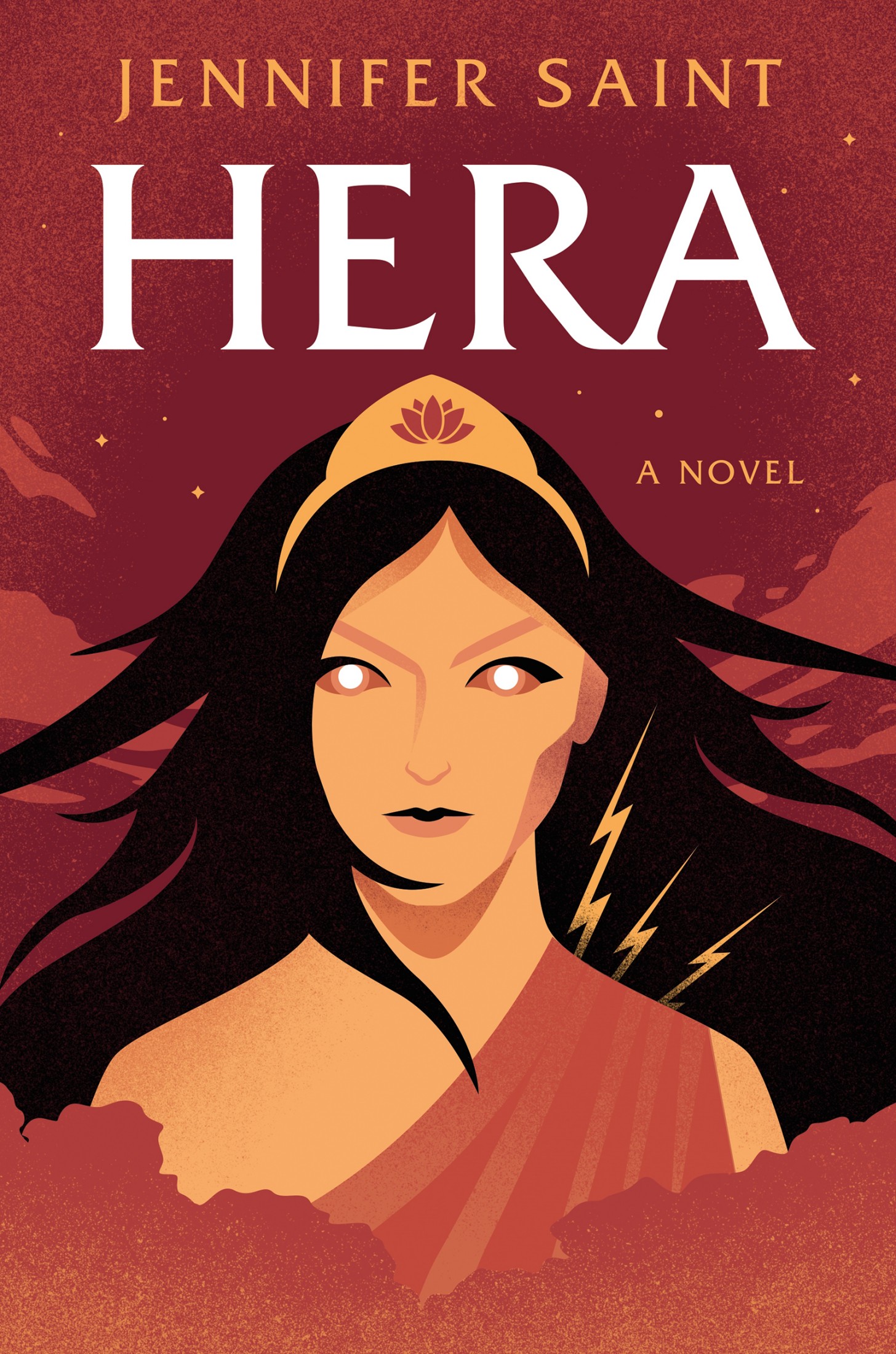
Hera
About this book
Hera enters the story as a warrior in the struggle against Cronus and the Titans. She expects the victorious Olympians to rule together, but Zeus consolidates authority around himself, and marriage to him gradually narrows a powerful goddess into the role later stories know best: wife, queen, and punisher of his lovers.
The centuries bring divine children, mortal favorites, rival cults, and the heroes whose fame depends on Hera's favor or resistance. From Heracles to the Trojan War, familiar myths look different when the queen of Olympus remembers the bargains and betrayals beneath their official order.
Jennifer Saint's novel does not make Hera innocent or gentle. It gives scale to her anger and examines how a goddess associated with marriage can become both enforcer and casualty of a system that excuses the king who repeatedly violates it.
Read a sample
5,058 words
Plain text
From the opening
PROLOGUE
The earth streams with molten gold. It flows in every direction, around the scattered rocks, gleaming in the light of the fires that rage all around. Ichor, the blood of the immortals, seeping into the soil.
Smoke hangs heavy in the air, obscuring the stars. Thunder rumbles in the distance, and the horizon flashes with lightning. It dances across the sky, leaping between the clouds, a glare that dazzles, white and blinding, and is gone, only to reappear somewhere else a moment later.
Hera glances up at it, narrowing her eyes to chart its progress as she steps across the ravaged battleground.
The falling dusk and swirling ash make it hard to see. The ground is churned up, great gashes in the earth where boulders have been heaved and trees torn up by their roots. Some of the mounds she skirts are these shattered rocks and mangled trunks, but some of them are not. Some are golden-stained, sprawled, staring glassy-eyed up to the heavens. Every now and then, one might stir painfully as she passes, let out a whimper of agony so that she raises her spear. She is swift and merciless, leaving silence in her wake.
Lightning sears the sky directly above her, its livid glow rendering every detail of the carnage in stark clarity for the space of a heartbeat before it dies away into darkness again. She listens, trying to distinguish the shrieking of the winds from another scream, one of anguish and rage. The earth is scarred and brutalised, but it is quiet at last. The fighting is in the heavens now.
The euphoric rush of victory still tingles through her body, but she senses something else too. As she walks on, her gold-spattered tunic damp against her skin, she feels the soft melancholy that hangs on the mist and drizzle. It rises from the vast craters; the wounds carved deep into the ground. It is the sorrow of Gaia that she feels. Gaia, the first of them all. The goddess of the earth, who bears the pain of this violation.
Hera glances around her, making sure that nothing else is still moving. Satisfied, she kneels, and rests her palms on the gold-stained mud. Her touch is gentle and reverent, her eyes closed, as she prays. One goddess to another; a holy moment of gratitude to the mother who had birthed them all: the Titans who lie bleeding and the warriors who fought at Hera’s side.
There has been so much suffering.
Hera opens her eyes and looks to the heavens, where the thunder is reaching its crescendo. It growls from the furthest edge of the horizon, the rage building as it echoes across the mountaintops, loud enough to split the rocks apart and send them tumbling down the steep slopes. Lightning shears the skies over and over, hurled by Zeus to bring down the last Titan still standing.
Her brothers and sisters are up there with him, fighting side by side. Hera’s battle-mates on the ground were not gods; they were Gaia’s monsters. Creatures of nightmare nurtured in the deepest caverns of Gaia’s womb, broken free to aid in this war against the Titans. Before Gaia had sent them, the two sides were evenly matched. Cronus and his five brothers had ruled the heavens since they overthrew their own father, Ouranos. Hera, Zeus and the other four children of Cronus had the advantage of youth – they were full of fiery rebellion, eager to seize the world. But the six Titans were experienced, they were crafty and they were long-enduring. And so, years of war have passed in spasms of frantic, boiling chaos punctuated by desperate councils where the gods proffered the same tactics over and over, and Hera saw her own frustration at the unending stalemate mirrored in Zeus’ eyes.
And then the three Hecatoncheires lumbered forth from the earth, sprouting fifty heads from each thick neck and a hundred arms bulging with muscle. The three Cyclopes followed, each with one vast eye in the centre of their craggy forehead. The gods turned their perfect faces away from them in distaste. But to Hera, their strength was beautiful.
Now Hera’s monstrous warriors come forth again, clanking bronze chains as they walk, their silhouettes massive against the incandescent sky. They spread out across the battlefield and begin to bind the defeated Titans, who have fallen to Hera’s blade or been crushed by the monsters at her side. Not that they can truly die; she knows that. The same golden blood runs in her own veins, and ichor is strong enough to sustain her through any injury, however grievous. It will sustain them too, just enough to keep them alive in this broken, battered state. It is the closest to death that an immortal can ever come. They are beyond resisting, unable to move or make a sound, drained and beaten to almost nothing.
The ground shudders. This is the end. Cronus, their father, who battles now against Zeus in the mountains, cannot stand against them alone. His allies are shackled at Hera’s feet, his children united against him, and even as his howl of fury rings out across the vast sky, she knows he is already beaten.
The age of the Titans has collapsed.
The rule of the Olympians begins.
Continue reading the sampleClose the sample
PART ONE
Come, blessed Goddess, fam’d almighty queen, with aspect kind, rejoicing and serene.
The Hymns of Orpheus XV: Juno [Hera], translated by Thomas Taylor, 1792
1
After the war is over, Gaia’s earth heals. In the years that follow, the plains where Hera cut down the Titans become meadows, and flowers grow in wild profusion where their blood soaked into the soil. The raw edges of the craters soften into gentle, grassy slopes. Hera strolls over them, and she remembers, This is where I led my monsters, this is where I plunged my spear into my enemies’ flesh, and the sunlight warms her skin. When she comes across pools that once glistened with golden blood, she smiles at her unchanged reflection in the clear water. Birds fly across skies that were once fractured with Zeus’ lightning, skies that now stretch blue and cloudless to the horizon.
In the war, time was measured in skirmishes and strategy. Now, Hera charts its passing by the trees that grow where the battlefields were; thin saplings becoming forests of broad-crowned oaks and towering pines.
It’s from such a forest that she emerges now, slipping out from between the wide trunks into the afternoon sunshine, her cheeks flushed and her eyes sparkling. She shakes out her hair, plucking a leaf from the dark waves tumbling down her back. Her skin is still warm and tingling as she hurries towards the mountain that rises up from the landscape, higher than any around it. She pictures the river-god she leaves behind her in their secluded glade; in her mind’s eye, she sees him bathing under his foaming waterfall, his thick chest gleaming in the spray, droplets glistening on his strong arms. She casts a longing glance back. These hazy days of peace afford a freedom that Hera never knew before. But today, she has somewhere she needs to be, and she moves briskly on.
When Cronus ruled, Hera was hidden away and raised in the darkness of the house of Oceanus beneath the waters. She can remember what it was like, hearing the great river above her, its distant thunder surging over the rocks, trickling down through the mud, tingeing the air she breathed with the scent of damp earth. Now she is free, and every joy is hers to discover. She is a goddess revelling in the infancy of the world. A warrior who fought side by side with giants. A girl delighting in birdsong. Reigning in the heavens alongside her siblings; laughing in the woods with her lovers. A sister, curled up by the fire, exchanging confidences, her face open and warm in the glow of the cosy flames.
She eyes the distant mountain. She can traverse great distances and never tire, but she decides to take the form of her preferred bird, the hawk, to get there now. Her body ripples in transformation, and she takes to the air, the ground dropping away. Since the war, no god has seen Gaia, but she has rewarded them with more and more bounteous life, and all of it is laid out beneath Hera now: silver schools of fish in the waters, bears and lions to prowl the forests, creatures that creep and slither and scamper, furred and feathered and scaled. On the plains, horses run wild, kicking up dust behind them, and Hera sees her brother Poseidon, darting between them, swinging himself on to their backs, seemingly just for the joy of galloping. He’s on his way to Mount Olympus too, the seat of the victorious gods, the mountain home that has given them their name. Up the steep slopes, past the ragged pines whose branches are stripped by the wind that whistles through the peaks, beyond the rough boulders, where the fresh tang of scattered snow is sharp in the air and the clouds wreathe around bare rock; from here, they can watch the world beneath them. The palace they have built is a feast for the eyes: shining white marble and gleaming gold columns so cold and smooth they could be carved from ice, every line and corner straight and sharp and flawless. It’s nothing like the rugged perfection of Gaia’s creation, Hera sometimes thinks. Its glory comes not from the wild and beautiful chaos of the earth below, but from order, and that’s more pleasing to her than anything else. After the tumult of war, they lift themselves now beyond the grasp of any possible usurper.
No one can challenge us, Zeus had said when it was all over. Hera thought no one would dare.
The victorious Olympians chained their father and four of his Titan brothers in the deepest bowels of the earth, a pit called Tartarus from which they can never escape. They will live out eternity in its darkness, sunk so deep that all their power and ferocity can’t shake even a pebble on the surface. Only one of Cronus’ allies, his nephew, Atlas, was spared the pit. He stands at the western edge of the world, the crushing weight of the heavens resting on his shoulders. His bowed, weary stance serves as a reminder to the other Titans – the Titans who didn’t fight, who now live free under Olympian rule – that they were right not to join the battle. A warning to them in case they ever doubt it; in case their allegiance to the Olympians should ever waver.
Hera keeps a close eye on these peaceful Titans. When Zeus consigned the five brothers to the pit, their skills went with them. Hyperion, who had commanded the sun, will never see its light again. It’s his children who perform his role now. Hera oversees, makes sure they never deviate. And sure enough, each morning, Eos appears, Hyperion’s daughter, Titaness of the dawn. The horses tethered to her chariot whicker softly, and Hera looks for the glitter of their wide, dark eyes reflecting the light of the morning star as they emerge from the banks of Oceanus and begin their climb through the dim air. Far above, Eos’ sister, Selene, withdraws slowly, the great silver orb of the moon gliding away with her as Eos makes her ascent to the heavens, strewing radiant sparks of fire through the dying night. Her rosy fingers trail through the sky, the bottom edges of the clouds blooming with pink feathery streaks of light where she touches them. Eos will give way to her brother, Helios, whose horses will charge forth, a crown of rays flashing atop his head, his gaudy procession through the skies relentless and unstoppable. But for a moment, the world is held still on the cusp of a new day and Eos, mother of stars and winds, laughs as her sons wreathe around her, their caresses lifting her hair and fluttering across her face in a scatter of gentle kisses. It unfolds the same way each time: regular, predictable, ordered. The days stack up, and no one cares to count how many. What matters to Hera is that each one happens as it should.
The sky behind the palace is white, merging with the shining stone. Wisps of cloud flutter past the graceful columns as Hera ascends the final stretch of the mountain. She has taken her goddess form again, preferring to climb. She likes to feel the rough surface of the rock beneath her smooth feet, the bracing shock of snow between her perfect, immortal toes. Sometimes a snake will dart from its hiding place, coil around her ankles and be gone again, and she’ll laugh out loud, relishing the sensation of its sleek power against her skin.
A bird swoops past, its wingspan wide enough to blot out the sunlight for a moment. An eagle; hardy enough to brave this bleak, rocky elevation. Hera likes its hooked beak, its sharp claws and the vast sweep of its wings, though she loves smaller birds better, the ones that rest on her palm, their heartbeats thrilling against her thumb.
The eagle is Zeus’ choice, and of course he is here with it now, on the wide marble steps that lead up to the gates of Olympus. It dives towards him, landing on his outstretched arm. It ruffles its wings, tucking them at its side as it dips its head into his palm. Zeus smiles at the bird as it stretches its throat back and swallows his gift. Something crushed and bloody, still warm.
When he sees Hera, his face brightens. ‘Where have you been?’ he asks her. The bird’s long black claws sink into his forearm, but of course they cannot puncture his skin.
‘Nowhere in particular.’
He gestures to her to walk with him, and the eagle, affronted, takes to the skies again.
Zeus’ appearance still takes Hera by surprise sometimes. Part of her expects to see the boy-god she knew on Crete, before the war. When it was only the two of them, hungry to claim their birthright. On Olympus, he has assumed a more regal dignity. A thicker beard, an air of authority. His words don’t tumble out so quickly anymore. But she still sees his delight in her presence, just the same as the first time they met and each of them realised they weren’t alone.
On the other side of the gates, the courtyard shimmers in the soft light of the sun. A haze hangs in the sky beyond, cloaking the other mountaintops in the distance. Hera would lean over the low wall, letting the cold breeze lift her hair – there is almost nothing she likes better than to survey the world from up here – but there are nymphs draped across the benches, giggling together, and she stands up straighter.
‘Isn’t there something they should be doing?’ she asks, and Zeus shrugs.
‘There will be.’
It’s frustratingly vague as an answer, and a challenge is already forming on her lips as she whips her head around towards him, but the words die in her throat when she sees his eyes are already locked on her, warm with amusement.
‘Is this what you do all day, check up on all the Titans and the nymphs, make sure everyone is usefully occupied?’ he asks. ‘Is there no better use of your time?’
She doesn’t think there is anyone in the world who speaks to her as directly as Zeus does. Nobody else would dare.
‘Don’t you think it’s important to know how your subjects spend their time?’ she counters. ‘And that they’re kept busy?’
‘In case they use their freedom like we did?’ he asks, and it takes her by surprise. To make even a joking reference to an imagined rebellion – it feels shocking, profane even. ‘These girls,’ he goes on, and he shakes his head, smiling. ‘There’s no cause for worry.’
There are a dozen retorts she could make, but he’s probably right about the nymphs. Hera watches them chatting breathlessly to one another, winding their hair around their fingers, their voices high and thin as they lean inwards, flutters of their conversation drifting across the perfumed air. They don’t look as though they’re intent on toppling any regime. They’re not like Zeus and Hera were.
‘Perhaps I shouldn’t, then,’ she says. ‘Worry, that is.’
He takes her arm, easy and confident. ‘Of course not.’
He doesn’t give any indication that he knows where she’s been, or what else she might do on her wanderings. There’s no teasing insinuation about her riverside trysts – today’s or any other – no raised eyebrow, no jokes like the ones he makes with his brothers about his own dalliances.
She’s glad. She likes to have secrets. Maybe she grew used to that in the old days, perhaps it’s a habit she can’t shake – the desire to hold something close to her heart and keep it just for herself, not for anyone else.
They pass through the columns, into the megaron. Four golden pillars in the centre hold up the ceiling. Hera’s eyes are drawn immediately to the seven golden thrones that line the far wall; they are new and startling, the sight of them sending a little thrill through her body. Poseidon is here already, ahead of her. The hearth burns bright as always, crimson flames casting dancing shadows on to stone. Hestia glances up from her low seat beside it and smiles at Hera as she enters. A flurry of voices and a clatter of steps announce the arrival of Demeter and Hades. Now the six siblings are together, and only Aphrodite is still to come.
‘Where is she?’ Zeus sounds annoyed.
‘You know she does as she pleases.’ Hera slides on to the bench next to Hestia.
‘She’ll be here,’ Hestia assures him.
There’s a tension in his shoulders. Demeter and Hades chatter on blithely, and Poseidon scowls into the fire. It’s only Hera who recognises Zeus’ mood, and she can’t resist provoking him.
‘Do you think she’ll miss it, though?’ she asks, her eyes round with innocence. ‘Because that would mean…’
His eyes darken, but at that very moment, Aphrodite sweeps in. Hera smiles sweetly. Nothing will puncture her good spirits today.
Zeus clears his throat and the gods fall silent. He gestures to the new thrones. ‘Sit,’ he says. ‘The Titans will be on their way.’
He takes the centre throne. Hera sits at his right. Poseidon sits on the other side, Hades next to him and Aphrodite at the end. Demeter takes the throne beside Hera, and Hestia the last. For a moment, they are silent and still. The gold feels cool where it touches Hera’s skin – the hand she rests on its side, the backs of her arms and the shoulder left bare by her draped dress.
Then one of the nymphs from the courtyard, her face serious now, opens the arched doors and ushers in the Titans.
The gods of the old world stand face to face with the new. Helios stands among them, crowned with golden rays; there is silver-horned Selene, and Eos clad in a rosy gown. Oceanus and Tethys, risen from the depths of their vast river, their robes trimmed with coral and pearl. Styx of the underground river that branches from theirs. Klymene, the mother of the beleaguered Atlas, her sweet face shadowed. Her husband languishes in Tartarus with Cronus; her son strains under the weight of the sky. But she is still here, in the Olympian palace.
‘Styx,’ Zeus says, and the Titaness steps forward. ‘You were the first of the Titans to come to me in the war and swear your loyalty to us instead of to Cronus and his brothers.’
Her gaze is steady, her dark eyes fixed on his.
‘You preside over the river that flows from the upper world to the lower,’ he goes on. ‘In gratitude for what you did for us, we will honour your stream now. Its waters will be the waters that all gods will swear oaths on from now on; oaths that will be as unbreakable as your word.’
He takes her hand, and looks out across the watching Titans. ‘We are all descendants of Gaia.’ His voice rolls across the silent hall like distant thunder. ‘A family, coming together in peace now the suffering of war is over. We welcome you here on Mount Olympus.’
No Titan betrays their thoughts. Every immortal face in the room is smooth, devoid of expression.
‘But,’ Zeus goes on, ‘we must make sure that the mistakes of the past are never repeated.’ His thunderbolt is tucked into his belt; the slender, pronged weapon that the Cyclopes forged for him, that could crumble the mountain beneath their feet if he wished. ‘The rule of the Titans that came before us was cruel. Ouranos, the sky-Titan, subdued Gaia in marriage and imprisoned her children. The world was crushed beneath his weight, stifled by his tyranny. It was only when Gaia gave her youngest son, Cronus, the sickle he would use to slice his father apart and scatter the pieces to the winds that the world would know freedom.’
For Hera, his words conjure the drifting fragments of the vanquished Titan; diffuse and weakened, floating on the breeze, an echo of the powerful king he once was.
‘The castration of Ouranos gave us Aphrodite.’ Zeus nods towards the goddess on her throne, and she smiles, lifting the solemnity in the room for a brief but dazzling moment. ‘His blood mingled with the seawater, and she was born from the foaming waves. But Aphrodite’s loyalty was never to Cronus. She would join with us against him.’ He nods emphatically. His thunderbolt is a warning to anyone who would not fall in line, but Aphrodite is an enticement. Her beauty, her allure, calls to everyone in the room far more seductively than Zeus’ lecture.
Still, he recites their history, one they all know intimately. ‘After Cronus toppled Ouranos, he married Rhea, his sister. But in fear that his own son might do to him what he did to his father, he plucked each infant she bore him from her arms and swallowed them whole. Hestia, Demeter, Poseidon and Hades. Only Hera and I were saved, spirited away by Gaia – Hera to the halls of Oceanus and me to Crete, to be raised by Metis.’
Hera catches the eye of the Titaness of whom he speaks. Metis looks back at her, the same grey eyes that Hera remembers from when she came to Crete to join her brother. Zeus spoke of Styx as though she was their first Titan ally, but before her there were Oceanus and Tethys, who had taken in Hera, and Metis, who hid Zeus away in the foothills of Mount Dicte. It was Metis who trained the two of them together for war. Metis who prepared the emetic herbs that she would use to trick Cronus later, so that he would bring his swallowed children back up. Hera wonders why it is only Styx that Zeus honours here today; perhaps he holds some other reward in store for Metis.
In this airy hall, where the gold shimmers in the firelight, where the gods are strong and young and glorious, the old savagery seems so very long ago – an age of darkness they have banished forever.
‘No Titans will rule again.’ Zeus echoes her thoughts. ‘We will never return to those days. Every one of you will swear today, just as Styx once did, that your allegiance is to us. The oath you swear will bind not just you, but your children as well, even those not yet born.’
There is no dissent. Hera doesn’t know what each Titan thinks as they step forward, one by one. It doesn’t matter, so long as they pour the water from the jug held by Styx, and swear upon its silvery stream that they will serve the Olympians. The peace they have won will be eternal.
When it’s done, the Titans depart and the atmosphere lightens. The Olympians descend from their thrones and sit instead on low benches, cushioned with shaggy furs, and sip sweet nectar from polished horns. Hera breathes in its fragrance. The honeyed spices rising from the thick, amber liquid are rich and intoxicating. Outside the palace, the sun sinks low behind the mountain, the sky alight with the same fiery shades as the nectar that she swirls one way then the other, watching it gleam as it catches the torchlight.
The gods are convivial, congratulatory as they talk and feast. Serving-nymphs bring platters of roasted meat, honey, cheese and figs, followed by the sweet ambrosia that is the privilege only of the gods. Demeter is animated, expressive, gesturing with her hands in the air to sketch out the shape of growing plants, and when she shakes back her hair, it ripples down her back and Hera thinks of leaves swaying in the breeze. Her sister smells of the earth after rain, fresh and vital and invigorating.
‘And how was your watch today?’ Hestia murmurs to Hera. ‘Is the world still in order, like always?’ She leans in close, the scent of smoke, a crackle of embers, a comforting sense of home and safety emanating from her.
‘Everything is the same,’ Hera answers, and she feels a fierce gladness at her own words. A satisfaction as she looks around the table. Aphrodite curves her lips at some private thought. The aroma of rose petals rises from the smooth, bare skin of her arms and neck. She has them crushed in golden oil, rubbed into her flesh when she stands up from her fragrant bath, and it always drifts behind her, a seductive trail in the air.
Hera notices the dust clinging to Poseidon’s forearms where his elbows rest on the table, his fingers interlinked beneath his chin. His eyes are dark and surly as ever, but tonight they seem fixed on Hestia, who keeps her face determinedly turned towards Hera.
‘And you?’ Hera asks, flicking her gaze to their brother and back, a pointed gesture for Hestia and no one else. She wants to know what’s going on, why Poseidon stares so.
Hestia shakes her head a fraction, rolls her eyes. ‘The same … for now.’ Perhaps she has no explanation either. She’s looking at Zeus and Hades now, the two of them deep in their own conversation. Every now and again, Zeus’ booming laughter rolls around the hall, an echo of thunder.
The conversation turns, as it always does, to their victory over the Titans. They never tire of bringing out the same stories, each of them eager to speak of their own bravery and decisive action at each moment of peril. Hera enjoys it just as much as the rest of them. She appreciates it all the better – the magnificent hall, the attentive nymphs, their seat in the clouds – when she remembers a time before these luxuries.
When Hera ascends to her chamber later, it is in a haze of contentment. Their seven thrones work. The continuation of the world proves that it works. Power shared between them, not one tyrant growing ever more solitary and ferocious.
Hera sleeps. The nectar and ambrosia she consumed replenish the ichor in her veins, strengthening her. In repose, any trace of wary watchfulness drops away from her. Her face is unchanged since she grew to womanhood. Aeons of war and an infinitude of peace have left no lines, no mark on her immortal flesh.
2
Demeter prefers to spend her time roaming rather than staying too long on her throne in the airy megaron of their palace. Zeus, Poseidon and Hades sprawl there more often than not, while Hestia prefers the cosy warmth of the hearth. Hera divides her time equally between the outside world and her royal seat. But when Hera wanders, she doesn’t forget how they won this freedom, and how closely they must guard it. She is ready for any sign of dissension, for the Titans to stray from their allotted tasks. They never do.
Other immortals swell their ranks; another tier of deities born. Zeus is busy consolidating their alliances. The Titaness Mnemosyne gives him nine daughters, and he calls them Muses. They aren’t charged with responsibility to keep the sun in the sky or the rivers flowing; they are blessed with beautiful voices that they lift together in song. What they sing of most often is the victory of the Olympians. The battle of gods and Titans will never be forgotten, Hera realises. The old rule of Cronus is hazy now, his cruelties left far behind in the past. But the Muses will keep the celebration of the gods alive. Hera thrills a little when she hears her own name in their songs.
She notes when more are born; when Zeus invites the Titaness Themis to counsel him – Themis, whose clear sight and foreknowledge of the future must have given her an inkling of what the outcome would be – and with her come her daughters, the graceful Horae who tend to the earth, and the three Fates. The task of the Fates will be to allot the lifespans of the mortals Zeus and Prometheus are bent on creating. Hera hears the two of them discussing it whenever she comes back to the palace, and she wonders at their vanity. It is Gaia who brings forth creation; it is goddesses and Titanesses who give birth. Zeus and Prometheus shaping dolls from clay is not how life is made. Cronus had attempted it before them, and his mortals had been too feeble to survive long in the world. She thinks that Zeus should be satisfied with his divine offspring, and leave Cronus’ failed experiments in the past with the rest of his rule.
Even their sister Demeter bears him a daughter, an infant called Kore. Hera wonders at this liaison more than any of the others. The gods do as they please, act on their whims and follow their desires, but somehow she is still surprised when Demeter swells and ripens like the fruit trees she nurtures, and attributes it to Zeus.