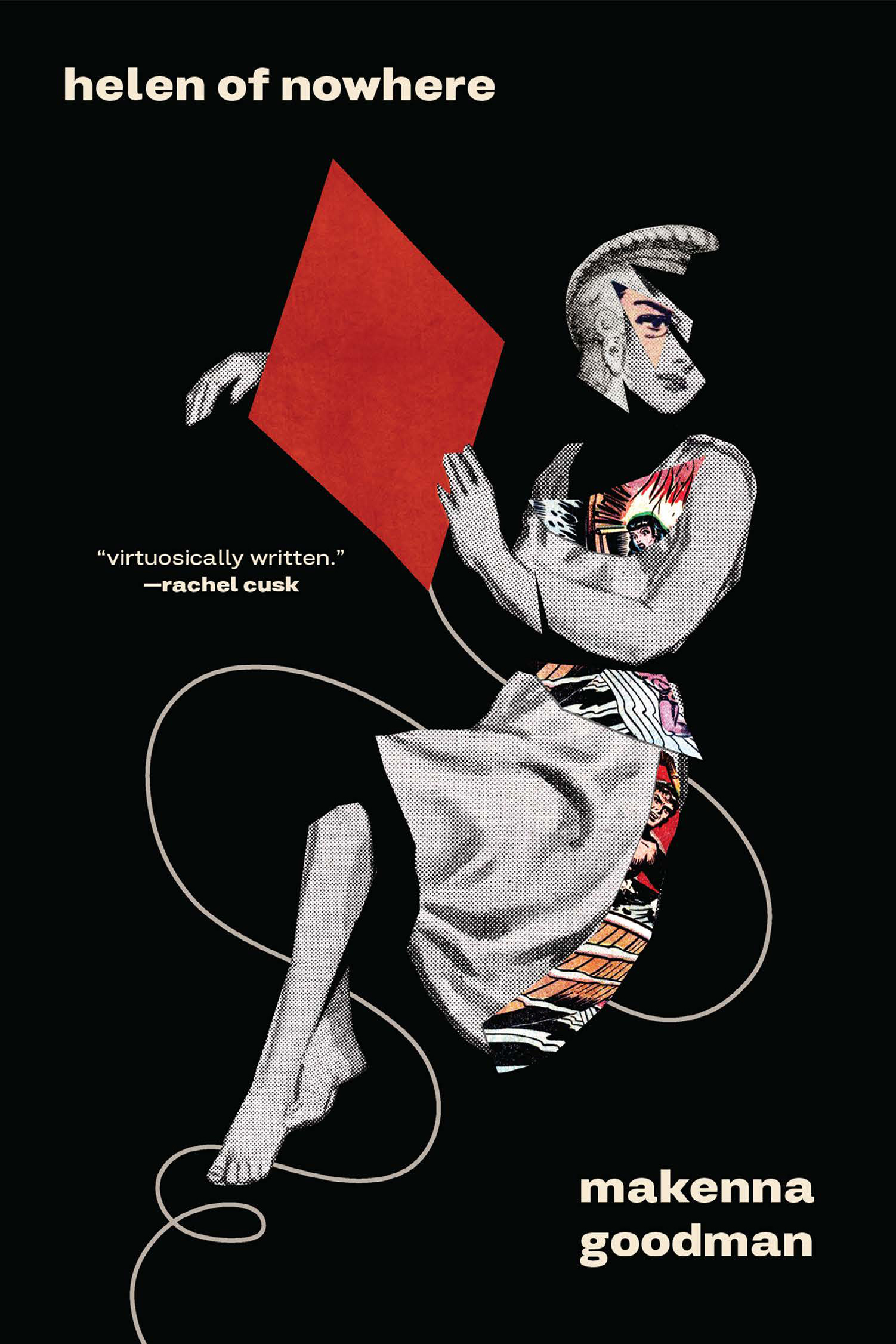
Helen of Nowhere
About this book
A realtor shows a man around a rural property at a moment when his academic career and former identity have collapsed. The house promises simplicity, distance, and the chance to begin again without the witnesses to his failure.
The realtor's account of the previous owner, Helen, gradually becomes more compelling than the usual details of rooms and land. Her choices seem to offer a complete alternative life, yet her continued presence in the house is difficult to classify as memory, salesmanship, or something stranger.
As daylight fades, the viewing turns into an argument about whether another person's way of living can be acquired with the property that contained it. The buyer must consider what he hopes to escape and what the apparent fresh start will require him to surrender.
Helen of Nowhere is a short, formally adventurous standalone novel. Makenna Goodman uses a real-estate tour to examine disgrace, rural fantasy, and the unsettling price attached to a life that appears self-sufficient.
Read a sample
5,038 words
Plain text
From the opening
ACT 1 MAN
I think it’s okay to tell a woman she’s beautiful once a year. Any more than that and her life will be about being beautiful, entirely. Anything less and she’ll feel a lack of love and attention. My wife always said I never told her she was beautiful enough. But like I said, I don’t think it’s good for women.
Someone told me that life is a collection of details you choose to pay attention to. Most of my life has been taken up by my work, but since my work has always been about observing nature, I consider my life’s work all about paying attention. This is what I told my students: The world is to be observed, and observing for its own sake is a life worth living.
The house, for example, was warm, despite its being unfurnished, with simple wooden features and beams containing echo strokes of a handheld chisel. There was a built-in couch with a dark blue fabric cushion, its edges sewn by hand, somehow both right-angled and arched in a crescent shape. Beside it, an ornate cast iron wood stove. The windows were large, single-paned. There was a piece of upright wood in the corner, a gnarled tree or trunk that had been elevated into something sculptural. Besides that, nothing but gleaming, empty space.
I was in the middle of nowhere. I was looking for a simpler life. I had driven all day, alone, to get there.
Everything had become so useless and vast, like acres and acres of lodged wheat.
My life had been lived in tune with one philosophy, which is this: within nature exists the divine. That’s all. And because the tools of human construction have warped the meaning of things like songbirds, it is the work of teachers—and people—to remove our constructions, and upon their removal, invoke our innate ability to engage in simply being. Nature is the teacher, not I, is what I always told my students.
I built my department from scratch around this beautiful idea. We read and wrote, but the greatest work of all was to remove ourselves from the politics of the city and allow the voice of nature to speak to us, through us. Through the act of such communion, our own true nature might reveal itself. We wrote for ourselves and also as a way to translate nature’s teachings for others. It was enough to witness the patterns of plants, the footprints of deer, the movement of grasses in the wind. This witnessing led to the transcendence of the human spirit.
My program was lauded for its experiential approach, and as such, funding was never hard to find. For years we cultivated a transformative practice through a curriculum combining time spent in natural spaces alongside the study of texts left by humble thinkers who spoke lovingly of the earth and the desires of the heart. I would take students out to wild places around the city, separate them, and alone they would observe, for three full days and two full nights with basic food and rudimentary shelter—no matter the weather or risk—the divine relationships in nature and the thoughts that were born.
Time passed.
And with it came a new generation of teachers.
Women, who were critics, and who encouraged others to be critical too.
Critical of me, among other subjects. Of my work. I don’t think I am wrong to say that they took a special pleasure in criticizing my field of interest.
Who is allowed to feel at home in this so-called nature, they asked, and what are the conditions informing the peace provided those people by the simplicity I espoused? The new generation of teachers said that my approach to teaching was a purity test, the imposition of ritualized discomfort in nature as a means of cultivating virtue.
They questioned my methods.
They rejoiced to find in my hunt for simplicity and silence a complexity of ambition and prejudice.
But in their own hunt for complexity, they were oversimplifying.
I had nothing against women.
In fact, I loved women. I’d worked hard for women my entire life.
It just so happened these new teachers were women. I swear it didn’t factor at all into my disdain for them. I didn’t like to think of myself as a man, even, as I was so much more than just man. But they were times of taxonomy.
One of these women accused me of overidentifying with my work. She was a writer who gave a captivating performance at faculty meetings. I found her prose was good at the sentence level, but her vision was still developing. She pointed out problems with my thinking. She wanted to discuss everything on a structural level. Our colleagues found her funny. She was magnetic, self-absorbed, convincing in her beliefs, arrogant in her delivery, annoying, reductive. She interrupted me, she disliked me.
She was successful, widely praised.
And she was close friends with my wife.
Three years, and I had been drinking.
My wife was, at one time, a very beautiful woman. But over time, her beauty faded, and with it went her desire for me. There were so many years of notoriety that had held us together, my success, her adoration, my appreciation, the agreements we had made.
It likely wasn’t fair of me to see her beauty as fading, it would have been fairer to see it as maturing, and yet if I’m being honest it really did look to me as though it were withering not ripening.
Continue reading the sampleClose the sample
At first the changes in my position were devastating, even though they were largely ideological. It wasn’t violent, but quiet. My wife and I would weep gently in each other’s arms.
And yet with time, the lower I felt, the brighter she became, though to me that brightness felt punishing, like exiting a theater at midday.
I had lost everything. And at the beginning, she felt she had lost everything too. It was a shared loss that at first brought us closer together. There wasn’t a way for us to remain viable without my career, we told ourselves. It was what provided us an excuse to remain in tandem. The university was our container, it was where we had met, it was where we had formed.
But I had died.
That is, I became dead. To the world, and to me.
And yet she was alive, my wife said.
Her dog enjoyed my spot on the bed.
She would caress it while I lay far out, pushed to the edge. Such gazing, such devotion. She would invite it on the blanket and rub its long, blond ear.
Early in my career I taught a nature writing class to a small number of students, each of whom was meant to research a plant that interested them.
Every meeting we would discuss a different student’s work by performing a collective interrogation, all of us asking one student questions rapidly in succession about their plant and their pasts as a way to access something deeper. The student in question would become flustered and exposed, providing an opening for their subconscious to emerge. These questions and answers, paired with a botanical inquiry into the plant they had chosen, culminated in a lyrical theory of each student’s driving inquiry, which was eventually revealed. This aided them in their writing—it gave them a root.
One of my students was beautiful.
Although I didn’t look at my students through the lens of desire, it was impossible not to notice her beauty, and I did so objectively.
She chose for her plant, Gomphrena, a tender annual with lovely, papery, globelike heads. Called the Amaranth of poets, this flower was considered the emblem of immortality, and was said to have been worn by the Thessalians at the funeral of Achilles. If cut before fully ripe, tied in bunches and hung upside down to dry in the airy dark, Gomphrena would retain its color for the entirety of the season, lasting seemingly forever in a dried bouquet.
The young woman said it was the power of influence she wanted to explore. She wanted to investigate who had it, and how it worked. How did power propagate.
This was the start of many long conversations, and our classes often went over, but no one complained. We read both horticultural and literary texts and discussed them at length, writing reflections and responding to each other’s ideas, and at the end of the term, we presented our finished work. I didn’t present myself, but I still say “we.” It was an experiment in collaboration, in alchemizing ideas out of plants. It was meant to show how the history of human evolution arises from our literary relationship to the earth. The class was called “True Nature.”
My beautiful student was last to present her work.
She said to think of a truth in nature is absurd. The birds, the flowers, the trees, the soil—each of these entities had a history that preceded its current state, and each stage of that history was informed by both regeneration and violence, and political and environmental factors that impacted it directly and indirectly. If there was any truth to be discovered, it was that nature itself was not neutral, and any so-called purity was imposed upon it by those of us with the need to use nature as a shield from our own complicity with systems of destruction.
It was impossible to simply “be” in nature, she said, without complicating the notion of “nature” itself, just as a border has nothing to do with the land’s actual requirements for entry or exit. In fact, she said, it wasn’t nature at all that man was searching for in his desire to exist closely within it, but a projection of the desire to be without politics, which man misinterpreted as being without consciousness. Man envied this seeming consciousnessless of nature, for he knew, deep down, that ego alone would never solve the problems of the heart.
But nature did have a conscience, she said, or it could have one, or two, or twelve. It was that man had no way of knowing what form that consciousness took, or how to interpret it, let alone how to contain it or embody it, and he never would, unless he gave up all control forever, and not just the illusions of it.
She wrote this in the form of a play and performed all the parts herself as a surprise for me. Her idea was expressed through a reenactment of the funeral of Achilles from the perspective of the flowers growing near his funeral pyre.
It was exquisite.
And I was jealous.
I began to doubt whether her work was wholly original. There was something about her conceptual framework that felt familiar, established, as though it were something I myself had studied. Of course, one could argue one’s way in and out of anything, one could evoke feelings of ancient ideas and still be contemporary, and anyway, that was why we were here, it was the whole point of literature, to question, to interpret, and to reimagine.
I resisted the thought because I knew it was ungenerous, and yet it kept coming back in. I recalled her admissions essay to the course, which had been very good, but still, the sensation of wrongdoing ate at me. It just didn’t seem possible.
I questioned her. You know, in the spirit of discourse.
It was the wrong thing to do.
She became a professor.
I’ve always been drawn to the written word. It began early on with comic books, and I read the same issues over and over. I never tired of battles between good and evil, stories of death and memory, all the darkness and all the light that felt so elusive to me then, so out of reach. I recall my mother relenting to my plea to please, let me read at the dinner table.
The more time passed, the more books I had to get through, and I began to read as if in a race against time. Simple pleasure in reading, the childhood delight of hunkering down with a good book and a warm bagel on my chest, sitting sideways on a sunken armchair with my head on its arm, no longer felt possible. Reading became an intellectual pursuit, one of focus instead of escape.
But maybe, with age, imagined realities that had felt out of reach and otherworldly began to feel more real, and this realness was what stripped the luxury out of the act of reading. The more I knew, the less I was moved by the fantastical stories I had reveled in as a child. Fables and allegories had once worked their magic on me, but now that I was myself capable of seeing how the tricks were done, and even able to play those tricks myself, I was bored. Now, when I read, nothing new occurred to me. Perhaps I had moved away from reading entirely, but the idea was frightening.
Was this what some people called analytic contentment?
I did not feel content. I wrote and read to get back to the ravenousness of childhood, to those days of dogeared comics stained with cream cheese at the corners.
But I also did it to prove that my mind was growing into something more than a child’s.
I didn’t think I had come to the end of my utility. I looked down on my younger colleagues with their notions of what education could accomplish. They wanted too much. They wanted to reinvent everyone’s methods. They wanted to do away with the systems that they felt imprisoned them, and yet in a way, they enjoyed their imprisonment because it gave them something to abhor. I found them lazy. They hated working. They just argued and argued. I asked them to take walks with me through peaceful places in the city, and they refused. Why would we walk? they asked, when we could talk right here?
What did they want from me? To cease to exist?
There’s such a thing as empathy, I told my colleagues. Don’t forget to be kind, I said. Don’t forget about joy! Whatever happened to having fun.
I had always been one of the outsiders, or so it had felt. I had led the way, written a map of alternative paths. And now they were asking me to kindly get out of the way. I guess I should have just done that, moved aside. But it’s not so easy.
On the other side of my career was a threatening darkness. The darkness not of mystery but of fear.
Perhaps, I told myself, there was a way I could see it as a risky adventure in self. After years of being face down in water, maybe now I had an opportunity to flip over, maybe I could publish new work—it had been so long—to correct the misinterpretations. I could rebut the critique of my beloved department, the diminishment of my value, by providing the public with a work that challenged my colleagues’ precious positionality, the ethics of relying on identity for the cultivation of merit, work that was about nature in its totality. Something rooted in the land. I’d set out into the wilderness and write about my experiences training falcons, eating nothing but seeds and mushrooms. Now, finally, I had time. It would be a work of genius—as my writings had been referred to once before, but not lately. A word I liked to say demanded definition, yet how can one define magic? I was attached to it, that word. But I only used it with a sense of embarrassment.
There are books that move people just by being read, my colleagues said. Books that are for people. Then there are books that can only move people who come to those books with prior knowledge, who have read the other books to which this new book alludes. Such books, among which my colleagues included my own, could only be considered complete when they were reflected upon by scholars: the people responsible for writing and then reading the books to which books like my own made reference. These reflections, too, would then be couched in a language too confusing for most readers to understand. You had to be willing to work hard to learn it. You couldn’t just read, you had to have read. To learn, you had to already know.
To my young colleagues, the best kinds of books—the ones that could move people just by being read—were like picnickers on the side of highways. There they were, sitting comfortably on the grass with a sandwich, wiping their hands on their pants, visited by deer and by sunlight.
Whereas my books were like clouds, up high, with matter but no mass.
I can appreciate the need for books that entertain, but I ask: Can you imagine contemplating a groundbreaking idea while eating a sandwich?
I do like sandwiches, of course.
I thought mostly about my career and making it better, especially when I was walking in the natural spaces that still existed in the city. It was in cemeteries, especially, where I found myself most overcome with worry: Had I done everything I could have? Would anyone remember me? I had no children.
My colleagues said I took few risks when it came to hiring, and they accused me of reacting to departmental changes with a subtle, quiet redirection, followed by a willful forgetting. I always told myself this deprioritization was because the institution at large was an unfriendly home to revolutionary ideas and their makers, not that I was unfriendly to them myself. But they felt otherwise.
I was not a bad man. Nowhere near it. But they said I was anyway.
They called me a taker.
It was natural, my colleague had said, to reject this thought, to consider myself a doer. She said most people identify as such. But a doer is someone who volunteers and makes sure a given job gets done. A taker, by contrast, is the person in the meeting who tries to seem invisible, who thinks, ‘How could they ask more of me, when I am already doing so much?’ A taker thinks about how much they need, not about how their need’s fulfillment might affect others. Whereas a doer is a person who takes positive action to benefit others.
A taker—me, she said—is someone who allows themselves to benefit from the actions of doers without making a contribution of their own. And, she said, no one really thinks, ‘I’m a taker,’ because this would mean acknowledging that they act largely in their own best interests. And even when someone does have a moment of doubt, worrying that they might be a taker, who would admit it? And certainly no one would aspire to be one. To hear people talk, every one of them is a doer, and all their ambitions are centered upon achieving greater feats of doing.
This is only logical, according to my colleague, who had her theory nicely buttoned up. Even if there were someone in the world who knew themselves to be a taker, who could accept that they were a taker? To make this admission would mean telling yourself and the world that your life had been spent exploiting the doers and the systems they had created to better do their doing.
To be an effective taker one must look like a doer.
It must be imperceptible.
My colleague said, of course, some people had every right to take. Some people had had so much taken from them—by takers, one assumes—that they had an obligation to tip the scales back toward balance. But that didn’t mean they were takers. They were just taking, and there was a difference. A taker, by definition, is someone who already has enough, who could afford to share but will not. Takers cry out for redistribution of supplies while hiding extra food in their basements, stuffing their provisions under quilts. And if they eventually went back to their cellars to discover that all the food that they had sequestered was rotting, takers cleaned up the muck bemoaning their bad luck even though they must have known all along that to hoard the food was to risk its becoming useless.
A taker who thinks they are a doer spends a good deal of time suggesting ways for people not to be takers. A doer, on the other hand, is too busy to theorize.
I suppose she considered herself a doer, didn’t she. Obviously.
Oh, it was tiring.
And it goes on!
Sometimes a taker who wishes they were a doer will occupy themselves with time-consuming tasks of no utility, tasks with no measurable result save using up time, no aim save to better convince themselves and their peers that they are a doer, like cutting wood for a furnace that uses only oil. A taker has to have an elevated sense of self, enough that they can’t see the implications of all their taking, they have to see it as political, as meaningful. Whereas doers cannot have elevated senses of self. Doers just do, and then, on their days off, recover from doing.
Even worse, my colleague said, takers often judge doers for what little taking they have to do in order to survive, as if to take anything from life was to become, oneself, a taker, which of course, it isn’t, because it all depends on what you need! These takers go around asking doers to be more generous and to join the cause of giving, because to give is more valuable and a higher calling than mere doing.
Takers who really think that they’re doers are worse than takers who just take.
Better to just take and wallow in the taking like a hog.
Of course, it might be that no one was solely a taker or a doer through their lives. Probably people flopped back and forth. Were takers one day and doers the next. One could even imagine doers voluntarily joining a community of takers because it could seem to them that this would make them more efficient in their doing. From afar, takers do seem to be nothing if not efficient. And would the takers ever expel a doer from their ranks?
Not on your life.
This woman was sorting people. She was sorting them! And what was it but taking to waste my time with these endless categorizations? But I let her speak at me. I nodded agreeably.
The fact was that war had been declared against me. On one side there was me, and on the other a faction of women who delighted at the slightest hint of my vulnerability. They were hysterical, I thought, and maybe evil, words I could only bring myself to whisper in the closest confidence for I knew the politics behind their deployment.
I longed for someone to eradicate them.
But no one said a word. The very people I thought might rally to my cause, who had once idolized me, instead got down on their knees before my persecutors. I had no one on my side. Not even my wife who had to be seen to remain neutral. And yet she agreed with me—I knew she agreed.
I had been betrayed by a system that once valued mastery and now seemed only to value its redistribution. It wasn’t fair, and it was dirty.
What about a moral code. A sense of decency! No true ally would have dared to stoop so low as to question the character of a man so kind, so plant-loving, so mild-mannered as I, suffering so much from being forced into the confines of these women’s newly minted stereotypes of maleness, stereotypes that like all stereotypes sought to simplify, to reduce, reduce, reduce, like the theories of my colleagues, theories that were created to destroy, to dismantle and ridicule, as sheer exercises of power. Categorizations founded on rage, not research. Written with a violence that frightened me. With a disgust that disgusted me. My colleague talked about men, about me, about ‘us,’ and she ridiculed our position. And yet I was different. I was hardly a man in its modern sense, but a man in search of his true nature, in search of a pure and burbling spring far out in the dark wood.
It was a kind of game to her, this woman—when it was my life!
I grazed my wife’s hair from her face. I tucked it behind her ear. I did this so she could see something in its completeness. Yes, it was a lovely face. I adored it before she betrayed me. I admired it often, the way it remained the same, the way it was always somehow different. She intrigued me.
I told her to see something for the first time is to see it in its completeness. Never again will the thing be seen anew. Never again will the rush of surprise associate itself with it. The first time is a revelation, and everything afterward is mere sameness. To find the complexity in sameness, however—that is art. This was something I tried to teach my students. It was something I tried to teach my wife.
I was delighted by her. Though she also repulsed me. When she was a student, and later when she became my wife. She annihilated me by knowing things I didn’t know. My desire was something about her I could control, and ultimately, marrying her was the greatest revenge against her brilliance. When she was my student, deep down, I wanted to lick up and down the route between her breasts. But she was my student, and so I kept this desire sublimated, entirely. I tell you: entirely.
But, when she stopped being my student and became a professor—years later, many years—we found ourselves in a room together. She asked me would I be interested in reviewing a book by her friend. The subject of the book fell into my area of interest, or roughly anyway.
I said: Of course. I’ve been hoping to touch you.
I meant talk to you. But I said, “touch.”
For years, her overpowering odor, the herbaceous smell of a seaside cliff, the moss. She was a pragmatist, she was granite and driftwood. She hated me so much, and it was a part of her, my desire for her, that I could control. I said the words I meant, although I didn’t mean to say them, because I had yet to evolve. I was a man, obsessed with the shape of her body. But she was older then, so in a sense it had been predestined.
I knew men who had paid for sex, with money or with objects of value, exchanging something of theirs in return, and these men panted by the copiers outside the faculty lounge. The idea of these men had never taken up residence inside of me. And yet, I had taken the idea in without knowing. They panted, I had judged them for their panting, and now their panting was in me. I was those men. This is what I worried my colleagues thought about me, anyway, that I was those men. Simply because she had once been my student, long ago.
I was not those men.
I was nothing like those men.
We were only human! She approached me, or had I approached her? We had approached each other at a fundraising event. Our presence was mandatory, our work was being honored, she was now a professor, she had written a celebrated play—I pretended to have read it—and we were there in service of our institution. Her friends were there, our colleagues, but my former student who was now a professor—she wanted to talk to me.
I apologized to her. For questioning her those years back about the play she had written in my class. I made my sorry brief; I had learned that apologizing is often worse than saying nothing.
She didn’t care. She thought it was funny. I was always funny, she said, from day one. And in fact, she wanted to talk somewhere else. She wanted to continue the conversation.
I was confused and elated, my hunger for her was overwhelming. Those years. All the years of wanting, of being destroyed. Because, her play, it was directed at me. It felt directed. It was pointed. It pointed right at me. And it was convincing to so many. But it was also misguided. It was laughable really, or it was almost laughable. She was laughing and she had been laughing! She knew. You know what I mean—it had lost its power. There had been a momentum behind it, but it wasn’t as strong as the momentum against it. She had good ideas and she needed time to perfect them, time that I had spent already, time they couldn’t take back from me. I was inspired by her and yet I also believed that I knew more than she did. It was a complicated feeling, to know more, but to be inspired.
We were at her house, upstairs, in a little closet without a door. Be quiet, she said. Her neighbor had children. The walls were thin.
I let myself go. She wanted me! I could have cared less about her play, then. I told her I was like her dog, loyal, devout. I told her that, like her dog, I waited for her in the campus courtyard. I told her that, like her dog, I would lick her hello, I would lick her awake, I would bathe her, I would shelter her in my tongue’s old house. I would chain myself up to the porch. I said all this while making love to her, my hands grabbing the meat of her hips. Shut up! I encouraged her, remembering the neighbor’s children, and I gave her a slap because I liked the sound of her as much as the smell.