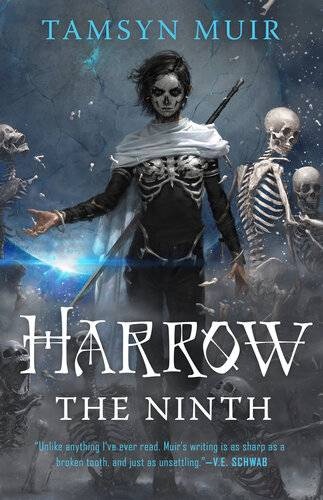
Harrow the Ninth
About this book
Harrowhark has survived the events of Canaan House but cannot use her transformation safely. On the Mithraeum, ancient Lyctors prepare for an approaching Resurrection Beast while treating Harrow as both liability and clue.
Her memories of the first book have been rewritten, replacing Gideon with a different history that the narrative presents in fractured layers. Letters, hallucinations, and hostile teachers force Harrow to protect a secret she no longer consciously understands.
Muir changes person, chronology, and genre to make damaged memory structural rather than decorative. The difficulty is purposeful: readers reconstruct the sacrifice and manipulation at the same time Harrow does.
Harrow the Ninth is the second Locked Tomb novel and requires Gideon the Ninth. It expands the necromantic empire while ending on the circumstances that lead into Nona the Ninth.
Read a sample
5,036 words
Plain text
From the opening
Prologue
THE NIGHT BEFORE THE EMPEROR’S MURDER
YOUR ROOM HAD LONG AGO plunged into near-complete darkness, leaving no distraction from the great rocking thump—thump—thump of body after body flinging itself onto the great mass already coating the hull. There was nothing to see—the shutters were down—but you could feel the terrible vibration, hear the groan of chitin on metal, the cataclysmic rending of steel by fungous claw.
It was very cold. A fine shimmer of frost now coated your cheeks, your hair, your eyelashes. In that smothering dark, your breath emerged as wisps of wet grey smoke. Sometimes you screamed a little, which no longer embarrassed you. You understood your body’s reaction to the proximity. Screaming was the least of what might happen.
God’s voice came very calmly over the comm:
“Ten minutes until breach. We’ve got half an hour of air-con left … after that, you’ll be working in the oven. Doors down until the pressure equalizes. Conserve your temp, everyone. Harrow, I’m leaving yours closed as long as possible.”
You staggered to your feet, limpid skirts gathered in both hands, and picked your way over to the comm button. Scanning for something damning and intellectual to say, you snapped: “I can take care of myself.”
“Harrowhark, we need you in the River, and while you are in the River your necromancy will not work.”
“I am a Lyctor, Lord,” you heard yourself say. “I am your saint. I am your fingers and gestures. If you wanted a Hand who needed a door to hide behind—even now—then I have misjudged you.”
From his far-off sanctum deep within the Mithraeum, you heard him exhale. You imagined him sitting in his patchy, worn-out chair, all alone, worrying his right temple with the thumb he always worried his right temple with. After a brief pause, he said: “Harrow, please don’t be in such a hurry to die.”
“Do not underestimate me, Teacher,” you said. “I have always lived.”
You picked your way back through the concentric rings of ground acetabula you had laid, the fine gritty layers of femur, and you stood in the centre and breathed. Deep through the nose, deep out the mouth, just as you had been taught. The frost was already resolving into a fine dew misting your face and the back of your neck, and you were hot inside your robes. You sat down with your legs crossed and your hands laid helplessly in your lap. The basket hilt of the rapier nudged into your hip, like an animal that wanted feeding, and in a sudden fit of temper you considered unbuckling the damn thing and hurling it as hard as you possibly could to the other side of the room; only you worried how pitifully short it would fall. Outside, the hull shuddered as a few hundred more Heralds assembled on its surface. You imagined them crawling over one another, blue in the shadow of the asteroids, yellow in the light of the nearest star.
The doors to your quarters slid open with an antique exhalation of gas levers. But the intruder did not set off the traps of teeth you’d embedded in its frame, nor the gobbets of regenerating bone you had gummed onto the threshold. She stepped over the threshold with her cobwebby skirts rucked high on her thighs, teetering like a dancer. In the darkness her rapier was black, and the bones of her right arm gleamed an oily gold. You closed your eyes to her.
“I could protect you, if you’d only ask me to,” said Ianthe the First.
A tepid trickle of sweat ran down your ribs.
“I would rather have my tendons peeled from my body, one by one, and flossed to shreds over my broken bones,” you said. “I would rather be flayed alive and wrapped in salt. I would rather have my own digestive acid dripped into my eyes.”
“So what I’m hearing is … maybe,” said Ianthe. “Help me out here. Don’t be coy.”
“Do not pretend to me that you’re here for anything other than to look after an investment.”
She said, “I came to warn you.”
“You came to warn me?” Your voice sounded flat and affectless, even to you. “You came to warn me now?”
The other Lyctor approached. You did not open your eyes. You were surprised to hear her crunch through your metrical overlay of bone, to kneel without flinching on the grim and powdery carpet beneath her. You would never sense Ianthe’s thanergy, but the darkness seemed to give you an immense attunement to her fear. You felt the hairs rise on the back of her forearms; you heard the hammering of her wet and human heart, her scapulae drawing together as she tensed her shoulders. You smelled the reek of sweat and perfume: musk, rose, vetiver.
“Nonagesimus, nobody is coming to save you. Not God. Not Augustine. Nobody.” There was no mockery in her voice now, but there was something else: excitement, perhaps, or unease. “You’ll be dead within the first half hour. You’re a sitting duck. Unless there’s something in one of those letters I don’t know about, you’re out of tricks.”
“I have never been murdered before, and I truly don’t intend to start now.”
“It’s over for you, Nonagesimus. This is the end of the line.”
You were shocked into opening your eyes when you felt the girl opposite cup your chin in her hands—her fingers febrile compared to the chilly shock of her gilded metacarpal—and put her meat thumb at the corner of your jaw. For a moment you assumed that you were hallucinating, but that assumption was startled away by the cool nearness of her, of Ianthe Tridentarius on her knees before you in unmistakable supplication. Her pallid hair fell around her face like a veil, and her stolen eyes looked at you with half-beseeching, half-contemptuous despair: blue eyes with deep splotches of light brown, like agate.
Continue reading the sampleClose the sample
Looking deep into the eyes of the cavalier she murdered, you realised, not for the first time, and not willingly, that Ianthe Tridentarius was beautiful.
“Turn around,” she breathed. “Harry, all you have to do is turn around. I know what you’ve done, and I know how to reverse it, if only you’d ask me to. Just ask; it’s that easy. Dying is for suckers. With you and me at full power, we could rip apart this Resurrection Beast and come away unscathed. We could save the galaxy. Save the Emperor. Let them talk back home of Ianthe and Harrowhark—let them weep to speak of us. The past is dead, and they’re both dead, but you and I are alive.
“What are they? What are they, other than one more corpse we’re dragging behind us?”
Ianthe’s lips were cracked and red. There was naked entreaty on her face. Excitement, then, not unease.
This was, as you understood it dimly, the psychological moment.
“Go fuck yourself,” you said.
The Heralds came plopping down onto the hull like rain. Ianthe’s face froze back into its white and mocking mask, and she dropped your jaw—untangled her restless fingers and her awful gold-shod bones.
“I didn’t think this was the time for dirty talk, but I can roll with it,” she said. “Choke me, Daddy.”
“Get out.”
“You always did think obstinacy the cardinal virtue,” she remarked, quite apropos of nothing. “I think now, perhaps, you should have died back at Canaan House.”
“You should have killed your sister,” you said. “Your eyes don’t match your face.”
Over the comm, the Emperor’s voice came, just as calm as before: “Four minutes until impact.” And, like a tutor chiding inattentive children: “Make sure you’re in place, girls.”
Ianthe turned away without violence. She stood and trailed her human fingers over the wall of your quarters—over the cool filigreed archway, over the polished metal panels and inlaid bone—and said, “Well, I tried, and therefore no one should criticize me,” before ducking through the arch to the foyer beyond. You heard the door shut behind her. You were left profoundly alone.
The heat rose. The station must have been completely smothered: wrapped in a squirming shroud of thorax and wing, mandible and antenna, the dead couriers of a hungry stellar revenant. Your communicator crackled with static, but there was only silence at the other end. There was silence in the lovely passageways of the Mithraeum, and there was a hot and sweating silence in your soul. When you screamed, you screamed without sound, your throat muscles gulping mutely.
You thought about the flimsy envelope addressed to you that read, To open in case of your imminent death.
“They’re breaching,” said the Emperor. “Forgive me … and give it hell, children.”
Somewhere far off on the station there was a warping crunch of plex and metal. Your knees became jelly, and you would have collapsed to the floor in a spasm had you not been sitting. With your fingers you closed your eyes, and you wrestled yourself into stillness. The darkness got darker and cooler as the first shield of perpetual bone cocooned you—the act of a fool, meaningless, doomed to dissolve the moment you submerged—then the second, then the third, until you were lost in an airless and impregnable nest. Throughout the Mithraeum, five pairs of eyes closed in concert, one of them yours. Unlike theirs, yours would not open again. In half an hour, no matter what Teacher might hope, you would be dead. The Lyctors of the Resurrecting Emperor began their long wade into the River to where the Resurrection Beast squatted—just out of the orbit of the Mithraeum, half-alive, half-dead, a verminous liminal mass—and you waded with them, but your meat you left vulnerably behind.
“I pray the tomb is shut forever,” you heard yourself saying aloud, and you could not bring your voice above a choked whisper. “I pray the rock is never rolled away. I pray that which was buried remains buried, insensate, in perpetual rest with closed eye and stilled brain. I pray it lives … O corse of the Locked Tomb,” you extemporised wildly. “Beloved dead, hear your handmaiden. I loved you with my whole rotten, contemptible heart—I loved you to the exclusion of aught else—let me live long enough to die at your feet.”
Then you went under to make war on Hell.
Hell spat you back out. Fair enough.
You did not wake up having passed into the thanergetic space that was the sole province of the dead, and the necromantic saints who fought the dead; you woke up in the corridor outside your rooms, on your side and broiling, gasping for air, soaked right through with sweat—your own—and blood—your own; the blade of your rapier leered through your stomach, punctured through from behind. The wound was not a hallucination or a dream: the blood was wet, and the pain was terrible. Your vision was already curling up black at the edges as you tried to close the rent—tried to sew your viscera shut, cauterize the veins, stabilize the organs whimpering into shutdown—but you were far too gone already. Even if you had wanted it, the imminent death letter would not be yours to read. All you could do was lie gasping in a pool of your own fluids, too powerful to die quickly, too weak to save yourself. You were only half a Lyctor, and half a Lyctor was worse than not a Lyctor at all.
Outside the plex, the stars were blocked by the skittering, buzzing Heralds of the Resurrection Beast, beating their wings furiously to roast everything inside. From very far away you thought you heard the ring of swords, and you flinched at each bright scream of striking metal. You had loathed that sound from birth.
You prepared to die with the Locked Tomb on your lips. But your idiot dying mouth rounded out three totally different syllables, and they were three syllables you did not even understand.
PARODOS
FOURTEEN MONTHS BEFORE THE EMPEROR’S MURDER
IN THE MYRIADIC YEAR OF OUR LORD—the ten thousandth year of the King Undying, our Resurrector, the full-pitying Prime!—the Reverend Daughter Harrowhark Nonagesimus sat on her mother’s sofa and watched her cavalier read. She idly fretted her thumbnail into a decaying brocade skull on the cover, carelessly destroying in a second long years of labour by some devoted anchorite. The mandible unravelled beneath the pad of her thumb.
Her cavalier sat very upright in the study chair. It had not taken anyone of comparable bulk since his father’s day, and was now in danger of a final fatal sag. He had tucked his considerable frame tight within its borders as though breaching them might cause Incident; and she knew full well that Ortus hated Incident.
“No retainers. No attendants, no domestics,” read Ortus Nigenad, folding the paper with obsequious care. “Then I will wait on you alone, my Lady Harrowhark?”
“Yes,” she said, vowing to keep her patience as long as possible.
“No Marshal Crux? No Captain Aiglamene?”
“In fact, no retainers, no attendants, and no domestics,” said Harrow, losing her patience. “I believe you’ve cracked the elaborate code. It will be you, the cavalier primary, and me, the Reverend Daughter of the Ninth House. That’s all. Which I find … suggestive.”
Ortus did not seem to find it suggestive. His dark eyes were downcast behind their thick black lashes, the sort Harrowhark had always fancied you might get on some nice domestic mammal, like a hog. He was perennially downcast, and not out of modesty; the faint crow’s feet trampling each eye were lines of sadness; the fine creases at his forehead were a careful act of tragedy. She was glad to see that someone—maybe his mother, the mawkish Sister Glaurica—had painted his face as his father had once painted his own, with a solid black jaw to represent the Mouthless Skull. This was not because she had any especial love for the Mouthless Skull, as paint sacrament went. It was merely because any jawéd skull he affected became a wide white skull with depression.
After a moment, he said abruptly: “Lady, I cannot help you become a Lyctor.”
She was only surprised that he dared to offer an opinion. “That’s as may be.”
“You agree with me. Good. I thank you for your mercy, Your Grace. I cannot represent you in a formal duel, not with the sword, nor the short sword, nor the chain. I cannot stand in a row of cavaliers primary and call myself their peer. The falsehood would crush me. I cannot begin to conceive of it. I will not be able to fight for you, my Lady Harrowhark.”
“Ortus,” she said, “I have known you my entire life. Did you really think I entertained any delusions that you could be mistaken, in the dark, by a dementia-ridden dog raised with no knowledge of bladed objects, for a swordsman?”
“Lady, it is only to honour my father that I call myself a cavalier,” said Ortus. “It is for my mother’s pride and my House’s scarcity that I call myself a cavalier. I have none of a cavalier’s virtues.”
“I am not sure how many times I must relay to you how truly I am aware of that,” said Harrowhark, picking a tiny fragment of jet thread from her fingernail. “Given that it has constituted one hundred percent of our exchanges over the years, I can only assume you are coming to some new point, and begin to feel excitement.”
Ortus leant forward on the edge of his chair, his restive, long-fingered hands locking together. His hands were big and soft—all of Ortus was big and soft, like a squashy black pillow—and he spread them open, beseeching. She was intrigued, despite herself. This was more than he had heretofore dared.
“Lady,” ventured Ortus, voice deepening with timidity, “I would not venture it—but if a cavalier’s duty is to hold the sword—if a cavalier’s duty is to protect with the sword—if a cavalier’s duty is to die by the sword—have you never considered ORTUS NIGENAD?”
“What?” said Harrow.
“Lady, it is only to honour my father that I call myself a cavalier,” said Ortus. “It is for my mother’s pride and my House’s scarcity that I call myself a cavalier. I have none of a cavalier’s virtues.”
“I feel as though we have had this conversation before,” said Harrowhark, pressing her thumbs together, testing with risky pleasure how malleable she might make her distal phalange. One misstep, and her nerves might split. It was an old exercise her parents had set her. “Each time, the news that you have not spent your life in acquiring martial virtues comes as a little less of a shock to me. But have a go. Surprise me. My body is ready.”
“I wish that our House had produced some swordsman more worthy of our glory days,” said Ortus meditatively, who always found enthusiasm for alternate histories where he was not pressed into service or asked to do anything he found difficult. “I wish that our House had not been diminished to ‘those who are fit but to hold their blade in the scabbard.’”
Harrowhark congratulated herself on not pointing out how this lack of production was directly due to three things: his mother, himself, and The Noniad, his ongoing verse epic devoted to Matthias Nonius. She had a vile suspicion that the quotation, around which he had somehow contrived to pronounce quotation marks, was from that very same verse epic, which she knew was already on its eighteenth book and showed no signs of slowing down. If anything it seemed to be gaining momentum, like a very boring avalanche. She was composing a rejoinder when she noticed that a serving sister had arrived in her father’s library.
Harrow had not noticed her knocking, or her passage in; this wasn’t the problem. The problem was that the sister’s ashen paint was decorating the lovely dead face of the Body.
Her palms felt wet. In this scenario, either the sister was real and her face was not, or the sister was herself unreal. One couldn’t simply gauge all the osseous mass in the room and do a best guess; bones in meat generated so much deceptive soft thalergy, only a fool would try. She flicked her eyes over to Ortus in the faint hope that he would betray her reality one way or another. But his gaze was still levelled at the ground.
“Our House has received good service from ‘those who are fit but to hold their blade in the scabbard,’” said Harrowhark, keeping her voice even. “Which is not a line that scans, just so you know. Nobody will be surprised to find you a laggard.”
“It’s enneameter. The traditional form. Those who are fit but to hold their blade in the scabbard—”
“That’s not nine feet of anything.”
“—never to draw it forth for the battle.”
“You will train with Captain Aiglamene for the next twelve weeks,” said Harrowhark, rubbing her fingers back and forth, back and forth, until the pad of her thumb felt very hot. “You will meet the very minimum that is expected of a Ninth House cavalier primary, which is now, fortunately, that you be as broad as you are tall with arms that can carry a weight. But I need … significantly more from you … than the edge of a sword, Nigenad.”
The serving sister shadowed the edge of Harrow’s peripheral vision. Ortus had raised his head and did not acknowledge the sister, which complicated things. He looked at Harrow with the faint kind of pity she always suspected he held her in: the pity that marked him as an outsider in his own House, and would mark him as all the more an outsider in the House of his mother’s line. She did not know what made Ortus Ortus. He was a mystery too boring to solve.
“What more is there?” he asked, a little bitterly.
Harrowhark closed her eyes, which shut out Ortus’s tremulous, worried face and the shadow of the Body-faced serving girl that fell over the desk. The shadow told her nothing. Physical evidence was often a trap. She shut out the new and rusty rapier that now creaked in the scabbard at Ortus’s hip. She shut out the comforting smell of dust made hot by the whirring heater in the corner of the room, mixing with the just-milled ink in her inkwell. Tannic acid, human salts.
“This isn’t how it happens,” said the Body.
Which gave Harrow a curious strength.
“I need you to hide my infirmity,” said Harrowhark. “You see, I am insane.”
ACT ONE
1
NINE MONTHS BEFORE THE EMPEROR’S MURDER
IT WAS IN THE CLOSE of the myriadic year of our Lord—that far-off King of Necromancers, that blessed Resurrector of Saints!—that you picked up your sword. This was your first big mistake.
The sword hated you to touch it. The long hilt burnt your bare hands as though heated to starlike temperatures. The vacuum of space outside yielded no thanergy and generated no thalergy, but it didn’t matter. You no longer needed either. You iced your palms over with thick bands of cartilage, and you tried again.
Now the grip seemed cold as death, and it was just as heavy. You lifted, and your elbows locked, and you grasped the pommel to try to steady yourself. You tried a new trick—you slipped a narrow ribbon of bone up from your living metacarpal and eased the fragment gently around the flexor tendon, and you pierced it through the back of your hand. You didn’t flinch. It was never your way. From there you unfolded long fingers of bone to grasp the handle, then more, to grasp it again; you lifted it, in a manner of speaking, assisted by a seething, clattering basket of eight phalanx articulates.
So now you could wobble the sword up in an obtuse angle before yourself. You waited. You felt nothing: no understanding, no mastery, no knowledge. You were just a necromancer, and it was just a sword. It fell away from your hands and clattered to the floor, and you folded in half, and you upchucked violently all over the hospital tiles.
There were many uniformed people in that room, but they were used to these antics. Harrowhark the First, ninth saint to serve the Emperor Undying, might throw up as much as she cared to. You were a walking sacrament, even if your early contributions to Lyctorhood seemed to be finding new and different ways to puke. They only intervened if it looked like you might choke to death on your own vomit, a mercy that you always vaguely thought a shame.
The first time the man you called God had delivered you the sword—in what seemed to you his aspect of the Kindly Prince, intending only gentleness—you’d fallen into a deep stupor from which you had never really risen. Maybe the sword had reified your grief into six feet of steel. You had loathed that thrice-damned blade from sight, which might have been unfair before you knew it loathed you in return.
You kept trying to wield it, all the same. Each touch ended with the contents of your stomach splattered colourfully on the floor. Your days dissolved like ashes in front of a fan—scattered beyond any hope of retrieval—blown back into your face or fluttering upward beyond your grasp. Sometimes you would rise, and you’d take up the blade, as though in expectation of something. Nothing ever happened; you felt nothing except the sword’s enormous, empty hate of you, which you knew to be real, even then. You and the sword would seethe in your mutual bitterness and fury, and then you would end up with blistered hands and a floor’s worth of vomit.
Details sat at awkward angles to one another. You’d been in this bed some time, wearing clothes that weren’t yours. Occasionally ticklish rasps at your ears or forehead would frighten you numb before you realised it was your own hair. Away from Drearburh shears, it grew in a way that was almost debauched. You would cut it yourself and still find irregular little licks of it tucked behind your ears—or maybe you had not cut it at all. Sometimes, in reaching up to it, you would then recall that you had no robe or skeletal mask. Nobody had given you any paint and there wasn’t a stick of grease on board the whole ship, though even if there had been it would not have been blessed properly. The first time this happened, in your hot upset and shame, you ripped a sheet to shreds and covered your head with that. This still left most of your forehead nude, discounting the hair. Also, you were wearing a bedsheet. You took the poetic way out and used a black vestal’s last-choice gambit: you opened a vein and, trembling neither from pain nor blood loss, daubed blind upon your skin the sacramental skull of the Inglorious Mask.
The uniformed attendants were always busy with things that weren’t you. Sometimes you were humbly prevailed upon to sit up and part your ad-hoc veil to struggle through a bowl of clear soup, though those memories were doubtful fragments. It did not seem right that you could ever eat again. Sometimes people would move all around you, and you lay supine on your cot, astonished and shivering before the vista of stars out the window. The thick plex barrier seemed too light and frangible to keep you safe. Beyond it the great black throat of space bared itself to you, which frightened you beyond sense. At these times you fell in and out of sleep, somehow. You had long since ceased to care for human voices, which only talked nonsense: they would murmur their prayers of Three thousand units—replenish, that’s on the provision list—dump that stock, munitions will take it.
In your old life you might have been curious. But other noises haunted you, quite apart from the ones occurring to your ears. There was a great unmusical straining aboard ship—the sounds of wet drums—which had panicked you before you’d realised, with settling calm, that you were hearing the heave of seven hundred and eight beating hearts. You heard seven hundred and eight brains, thrumming in their cerebral fluid. You knew without checking that three hundred and four of those straining hearts belonged to necromancers; a necromancer’s heart myocardium flexed differently to your ears, worked worse, squeezed more feebly. You were sensing the living. Once you worked out what you were hearing, you became aware of everything immediate to you: the dust settling on the gleaming black plaques of the floor; the roiling of your pulmonaries; the soft marrow of your bones sucking up oxygen. Despite all this cacophony, you could not stay awake.
Sometimes you found yourself standing, gorge risen, staring at the great sword left untidy and naked on the floor. You would not remember rising. You would not remember how you had come to be there. Sometimes you would forget who you were, and at recalling yourself, weep like a child.
In these digestions of time the Body would come. She would put her cool, dead hands on your forehead and close your pumping eyelids with her fingertips, so that you could not see the sword nor the people.
This was great honour. This was great mercy. She always came to you now with such easy forbearance, and you were so grateful for it, you were so relieved. The Body’s hands were grey with death and they were so soft and familiar on your skin, so much so that you were absolutely sure you could really feel them; that this time around, the dead caress was tangible. And when the Body turned so that you could see her face you were amazed, as ever, by that beauty unblemished by breath.
Then she would draw you back to your bed and direct you to sleep. For the Body you tried to be obedient, for once in your benighted life; it seemed beneath you not to. When the Body appeared time could be relied upon to work as it ought, rather than melting away like chips of ice only to reappear in unexpected places. But at these times your brain kept nagging itself to stay conscious. The fact that the Body had come to you now seemed tremendously important, if only you could stay awake long enough to figure out why.
And your face itched from the dried blood, and all around you the people whispered, Thousand kilos of osseo—old—keep that, that’s the first thing we run out of— No, Sergeant, ditch it; we’re behind schedule already.
Your world was a white and sterile box. This box was the hospital quarter on board the Erebos. The Erebos was the Behemoth-class flagship of the Emperor Undying. These facts you held on to like an asphyxiating man to a last lungful of air. You lived in a cool, colourless room of dismantled beds and cartons, and you had for your own a bed and a chair and a sword. They had tried to remove your sword, once—they had tried to take it away on some pretext you could not exactly remember—and you were perturbed in some distant way by that memory, which was red, and wet, and ill defined.
They no longer touched your two-hander. It appeared and reappeared around the room wherever you had dropped it, usually accompanied by the mysterious smell of upchuck. You now slept beside it, like it was your large steel infant. Truth be told you would have been happy hurling the thing straight into the hot heart of Dominicus, as it was loathsome to you and you were convinced it wanted to do you harm; but it was very important that it should not be placed in anyone else’s hand.