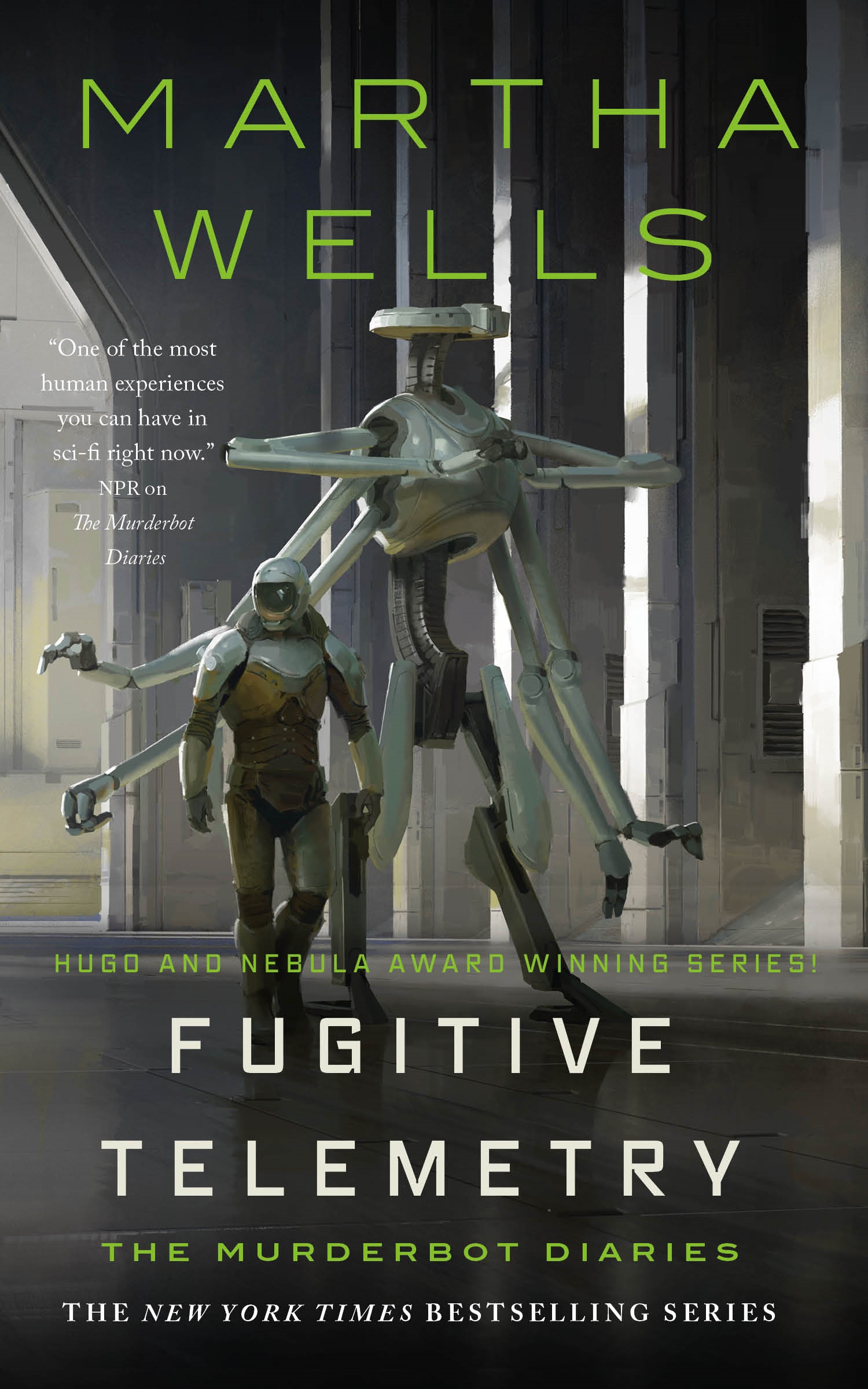
Fugitive Telemetry
About this book
Murderbot discovers a human body in a station corridor and reluctantly works with Preservation Security to establish who the person was and how they died. The investigation is complicated by its poor relationship with Senior Officer Indah and by station systems that are much less intrusive than corporate surveillance.
Evidence leads through transit rings, temporary workers, refugee routes, and the unregistered spaces where vulnerable people avoid authorities. Murderbot’s security expertise is useful, but solving the case requires earning cooperation rather than simply obtaining access.
The novella is structured as a contained police procedural with no need for a planetary war. That smaller scale makes institutional trust the central problem: what does safety mean when the people most in need of it have learned not to be visible?
Fugitive Telemetry takes place before Network Effect in the internal chronology. Martha Wells uses a station mystery to show Murderbot practising citizenship, a social activity it finds nearly as alarming as combat.
Read a sample
5,013 words
Plain text
From the opening
Chapter One
THE DEAD HUMAN WAS lying on the deck, on their side, half curled around. A broken feed interface was scattered under the right hand. I’ve seen a lot of dead humans (I mean, a lot) so I did an initial scan and compared the results to archived data sets, like human body temperatures vs. ambient temperature, lividity, and various other really disgusting things involving fluids that happen when humans die. This was all data I still had in longterm storage. The comparison let me estimate a time of death. I said, “Four hours, approximately.”
Dr. Mensah exchanged a look with Senior Officer Indah. Dr. Mensah’s expression was dry. Senior Indah looked annoyed, but then she always looked like that when I was around. She said, “How do you know?”
I converted my scan data, my query, and the comparison results into a report that humans could read and sent it to her feed address, with a copy to Mensah. Indah blinked, her gaze turning preoccupied as she read it. Mensah acknowledged the report as received, but kept watching Indah, one eyebrow raised. (I was still using scan and visual to examine the scene, but I had a task group of my new intel drones circling above my head, supplying me with video.)
We were in a junction in the Preservation Station mall, a circular space where three small corridors met, one a short passage that led through to a large secondary main corridor: the Trans Lateral Bypass. (All the corridors here had names, a Preservation tradition that was only mildly annoying.) This was not a well-traveled junction, whatever its name was; it was mostly a shortcut to get from a residential area to a work area. (On this station there was no separation between transient spaces and longterm station housing like on stations in the Corporation Rim, but that wasn’t even close to being the weirdest thing about Preservation.)
This junction, and Preservation Station in general, were also weird places for humans to get killed; the threat assessment for both transients and station residents was low anyway, and mostly involved accidents and cases of intoxication-related stupidity/aggression in the port area. In this specific junction, threat assessment for accidental death was even lower, close to null. There was nothing here except the lights in the high ceiling and the standard silver-blue textured wall panels, marked with some old graffiti and drawings that were actually being preserved as part of a station-wide history exhibit. I guess if you were really determined, you could find a way to get yourself killed by exposing the power connectors under the panels and shielding and, I don’t know, licking them or something, but this dead human clearly hadn’t.
The full station threat assessment for murder was sitting at a baseline 7 percent. (To make it drop lower than that we’d have to be on an uninhabited planet.) (I’ve never been on a contract on an uninhabited planet because if I was on the planet on a contract then we’d be inhabiting it.) You never found dead humans lying around on the floor like this.
“Well,” Indah began, having finally finished reading the report. (I know, it takes humans forever.) “I don’t know how accurate this is—”
Another security person walked in, one of the techs who normally worked on checking cargo shipments for biohazards, feed ID Tural. They said, “Our scan analysis says the victim’s been dead for about four hours.”
Indah sighed. Tech Tural, who had obviously expected this information to be greeted a little more enthusiastically, was confused.
“ID?” I said. The dead human’s interface was broken so I couldn’t pull anything off it. If whoever did it had been trying to conceal the dead human’s identity, were they naively optimistic? Preservation Station kept an identity record and body scan for permanent residents and every disembarking transient passenger, so it shouldn’t be that hard to run an identity check. “Known associates?”
Tural glanced at Indah and she nodded for them to answer. They said, “There was no subcutaneous marker or clip or augment or anything else with ID. We’ve done an initial search on recent arrival passenger lists using physical details, but couldn’t come up with anything.” At Indah’s dissatisfied expression, Tural added, “Without an interface, we have to wait until Medical gets here to do the body scan so we can try to match it with the visitor entry logs.”
Indah said, “And Medical isn’t here yet because…?”
Tural’s face formed an anticipatory wince. “It’s preventative health check day at the school and the bot who normally does the mobile body scan is busy with that? It has to move the mobile medical suite they use?”
Humans do the “make it a question so it doesn’t sound so bad” thing and it still sounds bad.
Indah did not look pleased. Mensah’s mouth twitched in an “I would like to say things but I am not going to” way. Indah said, “Did you tell them this was an emergency?”
Tural said, “Yes, but they said it was an emergency until the onsite medic pronounced the person dead/unrevivable, after that it went to the end of the list of non-emergency things they have to do.”
Preservation has to make everything complicated. And that’s not a metaphor for my experience here. Okay, yes, it is a metaphor.
Indah’s jaw went tight. “This is a murder. If whoever did this kills someone else—”
Continue reading the sampleClose the sample
Mensah cut her off. “I’ll call them and explain that it’s not an accidental death, and yes, it is an emergency and we need them here now.” She looked toward the body again, her brow furrowed. “The council closed the port and deployed the responder as soon as we got the alert, but are you certain this person is—was—a visitor and not a resident?”
The responder was the armed ship currently on picket duty, discouraging raiders from approaching the station and rendering assistance as needed to local and transient shipping. With the port closed, it would be out there keeping any docked or undocked transports from leaving until the council ordered otherwise.
Tural admitted, “Actually no, Councilor. We’re just guessing that they’re a visitor.”
“I see.” Mensah’s expression was not critical, but I can tell you the face she was making did not indicate that she thought Tural or Indah or anybody in the immediate area was doing a great job. It was obvious Station Security was out of its collective depth here. (At least it was obvious to me.)
Indah must have known that too because she rubbed the bridge of her nose like her head hurt. She was short for a Preservation human, a little lighter brown than Mensah and maybe a little older, but with a solid square build that looked like she could punch someone pretty effectively. That probably wasn’t why she was senior security officer, which was more of an admin job. She told Tural, “Just keep trying to make an ID.”
Tural left with the air of escaping before things got worse. Mensah’s eyebrow was still aimed at Indah and it was getting pointed. (Not really. It’s hard to describe, you had to see it.) Indah made a hands-flung-in-the-air gesture and said, “Fine, let’s go talk about this.”
Mensah led us away from the incident scene and out to the Trans Lateral Bypass. It was wide, with a high arched ceiling that projected a series of holo views of the planet’s surface as if you were looking up through a transparent port. It was an offshoot of the main station mall, a thoroughfare to a section of service offices, with branches into supply areas. Traffic was minimal here right now, but a bot that worked for the station was out with a glowing baton, directing humans, augmented humans, and drone delivery floaters away from the junction entrance and Station Security’s equipment. The group of security officers standing there tried to pretend they weren’t watching us. Mensah’s two council assistants who had walked down with us were watching the security officers critically.
The bot could have engaged a privacy shield but Mensah and Indah just stepped behind a large plant biome with giant paddle-shaped leaves that was screening the entrance to a food service place. (A feed marker in multiple languages and a colorful sign in Preservation Standard Nomenclature indicated it was called “Starchy Foods!!!” and noted that it was closed for its cycle rest period.)
It was relatively private, but I had my drones scan for any attempt to focus a listening device on us. Indah faced me and asked, “You have experience at this?”
Watching her via the drones, I kept my gaze on the Starchy Foods!!! sign, which had little dancing figures around it which I guess were supposed to be starchy foods. I said, “With dead humans? Sure.”
Mensah’s pointed eyebrow was now aimed at me. She tapped my feed for a private connection. I secured it and she sent, Do you think this is GrayCris?
Ugh, maybe? Right now all we had was an anomalous death with no indication of a connection to Mensah or any of my other humans that GrayCris might want to target. I told her, I don’t have enough data to make an assessment yet.
Understood. Then she added, I want you to work on this with Station Security. Even if it isn’t anything to do with our corporate problems, it’s a good opportunity for you.
Double ugh. I told her, They don’t want me. (Hey, I don’t want me, either, but I’m stuck with me.) And it would be easier for me to investigate on my own, particularly if my investigations led to me having to do things like disposing of abruptly dead GrayCris agents.
(No, I didn’t kill the dead human. If I had, I wouldn’t dump the body in the station mall, for fuck’s sake.)
She said, If you want to stay in the Preservation Alliance, improving your relationship with Station Security will help immeasurably. This might lead to them hiring you as a consultant.
Mensah didn’t usually take the “this is for your own good, you idiot” tone, so the fact that she had meant she really thought it was a good idea. Also, I’m not an idiot, I knew she was right. But it wasn’t like I could leave Preservation yet, anyway, even if I didn’t like it and it didn’t like me. My threat assessments were still rising steadily. (I had an input on my threat assessment module continuously now so I could get real-time updates instead of just checking it periodically, and yes, it was a constant source of irritation because it reacted to everything. No, it was not helping my anxiety. But it was necessary.)
Station Security had been briefed on the danger from GrayCris but I trusted them as much as they trusted me. (Surprise, it was not very much.) And they had no experience with corporate attacks. Their job was mostly accident first response and maintaining safety equipment and scanning for illegal hazardous cargo, not repelling assassination attempts. They didn’t even patrol outside the port.
Indah watched us with an acerbic expression that indicated she knew we were talking privately on the feed. Mensah was still eyebrow-glaring at me so I answered Indah’s question. “Yes, I’ve had experience with investigating suspicious fatalities in controlled circumstances.”
Indah’s gaze wasn’t exactly skeptical. “What controlled circumstances?”
I said, “Isolated work installations.”
Her expression turned even more grim. “Corporate slave labor camps.”
I said, “Yes, but if we call them that, Marketing and Branding gets angry and we get a power surge through our brains that fries little pieces of our neural tissue.”
Indah winced. Mensah folded her arms, her expression a combo of “are you satisfied now” and “get on with it.” Indah narrowed her eyes at me. “I know Dr. Mensah wants you involved in this investigation. Are you willing to work with us?”
Okay, I’m not lying about having investigated this kind of thing in the past. It turns out the big danger to humans on any isolated corporate project, whether it’s mining or—okay, it’s mostly mining. Whatever—the big danger to humans is not raiders, angry human-eating fauna, or rogue SecUnits; it’s other humans. They kill each other either accidentally or on purpose and you have to clear that up fast because it jeopardizes the bond and determines whether the company has to pay out damages on it or not. SecUnits are ordered by the HubSystem to gather video and audio evidence because nobody trusts the human supervisors, including the other human supervisors.
I had dealt with some instances of humans killing each other surreptitiously instead of, for example, in front of the entire mess hall during food service, but most had been pre–memory wipe(s) so the details were fuzzy. It was better to prevent them from murdering each other in the first place, by keeping watch for aggressive or destructive behaviors, things like trying to sabotage another human’s life support pack or poison their water supply. Then you put in a notice to MedSystem to call them in for an evaluation, or reported to the supervisor who moved them to a different section so it would be someone else’s problem if MedSystem couldn’t convince them to stop. But whatever, the idea was to keep it from getting that far.
(And I know it sounds like they were all just running around trying to murder each other on these contracts but really, it was more like it had been with the poor humans on the transport I used to get to HaveRatton, who thought I was an augmented human security consultant. They had been complaining and fighting out of frustration and fear about going into contract labor. Actually being in contract labor just made it that much worse.)
I had archives of everything that had happened since I hacked my governor module, but I hadn’t had as much relevant experience in that time. But what I did have were thousands of hours of category mystery media, so I had a lot of theoretical knowledge that was possibly anywhere from 60 to 70 percent inaccurate shit.
But Mensah was right, butting in on the investigation was the best way to find out if the anomalous death was a sign of GrayCris-related activity on station. I said, “Yes. Will you increase security around Dr. Mensah to the specifications I stipulated?” Yeah, that had been an ongoing argument.
Indah’s jaw tightened again (she was going to hurt herself) but she said, “Of course, with a murderer running loose on the station, I am upping every security level, including those around the council and Dr. Mensah. I actually don’t need you to tell me my job.”
Oh good, maybe the security level would go from barely adequate to mostly adequate. I didn’t make an expression because I knew Indah would be more annoyed by me not reacting than by me reacting.
Mensah cleared her throat in a “you are trying to annoy each other but are mostly annoying me” way. She said, “I assume an employment contract will be forthcoming.”
Indah’s voice was dry. “It will, no need to send the terrifying solicitor after me.”
She meant Pin-Lee because she said “terrifying.” Being the top Preservation expert in dealing with contract law in the Corporation Rim apparently made Pin-Lee like the CombatUnit version of a lawyer.
The employment contracts for Preservation citizens were pretty simple, because their planetary legal code had so many in-built protections already. (For example, humans and augmented humans can’t sign away their rights to their labor or bodily autonomy in perpetuity; that’s like, straight-up illegal.)
But I wasn’t a citizen and also technically not actually a person, which made it more difficult. But Pin-Lee’s contract would make sure that they couldn’t make me do anything I didn’t want to do and I would get a hard currency card out of it. (When we had first discussed the idea of me getting jobs as a way to encourage the Preservation Council to grant me permanent refugee status, I didn’t know very much about the kind of contract in which I was actually an active participant. (My previous contracts were rental contracts with the company, where I was just a piece of equipment.) Pin-Lee had promised, “Don’t worry, I’ll preserve your right to wander off like an asshole anytime you like.”)
(I said, “It takes one to know one.”)
(Mensah said, “People, please. I’m scheduled to mediate arguments between teenagers on my next commcall home and I need all my patience for that.”)
If I was going to do this, I wanted to get started so I could make sure this anomalous murder wasn’t an indication of a threat to Mensah. Plus I had a lot of downloaded shows to get through. I said, “Can I examine the dead human now?”
Indah just looked tired. “Can you humor me and please refer to the victim as ‘the deceased’ or ‘the victim’ during the course of the investigation?” She turned to go, not waiting for an answer.
She missed Mensah mouthing the words stop it at me. (I guess the feed isn’t adequate for all forms of communication, particularly those that involve a lot of glaring.)
Chapter Two
AT FIRST, PRESERVATION STATION Security had objected to my presence on the station. Correction, at first they were fine with it because they didn’t know anything about me except that I was a security consultant who had retrieved Dr. Mensah from TranRollinHyfa Station, was injured, and was getting refugee status. Most humans, unless they get stuck working in an isolated corporate installation, never see SecUnits except in the media where we’re always in armor. But Dr. Mensah had told the Preservation Council the truth (no, I don’t know why, either) and then she had to brief Station Security.
(Senior Indah had been with the rest of the upper level security staff for the “hey, there’s a rogue SecUnit here” meeting. You should have seen their expressions.)
There was a big huge deal about it, and Security was all “but what if it takes over the station’s systems and kills everybody” and Pin-Lee told them “if it wanted to do that it would have done it by now,” which in hindsight was probably not the best response. And then Mensah, Pin-Lee, and I had a private meeting with Senior Indah.
After some preliminary polite arguing between the humans, it became really obvious that Senior Indah was determined to get rid of me. She was trying to get Mensah to send me away somewhere, like a particularly isolated part of the planet, while the situation was being “evaluated.”
I didn’t even know how to react to that. For one thing, it was a terrible idea. Threat assessment for potential GrayCris retaliation suggested a steady increase, and I needed to stay with Mensah. I hate planets, but if she went to the planet, I’d go with her. (I really hate planets.) I wasn’t going to the fucking planet alone and leave her here to get killed and let GrayCris rampage around the station.
Pin-Lee wasn’t reacting, either, except to flick a glance at Mensah and send me a feed message that said, Could you at least try to look pathetic.
Yeah, I’m not going to respond to that.
Mensah didn’t even blink. She said, calmly, “No, that’s unacceptable.”
Senior Indah’s mouth went tight. I think she was angry Mensah hadn’t told her about me as soon as we arrived from the Corporation Rim. (It had to be that, I hadn’t done anything else yet to make her angry.) She said, “Just because you’re accustomed to using a dangerous weapon doesn’t mean it can’t turn on you. Or harm others.”
Okay, wow. But it wasn’t like it hurt my feelings or anything. Not at all. I was used to this. Completely used to it.
Mensah was not used to it. Her eyes narrowed, her head tilted slightly, and her mouth made a minute movement that turned her polite planetary leader “I am listening and receptive to your ideas” smile into something else. (If she had looked at me like that I would have created a distraction and run out of the room.) (Okay, not really, but I would have at least stopped talking.) In a voice that should have caused an ambient temperature drop, she replied, “We’re talking about a person.”
Mensah can be so calm under pressure that it’s easy to forget she can also get angry. From the minute changes in Indah’s expression, she was realizing she had fucked up, big time.
Pin-Lee had a tiny little smile at one corner of her mouth. I checked her feed activity and saw she had accessed a station database and was pulling documents into her feed storage. Since she was human she was doing it slowly (it was like watching algae grow) but I could see the information she was assembling had to do with Preservation’s original charter and its list of basic human rights. Also the regulations for holding public office. Public offices like Senior Station Security Officer.
Oh, maybe Indah had literally fucked up big time. Pin-Lee was planning a case for Mensah to take to the rest of the council to recommend Indah be dismissed.
(I knew by this time that on Preservation, dismissal isn’t as bad as it is in the Corporation Rim, so it’s not like she would get killed or starve or anything.)
Indah took a breath to speak and Mensah said evenly, “Don’t make it worse.”
Indah let the breath out.
Mensah continued, “I’ll agree to forget what you just said—” Pin-Lee made a sort of hissing noise of protest here, and Mensah paused to give her an opaque look that Pin-Lee apparently understood. Pin-Lee sighed and discontinued her document search. Mensah turned back to Indah and continued, “And I want to preserve our working relationship. To do that, we will both be reasonable about this and set our knee-jerk emotional responses aside.”
Indah kept her expression reserved, but I could tell she was relieved. “I apologize.” She also wasn’t a coward. “But I have concerns.”
So there was a lot of negotiation about me (always a fun time) and it ended up with me having to agree to two restrictions. The first one was to promise not to access any non-public systems or hack any other bots, drones, etc., a solution both I and Station Security were very unhappy with but for completely different reasons.
It’s not like the private station systems were all that great; Preservation didn’t use surveillance except on essential engineering and safety entry points. So it’s not like I wanted to have access to their stupid boring systems anyway. If GrayCris shows up and blows the station all to hell, it won’t be my fault.
Right, so it probably will be my fault. There just won’t be that much I can do about it.
So that’s where I was, figuratively in an uneasy truce with Station Security, when Mensah had gotten the call that a dead human had been found in the station mall.
(She had pressed her hands down on her desk and said, “Could this be it?”
She meant the GrayCris attack we had been waiting for. Without access to surveillance I felt so useless. “Maybe.”
Her face made a complicated grimace. “I almost hope it is. Then at least we could get it over with.”)
And now I was literally standing over a dead human.
Tech Tural was back, and two other techs were lurking out in the Trans Lateral Bypass, running analysis via the feed and ineffectively poking databases. Mensah headed back to her council office, with her two assistants and the task group of drones I had assigned to her. Since there were no station cameras in the corridors (which, if there were, I have to point out, we’d know who had killed the dead human—excuse me, the deceased) I had sort of built my own surveillance network using my intel drones.
(I had promised not to hack Station systems. Nobody had said anything about not setting up my own systems.)
“No ID report yet,” Tural was telling Indah.
Indah wasn’t pleased. “We need that ID.”
Tural said, “We tried a DNA check but it didn’t match anyone in the database, so the victim isn’t related to approximately 85 percent of Preservation planetary residents.”
Indah stared at Tural. So did I, with my drones. Was that supposed to be a result?
Tural cleared their throat and forged on, “So we’re going to have to wait for the body scan.”
DNA sampling in the Preservation Alliance was voluntary and no samples were taken from arriving travelers. There were too many ways to spoof DNA-related ID checks so most places I knew of, at least in the Corporation Rim, didn’t use it as a form of verifiable ID. Full body scans were more accurate, not that they couldn’t be fooled, too. Example A: me.
Indah stared at me in a challenging “let’s see what all you’ve got” way. Indah did not actually want to see what all I got so I just asked Tural, “Have you done a forensic sweep?”
“Yes.” Tural didn’t look like I’d asked anything strange, so I must have used the right words. Note to self: forensic sweep is not just a media term for it. “I’ll send you the report when it’s ready.”
It was too bad they’d already done it, I wanted to see what it looked like for real instead of just in my shows. “Do you have the raw data files? I can read those.”
Tural looked at Senior Officer Indah, who shrugged. Tural sent me the data files via the feed and I ran them through a quick analysis routine. There was a lot of stray contact DNA in the junction, caused by so many humans coming through here and touching stuff. (Humans touch stuff all the time, I wish they wouldn’t.) But the presences and absences of contact DNA on the body told an odd story. I said, “The perpetrator used some kind of cleaning field after the attack.”
Indah had just turned away to say something to one of the other officers. She turned back, and Tural looked startled. “You can tell that from the data?”
Well, yeah. Processing raw data and pulling out the relevant bits was a company specialty and I still had the code. “There’s an unusual lack of contact DNA on the deceased’s clothes.” Samples from the deceased, the two humans who had found the deceased, and the first responder medical team had been included in the comparison file; the latter two groups of samples were present on the deceased’s clothes, just like you would expect. But the deceased’s own sample was not present. The clothes were as clean as if they had just popped out of the recycler or a sterilization unit. So therefore … Right, you get it. I turned my analysis into a human-readable form and sent it back to Tural and Indah.
Tural blinked and Indah’s gaze went abstract as they both read it. That was going to take a while so I crouched down to look at the body’s obvious wound. (There could be others, and this wasn’t necessarily the cause of death; we wouldn’t know that until they took the deceased to a MedSystem with a pathology suite.)
It was in the back of the human’s head, near the base of the skull. All I could tell from a visual was that it was a deep wound, with no exit point. No sign of cauterization. And there should be more blood and brain matter on the floor plates. “If this was the cause of death, the deceased wasn’t killed here.”
“That we knew,” Indah said, her voice dry. She glanced at Tural and said, “We need a search for what kind of cleaning tools could remove contact DNA and which ones are available on station. Particularly the ones that are small enough to conceal in a pocket or bag.”
It’s too bad we don’t trust the SecUnit who is an expert at running those kinds of searches. Just to be an asshole, I said, “The tool could have been brought in from off-station.”
She ignored me.
Tural made notes in their feed, then said, “Even without the contact DNA, the clothes should tell us something. They’re distinctive.”
You might think that. The deceased was wearing a knee-length open coat over wide pants and a knee-length shirt, which wasn’t an uncommon combination as human clothing goes, but the colors and patterns were eye-catching. It might have been a clue leading to planetary or system origin, or at least suggest a place that the deceased had visited recently. But the chances were that it wasn’t. I said, “Not necessarily. You can get clothes like this in the automated shops in some station malls in the Corporation Rim. If you pay extra, you can get whatever color you want and design a pattern.” I knew this because my dark-colored pants, shirt, jacket, and boots had come from a place like that and I’d found it really annoying that the Preservation Station mall didn’t have one. Most of the station’s clothing supply came from the planet, where human-hand-made clothing and textiles were so popular there was hardly any recycler-produced fabric. (I told you Preservation is weird.)
Tural said, “I didn’t know that.” They leaned in with the scanner and took a tiny sample from the deceased’s coat.
Indah’s frown had deepened. She said, “So the clothes could indicate cultural origin, or have been chosen to blend in on some other station or system. Or just be a fashion whim.”
Don’t look at me like that’s my fault. I’m just telling you shit I know.
Tural studied the fabric analysis report. “You’re right, this is recycler fabric. It could have come from a store like that.”