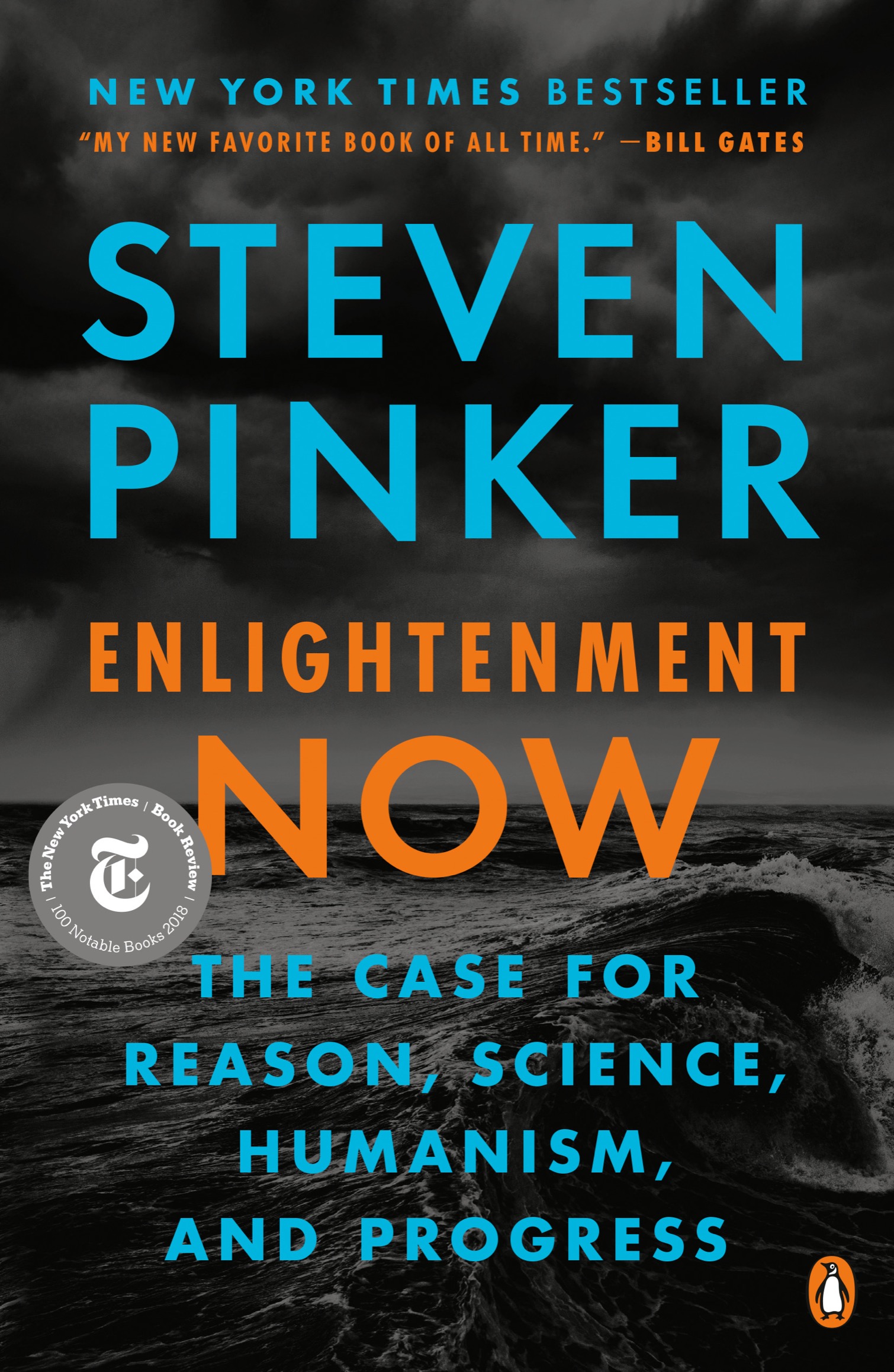
Enlightenment Now: The Case for Reason, Science, Humanism, and Progress
About this book
The book asks readers to compare alarming headlines with trends in life expectancy, health, food, wealth, safety, peace, knowledge, rights, and quality of life. Dozens of graphs show the direction and scale of change across different periods.
Pinker connects improvement to Enlightenment commitments: problems can be understood, evidence can correct intuition, and human welfare is a legitimate standard for judging institutions. Progress is presented as an achievement requiring maintenance, not an automatic law of history.
The choice of indicators, interpretation of causation, and treatment of inequality and environmental risk have attracted criticism. The book is clearest when read as an evidence-backed argument against blanket decline narratives, not as proof that every place or group is better off on every measure.
Enlightenment Now is broad public-facing nonfiction about progress and the values Pinker believes sustain it. Its tables and sources allow readers to examine individual claims separately from the book's larger philosophical case.
Read a sample
5,020 words
Plain text
From the opening
PREFACE
The second half of the second decade of the third millennium would not seem to be an auspicious time to publish a book on the historical sweep of progress and its causes. At the time of this writing, my country is led by people with a dark vision of the current moment: “mothers and children trapped in poverty . . . an education system which leaves our young and beautiful students deprived of all knowledge . . . and the crime, and the gangs, and the drugs that have stolen too many lives.” We are in an “outright war” that is “expanding and metastasizing.” The blame for this nightmare may be placed on a “global power structure” that has eroded “the underlying spiritual and moral foundations of Christianity.”1
In the pages that follow, I will show that this bleak assessment of the state of the world is wrong. And not just a little wrong—wrong wrong, flat-earth wrong, couldn’t-be-more-wrong. But this book is not about the forty-fifth president of the United States and his advisors. It was conceived some years before Donald Trump announced his candidacy, and I hope it will outlast his administration by many more. The ideas that prepared the ground for his election are in fact widely shared among intellectuals and laypeople, on both the left and the right. They include pessimism about the way the world is heading, cynicism about the institutions of modernity, and an inability to conceive of a higher purpose in anything other than religion. I will present a different understanding of the world, grounded in fact and inspired by the ideals of the Enlightenment: reason, science, humanism, and progress. Enlightenment ideals, I hope to show, are timeless, but they have never been more relevant than they are right now.
The sociologist Robert Merton identified Communalism as a cardinal scientific virtue, together with Universalism, Disinterestedness, and Organized Skepticism: CUDOS.2 Kudos indeed goes to the many scientists who shared their data in a communal spirit and responded to my queries thoroughly and swiftly. First among these is Max Roser, proprietor of the mind-expanding Our World in Data Web site, whose insight and generosity were indispensable to many discussions in part II, the section on progress. I am grateful as well to Marian Tupy of HumanProgress and to Ola Rosling and Hans Rosling of Gapminder, two other invaluable resources for understanding the state of humanity. Hans was an inspiration, and his death in 2017 a tragedy for those who are committed to reason, science, humanism, and progress.
My gratitude goes as well to the other data scientists I pestered and to the institutions that collect and maintain their data: Karlyn Bowman, Daniel Cox (PRRI), Tamar Epner (Social Progress Index), Christopher Fariss, Chelsea Follett (HumanProgress), Andrew Gelman, Yair Ghitza, April Ingram (Science Heroes), Jill Janocha (Bureau of Labor Statistics), Gayle Kelch (US Fire Administration/FEMA), Alaina Kolosh (National Safety Council), Kalev Leetaru (Global Database of Events, Language, and Tone), Monty Marshall (Polity Project), Bruce Meyer, Branko Milanović (World Bank), Robert Muggah (Homicide Monitor), Pippa Norris (World Values Survey), Thomas Olshanski (US Fire Administration/FEMA), Amy Pearce (Science Heroes), Mark Perry, Therese Pettersson (Uppsala Conflict Data Program), Leandro Prados de la Escosura, Steven Radelet, Auke Rijpma (OECD Clio Infra), Hannah Ritchie (Our World in Data), Seth Stephens-Davidowitz (Google Trends), James X. Sullivan, Sam Taub (Uppsala Conflict Data Program), Kyla Thomas, Jennifer Truman (Bureau of Justice Statistics), Jean Twenge, Bas van Leeuwen (OECD Clio Infra), Carlos Vilalta, Christian Welzel (World Values Survey), Justin Wolfers, and Billy Woodward (Science Heroes).
David Deutsch, Rebecca Newberger Goldstein, Kevin Kelly, John Mueller, Roslyn Pinker, Max Roser, and Bruce Schneier read a draft of the entire manuscript and offered invaluable advice. I also profited from comments by experts who read chapters or excerpts, including Scott Aaronson, Leda Cosmides, Jeremy England, Paul Ewald, Joshua Goldstein, A. C. Grayling, Joshua Greene, Cesar Hidalgo, Jodie Jackson, Lawrence Krauss, Branko Milanović, Robert Muggah, Jason Nemirow, Matthew Nock, Ted Nordhaus, Anthony Pagden, Robert Pinker, Susan Pinker, Steven Radelet, Peter Scoblic, Martin Seligman, Michael Shellenberger, and Christian Welzel.
Other friends and colleagues answered questions or made important suggestions, including Charleen Adams, Rosalind Arden, Andrew Balmford, Nicolas Baumard, Brian Boutwell, Stewart Brand, David Byrne, Richard Dawkins, Daniel Dennett, Gregg Easterbrook, Emily-Rose Eastop, Nils Petter Gleditsch, Jennifer Jacquet, Barry Latzer, Mark Lilla, Karen Long, Andrew Mack, Michael McCullough, Heiner Rindermann, Jim Rossi, Scott Sagan, Sally Satel, and Michael Shermer. Special thanks go to my Harvard colleagues Mahzarin Banaji, Mercè Crosas, James Engell, Daniel Gilbert, Richard McNally, Kathryn Sikkink, and Lawrence Summers.
I thank Rhea Howard and Luz Lopez for their heroic efforts in obtaining, analyzing, and plotting data, and Keehup Yong for several regression analyses. I thank as well Ilavenil Subbiah for designing the elegant graphs and for her suggestions on form and substance.
I am deeply grateful to my editors, Wendy Wolf and Thomas Penn, and to my literary agent, John Brockman, for their guidance and encouragement throughout the project. Katya Rice has now copyedited eight of my books, and I have learned and profited from her handiwork every time.
Special thanks go to my family: Roslyn, Susan, Martin, Eva, Carl, Eric, Robert, Kris, Jack, David, Yael, Solomon, Danielle, and most of all Rebecca, my teacher and partner in appreciating the ideals of the Enlightenment.
Continue reading the sampleClose the sample
PART I
ENLIGHTENMENT
The common sense of the eighteenth century, its grasp of the obvious facts of human suffering, and of the obvious demands of human nature, acted on the world like a bath of moral cleansing.
—Alfred North Whitehead
In the course of several decades giving public lectures on language, mind, and human nature, I have been asked some mighty strange questions. Which is the best language? Are clams and oysters conscious? When will I be able to upload my mind to the Internet? Is obesity a form of violence?
But the most arresting question I have ever fielded followed a talk in which I explained the commonplace among scientists that mental life consists of patterns of activity in the tissues of the brain. A student in the audience raised her hand and asked me:
“Why should I live?”
The student’s ingenuous tone made it clear that she was neither suicidal nor sarcastic but genuinely curious about how to find meaning and purpose if traditional religious beliefs about an immortal soul are undermined by our best science. My policy is that there is no such thing as a stupid question, and to the surprise of the student, the audience, and most of all myself, I mustered a reasonably creditable answer. What I recall saying—embellished, to be sure, by the distortions of memory and l’esprit de l’escalier, the wit of the staircase—went something like this:
In the very act of asking that question, you are seeking reasons for your convictions, and so you are committed to reason as the means to discover and justify what is important to you. And there are so many reasons to live!
As a sentient being, you have the potential to flourish. You can refine your faculty of reason itself by learning and debating. You can seek explanations of the natural world through science, and insight into the human condition through the arts and humanities. You can make the most of your capacity for pleasure and satisfaction, which allowed your ancestors to thrive and thereby allowed you to exist. You can appreciate the beauty and richness of the natural and cultural world. As the heir to billions of years of life perpetuating itself, you can perpetuate life in turn. You have been endowed with a sense of sympathy—the ability to like, love, respect, help, and show kindness—and you can enjoy the gift of mutual benevolence with friends, family, and colleagues.
And because reason tells you that none of this is particular to you, you have the responsibility to provide to others what you expect for yourself. You can foster the welfare of other sentient beings by enhancing life, health, knowledge, freedom, abundance, safety, beauty, and peace. History shows that when we sympathize with others and apply our ingenuity to improving the human condition, we can make progress in doing so, and you can help to continue that progress.
Explaining the meaning of life is not in the usual job description of a professor of cognitive science, and I would not have had the gall to take up her question if the answer depended on my arcane technical knowledge or my dubious personal wisdom. But I knew I was channeling a body of beliefs and values that had taken shape more than two centuries before me and that are now more relevant than ever: the ideals of the Enlightenment.
The Enlightenment principle that we can apply reason and sympathy to enhance human flourishing may seem obvious, trite, old-fashioned. I wrote this book because I have come to realize that it is not. More than ever, the ideals of reason, science, humanism, and progress need a wholehearted defense. We take its gifts for granted: newborns who will live more than eight decades, markets overflowing with food, clean water that appears with a flick of a finger and waste that disappears with another, pills that erase a painful infection, sons who are not sent off to war, daughters who can walk the streets in safety, critics of the powerful who are not jailed or shot, the world’s knowledge and culture available in a shirt pocket. But these are human accomplishments, not cosmic birthrights. In the memories of many readers of this book—and in the experience of those in less fortunate parts of the world—war, scarcity, disease, ignorance, and lethal menace are a natural part of existence. We know that countries can slide back into these primitive conditions, and so we ignore the achievements of the Enlightenment at our peril.
In the years since I took the young woman’s question, I have often been reminded of the need to restate the ideals of the Enlightenment (also called humanism, the open society, and cosmopolitan or classical liberalism). It’s not just that questions like hers regularly appear in my inbox. (“Dear Professor Pinker, What advice do you have for someone who has taken ideas in your books and science to heart, and sees himself as a collection of atoms? A machine with a limited scope of intelligence, sprung out of selfish genes, inhabiting spacetime?”) It’s also that an obliviousness to the scope of human progress can lead to symptoms that are worse than existential angst. It can make people cynical about the Enlightenment-inspired institutions that are securing this progress, such as liberal democracy and organizations of international cooperation, and turn them toward atavistic alternatives.
The ideals of the Enlightenment are products of human reason, but they always struggle with other strands of human nature: loyalty to tribe, deference to authority, magical thinking, the blaming of misfortune on evildoers. The second decade of the 21st century has seen the rise of political movements that depict their countries as being pulled into a hellish dystopia by malign factions that can be resisted only by a strong leader who wrenches the country backward to make it “great again.” These movements have been abetted by a narrative shared by many of their fiercest opponents, in which the institutions of modernity have failed and every aspect of life is in deepening crisis—the two sides in macabre agreement that wrecking those institutions will make the world a better place. Harder to find is a positive vision that sees the world’s problems against a background of progress that it seeks to build upon by solving those problems in their turn.
If you still are unsure whether the ideals of Enlightenment humanism need a vigorous defense, consider the diagnosis of Shiraz Maher, an analyst of radical Islamist movements. “The West is shy of its values—it doesn’t speak up for classical liberalism,” he says. “We are unsure of them. They make us feel uneasy.” Contrast that with the Islamic State, which “knows exactly what it stands for,” a certainty that is “incredibly seductive”—and he should know, having once been a regional director of the jihadist group Hizb ut-Tahrir.1
Reflecting on liberal ideals in 1960, not long after they had withstood their greatest trial, the economist Friedrich Hayek observed, “If old truths are to retain their hold on men’s minds, they must be restated in the language and concepts of successive generations” (inadvertently proving his point with the expression men’s minds). “What at one time are their most effective expressions gradually become so worn with use that they cease to carry a definite meaning. The underlying ideas may be as valid as ever, but the words, even when they refer to problems that are still with us, no longer convey the same conviction.”2
This book is my attempt to restate the ideals of the Enlightenment in the language and concepts of the 21st century. I will first lay out a framework for understanding the human condition informed by modern science—who we are, where we came from, what our challenges are, and how we can meet them. The bulk of the book is devoted to defending those ideals in a distinctively 21st-century way: with data. This evidence-based take on the Enlightenment project reveals that it was not a naïve hope. The Enlightenment has worked—perhaps the greatest story seldom told. And because this triumph is so unsung, the underlying ideals of reason, science, and humanism are unappreciated as well. Far from being an insipid consensus, these ideals are treated by today’s intellectuals with indifference, skepticism, and sometimes contempt. When properly appreciated, I will suggest, the ideals of the Enlightenment are in fact stirring, inspiring, noble—a reason to live.
CHAPTER 1
DARE TO UNDERSTAND!
What is enlightenment? In a 1784 essay with that question as its title, Immanuel Kant answered that it consists of “humankind’s emergence from its self-incurred immaturity,” its “lazy and cowardly” submission to the “dogmas and formulas” of religious or political authority.1 Enlightenment’s motto, he proclaimed, is “Dare to understand!” and its foundational demand is freedom of thought and speech. “One age cannot conclude a pact that would prevent succeeding ages from extending their insights, increasing their knowledge, and purging their errors. That would be a crime against human nature, whose proper destiny lies precisely in such progress.”2
A 21st-century statement of the same idea may be found in the physicist David Deutsch’s defense of enlightenment, The Beginning of Infinity. Deutsch argues that if we dare to understand, progress is possible in all fields, scientific, political, and moral:
Optimism (in the sense that I have advocated) is the theory that all failures—all evils—are due to insufficient knowledge. . . . Problems are inevitable, because our knowledge will always be infinitely far from complete. Some problems are hard, but it is a mistake to confuse hard problems with problems unlikely to be solved. Problems are soluble, and each particular evil is a problem that can be solved. An optimistic civilization is open and not afraid to innovate, and is based on traditions of criticism. Its institutions keep improving, and the most important knowledge that they embody is knowledge of how to detect and eliminate errors.3
What is the Enlightenment?4 There is no official answer, because the era named by Kant’s essay was never demarcated by opening and closing ceremonies like the Olympics, nor are its tenets stipulated in an oath or creed. The Enlightenment is conventionally placed in the last two-thirds of the 18th century, though it flowed out of the Scientific Revolution and the Age of Reason in the 17th century and spilled into the heyday of classical liberalism of the first half of the 19th. Provoked by challenges to conventional wisdom from science and exploration, mindful of the bloodshed of recent wars of religion, and abetted by the easy movement of ideas and people, the thinkers of the Enlightenment sought a new understanding of the human condition. The era was a cornucopia of ideas, some of them contradictory, but four themes tie them together: reason, science, humanism, and progress.
Foremost is reason. Reason is nonnegotiable. As soon as you show up to discuss the question of what we should live for (or any other question), as long as you insist that your answers, whatever they are, are reasonable or justified or true and that therefore other people ought to believe them too, then you have committed yourself to reason, and to holding your beliefs accountable to objective standards.5 If there’s anything the Enlightenment thinkers had in common, it was an insistence that we energetically apply the standard of reason to understanding our world, and not fall back on generators of delusion like faith, dogma, revelation, authority, charisma, mysticism, divination, visions, gut feelings, or the hermeneutic parsing of sacred texts.
It was reason that led most of the Enlightenment thinkers to repudiate a belief in an anthropomorphic God who took an interest in human affairs.6 The application of reason revealed that reports of miracles were dubious, that the authors of holy books were all too human, that natural events unfolded with no regard to human welfare, and that different cultures believed in mutually incompatible deities, none of them less likely than the others to be products of the imagination. (As Montesquieu wrote, “If triangles had a god they would give him three sides.”) For all that, not all of the Enlightenment thinkers were atheists. Some were deists (as opposed to theists): they thought that God set the universe in motion and then stepped back, allowing it to unfold according to the laws of nature. Others were pantheists, who used “God” as a synonym for the laws of nature. But few appealed to the law-giving, miracle-conjuring, son-begetting God of scripture.
Many writers today confuse the Enlightenment endorsement of reason with the implausible claim that humans are perfectly rational agents. Nothing could be further from historical reality. Thinkers such as Kant, Baruch Spinoza, Thomas Hobbes, David Hume, and Adam Smith were inquisitive psychologists and all too aware of our irrational passions and foibles. They insisted that it was only by calling out the common sources of folly that we could hope to overcome them. The deliberate application of reason was necessary precisely because our common habits of thought are not particularly reasonable.
That leads to the second ideal, science, the refining of reason to understand the world. The Scientific Revolution was revolutionary in a way that is hard to appreciate today, now that its discoveries have become second nature to most of us. The historian David Wootton reminds us of the understanding of an educated Englishman on the eve of the Revolution in 1600:
He believes witches can summon up storms that sink ships at sea. . . . He believes in werewolves, although there happen not to be any in England—he knows they are to be found in Belgium. . . . He believes Circe really did turn Odysseus’s crew into pigs. He believes mice are spontaneously generated in piles of straw. He believes in contemporary magicians. . . . He has seen a unicorn’s horn, but not a unicorn.
He believes that a murdered body will bleed in the presence of the murderer. He believes that there is an ointment which, if rubbed on a dagger which has caused a wound, will cure the wound. He believes that the shape, colour and texture of a plant can be a clue to how it will work as a medicine because God designed nature to be interpreted by mankind. He believes that it is possible to turn base metal into gold, although he doubts that anyone knows how to do it. He believes that nature abhors a vacuum. He believes the rainbow is a sign from God and that comets portend evil. He believes that dreams predict the future, if we know how to interpret them. He believes, of course, that the earth stands still and the sun and stars turn around the earth once every twenty-four hours.7
A century and a third later, an educated descendant of this Englishman would believe none of these things. It was an escape not just from ignorance but from terror. The sociologist Robert Scott notes that in the Middle Ages “the belief that an external force controlled daily life contributed to a kind of collective paranoia”:
Rainstorms, thunder, lightning, wind gusts, solar or lunar eclipses, cold snaps, heat waves, dry spells, and earthquakes alike were considered signs and signals of God’s displeasure. As a result, the “hobgoblins of fear” inhabited every realm of life. The sea became a satanic realm, and forests were populated with beasts of prey, ogres, witches, demons, and very real thieves and cutthroats. . . . After dark, too, the world was filled with omens portending dangers of every sort: comets, meteors, shooting stars, lunar eclipses, the howls of wild animals.8
To the Enlightenment thinkers the escape from ignorance and superstition showed how mistaken our conventional wisdom could be, and how the methods of science—skepticism, fallibilism, open debate, and empirical testing—are a paradigm of how to achieve reliable knowledge.
That knowledge includes an understanding of ourselves. The need for a “science of man” was a theme that tied together Enlightenment thinkers who disagreed about much else, including Montesquieu, Hume, Smith, Kant, Nicolas de Condorcet, Denis Diderot, Jean-Baptiste d’Alembert, Jean-Jacques Rousseau, and Giambattista Vico. Their belief that there was such a thing as universal human nature, and that it could be studied scientifically, made them precocious practitioners of sciences that would be named only centuries later.9 They were cognitive neuroscientists, who tried to explain thought, emotion, and psychopathology in terms of physical mechanisms of the brain. They were evolutionary psychologists, who sought to characterize life in a state of nature and to identify the animal instincts that are “infused into our bosoms.” They were social psychologists, who wrote of the moral sentiments that draw us together, the selfish passions that divide us, and the foibles of shortsightedness that confound our best-laid plans. And they were cultural anthropologists, who mined the accounts of travelers and explorers for data both on human universals and on the diversity of customs and mores across the world’s cultures.
The idea of a universal human nature brings us to a third theme, humanism. The thinkers of the Age of Reason and the Enlightenment saw an urgent need for a secular foundation for morality, because they were haunted by a historical memory of centuries of religious carnage: the Crusades, the Inquisition, witch hunts, the European wars of religion. They laid that foundation in what we now call humanism, which privileges the well-being of individual men, women, and children over the glory of the tribe, race, nation, or religion. It is individuals, not groups, who are sentient—who feel pleasure and pain, fulfillment and anguish. Whether it is framed as the goal of providing the greatest happiness for the greatest number or as a categorical imperative to treat people as ends rather than means, it was the universal capacity of a person to suffer and flourish, they said, that called on our moral concern.
Fortunately, human nature prepares us to answer that call. That is because we are endowed with the sentiment of sympathy, which they also called benevolence, pity, and commiseration. Given that we are equipped with the capacity to sympathize with others, nothing can prevent the circle of sympathy from expanding from the family and tribe to embrace all of humankind, particularly as reason goads us into realizing that there can be nothing uniquely deserving about ourselves or any of the groups to which we belong.10 We are forced into cosmopolitanism: accepting our citizenship in the world.11
A humanistic sensibility impelled the Enlightenment thinkers to condemn not just religious violence but also the secular cruelties of their age, including slavery, despotism, executions for frivolous offenses such as shoplifting and poaching, and sadistic punishments such as flogging, amputation, impalement, disembowelment, breaking on the wheel, and burning at the stake. The Enlightenment is sometimes called the Humanitarian Revolution, because it led to the abolition of barbaric practices that had been commonplace across civilizations for millennia.12
If the abolition of slavery and cruel punishment is not progress, nothing is, which brings us to the fourth Enlightenment ideal. With our understanding of the world advanced by science and our circle of sympathy expanded through reason and cosmopolitanism, humanity could make intellectual and moral progress. It need not resign itself to the miseries and irrationalities of the present, nor try to turn back the clock to a lost golden age.
The Enlightenment belief in progress should not be confused with the 19th-century Romantic belief in mystical forces, laws, dialectics, struggles, unfoldings, destinies, ages of man, and evolutionary forces that propel mankind ever upward toward utopia.13 As Kant’s remark about “increasing knowledge and purging errors” indicates, it was more prosaic, a combination of reason and humanism. If we keep track of how our laws and manners are doing, think up ways to improve them, try them out, and keep the ones that make people better off, we can gradually make the world a better place. Science itself creeps forward through this cycle of theory and experiment, and its ceaseless headway, superimposed on local setbacks and reversals, shows how progress is possible.
The ideal of progress also should not be confused with the 20th-century movement to re-engineer society for the convenience of technocrats and planners, which the political scientist James Scott calls Authoritarian High Modernism.14 The movement denied the existence of human nature, with its messy needs for beauty, nature, tradition, and social intimacy.15 Starting from a “clean tablecloth,” the modernists designed urban renewal projects that replaced vibrant neighborhoods with freeways, high-rises, windswept plazas, and brutalist architecture. “Mankind will be reborn,” they theorized, and “live in an ordered relation to the whole.”16 Though these developments were sometimes linked to the word progress, the usage was ironic: “progress” unguided by humanism is not progress.
Rather than trying to shape human nature, the Enlightenment hope for progress was concentrated on human institutions. Human-made systems like governments, laws, schools, markets, and international bodies are a natural target for the application of reason to human betterment.
In this way of thinking, government is not a divine fiat to reign, a synonym for “society,” or an avatar of the national, religious, or racial soul. It is a human invention, tacitly agreed to in a social contract, designed to enhance the welfare of citizens by coordinating their behavior and discouraging selfish acts that may be tempting to every individual but leave everyone worse off. As the most famous product of the Enlightenment, the Declaration of Independence, put it, in order to secure the right to life, liberty, and the pursuit of happiness, governments are instituted among people, deriving their just powers from the consent of the governed.
Among the powers of government is meting out punishment, and writers such as Montesquieu, Cesare Beccaria, and the American founders thought afresh about the government’s license to harm its citizens.17 Criminal punishment, they argued, is not a mandate to implement cosmic justice but part of an incentive structure that discourages antisocial acts without causing more suffering than it deters. The reason the punishment should fit the crime, for example, is not to balance some mystical scale of justice but to ensure that a wrongdoer stops at a minor crime rather than escalating to a more harmful one. Cruel punishments, whether or not they are in some sense “deserved,” are no more effective at deterring harm than moderate but surer punishments, and they desensitize spectators and brutalize the society that implements them.
The Enlightenment also saw the first rational analysis of prosperity. Its starting point was not how wealth is distributed but the prior question of how wealth comes to exist in the first place.18 Smith, building on French, Dutch, and Scottish influences, noted that an abundance of useful stuff cannot be conjured into existence by a farmer or craftsman working in isolation. It depends on a network of specialists, each of whom learns how to make something as efficiently as possible, and who combine and exchange the fruits of their ingenuity, skill, and labor. In a famous example, Smith calculated that a pin-maker working alone could make at most one pin a day, whereas in a workshop in which “one man draws out the wire, another straights it, a third cuts it, a fourth points it, a fifth grinds it at the top for receiving the head,” each could make almost five thousand.
Specialization works only in a market that allows the specialists to exchange their goods and services, and Smith explained that economic activity was a form of mutually beneficial cooperation (a positive-sum game, in today’s lingo): each gets back something that is more valuable to him than what he gives up. Through voluntary exchange, people benefit others by benefiting themselves; as he wrote, “It is not from the benevolence of the butcher, the brewer, or the baker that we expect our dinner, but from their regard to their own interest. We address ourselves, not to their humanity but to their self-love.” Smith was not saying that people are ruthlessly selfish, or that they ought to be; he was one of history’s keenest commentators on human sympathy. He only said that in a market, whatever tendency people have to care for their families and themselves can work to the good of all.
Exchange can make an entire society not just richer but nicer, because in an effective market it is cheaper to buy things than to steal them, and other people are more valuable to you alive than dead. (As the economist Ludwig von Mises put it centuries later, “If the tailor goes to war against the baker, he must henceforth bake his own bread.”) Many Enlightenment thinkers, including Montesquieu, Kant, Voltaire, Diderot, and the Abbé de Saint-Pierre, endorsed the ideal of doux commerce, gentle commerce.19 The American founders—George Washington, James Madison, and especially Alexander Hamilton—designed the institutions of the young nation to nurture it.