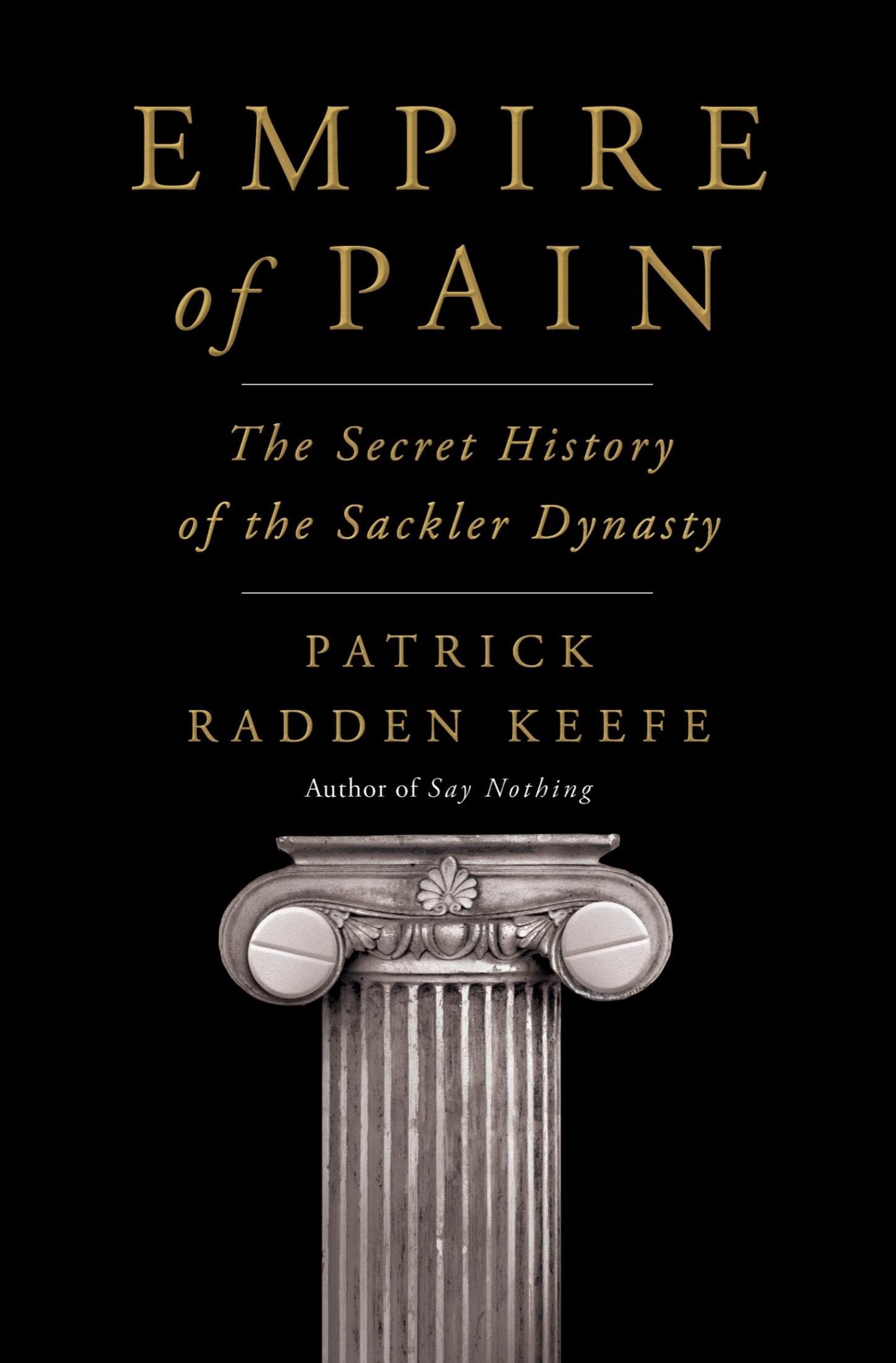
Empire of Pain: The Secret History of the Sackler Dynasty
About this book
The history begins before OxyContin with Arthur Sackler's innovations in pharmaceutical advertising and the family's accumulation of wealth and cultural prestige. Later generations applied an aggressive sales model to a powerful opioid promoted for broad use.
Internal strategies, medical claims, sales incentives, regulators, lawsuits, and the experiences of people with addiction reveal how commercial success was separated from public responsibility. Philanthropic naming allowed the family story to remain distinct from the product story for years.
Keefe combines corporate documents, legal records, and extensive reporting. The book distinguishes between the actions of particular people and the larger failures of medicine and regulation, while refusing to let complexity become an excuse for impunity.
Empire of Pain is a multigenerational family chronicle and a work of accountability journalism. It shows how reputation, secrecy, and professional institutions can protect a fortune after the source of that fortune becomes a public disaster.
Read a sample
5,103 words
Plain text
From the opening
Prologue
THE TAPROOT
the new york headquarters of the international law firm Debevoise & Plimpton occupy ten floors of a sleek black office tower that stands in a grove of skyscrapers in midtown Manhattan. Founded in 1931 by a pair of blue-blooded attorneys who defected from a venerable Wall Street firm, Debevoise became venerable itself, expanding, over the decades, into a global juggernaut with eight hundred lawyers, a roster of blue-chip clients, and nearly $1 billion in annual revenue. The midtown offices bear no trace of the oak-and-leather origins of the firm. Instead, they are decorated in the banal tones of any contemporary corporate office, with carpeted hallways, fishbowl conference rooms, and standing desks. In the twentieth century, power announced itself. In the twenty-first, the surest way to spot real power is by its understatement.
One bright, cold morning in the spring of 2019, as reflected clouds slid across the black glass of the facade, Mary Jo White entered the building, ascended in an elevator to the Debevoise offices, and took up position in a conference room that was buzzing with subdued energy. At seventy-one years old, White epitomized, in her very physicality, the principle of power as understatement. She was tiny—barely five feet tall, with close-cropped brown hair and wizened eyes—and her manner of speech was blunt and unpretentious. But she was a fearsome litigator. White sometimes joked that her specialty was the “big mess” business: she wasn’t cheap, but if you found yourself in a lot of trouble, and you happened to have a lot of money, she was the lawyer you called.
Earlier in her career, White had spent nearly a decade as the U.S. Attorney for the Southern District of New York, where she prosecuted the perpetrators of the 1993 World Trade Center bombing. Barack Obama appointed her chair of the Securities and Exchange Commission. But between these stints in government, she always returned to Debevoise. She had joined the firm as a young associate, becoming the second woman ever to make partner. She represented the big dogs: Verizon, JP Morgan, General Electric, the NFL.
The conference room was teeming with lawyers, not just from Debevoise but from other firms, too, more than twenty of them, with notebooks and laptops and mammoth three-ring binders bristling with Post-it notes. There was a speakerphone on the table, and another twenty lawyers from across the country had dialed in. The occasion for which this small army of attorneys had assembled was the deposition of a reclusive billionaire, a longtime client of Mary Jo White’s who was now at the center of a blizzard of lawsuits alleging that the accumulation of those billions had led to the deaths of hundreds of thousands of people.
White once observed that when she was a prosecutor, her job was simple: “Do the right thing. You’re going after bad guys. You’re doing something good for society every day.” These days, her situation was more complicated. High-end corporate attorneys like White are skilled professionals who enjoy a certain social respectability, but at the end of the day it’s a client-driven business. This is a familiar dynamic for a lot of prosecutors with a mortgage and tuitions to think about. You spend the first half of your career going after the bad guys and then the second half representing them.
The lawyer who would be posing the questions that morning was a man in his late sixties named Paul Hanly. He did not look like the other attorneys. Hanly was a class-action plaintiffs’ lawyer. He favored custom-made suits in bold colors and tailored shirts with stiff, contrasting collars. His steel-gray hair was slicked straight back, his piercing eyes accentuated by horn-rimmed glasses. If White was a master of muted power, Hanly was the opposite: he looked like a lawyer in a Dick Tracy cartoon. But he had a competitive edge to match White’s and a visceral contempt for the veneer of propriety that people like White brought to this sort of undertaking. Let’s not kid ourselves, Hanly thought. In his view, White’s clients were “arrogant assholes.”
The billionaire being deposed that morning was a woman in her early seventies, a medical doctor, though she had never actually practiced medicine. She had blond hair and a broad face, with a high forehead and wide-set eyes. Her manner was gruff. Her lawyers had fought to prevent this deposition, and she did not want to be there. She projected the casual impatience, one of the lawyers in attendance thought, of someone who never waits in line to board an airplane.
“You are Kathe Sackler?” Hanly asked.
“I am,” she replied.
Kathe was a member of the Sackler family, a prominent New York philanthropic dynasty. A few years earlier, Forbes magazine had listed the Sacklers as one of the twenty wealthiest families in the United States, with an estimated fortune of some $14 billion, “edging out storied families like the Busches, Mellons and Rockefellers.” The Sackler name adorned art museums, universities, and medical facilities around the world. From the conference room, Kathe could have walked twenty blocks downtown, to the Sackler Institute of Graduate Biomedical Sciences, at NYU Medical School, or ten blocks uptown to the Sackler Center for Biomedicine and Nutrition Research, at Rockefeller University, then farther uptown to the Sackler Center for Arts Education at the Guggenheim Museum, and along Fifth Avenue to the Sackler Wing at the Metropolitan Museum of Art.
Continue reading the sampleClose the sample
Over the previous six decades, Kathe Sackler’s family had left its mark on New York City, in a manner that the Vanderbilts or the Carnegies once did. But the Sacklers were wealthier now than either of those families that traced their fortunes to the Gilded Age. And their gifts extended well beyond New York, to the Sackler Museum at Harvard and the Sackler School of Graduate Biomedical Sciences at Tufts, the Sackler Library at Oxford and the Sackler Wing at the Louvre, the Sackler School of Medicine in Tel Aviv and the Sackler Museum of Art and Archaeology in Beijing. “I grew up,” Kathe told Hanly, “with my parents having foundations.” They contributed, she said, to “social causes.”
The Sacklers had given away hundreds of millions of dollars, and for decades the Sackler name had been associated in the public mind with philanthropy. One museum director likened the family to the Medicis, the noble clan in fifteenth-century Florence whose patronage of the arts helped give rise to the Renaissance. But whereas the Medicis made their fortune in banking, the precise origins of the Sacklers’ wealth had, for a long time, been more mysterious. Members of the family bestowed their name on arts and education institutions with a sort of mania. It was etched into marble, emblazoned on brass plaques, even spelled out in stained glass. There were Sackler professorships and Sackler scholarships and Sackler lecture series and Sackler prizes. Yet, to the casual observer, it could be difficult to connect the family name with any sort of business that might have generated all this wealth. Social acquaintances would see members of the family out, at gala dinners and Hamptons fund-raisers, on a yacht in the Caribbean or skiing in the Swiss Alps, and wonder, or whisper, about how they made their money. And this was strange, because the bulk of the Sacklers’ wealth had been accumulated not in the era of the robber barons but in recent decades.
“You graduated from NYU undergraduate in 1980,” Hanly said. “True?”
“Correct,” Kathe Sackler replied.
“And from NYU Medical School in 1984?”
“Yes.”
And was it true, Hanly asked, that after a two-year surgical residency she had gone to work for the Purdue Frederick Company?
Purdue Frederick was a drug manufacturer, which subsequently became known as Purdue Pharma. Based in Connecticut, it was the source of the vast majority of the Sackler fortune. Whereas the Sacklers tended to insist, through elaborate “naming rights” contracts, that any gallery or research center that received their generosity must prominently feature the family name, the family business was not named after the Sacklers. In fact, you could scour Purdue Pharma’s website and find no mention of the Sacklers whatsoever. But Purdue was a privately held company entirely owned by Kathe Sackler and other members of her family. In 1996, Purdue had introduced a groundbreaking drug, a powerful opioid painkiller called OxyContin, which was heralded as a revolutionary way to treat chronic pain. The drug became one of the biggest blockbusters in pharmaceutical history, generating some $35 billion in revenue.
But it also led to a rash of addiction and abuse. By the time Kathe Sackler sat for her deposition, the United States was seized by an opioid epidemic in which Americans from every corner of the country found themselves addicted to these powerful drugs. Many people who started abusing OxyContin ended up transitioning to street drugs, like heroin or fentanyl. The numbers were staggering. According to the Centers for Disease Control and Prevention, in the quarter century following the introduction of OxyContin, some 450,000 Americans had died of opioid-related overdoses. Such overdoses were now the leading cause of accidental death in America, accounting for more deaths than car accidents—more deaths, even, than that most quintessentially American of metrics, gunshot wounds. In fact, more Americans had lost their lives from opioid overdoses than had died in all of the wars the country had fought since World War II.
Mary Jo White sometimes observed that one thing she loved about the law is the way it forces you “to distill things down to their essence.” The opioid epidemic was an enormously complex public health crisis. But, as Paul Hanly questioned Kathe Sackler, he was trying to distill this epic human tragedy down to its root causes. Prior to the introduction of OxyContin, America did not have an opioid crisis. After the introduction of OxyContin, it did. The Sacklers and their company were now defendants in more than twenty-five hundred lawsuits that were being brought by cities, states, counties, Native American tribes, hospitals, school districts, and a host of other litigants. They had been swept up in a huge civil litigation effort in which public and private attorneys sought to hold pharmaceutical companies accountable for their role in marketing these powerful drugs and misleading the public about their addictive properties. Something like this had happened once before, when tobacco companies were made to answer for their decision to knowingly downplay the health risks of cigarettes. Company executives were hauled before Congress, and the industry ended up agreeing to a landmark $206 billion settlement in 1998.
White’s job was to prevent that sort of reckoning from happening to the Sacklers and Purdue. The attorney general of New York, who was suing Purdue and had named Kathe and seven other members of the Sackler family as defendants, argued in a legal complaint that OxyContin was “the taproot of the opioid epidemic.” It was the pioneer, the painkiller that changed the way American doctors prescribed pain medication, with devastating consequences. The attorney general of Massachusetts, who was also suing the Sacklers, maintained that “a single family made the choices that caused much of the opioid epidemic.”
White had other ideas. Those bringing cases against the Sacklers were twisting the facts to scapegoat her clients, she argued. What was their crime? All they had done was sell a drug that was perfectly legal—a product that had been approved by the Food and Drug Administration. This whole charade was “a litigation blame game,” White contended, insisting that the opioid epidemic “is not a crisis of my clients’ or Purdue’s creation.”
But in the deposition that day, she said nothing. After introducing herself (“Mary Jo White, Debevoise & Plimpton, for Dr. Sackler”), she simply sat and listened, allowing other colleagues to jump in and interrupt Hanly with objections. Her function was not to make noise but to serve as a holstered gun, silent but visible, by Kathe’s side. And White and her team had coached their client well. Whatever White might say about the law getting to “the essence” of things, when your client is in the hot seat in a deposition, the whole point is to avoid the essence.
“Dr. Sackler, does Purdue bear any responsibility for the opioid crisis?” Hanly asked.
“Objection!” one of the lawyers interjected. “Objection!” another chimed in.
“I don’t believe Purdue has a legal responsibility,” Kathe replied.
That’s not what I asked, Hanly pointed out. What I want to know “is whether Purdue’s conduct was a cause of the opioid epidemic.”
“Objection!”
“I think it’s a very complex set of factors and confluence of different circumstances and societal issues and problems and medical issues and regulatory gaps in different states across the country,” she replied. “I mean, it’s very, very, very complex.”
But then Kathe Sackler did something surprising. One might suppose, given the dark legacy of OxyContin, that she would distance herself from the drug. As Hanly questioned her, however, she refused to accept the very premise of his inquiry. The Sacklers have nothing to be ashamed of or to apologize for, she maintained—because there’s nothing wrong with OxyContin. “It’s a very good medicine, and it’s a very effective and safe medicine,” she said. Some measure of defensiveness was to be expected from a corporate official being deposed in a multibillion-dollar lawsuit. But this was something else. This was pride. The truth is, she said, that she, Kathe, deserved credit for coming up with “the idea” for OxyContin. Her accusers were suggesting that OxyContin was the taproot of one of the most deadly public health crises in modern history, and Kathe Sackler was outing herself, proudly, as the taproot of OxyContin.
“Do you recognize that hundreds of thousands of Americans have become addicted to OxyContin?” Hanly asked.
“Objection!” a pair of lawyers blurted. Kathe hesitated.
“Simple question,” Hanly said. “Yes or no.”
“I don’t know the answer to that,” she said.
At one point in his questioning, Hanly inquired about a particular building on East Sixty-Second Street, just a few blocks from the conference room where they were sitting. There are actually two buildings, Kathe corrected him. From the outside, they look like two discrete addresses, but inside “they’re connected,” she explained. “They function as one.” They were handsome limestone town houses, in a rarefied neighborhood alongside Central Park, the sorts of timeless New York buildings that prompt real estate envy and conjure reveries of an earlier era. “That’s an office which is”—she caught herself—“was…my father and my uncle’s offices originally.”
Originally, there had been three Sackler brothers, she explained. Arthur, Mortimer, and Raymond. Mortimer was Kathe’s father. All three of them were doctors, but the Sackler brothers were “very entrepreneurial,” she continued. The saga of their lives and the dynasty they would establish was also the story of a century of American capitalism. The three brothers had purchased Purdue Frederick back in the 1950s. “It was a much smaller company, originally,” Kathe said. “It was a small family business.”
Chapter 1
A GOOD NAME
arthur sackler was born in Brooklyn, in the summer of 1913, at a moment when Brooklyn was burgeoning with wave upon wave of immigrants from the Old World, new faces every day, the unfamiliar music of new tongues on the street corners, new buildings going up left and right to house and employ these new arrivals, and everywhere this giddy, bounding sense of becoming. As the firstborn child of immigrants himself, Arthur came to share the dreams and ambitions of that generation of new Americans, to understand their energy and their hunger. He vibrated with it, practically from the cradle. He was born Abraham but would cast off that old-world name in favor of the more squarely American-sounding Arthur. There’s a photo, taken in 1915 or 1916, of Arthur as a toddler, sitting upright in a patch of grass while his mother, Sophie, reclines behind him like a lioness. Sophie is dark-haired, dark-eyed, and formidable. Arthur stares straight at the camera, a cherub in short pants, his ears sticking out, his eyes steady and preternaturally serious, as though he already knows the score.
Sophie Greenberg had emigrated from Poland just a few years earlier. She was a teenager when she arrived in Brooklyn in 1906 and met a mild-mannered man nearly twenty years her senior named Isaac Sackler. Isaac was an immigrant himself, from Galicia, in what was then still the Austrian Empire; he had come to New York with his parents and siblings, arriving on a ship in 1904. Isaac was a proud man. He was descended from a line of rabbis who had fled Spain for central Europe during the Inquisition, and now he and his young bride would build a new beachhead in New York. Isaac went into business with his brother, operating a small grocery store at 83 Montrose Avenue in Williamsburg. They called it Sackler Bros. The family lived in an apartment in the building. Three years after Arthur was born, Isaac and Sophie had a second boy, Mortimer, and four years after that, a third, Raymond. Arthur was devoted to his little brothers and fiercely protective of them. For a time, when they were small, all three brothers shared a bed.
Isaac did well enough in the grocery business that the family soon moved to Flatbush. A bustling neighborhood that felt like the heart of the borough, Flatbush was considered middle class, even upper middle class, compared with the far reaches of immigrant Brooklyn, like Brownsville and Canarsie. Real estate was the great benchmark in New York, even then, and the new address signified that Isaac Sackler had made something of himself in the New World, achieving a degree of stability. Flatbush felt like a place you graduated to, with tree-lined streets and solid, spacious apartments. One of Arthur’s contemporaries went so far as to remark that to Brooklyn Jews of that era it could seem that other Jews who lived in Flatbush were “practically Gentiles.” With his earnings from the grocery business, Isaac invested in real estate, purchasing tenement buildings and renting out apartments. But Isaac and Sophie had dreams for Arthur and his brothers, dreams that stretched beyond Flatbush, beyond even Brooklyn. They had a sense of providence. They wanted the Sackler brothers to leave their mark on the world.
If Arthur would later seem to have lived more lives than anyone else could possibly squeeze into one lifetime, it helped that he had an early start. He began working when he was still a boy, assisting his father in the grocery store. From an early age, he evinced a set of qualities that would propel and shape his life—a singular vigor, a roving intelligence, an inexhaustible ambition. Sophie was clever, but not educated. At seventeen she had gone to work in a garment factory, and she would never fully master written English. Isaac and Sophie spoke Yiddish at home, but they encouraged their sons to assimilate. They kept kosher, but rarely attended synagogue. Sophie’s parents lived with the family, and there was a sense, not uncommon in any immigrant enclave, that all the accumulated hopes and aspirations of the older generations would now be invested in these American-born kids. Arthur in particular felt the weight of those expectations: he was the pioneer, the firstborn American son, and everyone staked their dreams on him.
The vehicle for achieving those dreams would be education. One fall day in 1925, Artie Sackler (he went by Artie) arrived at Erasmus Hall High School on Flatbush Avenue. He was young for his class—he had just turned twelve—having tested into a special accelerated program for bright students. Artie was not one to be easily cowed, but Erasmus was an intimidating institution. Built by the Dutch in the eighteenth century, the original structure was a two-story wooden schoolhouse. In the first years of the twentieth century, the school expanded, around that ancient schoolhouse, to include a quadrangle in the style of Oxford University with castle-like neo-Gothic buildings clad in ivy and adorned with gargoyles. This expansion was designed to accommodate the great surge of immigrant children in Brooklyn. The faculty and students at Erasmus saw themselves as occupying the vanguard of the American experiment and took the notion of upward mobility and assimilation seriously, providing a first-class public education. The school had science labs and taught Latin and Greek. Some of the teachers had PhDs.
But Erasmus was also enormous. With some eight thousand students, it was one of the biggest high schools in the country, and most of the students were just like Arthur Sackler—the eager offspring of recent immigrants, children of the Roaring Twenties, their eyes bright, their hair pomaded to a sheen. They surged into the corridors, the boys dressed in suits and red ties, the girls in dresses with red ribbons in their hair. When they met under the great vaulted entrance arch during the lunch hour, it looked, in the words of one of Arthur’s classmates, like a “Hollywood cocktail party.”
Arthur loved it. In history class, he found that he admired and related to the Founding Fathers, and particularly Thomas Jefferson. Like Jefferson, Artie had eclectic interests—art, science, literature, history, sports, business; he wanted to do everything—and Erasmus put a great emphasis on extracurriculars. There must have been a hundred clubs, a club for practically everything. On a late afternoon in winter, when classes had ended for the day and dark had fallen, the whole school was lit up, windows blazing around the quad, and as you walked the corridors, you would hear the sounds of one club or another being convened: “Mr. Chairman! Point of order!”
In later life, when he spoke of these early years at Erasmus, Arthur would talk about “the big dream.” Erasmus was a great stone temple to American meritocracy, and most of the time it seemed that the only practical limitation on what he could expect to get out of life would be what he was personally prepared to put into it. Sophie would prod him about school: “Did you ask a good question today?” Arthur had grown up to be gangly and broad-shouldered, with a square face, blond hair, and eyes that were blue and nearsighted. He had tremendous stamina, and he needed it. In addition to his studies, he joined the student newspaper as an editor and found an opening in the school’s publishing office, selling advertising for school publications. Rather than accept a standard pay arrangement, Arthur proposed that he receive a small commission on any ad sale he made. The administration agreed, and soon Arthur was making money.
This was a lesson he learned early, one that would inform his later life in important ways: Arthur Sackler liked to bet on himself, going to great lengths in order to devise a scheme in which his own formidable energies might be rewarded. Nor was he content with the one job. He set up a business to handle photography for the school yearbook. After selling advertising space to Drake Business Schools, a chain specializing in postsecondary clerical education, he proposed to the company that they make him—a high school student—their advertising manager. And they did.
His inexhaustible gusto and restless creativity were such that he always seemed to be fizzing with new innovations and ideas. Erasmus issued “program cards” and other pieces of humdrum curricular paperwork to its eight thousand students. Why not sell advertising on the back of them? What if Drake Business Schools paid for rulers branded with the company name and issued them to Erasmus students for free? By the time Arthur was fifteen, he was bringing in enough money from these various hustles to help support his family. He was accumulating new jobs more quickly than he could work them, so he started to hand some of them off to his brother Morty. Initially, Arthur felt that Ray, as the youngest, shouldn’t have to work. “Let the kid enjoy himself,” he would say. But eventually, Ray took jobs, too. Arthur arranged for his brothers to sell advertising for The Dutchman, the student magazine at Erasmus. They persuaded Chesterfield cigarettes to run ads aimed at their fellow students. This generated a nice commission.
For all of its orientation toward the future, Erasmus also had a vivid connection to the past. Some of the Founding Fathers whom Artie Sackler so revered had been supporters of the school he now attended: Alexander Hamilton, Aaron Burr, and John Jay had contributed funds to Erasmus. The school was named after the fifteenth-century Dutch scholar Desiderius Erasmus, and in the library a stained-glass window celebrated scenes from his life. The window had been completed just a few years before Arthur arrived, dedicated to “the great man whose name we have carried for a hundred and twenty-four years.” Each day, Arthur and his fellow students were inculcated with the idea that they would eventually take their place in a long line of great Americans, a continuous line that stretched back to the country’s founding. It didn’t matter that they lived in cramped quarters or wore the same threadbare suit every day, or that their parents spoke a different language. This country was theirs for the taking, and in the span of a single lifetime true greatness could be achieved. They spent their days at Erasmus surrounded by traces of great men who had come before, images and names, legacies etched in stone.
In the center of the quad, the ramshackle old Dutch schoolhouse still stood, a relic of a time when this part of Brooklyn had all been farmland. When the wind blew in the wintertime, the wooden beams of the old building would creak, and Arthur’s classmates joked that it was the ghost of Virgil, groaning at the sound of his beautiful Latin verses being recited in a Brooklyn accent.
Arthur’s hyperactive productivity in these years might have stemmed in part from anxiety: while he was at Erasmus, his father’s fortunes began to slip. Some of the real estate investments went bad, and the Sacklers were forced to move in to cheaper lodging. Isaac bought a shoe shop on Grand Street, but it failed and ended up closing. Having sold the grocery in order to finance his real estate investments, Isaac was now reduced to taking a low-paying job behind the counter at someone else’s grocery store, just to pay the bills.
Arthur would later recall that during these years, he was often cold but never hungry. Erasmus had an employment agency to help students find work outside school, and Arthur began to take on additional jobs to support the family. He got a newspaper route. He delivered flowers. He didn’t have time to date or attend summer camp or go to parties. He worked. It would become a point of pride for him that he never took a holiday until he was twenty-five years old.
Even so, in stray moments, Arthur glimpsed another world—a life beyond his existence in Brooklyn, a different life, which seemed close enough to touch. From time to time, he would take a break from his frenetic schedule and trot up the stone steps of the Brooklyn Museum, through the grove of Ionic columns and into the vast halls, where he would marvel at the artworks on display. Sometimes, his delivery jobs would take him into Manhattan, all the way uptown to the gilded palaces of Park Avenue. At Christmas, he would deliver great bouquets of flowers, and as he walked along the broad avenues, he would peer through brightly lit windows into the apartments and see the twinkle of Christmas lights inside. He loved the sensation, as he entered a big doorman building, his arms full of flowers, of stepping off the frigid sidewalk and getting enveloped in the velvet warmth of the lobby.
When the Great Depression hit in 1929, Isaac Sackler’s misfortune intensified. All of his money had been tied up in his tenement properties, and now they were worthless: he lost what little he had. On the streets of Flatbush, forlorn-looking men and women joined breadlines. The employment agency at Erasmus started accepting applications not just from students but from their parents. One day, Isaac called his three sons together. With a defiant flash of the old family pride, he informed them that he would not be going bankrupt. He had marshaled his meager resources responsibly and had at least been able to pay his bills. But he had nothing left. Isaac and Sophie desperately wanted their sons to continue their education—to go to college, to keep climbing the ladder, to do everything that a young man with ambition in America was supposed to do. But Isaac did not have the money to pay for it. If the Sackler boys were going to get an education, they would have to finance it themselves.
It must have been painful for Isaac to say this. But he insisted that he had not given his children nothing. On the contrary, he had bestowed upon them something more valuable than money. “What I have given you is the most important thing a father can give,” Isaac told Arthur, Mortimer, and Raymond. What he had given them, he said, was “a good name.”
When Arthur and his brothers were children, Sophie Sackler would check to see if they were sick by kissing them on the forehead to take their temperature with her lips. Sophie had a more dynamic and assertive personality than her husband and a very clear sense, from the time that her children were little, of what she wanted for them in life: she wanted them to be doctors.
“By the time I was four, I knew that I was going to be a physician,” Arthur later said. “My parents brainwashed me about being a doctor.” Both Sophie and Isaac regarded medicine as a noble profession. During the nineteenth century, many doctors had been perceived as snake oil salesmen or quacks. But Arthur and his brothers were born into what has been described as the golden age of American medicine, a period during the early twentieth century when the efficacy of medicine—and the credibility of the medical profession—were greatly enhanced by new scientific discoveries about the sources of various illnesses and the best means of treating them. As a consequence, it was not unusual for Jewish immigrant families to aspire to have their children pursue medicine. There was a sense that doctors were morally upright, and it was a vocation that served the public good and promised prestige and financial stability.