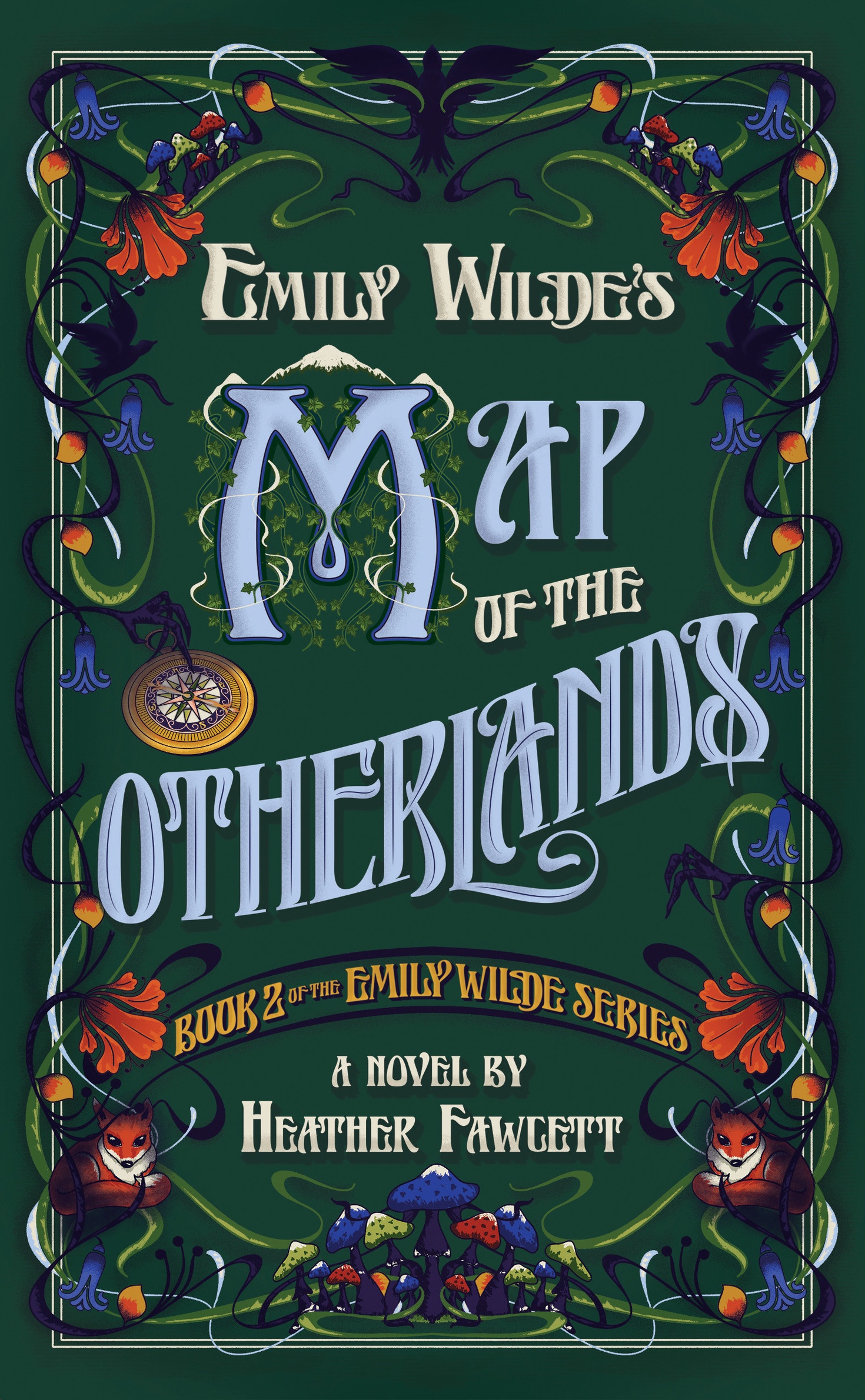
Emily Wilde's Map of the Otherlands
About this book
Emily has returned from Ljosland with more evidence, more questions, and a proposal from Wendell she has not answered. When assassins from his stepmother’s court reach the university, the danger makes his hidden royal identity impossible to treat as an academic curiosity.
The expedition includes Emily’s niece Ariadne and the disapproving scholar Rose as they follow traces left by an earlier researcher into the Austrian Alps. Maps, local tales, and vanished doors create a field problem in which the correct route may not remain in one place.
Emily’s expertise continues to depend on precision, but leadership requires her to account for people rather than merely deploy them. Her relationship with Wendell advances through practical trust while the politics of his realm become more immediate.
Emily Wilde’s Map of the Otherlands is the second book and should be read after Encyclopaedia of Faeries. Heather Fawcett expands the geography and cast without abandoning the diary’s intimate, wry perspective.
Read a sample
5,022 words
Plain text
From the opening
The foot would not fit in my briefcase, so I wrapped it in cloth and wrestled it into an old knapsack I sometimes carry with me on expeditions. Surprisingly—or perhaps unsurprisingly, as it is a faerie foot—it is neither dirty nor foul-smelling. It is, of course, long mummified and would probably be mistaken for a goat’s foot by a casual observer, perhaps an unlikely offering excavated from the tomb of some ancient pharaoh. While it does not smell bad, since bringing the foot into my office I have at odd moments caught the scent of wildflowers and crushed grass carried on a little breeze whose source I cannot trace.
I gazed at my now-bulging knapsack, feeling entirely ridiculous. Trust me when I say that I would rather not cart a foot around campus with me. But faerie remains, mummified or not, have been known to slip away as the fancy takes them, and I can only assume that feet are particularly inclined to such wanderlust. I shall have to keep it with me until its usefulness has been exhausted. Good grief.
The soft chiming of the grandfather clock alerted me that I was late for breakfast with Wendell. I know from experience that if I miss our breakfast appointments he will bring the meal to me himself, in such a quantity that the entire department will smell of eggs, and then for the rest of the day I shall have to suffer Professor Thornthwaite sniping at me about his delicate stomach.
I paused to pin my hair back up—it’s grown far too long, as I’ve spent the past several weeks descending into one of my obsessive periods, when I can think of little else beyond the subject of my research. And the question of Wendell’s door has consumed me more than any other academic mystery I can remember. My hair is not the only area of my appearance I have neglected of late—my brown dress is rumpled, and I am not altogether certain it is clean; I found it in a heap of other questionably laundered items on the floor of my closet.
“Come, dear,” I said to Shadow. The dog roused himself from his bed by the oil heater with a yawn, stretching his massive paws. I stopped for a moment to glance around my office with satisfaction—when I was recently granted tenure, I also inherited a much more spacious office, now three doors away from Wendell’s (naturally he has found a way to complain about this additional twenty feet of distance). The grandfather clock came with the room, as did the enormous damasked curtains lining the sash window that overlooks Knight College’s pond—presently dotted with swans—and the magnificent oak desk with its drawers lined with black velvet. I added bookshelves, of course, and a ladder to reach the uppermost volumes, whilst Wendell insisted on cluttering the place up with two photographs from Hrafnsvik that I did not even know he took, one of me standing in the snowy garden with Lilja and Margret, the other of a village scene; a vase of dried flowers that somehow never lose their scent; and the newly reframed painting of Shadow he commissioned for my twenty-eighth birthday—all right, I cannot complain about that. My beast looks very fetching.
I passed several students sunk deep into the armchairs of the dryadology department common room, an open space beyond the faculty offices that boasts a cosy fireplace—unlit on this warm September day—as well as an impressive row of windows taller than several men, with little half-moons of stained glass at the top, which face the Gothic grandeur of the Library of Medicine, its proximity the subject of innumerable wry remarks concerning a dryadologist’s susceptibility to strange injuries. In one corner is a bronze urn filled with salt—campus legend has it this began as a joke, but many a whey-faced undergraduate has visited this vessel to stuff their pockets after sitting through their first lecture on wights. Not that there is much to worry about, as we do not ordinarily have Folk wandering into the department to hear what we mortals are saying about them (Wendell excepted). The thick rugs scattered on the floor must be trodden on with care, for they are lumpy from the coins stuffed beneath them. Like the salt, this tradition most likely originated as a humourous diversion rather than any serious design to ward the Folk away from our halls, and has now largely devolved into a sort of good-luck ritual, with students pressing a ha’penny into the floor before an exam or dissertation. (Less superstitious young scholars have also been known to raid this lowly hoard for pub money.)
Shadow gave a happy grunt when we stepped outside—he is ordinarily a quiet dog—and plunged into the sunlit grass, snuffling about for snails and other edibles.
I followed at a more sedate walk, enjoying the sun on my face, as well as the cool edge to the wind that heralded the coming autumn. Just past the main dryadology building was the ivy-clad magnificence of the Library of Dryadology, which overlooks a lawn dotted with trees known in this part of Britain as faerie favourites, yew and willow. Several students were napping beneath the largest of these, a great hoary willow believed (erroneously, I’m afraid) to be the home of a sleeping leprechaun, who will one day awaken and stuff the pockets of the nearest slumberer he encounters with gold.
Continue reading the sampleClose the sample
I felt a pleasant sense of kinship as I passed into the shadow of that library. I can hear Wendell mocking me for having familial feelings for a library, but I don’t care; it’s not as if he reads my personal journals, though he is not above teasing me for continuing the journalling habit after we left Ljosland. I seem unable to quit it; I find it greatly helps me organize my thoughts.
I continued to gaze at the library as the path rounded a corner—unwisely, as it happened, for I collided with a man walking in the opposite direction, so forcefully I nearly lost my footing.
“I’m so sorry,” I began, but the man only rudely waved my apology away. He was holding a great quantity of ribbons in his hands, which he seemed to be in the process of tying together.
“Have you any more?” he demanded. “These won’t be enough.”
“I’m afraid not,” I replied cautiously. The man was dressed oddly for the weather, in a long, fur-lined cloak and tremendous boots extending to his knees. In addition to the ribbons in his hands, he had a long chain of them looped multiple times round his neck, and more spilling from his pockets. They were a highly eclectic assemblage, varied in both colour and size. Between the ribbons and his considerable height, the man had the look of a maypole given human form. He was perhaps in the latter stages of middle age, with mostly brown hair a shade or two lighter than his skin, as if bleached by the elements, and a scraggly white beard.
“They won’t be enough for what?” I enquired.
The man gave me the most inexplicable glare. There was something familiar about that look that I could not put my finger on, though I was certain I had never met this strange person before. I felt a shiver glide along my neck like the brush of a cold fingertip.
“The path is eternal,” he said. “But you mustn’t sleep—I made that mistake. Turn left at the ghosts with ash in their hair, then left at the evergreen wood, and straight through the vale where my brother will die. If you lose your way, you will lose only yourself, but if you lose the path, you will lose everything you never knew you had.”
I stared at him. The man only looked down at his ribbons with an air of dismissing me and continued on his way. Of course I turned to see which direction he went, and was only mildly surprised to find that he had disappeared.
“Hm!” I grunted. “What do you think of that, my love?”
Shadow, though, had taken little interest in the man; he was presently eyeing a magpie that had descended to the lawn to yank at a worm. I filed the encounter away and continued across the leafy campus grounds.
Wendell’s favourite café perches on the bank of the River Cam adjacent to Pendleigh Bridge. It is a fifteen-minute walk from our offices, and if it were up to me, we would eat somewhere more conveniently situated, but he is very particular about breakfast and claims that the Archimedes Café—it adjoins the mathematics department—is the only place that knows the proper way to poach eggs.
As usual, Wendell was easy to locate; his golden hair drew the eye like a beacon, glinting intermittently as the wind tossed the branches to and fro. He was seated at our usual table beneath the cherry tree, his elegant frame folded into a slump with his elbow on the table and his forehead pressed against his hand. I suppressed a smile.
“Good morning,” I chirped, not bothering to keep the smugness out of my voice. I had timed it well, for the table had recently been filled; the bacon and eggs were steaming, as was the coffee in Wendell’s cup.
“Dear Emily,” he said as I sat down, not troubling to lift his head from his hand but smiling at me slantwise. “You look as if you’ve come from a wrestling match with one of your books. May I ask who won?”
I ignored this. “Something peculiar happened on the way here,” I said, and described my encounter with the mysterious ribbons man.
“Perhaps my stepmother has finally decided to send her assassins after me,” he said in a voice that was more disdainful than anything, as if there were something unfashionable about the business of assassins.
Of course I didn’t bother pointing out that the stranger had not mentioned Wendell nor seemed in any way connected to him or his problems, knowing this would fall on deaf ears, and merely said, “He didn’t seem very threatening.”
“Perhaps he was a poisoner. Most poisoners are strange, irritable things, with a great fondness for talking in riddles. It must be all that hunching over measurements, breathing in fumes.” He eyed his coffee morosely, then dumped another scoop of sugar in and tossed the whole thing back.
I filled a plate for Shadow with eggs and sausages and set it under the table, where the dog happily settled himself, then slung the knapsack casually over the back of my chair. Wendell continued to take no notice of the powerful faerie artefact I had brought with me to breakfast, which I found entertaining. “Do you notice that smell?” I said innocently as I again caught the scent of wildflowers emanating from no particular direction.
“Smell?” He was scratching Shadow’s ears. “Are you trying out a perfume? If so, I’m afraid it’s been overwhelmed by your usual aroma of inkwells and libraries.”
“I didn’t mean me,” I said a little too loudly.
“What then? My senses are utterly incapacitated by this damned headache.”
“I don’t think that’s how it works,” I said, amused. Only a little, though; he really did look like death. His ordinarily rosy skin had a greyish pallor, his dark eyes underscored with shadows. He mumbled something unintelligible as he rubbed his forehead, tangling the golden locks that had fallen into his eyes. I suppressed the familiar urge to reach out and brush them back into place.
“I have to say I’ve never understood this annual ritual of poisoning oneself,” I said. “Where’s the appeal? Shouldn’t a birthday be an enjoyable affair?”
“I believe mortals wish to blot out the reminder of their inexorably approaching demise. I just got a bit carried away—bloody Byers and his drinking games. And then they brought out a cake—or was it two cakes? Anyway, never again.”
I smiled. Despite Wendell’s habit of complaining of fatigue, sore feet, and a myriad of other ailments—generally when confronted by the necessity of hard work—it’s rare to see him in any actual distress, and on some level I found it gratifying. “I managed to mark my thirtieth—as well as my thirty-first last month—without drinking myself into stupefaction. It is possible.”
“You also retired at nine o’clock. Reid, Thornthwaite, and the rest of us celebrated your birthday longer than you did. Yours is only a different category of excess, Em.” Something—perhaps a twitch in one of the faerie foot’s toes—must have finally alerted him to my knapsack, for his bleary gaze snagged upon it suspiciously. “What have you got in there? And what is all this smirking about? You’re up to something.”
“I don’t know what you mean,” I said, pressing my lips together to contain said smirk.
“Have you gotten yourself enchanted again? Must I begin plotting another rescue?”
I glared. I’m afraid I have not gotten over my resentment of him for saving me from the snow king’s court in Ljosland earlier this year, and have made a solemn vow to myself that I shall be the one to rescue him from whatever faerie trouble we next find ourselves in. Yes, I realize this is illogical, given that it requires Wendell to end up in some dire circumstance, which would ideally best be avoided, but there it is. I’m quite determined.
“I’ll explain everything tomorrow,” I said. “For now, let us say that I have had a breakthrough in my research. I am planning to make a presentation out of it.”
“A presentation?” He looked amused. “To an audience of one. Can you not do anything without waving around a pointer and a stack of diagrams?”
“An audience of two,” I said. “I suppose I must invite Ariadne, mustn’t I?”
“She would be put out if you didn’t.”
I stabbed my knife into the butter and applied it to my toast in unnecessarily sharp strokes. Ariadne is my brother’s eldest daughter. She arrived at Cambridge for the summer term with a deep-rooted love for dryadology, which my brother, unsurprisingly, has added to the extensive list of items he holds against me. Only nineteen, she is easily the brightest student I have ever taught, with an impressive alacrity for getting what she wants, whether it be a research assistantship, after-hours tutoring, or access to the faculty-only section of the Library of Dryadology, where we keep our rarest texts, half of which are enchanted. I’m afraid that her habit of reminding me how frequently she writes to Thomas has more to do with this than her powers of persuasion; much as I tell myself I could hardly care less about my brother’s opinion of me—he is a full twelve years my senior, and my opposite in every way—I cannot help picturing his frowning face whenever she mentions their correspondence, and would, on the whole, prefer not to provide him with additional points for his list.
“Is this about my door?” A youthful hope enlivened Wendell’s drawn face.
“Of course,” I said. “I only regret it’s taken this long to develop a workable theory. But I’ll reveal all tomorrow. I have a few more details to pin down—and anyway you have two lectures this afternoon.”
“Don’t remind me.” He buried his forehead in his hand again. “After I get through them—if I get through them—I am going home and burying myself in pillows until this bloody pounding ceases.”
I nudged the bowl of oranges in his direction. He seemed to have eaten little, which is unlike him. He took one, peeled it, then gazed at it a moment before setting it aside.
“Here,” I said, handing him my buttered toast. He was able to force this down, at least, and it seemed to settle his stomach somewhat, enough to tackle the eggs I spooned onto his plate.
“Where would I be without you, Em?” he said.
“Probably still flailing about in Germany, looking for your door,” I said. “Meanwhile, I would be sleeping more soundly without a marriage proposal from a faerie king dangling over my head.”
“It would cease to dangle if you accepted.” He rested his hand over mine and teasingly ran his thumb over my knuckles. “Shall I write you an essay on the subject? I can provide an extensive list of reasons to acquiesce.”
“I can imagine,” I said drily. A slow shiver travelled up my arm. “And what would be the first? That I shall enjoy an eternity of clean floors and dust-free bookshelves, as well as a constant refrain of nagging to pick up after myself?”
“Ah, no. It would be that our marriage would stop you from charging off into the wilderness in search of other faerie kings to marry, without first checking if they are made of ice.”
I made a grab for his coffee cup—I did not actually intend to empty it into his lap, though I could not be blamed if my hand had happened to slip—but he had already snatched it away, a motion too quick for my mortal reflexes to counter.
“That is unfair,” I complained, but he only laughed at me.
We have fallen into this pattern of jesting over his marriage proposal, though it is clear he is no less serious about it, as he has informed me more times than I care to count. For my part, I wish I could see the whole thing in a humourous light—I have indeed lost sleep over it. My stomach is in knots even as I write these words, and in general I prefer to avoid thinking about the whole business so as not to be sent into a minor panic. It is in part, I suppose, that the thought of marrying anyone makes me wish to retreat to the nearest library and hide myself among the stacks; marriage has always struck me as a pointless business, at best a distraction from my work and at worst a very large distraction from my work coupled with a lifetime of tedious social obligations.
But I am also keenly aware that I should have refused Wendell long ago, and that allowing him to hope like this is cruel. I do not wish to be cruel to Wendell; the thought gives rise to a strange and unpleasant sensation, as if the air is being squeezed from my body. But the reality is that one would have to be an utter idiot to marry one of the Folk. There are perhaps a handful of stories in which such a union ends well and a mountain of them in which it ends in madness or an untimely and unpleasant death.
I am also, of course, constantly aware of the ridiculousness of my being the object of a marriage offering by a faerie monarch.
“Give me a hint at least,” he said after we had spent several minutes attending to our food.
“Not until you’ve made a start on that essay.”
“Much as I appreciate that you cannot stop thinking of marrying me,” he said, “I was referring to this breakthrough of yours. Have you narrowed down the possible locations of my door?”
“Ah.” I put my crêpe down. “Yes. Although, as my research points to many possible locations, it would be more accurate to say that I have landed upon one that seems particularly promising. How familiar are you with the work of Danielle de Grey?”
“De Grey? Not very. Bit of a rebel; disappeared decades ago after wandering into some faerie realm. Her research has been rather discredited, hasn’t it?”
“She has been discredited. She was arrested in four different countries, most notably for stealing a faerie sword from the estate of a French duke. Undid a curse upon his family in the process, not that he ever thanked her for it. I have always found her research to be exemplary. It’s a pity it’s no longer cited. I tried once, in graduate school, and my supervisor informed me that it would not be politic.”
“That’s hardly a surprise. Scholars are a conservative lot. De Grey sounds like she was far too much fun.”
“Her ideas are innovative. She believed ardently that the Folk of different regions are in closer communication than scholars assume—back then they called this the Trade Routes Theory. She also came up with a classification system that would still be useful today if it had ever gained traction. When she disappeared, she was investigating a species of faun.”[*]
Wendell made a face. “I hate fauns—we have them in my kingdom. They’re vicious little beasts—and not in an interesting way. I don’t know why dryadologists make such a fuss over them. What on earth do they have to do with my door?”
I leaned forward. “In fact, you have several species of faun within your kingdom, don’t you?”
He sighed. “Don’t ask me to name them, I beg of you. I have as little to do with the creatures as possible.”
I pulled out a book from my pocket—naturally I hadn’t stored anything else in the knapsack, in case the foot decided to hop out as soon as I unclipped the flap. I opened it to the marked page and handed it to him. “Does he look familiar?”
“She,” Wendell said absently, looking at the drawing. It showed a blurred, hairy creature with a goat’s legs and hooves—many fauns alternate between bipedalism and a sort of crouched, apelike lope. Rising from the faun’s head were two majestic horns, sharp as knifepoints. “Yes. They live in the mountains to the east of my court.”
“De Grey called them tree fauns—not because they dwell in forests, but because their horns resemble tree rings, the intricacy of them. It’s a feature unique to their species.”
I took the book from him before he could read the caption below the illustration—I wanted to surprise him tomorrow. He seemed to guess this and smiled.
“That’s all I’ll get for now, is it? A story about a disreputable scholar and a lecture on the common fae? And you are always after me for being mysterious.”
“I’m sure that the person who spent ten years failing to locate a simple faerie door can wait another day without grumbling about it,” I said, only half suppressing my smugness. “Pass the tea.”
He picked up the pot and filled my cup. I froze, staring.
“What?” he said, setting the pot down. Wordlessly, I gestured. The tea in my mug was blue-black, and floating across the surface were tiny lily pads, each cradling a perfect white flower. Shadows flitted across the surface of the water, as if above it was a canopy of dark trees admitting only the thinnest of sunbeams.
Wendell swore. He reached for the cup, but I was already cradling it. “Are they blooming?” I said. Indeed, as I watched, another flower opened, petals waving in a wind that did not belong to the calm Cambridge weather. I couldn’t look away.
The bizarre concoction smelled divine—both like and unlike tea, bitter and floral. I tilted the cup to take a sip, but suddenly Wendell’s hand was covering the rim—that unnerving trick of his of moving more quickly than my mortal eyes could follow. “Don’t,” he said, pressing the cup towards the table.
“Poison?”
“Of course not. It’s just tea. Commonly served at breakfast in my court.”
“Ah.” The general rule is that mortals should avoid consuming anything in Faerie—particularly faerie wine, which erases human inhibitions. Most commonly the drinker, who has been lured into some faerie revel, dances until they die, or until the faeries tire of them, which is often the same thing.
“I’m not in the mood to dance at present,” I said. “Thank you for ruining my tea.”
“Obviously I didn’t mean to. I don’t—” He frowned and shook his head.
I emptied the tea onto the grass—the pot, anyhow; he was still holding the cup. “I’ve never seen you lose control of your magic before. Were you thinking of home just now?”
“No more than usual.” He sipped the tea, closed his eyes briefly, then shrugged. “Some effect of the hangover, I suppose.”
I eyed him thoughtfully. He flagged down a waiter and requested a fresh pot of tea. Our conversation turned then to a familiar debate concerning department politics; Wendell ordinarily takes little interest in the subject, but given his skill for charming his way into others’ confidences, he is nevertheless an excellent source for gossip. Currently we are all placing bets on the outcome of an ongoing feud between Professors Clive Errington and Sarah Alami, which began over a misplaced tea tray in the faculty lounge and devolved into accusations of professional sabotage. Alami is convinced Errington broke her glass mirror containing a captive faerie light, while Errington believes Alami followed him to the Wiltshire downs in order to leave out mouldy scones for the brownies he was investigating, about which they purportedly took great offence.
“Excuse me?”
I turned and found a young scholar hovering at my shoulder, a hesitant smile on her ruddy face. “I’m sorry to trouble you, Professor. I’m in one of your classes—Dryadology in the Early Modern Period?”
“Oh, yes,” I said, though I could not place her. Well, there are more than a hundred students in that class, after all.
“You’ll think this is silly,” she said, clutching her book more tightly to her chest—which I realized was my encyclopaedia of the Folk, published earlier this summer. “But I wanted to tell you what an inspiration you are. I came here to study architecture, you know—well, that’s what my parents wished me to study. But now, because of you, my mind is made up. I’m going to major in dryadology like I always wanted.”
“I’m happy to have been an inspiration for you. But it’s neither an easy profession nor a safe one.”
“Oh, I know,” the young girl said, her eyes alight. “But I—”
Her gaze fell then on Wendell, who was tilting his chair back and smiling at me, and she seemed to forget what she had been saying. At first I thought it was merely his appearance that had distracted her—not an unusual occurrence even among those who know him well. I think if it was just a matter of good looks, one could get used to him, but Wendell has—I can think of no better way to put it—a vividness that is difficult to ignore. It is largely indefinable, and perhaps all faerie monarchs have it; I don’t know. There is a sharpness to his presence that snags one’s attention.
It was only when her eyes darted back to me that I realized. There was in her expression something I had seen before in the villagers of Hrafnsvik, and I felt my mouth tighten.
The girl thanked me again and departed with some haste. I turned to Wendell with a frown.
“What now?” he said.
“I believe the rumours about you have reached Cambridge,” I said.
“Oh, good grief.”
In Hrafnsvik, the villagers had known Wendell’s true identity—there had been no avoiding it. Wendell and I had not worried overmuch about this—it is such a small, out-of-the-way place, and we’d assumed his secret would be easily kept.
He was rubbing the bridge of his nose, his eyes closed. “How did it happen?”
“I don’t know. But this is the modern world, Wendell. The Department Head has a telephone in his office now. Not that he knows how to use it, of course…”
He reached for the coffeepot, and I realized I had misjudged his reaction—he was not anxious at all, merely preoccupied with his hangover. “Oh well.”
“Oh well?” I repeated. “We don’t know how many people have heard this rumour, nor how many believe it. We’d best take it seriously. At the very least, you will have to be more careful from now on. You don’t always guard yourself—I am not the only observant person on the planet, you know. And I hope that is the last pot of tea you accidentally enchant.”
“The faculty won’t believe it,” he said. “Can you imagine? They’d feel like common dupes. You know they’d go to any lengths to avoid that.”
“I don’t know,” I said. “You have plenty of enemies. Some would jump at the chance to villainize you, and I think a rumour that you are here playing some cruel faerie game aimed at making us all look ridiculous would suit that purpose nicely. We cannot lose our funding, Wendell. We need that if we are going to find your door.”
“All this is not helping my headache.” He took my hand. “It’s all right, Em. It’s only a rumour. One would think you cared more about finding my door than I do!”
“I doubt that’s possible.” For he is constantly complaining of homesickness.
“I hadn’t thought so.”
I withdrew my hand, which was feeling overheated. “Of course I care about your door. It is one of the most interesting mysteries I have encountered in my career, and I intend to solve it. You know how I am.”
He smiled. “Yes. I do.”
He left me shortly thereafter, saying that he would nap for an hour or so before his first lecture in the hopes of ameliorating his headache. I remained at the table to finish off the tea and toast as I worked on my latest letter to Lilja and Margret. I have a regular correspondence with them, as I do with Aud and—more sporadically—with Thora. I pictured Lilja opening the letter by the fireside in the little cottage she shared with Margret—no doubt they would be already thinking ahead to the winter in Hrafnsvik.