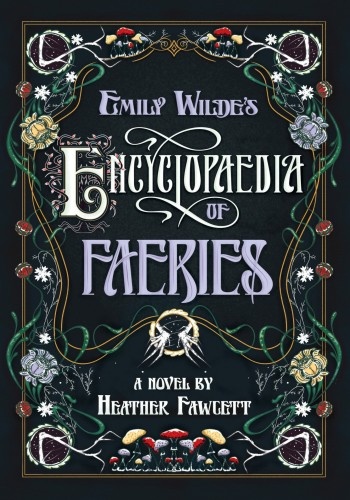
Emily Wilde's Encyclopaedia of Faeries
About this book
Emily Wilde arrives in Hrafnsvik with her dog, notebooks, and little interest in social niceties. She is preparing the first comprehensive encyclopaedia of faerie lore and expects careful fieldwork to matter more than winning the confidence of villagers.
Wendell Bambleby follows her to Ljosland, bringing ease, comfort, and mysteries Emily has avoided naming. Their contrasting methods become important when the Hidden Ones take an interest in the village and observation no longer keeps the researcher outside the story.
The diary form preserves Emily’s dry, exact voice as scholarly categories meet bargains, stories, and local knowledge. Faeries remain beautiful and hazardous rather than becoming misunderstood humans with magic.
Emily Wilde’s Encyclopaedia of Faeries begins Heather Fawcett’s series. It combines an academic rivals romance with folklore adventure, treating hospitality and friendship as forms of expertise Emily must learn to value.
Read a sample
5,029 words
Plain text
From the opening
20th October, 1909
Hrafnsvik, Ljosland
Shadow is not at all happy with me. He lies by the fire while the chill wind rattles the door, tail inert, staring out from beneath that shaggy forelock of his with the sort of accusatory resignation peculiar to dogs, as if to say: Of all the stupid adventures you’ve dragged me on, this will surely be the death of us. I fear I have to agree, though this makes me no less eager to begin my research.
Herein I intend to provide an honest account of my day-to-day activities in the field as I document an enigmatic species of faerie called “Hidden Ones.” This journal serves two purposes: to aid my recollection when it comes time to formally compile my field notes, and to provide a record for those scholars who come after me should I be captured by the Folk. Verba volant, scripta manent. As with previous journals, I will presume a basic understanding of dryadology in the reader, though I will gloss certain references that may be unfamiliar to those new to the field.
I have not had reason to visit Ljosland before, and would be lying if I said my first sighting this morning didn’t temper my enthusiasm. The journey takes five days from London, and the only vessel to get you there is a weekly freighter carrying a great variety of goods and a much smaller variety of passengers. We ventured steadily north, dodging icebergs, whilst I paced the deck to keep my seasickness at bay. I was among the first to sight the snowbound mountains rising out of the sea, the little red-roofed village of Hrafnsvik huddled below them like Red Riding Hood as the wolf loomed behind her.
We inched carefully up to the dock, striking it hard once, for the grey waves were fierce. The gangway was lowered by means of a winch operated by an old man with a cigarette clamped nonchalantly between his teeth—how he kept it lit in that wind was a feat so impressive that hours later I found myself thinking back to the glowing ember darting through the sea spray.
I came to the realization that I was the only one disembarking. The captain set my trunk down upon the frosty dock with a thunk, giving me his usual bemused smile, as if I were a joke he only half understood. My fellow passengers, it seemed, few that there were, were headed for the only city in Ljosland—Loabær, the ship’s next port of call. I would not be visiting Loabær, for one does not find the Folk in cities, but in the remote, forgotten corners of the world.
I could see the cottage I had rented from the harbour, which astonished me. The farmer who owned the land, one Krystjan Egilson, had described it to me in our correspondence—a little stone thing with a roof of vivid green turf just outside the village, perched upon the slope of the mountain near the edge of the forest of Karrðarskogur. It was such stark country—every detail, from the jumble of brightly painted cottages to the vivid greenery of the coast to the glaciers lurking on the peaks, was so sharp and solitary, like embroidered threads, that I suspect I could have counted the ravens in their mountain burrows.
The sailors gave Shadow a wide berth as we made our way up the dock. The old boarhound is blind in one eye and lacks the energy for any exercise beyond an ambling walk, let alone tearing out the throats of ill-mannered sailors, but his appearance belies him; he is an enormous creature, black as pitch with bearish paws and very white teeth. Perhaps I should have left him in the care of my brother back in London, but I could not bear to, particularly as he is given to fits of despondency when I am away.
I managed to drag my trunk up the dock and through the village—few were about, being most likely in their fields or fishing boats, but those few stared at me as only rural villagers at the edge of the known world can stare at a stranger. None of my admirers offered help. Shadow, padding along at my side, glanced at them with mild interest, and only then did they look away.
I have seen communities far more rustic than Hrafnsvik, for my career has taken me across Europe and Russia, to villages large and small and wilderness fair and foul. I am used to humble accommodations and humble folk—I once slept in a farmer’s cheese shed in Andalusia—but I have never been this far north. The wind had tasted snow, and recently; it pulled at my scarf and cloak. It took some time to haul my trunk up the road, but I am nothing if not persevering.
The landscape surrounding the village was given over to fields. These were not the tidy hillsides I was used to, but riddled with lumps, volcanic rock in haphazard garments of moss. And if that wasn’t enough to disorient the eye, the sea kept sending waves of mist over the coastland.
I reached the edge of the village and found the little footpath up to the cottage—the terrain was so steep that the path was a series of switchbacks. The cottage itself rested precariously upon a little alcove in the mountainside. It was only about ten minutes beyond the village, but that was ten minutes of sweaty inclines, and I was panting by the time I reached the door. It was not only unlocked, but contained no lock at all, and when I pushed it open, I found a sheep.
Continue reading the sampleClose the sample
It stared at me a moment, chewing at something, then sauntered off to rejoin its fellows as I politely held the door. Shadow gave a huff but was otherwise unmoved—he’s seen plenty of sheep in our rambles in the countryside around Cambridge, and looks upon them with the gentlemanly disinterest of an aging dog.
Somehow the place felt even colder than the outdoors. It was as simple as I had imagined, with walls of hearteningly solid stone and the smell of something I guessed to be puffin dung, though it could also have been the sheep. A table and chairs, dusty, a little kitchen at the back with a number of pots dangling from the wall, very dusty. By the hearth with its woodstove was an ancient armchair that smelled of must.
I was shivering, in spite of the uphill trunk-dragging, and I realized I had neither wood nor matches to warm that dingy place, and perhaps more alarmingly, that I might not know how to light a fire if I did—I had never done so before. Unfortunately, I happened to glance out the window at that moment and found that it had begun to snow.
It was then, as I stared at the empty hearth, hungry and cold, that I began to wonder if I would die here.
Lest you think me a newcomer to foreign fieldwork, let me assure you this is not the case. I spent a period of months in a part of Provence so rural that the villagers had never seen a camera, studying a river-dwelling species of Folk, les lutins des rivières. And before that there was a lengthy sojourn in the forests of the Apennines with some deer-faced fate and half a year in the Croatian wilderness as an assistant to a professor who spent his career analysing the music of mountain Folk. But in each case, I had known what I was getting into, and had a student or two to take care of logistics.
And there had been no snow.
Ljosland is the most isolated of the Scandinavian countries, an island situated in the wild seas off the Norwegian mainland, its northern coastline brushing the Arctic Circle. I had accounted for the awkwardness of reaching such a place—the long and uncomfortable voyage north—yet I was realizing that I had given little consideration to the difficulties I might face in leaving it if something went wrong, particularly once the sea ice closed in.
A knock upon the door launched me to my feet. But the visitor was already entering without bothering about my permission, stamping his boots with the air of a man entering his own abode after a long day.
“Professor Wilde,” he said, holding out a hand. It was a large hand, for he was a large man, both in height and around the shoulders and midsection. His hair was a shaggy black, his face square, with a broken nose that came together in a way that was surprisingly becoming, though in an entirely uninviting way. “Brought your dog, I see. Fine beast.”
“Mr. Egilson?” I said politely, shaking the hand.
“Well, who else would I be?” my host replied. I wasn’t sure if this was meant to be unfriendly or if the baseline of his demeanour was mild hostility. I should mention here that I am terrible at reading people, a failing that has landed me in my fair share of inconveniences. Bambleby would have known exactly what to make of this bear of a man, would probably already have him laughing at some charmingly self-effacing joke.
Bloody Bambleby, I thought. I haven’t much of a sense of humour myself, something I dearly wish I could call upon in such situations.
“Quite a journey you’ve had,” Egilson said, staring at me disconcertingly. “All the way from London. Get seasick?”
“Cambridge, actually. The ship was quite—”
“Villagers stared as you came up the road, I bet? ‘Who’s that little mouse of a thing, coming up the road?’ they were thinking. ‘She can’t be that fancy scholar we’ve been hearing about, come all the way from London. Looks like she’d never survive the journey.’ ”
“I wouldn’t know what they were thinking about me,” I said, wondering how on earth to turn the conversation to more pressing matters.
“Well, they told me,” he said.
“I see.”
“Ran into old Sam and his wife, Hilde, on the way up. We’re all very curious about your research. Tell me, how is it that you plan on catching the Folk? Butterfly net?”
Even I could tell this was meant to be mocking, so I replied coolly, “Rest assured that I have no intention of catching one of your faerie folk. My goal is simply to study them. This is the first investigation of its kind in Ljosland. I’m afraid that, until recently, the rest of the world saw your Hidden Ones as little more than myth, unlike the various species of Folk inhabiting the British Isles and the continent, ninety percent of which have been substantively documented.”
“Probably best it stays that way, for all concerned.”
Not an encouraging statement, that. “I understand that you have several species of faerie in Ljosland, many of which can be found in this part of the Suðerfjoll Mountains. I have stories of Folk ranging from brownie type to courtly fae to investigate.”
“I don’t know what any of that means,” he said in a flat voice. “But you’d be best confining your investigations to the wee ones. No good will come of your provoking the others, for yourself or for us.”
I was immediately intrigued by this, though I’d of course heard hints of the fearsome nature of the courtly fae of Ljosland—that is, those faeries who assume near-human form. But my questions were forestalled by the wind, which blew open the door and spat a great breath of snowflakes into the cottage. Egilson shouldered it closed again.
“It’s snowing,” I said, an uncharacteristic inanity. I’m sorry to say that the sight of snow drifting into the fireplace had me edging once again towards morbid despair.
“It does that on occasion,” replied Egilson with a touch of black humour that I found preferable to false friendliness, which is not the same as saying I appreciated it. “Not to worry, though. Winter isn’t here yet, it’s just clearing its throat. These clouds will open up momentarily.”
“And when will winter arrive?” I enquired grimly.
“You’ll know it when it does,” he said, a sideways sort of answer that I would soon grow accustomed to, for Krystjan is a sideways sort of man. “You’re young to be a professor.”
“In a sense,” I said, hoping to discourage this line of questioning with vagueness. I am not really young for a professor now, at thirty, or at least not young enough to astonish anyone; though eight years ago I had indeed been the youngest professor Cambridge ever hired.
He gave an amused grunt. “I’ve got to be getting on with the farm. Can I help you with anything?”
He said it perfunctorily, and looked to be on the verge of slipping away sideways through the door even as I replied quickly, “Tea would be lovely. And firewood—where would that be kept?”
“In the wood box,” he said, puzzled. “Next to the fireplace.”
I turned, and saw the aforementioned box immediately—I had taken it for some sort of rudimentary armoire.
“There’s more in the woodshed out back,” he said.
“The woodshed,” I breathed with relief. My fantasies of freezing to death had been premature.
He must have noticed the way I said it, which unfortunately had the distinct cadence of a word never spoken before, for he remarked, “You’re more the indoors type, are you? I’m afraid such folk are rather thin on the ground around here. I’ll have Finn bring the tea. That’s my son. And before you ask, the matches are in the matchbox.”
“Naturally,” I said, as if I had noticed the matchbox already. Damn my pride, but I couldn’t bring myself to enquire as to its whereabouts after the wood box humbling. “Thank you, Mr. Egilson.”
He gave me a slow-blinking look, then drew a little box from his pocket and set it upon the table. He was gone in a swirl of icy air.
20th October—evening
After Krystjan left, I barred the door with the plank that must have been set against the wall for that purpose, and which, like the damned wood box, I had failed to note before. Then I spent an entirely unproductive twenty minutes scrabbling about with the wood and the matches, until there came another knock.
I opened the door, praying that this visitor’s relative politeness boded well for my survival.
“Professor Wilde,” said the young man on the threshold in that faintly awed tone I have encountered before in rural villages, and I nearly melted with relief. Finn Krystjanson was a near–mirror image of his father, though narrower of midsection and with a pleasant set to his mouth.
He shook my hand eagerly and tiptoed into the cottage, starting a little at the sight of Shadow. “What a handsome beast,” Finn said. His English was more heavily accented than that of his father, though still perfectly fluent. “He’ll give the wolves something to think about.”
“Mm,” I said. Shadow takes little interest in wolves, seeming to place them in the same category as cats. I can’t imagine what he’d do if a wolf ever challenged him, other than yawn and give it a swat with one of his dinnerplate paws.
Finn eyed the cold fireplace and debitage of snapped matches without surprise, and I suspected that his father had already warned him of my capabilities. Indoors type still smarted.
In a few short moments, he had a hearty fire crackling and a pot of water set upon the stove to boil. He chattered as he worked, directing me to the stream behind the cottage, which I understood to be my only source of water, the cottage not being plumbed; the outdoor privy; and a shop in town where I could purchase supplies. My host would provide my breakfast, and dinner could be had at the local tavern. I was on my own for the midday meal only, which suited me well, as I am accustomed to spending my days in the field when conducting research and would pack my own light repast.
“Father says you’re writing a book,” he said, heaping logs by the fire. “About our Hidden.”
“Not just the Hidden,” I said. “The book is about all known species of Folk. We have learned much about their kind since the dawning of this era of science, but no one has yet ventured to assemble this information into a comprehensive encyclopaedia.”[*1]
He gave me a look that was both dubious and impressed. “My, but that sounds like a lot of work.”
“Yes.” Nine years of it, to be specific. I have been working on my encyclopaedia since earning my doctorate. “I hope to complete my fieldwork here by spring—the chapter on your Hidden Ones is the very last piece. My publisher is eagerly awaiting the manuscript.”
The mention of a publisher seemed to impress him all over again, though the furrow in his brow remained. “Well. We have plenty of stories. I don’t know, though, that they’ll be any use to you.”
“Stories are of great use,” I said. “Indeed, they are the foundation of dryadology. We would be lost without them, as astronomers cut off from the sky.”
“They’re not all true, though,” he said with a frown. “Can’t be. All storytellers embellish. You should listen to my grandmother when she gets going—she’ll have us hanging on every word, yes, but a visitor from the next village will say they don’t know the tale, though it’s the same one their own amma tells at her hearth.”
“Such variation is common. Nevertheless, when it comes to the Folk, there is something true in every story, even the false ones.”
I could have gone on about faerie stories—I’ve written several articles on the subject—but I didn’t know how to talk to him about my scholarship, if what I said would be nonsense to his ears. The truth is that, for the Folk, stories are everything. Stories are part of them and their world in a fundamental way that mortals have difficulty grasping; a story may be a singular event from the past, but—crucially—it is also a pattern that shapes their behaviour and predicts future events. The Folk have no system of laws, and while I am not saying stories are as law to them, they are the closest thing their world has to some form of order.[*2]
I finished simply, “My research generally consists of an amalgam of oral accounts and hands-on investigation. Tracking, observations in the field, that sort of thing.”
If anything, the furrow had deepened. “And you—you’ve done this before? You’ve met them, I mean. The Folk.”
“Many times. I would say that your Hidden Ones would be unable to surprise me, but that is a talent universally held by the Folk, is it not? The ability to surprise?”
He smiled. I believe he thought me half akin to the Folk at that point, a strange magician of a woman conjured into his midst in a village little touched by the outside world. “That I couldn’t say,” he replied. “As I’ve only known our Folk. That’s enough for one man, I’ve always thought. More than enough.”
His tone had darkened a little, but in a grim rather than an ominous way, the sort of voice one uses when speaking of those hardships that are a fact of life. He set a loaf of dark bread upon the table, which he informed me quite casually had been baked in the ground via geothermal heat, along with enough cheese and salted fish for two. He was quite cheery about it, and seemed intent on joining me for the humble feast.
“Thank you,” I said, and we gazed at each other awkwardly. I suspected that I was supposed to say something else—perhaps enquire about his life or duties, or joke about my helplessness—but I’ve always been useless at that sort of amiable chatter, and my life as a scholar affords me few opportunities for practice.
“Is your mother about?” I said finally. “I would thank her for the bread.”
I may be a poor judge of human feeling, but I have had plenty of experience with putting my feet wrong to know that it was the worst possible thing to say. His handsome face closed, and he replied, “I made it. My mother passed a year and more ago.”
“My apologies,” I said, putting on a show of surprise in an attempt to cover the fact that Egilson had included this information in one of our early letters. What a thing to forget about, you idiot. “Well, you’ve quite a talent for it,” I added. “I expect your father is proud of your skill.”
Unfortunately, this inept rejoinder was met with a wince, and I guessed that his father was not in fact proud of his son’s skill in the kitchen, perhaps even viewing it as a degradation of his manhood. Fortunately, Finn seemed kindhearted at the core, and he said with some formality, “I hope you enjoy it. If you need anything else, you can send word to the big house. Will half seven suit for breakfast?”
“Yes,” I said, regretting the change from his former easy conversation. “Thank you.”
“Oh, and this arrived for you two days ago,” he said, withdrawing an envelope from his pocket. “We get mail deliveries every week.”
From the way he said it, he saw this as a source of local pride, so I forced a smile as I thanked him. He smiled back and departed, murmuring something about the chickens.
I glanced at the letter, and found myself confronted with a florid script that read The Office of Dr. Wendell Bambleby, Cambridge in the upper left corner, and in the middle, Dr. Emily Wilde, Abode of Krystjan Egilson, Farmer, Village of Hrafnsvik, Ljosland.
“Bloody Bambleby,” I said.
I set the letter aside, too hungry to be vexed just then. Before I tucked into my own refreshments, I took the time to prepare Shadow’s, as was our custom. I collected a mutton steak from the outdoor cellar—to which I had been directed by Finn—and set it on a plate beside a bowl of water. My dear beast devoured his meal without complaint, while I sat by the crackling fire with my tea, which was strong and smoky, but good.
I felt some regret at having poorly repaid Finn’s kindness, but I didn’t mourn the absence of his company—I had not been expecting it.
I gazed out the window. The forest was visible, starting a little higher up the slope and giving off the inauspicious impression of a dark wave about to come cresting down on me. Ljosland has little in the way of trees, as its mortal inhabitants denuded much of the sub-Arctic landscape. However, a few forests remain—those claimed, or believed to be claimed, by their Hidden Ones. These are largely comprised of the humble downy birch, along with a few rowans and shrub willows. Nothing grows to a great height in such a cold place, and what trees I could see were stunted, tucking themselves ominously into the shadow of the mountainside. Their appearance was mesmerizing. The Folk are as embedded in their environments[*3] as the deepest of taproots, and I was all the more eager to meet the creatures who called such an inhospitable place home.
Bambleby’s letter sat upon the table, somehow conspiring to give off a kind of negligent ease, and so finally, once I had finished the bread (good, tasting of smoke) as well as the cheese (also good, also tasting of smoke), I took it up and slid my nail through the seam.
My dear Emily, it began. I hope you’re settled comfortably in your snowbound fastness, and that you are merry as you pore over your books and collect a variety of inkstains upon your person, or as close to merry as you can come, my friend. Though you’ve been gone only a few days, I confess that I miss the sound of your typewriter clack-clacking away across the hall while you hunch there with the drapes drawn like a troll mulling some dire vengeance under a bridge. So woebegone have I been without your company that I drew you a small portrait—enclosed.
I glared at the sketch. It showed what I considered a highly unfaithful rendering of me in my Cambridge office, my dark hair pinned atop my head but terribly dishevelled (that part, I admit, is true—I have a bad habit of playing with my hair whilst I work), and a fiendish expression on my face as I scowled at my typewriter. Bambleby had even had the gall to make me pretty, enlarging my deep-set eyes and giving my round face a look of focused intelligence that sharpened its unexceptional profile. No doubt he lacked the ability to imagine a woman he would find unattractive, even if he had seen said woman before.
I was certainly not amused by the caricature. No, I was not.
Bambleby then went on at length about the most recent meeting of the dryadology department faculty, to which I would not have been invited, being only an adjunct professor and not a tenured one, including many entertaining observations about how prettily the light caught at Professor Thornthwaite’s new hairpiece and asking whether I would agree with his theory that Professor Eddington’s relative silence at such convocations suggested a mastery of the open-eyed nap. I did find myself smirking a little as he rambled on—it is hard not to be entertained by Bambleby. It is one of the things I resent most about him. That and the fact that he considers himself my dearest friend, which is only true in the sense that he is my sole friend.
Part of my reason in writing, my dear, is to remind you I am worried for your safety. I speak not of whatever unusual species of ice-encrusted faerie you may encounter, as I know you can handle yourself in that regard, but of the harshness of the climate. Though I must confess a secondary motive in writing—a fascination with the legends you’ve uncovered about these Hidden Ones. I urge you to write to me with your findings—although, if certain plans I’ve set in motion come to fruition, this may prove redundant.
I sat frozen in my chair. Good God! Surely he was not thinking of joining me here? Yet what else could he have meant by such a remark?
My fear ebbed somewhat, though, as I sat back and imagined Bambleby actually venturing to such a place as this. Oh, Bambleby has done extensive work in the field, to be sure, most recently organizing an expedition to investigate reports of a miniature species of Folk in the Caucasus, but Bambleby’s method of fieldwork is one of delegation more than anything else; he settles himself at the nearest thing that passes for a hotel and from there provides directives to the small army of graduate students constantly trailing in his wake. He is much praised at Cambridge for deigning to provide co-author credit to his students in his many publications, but I know what those students put up with, and the truth is that it would be monstrous if he did not.
I was unable to convince even one of my students to accompany me to Hrafnsvik, and I very much doubt that Bambleby, despite his charms, would have much better luck. And so, he will not come.
The remainder of the letter consisted of assurances of his intention to provide the foreword to my book. I felt a little ill at this—a combination of relief and resentment—for though I do not want his assistance, particularly after he scooped me on the gean-cannah changeling discovery, I cannot deny its value. Wendell Bambleby is one of the foremost dryadologists at Cambridge, which is to say that he is one of the foremost dryadologists in the world. The one paper we co-authored, a straightforward but comprehensive meta-analysis of the diet of Baltic river fae, earned me invitations to two national conferences and remains my most cited work.
I tossed the letter into the fire, determined to think no more of Bambleby until the arrival of his next letter, which would no doubt be swift if I did not reply with a haste sufficient to his self-regard.
I turned to Shadow, curled at my feet. The beast had been watching me with solemn dark eyes, concerned for my well-being in the wake of my panic. I discovered another chilblain upon his paw and fetched the salve I had purchased specially for him. I also took the time to comb through his long fur until his eyes drooped with pleasure.
I removed my manuscript from my suitcase, carefully unfolding the protective wrapping, then laid it upon the table. I flicked through the pages, savouring the crisp sound of the heavily inked paper, ensuring they were still in order.
It is a heavy thing, presently totalling some five hundred pages, not inclusive of the appendices, which will likely be extensive. Yet within these pages, like specimens threaded with pins and trapped behind glass in a museum display, is every species of faerie yet encountered by Man, from the mist-dwelling bogban of the Orkneys to the ghoulish thief known as l’hibou noir by those inhabiting the Mediterranean country of Miarelle. They have been alphabetized, cross-referenced, and paired with figures where available as well as a phonetic guide to pronunciation.
I let my hand rest briefly on the stack of pages. I then set atop the manuscript a paperweight, one of my faerie stones[*4] —devoid of magic now, of course. Beside it, at a right angle, I placed my favourite pen—it bears the Cambridge crest; a gift from the university when I was hired—ruler, and inkwell. I surveyed the tableau with satisfaction.