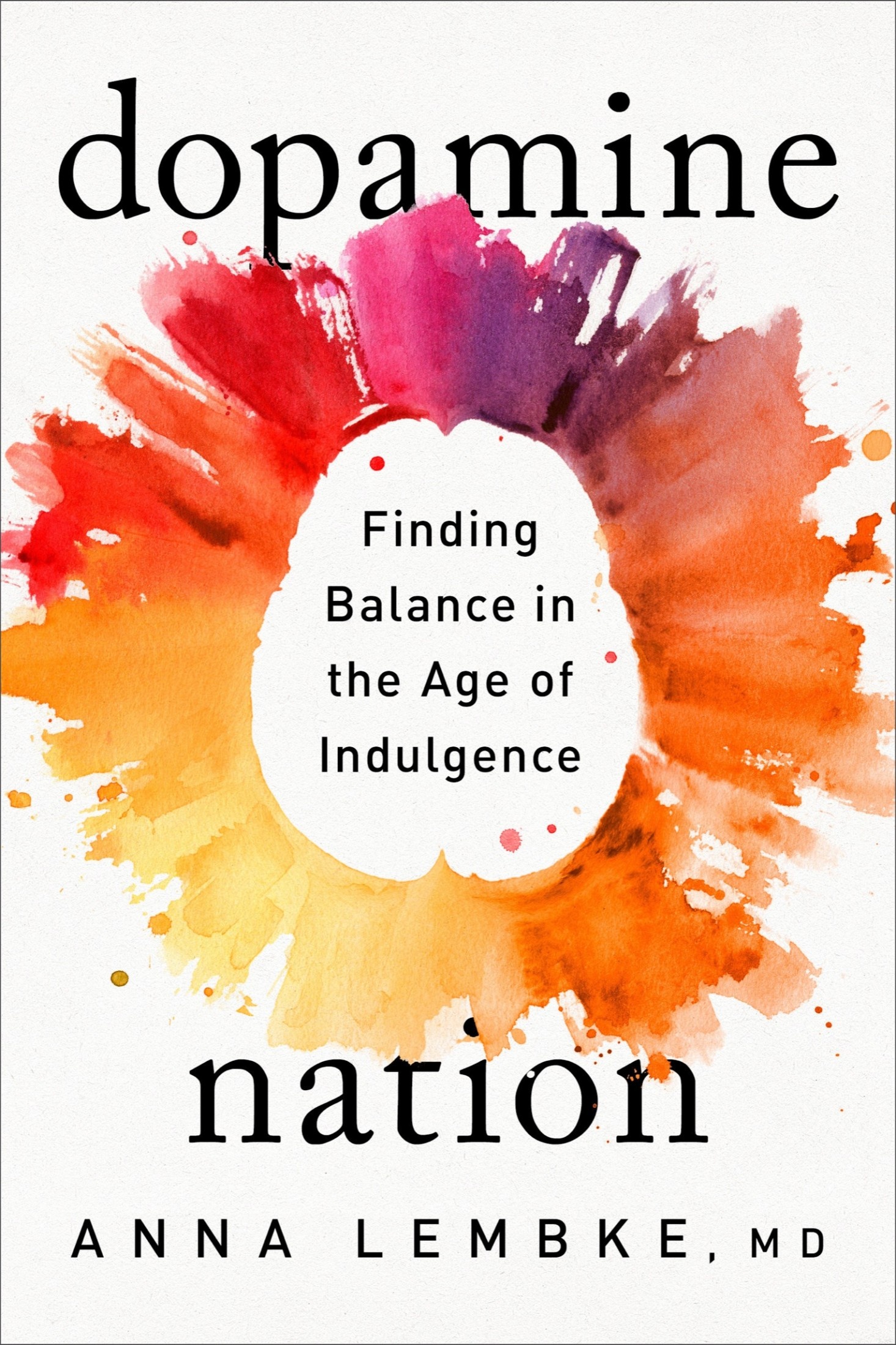
Dopamine Nation: Finding Balance in the Age of Indulgence
About this book
The patients in these pages struggle with substances, sex, food, shopping, games, and other rewards that are unusually easy to obtain. Their circumstances differ, but each story shows desire becoming narrower as repeated use reorganizes daily life.
Lembke describes pleasure and pain as opposing processes that the brain continually tries to balance. When intense rewards arrive too often, tolerance and craving can grow while ordinary experiences lose their force; periods of abstinence can reveal how much the balance has shifted.
The book is not a substitute for medical care, and it does not claim that every pleasure is an addiction. Its practical value lies in the questions it offers about honesty, access, triggers, self-binding, and the role of supportive relationships in changing behaviour.
Dopamine Nation is a direct introduction to addiction in an age of abundance. It joins memorable case histories to a framework readers can use without reducing suffering to either chemistry or character.
Read a sample
5,008 words
Plain text
From the opening
INTRODUCTION
The Problem
Feelin’ good, feelin’ good, all the money in the world spent on feelin’ good.
—LEVON HELM
This book is about pleasure. It’s also about pain. Most important, it’s about the relationship between pleasure and pain, and how understanding that relationship has become essential for a life well lived.
Why?
Because we’ve transformed the world from a place of scarcity to a place of overwhelming abundance: Drugs, food, news, gambling, shopping, gaming, texting, sexting, Facebooking, Instagramming, YouTubing, tweeting . . . the increased numbers, variety, and potency of highly rewarding stimuli today is staggering. The smartphone is the modern-day hypodermic needle, delivering digital dopamine 24/7 for a wired generation. If you haven’t met your drug of choice yet, it’s coming soon to a website near you.
Scientists rely on dopamine as a kind of universal currency for measuring the addictive potential of any experience. The more dopamine in the brain’s reward pathway, the more addictive the experience.
In addition to the discovery of dopamine, one of the most remarkable neuroscientific findings in the past century is that the brain processes pleasure and pain in the same place. Further, pleasure and pain work like opposite sides of a balance.
We’ve all experienced that moment of craving a second piece of chocolate, or wanting a good book, movie, or video game to last forever. That moment of wanting is the brain’s pleasure balance tipped to the side of pain.
This book aims to unpack the neuroscience of reward and, in so doing, enable us to find a better, healthier balance between pleasure and pain. But neuroscience is not enough. We also need the lived experience of human beings. Who better to teach us how to overcome compulsive overconsumption than those most vulnerable to it: people with addiction.
This book is based on true stories of my patients falling prey to addiction and finding their way out again. They’ve given me permission to tell their stories so that you might benefit from their wisdom, as I have. You may find some of these stories shocking, but to me they are just extreme versions of what we are all capable of. As philosopher and theologian Kent Dunnington wrote, “Persons with severe addictions are among those contemporary prophets that we ignore to our own demise, for they show us who we truly are.”
Whether it’s sugar or shopping, voyeuring or vaping, social media posts or The Washington Post, we all engage in behaviors we wish we didn’t, or to an extent we regret. This book offers practical solutions for how to manage compulsive overconsumption in a world where consumption has become the all-encompassing motive of our lives.
In essence, the secret to finding balance is combining the science of desire with the wisdom of recovery.
PART I
The Pursuit of Pleasure
CHAPTER 1
Our Masturbation Machines
I went to greet Jacob in the waiting room. First impression? Kind. He was in his early sixties, middleweight, face soft but handsome . . . aging well enough. He wore the standard-issue Silicon Valley uniform: khakis and a casual button-down shirt. He looked unremarkable. Not like someone with secrets.
As Jacob followed me through the short maze of hallways, I could feel his anxiety like waves rolling off my back. I remembered when I used to get anxious walking patients back to my office. Am I walking too fast? Am I swinging my hips? Does my ass look funny?
It seems so long ago now. I admit I’m a battle-hardened version of my former self, more stoic, possibly more indifferent. Was I a better doctor then, when I knew less and felt more?
We arrived at my office and I shut the door behind him. Gently, I offered him one of two identical, equal-in-height, two-feet-apart, green-cushioned, therapy-sanctioned chairs. He sat. So did I. His eyes took in the room.
My office is ten by fourteen feet, with two windows, a desk with a computer, a sideboard covered with books, and a low table between the chairs. The desk, the sideboard, and the low table are all made of matching reddish-brown wood. The desk is a hand-me-down from my former department chair. It’s cracked down the middle on the inside, where no one else can see it, an apt metaphor for the work I do.
On top of the desk are ten separate piles of paper, perfectly aligned, like an accordion. I am told this gives the appearance of organized efficiency.
The wall décor is a hodgepodge. The requisite diplomas, mostly unframed. Too lazy. A drawing of a cat I found in my neighbor’s garbage, which I took for the frame but kept for the cat. A multicolored tapestry of children playing in and around pagodas, a relic from my time teaching English in China in my twenties. The tapestry has a coffee stain, but it’s only visible if you know what you’re looking for, like a Rorschach.
On display is an assortment of knickknacks, mostly gifts from patients and students. There are books, poems, essays, artwork, postcards, holiday cards, letters, cartoons.
One patient, a gifted artist and musician, gave me a photograph he had taken of the Golden Gate Bridge overlaid with his hand-drawn musical notes. He was no longer suicidal when he made it, yet it’s a mournful image, all grays and blacks. Another patient, a beautiful young woman embarrassed by wrinkles that only she saw and no amount of Botox could erase, gave me a clay water pitcher big enough to serve ten.
Continue reading the sampleClose the sample
To the left of my computer, I keep a small print of Albrecht Dürer’s Melencolia 1. In the drawing, Melancholia personified as a woman sits stooped on a bench surrounded by the neglected tools of industry and time: a caliper, a scale, an hourglass, a hammer. Her starving dog, ribs protruding from his sunken frame, waits patiently and in vain for her to rouse herself.
To the right of my computer, a five-inch clay angel with wings wrought from wire stretches her arms skyward. The word courage is engraved at her feet. She’s a gift from a colleague who was cleaning out her office. A leftover angel. I’ll take it.
I’m grateful for this room of my own. Here, I am suspended out of time, existing in a world of secrets and dreams. But the space is also tinged with sadness and longing. When my patients leave my care, professional boundaries forbid that I contact them.
As real as our relationships are inside my office, they cannot exist outside this space. If I see my patients at the grocery store, I’m hesitant even to say hello lest I declare myself a human being with needs of my own. What, me eat?
Years ago, when I was in my psychiatry residency training, I saw my psychotherapy supervisor outside his office for the first time. He emerged from a shop wearing a trench coat and an Indiana Jones–style fedora. He looked like he’d just stepped off the cover of a J. Peterman catalogue. The experience was jarring.
I’d shared many intimate details of my life with him, and he had counseled me as he would a patient. I had not thought of him as a hat person. To me, it suggested a preoccupation with personal appearance that was at odds with the idealized version I had of him. But most of all, it made me aware of how disconcerting it might be for my own patients to see me outside my office.
I turned to Jacob and began. “What can I help you with?”
Other beginnings I’ve evolved over time include: “Tell me why you’re here,” “What brings you in today?” and even “Start at the beginning, wherever that is for you.”
Jacob looked me over. “I am hoping,” he said in a thick Eastern European accent, “you would be a man.”
I knew then we would be talking about sex.
“Why?” I asked, feigning ignorance.
“Because it might be hard for you, a woman, to hear about my problems.”
“I can assure you I’ve heard almost everything there is to hear.”
“You see,” he stumbled, looking shyly at me, “I have the sex addiction.”
I nodded and settled into my chair. “Go on . . .”
Every patient is an unopened package, an unread novel, an unexplored land. A patient once described to me how rock climbing feels: When he’s on the wall, nothing exists but infinite rock face juxtaposed against the finite decision of where next to put each finger and toe. Practicing psychotherapy is not unlike rock climbing. I immerse myself in story, the telling and retelling, and the rest falls away.
I’ve heard many variations on the tales of human suffering, but Jacob’s story shocked me. What disturbed me most was what it implied about the world we live in now, the world we’re leaving to our children.
Jacob started right in with a childhood memory. No preamble. Freud would have been proud.
“I masturbated first time when I was two or three years old,” he said. The memory was vivid for him. I could see it on his face.
“I am on the moon,” he continued, “but it is not really the moon. There is a person there like a god . . . and I have sexual experience which I don’t recognize . . .”
I took moon to mean something like the abyss, nowhere and everywhere simultaneously. But what of God? Aren’t we all yearning for something beyond ourselves?
As a young schoolboy, Jacob was a dreamer: buttons out of order, chalk on his hands and sleeves, the first to look out the window during lessons, and the last to leave the classroom for the day. He masturbated regularly by the time he was eight years old. Sometimes alone, sometimes with his best friend. They had not yet learned to be ashamed.
But after his First Communion, he was awakened to the idea of masturbation as a “mortal sin.” From then on, he only masturbated alone, and he visited the Catholic priest of his family’s local church every Friday to confess.
“I masturbate,” he whispered through the latticed opening of the confessional.
“How many times?” asked the priest.
“Every day.”
Pause. “Don’t do it again.”
Jacob stopped talking and looked at me. We shared a small smile of understanding. If such straightforward admonitions solved the problem, I would be out of a job.
Jacob the boy was determined to obey, to be “good,” and so he clenched his fists and didn’t touch himself there. But his resolve only ever lasted two or three days.
“That,” he said, “was the beginning of my double life.”
The term double life is as familiar to me as ST segment elevation is to the cardiologist, stage IV is to the oncologist, and hemoglobin A1C is to the endocrinologist. It refers to the addicted person’s secret engagement with drugs, alcohol, or other compulsive behaviors, hidden from view, even in some cases from their own.
Throughout his teens, Jacob returned from school, went to the attic, and masturbated to a drawing of the Greek goddess Aphrodite he had copied from a textbook and hidden between the wooden floorboards. He would later look on this period of his life as a time of innocence.
At eighteen he moved to live with his older sister in the city to study physics and engineering at the university there. His sister was gone much of the day working, and for the first time in his life, he was alone for long stretches. He was lonely.
“So I decided to make a machine . . .”
“A machine?” I asked, sitting up a little straighter.
“A masturbation machine.”
I hesitated. “I see. How did it work?”
“I connect a metal rod to a record player. The other end I connect to an open metal coil, which I wrap with a soft cloth.” He drew a picture to show me.
“I put the cloth and the coil around my penis,” he said, pronouncing penis as if it were two words: pen like the writing instrument, and ness like the Loch Ness Monster.
I had an urge to laugh but, after a moment’s reflection, realized the urge was a cover for something else: I was afraid. Afraid that after inviting him to reveal himself to me, I wouldn’t be able to help him.
“As the record player move round and round,” he said, “the coil go up and down. I adjust the speed of the coil by adjusting the speed of the record player. I have three different speeds. In this way, I bring myself to the edge . . . many times, without going over. I also learn that smoking a cigarette at the same time brings me back from the edge, so I use this trick.”
Through this method of microadjustments, Jacob was able to maintain a preorgasm state for hours. “This,” he said, nodding, “very addictive.”
Jacob masturbated for several hours a day using his machine. The pleasure for him was unrivaled. He swore he would stop. He hid the machine high up in a closet or dismantled it completely and threw away the parts. But a day or two later, he was pulling the parts down from the closet or out of the trash can, only to reassemble them and start again.
Perhaps you are repulsed by Jacob’s masturbation machine, as I was when I first heard about it. Perhaps you regard it as a kind of extreme perversion that is beyond everyday experience, with little or no relevance to you and your life.
But if we do that, you and I, we miss an opportunity to appreciate something crucial about the way we live now: We are all, of a sort, engaged with our own masturbation machines.
Circa age forty, I developed an unhealthy attachment to romance novels. Twilight, a paranormal romance about teenage vampires, was my gateway drug. I was embarrassed enough to be reading it, much less admitting I was enthralled by it.
Twilight hit that sweet spot between love story, thriller, and fantasy, the perfect escape as I rounded the corner of my midlife bend. I was not alone. Millions of women my age were reading and fanning Twilight. There was nothing unusual per se about my getting caught up in a book. I’ve been a reader all my life. What was different was what happened next. Something I couldn’t account for based on past proclivities or life circumstance.
When I finished Twilight, I ripped through every vampire romance I could get my hands on, and then moved on to werewolves, fairies, witches, necromancers, time travelers, soothsayers, mind readers, fire wielders, fortune-tellers, gem workers . . . you get the idea. At some point, tame love stories no longer satisfied, so I searched out increasingly graphic and erotic renditions of the classic boy-meets-girl fantasy.
I remember being shocked at how easy it was to find graphic sex scenes right there on the general fiction shelves at my neighborhood library. I worried that my kids had access to these books. The raciest thing at my local library growing up in the Midwest was Are You There, God? It’s Me, Margaret.
Things escalated when, at the urging of my tech-savvier friend, I got a Kindle. No more waiting for books to be delivered from another library branch or hiding steamy book jackets behind medical journals, especially when my husband and kids were around. Now, with two swipes and a click, I had any book I wanted instantly, anywhere, anytime: on the train, on a plane, waiting to get my hair cut. I could just as easily pass off Darkfever, by Karen Marie Moning, as Crime and Punishment by Dostoyevsky.
In short, I became a chain reader of formulaic erotic genre novels. As soon as I finished one e-book, I moved on to the next: reading instead of socializing, reading instead of cooking, reading instead of sleeping, reading instead of paying attention to my husband and my kids. Once, I’m ashamed to admit, I brought my Kindle to work and read between patients.
I looked for ever-cheaper options all the way down to free. Amazon, like any good drug dealer, knows the value of a free sample. Once in a while I found a book of real quality that happened to be cheap; but most of the time, they were truly terrible, relying on worn-out plot devices and lifeless characters, chock-full of typos and grammatical errors. But I read them anyway because I was increasingly looking for a very specific type of experience. How I got there mattered less and less.
I wanted to indulge in that moment of mounting sexual tension that finally gets resolved when the hero and heroine hook up. I no longer cared about syntax, style, scene, or character. I just wanted my fix, and these books, written according to a formula, were designed to hook me.
Every chapter ended on a note of suspense, and the chapters themselves built toward the climax. I started rushing through the first part of the book until I got to the climax and didn’t bother to read the rest after it was done. I am now sadly in possession of the knowledge that if you open any romance novel to approximately three-quarters of the way through, you can get right to the point.
About a year into my new obsession with romance, I found myself up at 2:00 a.m. on a weeknight reading Fifty Shades of Grey. I rationalized it was a modern-day telling of Pride and Prejudice—right up until I got to the page on “butt plugs” and had a flash of insight that reading about sadomasochistic sex toys in the wee hours of the morning was not how I wanted to be spending my time.
Addiction broadly defined is the continued and compulsive consumption of a substance or behavior (gambling, gaming, sex) despite its harm to self and/or others.
What happened to me is trivial compared to the lives of those with overpowering addiction, but it speaks to the growing problem of compulsive overconsumption that we all face today, even when our lives are good. I have a kind and loving husband, great kids, meaningful work, freedom, autonomy, and relative wealth—no trauma, social dislocation, poverty, unemployment, or other risk factors for addiction. Yet I was compulsively retreating further and further into a fantasy world.
The Dark Side of Capitalism
At age twenty-three, Jacob met and married his wife. They moved together into the three-room apartment she shared with her parents, and he left his machine behind—forever, he hoped. He and his wife registered to get an apartment of their own but were told the wait would be twenty-five years. This was typical in the 1980s in the Eastern European country where they lived.
Instead of consigning themselves to decades of living with her parents, they decided to earn extra money on the side to buy their own place sooner. They started a computer business importing machines from Taiwan, joining the growing underground economy.
Their business prospered, and they soon became rich by local standards. They acquired a house and plot of land. They had two children, a son and a daughter.
Their upward trajectory seemed assured when Jacob was offered a job working as a scientist in Germany. They jumped at the chance to move west, further his career, and provide their children with all the opportunities that Western Europe could offer. The move offered opportunities all right, not all of them good.
“Once we move to Germany, I discover pornography, porn-kinos, live shows. This town I live in is known for this, and I cannot resist. But I manage. I manage for ten years. I am working as a scientist, working hard, but in 1995, everything change.”
“What changed?” I asked, already guessing the answer.
“The Internet. I am forty-two years old, and doing okay, but with the Internet, my life start to fall apart. Once in 1999, I am in same hotel room I stay in maybe fifty times before. I have big conference, big talk the next day. But I stay up all night watching porn instead of preparing my talk. I show up at the conference with no sleep and no talk. I give a speech, very bad. I almost lose my job.” He looked down and shook his head, remembering.
“After that I start a new ritual,” he said. “Every time I go into hotel room, I place sticky notes all around—on the bathroom mirror, the TV, the remote control—saying, ‘Don’t do it.’ I don’t even last one day.”
I was struck by how much hotel rooms are like latter-day Skinner boxes: a bed, a TV, and a minibar. Nothing to do but press the lever for drug.
He looked down again and the silence stretched. I gave him time.
“That was when I first think about ending my life. I think the world will not miss me, and maybe better without me. I walk to the balcony and look down. Four stories . . . that would be enough.”
One of the biggest risk factors for getting addicted to any drug is easy access to that drug. When it’s easier to get a drug, we’re more likely to try it. In trying it, we’re more likely to get addicted to it.
The current US opioid epidemic is a tragic and compelling example of this fact. The quadrupling of opioid prescribing (OxyContin, Vicodin, Duragesic fentanyl) in the United States between 1999 and 2012, combined with widespread distribution of those opioids to every corner of America, led to rising rates of opioid addiction and related deaths.
A task force appointed by the Association of Schools and Programs of Public Health (ASPPH) issued a report on November 1, 2019, concluding, “The tremendous expansion of the supply of powerful (high-potency as well as long-acting) prescription opioids led to scaled increases in prescription opioid dependence, and the transition of many to illicit opioids, including fentanyl and its analogs, which have subsequently driven exponential increases in overdose.” The report also stated that opioid use disorder “is caused by repeated exposure to opioids.”
Likewise, decreasing the supply of addictive substances decreases exposure and risk of addiction and related harms. A natural experiment in the last century to test and prove this hypothesis was Prohibition, a nationwide constitutional ban on the production, importation, transportation, and sale of alcoholic beverages in the United States from 1920 to 1933.
Prohibition led to a sharp decrease in the number of Americans consuming and becoming addicted to alcohol. Rates of public drunkenness and alcohol-related liver disease decreased by half during this period in the absence of new remedies to treat addiction.
There were unintended consequences, of course, such as the creation of a large black market run by criminal gangs. But the positive impact of Prohibition on alcohol consumption and related morbidity is widely underrecognized.
The reduced drinking effects of Prohibition persisted through the 1950s. Over the subsequent thirty years, as alcohol became more available again, consumption steadily increased.
In the 1990s, the percentage of Americans who drank alcohol increased by almost 50 percent, while high-risk drinking increased by 15 percent. Between 2002 and 2013, diagnosable alcohol addiction rose by 50 percent in older adults (over age sixty-five) and 84 percent in women, two demographic groups who had previously been relatively immune to this problem.
To be sure, increased access is not the only risk for addiction. The risk increases if we have a biological parent or grandparent with addiction, even when we’re raised outside the addicted home. Mental illness is a risk factor, although the relationship between the two is unclear: Does the mental illness lead to drug use, does drug use cause or unmask mental illness, or is it somewhere in between?
Trauma, social upheaval, and poverty contribute to addiction risk, as drugs become a means of coping and lead to epigenetic changes—heritable changes to the strands of DNA outside of inherited base pairs—affecting gene expression in both an individual and their offspring.
These risk factors notwithstanding, increased access to addictive substances may be the most important risk factor facing modern people. Supply has created demand as we all fall prey to the vortex of compulsive overuse.
Our dopamine economy, or what historian David Courtwright has called “limbic capitalism,” is driving this change, aided by transformational technology that has increased not just access but also drug numbers, variety, and potency.
The cigarette-rolling machine invented in 1880, for example, made it possible to go from four cigarettes rolled per minute to a staggering 20,000. Today, 6.5 trillion cigarettes are sold annually around the world, translating to roughly 18 billion cigarettes consumed per day, responsible for an estimated 6 million deaths worldwide.
In 1805, the German Friedrich Sertürner, while working as a pharmacist’s apprentice, discovered the painkiller morphine—an opioid alkaloid ten times more potent than its precursor opium. In 1853, the Scottish physician Alexander Wood invented the hypodermic syringe. Both of these inventions contributed to hundreds of reports in late-nineteenth-century medical journals of iatrogenic (physician-initiated) cases of morphine addiction.
In an attempt to find a less addictive opioid painkiller to replace morphine, chemists came up with a brand-new compound, which they named “heroin” for heroisch, the German word for “courageous.” Heroin turned out to be two to five times more potent than morphine and gave way to the narcomania of the early 1900s.
Today, potent pharmaceutical-grade opioids such as oxycodone, hydrocodone, and hydromorphone are available in every imaginable form: pills, injection, patch, nasal spray. In 2014, a middle-aged patient walked into my office sucking on a bright red fentanyl lollipop. Fentanyl, a synthetic opioid, is fifty to one hundred times more potent than morphine.
Beyond opioids, many other drugs are also more potent today than in yesteryear. Electronic cigarettes—chic, discreet, odorless, rechargeable nicotine delivery systems—lead to higher levels of blood nicotine over shorter periods of consumption than traditional cigarettes. They also come in a multitude of flavors designed to appeal to teenagers.
Today’s cannabis is five to ten times more potent than the cannabis of the 1960s and is available in cookies, cakes, brownies, gummy bears, blueberries, “pot tarts,” lozenges, oils, aromatics, tinctures, teas . . . the list is endless.
Food is manipulated by technicians around the world. Following World War I, the automation of chip and fry production lines led to the creation of the bagged potato chip. In 2014, Americans consumed 112.1 pounds of potatoes per person, of which 33.5 pounds were fresh potatoes and the remaining 78.5 pounds were processed. Copious amounts of sugar, salt, and fat are added to much of the food we eat, as well as thousands of artificial flavors to satisfy our modern appetite for things like French toast ice cream and Thai tomato coconut bisque.
With increasing access and potency, polypharmacy—that is, using multiple drugs simultaneously or in close proximity—has become the norm. My patient Max found it easier to draw out a timeline of his drug use than to explain it to me.
As you can see in his illustration, he started at age seventeen with alcohol, cigarettes, and cannabis (“Mary Jane”). By age eighteen, he was snorting cocaine. At age nineteen, he switched to OxyContin and Xanax. Through his twenties, he used Percocet, fentanyl, ketamine, LSD, PCP, DXM, and MXE, eventually landing on Opana, a pharmaceutical-grade opioid that led him to heroin, where he stayed until he came to see me at age thirty. In total, he went through fourteen different drugs in a little over a decade.
The world now offers a full complement of digital drugs that didn’t exist before, or if they did exist, they now exist on digital platforms that have exponentially increased their potency and availability. These include online pornography, gambling, and video games, to name a few.
DRUG USE TIMELINE
Furthermore, the technology itself is addictive, with its flashing lights, musical fanfare, bottomless bowls, and the promise, with ongoing engagement, of ever-greater rewards.
My own progression from a relatively tame vampire romance novel to what amounts to socially sanctioned pornography for women can be traced to the advent of the electronic reader.
The act of consumption itself has become a drug. My patient Chi, a Vietnamese immigrant, got hooked on the cycle of searching for and buying products online. The high for him began with deciding what to buy, continued through anticipating delivery, and culminated in the moment he opened the package.
Unfortunately, the high didn’t last much beyond the time it took him to rip off the Amazon tape and see what was inside. He had rooms full of cheap consumer goods and was tens of thousands of dollars in debt. Even then, he couldn’t stop. To keep the cycle going, he resorted to ordering ever-cheaper goods—key chains, mugs, plastic sunglasses—and returning them immediately upon arrival.
The Internet and Social Contagion
Jacob decided not to end his life that day in the hotel. The very next week, his wife was diagnosed with brain cancer. They returned to their home country and he spent the next three years taking care of her until she died.
In 2001, at age forty-nine, he reconnected with and married his high school sweetheart.
“I tell her before we marry about my problem. But maybe I minimize when I tell her.”
Jacob and his new wife bought a home together in Seattle. Jacob commuted to a job as a scientist in Silicon Valley. The more time he spent in Silicon Valley and away from his wife, the more he returned to old patterns of pornography and compulsive masturbation.
“I never do pornography when we are together. But when I am here in Silicon Valley or traveling, and she is not with me, then I do.”
Jacob paused. What came next was clearly difficult for him to talk about.
“Sometimes when I play with electricity, in my job, I can feel something in my hands. I am curious. I begin to wonder what it would feel like to touch my penis with a current. So I start to research online, and I discover a whole community of people using electrical stimulation.