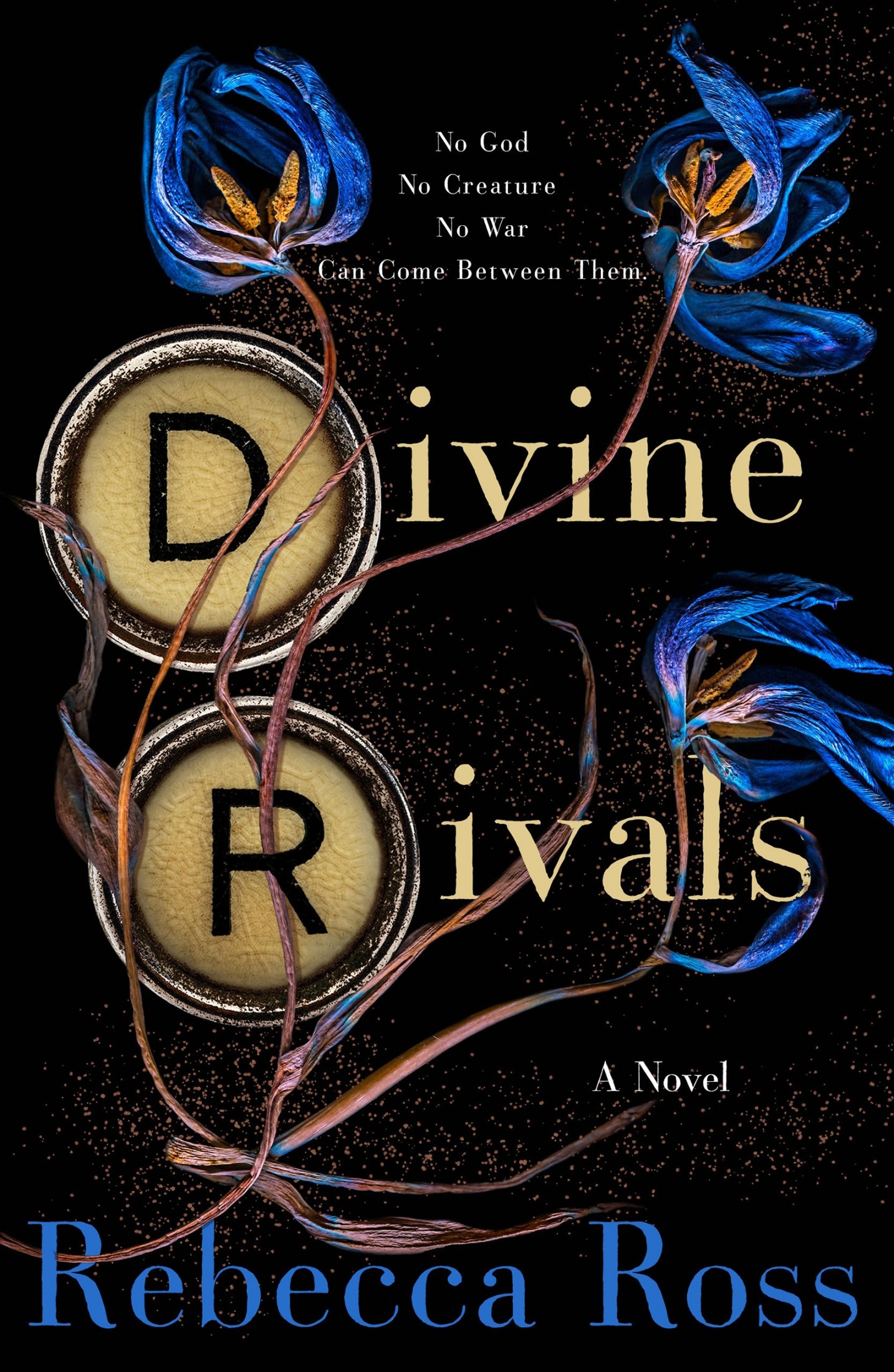
Divine Rivals
About this book
Iris Winnow needs the columnist job at the Oath Gazette to support her family and find news of the brother who enlisted. Her chief rival, Roman Kitt, appears to possess every advantage she lacks, including money, education, and professional composure.
Letters Iris types to her brother vanish through a magical wardrobe and reach Roman, who replies without revealing his identity. Their written intimacy develops beside open rivalry, allowing each to speak honestly to the person they believe is a stranger.
When Iris travels to report on the war between Enva and Dacre, the novel shifts from city offices to hospitals, trenches, and communities under bombardment. The gods matter, but so do propaganda, working conditions, and the responsibility of recording what civilians endure.
Divine Rivals begins Rebecca Ross’s Letters of Enchantment duology. It joins epistolary romance to wartime fantasy and ends at a genuine turning point rather than resolving the larger conflict.
Read a sample
5,001 words
Plain text
From the opening
Prologue
Cold fog had settled over the depot like a burial shroud, and Iris Winnow thought the weather couldn’t have been better. She could hardly see the train through the gloam, but she could taste it in the evening air: metal and smoke and burning coal, all woven together with a trace of petrichor. The wooden platform was slick beneath her shoes, gleaming with rain puddles and piles of decaying leaves.
When Forest came to a stop at her side, she stopped as well, as if she were his mirror. The two of them were often mistaken for twins with their wide-set hazel eyes, wavy chestnut hair, and the freckles that spilled across their noses. But Forest was tall, Iris petite. He was five years her senior, and for the first time in her life, Iris wished that she were older than him.
“I won’t be gone long,” he said. “Only a few months, I think.”
Her brother glanced at her in the fading light, waiting for her to respond. It was eventide, the moment between darkness and light, when the constellations began to dust the sky and the city lamps flickered to life in reply. Iris could feel the draw of it—Forest’s concerned stare and the golden light that illuminated the low-hanging clouds—and yet her eyes wandered, desperate for a distraction. A moment to blink away her tears before Forest could see them.
There was a soldier to her right. A young woman dressed in a perfectly starched uniform. Iris was struck by a wild thought. One that must have traveled across her face, because Forest cleared his throat.
“I should come with you,” Iris said, meeting his gaze. “It’s not too late. I can enlist—”
“No, Iris,” Forest replied sharply. “You made me two promises, remember?”
Two promises, hardly a day old. Iris frowned. “How could I forget.”
“Then speak them back to me.”
She crossed her arms to ward off the autumn chill and the strange cadence in Forest’s voice. There was a hint of desperation she hadn’t heard in him until now, and gooseflesh rippled across her arms beneath her thin sweater.
“Take care of Mum,” she said, mimicking his baritone. It brought a smile to his face. “Stay in school.”
“I believe it was a bit more than a gruff ‘Stay in school,’” Forest said, nudging her foot with his boot. “You brilliant academic who has yet to miss a day of class in all her years. They give awards for that, you know.”
“Fine.” Iris relented, a blush nipping her cheeks. “You said, ‘Promise me you’ll enjoy your final year of school, and I’ll be back in time to see you graduate.’”
“Yes,” Forest said, but his smile began to wane.
He didn’t know when he’d return. It was a promise he couldn’t keep to her, although he continued to make it sound as if the war would end in a matter of months. A war that had only just begun.
What if I had been the one to hear the song? Iris thought, her heart so heavy it felt bruised against her ribs. If I had encountered the goddess and not him … would he let me go like this?
Her gaze dropped to Forest’s chest. The place where his own heart was beating beneath his olive-green uniform. A bullet could pierce him in a split second. A bullet could keep him from ever returning home.
“Forest, I—”
She was interrupted by a shrill whistle that made her jump. It was the last call to board, and there was a sudden shuffle toward the train cars. Iris shivered again.
“Here,” Forest said, setting down his leather satchel. “I want you to have this.”
Iris watched as her brother opened the clasp and withdrew his tan-colored trench coat. He held it out to her, arching his brow when she merely stared at it.
“But you’ll need it,” she argued.
“They’ll give me one,” he replied. “Something war approved, I imagine. Go on, take it, Little Flower.”
Iris swallowed, accepting his trench coat. She slipped her arms into it, belting the worn fabric tight across her waist. It was too big for her, but it was comforting. It felt like armor. She sighed.
“You know, this smells like the horologist’s shop,” she drawled.
Forest laughed. “And what, exactly, does a horologist’s shop smell like?”
“Like dusty, half-wound clocks and expensive oil and those tiny metal instruments you use to fix all the broken pieces.” But that was only partly true. The coat also held a remnant of the Revel Diner, where she and Forest would eat dinner at least twice a week while their mother waited tables. It smelled of the riverside park, of moss and damp stones and long walks, and Forest’s sandalwood aftershave because, no matter how much he wanted one, he couldn’t grow a beard.
“Then it should keep you good company,” he said, slinging his satchel over his shoulder. “And you can have the wardrobe all to yourself now.”
Iris knew he was trying to lighten the mood, but it only made her stomach ache to think about the small closet they shared in their flat. As if she would truly store his clothes somewhere else while he was gone.
“I’m sure I’ll need the spare hangers, since—as you well know—I keep up with all the current fashion trends,” Iris countered wryly, hoping Forest couldn’t hear the sadness in her voice.
He only smiled.
This was it, then. The platform was nearly empty of soldiers, and the train was hissing through the gloom. A knot welled in Iris’s throat; she bit the inside of her cheek as Forest embraced her. She closed her eyes, feeling the scratch of his linen uniform against her cheek, and she held the words she wanted to say in her mouth like water: How can you love this goddess more than me? How can you leave me like this?
Their mother had already spoken such sentiments, angry and upset with Forest for enlisting. Aster Winnow had refused to come to the depot to see him off, and Iris imagined she was at home, weeping as the denial wore away.
The train began to move, creeping along the tracks.
Forest slipped from Iris’s arms.
“Write to me,” she whispered.
“I promise.”
He took a few steps backward, holding her gaze. There was no fear in his eyes. Only a dark, feverish determination. And then Forest turned, rushing to board the train.
Iris followed until he disappeared into the closest car. She lifted her hand and waved, even as tears blurred her vision, and she stood on the platform long after the train had vanished into the fog. Rainwater was seeping into her shoes. The lamps flickered overhead, buzzing like wasps. The crowd had dispersed, and Iris felt hollow—alone—as she began to walk home.
Her hands were cold, and she slipped them into the coat pockets. That was when she felt it—a crinkle of paper. Frowning, she assumed it was a candy wrapper that Forest had forgotten about until she pulled it out to study in the dim light.
It was a small piece of paper, folded crookedly, with a vein of typed words. Iris couldn’t resist smiling, even as her heart ached. She read:
Just in case you didn’t know … you are by far the best sister I’ve ever had. I’m so proud of you.
And I’ll be home before you know it, Little Flower.
Continue reading the sampleClose the sample
PART ONE
Letters Through the Wardrobe
{1}
Sworn Enemies
FIVE MONTHS LATER
Iris dashed through the rain with a broken high heel and a tattered trench coat. Hope was beating wildly in her chest, granting her speed and luck as she crossed the tram tracks downtown. She had been anticipating this day for weeks, and she knew she was ready. Even soaked, limping, and hungry.
Her first pang of unease came when she stepped into the lobby. This was an old building, constructed before the gods were vanquished. A few of those dead divines were painted on the ceiling, and despite the cracks and the faint light of the low-hanging chandeliers, Iris always glanced up at them. Gods and goddesses dancing among the clouds, dressed in long gilded robes with stars gleaming in their hair, their gazes sweeping the ground. It sometimes felt like those painted eyes were watching her, and Iris stifled a shiver. She removed her mangled right shoe and hurried to the lift with a stilted gait, thoughts of the gods swiftly fading when she thought about him. Perhaps the rain had slowed down Roman too, and she still had a chance.
She waited a full minute. The confounded lift must be stuck, of all days, and she decided to take the stairs, hustling up to the fifth floor. She was shaking and sweating when she finally pushed through the heavy doors to the Oath Gazette, greeted by a wash of yellow lamplight, the scent of strong tea, and the morning hustle of preparing the newspaper.
She was four minutes late.
Iris stood amidst the hum, her gaze flickering to Roman’s desk.
It was empty, and she was pleased until she glanced at the assignment board and saw him standing there, waiting for her to appear. As soon as their eyes met, he gave her a lazy smile and reached up to the board, yanking a piece of paper from a pin. The last assignment.
Iris didn’t move, not even when Roman Kitt wound around the cubicles to greet her. He was tall and lithe with cheekbones that could cut stone, and he waved the piece of paper in the air, just out of her reach. The piece of paper she so badly wanted.
“Late again, Winnow,” he greeted her. “The second time this week.”
“I didn’t know you were keeping tally, Kitt.”
His smirk eased as his gaze dropped to her hands, cradling her broken shoe. “Looks like you ran into a bit of trouble this time.”
“Not at all,” she replied, her chin tilted upward. “I planned for this, of course.”
“For your heel to break?”
“For you to get this final assignment.”
“Going easy on me, then?” He arched a brow. “That’s surprising. We’re supposed to duel to the death.”
She snorted. “A hyperbolic turn of phrase, Kitt. Which you do often in your articles, by the way. You should be careful of that tendency if you get columnist.”
A lie. Iris rarely read what he wrote. But he didn’t know that.
Roman’s eyes narrowed. “What’s so hyperbolic about soldiers going missing at the front?”
Iris’s stomach clenched, but she hid her reaction with a thin smile. “Is that the topic of the last assignment? Thanks for letting me know.” She turned away from him and began to weave around cubicles to her desk.
“It doesn’t matter if you know it,” he insisted as he followed her. “I have the assignment.”
She reached her desk and flicked on her lamp. “Of course, Kitt.”
He wasn’t leaving. He continued to stand by her cubicle, watching her set down her tapestry bag and her mangled high heel like it was a badge of honor. She shed her trench coat. He rarely watched her this attentively, and Iris knocked over her tin of pencils.
“Did you need something?” she asked, hurrying to gather the pencils before they rolled off the desk. Of course, one did, landing right before Roman’s leather brogues. He didn’t bother to pick the pencil up for her, and she swallowed a curse as she bent down to retrieve it, noticing the spit polish of his shoes.
“You’re going to write your own article about missing soldiers,” he stated. “Even though you don’t have the full information on the assignment.”
“And that worries you, Kitt?”
“No. Course not.”
She glanced at him, studying his face. She put her tin of pencils on the back side of her desk, far from any chance of spilling again. “Has anyone ever told you that you squint when you lie?”
His scowl only deepened. “No, but only because no one has spent as much time looking at me as you do, Winnow.”
Someone snickered from a nearby desk. Iris flushed, sitting down in her chair. She grappled for a witty reply but came up short, because he was unfortunately handsome and he often drew her eyes.
She did the only thing she could; she leaned back in her chair and granted Roman a brilliant smile. One that reached her eyes, crinkling the corners. His expression darkened instantly, just as she expected. He hated it when she smiled like this at him. It always made him retreat.
“Good luck on your assignment,” she said brightly.
“And you can have fun with the obituaries,” he countered in a clipped tone, at last departing to his cubicle, which was—regrettably—only two desks away.
Iris’s smile melted as soon as his back was turned. She was still absently staring in that direction when Sarah Prindle stepped into her field of vision.
“Tea?” Sarah asked, raising a cup. “You look like you need some, Winnow.”
Iris sighed. “Yes, thanks, Prindle.” She accepted the offering but set it down with a hard clunk on her desk, right next to the stack of handwritten obituaries, waiting for her to sort, edit, and type them. If she had been early enough to snag the assignment, Roman would be the one sifting through this heartache on paper.
Iris stared at the pile, remembering her first day of work three months ago. How Roman Kitt had been the last to shake her hand and introduce himself, approaching her with a hard-set mouth and cold, keen eyes. As if he were measuring how much of a threat she was to him and his position at the Gazette.
It hadn’t taken long for Iris to learn what he truly thought of her. In fact, it had taken only half an hour after she had first met Roman. She had overheard him saying to one of the editors, “She’ll give me no competition. None at all. She dropped out of Windy Grove School in her final year.”
The words still stung.
She hadn’t expected to ever be friends with him. How could she, when they were both competing for the same columnist position? But his pompous demeanor had only sharpened her desire to defeat him. And it had also been alarming that Roman Kitt knew more about her than she knew of him.
Which meant Iris needed to dig up his secrets.
On her second day of work, she went to the friendliest person on staff. Sarah.
“How long has Kitt been here?” Iris had asked.
“Almost a month,” Sarah had replied. “So don’t worry about him having seniority. I think you both have a fair shot at the promotion.”
“And what does his family do?”
“His grandfather pioneered the railroad.”
“So his family has money.”
“Heaps,” Sarah said.
“Where did he go to school?”
“I think Devan Hall, but don’t quote me on that.”
A prestigious school where most of the rich parents of Oath sent their spoiled brats. A direct contrast to Iris’s humble Windy Grove. She had almost winced at this revelation, but pressed on with “Is he courting anyone?”
“Not that I know of,” Sarah had answered with a shrug. “But he doesn’t share much about his life with us. In fact, I don’t really know that much about him, other than he doesn’t like anyone touching the things on his desk.”
Partly satiated with her newfound knowledge, Iris had decided the best course of action was to ignore her competition. She could pretend he didn’t exist most of the time. But she soon discovered that would be increasingly difficult as they had to race each other to the bulletin board for weekly assignments.
She had triumphantly snagged the first one.
Roman had then obtained the second, but only because she had let him.
It had given her the chance to read a published article of his. Iris had sat hunched at her desk, reading what Roman had written about a retired baseball player—a sport Iris had never cared about but suddenly found herself ensorcelled by, all due to the poignant and witty tone of Roman’s writing. She was transfixed by his every word, feeling the stitches of the baseball in her hand, the warm summer night, the thrill of the crowd in the stadium—
“See something you like?”
Roman’s haughty voice broke the spell. Iris had startled, crumpling the paper in her hands. But he knew exactly what she had been reading, and he was smug about it.
“Not at all,” she had said. And because she was desperate for something to distract her from her mortification, she noticed his name, printed in small black type beneath the column headline.
ROMAN C. KITT
“What does the C stand for?” she asked, glancing up at him.
He had only lifted his cup of tea and taken a sip, refusing to reply. But he held her gaze over the chipped edge of the porcelain.
“Roman Cheeky Kitt?” Iris had guessed. “Or maybe Roman Churlish Kitt?”
His amusement dimmed. He didn’t like to be made fun of, and Iris’s grin broadened as she leaned back in her chair.
“Or perhaps it’s Roman Cantankerous Kitt?”
He had turned and left without another word, but his jaw had been clenched.
Once he was gone, she had finished reading his article in peace. It made her heart ache—his writing was extraordinary—and she had dreamt about him that night. The next morning, she had promptly torn the paper to shreds and vowed to never read another one of his pieces again. If she did, she was bound to lose the position to him.
But she was reconsidering now as her tea went cold. If he wrote an article about missing soldiers, she might be inclined to read it.
Iris yanked a fresh sheet of paper from the stack on her desk, feeding it into her typewriter. But her fingers hovered over the keys as she listened to Roman pack his messenger bag. She listened to him leave the office, no doubt to gather information for his article, his footsteps muffled amongst the clack of typebars and the murmur of voices and the swirl of cigarette smoke.
She clenched her teeth together as she began to type out the first obituary.
By the time Iris was almost done for the day, she felt heavy from the obituaries. She always wondered what had caused the deaths, and although that information was never included, she imagined people would be more inclined to read the eulogies if it was.
She gnawed on a hangnail, tasting a faint trace of metal from the typewriter keys. If she wasn’t working on an assignment, she was elbow deep in either classifieds or obituaries. The past three months at the Gazette had seen her cycle through all three, each drawing different words and emotions from her in turn.
“In my office, Winnow,” said a familiar voice. Zeb Autry, her boss, was walking by, and he tapped the edge of her cubicle with his golden ringed fingers. “Now.”
Iris abandoned the obituary and followed him into a glass-walled chamber. It always smelled oppressive here, like oiled leather and tobacco and the strong sting of aftershave. When he sat at his desk, she settled in the wingback chair across from him, resisting the urge to crack her knuckles.
Zeb stared at her for a long, hard minute. He was a middle-aged man with thinning blond hair, pale blue eyes, and a cleft in his chin. Sometimes she thought he could read minds, and it made her uneasy.
“You were late this morning,” he stated.
“Yes, sir. I apologize. I overslept and missed the tram.”
By the way his frown deepened … she wondered if he could sense lies too.
“Kitt got the final assignment, but only because you were late, Winnow. I posted it on the board at eight o’clock sharp, like all the others,” Zeb drawled. “You’ve been late to work two times this week alone. And Kitt has yet to be tardy.”
“I understand, Mr. Autry. It won’t happen again, though.”
Her boss was quiet for a beat. “Over the past few months, I’ve published eleven articles of Kitt’s. I’ve published ten of yours, Winnow.”
Iris braced herself. Was it truly going to come down to the numbers? That Roman had written slightly more than her?
“Do you know that I was going to simply give the position to Kitt after he got his feet wet here?” Zeb continued. “That is, until your essay won the Gazette-in-Winter Competition. Out of the hundreds of essays I sifted through, yours caught my eye. And I thought, Here is a girl who has raw talent, and it would be a shame if I let that slip away.”
Iris knew what came next. She had been working at the diner, washing dishes with muted, broken dreams. She hadn’t once thought the essay she submitted to the Gazette’s annual competition would amount to anything, until she returned home to find a letter from Zeb with her name on it. It was an offer to work at the paper, with the tantalizing promise of columnist if she continued to prove herself exceptional.
It had completely changed Iris’s life.
Zeb lit a cigarette. “I’ve noticed that your writing hasn’t been as sharp lately. It’s been quite messy, in fact. Is there something happening at home, Winnow?”
“No, sir,” she answered, too swiftly.
He regarded her, one eye smaller than the other. “How old are you again?”
“Eighteen.”
“You dropped out of school this past winter, didn’t you?”
She hated thinking about her broken promise to Forest. But she nodded, sensing that Zeb was digging. He wanted to know more about her personal life, which made her tense.
“You have any siblings?”
“An older brother, sir.”
“And where is he, now? What does he do for a living?” Zeb pressed on.
Iris glanced away, studying the black and white checkered floor. “He was a horologist’s apprentice. But he’s at war now. Fighting.”
“For Enva, I presume?”
She nodded again.
“Is that why you dropped out of Windy Grove?” Zeb asked. “Because your brother left?”
Iris didn’t reply.
“That’s a pity.” He sighed, releasing a puff of smoke, although Iris knew Zeb’s opinion on the war, and it never failed to irk her. “What about your parents?”
“I live with my mother,” she replied in a curt tone.
Zeb withdrew a small flask from his jacket and poured a few drops of liquor into his tea. “I’ll think about giving you another assignment, although that’s not how I usually do things around here. Now, I want those obituaries on my desk by three this afternoon.”
She left without another word.
Iris set the finished obituaries on his desk an hour early, but she didn’t leave the office. She remained at her cubicle and began to think of an essay to write, just in case Zeb did give her a chance to counter Roman’s assignment.
But the words felt frozen inside of her. She decided to walk to the sideboard to pour herself a fresh cup of tea when she saw Roman Conceited Kitt walk into the office.
He had been gone all day, to her relief, but he now had that annoying bounce in his stride, as if he were teeming with words he needed to spill across the page. His face was flushed from the chill of early spring, his coat speckled with rain as he sat at his desk, rummaging through his messenger bag for his notepad.
Iris watched as he fed a page to his typewriter and began to furiously type. He was lost to the world, lost to his words, and so she didn’t take the long way back to her desk, as she often did, to avoid passing him directly. He didn’t notice her walking by, and she sipped her overly sweetened tea and stared at her blank page.
Soon everyone began to leave for the day, save for her and Roman. Desk lamps were being turned off, one by one, and yet Iris remained, typing slowly and arduously, as if every word had to be pulled from her marrow, while Roman two cubicles away was pounding into the keys.
Her thoughts drifted to the gods’ war.
It was inevitable; the war always seemed to simmer at the back of her mind, even if it was raging six hundred kilometers west of Oath.
How will it end? she wondered. With one god destroyed, or both of them?
Endings were often found in beginnings, and she began to type what she knew. Snippets of news that had drifted across the land, reaching Oath weeks after they had happened.
It began in a small, sleepy town surrounded by gold. Seven months ago, the wheat fields were ready for harvest, nearly swallowing a place called Sparrow, where sheep outnumber people four to one, and it rains only twice a year due to an old charm cast by an angry—and now slain—god, centuries ago.
This idyllic town in Western Borough is where Dacre, a defeated Underling god, was laid to sleep in a grave. And there he slept for two hundred and thirty-four years until one day, at harvest time, he unexpectedly woke and rose, sifting through the soil and burning with fury.
He came upon a farmer in the field, and his first words were a cold, ragged whisper.
“Where is Enva?”
Enva, a Skyward goddess and Dacre’s sworn enemy. Enva, who had also been defeated two centuries ago, when the five remaining gods fell captive beneath mortal power.
The farmer was afraid, cowering in Dacre’s shadow. “She is buried in the Eastern Borough,” he eventually replied. “In a grave not unlike your own.”
“No,” Dacre said. “She is awake. And if she refuses to greet me … if she chooses to be a coward, I will draw her to me.”
“How, my lord?” the farmer asked.
Dacre stared down at the man. How does one god draw another? He began to
“What’s this?”
Iris jumped at Zeb’s voice, turning to see him standing nearby with a scowl, trying to read what she had typed.
“Just an idea,” she replied, a bit defensive.
“It’s not about how the gods’ war began, is it? That’s old news, Winnow, and people here in Oath are sick of reading about it. Unless you have a fresh take on Enva.”
Iris thought about all the headlines Zeb had published about the war. They screamed things like THE DANGERS OF ENVA’S MUSIC: THE SKYWARD GODDESS HAS RETURNED AND SINGS OUR SONS AND DAUGHTERS TO WAR or RESIST THE SIREN’S CALL TO WAR: ENVA IS OUR MOST DANGEROUS THREAT. ALL STRINGED INSTRUMENTS ARE OUTLAWED IN OATH.
All his articles blamed Enva for the war, while few mentioned Dacre’s involvement at all. Sometimes Iris wondered if it was because Zeb was afraid of the goddess and how easily she recruited soldiers, or if he had been instructed to publish only certain things—if the chancellor of Oath was controlling what the newspaper could share, quietly spreading propaganda.
“I … yes, I know, sir, but I thought—”
“You thought what, Winnow?”
She hesitated. “Has the chancellor given you restrictions?”
“Restrictions?” Zeb laughed as if she were being ridiculous. “On what?”
“On what you can and cannot feature in the paper.”
A frown creased Zeb’s ruddy face. His eyes flashed—Iris couldn’t tell if it was fear or irritation—but he chose to say, “Don’t waste my paper and ink ribbons on a war that is never going to reach us here in Oath. It’s a western problem and we should carry on as normal. Find something good to write about, and I might consider publishing it in the column next week.” With that, he rapped his knuckles on the wood and left, grabbing his coat and hat on the way out.
Iris sighed. She could hear Roman’s steady typing, like a heartbeat in the vast room. Fingertips striking keys, keys striking paper. A prodding for her to do better than him. To claim the position before he did.
Her mind was mush, and she yanked her essay from the typewriter. She folded it and tucked it away in her small tapestry bag, knotting the drawstrings before she scooped up her broken shoe. She turned her lamp off and stood, rubbing a crick in her neck. It was dark beyond the windows; night had settled over the city, and the lights beyond bled like fallen stars.
This time when she walked by Roman’s desk, he noticed her.
He was still wearing his trench coat, and a tendril of black hair cut across his furrowed brow. His fingers slowed on the keys, but he didn’t speak.
Iris wondered if he wanted to, and if so, what he would say to her in a moment when they had the office to themselves, and no one else watching them. She thought of an old proverb that Forest used to invoke: Turn a foe into a friend, and you’ll have one less enemy.
A tedious task, indeed. But Iris paused, backtracking to stand at Roman’s cubicle.
“Do you want to grab a sandwich?” she asked, hardly aware of the words spilling from her mouth. All she knew was she hadn’t eaten that day, and she was hungry for food and a stirring conversation with someone. Even if it was him. “There’s a delicatessen two doors down that stays open this late. They have the best pickles.”
Roman didn’t even slow his typing. “I can’t. Sorry.”
Iris nodded and hurried on her way. She was ridiculous for even thinking he’d want to share dinner with her.
She left with bright eyes, hurling her broken heel into the dustbin on her way out.