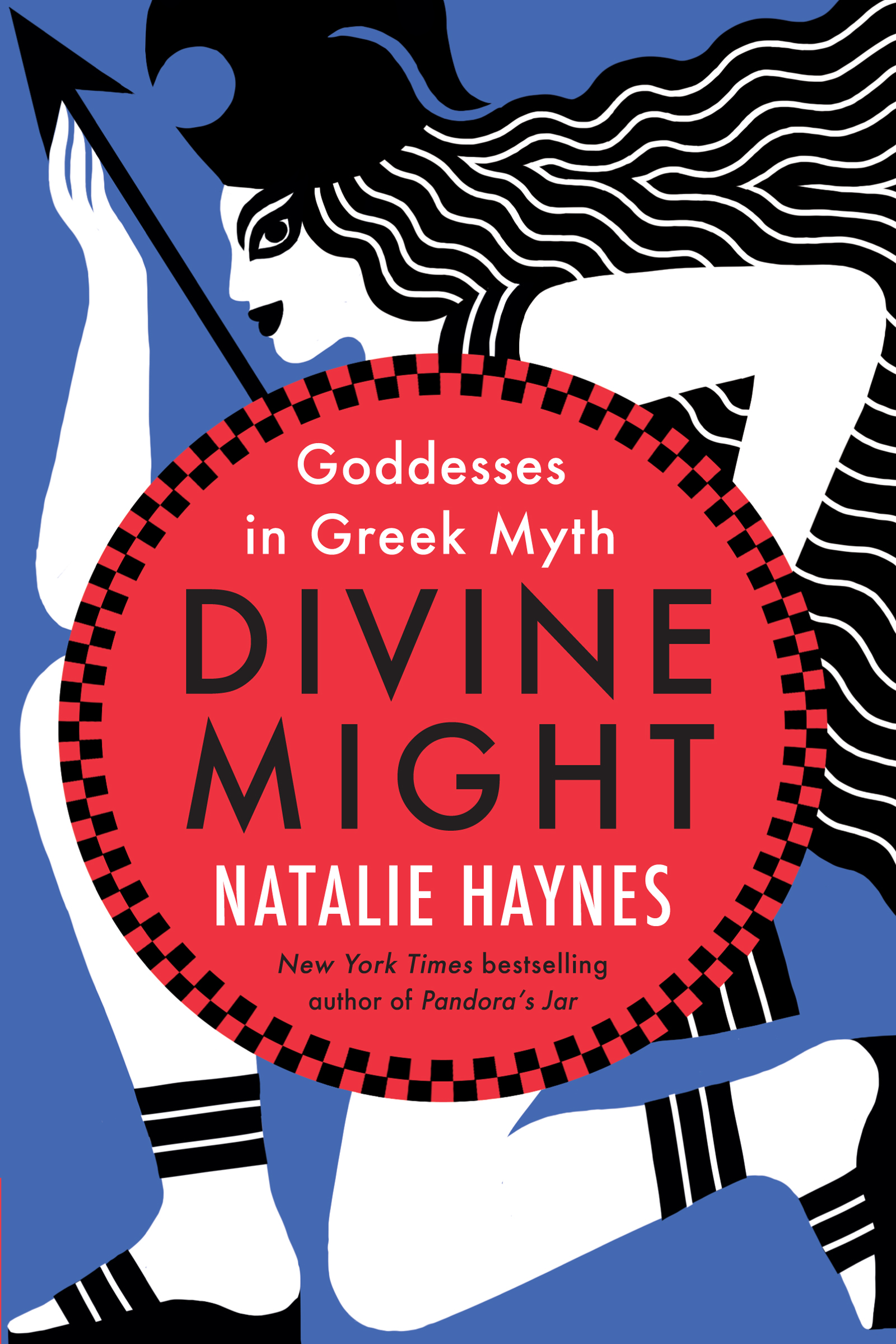
Divine Might
About this book
Greek goddesses are immortal and formidable, but their power does not operate on equal terms with that of gods. Natalie Haynes begins with the worlds people create through their deities, then asks what the stories of female divinity disclose about authority, family, sex, work, grief, and revenge.
Chapters on the Muses, Hera, Aphrodite, Artemis, Demeter, Hestia, Athene, and the Furies move among epic, hymn, tragedy, vase painting, sculpture, and later popular culture. Differences among ancient sources remain visible instead of being combined into a single official biography for each goddess.
Divine Might is a companion in method to Pandora's Jar, with its attention shifted from mortal women to female gods. Humor and contemporary reference sit beside close reading, showing how divine images survive because later audiences continue to select which parts of their power they want to see.
Read a sample
5,074 words
Plain text
From the opening
Introduction
IF OXEN and lions and horses had hands like men, and could draw and make works of art, horses would draw gods like horses, and oxen like oxen, and each would draw pictures of the gods as if they had bodies like their own.
The philosopher Xenophanes wrote these words in the late sixth or early fifth century BCE, and I have been turning them about in my mind since I first read them as a student. At first, I was most interested in the rebuttal of the idea that God made man in his image. Here was someone pointing out what seemed to me a much more plausible scenario: we create gods that reflect us and the way we see ourselves. This is a reasonably uncontroversial view if you read Homer, as an educated Greek like Xenophanes certainly had. Homeric gods are petty, aggressive, and routinely obnoxious. They are immortal, hugely powerful, and have the emotional range and sense of proportion we might expect to find in a toddler deprived of a favourite toy. The smallest slight or setback meets with coruscating rage; gods don’t hesitate to unleash violence on mortals and other gods alike. Not only did the ancient Greeks seem to have modelled gods in their mortal image, but they apparently chose their worst selves as the template.
It can be rather bracing for twenty-first-century readers to discover just how badly behaved ancient gods were: raping, murdering, demanding child sacrifice, and more. I’m often asked to explain why and how people would worship such immoral (or even amoral) deities. Why – if we create gods in our own image – didn’t the Greeks design nicer ones? My answers to this question vary, but in essence I think that Greek gods are capricious and destructive because they are connected with the natural world, which can often be the same – more so in prescientific times than now. When a bolt of lightning or an earthquake could destroy homes and families in an instant, when a famine or plague could devastate your agriculture and your livestock, you might struggle to believe in a benevolent deity. Trying to make sense of the world you inhabit would force you – wouldn’t it? – to assume that sometimes a god was choosing to punish you, exacting revenge on your people or your land. If your crops failed, you needed something to explain it, someone you could try to appease. Artemis and Apollo were connected with the sudden – otherwise inexplicable – deaths of young girls and boys respectively. Child mortality was high in the ancient world; no wonder people sought an explanation. Of course men had a god of war and of course women had a goddess of childbirth. Just because a lot of people died young doesn’t mean anyone wanted to.
We also need to remember that worshipping a god doesn’t necessarily require approval of that god. People might experience love or devotion as they made their offerings of wine and animals. But – at least for some worshippers – they may have been simply acknowledging a figure who had power over them, in the same way that one might pay taxes to a despot or tithes to a corrupt church, because of fear or social obligation rather than approval or love.
And these aren’t questions that I am imposing on the past, of how we respond to stories of gods and goddesses behaving badly. There is a dialogue by Plato called Euthyphro, in which Socrates – Plato’s mentor and inspiration – is in conversation with a man named Euthyphro, who prides himself on his understanding of what is godly or pious. Socrates – at the age of seventy – is about to stand trial for the crime of asebeia, impiety. So he is keen to solicit advice from someone who professes expertise in these matters. But Socrates is soon astonished to discover the reason for Euthyphro’s trip to Athens is that he is bringing a murder charge against his own father. The Athenians didn’t have a civic prosecution service, so crimes had to be charged by individuals. Needless to say, for a man to prosecute his own parent was vanishingly rare.
Socrates is even more puzzled when he hears that Euthyphro is charging his father with murder, and the murder victim isn’t someone to whom Euthyphro is related. Here – though Plato couldn’t have known it – we see a remarkable example of moral relativism in action. Socrates might be shocked by Euthyphro’s lack of filial piety, but we probably aren’t. As Euthyphro points out, it doesn’t matter whether he’s related to the victim or not; murder is murder. This is surely a position that we would share: one life isn’t worth more than another because you’re family.
And the more the story unfolds, the more sympathetic Euthyphro seems: a man working on his land got into a drunken altercation with another man and stabbed him. Euthyphro’s father tied the drunk man by his hands and feet and threw him into a ditch. The man died of exposure. This makes Euthyphro even more unpopular with his family: his father had only killed a drunk murderer, and anyway, he didn’t even kill him on purpose (just ignored him until he died of thirst or the cold). To Euthyphro’s family – and apparently to Socrates – Euthyphro is the impious one, charging his father for a crime he barely even committed. But to a modern audience, I suspect Euthyphro’s position looks like the ethical one.
Continue reading the sampleClose the sample
When challenged by Socrates on his notions of piety and impiety, Euthyphro claims no less an authority than Zeus as his inspiration. Zeus is considered the ariston kai dikaiotaton – the best and most just – of the gods, he says. And they think that even though Zeus put his own father (who deserved it, by the way) in chains. Other Greeks might see filial devotion as the most ethical behaviour, but Euthyphro has drawn a very different lesson.
The subject only grows more unclear as the two men discuss things further. This is often the case when Socrates is involved. But the questions he asks are ones we might also struggle to answer: if you have multiple gods who disagree, how do you know what is right? Two equally powerful deities could make equally strong cases for opposing actions. So we might find ourselves at a loss for what the most pious or godly behaviour is, even before Xenophanes confuses us further by telling us we’re responsible for creating such chaotic deities.
Xenophanes elaborates on his argument that gods are culturally specific (though his work survives to us only in frustratingly short fragments). He moves from the animal kingdom to the human one to refine his point: Ethiopians say their gods have black skin; Thracians say theirs have red hair. This is quite a radical view for someone writing two and a half millennia ago; a few decades later, the philosopher Protagoras apparently had his work burned in the agora (marketplace) because he claimed that it wasn’t possible to know whether or not gods exist. But while Xenophanes doesn’t stray into such inflammatory agnosticism – he doesn’t question the existence of gods – he does still observe that the way we depict or perceive gods might reflect our own appearances and values more than the gods we claim to define.
When I read these fragments now, I’m equally intrigued by a second point. Xenophanes asks us to imagine what would happen if those animals had hands and could draw, if they could make works of art like people do. But he doesn’t use the word anthrōpos – which means ‘man’, in the sense of mankind: humans rather than gods or animals. He uses the word andres. And this word means ‘men’, as opposed to ‘women’. The Greeks loved to divide things into binaries: mortal and immortal, enslaved and free. So Xenophanes is considering not the way that humans in general depict gods, but the way that specifically men do.
As I said, his work is fragmentary, and I am not claiming Xenophanes as a radical proto-feminist. But I have found myself coming back to this line and wondering what it might mean if men – and only men – made images of the gods – and goddesses – they worshipped. Would it make a difference? A quick glance at art history and its abundant supply of naked and desirable (to men) female bodies suggests that it might. But would it change the nature of the characters depicted, or just their physical appearance? And – most interestingly to me – would male and female characters be created in different ways?
Let’s look at what happened when a new set of gods was created in the mid-twentieth century. Superman appeared in 1938 on the cover of the first issue of Action Comics. He wears an all-in-one blue bodysuit, with the signature yellow panel on the chest and a large S in the middle. He has red boots, trunks, and cloak. He is highly muscled, and even if we didn’t notice that, we can see how strong he is because he is holding a car above his head.1 The following year, Detective Comics introduced us to The Batman.2 This hero (whose superpower is having a vast fortune) swings on a rope, his large bat wings fanning out behind him. His face is covered by a mask with two pointed ears, and his bodysuit is grey, with black boots and trunks. We can only just see the bat insignia on his chest, because he has scooped up a villain by the throat: the man’s hat is falling past his shoe as they swoop through the sky. Again, we are witnessing a powerful figure exhibiting his strength. Two seedy-looking men in the foreground – one holding a gun ineffectually in his right hand – are watching the scene in astonishment.
These superheroes were so popular that they swiftly inspired many more. In the autumn of 1941, All Star Comics gave us Wonder Woman. But you’d have to buy the issue to find out, because she isn’t on the cover.3 Inside, we discover her wearing the famous red bustier and blue flared miniskirt covered in white stars. She looks strong and regal, wearing mid-calf boots, a small jewelled diadem and a pair of indestructible bracelets. And so she should – she is an Amazon, after all.
But as the years pass and the cast of characters increases, the slightly skewed reality of comic books – with their predominantly male writers and artists – produces some strange quirks. Batman is always a tough guy, as we’d expect from a man who puts on a disguise to fight and prevent crime. And – in general – male superheroes are strong: Superman comes from another planet and is virtually invulnerable, Wolverine has retractable claws of adamantium and can heal super-fast, the Hulk is incredible in both size and strength. To be a male superhero means to be powerful in brute physical strength, or to approximate that with your Batmobile. Even Spider-Man – a plucky young hero – derives super strength from his encounter with a radioactive spider, though his speed and agility are probably more important.
Heroes need villains, though Greek gods were often capable of being both at once: supporter of one mortal and destroyer of another. The villains Batman meets are often as iconic as he is: the Joker, the Penguin, and the unforgettable Catwoman. Batman’s male adversaries can be physically imposing, like Bane. But the more predominant theme is one of insanity. The Joker is the most notorious, but Arkham Asylum – the facility where many of Batman’s crazed enemies end up – has literally dozens of inhabitants. I suppose we might wonder just why mental illness has so often been connected with villainy. Facial disfigurement is also used in the comic-book world as a shorthand for being evil, and a character like the Joker handily combines both.
But Batman’s female opponents – who also occupy a fine line when it comes to sanity – are usually presented as sexy first and foremost, even when their professional qualifications are impressive. Poison Ivy – botanist and biochemist – uses her plant-controlling skills to make any man fall in love with her. Harley Quinn – psychiatrist – presents as a cheerleader gone bad: candy-coloured hair in adorable pigtails, tiny shorts, tight T-shirt, baseball bat. As for Catwoman, it is hard to imagine any other character in the history of cinema who has been played by so many super-sexy women, from Eartha Kitt to Michelle Pfeiffer. And that is before we remember her skin-tight black latex suit with its cute little cat ears.
Male characters – in the hypermasculine world of superheroes – convey power first; the rest comes later. We might also have the hots for Wolverine or Aquaman (just to pick two names at random while staring at the internet), but desirability is a secondary characteristic for these heroes and villains. Female characters, though, are always presented through the prism of sexiness: Wonder Woman was as strong as Superman, but she also needed to have – in the words of her creator – the allure of a beautiful woman.4 William Moulton Marston created Wonder Woman with a conscious nod to Greek myth and wrote knowledgeably about the Homeric tradition in superhero narratives. He wanted a female hero who was superior to men in strength, but who also excelled in feminine attraction. Boys reading about an alluring woman stronger than themselves will ‘be proud to become her willing slaves!’ Marston later wrote, of his pitch to publishers. Desirability (at least in the mind of her creator) was integral to the character from the outset.
So – to return to Xenophanes – if lions had hands like men and could draw, their gods would look like lions. But what would the goddess-lionesses look like? Would they conform to male ideals of femaleness, as female characters so often do in human art? And if those lions were still drawing their gods in the twentieth century, I wonder whether their comic books would follow the same pattern as ours have. Perhaps lions too would create hypermasculine characters with super-leonine strength, alongside sexy lionesses with skimpy fur? I suppose we’ll never know. Although I can’t help remembering that in 1994’s The Lion King, the hero, his father, his evil uncle, his two fun pals, and his adviser are all male. The female characters are: his girlfriend, her mother, and one hyena.
I still like comic books, incidentally. I like Catwoman and Wonder Woman, even if they were created as male fantasy figures. Batman is a male fantasy figure too – even if it’s his gadgets and his wealth that are the dream, more than his muscles. The same is true for James Bond, of course: it’s his lifestyle that is desirable, rather than his body (although you are free to desire that too). My point isn’t that men create deficient art, it’s that if we only have art created by men, we might want to bear that in mind when we respond to it. James Bond shows us who Ian Fleming (and, by extension, at least some of his readers) wanted to be; Pussy Galore just shows us who he wanted to bang.
The solution to filling in the missing areas of this partial picture is simple. Women can now make art, and we require no one’s permission. We can create our own stories of all those gods and monsters and – if we choose – make them in our image.
There is no finer example than that of Lizzo and Cardi B, in the video for ‘Rumors’: two women at the peak of their success, hitting back at those who spread lies and cruel jibes about them online. They quote some of the more outlandish claims and agree – deadpan – that all this nonsense is true. They also reject the endless critique of their bodies and behaviour: for being too fat, too slutty, too outspoken. And they do this dressed as Greek goddesses. Lizzo strides across her set – a computer-generated space filled with giant vases, their paintings animated and cheeky – in a draped gold lamé dress. It’s cinched at the waist with a gold belt, and she wears gold boots, gold jewellery, and a glittering gold manicure. Her backing dancers, also clad in gold, appear on top of Ionic columns. Lizzo gives us a cheeky wink as she dances among them. The subtextual message of these empowering images against the lyrics, which detail just a few of the hurtful comments directed at her, seems clear. If you don’t acknowledge Lizzo as a modern-day Greek goddess, you should probably look again.
The camera cuts to Cardi B, perched on a throne, reading a scroll. She wears a white slashed skirt and a gold bikini top, slender gold chains draping across her pregnant body. Golden sandals are laced up her calves. A sculpted snake curls up the back of her seat. In case you missed the Freudian subtext here, she is also wearing a pair of gigantic gold aubergine earrings. (For those of you who haven’t been dating during the emoji era, this cartoon image of an aubergine has become symbolic of male genitalia. Take this knowledge and use it wisely.)
The women now appear together in all their glory: Lizzo has changed into a white bodysuit with a magnificent headdress that creates gold vase handles on either side of her head. She is not just a goddess, she is a work of art. Cardi B has an equally spectacular headdress: an Ionic capital – the top of a column – made in sparkling gold. Those haters can tell her she has fake boobs if they want to: she is architecture, she doesn’t require their approval. Whenever I am asked if Classics is irrecoverably elitist – male, pale, and stale, as the accusation goes – I am going to refer the questioner to this video.
And I’ll watch it again myself for good measure. That way, when I return to poetry, paintings, and sculpture made by male geniuses for millennia, I’ll have another view in my mind as well. So this is my answer to that question prompted by Xenophanes. When women make art like men do, their goddesses look divine.
The Muses
WE ARE in a museum which is packed with exhibits but empty of visitors. Has it closed for the day, or are we here early? As we pick our way past sculptures of Athene and other gods and goddesses, daylight streams through a roundel in the roof of a gallery ahead of us. The darkness that surrounds us is banished from this bright column. It illuminates a single vase, a huge piece of black-figure terra-cotta. This shows one of the most popular scenes in Greek mythology: Hercules (Heracles, to give him his Greek name) in battle with the Nemean lion. The lion rears up on its back legs. Its jaws are open and one forepaw reaches out to claw at Hercules. The hero looks unconcerned, and his right arm is drawn back, ready to strike. His left hand reaches forward, mirroring the lion. Perhaps he is about to grab at the thick mane.
Above this image is a geometric black border, and above that, on the neck of the jar, is a second figurative image. Five Muses all wear similar but subtly different white robes, draping down from the shoulders, belted at the waist. Each has finely dressed hair: piled in curls atop her head, flowing in waves down her back, tied into a topknot. Five is an unusual number for Muses – according to the second-century geographer Pausanias, the earliest writers (now lost) claimed three Muses, then four. By the time of Hesiod in the eighth or perhaps seventh century BCE – and our earliest source – there were nine.
The Muses face us. We don’t know it yet, but later we’ll realize that they are Calliope, Muse of epic poetry; Clio, Muse of history; Thalia, Muse of comedy; Terpsichore, Muse of dance; Melpomene, Muse of tragedy. Clio holds a scroll to represent history, and Melpomene carries a tragedy mask. They may not be the first thing we see when we look at the vase, but they’re soon the only thing. Perhaps it’s a little reminder that the word museum means ‘home of the Muses’. They own this space, and we are their audience.
This is the opening sequence of Disney’s 1997 movie Hercules. The music begins to play, and the Muses do what has come naturally to them for millennia: they sing, and they dance. They act as the chorus of a comic play: they react to the plot as it occurs – most brilliantly as the backing singers in ‘I Won’t Say (I’m in Love)’, midway through the film. They also provide us with some backstory at the start. In this instance, it is the story of the Titanomachy: the war between the Olympian gods, led by Zeus, and the Titans, an earlier race of gods who rose up against them. Although Zeus proved triumphant, we soon discover that the Titans are waiting to be released from their subterranean prison to try again. Hades – god of the Underworld – is ready to orchestrate this attack, but a puny mortal stands in his way.
And so the stage is set for a hugely witty and sophisticated version of the Heracles story. Not only that, but the Muses have continued in a tradition which began in Hesiod’s poem the Theogony. This introduces us to the idea of a set of beautiful goddesses who tell us in song about the earliest gods. The Disney Muses do just the same thing: our story actually begins long before Hercules, many aeons ago, says Calliope, as they warm up that opening number. She’s about to tell us a pretty outlandish story. So can we take their word for it? Well, Hesiod certainly does in his poem. And we should too. Even if these Muses weren’t singing a gospel number, we would surely know they can be relied upon from the title of the song: ‘The Gospel Truth’.
The Theogony tells the origin story of the gods, the very beginning of Greek myth. Hesiod details the creation of the earliest powers – Chaos, Heaven, Earth – and then the gradual arrival of more familiar divinities: nymphs, giants, Titans. Gaia and Ouranos—Earth and Heaven – produce many children, including Kronos, who will be father to Hestia, Demeter, Hera, Hades, Poseidon, and Zeus. Their mother, the goddess Rhea, helps Zeus to overthrow Kronos, just as the latter had overcome Ouranos.
But before Hesiod can tell us about any of these internecine battles among gods and goddesses, he has to begin at the beginning. This is – for Hesiod and for us – quite a knotty ontological question. Does he start with the first divine power – with Chaos (or Chasm, to give a more accurate translation)? That’s quite a challenge, when it’s a gaping void that our minds can barely comprehend. And besides, who is he to be telling this story? Why should we trust him? This isn’t just about the unknowability of the primordial gods; it’s about the reliability of our narrator. Hesiod needs to begin his poem with something his audience can understand, and he needs to prove he is the man for the job. And what better way to establish your credentials than by appealing to the Muses?
The first word of the poem is mousaōn – Muses are part of this story from the outset. And because Hesiod is keen to emphasize his close connection with them, he starts by telling us a little about them and where they live. They are the Muses of Mount Helicon,1 he explains, in Boeotia, in central Greece. It is a large and sacred mountain, according to Hesiod (who lives nearby), and the Muses dance around a flower-bright stream and an altar to Kronos. They bathe in one of several rivers, then dance their fine dances on the high reaches of Helicon. Hesiod mentions their soft skin twice: when he describes them bathing, and specifically their feet when they dance. Expectations of feminine corporeal softness have existed for as long as women have been in stories, it seems: do not imagine these barefoot dancing Muses have rough skin anywhere, even on their heels. I half expect them to start advertising moisturizer at this point. But don’t be misled into thinking all this soft skin means they aren’t tough. Hesiod also notes that they dance with strong feet.2 There is also something withheld about these Muses: from the high slopes of Helicon, they go by night, veiled in mist. It is only now, when they are effectively invisible, that they begin their song.
So what do the Muses sing about, within the poem Hesiod has created? The good news for him is that they sing about Zeus, and Hera, Athene, Apollo, and Artemis, and the whole deathless race of gods.3 In other words, the Muses cover the same kind of material that Hesiod is planning to, with the same cast of characters. Perhaps another poet might feel a bit intimidated by this, but not Hesiod. Because the Muses themselves taught him kalēn aoidēn – fine song. Until his meeting with these goddesses, Hesiod was no poet, no singer. Rather, he was a shepherd, tending to his flock at the foot of the sacred Mount Helicon.
This lovely poetic device offers validation in two ways. Firstly, we must accept that Hesiod really knows what he’s talking about when he describes the Muses dancing or being swathed in mist and moving through the dark night. He was an eyewitness: he literally saw and heard this for himself. Equally, if you were having any qualms about Hesiod’s qualifications to describe what is to come – the creation of the very first gods, to which he definitely was not a witness – worry no more. Because Hesiod has been in direct contact with the most authoritative source there could be: the divine Muses. And on the off chance you might consider the sharing of this story to be a bit self-important, Hesiod is about to deliver one of literature’s earliest humblebrags. Because when he does meet the Muses, they don’t congratulate him on his potential to be a great poet. They don’t admire his sheep. In fact, they criticize him: shepherds, they claim, are awful, just bellies. Lucky these Muses will never need woolly socks.
But then they reveal something that is genuinely troubling, for those who might seek certainty in Hesiod’s account of how the world begins. We know how to tell lies as though they were true, the Muses explain. And we also know, when we want to, how to sing the truth.4 But how is Hesiod meant to know the difference? And, by extension, how are we? One story of the Muses told by mythographer Pseudo-Apollodorus5 has them giving the Sphinx her famous riddle (solved by Oedipus before he meets and marries Jocasta), so perhaps they enjoy being an enigma.
The more times I read this opening to the Theogony, the more I like it, from the mock humility to the assurance of authenticity. And I think this might be my favourite part of it. We just won’t know, according to Hesiod’s Muses, if they’re telling us the truth or not. It’ll sound the same to us, and they’ve just confessed that they sometimes lie. They have removed certainty from this account while appearing to bestow it, and they have admitted it right at the start. I find myself wondering whether if all ancient texts on the origins of gods had come with the same disclaimer, we might have had to work a bit harder to find things to fight wars over.
The Muses then give Hesiod a laurel walking stick, and they breathe a godlike voice into him. All traces of humility are gone now: the Muses are making Hesiod their favourite with gifts and talent alike. A variation on this scene was painted by the French artist Gustave Moreau in 1891. Hesiod and the Muse is now held in the Musée d’Orsay. This Hesiod is no empty belly, though, nor does he look like an ordinary shepherd. This version of the poet is young, androgynous, beautiful. He is naked, his finely muscled body draped only with a narrow swag of rich, jewel-coloured fabric across the hip. He stands with his weight on his right leg; his left foot is flexed and leg bent. There are flowers trampled beneath him, narcissi perhaps. In his arms is not the laurel staff we might expect from the Theogony, but rather a lyre, highly ornate and painted bright red, white, and green. The strings are gold. His slender fingers hold it against his naked torso. His expression is quite sombre, his lips slightly pursed as he gazes down at the instrument. All his focus is on the lyre: this young man is dedicated to his newfound art.
Nestling into his back is a Muse. Her golden hair is tied back in a complicated bun, and she too is gazing at the lyre. Perhaps that’s why she is pressed up against this naked young man (for what it’s worth, I have to think of him as being a whole other Hesiod from the one who wrote the poems, as I cannot square the appearance of this beautiful naked man with the verse of the other. I often wonder if I had seen this painting when I was younger whether I might have done better in my Greek poetry translation classes). She wears a draped red dress over a white tunic, and her gold lyre is slung behind her so she can more easily teach Hesiod how to play his.
And she is doing this with great care. Her outstretched right arm – resting on Hesiod’s wrist to help him with his fingering – is as finely toned as his. She holds golden laurel leaves in her left hand, and Hesiod wears a wreath of green laurel. It’s almost invisible, because the leaves echo the feathers of her beautiful dark teal-coloured wings, which are spread behind them both. In the distance, above the arc of the wings, we see a bright star illuminating a temple that stands atop a dizzyingly steep rock. Music is not just a gift from goddess to mortal; it is also a way to celebrate the divine, another kind of temple. The scene is intimate and sexy, a reminder that art – and, in particular, creating art – can be a deeply arousing experience.