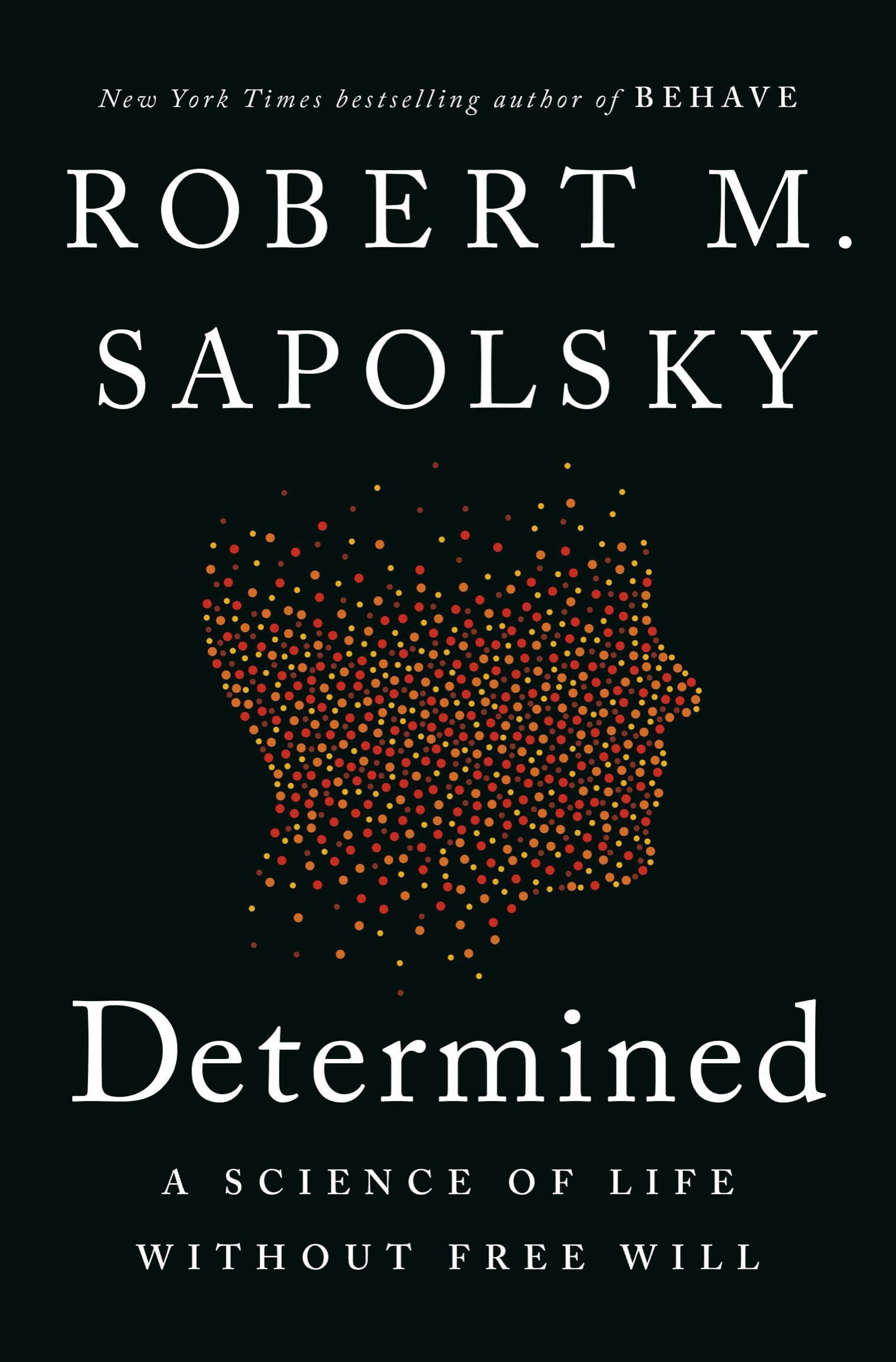
Determined: A Science of Life Without Free Will
About this book
The book follows causes across seconds, hours, years, and generations: neural activity, hormones, development, learning, culture, ecology, and evolution. A decision feels immediate, but every brain state was shaped by conditions that preceded the moment of awareness.
Sapolsky addresses common attempts to preserve a smaller free will through randomness, complexity, emergence, quantum effects, or an unexplained capacity to have done otherwise. Unpredictability, he argues, is not the same thing as agency independent of causes.
The social argument concerns responsibility. Rejecting free will need not mean ignoring danger or consequences; it may replace moral hatred with prevention, containment, rehabilitation, and attention to the conditions that make harmful behaviour more likely.
Determined is an interdisciplinary case for hard determinism, not a settled consensus across neuroscience and philosophy. Its value lies in the breadth of the causal evidence and in the ethical challenge it poses, even for readers who reject its final conclusion.
Read a sample
5,132 words
Plain text
From the opening
1
Turtles All the Way Down
When I was in college, my friends and I had an anecdote that we retold frequently; it went like this (and our retelling was so ritualistic that I suspect this is close to verbatim, forty-five years later):
So, it seems that William James was giving a lecture about the nature of life and the universe. Afterward, an old woman came up and said, “Professor James, you have it all wrong.”
To which James asked, “How so, madam?”
“Things aren’t at all like you said,” she replied. “The world is on the back of a gigantic turtle.”
“Hmm.” said James, bemused. “That may be so, but where does that turtle stand?”
“On the back of another turtle,” she answered.
“But madam,” said James indulgently, “where does that turtle stand?”
To which the old woman responded triumphantly: “It’s no use, Professor James. It’s turtles all the way down!”[*]
Oh, how we loved that story, always told it with the same intonation. We thought it made us seem droll and pithy and attractive.
We used the anecdote as mockery, a pejorative critique of someone clinging unshakably to illogic. We’d be in the dinner hall, and someone had said something nonsensical, where their response to being challenged had made things worse. Inevitably, one of us would smugly say, “It’s no use, Professor James!” to which the person, who had heard our stupid anecdote repeatedly, would inevitably respond, “Screw you, just listen. This actually makes sense.”
Here is the point of this book: While it may seem ridiculous and nonsensical to explain something by resorting to an infinity of turtles all the way down, it actually is much more ridiculous and nonsensical to believe that somewhere down there, there’s a turtle floating in the air. The science of human behavior shows that turtles can’t float; instead, it is indeed turtles all the way down.
Someone behaves in a particular way. Maybe it’s wonderful and inspiring, maybe it’s appalling, maybe it’s in the eye of the beholder, or maybe just trivial. And we frequently ask the same basic question: Why did that behavior occur?
If you believe that turtles can float in the air, the answer is that it just happened, that there was no cause besides that person having simply decided to create that behavior. Science has recently provided a much more accurate answer, and when I say “recently,” I mean in the last few centuries. The answer is that the behavior happened because something that preceded it caused it to happen. And why did that prior circumstance occur? Because something that preceded it caused it to happen. It’s antecedent causes all the way down, not a floating turtle or causeless cause to be found. Or as Maria sings in The Sound of Music, “Nothing comes from nothing, nothing ever could.”[*]
To reiterate, when you behave in a particular way, which is to say when your brain has generated a particular behavior, it is because of the determinism that came just before, which was caused by the determinism just before that, and before that, all the way down. The approach of this book is to show how that determinism works, to explore how the biology over which you had no control, interacting with environment over which you had no control, made you you. And when people claim that there are causeless causes of your behavior that they call “free will,” they have (a) failed to recognize or not learned about the determinism lurking beneath the surface and/or (b) erroneously concluded that the rarefied aspects of the universe that do work indeterministically can explain your character, morals, and behavior.
Once you work with the notion that every aspect of behavior has deterministic, prior causes, you observe a behavior and can answer why it occurred: as just noted, because of the action of neurons in this or that part of your brain in the preceding second.[*] And in the seconds to minutes before, those neurons were activated by a thought, a memory, an emotion, or sensory stimuli. And in the hours to days before that behavior occurred, the hormones in your circulation shaped those thoughts, memories, and emotions and altered how sensitive your brain was to particular environmental stimuli. And in the preceding months to years, experience and environment changed how those neurons function, causing some to sprout new connections and become more excitable, and causing the opposite in others.
And from there, we hurtle back decades in identifying antecedent causes. Explaining why that behavior occurred requires recognizing how during your adolescence a key brain region was still being constructed, shaped by socialization and acculturation. Further back, there’s childhood experience shaping the construction of your brain, with the same then applying to your fetal environment. Moving further back, we have to factor in the genes you inherited and their effects on behavior.
But we’re not done yet. That’s because everything in your childhood, starting with how you were mothered within minutes of birth, was influenced by culture, which means as well by the centuries of ecological factors that influenced what kind of culture your ancestors invented, and by the evolutionary pressures that molded the species you belong to. Why did that behavior occur? Because of biological and environmental interactions, all the way down.[*]
As a central point of this book, those are all variables that you had little or no control over. You cannot decide all the sensory stimuli in your environment, your hormone levels this morning, whether something traumatic happened to you in the past, the socioeconomic status of your parents, your fetal environment, your genes, whether your ancestors were farmers or herders. Let me state this most broadly, probably at this point too broadly for most readers: we are nothing more or less than the cumulative biological and environmental luck, over which we had no control, that has brought us to any moment. You’re going to be able to recite this sentence in your irritated sleep by the time we’re done.
Continue reading the sampleClose the sample
There are all sorts of aspects about behavior that, while true, are not relevant to where we’re heading. For example, the fact that some criminal behavior can be due to psychiatric or neurological problems. That some kids have “learning differences” because of the way their brains work. That some people have trouble with self-restraint, because they grew up without any decent role models or because they’re still a teenager with a teenager’s brain. That someone has said something hurtful merely because they’re tired and stressed, or even because of a medication they’re taking.
All of these are circumstances where we recognize that sometimes, biology can impinge on our behavior. This is essentially a nice humane agenda that endorses society’s general views about agency and personal responsibility but reminds you to make exceptions for edge cases: judges should consider mitigating factors in criminals’ upbringing during sentencing; juvenile murderers shouldn’t be executed; the teacher handing out gold stars to the kids who are soaring in learning to read should do something special too for that kid with dyslexia; college admissions officers should consider more than just SAT cutoffs for applicants who have overcome unique challenges.
These are good, sensible ideas that should be instituted if you decide that some people have much less self-control and capacity to freely choose their actions than average, and that at times, we all have much less than we imagine.
We can all agree on that; however, we’re heading into very different terrain, one that I suspect most readers will not agree with, which is deciding that we have no free will at all. Here would be some of the logical implications of that being the case: That there can be no such thing as blame, and that punishment as retribution is indefensible—sure, keep dangerous people from damaging others, but do so as straightforwardly and nonjudgmentally as keeping a car with faulty brakes off the road. That it can be okay to praise someone or express gratitude toward them as an instrumental intervention, to make it likely that they will repeat that behavior in the future, or as an inspiration to others, but never because they deserve it. And that this applies to you when you’ve been smart or self-disciplined or kind. Oh, as long as we’re at it, that you recognize that the experience of love is made of the same building blocks that constitute wildebeests or asteroids. That no one has earned or is entitled to being treated better or worse than anyone else. And that it makes as little sense to hate someone as to hate a tornado because it supposedly decided to level your house, or to love a lilac because it supposedly decided to make a wonderful fragrance.
That’s what it means to conclude that there is no free will. This is what I’ve concluded, for a long, long time. And even I think that taking that seriously sounds absolutely nutty.
Moreover, most people agree that it sounds that way. People’s beliefs and values, their behavior, their answers to survey questions, their actions as study subjects in the nascent field of “experimental philosophy,” show that people believe in free will when it matters—philosophers (about 90 percent), lawyers, judges, jurors, educators, parents, and candlestick makers. As well as scientists, even biologists, even many neurobiologists, when push comes to shove. Work by psychologists Alison Gopnik at UC Berkeley and Tamar Kushnir at Cornell shows that preschool kids already have a robust belief in a recognizable version of free will. And such a belief is widespread (but not universal) among a wide variety of cultures. We are not machines in most people’s view; as a clear demonstration, when a driver or an automated car makes the same mistake, the former is blamed more.[1] And we are not alone in our faith in free will—research that we’ll look at in a later chapter suggests that other primates even believe that there is free will.[2]
This book has two goals. The first is to convince you that there is no free will,[*] or at least that there is much less free will than generally assumed when it really matters. To accomplish that, we’ll look at the way smart, nuanced thinkers argue for free will, from the perspectives of philosophy, legal thought, psychology, and neuroscience. I’ll be trying to present their views to the best of my ability, and to then explain why I think they are all mistaken. Some of these mistakes arise from the myopia (used in a descriptive rather than judgmental sense) of focusing solely on just one sliver of the biology of behavior. Sometimes this is because of faulty logic, such as concluding that if it’s not possible to ever tell what caused X, maybe nothing caused it. Sometimes the mistakes reflect unawareness or misinterpretation of the science underlying behavior. Most interestingly, I sense that mistakes arise for emotional reasons that reflect that there being no free will is pretty damn unsettling; we’ll consider this at the end of the book. So one of my two goals is to explain why I think all these folks are wrong, and how life would improve if people stopped thinking like them.[3]
Right around here, one might ask of me, Where do you get off? As will be seen, free-will debates often revolve around narrow issues—“Does a particular hormone actually cause a behavior or just make it more likely?” or “Is there a difference between wanting to do something and wanting to want something?”—that are usually debated by specialized authorities. My intellectual makeup happens to be that of a generalist. I’m a “neurobiologist” with a lab that does things like manipulate genes in a rat’s brain to change behavior. At the same time, I spent part of each year for more than three decades studying the social behavior and physiology of wild baboons in a national park in Kenya. Some of my research turned out to be relevant to understanding how adult brains are influenced by the stress of childhood poverty, and as a result, I’ve wound up spending time around the likes of sociologists; another facet of my work has been relevant to mood disorders, leading me to hang with psychiatrists. And for the last decade, I’ve had a hobby of working with public defender offices on murder trials, teaching juries about the brain. As a result, I’ve been carpetbagging in a number of different fields related to behavior. Which I think has made me particularly prone toward deciding that free will doesn’t exist.
Why? Crucially, if you focus on any single field like these—neuroscience, endocrinology, behavioral economics, genetics, criminology, ecology, child development, or evolutionary biology—you are left with plenty of wiggle room for deciding that biology and free will can coexist. In the words of UC San Diego philosopher Manuel Vargas, “Claiming that some scientific result shows the falsity of ‘free will’ . . . is either bad scholarship or academic hucksterism.”[4] He is right, if in-your-face. As we will see in the next chapter, most experimental neurobiology research about free will is narrowly anchored by the result of one study that examined events that happen in the brain a few seconds before a behavior occurs. And Vargas would correctly conclude that this “scientific result” (plus the spin-offs it has generated in the subsequent forty years) doesn’t prove there’s no free will. Similarly, you can’t disprove free will with a “scientific result” from genetics—genes in general are not about inevitability but, rather, about vulnerability and potential, and no single gene, gene variant, or gene mutation has ever been identified that falsifies free will;[*] you can’t even do it when considering all our genes at once. And you can’t disprove free will from a developmental/sociological perspective by emphasizing the scientific result that a childhood filled with abuse, deprivation, neglect, and trauma astronomically increases the odds of producing a deeply damaged and damaging adult—because there are exceptions. Yeah, no single result or scientific discipline can do that. But—and this is the incredibly important point—put all the scientific results together, from all the relevant scientific disciplines, and there’s no room for free will.[*]
Why is that? Something deeper than the idea that if you examine enough different disciplines, one -ology after another, you’re bound to eventually find one that provides a slam dunk, falsifying free will all by itself. It is also deeper than the idea that even though each discipline has a hole that precludes it from falsifying free will, at least one of the other disciplines compensates for it.
Crucially, all these disciplines collectively negate free will because they are all interlinked, constituting the same ultimate body of knowledge. If you talk about the effects of neurotransmitters on behavior, you are also implicitly talking about the genes that specify the construction of those chemical messengers, and the evolution of those genes—the fields of “neurochemistry,” “genetics,” and “evolutionary biology” can’t be separated. If you examine how events in fetal life influence adult behavior, you are also automatically considering things like lifelong changes in patterns of hormone secretion or in gene regulation. If you discuss the effects of mothering style on a kid’s eventual adult behavior, by definition you are also automatically discussing the nature of the culture that the mother passes on through her actions. There’s not a single crack of daylight to shoehorn in free will.
As such, the first half of the book’s point is to rely on this biological framework in rejecting free will. Which brings us to the second half of the book. As noted, I haven’t believed in free will since adolescence, and it’s been a moral imperative for me to view humans without judgment or the belief that anyone deserves anything special, to live without a capacity for hatred or entitlement. And I just can’t do it. Sure, sometimes I can sort of get there, but it is rare that my immediate response to events aligns with what I think is the only acceptable way to understand human behavior; instead, I usually fail dismally.
As I said, even I think it’s crazy to take seriously all the implications of there being no free will. And despite that, the goal of the second half of the book is to do precisely that, both individually and societally. Some chapters consider scientific insights about how we might go about dispensing with free-will belief. Others examine how some of the implications of rejecting free will are not disastrous, despite initially seeming that way. Some review historical circumstances that demonstrate something crucial about the radical changes we’d need to make in our thinking and feeling: we’ve done it before.
The book’s intentionally ambiguous title reflects these two halves—it is both about the science of why there is no free will and the science of how we might best live once we accept that.
Styles of Views: Whom I Will Be Disagreeing With
I’m going to be discussing some of the common attitudes held by people writing about free will. These come in four basic flavors:[*]
The world is deterministic and there’s no free will. In this view, if the former is the case, the latter has to be as well; determinism and free will are not compatible. I am coming from this perspective of “hard incompatibilism.”[*]
The world is deterministic and there is free will. These folks are emphatic that the world is made of stuff like atoms, and life, in the elegant words of psychologist Roy Baumeister (currently at the University of Queensland in Australia), “is based on the immutability and relentlessness of the laws of nature.”[5] No magic or fairy dust involved, no substance dualism, the view where brain and mind are separate entities.[*] Instead, this deterministic world is viewed as compatible with free will. This is roughly 90 percent of philosophers and legal scholars, and the book will most often be taking on these “compatibilists.”
The world is not deterministic; there’s no free will. This is an oddball view that everything important in the world runs on randomness, a supposed basis of free will. We’ll get to this in chapters 9 and 10.
The world is not deterministic; there is free will. These are folks who believe, like I do, that a deterministic world is not compatible with free will—however, no problem, the world isn’t deterministic in their view, opening a door for free-will belief. These “libertarian incompatibilists” are a rarity, and I’ll only occasionally touch on their views.
There’s a related quartet of views concerning the relationship between free will and moral responsibility. The last word obviously carries a lot of baggage with it, and the sense in which it is used by people debating free will typically calls forth the concept of basic desert, where someone can deserve to be treated in a particular way, where the world is a morally acceptable place in its recognition that one person can deserve a particular reward, another a particular punishment. As such, these views are:
There’s no free will, and thus holding people morally responsible for their actions is wrong. Where I sit. (And as will be covered in chapter 14, this is completely separate from forward-looking issues of punishment for deterrent value.)
There’s no free will, but it is okay to hold people morally responsible for their actions. This is another type of compatibilism—an absence of free will and moral responsibility coexist without invoking the supernatural.
There’s free will, and people should be held morally responsible. This is probably the most common stance out there.
There’s free will, but moral responsibility isn’t justified. This is a minority view; typically, when you look closely, the supposed free will exists in a very narrow sense and is certainly not worth executing people about.
Obviously, imposing these classifications on determinism, free will, and moral responsibility is wildly simplified. A key simplification is pretending that most people have clean “yes” or “no” answers as to whether these states exist; the absence of clear dichotomies leads to frothy philosophical concepts like partial free will, situational free will, free will in only a subset of us, free will only when it matters or only when it doesn’t. This raises the question of whether the edifice of free-will belief is crumbled by one flagrant, highly consequential exception and, conversely, whether free-will skepticism collapses when the opposite occurs. Focusing on gradations between yes and no is important, since interesting things in the biology of behavior are often on continua. As such, my fairly absolutist stance on these issues puts me way out in left field. Again, my goal isn’t to convince you that there’s no free will; it will suffice if you merely conclude that there’s so much less free will than you thought that you have to change your thinking about some truly important things.
Despite starting by separating determinism / free will and free will / moral responsibility, I follow the frequent convention of merging them into one. Thus, my stance is that because the world is deterministic, there can’t be free will, and thus holding people morally responsible for their actions is not okay (a conclusion described as “deplorable” by one leading philosopher whose thinking we’re going to dissect big time). This incompatibilism will be most frequently contrasted with the compatibilist view that while the world is deterministic, there is still free will, and thus holding people morally responsible for their actions is just.
This version of compatibilism has produced numerous papers by philosophers and legal scholars concerning the relevance of neuroscience to free will. After reading lots of them, I’ve concluded that they usually boil down to three sentences:
Wow, there’ve been all these cool advances in neuroscience, all reinforcing the conclusion that ours is a deterministic world.
Some of those neuroscience findings challenge our notions of agency, moral responsibility, and deservedness so deeply that one must conclude that there is no free will.
Nah, it still exists.
Naturally, a lot of time will be spent examining the “nah” part. In doing so, I’ll consider only a subset of such compatibilists. Here’s a thought experiment for identifying them: In 1848 at a construction site in Vermont, an accident with dynamite hurled a metal rod at high speed into the brain of a worker, Phineas Gage, and out the other side. This destroyed much of Gage’s frontal cortex, an area central to executive function, long-term planning, and impulse control. In the aftermath, “Gage was no longer Gage,” as stated by one friend. Formerly sober, reliable, and the foreman of his work crew, Gage was now “fitful, irreverent, indulging at times in the grossest profanity (which was not previously his custom) . . . obstinate, yet capricious and vacillating,” as described by his doctor. Phineas Gage is the textbook case that we are the end products of our material brains. Now, 170 years later, we understand how the unique function of your frontal cortex is the result of your genes, prenatal environment, childhood, and so on (wait for chapter 4).
Now the thought experiment: Raise a compatibilist philosopher from birth in a sealed room where they never learn anything about the brain. Then tell them about Phineas Gage and summarize our current knowledge about the frontal cortex. If their immediate response is “Whatever, there’s still free will,” I’m not interested in their views. The compatibilist I have in mind is one who then wonders, “OMG, what if I’m completely wrong about free will?,” ponders hard for hours or decades, and concludes that there’s still free will, here’s why, and it’s okay for society to hold people morally responsible for their actions. If a compatibilist has not wrestled through being challenged by knowledge of the biology of who we are, it’s not worth the time trying to counter their free-will belief.
Ground Rules and Definitions
What is free will? Groan, we have to start with that, so here comes something totally predictable along the lines of “Different things to different types of thinkers, which gets confusing.” Totally uninviting. Nevertheless, we have to start there, followed by “What is determinism?” I’ll do my best to mitigate the drag of this.
What Do I Mean by Free Will?
People define free will differently. Many focus on agency, whether a person can control their actions, act with intent. Other definitions concern whether, when a behavior occurs, the person knows that there are alternatives available. Others are less concerned with what you do than with vetoing what you don’t want to do. Here’s my take.
Suppose that a man pulls the trigger of a gun. Mechanistically, the muscles in his index finger contracted because they were stimulated by a neuron having an action potential (i.e., being in a particularly excited state). That neuron in turn had its action potential because it was stimulated by the neuron just upstream. Which had its own action potential because of the next neuron upstream. And so on.
Here’s the challenge to a free willer: Find me the neuron that started this process in this man’s brain, the neuron that had an action potential for no reason, where no neuron spoke to it just before. Then show me that this neuron’s actions were not influenced by whether the man was tired, hungry, stressed, or in pain at the time. That nothing about this neuron’s function was altered by the sights, sounds, smells, and so on, experienced by the man in the previous minutes, nor by the levels of any hormones marinating his brain in the previous hours to days, nor whether he had experienced a life-changing event in recent months or years. And show me that this neuron’s supposedly freely willed functioning wasn’t affected by the man’s genes, or by the lifelong changes in regulation of those genes caused by experiences during his childhood. Nor by levels of hormones he was exposed to as a fetus, when that brain was being constructed. Nor by the centuries of history and ecology that shaped the invention of the culture in which he was raised. Show me a neuron being a causeless cause in this total sense. The prominent compatibilist philosopher Alfred Mele of Florida State University emphatically feels that requiring something like that of free will is setting the bar “absurdly high.”[6] But this bar is neither absurd nor too high. Show me a neuron (or brain) whose generation of a behavior is independent of the sum of its biological past, and for the purposes of this book, you’ve demonstrated free will. The point of the first half of this book is to establish that this can’t be shown.
What Do I Mean by Determinism?
It’s virtually required to start this topic with the dead White male Pierre Simon Laplace, the eighteenth-/nineteenth-century French polymath (it’s also required that you call him a polymath, as he contributed to mathematics, physics, engineering, astronomy, and philosophy). Laplace provided the canonical claim for all of determinism: If you had a superhuman who knew the location of every particle in the universe at this moment, they’d be able to accurately predict every moment in the future. Moreover, if this superhuman (eventually termed “Laplace’s demon”) could re-create the exact location of every particle at any point in the past, it would lead to a present identical to our current one. The past and future of the universe are already determined.
Science since Laplace’s time shows that he wasn’t completely right (proving that Laplace was not a Laplacian demon), but the spirit of his demon lives on. Contemporary views of determinism have to incorporate the fact that certain types of predictability turn out to be impossible (the subject of chapters 5 and 6) and certain aspects of the universe are actually nondeterministic (chapters 9 and 10).
Moreover, contemporary models of determinism must also accommodate the role played by meta-level consciousness. What do I mean by this? Consider a classic psychology demonstration of people having less freedom in their choices than they assumed.[7] Ask someone to name their favorite detergent, and if you have unconsciously cued them earlier with the word ocean, they become more likely to answer, “Tide.” As an important measure of where meta-level consciousness comes in, suppose the person realizes what the researcher is up to and, wanting to show that they can’t be manipulated, decides that they won’t say “Tide,” even if it is their favorite. Their freedom has been just as constrained, a point in many of the coming chapters. Similarly, wind up as an adult exactly like your parents or the exact opposite of them, and you are equally unfree—in the latter case, the pull toward adopting their behavior, the ability to consciously recognize that tendency to do that, the mindset to recoil from that with horror and thus do the opposite, are all manifestations of the ways that you became you outside your control.
Finally, any contemporary view of determinism must accommodate a profoundly important point, one that dominates the second half of the book—despite the world being deterministic, things can change. Brains change, behaviors change. We change. And that doesn’t counter this being a deterministic world without free will. In fact, the science of change strengthens the conclusion; this will come in chapter 12.
With those issues in mind, time to see the version of determinism that this book builds on.
Imagine a university graduation ceremony. Almost always moving, despite the platitudes, the boilerplate, the kitsch. The happiness, the pride. The families whose sacrifices now all seem worth it. The graduates who were the first in their family to finish high school. The ones whose immigrant parents sit there glowing, their saris, dashikis, barongs broadcasting that their pride in the present isn’t at the cost of pride in their past.
And then you notice someone. Amid the family clusters postceremony, the new graduates posing for pictures with Grandma in her wheelchair, the bursts of hugs and laughter, you see the person way in the back, the person who is part of the grounds crew, collecting the garbage from the cans on the perimeter of the event.
Randomly pick any of the graduates. Do some magic so that this garbage collector started life with the graduate’s genes. Likewise for getting the womb in which nine months were spent and the lifelong epigenetic consequences of that. Get the graduate’s childhood as well—one filled with, say, piano lessons and family game nights, instead of, say, threats of going to bed hungry, becoming homeless, or being deported for lack of papers. Let’s go all the way so that, in addition to the garbage collector having gotten all that of the graduate’s past, the graduate would have gotten the garbage collector’s past. Trade every factor over which they had no control, and you will switch who would be in the graduation robe and who would be hauling garbage cans. This is what I mean by determinism.