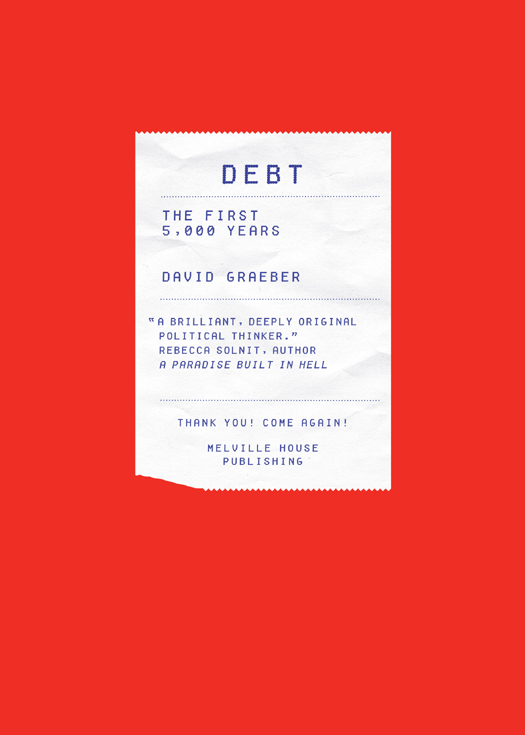
Debt: The First 5,000 Years
About this book
Drawing on anthropology and history, Graeber argues that elaborate credit relationships often preceded coinage and that the familiar barter-origin story lacks supporting evidence from societies observed by anthropologists.
Across ancient states, religious traditions, empires, and markets, debt becomes a numerical obligation and a moral language. The book follows recurring tensions between creditors and debtors, including jubilees, enslavement, conquest, and revolt.
Graeber distinguishes everyday reciprocity from obligations enforced by violence and asks why repayment is treated as an absolute duty even when the original relationship was unequal. His five-thousand-year synthesis is provocative and contested in parts, especially at its broadest transitions.
Debt: The First 5,000 Years is anthropological and historical nonfiction, not a personal-finance guide. It invites readers to see money, markets, and states as social arrangements with histories rather than natural facts.
Read a sample
5,022 words
Plain text
From the opening
Chapter One ON THE EXPERIENCE OF MORAL CONFUSION
debt
• noun 1 a sum of money owed. 2 the state of owing money. 3 a feeling of gratitude for a favour or service.
—Oxford English Dictionary
If you owe the bank a hundred thousand dollars, the bank owns you. If you owe the bank a hundred million dollars, you own the bank.
—American Proverb
TWO YEARS AGO, by a series of strange coincidences, I found myself attending a garden party at Westminster Abbey. I was a bit uncomfortable. It’s not that other guests weren’t pleasant and amicable, and Father Graeme, who had organized the party, was nothing if not a gracious and charming host. But I felt more than a little out of place. At one point, Father Graeme intervened, saying that there was someone by a nearby fountain whom I would certainly want to meet. She turned out to be a trim, well-appointed young woman who, he explained, was an attorney—“but more of the activist kind. She works for a foundation that provides legal support for anti-poverty groups in London. You’ll probably have a lot to talk about.”
We chatted. She told me about her job. I told her I had been involved for many years with the global justice movement—“anti-globalization movement,” as it was usually called in the media. She was curious: she’d of course read a lot about Seattle, Genoa, the tear gas and street battles, but … well, had we really accomplished anything by all of that?
“Actually,” I said, “I think it’s kind of amazing how much we did manage to accomplish in those first couple of years.”
“For example?”
“Well, for example, we managed to almost completely destroy the IMF.”
As it happened, she didn’t actually know what the IMF was, so I offered that the International Monetary Fund basically acted as the world’s debt enforcers—“You might say, the high-finance equivalent of the guys who come to break your legs.” I launched into historical background, explaining how, during the ’70s oil crisis, OPEC countries ended up pouring so much of their newfound riches into Western banks that the banks couldn’t figure out where to invest the money; how Citibank and Chase therefore began sending agents around the world trying to convince Third World dictators and politicians to take out loans (at the time, this was called “go-go banking”); how they started out at extremely low rates of interest that almost immediately skyrocketed to 20 percent or so due to tight U.S. money policies in the early ‘80s; how, during the ’80s and ’90s, this led to the Third World debt crisis; how the IMF then stepped in to insist that, in order to obtain refinancing, poor countries would be obliged to abandon price supports on basic foodstuffs, or even policies of keeping strategic food reserves, and abandon free health care and free education; how all of this had led to the collapse of all the most basic supports for some of the poorest and most vulnerable people on earth. I spoke of poverty, of the looting of public resources, the collapse of societies, endemic violence, malnutrition, hopelessness, and broken lives.
“But what was your position?” the lawyer asked.
“About the IMF? We wanted to abolish it.”
“No, I mean, about the Third World debt.”
“Oh, we wanted to abolish that too. The immediate demand was to stop the IMF from imposing structural adjustment policies, which were doing all the direct damage, but we managed to accomplish that surprisingly quickly. The more long-term aim was debt amnesty. Something along the lines of the biblical Jubilee. As far as we were concerned,” I told her, “thirty years of money flowing from the poorest countries to the richest was quite enough.”
“But,” she objected, as if this were self-evident, “they’d borrowed the money! Surely one has to pay one’s debts.”
It was at this point that I realized this was going to be a very different sort of conversation than I had originally anticipated.
Where to start? I could have begun by explaining how these loans had originally been taken out by unelected dictators who placed most of it directly in their Swiss bank accounts, and ask her to contemplate the justice of insisting that the lenders be repaid, not by the dictator, or even by his cronies, but by literally taking food from the mouths of hungry children. Or to think about how many of these poor countries had actually already paid back what they’d borrowed three or four times now, but that through the miracle of compound interest, it still hadn’t made a significant dent in the principal. I could also observe that there was a difference between refinancing loans, and demanding that in order to obtain refinancing, countries have to follow some orthodox free-market economic policy designed in Washington or Zurich that their citizens had never agreed to and never would, and that it was a bit dishonest to insist that countries adopt democratic constitutions and then also insist that, whoever gets elected, they have no control over their country’s policies anyway. Or that the economic policies imposed by the IMF didn’t even work. But there was a more basic problem: the very assumption that debts have to be repaid.
Actually, the remarkable thing about the statement “one has to pay one’s debts” is that even according to standard economic theory, it isn’t true. A lender is supposed to accept a certain degree of risk. If all loans, no matter how idiotic, were still retrievable—if there were no bankruptcy laws, for instance—the results would be disastrous. What reason would lenders have not to make a stupid loan?
Continue reading the sampleClose the sample
“Well, I know that sounds like common sense,” I said, “but the funny thing is, economically, that’s not how loans are actually supposed to work. Financial institutions are supposed to be ways of directing resources toward profitable investments. If a bank were guaranteed to get its money back, plus interest, no matter what it did, the whole system wouldn’t work. Say I were to walk into the nearest branch of the Royal Bank of Scotland and say ‘You know, I just got a really great tip on the horses. Think you could lend me a couple million quid?’ Obviously they’d just laugh at me. But that’s just because they know if my horse didn’t come in, there’d be no way for them to get the money back. But, imagine there was some law that said they were guaranteed to get their money back no matter what happens, even if that meant, I don’t know, selling my daughter into slavery or harvesting my organs or something. Well, in that case, why not? Why bother waiting for someone to walk in who has a viable plan to set up a laundromat or some such? Basically, that’s the situation the IMF created on a global level—which is how you could have all those banks willing to fork over billions of dollars to a bunch of obvious crooks in the first place.”
I didn’t get quite that far, because at about that point a drunken financier appeared, having noticed that we were talking about money, and began telling funny stories about moral hazard—which somehow, before too long, had morphed into a long and not particularly engrossing account of one of his sexual conquests. I drifted off.
Still, for several days afterward, that phrase kept resonating in my head.
“Surely one has to pay one’s debts.”
The reason it’s so powerful is that it’s not actually an economic statement: it’s a moral statement. After all, isn’t paying one’s debts what morality is supposed to be all about? Giving people what is due them. Accepting one’s responsibilities. Fulfilling one’s obligations to others, just as one would expect them to fulfill their obligations to you. What could be a more obvious example of shirking one’s responsibilities than reneging on a promise, or refusing to pay a debt?
It was that very apparent self-evidence, I realized, that made the statement so insidious. This was the kind of line that could make terrible things appear utterly bland and unremarkable. This may sound strong, but it’s hard not to feel strongly about such matters once you’ve witnessed the effects. I had. For almost two years, I had lived in the highlands of Madagascar. Shortly before I arrived, there had been an outbreak of malaria. It was a particularly virulent outbreak because malaria had been wiped out in highland Madagascar many years before, so that, after a couple of generations, most people had lost their immunity. The problem was, it took money to maintain the mosquito eradication program, since there had to be periodic tests to make sure mosquitoes weren’t starting to breed again and spraying campaigns if it was discovered that they were. Not a lot of money. But owing to IMF-imposed austerity programs, the government had to cut the monitoring program. Ten thousand people died. I met young mothers grieving for lost children. One might think it would be hard to make a case that the loss of ten thousand human lives is really justified in order to ensure that Citibank wouldn’t have to cut its losses on one irresponsible loan that wasn’t particularly important to its balance sheet anyway. But here was a perfectly decent woman—one who worked for a charitable organization, no less—who took it as self-evident that it was. After all, they owed the money, and surely one has to pay one’s debts.
For the next few weeks, that phrase kept coming back at me. Why debt? What makes the concept so strangely powerful? Consumer debt is the lifeblood of our economy. All modern nation-states are built on deficit spending. Debt has come to be the central issue of international politics. But nobody seems to know exactly what it is, or how to think about it.
The very fact that we don’t know what debt is, the very flexibility of the concept, is the basis of its power. If history shows anything, it is that there’s no better way to justify relations founded on violence, to make such relations seem moral, than by reframing them in the language of debt—above all, because it immediately makes it seem that it’s the victim who’s doing something wrong. Mafiosi understand this. So do the commanders of conquering armies. For thousands of years, violent men have been able to tell their victims that those victims owe them something. If nothing else, they “owe them their lives” (a telling phrase) because they haven’t been killed.
Nowadays, for example, military aggression is defined as a crime against humanity, and international courts, when they are brought to bear, usually demand that aggressors pay compensation. Germany had to pay massive reparations after World War I, and Iraq is still paying Kuwait for Saddam Hussein’s invasion in 1990. Yet the Third World debt, the debt of countries like Madagascar, Bolivia, and the Philippines, seems to work precisely the other way around. Third World debtor nations are almost exclusively countries that have at one time been attacked and conquered by European countries—often, the very countries to whom they now owe money. In 1895, for example, France invaded Madagascar, disbanded the government of then–Queen Ranavalona III, and declared the country a French colony. One of the first things General Gallieni did after “pacification,” as they liked to call it then, was to impose heavy taxes on the Malagasy population, in part so they could reimburse the costs of having been invaded, but also, since French colonies were supposed to be fiscally self-supporting, to defray the costs of building the railroads, highways, bridges, plantations, and so forth that the French regime wished to build. Malagasy taxpayers were never asked whether they wanted these railroads, highways, bridges, and plantations, or allowed much input into where and how they were built.1 To the contrary: over the next half century, the French army and police slaughtered quite a number of Malagasy who objected too strongly to the arrangement (upwards of half a million, by some reports, during one revolt in 1947). It’s not as if Madagascar has ever done any comparable damage to France. Despite this, from the beginning, the Malagasy people were told they owed France money, and to this day, the Malagasy people are still held to owe France money, and the rest of the world accepts the justice of this arrangement. When the “international community” does perceive a moral issue, it’s usually when they feel the Malagasy government is being slow to pay their debts.
But debt is not just victor’s justice; it can also be a way of punishing winners who weren’t supposed to win. The most spectacular example of this is the history of the Republic of Haiti—the first poor country to be placed in permanent debt peonage. Haiti was a nation founded by former plantation slaves who had the temerity not only to rise up in rebellion, amidst grand declarations of universal rights and freedoms, but to defeat Napoleon’s armies sent to return them to bondage. France immediately insisted that the new republic owed it 150 million francs in damages for the expropriated plantations, as well as the expenses of outfitting the failed military expeditions, and all other nations, including the United States, agreed to impose an embargo on the country until it was paid. The sum was intentionally impossible (equivalent to about 18 billion dollars), and the resultant embargo ensured that the name “Haiti” has been a synonym for debt, poverty, and human misery ever since.2
Sometimes, though, debt seems to mean the very opposite. Starting in the 1980s, the United States, which insisted on strict terms for the repayment of Third World debt, itself accrued debts that easily dwarfed those of the entire Third World combined—mainly fueled by military spending. The U.S. foreign debt, though, takes the form of treasury bonds held by institutional investors in countries (Germany, Japan, South Korea, Taiwan, Thailand, the Gulf States) that are in most cases, effectively, U.S. military protectorates, most covered in U.S. bases full of arms and equipment paid for with that very deficit spending. This has changed a little now that China has gotten in on the game (China is a special case, for reasons that will be explained later), but not very much—even China finds that the fact it holds so many U.S. treasury bonds makes it to some degree beholden to U.S. interests, rather than the other way around.
So what is the status of all this money continually being funneled into the U.S. treasury? Are these loans? Or is it tribute? In the past, military powers that maintained hundreds of military bases outside their own home territory were ordinarily referred to as “empires,” and empires regularly demanded tribute from subject peoples. The U.S. government, of course, insists that it is not an empire—but one could easily make a case that the only reason it insists on treating these payments as “loans” and not as “tribute” is precisely to deny the reality of what’s going on.
Now, it’s true that, throughout history, certain sorts of debt, and certain sorts of debtor, have always been treated differently than others. In the 1720s, one of the things that most scandalized the British public when conditions at debtors’ prisons were exposed in the popular press was the fact that these prisons were regularly divided into two sections. Aristocratic inmates, who often thought of a brief stay in Fleet or Marshalsea as something of a fashion statement, were wined and dined by liveried servants and allowed to receive regular visits from prostitutes. On the “common side,” impoverished debtors were shackled together in tiny cells, “covered with filth and vermin,” as one report put it, “and suffered to die, without pity, of hunger and jail fever.”3
In a way you can see current world economic arrangements as a much larger version of the same thing: the U.S. in this case being the Cadillac debtor, Madagascar the pauper starving in the next cell—while the Cadillac debtors’ servants lecture him on how his problems are due to his own irresponsibility.
And there’s something more fundamental going on here, a philosophical question, even, that we might do well to contemplate. What is the difference between a gangster pulling out a gun and demanding you give him a thousand dollars of “protection money,” and that same gangster pulling out a gun and demanding you provide him with a thousand-dollar “loan”? In most ways, obviously, nothing. But in certain ways there is a difference. As in the case of the U.S. debt to Korea or Japan, were the balance of power at any point to shift, were America to lose its military supremacy, were the gangster to lose his henchmen, that “loan” might start being treated very differently. It might become a genuine liability. But the crucial element would still seem to be the gun.
There’s an old vaudeville gag that makes the same point even more elegantly—here, as improved on by Steve Wright:
I was walking down the street with a friend the other day and a guy with a gun jumps out of an alley and says “stick ’em up.”
As I pull out my wallet, I figure, “shouldn’t be a total loss.” So I pull out some money, turn to my friend and say, “Hey, Fred, here’s that fifty bucks I owe you.”
The robber was so offended he took out a thousand dollars of his own money, forced Fred to lend it to me at gunpoint, and then took it back again.
In the final analysis, the man with the gun doesn’t have to do anything he doesn’t want to do. But in order to be able to run even a regime based on violence effectively, one needs to establish some kind of set of rules. The rules can be completely arbitrary. In a way it doesn’t even matter what they are. Or, at least, it doesn’t matter at first. The problem is, the moment one starts framing things in terms of debt, people will inevitably start asking who really owes what to whom.
Arguments about debt have been going on for at least five thousand years. For most of human history—at least, the history of states and empires—most human beings have been told that they are debtors.4 Historians, and particularly historians of ideas, have been oddly reluctant to consider the human consequences; especially since this situation—more than any other—has caused continual outrage and resentment. Tell people they are inferior, they are unlikely to be pleased, but this surprisingly rarely leads to armed revolt. Tell people that they are potential equals who have failed, and that therefore, even what they do have they do not deserve, that it isn’t rightly theirs, and you are much more likely to inspire rage. Certainly this is what history would seem to teach us. For thousands of years, the struggle between rich and poor has largely taken the form of conflicts between creditors and debtors—of arguments about the rights and wrongs of interest payments, debt peonage, amnesty, repossession, restitution, the sequestering of sheep, the seizing of vineyards, and the selling of debtors’ children into slavery. By the same token, for the last five thousand years, with remarkable regularity, popular insurrections have begun the same way: with the ritual destruction of the debt records—tablets, papyri, ledgers, whatever form they might have taken in any particular time and place. (After that, rebels usually go after the records of landholding and tax assessments.) As the great classicist Moses Finley often liked to say, in the ancient world, all revolutionary movements had a single program: “Cancel the debts and redistribute the land.”5
Our tendency to overlook this is all the more peculiar when you consider how much of our contemporary moral and religious language originally emerged directly from these very conflicts. Terms like “reckoning” or “redemption” are only the most obvious, since they’re taken directly from the language of ancient finance. In a larger sense, the same can be said of “guilt,” “freedom,” “forgiveness,” and even “sin.” Arguments about who really owes what to whom have played a central role in shaping our basic vocabulary of right and wrong.
The fact that so much of this language did take shape in arguments about debt has left the concept strangely incoherent. After all, to argue with the king, one has to use the king’s language, whether or not the initial premises make sense.
If one looks at the history of debt, then, what one discovers first of all is profound moral confusion. Its most obvious manifestation is that most everywhere, one finds that the majority of human beings hold simultaneously that (1) paying back money one has borrowed is a simple matter of morality, and (2) anyone in the habit of lending money is evil.
It’s true that opinions on this latter point do shift back and forth. One extreme possibility might be the situation the French anthropologist Jean-Claude Galey encountered in a region of the eastern Himalayas, where as recently as the 1970s, the low-ranking castes—they were referred to as “the vanquished ones,” since they were thought to be descended from a population once conquered by the current landlord caste, many centuries before—lived in a situation of permanent debt dependency. Landless and penniless, they were obliged to solicit loans from the landlords simply to find a way to eat—not for the money, since the sums were paltry, but because poor debtors were expected to pay back the interest in the form of work, which meant they were at least provided with food and shelter while they cleaned out their creditors’ outhouses and reroofed their sheds. For the “vanquished”—as for most people in the world, actually—the most significant life expenses were weddings and funerals. These required a good deal of money, which always had to be borrowed. In such cases it was common practice, Galey explains, for high-caste moneylenders to demand one of the borrower’s daughters as security. Often, when a poor man had to borrow money for his daughter’s marriage, the security would be the bride herself. She would be expected to report to the lender’s household after her wedding night, spend a few months there as his concubine, and then, once he grew bored, be sent off to some nearby timber camp, where she would have to spend the next year or two as a prostitute working off her father’s debt. Once it was paid off, she’d return to her husband and begin her married life.6
This seems shocking, outrageous even, but Galey does not report any widespread feeling of injustice. Everyone seemed to feel that this was just the way things worked. Neither was there much concern voiced among the local Brahmins, who were the ultimate arbiters in matters of morality—though this is hardly surprising, since the most prominent moneylenders were often Brahmins themselves.
Even here, of course, it’s hard to know what people were saying behind closed doors. If a group of Maoist rebels were to suddenly seize control of the area (some do operate in this part of rural India) and round up the local usurers for trial, we might hear all sorts of views expressed.
Still, what Galey describes represents, as I say, one extreme of possibility: one in which the usurers themselves are the ultimate moral authorities. Compare this with, say, medieval France, where the moral status of moneylenders was seriously in question. The Catholic Church had always forbidden the practice of lending money at interest, but the rules often fell into desuetude, causing the Church hierarchy to authorize preaching campaigns, sending mendicant friars to travel from town to town warning usurers that unless they repented and made full restitution of all interest extracted from their victims, they would surely go to Hell.
These sermons, many of which have survived, are full of horror stories of God’s judgment on unrepentant lenders: stories of rich men struck down by madness or terrible diseases, haunted by deathbed nightmares of the snakes or demons who would soon rend or eat their flesh. In the twelfth century, when such campaigns reached their heights, more direct sanctions began to be employed. The papacy issued instructions to local parishes that all known usurers were to be excommunicated; they were not to be allowed to receive the sacraments, and under no conditions could their bodies be buried on hallowed ground. One French cardinal, Jacques de Vitry, writing around 1210, recorded the story of a particularly influential moneylender whose friends tried to pressure their parish priest to overlook the rules and allow him to be buried in the local churchyard:
Since the dead usurer’s friends were very insistent, the priest yielded to their pressure and said, “Let us put his body on a donkey and see God’s will, and what He will do with the body. Wherever the donkey takes it, be it a church, a cemetery, or elsewhere, there will I bury it.” The body was placed upon the donkey which without deviating either to right or left, took it straight out of town to the place where thieves are hanged from the gibbet, and with a hearty buck, sent the cadaver flying into the dung beneath the gallows.7
Looking over world literature, it is almost impossible to find a single sympathetic representation of a moneylender—or anyway, a professional moneylender, which means by definition one who charges interest. I’m not sure there is another profession (executioners?) with such a consistently bad image. It’s especially remarkable when one considers that unlike executioners, usurers often rank among the richest and most powerful people in their communities. Yet the very name, “usurer,” evokes images of loan sharks, blood money, pounds of flesh, the selling of souls, and behind them all, the Devil, often represented as himself a kind of usurer, an evil accountant with his books and ledgers, or alternately, as the figure looming just behind the usurer, biding his time until he can repossess the soul of a villain who, by his very occupation, has clearly made a compact with Hell.
Historically, there have been only two effective ways for a lender to try to wriggle out of the opprobrium: either shunt off responsibility onto some third party, or insist that the borrower is even worse. In medieval Europe, for instance, lords often took the first approach, employing Jews as surrogates. Many would even speak of “our” Jews—that is, Jews under their personal protection—though in practice this usually meant that they would first deny Jews in their territories any means of making a living except by usury (guaranteeing that they would be widely detested), then periodically turn on them, claiming they were detestable creatures, and take the money for themselves. The second approach is of course more common. But it usually leads to the conclusion that both parties to a loan are equally guilty; the whole affair is a shabby business; and most likely, both are damned.
Other religious traditions have different perspectives. In medieval Hindu law codes, not only were interest-bearing loans permissible (the main stipulation was that interest should never exceed principal), but it was often emphasized that a debtor who did not pay would be reborn as a slave in the household of his creditor—or in later codes, reborn as his horse or ox. The same tolerant attitude toward lenders, and warnings of karmic revenge against borrowers, reappear in many strands of Buddhism. Even so, the moment that usurers were thought to go too far, exactly the same sort of stories as found in Europe would start appearing. A Medieval Japanese author recounts one—he insists it’s a true story—about the terrifying fate of Hiromushime, the wife of a wealthy district governor around 776 ad. An exceptionally greedy woman,
she would add water to the rice wine she sold and make a huge profit on such diluted saké. On the day she loaned something to someone she would use a small measuring cup, but on the day of collection she used a large one. When lending rice her scale registered small portions, but when she received payment it was in large amounts. The interest that she forcibly collected was tremendous—often as much as ten or even one hundred times the amount of the original loan. She was rigid about collecting debts, showing no mercy whatsoever. Because of this, many people were thrown into a state of anxiety; they abandoned their households to get away from her and took to wandering in other provinces.8
After she died, for seven days, monks prayed over her sealed coffin. On the seventh, her body mysteriously sprang to life:
Those who came to look at her encountered an indescribable stench. From the waist up she had already become an ox with four-inch horns protruding from her forehead. Her two hands had become the hooves of an ox, her nails were now cracked so that they resembled an ox hoof’s instep. From the waist down, however, her body was that of a human. She disliked rice and preferred to eat grass. Her manner of eating was rumination. Naked, she would lie in her own excrement.9
Gawkers descended. Guilty and ashamed, the family made desperate attempts to buy forgiveness, canceling all debts owed to them by anybody, donating much of their wealth to religious establishments. Finally, mercifully, the monster died.
The author, himself a monk, felt that the story represented a clear case of premature reincarnation—the woman was being punished by the law of karma for her violations of “what is both reasonable and right.” His problem was that Buddhist scriptures, insofar as they explicitly weighed in on the matter, didn’t provide a precedent. Normally, it was debtors who were supposed to be reborn as oxen, not creditors. As a result, when it came time to explain the moral of the story, his exposition grew decidedly confusing: