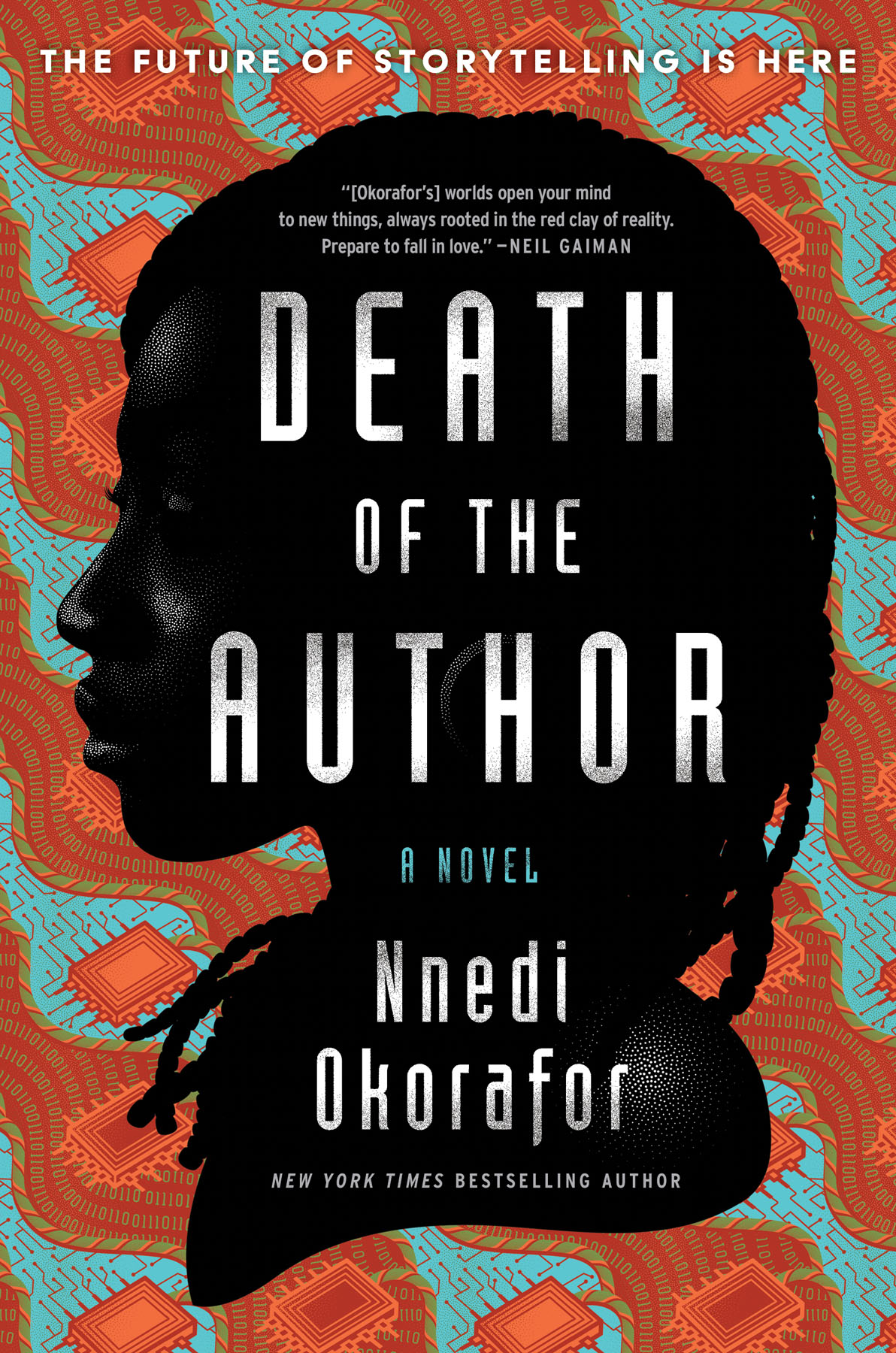
Death of the Author
About this book
Zelu loses her university job and begins writing Rusted Robots in a hotel room at the low point of her career. The science-fiction novel becomes an extraordinary success, changing her finances, reputation, and place inside a large Nigerian American family.
Fame brings adaptation deals, interviews, and arguments about what Zelu's work means. It also gives her access to mobility technology that changes what her body can do, without simplifying how relatives and strangers perceive her.
Chapters move between Zelu's life, interviews with people around her, and the robot future she created. The forms question whether an author controls a narrative once readers, family, machines, and commercial systems begin speaking through it.
Death of the Author is a standalone literary science-fiction novel. Nnedi Okorafor joins a family chronicle to a story within the story, allowing each to revise the reader's understanding of the other.
Read a sample
5,082 words
Plain text
From the opening
1 Interview Chinyere
What’s the story you want?
Honestly, I don’t see it. Even after everything, Zelu will always just be Zelu to me. What you think she is—it’s all made up. Life is short. Fortune is fleeting. Fame is just swirling dust. It’s people dreaming and perceiving while they say your name like it’s some tangible object, but it’s not. A name is just a name. A sound.
What matters is family. Without family, you’re nothing. You’re debris tumbling through space. Unseen, unconnected, uncollected, unknown, no matter how famous you are.
Zelu will always be part of our family. She will always be my sister. No matter what. Oh, it’s been rough. The fact is that Zelu never really cared about family. Zelu had to do her own thing. Then she’d expect everyone else to deal with her mess. We will always love Zelu. We hang in there for her. She never made it easy, though.
My name is Chinyere. I’m the oldest. That’s a year older than Zelu, though growing up, most assumed she was a lot younger. I’m a cardiovascular surgeon. The chief of surgery at Advent Hospital. I’ve lived in Chicago all my life and I love it here. I’m married to a wonderful man named Arinze. He’s Igbo, like me, though both of his parents are Igbo, whereas only one of mine is. What’s interesting is that he was born in Chad. Long story. We have two sons.
Our family is sizable, by American standards. So being asked only about my sister will always feel strange. But she’s the one everyone is talking about, I guess. She’s the one everyone is always talking about now. Whose fault is that? You all should be ashamed of yourselves. The irony no one seems to understand is that Zelu has always been the most unstable of us all. And I’m not talking about her disability. She’s not the first person to have a disability. And I acknowledge that society has its biases, but we each move through the world in our own way. We all have a path.
Let me tell you a story . . .
Some years ago, before all this happened, I was a new mom. My first son was only three months old. I wasn’t very happy, I admit. I’m a surgeon, and suddenly I had all these months where I was staying home. My son wasn’t sleeping; I wasn’t sleeping. My husband was always escaping to work. I wasn’t upset with him, though; I’d have done the same if I’d had the chance. Being a woman is tough. Especially one who is a mother. We’re not all cut out for domesticity, even when we love our children.
It was about 10 p.m. and I was at home with baby Emeka. It was raining outside. Absolutely pouring. And lightning and thundering. Emeka was crying and crying because he was gassy. I was walking up and down the hallway, rocking him and patting his little back. I was so exhausted. My phone buzzed. It was Zelu, and she sounded like a slowed record. Slurring her words, barely making sense.
“Zelu? Is that you?” I asked.
“Ssssoooo annoying. ’Course s’me. Caller eye-deeeee.”
“Oh my God, come on.”
“Ever look at your hand an’ think you have six fingers instead of five?” she whispered.
“What?”
“Needa ride, Chinyere. Don’t trust Uber.”
The rest of what she said was mainly giggling, snickering, and what sounded like blowing raspberries. It was late. I was alone with an unhappy infant. And now I had to go out and get my sister. We all shared our locations with each other, so I could find her. I dressed, bundled up the baby, and went to get her.
My BMW is a two-door (two years prior, we hadn’t thought we’d have any kids—funny how life decides certain things for you), so it took me a few minutes to strap Emeka in the back seat. By this time, he was absolutely shrieking. But I stayed focused and got it done. No use in my freaking out, too. Zelu’s location took me from Hyde Park all the way past the end of Lake Shore Drive on the North Side. I found her in an all-night diner. She was sitting in a booth, looking out the window right at me as I pulled up. Even from where I was, I could see that her eyes were glassy and red.
Emeka was fast asleep. Finally. The drive had worked like magic on him, and this would be a trick I’d use to calm him for the next year. I had Zelu to thank for that, Zelu and her wahala. I was right in front of the diner, so I opted to leave him in my car, with the heat on, of course. It was below zero degrees Fahrenheit outside. When I entered the diner, a waitress came right up to me. A short white woman with spiky pink hair. “Please say you’re here to take that girl home.”
“I am.”
“Oh, thank God.”
I stepped toward Zelu and she looked up at me and grinned. She was wearing an Ankara pantsuit; West African wax-print cloth was her go-to when it came to fashion. She said she liked the colors and that Ankara cloth always looked like it was “trying to go somewhere,” whatever that meant. And she had on red heels. It didn’t matter to her that she couldn’t walk—Zelu’s shoes had to be fire. Her outfit was pretty nice. That’s one thing you can always count on my sister for: when she wants to, which is usually, she can dress to the nines.
Continue reading the sampleClose the sample
“My sistah,” she said in our mother’s accent. “Bawo ni.”
I rolled my eyes.
She reached into her breast pocket and brought out a large overstuffed blunt and a lighter. I heard the waitress, who was standing behind me, gasp as Zelu started trying to light it.
“Zelu, stop it.” I snatched the blunt and lighter from her hands and grasped the handlebars of her wheelchair. She wasn’t drunk, but she was very, very high. Like, you could get high just by sniffing her. I enjoy my occasional glass of wine, even brandy, but I have control. Zelu? None.
This is my sister. This woman you all know and love. Our ancestors were probably so ashamed this night. I somehow got her in the passenger seat, then I put her chair in the trunk. She was snickering the entire time, like my touch was the most ticklish thing on earth. And I was sweating, despite it being freezing. I thought about the recent rain and wondered about black ice. I shoved the thought away. I had to focus. Emeka didn’t wake up, which was a blessing.
I still had her door open when a guy came out of a Mercedes SUV parked beside me.
“Zelu! Come on! Where you going?” He was a gorgeous black man in his twenties wearing a very expensive-looking tan suit, but it was all wrinkled up. He didn’t look like the kind of guy who normally did wrinkled suits.
“You for real?” Zelu shouted. “Go away!”
“Who is this?” I asked her.
“Some guy.”
“Baby,” the guy said, “I’ve been waiting for you in the freezing cold!”
“’Cuz they kicked you out! Take a hint! Don’t want you.”
“Just give me another chance.”
He was feet away now, and I turned to face him.
“Are you her girlfriend?” he asked me.
“I’m her sister.”
“Oh, thank goodness. Just tell her I want to talk to her.”
He didn’t seem drunk or high or anything, and that worried me. This was clearheaded distress.
“She can hear you,” I said.
“Go away! We’re done. ’S called . . . a One. Night. Stand,” Zelu slurred.
“I don’t do those,” he snapped.
“Apparently you do,” I said. “Hey, I’ve got a sleeping infant in the car. Can you just . . . quiet down and, even better, go away? I’m sure you have my sister’s number—”
“I don’t! She gave me a fake one. I had to follow her here!” he snapped. He stepped closer. “Look, just get out of my way so I can talk some sense into your sister.”
I didn’t move. I had no space to shut the door. He was getting angrier; I could tell. I’d dated a guy when I was in college who . . . well, let’s just say, this guy’s behavior was familiar to me. I wasn’t sticking around to let him reach what he was working up to. He was nearly in my face. My baby was in the car. That was it for me. I reached into my pocket, grabbed my tiny canister of pepper spray, unlocked it as I brought it out, and aimed it right in his face. I pressed the button and sprayed the hell out of him. Me! I had carried it in my pocket at night, and sometimes during the day, for years. I didn’t even know if the shit worked. Still, it had always made me feel a tiny bit safer. But I’d never really imagined I’d use it. That I could bring myself to use it.
While he screeched and clawed at his face, Zelu snickered, and the concerned waitress inside was probably already calling the police. I shut the door, ran to the driver’s side, got in, and drove off. For several minutes, Zelu and I were silent . . . except for our coughing. When you pepper spray someone, you have to deal with what you’ve done, on a smaller scale. In the back seat, Emeka hadn’t woken up even for all that. None of the fumes reached him, thankfully.
“What did you do to him?” I asked my sister.
She only shrugged. The incident seemed to have sobered her up. “Fucked him. Was a student from one of my classes a few semesters ago. Lawyer trying to be a writer. I just got tired of him by the next morning.”
“And you told him so.”
“Yeah,” she said. “It’s funny. Guys like that are so entitled. But even more so when you can’t walk. They think you should be soooo grateful.” She giggled again, even harder.
That’s Zelu. She’ll do something, then right after, just let go of it. Zelu puts it all behind her right away. So wrapped up in herself that she doesn’t know when she’s kicked people out of their sense of normalcy. She’ll just leave you there, reeling and wondering why.
Maybe that’s what you all love so much about her.
2 The Wedding
Zelu was thinking about water.
Trinidad and Tobago had the sweetest beaches she’d ever seen. They went on for miles and miles with not a human in sight, and the waters were so warm. The day after she’d arrived, she’d gone with her soon-to-be brother-in-law and three of his local Trini friends. All of them could swim like fish . . . but none as well as she, of course. Once she put the elastic bands around her legs and ankles, she moved with power and confidence using her powerful arms, her back, shoulders, and abdominal muscles. She’d been swimming since she was five. “Oh, it’s just something I . . . fell into,” she’d tell people. She rarely explained how literal this was; she’d intentionally fallen into the water one day. Her family thought it was an accident, but it was the only way she could prove to anyone, including herself, that she could swim. When the wedding ceremony was over, she planned to go right back to those human-free beaches and swim some more. Preferably alone, this time. For now, she endured all the primping, preening, and perfuming of the bridal suite.
“I look hot!” Zelu’s younger sister Amarachi proclaimed. She did a twirl and a pose in front of the mirror. Amarachi’s wedding dress was like something from another planet, and Zelu loved it. She’d been there to help her sister choose it, of course. “Zelu, you are a genius.”
Zelu flipped some of her braids back and smirked. “I know.” Their sisters—Chinyere, the oldest of them all; Bola, the youngest; and Uzo, the second youngest—laughed as they perfected their makeup in front of the large mirror. Zelu’s own dress was buttercup yellow, and it billowed over her wheelchair, making her look somewhat like the flower. She hated it, but this wasn’t her day. Whatever her sister wanted, she would do. Still, she snuck two thin bracelets made of green Ankara cloth onto her left wrist to maintain her identity. Bola’s dress was a soft carnation pink and Uzo’s was a lilac purple. Zelu had to admit, the combination of the colors with her sister’s gorgeous Technicolor sci-fi-looking wedding dress was stunning.
“Zelu, want me to help you with your makeup?” Bola asked.
“Nope,” Zelu said. “Don’t need any.”
“You’ll be sorry when you see the photos,” Uzo said, patting her already perfect midsized ’fro. She’d placed a lavender butterfly pin in it. “They’ll be all over our social media.”
“Meh, I’m not the one getting married. Today isn’t about me. And social media can deal with me looking like myself.”
“Zelu radiates an inner beauty that makeup cannot enhance, don’t you know?” Chinyere said.
They all laughed. Of course, Chinyere’s makeup was flawless and already done. Her sky-blue dress was nearly as magnificent as Amarachi’s, but it was more how she wore it. It was Amarachi’s day, but Chinyere was and always would be queen.
“Well, I think that’s a weak excuse for looking plain, Zelu,” Amarachi said.
“You’ll be all right,” she said, grinning. “Marriage isn’t my thing, so I don’t have to suffer it. But I can have fun watching you.” This was her naked truth. Marriage had never been in her cards. She enjoyed her freedom and autonomy too much, and she loathed the idea of someone calling her his “wife.” It just seemed ridiculous. Not that she hadn’t had the option; so far, she’d had two wonderful men propose to her: one who was named Zelu, just like her, and one named Obi, who had been her creative twin; they’d passionately dated for three years . . . until he got the idea of marriage into his head and ruined everything.
“Ugh,” Chinyere said. “Spare us your lecture, Zelu. Today’s a day of marriage. Deal with it.”
Their mother, Omoshalewa, came in with a large box. Inside it was a thick orange coral bead necklace and matching earrings.
“Oh boy,” Zelu said. “Here we go.”
The necklace was worth a small fortune. The others gathered around as their mother put the necklace around Amarachi’s neck. “NOW you look like the true princess you are,” Omoshalewa said. It totally threw off Amarachi’s sci-fi dress. Zelu rolled her eyes, annoyed.
“This type of coral is the finest,” their mother said. “Only the most powerful people in the palace can wear it.”
Zelu flared her nostrils, fighting to keep her mouth shut. It was a horrible fact: their mother was indeed a princess from a long, strong line of proud (and useless, according to her father) Yoruba royalty. This made Zelu and her sisters also princesses and their brother, Tolu, a prince, something Zelu preferred to never tell anyone, despite her mother insisting they go by “princess” and “prince” whenever they visited Omoshalewa’s hometown or spent time with their maternal relatives. Being a Nigerian American in Nigeria, and imposing the privilege of royalty on top of that, disgusted Zelu.
Today, her mother was going to be really crazy with it. Which meant there was going to be drama, because their father was from a very proud Igbo family that spat on any idea of entitled predestination and opted for embracing education and capitalism and the Lord Jesus Christ. In her father’s family, everyone did their own thing, but it was all for the family. Thus, every single one of her father’s siblings had earned a PhD or the equivalent and was wealthy. If they heard any of this talk of princesses and princes and kings and queens, they’d make sure to loudly point out that it was total bullshit.
“It’s super heavy.” Amarachi laughed, adjusting the humongous necklace hanging around her neck.
“A princess can carry it,” their mother said. “Remember how Chinyere wore it.”
“I certainly do,” Chinyere said.
“Like a pink-orange tire,” Amarachi muttered.
“We are royalty,” their mother proclaimed.
Zelu frowned and looked away. Her eyes fell on her phone. She’d silenced it and put it on the table beside her. For once, she’d completely forgotten about it. Until now. And it was vibrating. She picked it up and wheeled herself toward the window on the far side of the room. It was her boss, Brittany Burke, head of the university’s English Department.
“Hello?” she answered with a frown.
“Hi, Zelu. I know you’re in Trinidad.”
“Tobago.”
“Oh. Yeah. I get them mixed up.”
“The country is Trinidad and Tobago, but I’m on the island of Tobago,” she said. She sighed, pushing back her irritation. What did Brittany want?
“Hell, I’m surprised I can even reach you.”
“A good international package is part of my phone contract.”
“Heh, smart.” Silence.
“Um . . . everything all right?”
As Brittany spoke, Zelu gazed out the window, over the hills covered with lush trees and bushes. In the opposite direction, just behind the hotel, was the ocean. Zelu giggled, because it was all she could do to not smash her phone on the windowsill and potentially mess up her sister’s big day. There was a ringing in her ears, but it wasn’t loud enough to drown out this woman’s fucking voice spewing bile all the way from the United fucking States.
It was surreal, but not surprising. Adjuncting was a shit job that treated you like shit. Her creative writing students always deeply annoyed her, but this semester had been especially brutal. She’d come to every class with a false smile plastered on her face and fantasies of smacking each of them upside the head with a copy of Infinite Jest—the hardcover, of course. This semester, she had a class full of creative writing PhD students who’d all convinced themselves and one another that the best type of storytelling was plotless, self-indulgent, and full of whiny characters who lived mostly in their minds.
Four days ago, she’d come to class full of rage because the student whose “story” they were workshopping that day had written twenty-five pages in which none of the sentences related to one another. There was no system or logic to the sentences. Nothing. Just gibberish. Like a robot attempting to be creative and getting the very concept of what that means all wrong. And she’d had to read it closely enough to give this student proper feedback. On top of this, the student was an entitled white boy who had been questioning her authority since the beginning of the semester, far more than anyone else. Oh, she detested him already, but this story was the straw that broke the camel’s back.
After her students had each gone around the room and said what they thought (“This is really ambitious,” “I felt stretched by this piece,” “It’s brilliant! I wish I’d written it!,” etc.), Zelu had tried her best to give him useful feedback. But when she finally just asked him what he believed the story meant, he’d said, “Why don’t you tell me? What I think of my own work doesn’t matter. The reader decides what it’s about, right? Isn’t that what you said ‘death of the author’ meant?” Then he’d smiled a very annoying and smug smile.
This motherfucker, Zelu thought. She’d paused, trying to collect herself, to stop herself. But she couldn’t. Not at that point. And so she’d told him what she thought his story meant. Since he’d asked. “This is twenty-five pages of self-indulgent drivel. You’ve just wasted your reader’s time. Throw this away, and when you’re ready to stop fucking around and actually tell a story, start over and have some confidence in the power of storytelling. You’ve only had the privilege of torturing your readers with this because this is a class and we all have to read what you’ve given us.”
Silence.
Students exchanging glances. Wide eyes. Pursed yet buttoned lips. Fidgeting. More silence.
Then this student, who had looked at her with such ire and arrogance all semester, who had even refused to participate in one of her writing exercises because he thought it “below” him, had burst into sloppy tears. Now, days later, while she was out of the country, the entire class had shown up at the department head’s office to complain about this “traumatic” incident and how “insensitive,” “toxic,” “verbally violent,” “unprofessional,” “problematic,” and “rude” Zelu was as a person.
All this Brittany told her now on the phone. She also mentioned that these students had complained about how twice this semester Zelu had ended class early so she could work on her own novel. Zelu had been a dumbass and thought that telling them the reason would get her empathy. They were all aspiring authors, right? They’d understand.
Then Brittany told her she was fired, effective immediately.
“Does my being faculty for five years count for anything?”
“Faculty, but adjunct. And do I need to bring out your files? We’ve held on to you despite so many complaints—”
“Because I’m a good writer who is good at teaching; you all benefit!” she snapped. “And that’s also made clear in my files.”
“Be that as it may, Zelu, the department has decided—”
“Ah, fuck you.” She hung up. “Asshole. And when did students become such entitled snitches, anyway?!”
“Everything all right?” Chinyere asked from the other side of the room.
Zelu looked over her shoulder. “I’m cool. Just university stuff.” She wheeled to the door. “I’m gonna go to the . . . I’ll be right back. Need some air.”
The hallway smelled sweet with incense. The wallpaper was a bright pattern of fuchsia flowers and vibrant olive leaves, and the lush, dark green carpet was a bitch to wheel across. Regardless, getting away from the others made her feel a little better. She squinted, wiped away her tears, and flared her nostrils. Holding up a fist as if to threaten someone, she took in a deep incense-scented breath.
“Okay,” she whispered, clenching and unclenching her fists. “Fucking fuckery.” She wheeled down the hall.
This was her first time in Trinidad and Tobago, but it was definitely not going to be her last. And this beach hotel, with its old, bright orange colonial-style exterior would stay on her list. It was small and cheap enough that Amarachi and her fiancé could afford to rent it out completely for three days. Zelu was about to exit the front doors when she heard raised voices coming from a room to her right. She smiled. Raised voices among Nigerians were usually not a bad thing. Her suspicions were verified when she heard laughter woven through the shouting.
She peeked inside the ajar door. Inside was a conference room, and it seemed that just about all the men attending the wedding were in here, from the teenaged to the elderly, Nigerian to South African, Igbos and Yorubas to Zulus. They were all crowded around her sister’s fiancé, Jackie, who was standing next to his father, her father, and several of the elders. They stood before a table. The oldest-looking elder was a tall, thin man with dark skin wearing a richly embroidered white kaftan and pants. He held a handful of straws. Jackie’s father took two of the straws and put them on the table, and everyone in the room exclaimed.
“Ah! Now the pot is adequate,” Zelu’s father shouted, “but not full!”
The men laughed.
Jackie’s father huddled with the elders, and they whispered and waved their hands and stamped their feet. When they turned back to her father, one of the elders handed Jackie’s father several more straws. The sound of everyone exclaiming “Ooh” rippled through the room. Her father clapped his hands, pleased as punch. Zelu chuckled wryly. Whether it was bags of palm wine, yams, cattle, or symbolic straws, the deciding of the bride price and the joy men took in doing the deciding was yet more bullshit.
“African men,” Zelu muttered, rolling her eyes. She wheeled outside and was thankful when she hit the concrete of the front area. Smooth. And she was glad she wasn’t wearing any makeup because it was hot and humid out here. She went to the side of the building, where the ceremony area was set up. The center-aisle chairs were connected with woven flowers and Ankara cloth, leading toward the platform where Amarachi and Jackie would take their vows. Some of the guests were already seated and waiting.
Behind the ceremony area, the ocean stretched dark and blue into the horizon. She paused, listening to the rhythmic crash of waves in the distance. “Magnificent friend,” she whispered. “One of the world’s greatest storytellers.” She wheeled backward, mashing the foot of a man she didn’t realize was right behind her.
“Aye!” he hissed.
She didn’t have to turn around to know who he was. Uncle Vincent always wore that distinctive woody-spicy smell that she kind of loved, Tom Ford Tobacco Oud. “Oh, sorry, Uncle Vincent!”
“Don’t worry, don’t worry,” he said, waving her off. He pointed to where the chairs were set up. “That’s where it’s going to be?”
“Yeah.”
He began to step around her. He paused. “How are you doing?” he asked, a small smile on his face. His gray beard was always perfectly trimmed.
Zelu bit her lip. His question brought back the department head’s bullshit. “Oh, I’m fine, heh.”
“You still teaching writing at that university?”
“I’m getting by,” she said, clenching a fist.
“Good, good. Will we see you wheeling down the aisle one of these days?”
She laughed. “Nah. I don’t believe in marriage. Not for myself.”
“You just need to find the right man,” he said.
No, I simply don’t believe in marriage, she thought. She smiled and shrugged.
“You like to swim,” he said. “Have you been in the ocean?”
She perked up. Her favorite subject. “Oh, yes! This place is magical. The water just carries you! And it’s so warm!”
“Indeed, like something alive,” he said. “I went swimming this morning. Chey! Your father and I used to swim the rivers in the village, the streams, too, even the ocean near Port Harcourt. None were calm like it is here. Well, I’m glad I’m not the only one enjoying.” He tugged at his short beard as he looked at her. “You don’t have to be so tough, Zelu,” he said. “And smile more. A man likes some softness. You’re a beautiful girl.”
She forced her lips into a smile. “Gonna get back to my sister.”
“Yes! She needs you in her finest hour.” He turned and went to the ceremony area.
Her finest hour? The way people talk, like it’s all downhill after the wedding, she thought.
By the time she returned to the bridal suite, all her sisters’ heavy makeup was complete and the room reeked of expensive perfume, powder, and anxiety.
“Zelu!” Amarachi said. Her face now sparkled and shimmered in its flawlessness. “Get over here. Let’s at least put some eyeliner on you. Please.”
Zelu submitted to their torture for the next ten minutes. It was unpleasant, but it could have been worse. She took comfort in the knowledge that when the wedding was over, she would scrub it all off her face. There was a knock on the door and their father peeked into the room. “Ready?”
Amarachi looked at the four of them. “Are we ready?”
“Always,” Chinyere said.
“Yep!” Bola said.
“You’re beautiful,” Uzo said, laughing.
“I am!” Amarachi agreed.
Zelu’s phone buzzed in her hand as everyone moved toward the door. She turned back to the window, squeezing her eyes shut as thoughts of the phone call from the department head seeped in again. Her eyes began to water. “Shit,” she whispered.
“Want some help?” her father asked.
Normally she’d say no—she hated receiving help—but she could barely breathe. “Yeah,” she managed. Her father was too preoccupied to ask about her unusual acceptance, and she was glad. He pushed her swiftly with his strong arms and his long legs. They caught up with the others quickly. As they moved, Zelu took the moment to glance at her phone. A notification alerted her of a new email from her literary agent. She swiped it open. Her novel had gotten its tenth rejection. This one from some small publisher who couldn’t be bothered to speak directly to her agent or even write a personal rejection letter. A form letter? To her agent? Seriously?
A wave of nausea churned in her belly, and she leaned to the side to catch her breath, glad that all attention was on her sister.
There was so much going on that for a while, Zelu did forget about her personal problems. Amarachi and Jackie liked to do things big. Jackie was a South African–born physician who was proudly Zulu and atheist and had deep African National Congress roots. Amarachi was a Christian neurology resident physician who was the child of Nigerian immigrants with deep Yoruba royal and Biafran roots. Amarachi and Jackie loved each other, and each other’s families, but there was strong, proud, dominating culture on both sides. Having everyone together like this, full force, was going to be a battle over who could be the showiest. Yet Amarachi and Jackie wanted to do only one wedding, have it all be just one thing, no matter how multiheaded that thing was. Thus, a priest, a judge, and two elders all presided over the ceremony to bond the two forever.
Zelu had never seen anything like it, and she loved it. As they moved from the ceremony outside to the lavishly decorated banquet hall, she looked over the attendees who’d come to Trinidad and Tobago from all over the world, mainly from Africa, to celebrate the union. The space was grand and opulent with sparkling chandeliers, peach-colored wall sconces with red LED lights, and rows of round tables with crisp tablecloths and enormous bouquets of roses in the centers. But there were also African masks hanging on the walls overlooking everything; Zulu baskets sat in corners, and colorful Zulu textiles were draped on the tables.