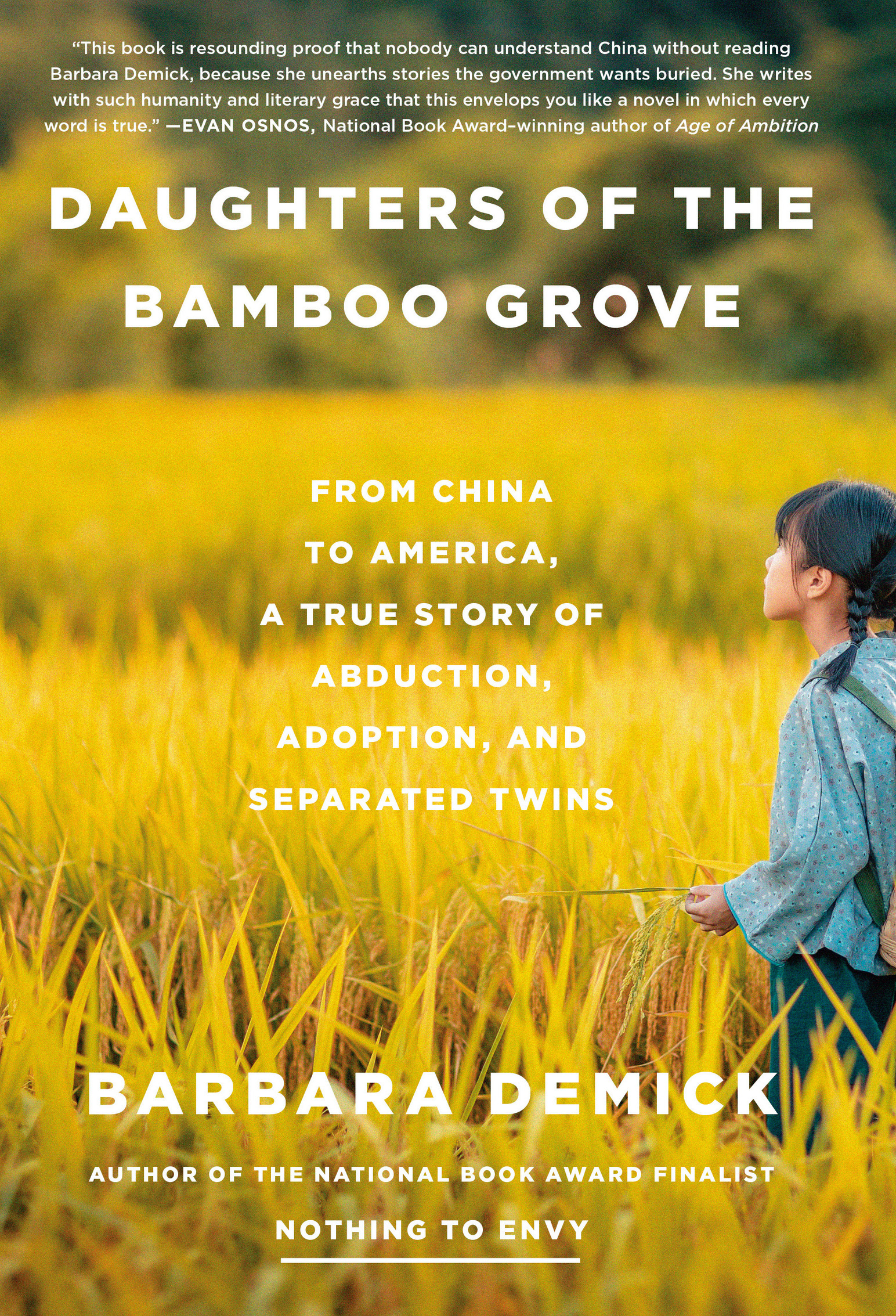
Daughters of the Bamboo Grove: From China to America, a True Story of Abduction, Adoption, and Separated Twins
About this book
In 2000, Zanhua gives birth to twin girls in rural Hunan after already having children. Under the pressure of China's population-control system, one daughter remains with the family while the other is taken, enters an orphanage, and is adopted in the United States.
Fangfang and Shuangjie grow up on different continents without knowing the full circumstances of their separation. Demick traces the Chinese relatives, the American adoptive family, and the chain of local officials and intermediaries through which children moved into international adoption.
The reporting places one family's story inside policies that produced fines, concealment, abandonment, coercion, and a market for supposedly orphaned children. It distinguishes what records claim from what witnesses remember and what years of investigation can establish.
Daughters of the Bamboo Grove is narrative nonfiction about separated twins, adoption, and the human consequences of state policy. Its focus remains on the people who lived the story rather than treating the sisters as an abstract example.
Read a sample
5,027 words
Plain text
From the opening
Prologue
New York
On a cold January afternoon in 2017, I was prone on the couch in my apartment and home office in New York, fighting off the urge to take a nap, when a message popped up on Facebook from a name I didn’t recognize.
Ms. Demick. You contacted me a long time ago? Are you still interested in talking with me? If so, my family and I are interested.
I wasn’t in a receptive mood. I was a journalist covering New York for the Los Angeles Times. And like many of us, I’d been working without a day off for months, covering the aftermath of Donald Trump’s election and inauguration. I was slumped on the sofa, dejected by the animus emanating from my television set. I tapped out a curt reply, telling this man, in essence, that I didn’t know who he was or what he wanted from me. He wrote back immediately.
My mom adopted a little Chinese girl years ago…and it appears like she has a twin sister still in China.
I bolted upright. Before New York, I’d spent seven years as a China correspondent for the Los Angeles Times. I was based in Beijing but often worked in the countryside, writing about life in the left-behind backwaters of modern China. Reporting on this little girl was one of my most memorable experiences. This was a story that took me to places few foreigners had seen, geographically and psychically. Not only into remote mountain villages but also deep into the intimate realm of Chinese families. Of course, I hadn’t forgotten.
This is the story as it unfolded for me. It is dedicated to the 160,000 Chinese adoptees around the world, with the hope it might in some small way help them understand where they came from and how they got to where they are today.
Part One
Gaofeng Village
Chapter One
Born in the Bamboo
Yuan Zanhua.
September 9, 2000. From above, the landscape was a patchwork of florid greens and yellows climbing up and down a dizzying staircase. Chinese farmers hacked these terraced fields out of the mountains more than two thousand years ago with the ingenuity and persistence to shape the earth to their will. A single rutted road wound around the terraces, now flooded for growing rice, vanishing into the low-hanging mist before emerging at the entrance of a small village.
In a house at the edge of the rice paddies, a twenty-eight-year-old woman was trimming vegetables for lunch when she was interrupted by a familiar sensation. It was like a belt cinching around her middle. Zanhua wasn’t alarmed. Although she wasn’t sure exactly how far along she was, the ballooning size of her belly told her the baby was coming any day now. She was eager to give birth sooner rather than later, because the hundred-degree temperatures of an unusually hot summer left her overripe body drenched in sweat. Even as another contraction gripped her body, she smiled through the grimace. It was about noon, time for lunch, but she had other priorities. She carefully set down her kitchen utensils and covered the bowl of rice with a plate to protect it from the circling flies. The first flush of autumn had yet to settle upon the rice paddies of Hunan. She wiped her brow and washed her hands, even tidied up a bit. Then she called out to her mother in the next room that they should get ready.
Zanhua moved quickly but deliberately. She wasn’t agitated. This would be her third time around. She was hardly bigger than a child herself, standing well under five feet, narrow in the hips, at least when she wasn’t pregnant, but she was confident in her physical prowess. Since early childhood, she’d helped out in the family fields, which left her arms and back taut with muscle. She had a broad, flat nose and a ruddy complexion from working outside, although this summer she was paler than usual, since she’d mostly stayed indoors, not wanting to advertise her condition. She’d taken care to buy extra-large clothing to conceal her swollen body. She was anxious, not about childbirth itself—she wasn’t the type to complain about pain—but about the need for secrecy.
Since 1979, China had limited most families to only one child. Under the law, you were supposed to apply for a permit even before you got pregnant. It was the signature policy of the ruling Communist Party, which had developed an almost mystical belief that population control was the secret to jump-starting the economy. The law was enforced by an agency euphemistically known as the jisheng ban, literally “planned birth” or “family-planning agency.” It didn’t actually plan or advise so much as punish. Violators could be fined more than a year’s wages, their homes demolished and property confiscated. If you were visibly pregnant without a permit, you could be hog-tied and hauled away for a forced abortion. Then they’d send you a bill for the favor. No matter that the village where Zanhua grew up in Hunan Province was deep in the mountains, almost an hour’s drive from the nearest government offices or a two-hour walk when mountain roads were washed out; the law was never far away. The village was full of spies and Communist Party loyalists who might rat you out.
The Communist Party ruled here with impunity. Hunan Province is in more ways than one the heartland of modern China. With a population as large as that of France, Hunan is a landlocked province smack in the middle of the country, just below the Yangtze River. The founder of modern China, Mao Zedong, was a Hunan man, born about one hundred miles away from Zanhua’s village, in Shaoshan—roughly the same neighborhood, although not nearly as mountainous nor as poor. Mao was the son of what the Chinese called a “prosperous peasant.” He was educated in the Hunan provincial capital of Changsha, where he read the classics and organized one of the first branches of the Socialist Youth League. In 1927, he led a few hundred peasants to become guerrilla fighters in the Jinggang Mountains, which, bordering Hunan and Jiangxi provinces, would become known as the cradle of the revolution.
Continue reading the sampleClose the sample
Mao was inspired by the plight of Hunan’s peasantry and the need for land reform. Hunan is the largest rice-producing province in China, its semitropical climate just warm enough, the rainfall generous, and the soil red and fertile. It should have been a place of abundance. But rice farming was a precarious existence. Rice farmers survived at the mercy of floods, droughts, and unscrupulous landowners, who often demanded most of the crop in rent. When he founded the People’s Republic of China in 1949, Mao vowed to redistribute the land and liberate the underclasses from the tyranny of the ruling class.
Instead, it got worse. Farmers were forced into inefficient communes that were required to sell most of their grain at below-market prices for export abroad. Farm equipment and kitchen utensils were melted down in backyard furnaces to create steel. This was all part of an ill-conceived vision to turn China into an industrial powerhouse that would rival the United States and the Soviet Union. But the furnaces produced pig iron of such poor quality that it was of little use. Meanwhile, fueling the furnaces led to widespread deforestation. The diversion of the workforce away from agriculture resulted in a famine. An estimated forty-five million people died during what was known as the Great Leap Forward. It was followed by another man-made disaster—the decade-long Cultural Revolution, in which the intelligentsia or anybody perceived as elite were eradicated in the name of class justice. Neighbors were goaded into persecuting one another. The madness endured until Mao died in 1976. His successors wasted little time in rolling back the worst of his excesses.
At the time of Zanhua’s birth in 1973, China already was on the cusp of reinventing itself. Although Mao’s portrait remained on everybody’s walls, the country had started to wriggle free of the strictures of doctrinaire communism. In Zanhua’s village, farmers took it upon themselves to dismantle the communes even before the land was legally distributed to households. Although they didn’t own the land outright, they earned the right to farm their plots individually. Productivity soared. Zanhua was told she should be grateful for the food of the land—the rice, sweet potatoes, and cabbages grown on her family’s fields. Unlike her parents, she didn’t have to survive on wild grass, roots, and bark. Her father had a job at a state-owned factory that made dishware. It was an hour’s walk away and paid a tiny salary, but there were perks, like an occasional bundle of pork or a chicken. She wasn’t starving, but she was still hungry.
The village, then called Shanghuang, literally “on the yellow,” was poor even by the standards of one of the poorest countries in the world. It was so wild that until the 1960s tigers were still seen in the nearby mountains. The steep terrain dictated that the terraced fields be small and irregularly shaped, with little of the postcard-perfect symmetry that attracted photographers to the undulating green terraces elsewhere in China. The houses were built mostly of wood, weathered and flimsy, brick still outside the reach of many villagers. The roads were poor to nonexistent.
Zanhua occupied an unfortunate position in her family’s birth order. As the fourth of six children and the third daughter, she wore her older siblings’ hand-me-down clothing, so threadbare it was beyond patching. When her parents went to the township for the market, held every five days, she begged her mother to buy her clothing of her own.
“Only if you work harder” was the retort.
That was impossible because she already worked all the time. As a small child, her work began at dawn, when she tended to the oxen. She weeded the fields and washed laundry, an ordeal without running water or soap. It required multiple trips to the well, since she was too small to carry more than one bucket of water at a time. She cared for her younger siblings, hand-washing diapers made of old clothing. From the time she was seven, she prepared her own meals, since her parents and older siblings were busy with their own work.
Her village had an elementary school housed in four ramshackle wooden buildings, one for each grade. An empty lot served as the playground. The school offered basic instruction in math, Chinese, physical education, and, most important, music. The kids couldn’t read well, but they were indoctrinated through song.
Without the Communist Party, there will be no new China.
The Communist Party toiled for the nation.
The Communist Party of one mind saved China.
It pointed to the road of liberation for the people.
It led China toward the light.
Zanhua attended the school but rarely finished her chores quickly enough to get there by the start of the school day. She also had in tow one of her baby brothers. There was nobody else to take care of him. The teachers were sympathetic. Most people in the village were relatives, so they understood her predicament. Nonetheless, the toddler fussed so much that the school eventually asked Zanhua to leave. As a result, she dropped out after three years and barely learned to read.
Later in life, when asked what were her happiest memories from childhood, she said that she had none.
It was Deng Xiaoping, a two-time survivor of Mao’s repeated purges, who would give Zanhua a chance to escape. In 1978, Deng became China’s paramount leader and launched what he called reform and opening—prying open the economy and repairing relations with the West. In 1979, Deng visited the United States, once the sworn enemy. Americans were charmed to see the pint-size leader don a ten-gallon cowboy hat. Although the Chinese Communist Party continued to rule and does so to this day, long outlasting the Soviet Union and the rest of the Communist Bloc, after Deng’s rise, it was not the same party. Deng embraced what he called “socialism with Chinese characteristics.” (Wags called it “capitalism with Chinese characteristics.”) Now the party was all about making money. To rebuild legitimacy in the eyes of the people, the Chinese needed to get rich. And it would be acceptable to “let some people get rich first.” (Contrary to popular belief, Deng did not say it was glorious to get rich.)
Zanhua’s family would not be among those getting rich, but they did get a little less poor. In 1985, Deng lifted controls on domestic travel. Until then, it had been a crime to live or work outside the place you were registered, leaving villagers tethered to their impoverished villages. Zanhua was turning thirteen, just old enough that she could be sent out with her older brother, a sister, and a brother-in-law. They had a simple trading business: They bought schoolbags and suitcases wholesale from a factory in Shaoyang, the nearest big city, and sold them retail on the streets. It was an opportune time to sell bags, as millions of Chinese like them were on the move, needing to transport their possessions as they left their villages. The siblings took their merchandise to sell in neighboring Jiangxi Province, which was closer to the east coast and slightly more prosperous.
Joining the lowest rung of peddlers, they didn’t have a stall at one of the markets. Instead, they fanned out during the day to well-trafficked locations and spread their wares on a tarpaulin on the street. Zanhua was usually working alone, which was intimidating for a shy, still very small teenager. But she was a quick study. Despite almost no formal education in math, she was good at bargaining with customers. After being fleeced once, she figured out how to spot counterfeit bills. Even after sending money home, she had enough left over to buy her own clothing. She bought trousers for her little brothers. She didn’t begrudge the better opportunities afforded the boys, and she helped support their education. She was proud to be one of the first girls from her little village to chuqu, literally to “go out.” It was a term that defined the lifestyle of millions of Chinese similarly escaping their village to work.
Chinese migrants are expected to come home for the Lunar New Year, a holiday so baked into the calendar that businesses close down for weeks. No matter where you live or your professional status, people return to what they call the laojia, the “old home.” So much of the country is on the move that it is the largest human migration in the world, albeit only for a few weeks.
The year Zanhua was turning twenty, she decided to buck tradition and work through the holiday. She figured she could sell off her remaining inventory, since people needed bags to transport the gifts they were buying and receiving, and those who’d received cash or bonuses would be relatively flush.
Her father, though, was insistent.
“Forget about the bags. Come home.”
When she arrived, she found out why. Modernity had nibbled away at only so much of tradition. Her parents had hired a matchmaker for her. Even though girls were allowed to go out to work, even encouraged because families wanted their earnings, they weren’t supposed to have a social life. It was frowned upon for them to meet somebody on their own, worse still somebody from another province. Since the custom was for daughters to live with their husband’s family after marriage, parents wanted them nearby. But not in the same village. People in villages were usually related to one another and aware of the genetic risks. They needed matchmakers to find the right person.
The young man selected for Zanhua was invited to her home for an introduction. At first, she was disappointed. Zeng Youdong came from a village called Gaofeng (literally “high phoenix”) at the top of a four-hundred-meter mountain of the same name. It had no shops, no little businesses, nothing but a few hundred households, often hidden in the low-hanging clouds. Her own village, Shanghuang, was barely a mile away, but it was down the hill, in the direction of the main town. Zanhua hoped to advance her situation in life by moving to a more urban area. In China, you always wanted to go down the hill, not uphill.
Youdong[*] was barely taller than she was. In China, height is a proxy for social status, and it was evident from his stature that he had been poorly nourished as a child. The Zengs were rice farmers, and they raised pigs, but they didn’t have the perks that Zanhua’s father enjoyed from the factory. Chinese use the expression “family doors of equal size,” matching young people of similar economic standing. The Zeng family didn’t quite live up to that standard.
Zanhua thought about saying no—this was the 1990s, after all, and a young woman had the right to reject her match. But the quiet young man felt right when he stood up next to her. He had a slim, limber physique, a narrow face, and a long sloped nose, a feature prized by many Chinese, who associate the look with the Manchurian rulers of the north. Side by side, they looked like a pair of gymnasts. Unlike her brothers, who could be loud and boastful, he was soft-spoken and gentle. He didn’t show his teeth when he smiled but pressed his lips together as though enjoying a private joke. He had been educated through junior high school and was comfortably literate, much better at reading and writing than most in his social class. He didn’t smoke cigarettes, which made him an outlier among Chinese men. He rarely drank. A few months after their introduction, she agreed to get married. They had a large engagement party, setting up ten tables in front of her house and serving bottles of baijiu, a cheap white liquor, to neighbors and family.
Zanhua and her fiancé were not so much a romance as a partnership, in life and in business. Youdong was as hardworking as Zanhua. He accompanied her to Jiangxi Province to sell bags. With a partner, business improved. They began to save money so that they could build their own house.
Engagements were more important in the village than weddings, so it was no scandal for them to live together. By the time they were formally married ten months later, Zanhua was already pregnant.
Their first child was born in 1995, a healthy baby girl. They named her Ping, a popular name meaning “even” or “calm.” They were happy to have a daughter. Under a loophole in the family-planning laws, rural families were entitled to have a second baby if their first was a girl. Zanhua and Youdong were born before the implementation of the one-child policy—her family had six children, his had seven—and having only one child felt unnatural. As much as Zanhua resented her lowly position in the birth order, wearing hand-me-downs and caring for little brothers, she took comfort in the size of her family. She was close to all her siblings and was relieved that her daughter wouldn’t be an only child.
Under the law, Zanhua and her husband were supposed to wait for five years before the second birth. But they were impatient. When Zanhua got pregnant again the following year, family members advised her to get an abortion. Abortions were a common and inexpensive method of birth control in China, but Zanhua resisted. Their second daughter was born in 1997. They named her Yan, which means “splendid.” She was an adorable baby and they were immediately smitten. But for the first time in their lives, they understood they had done something illegal.
The fines for having a second baby without the required waiting period amounted to the equivalent of several hundred dollars, which they didn’t have. All their cash had been poured into a house they were building. They would have to leave the village to raise the money for the fines, since there were no jobs nearby. They left their two small daughters in the care of grandparents and skipped town, figuring they’d earn enough to pay up.
When the young couple came home to the village, they had an unpleasant surprise. The officials from the family-planning agency were furious that they’d fled town. As punishment, they’d punched a hole in the tile roof of their still-under-construction house and walked off with a table and chairs, the only furniture in the place. Vandalizing houses, confiscating livestock, repossessing appliances and furniture, and administering beatings were usual tactics to coerce people to pay their fines. The law didn’t prescribe this kind of penalty, but it was common nonetheless. Zanhua and her husband were outraged.
“Monsters,” “Common thieves.”
They ranted. They swore. But there was little they could do to avoid paying entirely. They talked to the officials and negotiated the fine down to eight hundred yuan, about one hundred dollars, and paid up.
They had just enough to repair the damage and keep building. And to think about having another baby.
Youdong’s father urged them to try again. He wanted a boy. Despite all the changes sweeping China, women still occupied a tenuous place in the social hierarchy. They left their village when they married, moved to their husband’s home, and were expected to serve their in-laws. And yet they did not become full-fledged members of their husband’s family. They retained their father’s surname for life. Zanhua would never be known as a Zeng—she would always be Yuan, the name with which she was born, although her children would carry the family name Zeng. She could be buried next to her husband in the Zengs’ family cemetery only if she gave birth to a boy. And only a boy, grown into a man, would be able to conduct the ritual displays of filial piety at the cemetery, burning incense, bowing to the ancestors. Women might care for the elderly, cook, and clean, unpaid servants to their in-laws, but in the afterlife, it was men who were supposed to propitiate the ancestors.
Zanhua and her husband fancied themselves modern Chinese, free of what the Communist Party dismissed as feudal superstition. In this progressive new era, girls were supposed to be as valuable as boys.
But Youdong’s father persisted, making it clear that Zanhua was a disappointment as a daughter-in-law.
“You have to have a boy.”
“It doesn’t matter anymore. Males and females are equal,” Zanhua retorted. She echoed the Communist Party’s slogans about ending gender discrimination. The one-child policy was accompanied by a propaganda campaign touting the value of girls. Perhaps it was less about genuine concern for gender equality than about keeping down the birth rate.
“But when you get old. Who will take care of you in your old age?” he shot back.
“My daughters will take care of me.”
“But for the cemetery. You need to have a boy at least for the cemetery.”
Zanhua took this criticism to heart. She didn’t agree with her father-in-law, but she also understood that her status in the family, indeed in the village as a whole, suffered by her failure to produce a son. Families without sons were often bullied, believed to have no future beyond the current generation. It wasn’t uncommon for women to commit suicide if they didn’t bear a son. Zanhua had accomplished too little to be proud of in her life. She wanted to be a good wife and a good mother. Even if her husband didn’t seem to care, she felt she needed to produce a son for her own self-esteem.
Within two years of the birth of her second daughter, she was pregnant again.
This time, she felt confident. She had gone for an ultrasound in her fourth month. Although the hospital was not supposed to inform her of the gender, the technician winked at her in a way that made her think that the baby was a boy. And this pregnancy felt different from the others. She was more tired, her complexion sallow and splotchy. Her belly was so much bigger. It protruded like an overinflated basketball. Zanhua and her husband rejected the folk wisdom of the elders—to eat sour food for a male offspring. Unlike other villagers, they didn’t pray to Guanyin, the Buddhist deity of compassion. But Zanhua felt the odds were in their favor. It was 2000, the start of the millennium in the Western calendar and the Year of the Dragon in the twelve-year Chinese zodiac. People born under the sign of the dragon are supposed to be strong and independent, the boys in particular destined for success and wealth. Chinese communities often experience a bumper crop of births during dragon years. Although Zanhua and her husband abhorred superstition, they couldn’t help thinking it was an auspicious time.
That’s why they were taking no chances. To avoid the eyes of the law, they decided Zanhua would spend the final months of her pregnancy with her oldest brother in her own village. Local tradition had it that it would be bad fortune for a woman to give birth in her mother’s home, but another relative’s house would be fine, especially if it was a place where local authorities didn’t expect to find you.
Her brother’s place was a two-story house of red brick with double doors that swung open to the road like a storefront. During the summer months, those doors were often left open to let in the air, and it was common in the village for people to pop in unannounced, especially since few had telephones.
More secure, there was a hideaway behind the house where the land sloped downward into a thicket of bamboo and a swampy pond. The bamboo was used for every conceivable purpose—for carrying poles, baskets, furniture—but it also provided the necessary privacy.
Next to the bamboo, Zanhua’s father had planted two hundred young pomelo saplings, which had matured into nearly full-grown trees. Citrus grows well in Hunan’s warm, moist climate, and the fat pomelos were sold at the market, an extra source of cash for the family.
Nearby, the family had built a small shed out of bamboo and leftover roof tiles so that somebody could keep watch over the ripening fruit. Even in a small village where everybody knew one another, thieves sometimes plucked fruit from the orchards. The shed was the perfect retreat, cradled deep in the bamboo grove, secret and safe.
There was no running water or electricity, but it was big enough for a small bed, a table, and a chair. Zanhua spent much of the summer resting there during the day to avoid nosy visitors. She also figured it would be a discreet place for her to give birth. In preparation, the family outfitted the shed with quilts and towels and a basin. They were ready.
Zanhua’s mother came to the house as Zanhua was tidying up. She fussed about her daughter.
“You should eat a little something first. Keep up your strength,” Zanhua’s mother advised. She pointed to a freshly cut watermelon.
Zanhua felt another contraction. Her previous childbirths had been slow, but this baby felt like it was in a hurry to get out.
She waved aside her mother’s suggestion.
“No time. This one’s going to be quick.”
The women headed down the path to the bamboo grove, Zanhua clutching her oversize belly with both hands so she wouldn’t stumble on the slope. A relative ran to summon Li Guihua, a midwife who lived a few doors down. Her house was three stories high with Juliet balconies out front, befitting one of the wealthiest people in the village. She had studied at a nursing school, so she was also the best educated.
Heavy in the hips and already in her later years, she moved slowly, so by the time she navigated the uneven path to the shed in the bamboo grove, Zanhua’s water had broken.
The contractions were coming quickly now. Zanhua arranged herself on the small bed and clenched her mouth to avoid any moans or screams that could alert somebody lurking nearby. She felt like an old pro at childbirth, a contraction, a grimace, a push. This seemed like an uncomplicated birth, easier than the previous two. A few more pushes and the baby’s head was crowning. The midwife barely needed to pull.
The midwife was quiet, uncharacteristically so. She was a talkative woman who usually kept up a cheerful patter to distract her patients from the pains of labor. From her silence, Zanhua understood. Zanhua turned her head to the side rather than look the midwife directly in the eye. They didn’t need to voice their disappointment.
But the girl seemed healthy enough. Perhaps not as big as Zanhua had expected given the size of her belly—maybe about five pounds.
Her color was good and she let out a reassuring wail to announce her presence to the world. Zanhua tried to roll onto her side to get up off of the bed to take a better look at her newest daughter, but something seemed off. Her cramps hadn’t subsided. She felt her innards were alive with something wriggling inside her. She tried to arrange herself more comfortably on the small cot as the midwife peered between her legs at a protruding foot.
“Wait. There’s another one,” yelled the midwife.
Skip Notes
* In China, the family takes precedence over the individual. Accordingly, the family name comes first and the given name after it.
Chapter Two
Comeuppance
Zeng Youdong.
Youdong just laughed. He couldn’t stop himself. He knew he was supposed to be cursing and stomping his feet in frustration that he still didn’t have a son, but he couldn’t help himself.
Under Confucian ideals, a man’s chief duty in life was to sire a son. He’d been harangued for years about perpetuating the family line and paying homage to the ancestors. But Youdong was a practical man who concerned himself more with the here and now.