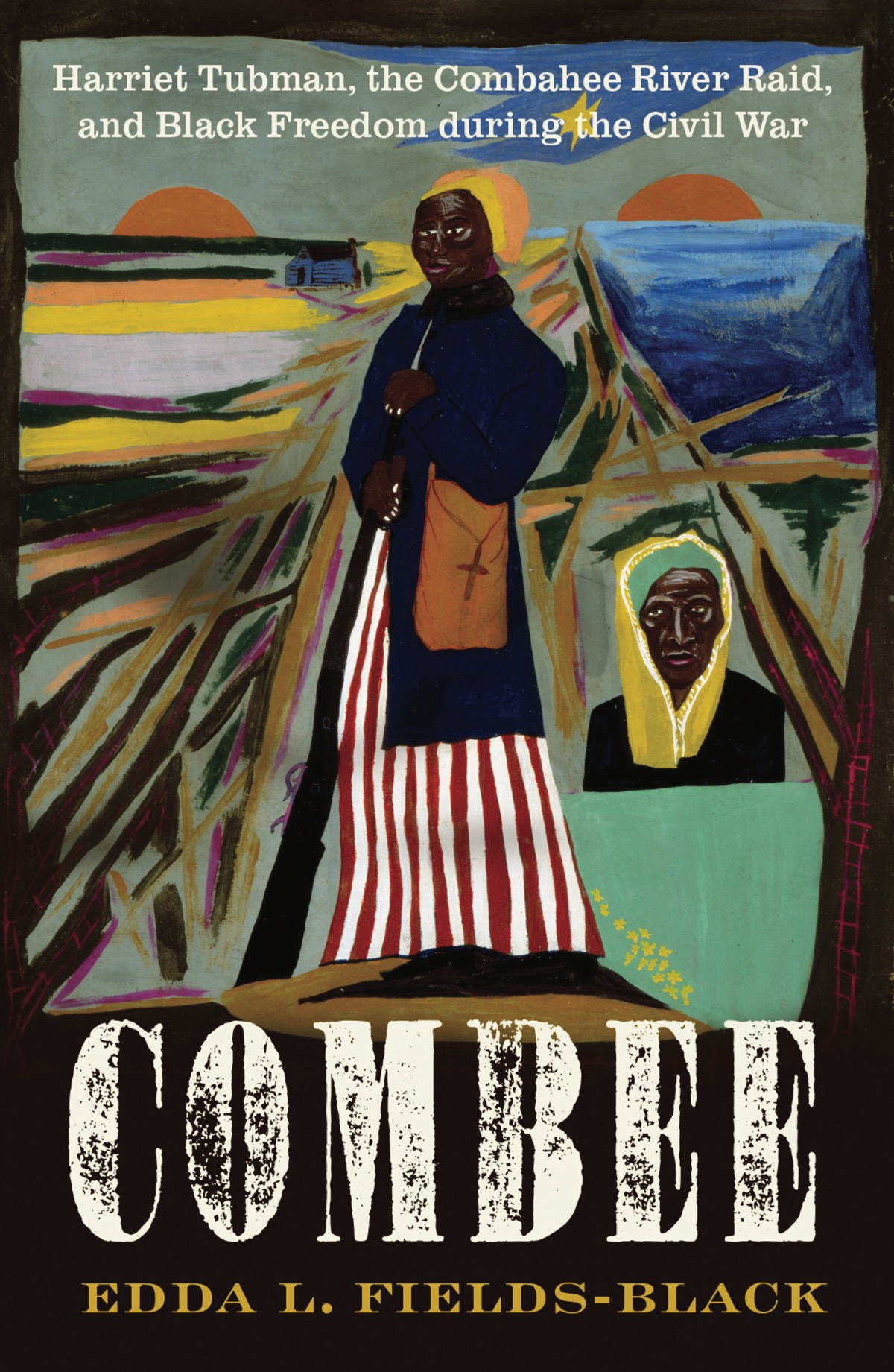
Combee: Harriet Tubman, the Combahee River Raid, and Black Freedom During the Civil War
About this book
During the Civil War, Tubman worked in Union-occupied South Carolina as a nurse, scout, and organizer. Knowledge from people who had escaped the rice plantations made a dangerous night operation up the river possible.
Edda L. Fields-Black restores the names, communities, routes, and military labor obscured when the raid is told as the achievement of a single famous leader. Tubman's command depended on local Black intelligence and collective action.
The account follows freedom beyond the moment enslaved people reached Union boats. Recruitment, refugee camps, family separation, land, military service, and Reconstruction determined what liberation could practically mean.
Combee is a deeply documented Civil War history written by a scholar descended from a raid participant. Maps, images, records, and extensive notes support its reconstruction of people often missing from the archive.
Read a sample
5,096 words
Plain text
From the opening
A Note on Names
In many ways this book is about naming, in that it uncovers the identities of people who were heretofore not identified. For many, this account represents their first appearance in the historical record.
The names given to or assumed by enslaved or formerly enslaved people reflect a wide variety of traditions and practices, making consistency in the historical record challenging for anyone trying to set the record straight. There are also multiple spellings of the names from a wide variety of sources. In recovering the historical actors’ stories, I have done the very best I can to standardize the spellings, choosing one spelling (usually based on government-issue documents when available or attestations of their names from later in their lives—that is, after freedom). Variants still remain. In addition, I have tried to retain the original spellings in the primary source documents quoted in the text and cited in the endnotes.
Foreword
On June 20, 1863, less than two weeks before the Battle of Gettysburg, the Wisconsin State Journal reported with great excitement that earlier in the month Colonel James Montgomery of the US Army and his “gallant band of 300 Black soldiers” had “dashed” into what was widely considered a breadbasket of the Confederacy, the rice plantations along the Combahee River in South Carolina, destroyed millions of dollars of property and mansions along fifteen miles of the river, and struck fear into the heart of the rebellion. Moreover, it had done all this “under the guidance of a Black woman.” It gave this Black woman and the Black soldiers “some credit for the exploit,” which was now being called the Combahee River Raid.1
This woman was none other than Harriet Tubman, the fugitive slave known as “Moses.” To Sarah Bradford, one of her biographers, Tubman recalled that she had “nebber see such a sight” as early on the morning of the Combahee raid: hundreds, if not thousands, of Blacks running for their lives—and their freedom—when they heard the whistles of the US Army gunboat John Adams and the armed transport steamer Harriet A. Weed coming up the river. First they peered out “like startled deer” from their hiding places in the rice fields and slave cabins. Then freedom seekers rushed to the boats with their children and belongings. They came loaded down with bags on their shoulders, baskets on their heads, young children struggling to keep up, pigs squealing, chickens squawking, and babies crying. Tubman told an interviewer decades after the war, “These here, puts me in the mind of the children of Israel, coming out of Egypt.”2
Tubman remembered it as a chaotic scene. One mother carried a pail of rice on her head that was still smoking, as if just removed from the fire. Children trailed behind her, clinging to her dress. Another child was perched on her shoulders, gripping her forehead from behind and digging a hand in the smoking rice pot: breakfast in flight. On her back, the woman carried a bag with a pig in it. Another woman brought two pigs, one white and one black. Tubman remembered the white pig was named Beauregard and the black pig Jeff Davis. She herself brought both Beauregard and Jeff Davis onboard so that the woman, who was clearly weak from illness, could carry her child onto the boat. Some women fled with twins hanging around their necks. Tubman thought she had never seen so many sets of twins in her life. They all came rushing to the Union gunboats, followed close behind by enslaved drivers who lashed them with whips, trying to get them to go back to the slave quarters and rice fields. Then the drivers, too, got on the boats.3
The Union commanders, who were white, gave the orders for the Black soldiers who had gone ashore—as well as others assisting in the raid, including Tubman—to “double-quick” back to the boats. Running, Tubman tripped on her long dress and fell. In frustration she tore her garments so that she could move freely. When she got back on the boat, her dress was little more than shreds.4
By now hundreds of freedom seekers stood on the riverbanks, waiting to board the small rowboats designated to transport them from the shore to the gunboats. The rowboats filled up quickly. Another transport steamer, the Sentinel, had earlier run aground on a sandbar and could not be dislodged; it had been abandoned for the time being. Without that third vessel available to transport everyone who had rushed to the riverbank, most freedom seekers were not able to bring on board any of the personal effects they had laboriously toted to the riverbanks. In fact, they could not take anything with them except the clothes on their backs. On the landing, they left an assortment of clothes, pots, kettles, baskets, bolts of cloth, hats, and shoes, everything they possessed in the world. Nevertheless, the loss of these possessions was a small price to pay for a way out of what Frederick Douglass called the “prison-house of bondage.”5
Those who hadn’t yet boarded held on to the sides of the rowboats, preventing the boats from taking off without them. They must have known this would be their only opportunity to leave, and these boats the only way out. Though the crews smacked their hands with the oars to get them to let go, they were determined to hold on. The entire mission came close to disaster.6
Continue reading the sampleClose the sample
By this point the sun was coming up and Montgomery’s mission would be in full view of any Confederate forces that might have been in the area. Any delay could have given the Confederate forces enough time to regroup and attack, slaughtering everyone, soldiers and freedom seekers alike. Confederate pickets could have shot them off like sitting ducks. Every second counted.7
Someone had to calm the desperate freedom seekers. Colonel Montgomery implored Tubman, or “Moses,” as he called her, to “speak a word of consolation to your people.” Decades later, Tubman told an interviewer that they were no more her people than they were Montgomery’s—“only [they] was all Negroes.” To Sarah Bradford she recalled that those she encountered in coastal South Carolina were foreign to her: “Why der language down dar in de far South is jus’ as different from ours in Maryland as you can tink.” In fact, Tubman and the Blacks in coastal South Carolina spoke different varieties of a Creole dialect that was evolving among enslaved and free Black people in the Atlantic basin. Tubman spoke a Chesapeake Creole that was influenced primarily by English and other European languages and thus likely revealed fewer African inflections. Freedom seekers in coastal South Carolina spoke a Lowcountry Creole that continued to incorporate elements of West African languages up until almost the Civil War. A similar creolization process created the two dialects, but different inputs put into different physical and social environments over time had resulted in different linguistic products. Thus, Tubman and the freedom seekers had difficulty understanding each other. As Tubman put it, “Dey laughed when dey heard me talk. An’ I could not understand dem, no how.”8
But why Tubman was in the South—in South Carolina, where the Civil War began—was unambiguous. She had known since the passage of the Fugitive Slave Act of 1850 that there was “gwine to be war.” In 1862, she decided to do her part, risking her freedom, her safety, and her very life. She was ready to go to war for people she did not know and whose language and culture she could not even understand. However, she knew that they all had one thing in common: the pursuit of freedom.9
The centerpiece of Tubman’s efforts was the Combahee River Raid. In the course of six hours, she, Montgomery, the 2nd South Carolina Volunteers, and one battery of the 3rd Rhode Island Heavy Artillery attacked no fewer than seven rice plantations. They destroyed $6 million in property, including homes, stables, storehouses, and other outbuildings, as well as millions of bushels of rice. They confiscated hundreds of heads of livestock, including eighty or ninety horses. Most of all, they set in motion the freedom of 756 enslaved people, Confederate planters’ most valuable “possessions.” The US forces did not lose a single life. One could argue that they executed the largest and most successful slave rebellion in US history.10
********
Most know that Harriet Tubman escaped enslavement, led herself and more than sixty others out of bondage via the Underground Railroad—giving about seventy more people detailed instructions on how to get to freedom—and became a suffragist, fighting to expand voting and civil rights to those who had been excluded from them. Though some of Tubman’s biographers, including Earl Conrad and Kate Larson, have written about Tubman’s Civil War experiences, her work for the US Army’s Department of the South during the Civil War remains the least-studied period of Tubman’s otherwise well-studied life.
Tubman left Boston in 1862 and traveled to Port Royal, South Carolina, one year into the war, shortly after the port city had been liberated by Union forces. She embedded herself in the Beaufort Black refugee community, acting as a nurse, cook, spy, and scout for the US Army. There she recruited the men who piloted Colonel Montgomery, the 2nd South Carolina Volunteers, and the 3rd Rhode Island Heavy Artillery up the Combahee River and onto the plantations in the Combahee River Raid.
We know this because there are records of her service. Tubman’s second husband, Nelson Davis, served in the 8th Regiment, Company C, of the US Colored Troops (USCT) from September 25, 1863, to November 10, 1865. After Davis’s death on October 14, 1888, Tubman received a widow’s pension of $8 per month for her husband’s service. Her testimony is recorded in a report from the House Committee on Invalid Pensions submitted to the whole House of Representatives and requesting an increase to $25. Tubman’s application for a widow’s pension—similar to others in the massive collection of documents housed in the National Archives in Washington, DC—reveals that she worked as a “nurse and cook in hospitals and a commander of several men (eight or nine).” She therefore had a “double claim” on the US government—one for a widow’s pension and the other for her own military service.11
The Combahee River Raid was Colonel Montgomery’s most successful Civil War expedition. In fact, it was one of the most successful Union expeditions of the entire Civil War in terms of property damage and number of enslaved people freed. Yet aside from Jeff Grigg’s study, The Combahee River Raid: Harriet Tubman and Lowcountry Liberation, very little has been written about it. Why? The answer is that Tubman and the men and women she freed were all illiterate. Tubman never wrote her own account of the raid. She told parts of it to abolitionist friends—like Sarah Bradford, mentioned earlier—and supporters, who wrote it down for her. Taken together, all these accounts provide evidence of her Civil War activities in coastal South Carolina, where, despite language and cultural differences, she gathered from the Lowcountry Creoles the intelligence the US military commanders needed.
However, many of the critical elements of the Combahee story have been largely absent. Who were these people who gained their freedom? The majority of plantation records were destroyed when the plantations were burned (Colonel Montgomery’s men spared only one on that stretch of the river). Incinerated were slave lists, plantation daybooks, diaries, ledgers, and business and personal correspondence. The Confederates had moved records for Beaufort and Colleton Counties to Columbia, South Carolina, during the war to protect them from the Union. Ironically, those burned in February 1865, when General William T. Sherman’s army marched through the Carolinas (though Charleston County’s archives survived). Thus, many documents filed in municipal archives located in the parishes where the raid took place are also lost forever.12
However, papers from other rice plantations in the area owned by the same planter families or their relatives help paint a picture of life on the lower Combahee. Moreover, planters whose property was burned during the raid applied for compensation from the Confederate government, cataloguing their losses. (One planter was a double-dipper, as I learned. He applied for compensation from both the Confederate and US governments.) In addition to buildings and equipment, bushels of rice, livestock, and personal possessions, the affidavits listed the names of the enslaved men, women, and children who seized their chance for their freedom on June 2, 1863. A number of planter families filed marriage settlements, wills, bills of sale for slaves, and court proceedings in Charleston or kept private collections that survived. Some planters scrawled back-of-the-envelope lists of the enslaved people they had lost in the raid or who had moved out of the area before and after June 2, and these, too, have survived. Finally, there are surviving letters in which planters, their family members, and neighbors lamented and commiserated about their losses. Still, while these help with names, family connections, and ages, they reveal too little about the lived experiences of enslaved people and their communities.
So telling the Combahee story presents challenges. What we have most of all, however, are the pension files, which allow us to reconstruct the story of Tubman’s Civil War service, the Combahee River Raid, and the hundreds of husbands, wives, siblings, in-laws, cousins, childhood friends, neighbors, and sweethearts who all ran for their lives and their freedom when the steamboat whistle blew. They constitute the foundation of the story that follows.
********
The United States Civil War Pension Files offer a fresh perspective on Harriet Tubman’s Civil War service, putting this chapter of her life in the context of the Combahee River Raid, the freedom seekers who liberated themselves as a result of it, the Black regiments, and the evolution of a new Creole culture and language. They are an underutilized source. Like slave narratives (often dictated by formerly enslaved people to abolitionist amanuenses) and interviews collected among formerly enslaved people by the Federal Writers’ Project from 1936 to 1938, the US Civil War Pension Files provide a window into the intimate lives of enslaved people, their families, and communities.13
Under the General Act of 1862, Congress created the US Pension Bureau to evaluate pension claims and administer pension benefits to white and Black US veterans disabled by military service and to the widows and dependents (children under sixteen at time of their father’s death and adult dependents) of men killed in action. The Dependent and Disability Pension Act of 1890 greatly expanded the pension system, making disabled veterans eligible for pensions whether or not their disabilities were related to military service and their widows and dependents eligible for pensions whether or not the veteran’s death was related to his military service. Successfully navigating the pension system was expensive, time-consuming, and frustrating. It presented untold challenges for African American Civil War veterans, the majority of whom were born enslaved and remained illiterate all of their lives. Roughly 83,000, slightly more than 42 percent, of African American veterans who applied for pensions were approved. Tens of thousands more veterans, widows, and dependents’ applications were not approved and/or they did not live long enough to collect their benefits.14
USCT veterans and their widows applied for pensions for their Civil War service through local attorneys mostly located in Beaufort and Colleton Counties and attorneys in Washington, DC. Veterans and widows were required to produce many different kinds of documentation, including the soldier’s discharge papers and a marriage certificate. The documents had to be notarized by a local notary in order for a successful pension application to be filed. The notaries also took affidavits from veterans, widows, comrades, “Old Heads” (the oldest people in the community, who knew everyone else’s business), neighbors, church members, and others who had known the veteran, the widow, and their children for much of their lives. The Bureau of Pensions sent special examiners in to investigate when the process went awry, as it frequently did, because Black veterans’ applications often lacked the necessary documentation (marriage certificates, birth certificates, even discharge papers) and required depositions from many more witnesses to verify the information. The testimonies were often contradictory. So special examiners took more affidavits from witnesses, attempted to assess whose testimony was most reliable, wrote a report back to the Bureau of Pensions, and made a recommendation whether the veteran, widow, or dependent should be granted a pension or the veteran an increase in pension benefits because of disability.15
Once the veteran or widow had secured pension benefits, they had to visit a notary every quarter to execute their pension vouchers and collect their monetary benefits. Four times yearly, many traveled from the towns of Dale and Sheldon to downtown Beaufort, from St. Helena Island to Frogmore (also in Beaufort County), or from Green Pond to Walterboro (in Colleton County) to pick up mail addressed to them and delivered to the general store, including their mail from the Bureau of Pensions. General stores were the one-stop shops of small southern towns in the post–Civil War era. Located in the center of town, they sold everything, including groceries, clothing, household goods, tools, and seed, to white and Black customers in the local area. In addition, the notary public’s office was often located at the back of the store. This being Reconstruction, the general store had two doors and the office two rooms, and that segregation endured through the period of Jim Crow.16
White farmers browsed the wares at their leisure, catching up on the week’s news with the store clerk and fellow white customers, and transacted business with the notary public in the main office. For them, the general store was a central social spot during the evening hours. Black customers, on the other hand, came in the back door and stated their business. If shopping, they requested items and had to purchase them without inspecting them or trying them on. If they came to transact business with the notary public, including pension business, they waited in a back room, often a storeroom, for the notary to finish attending to the needs of white customers. USCT veterans who had fought courageously and proudly for the Union, their freedom, and the freedom of others entered through the back door and sat in the back room waiting for the notary to have the time (or take the time) to notarize their pension vouchers and count out the payments due for their service.17
When called upon, the veterans and widows held up one hand, swore to tell the truth, signed—usually with a mark, as only a handful could sign their names—and had their signature or mark witnessed, usually by other veterans and/or widows sitting in the back room. If the pensioner needed to have a letter written or a form filled out to apply for a disability pension or an increase, the notary could perform all of these tasks in the same visit. Most veterans came alone and met their comrades at the general store; most widows did not come alone, instead accompanied by a male relative (brother, brother-in-law, son, grandson) or one of their husband’s comrades. During these quarterly reunions, veterans and widows stayed abreast of one another’s health, family, and financial circumstances, identified who among their community needed help, and pledged to keep in touch until they met again.
If a veteran or widow was applying for a pension, disability, or an increase, they often brought witnesses with them, in which case they all sat together in the back room and waited. If the witnesses did not come with the veteran or widow, they could come separately for the notary to take their affidavits. If the notary was attending to white customers, quite possibly the USCT veterans, widows, and witnesses would have to wait for a considerable amount of time, and if the notary did not have time that day, they would have to travel home or spend the night in town and come back another day, all at their own expense, to try their luck again. The costs associated with applying for a pension—particularly traveling to and from rural areas to attorneys, notary publics, and surgical boards, and paying notary publics to read, explain, and fill out forms, take depositions, and notarize documents—were prohibitive for many veterans and widows.18
In one trip, veterans and widows could execute and cash their pension vouchers, as well as spend their quarterly pension benefits on foodstuffs, clothing, shoes, and supplies for themselves, their families, and their households. Veterans and widows frequently left discharge papers and other important documents on file with the notary public with whom they executed their quarterly vouchers or at the general store where they did their shopping, so that the documents would not be destroyed by rats, fire, or water. Veterans and widows had to testify that they did not pledge their pension certificates to the storekeepers who kept their pension papers on file and/or where they collected their quarterly benefits, and storekeepers had to testify that they did not require veterans and widows to pledge their certificates in order to be granted store credit. However, it’s highly likely that some of them were indeed leaving their pension papers at the stores as collateral, even though they told the pension officers they didn’t and the practice was illegal under federal law. As the Federal Writers’ Project interviews demonstrate, it is no surprise that poor Black people—especially ones dependent on government benefits—told federal interviewers what they thought the government officials wanted to hear, particularly about slavery.19
Formerly enslaved people told their stories to notary publics, pension attorneys, and officials from the Department of the Interior’s Bureau of Pensions. Veterans who enlisted in the US Army after the Combahee River Raid told their story to apply for Civil War pensions; they told it to apply for increases in their pensions if they became disabled or had reached the age of seventy. When one of their comrades died, they told his story, and theirs in relationship to his, to be sure his widow and/or minor children received pension benefits. Widows, like Harriet Tubman Davis, applied for their husbands’ pension benefits after their husbands died. After a comrade or widow died, their story was told to ensure that whoever nursed him or her in their last days and paid the burial expenses would receive accrued pension benefits to defray the costs. Moreover, the comrades, friends, and neighbors who knew the veteran, widow, and/or minor children during enslavement and after discharge told their stories as well.
When notary publics exercised best practices, they recorded witnesses’ testimony given under oath. On a separate document, they rated the reliability of the witnesses; sometimes they asked postmasters to weigh in on the witnesses’ standing in the community. Occasionally special examiners stepped out of their roles as neutral scribes and wrote their real feelings about a witness in a deposition or a special examiner’s report. It is not surprising that when they let their guard down, special examiners admitted they thought Black people were ignorant. Many of special examiner James A. Bell’s colleagues would have agreed with his judgments of the veterans, widows, and neighbors who lived on the isolated and unhealthful lands along the Combahee River. He pronounced that Sina Bolze Young Green had once “belonged to a rice planter” and that people who had been held in bondage by rice planters were among the “most ignorant and degraded.” He continued by saying that those who had been enslaved on Lowcountry rice plantations and freedpeople in general had lost the morality they possessed in bondage by coming into contact with the world in freedom. Notary public N. G. Moore articulated how his colleagues likely felt when he wrote to his superiors to note that Moses Simmons’s first wife’s name was Christy, not Cushie as it had appeared previously in Moses’s pension file, and opined that “these people talk very indistinct and it is very hard to write from pronunciation. They are all negroes and very ignorant. This explains the difference in the name as it appeared.” Thus, most notary publics and special examiners filtered witnesses’ testimony through their language, Standard English, obscuring the witnesses’ Gullah Geechee dialect. The Gullah Geechee are the descendants of Blacks enslaved on Lowcountry rice, Sea Island cotton, and indigo plantations from the Cape Fear River in North Carolina to the St. John River in Florida and in the port cities of Charleston, Beaufort, Savannah, and Jacksonville.20
Inconsistencies in witnesses’ stories may have contributed to special examiners’ negative opinions about USCT veterans and their widows, though the rampant discrimination and racism among whites during Reconstruction and in the Jim Crow South were surely the root cause. When veterans, widows, and neighbors misrepresented information, such as their marital status or nature of their disability, the special examiners usually unearthed the truth, usually with help from the Old Heads. In 1911, Fannie Lee Green Simmons, widow of Moses Simmons, testified that “every old head on this plantation knows that I had no wife [sic] between Caesar [Green] and Moses [Simmons].” The Old Heads knew who was married before the war, who had remarried even though their first spouse was still living, who had never married even though they lived together as husband and wife, who told members of the community to say they were or were not married when the pension officer came around, and whose children were born out of wedlock. They did not hesitate to tell what they knew when the pension officers showed up. As the decades wore on, there were always Old Heads around who could tell the tale. The men who enlisted and the women they married all became Old Heads if they just kept living. It was the special examiners’ job to find the Old Heads and ask the right question. Occasionally, witnesses told pension officers about the night when Colonel Montgomery and the “Yankee gunboats” came up the river and “took all of the colored people off” to freedom.21
********
As noted, the US Civil War Pension Files hold a treasure trove of historical information about enslaved people’s lives. Take, for example, the file—255 pages in all—of my great-great-great-uncle Jonas Fields, who enlisted in the United States Colored Troops, 128th Regiment, Company C, in April 1865, not long before the war ended. Medical examinations in Jonas Fields’s pension file state that he was “height 5 feet 8 inches; complexion Dark; color of eyes Black; color of hair Black.” For African American Civil War soldiers, that is the extent of what the pension files provide of their physical descriptions, except for their injuries and disabilities. It is enough for me to imagine that Jonas was taller than most, dark, and lean, like the men in my granddaddy’s family. Like his namesake Jonas Fields, who was my grandfather’s first cousin, my great-great-great-uncle likely had a back strong enough to work on the railroad (a line of work the Fields men followed south to Miami), arms strong enough to need only one to scoop his well-proportioned wife out of the baptismal pool and carry her up the stairs (as family and members of the Baptist Church in Ruffin, South Carolina, witnessed Cousin Jonas do), and hands big enough to grip the top of an errant child’s head before we got away.22
My uncle Jonas testified in June 1902 that he had been born on Keans Neck in Beaufort, and that Dr. James Robert Verdier had held him in bondage. Jonas also revealed the names of his parents, Anson and Judy Fields (my great-great-great-great-grandparents), noting that “their owner was my owner.” In his 1914 deposition, Emmanuel Gettes testified that Jonas had been a house slave; he had waited on Verdier and his son-in-law, a Mr. Sams, who was certainly Berners Bainbridge Sams. Jonas “used to travel about during slave times,” even to the neighborhood of the Heyward Plantation, where he became acquainted with his future wife, Nellie Small. On that same day in 1914, Phoebe Washington testified that she was Jonas’s sister and that they had a brother named Hector, my great-great-great-grandfather. Verdier, she said, had enslaved both Hector and Jonas Fields; “Mrs. Sams,” who was Sarah F. Verdier Sams (Verdier’s daughter), held Phoebe in bondage. During the Civil War the Verdiers evacuated the male and female house slaves they held in bondage at their home in downtown Beaufort to different locations, separating Jonas from his first wife, Margaret, whom the Verdiers also held in bondage. Hector, a field hand on a rural plantation, had already run away and joined the US Army. After the Civil War, Jonas testified that he “went into the Heyward neighborhood to work in the rice fields” near the small town of White Hall, and there married Nellie. White Hall is where my father was born. I often visited cousins on my paternal grandfather’s side when I was a child, and many in my family still live there.23
When Jonas arrived in White Hall after the war, he worked as a coachman for Barnwell Heyward, grandson of Nathaniel Heyward (the Heywards had been one of the Combahee’s most prominent rice families before the war), and for Barnwell’s great-uncle Colonel Alan Izzard, and he lived next door to Nellie for a few years before they married. Nellie testified Nathaniel Heyward had held her in bondage. Stephen Graham, who was younger than Nellie, testified in his pension file that he had been enslaved on the same Heyward plantation as Nellie and held in bondage by Blake Heyward, another of Nathaniel Heyward’s grandsons. Jonas and Nellie lived in White Hall until January 17, 1891, when they moved to Lady’s Island, where my uncle died on September 22, 1911. On June 25, 1902, Jonas testified that his brother Hector Fields lived on Lady’s Island. Affiants testified that Verdier had also held in bondage Margaret Fields, Jonas’s wife during enslavement, John Bryan, and Clara Gillison, and that the Heywards, Nathaniel and Blake, had enslaved Moses Youngblood, Nellie Small’s fiancé or possibly her first husband, and a man named Stephen Graham. With one US Civil War pension file, I discovered ancestors in my Fields family line whose names were previously unknown. This facilitated my reconstruction of the beginnings of two enslaved communities.24