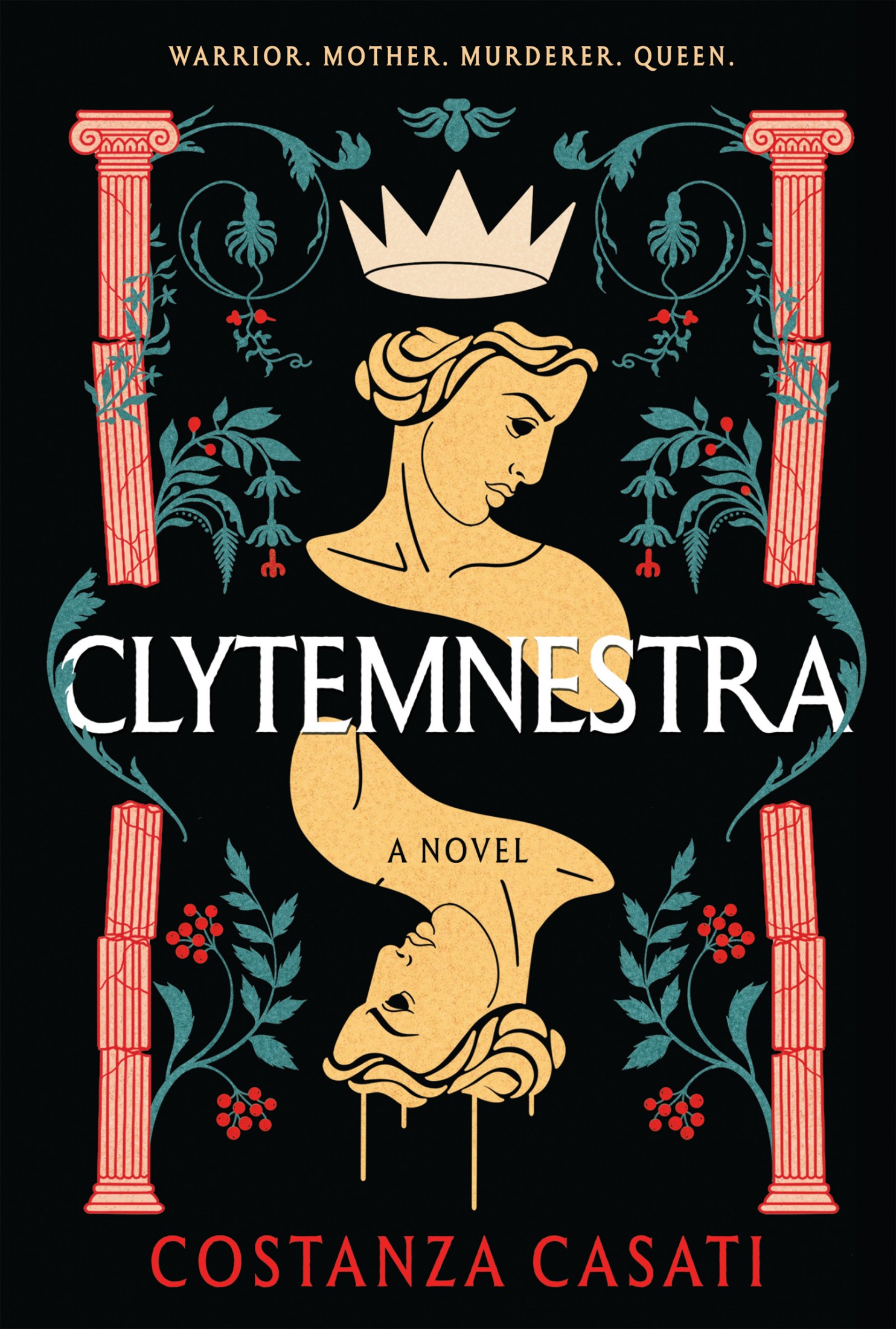
Clytemnestra
About this book
Clytemnestra grows up in Sparta beside Helen, trained to run, fight, and understand the uses of royal power. Her first marriage gives her a child and a future of her own, until Agamemnon takes both by force and carries her to Mycenae as his wife.
Years of rule do not erase what founded the marriage. When Agamemnon sacrifices their daughter Iphigenia and sails to Troy, Clytemnestra remains to govern a kingdom, raise the children left to her, and decide what justice can mean when the victorious king finally comes home.
Costanza Casati retells the House of Atreus from Clytemnestra's youth rather than beginning with the murder for which she is remembered. The novel treats strength as physical discipline, political intelligence, and the dangerous ability to preserve a grievance across years.
Read a sample
5,042 words
Plain text
From the opening
1
Prey
CLYTEMNESTRA LOOKS DOWN at the steep ravine but can see no trace of dead bodies. She searches for cracked skulls, broken bones, corpses eaten by wild dogs and pecked by vultures, but nothing. There are only a few brave flowers, growing between the cracks, their petals white against the darkness of the ravine. She wonders how they manage to grow in such a place of death.
There were no flowers down there when she was little. She remembers crouching in the forest as a child, watching the elders drag criminals and weak babies up the trail and throw them into the gorge Spartans call Ceadas. Down the cliff, the rocks are as sharp as freshly cast bronze and as slippery as raw fish. Clytemnestra used to hide and pray for all those men whose deaths would be long and painful. She couldn’t pray for the babies: the thought made her restless. If she walked closer to the edge of the ravine, she could feel a soft breeze caressing her skin. Her mother had told her that the dead infants lying at the bottom of the Ceadas spoke through the wind. Those voices whispered, yet Clytemnestra couldn’t grasp their words. So she let her mind wander as she looked at the sun peeping through the leafy branches.
An eerie silence looms over the forest. Clytemnestra knows she is being followed. She descends quickly from the high ground, leaving the ravine behind, trying not to trip on the slippery stones that form the hunting trail. The wind is colder, the sky darker. When she left the palace hours ago, the sun was rising, warm on her skin, and the grass was wet against her soles. Her mother was already sitting in the throne room, her face glowing in the orange light, and Clytemnestra slipped past the doors before she could be seen.
There is a sudden movement behind the trees, and the sound of crunching leaves. Clytemnestra slips and cuts her palm against the sharp edge of a rock. When she looks up, ready to defend herself, two big, dark eyes are staring back at her. Just a deer. She clenches her fist, then wipes her hand on her tunic before the blood can leave tracks for her hunter.
She can hear wolves howl somewhere far above her but forces herself to keep going. Spartan boys of her age fight wolves and panthers in pairs as part of their training. Clytemnestra once shaved her head, like a boy, and went to the gymnasium with them hoping to prepare for a hunt. When her mother found out, she didn’t feed her for two days. “Part of the training is to starve Spartan boys until they are forced to steal,” she said. Clytemnestra endured the punishment—she knew she deserved it.
The stream leads to a spring and a little waterfall. Above it, she can see a crevice, an entrance to what looks like a cave. She starts to climb the mossy rocks at the sides of the spring. Her hand throbs and slips on the surface of the cliff. Her bow is slung over her back, and the dagger hangs loose from her belt, its handle pressing against her thigh.
At the top, she stops to catch her breath. She tears off a piece of her tunic, douses it in the clear water of the spring, and wraps it around her bleeding hand. The crowns of the oaks blend with the darkening sky, and everything is blurred to her tired eyes. She knows she is too exposed on the ground. The higher you climb, the better, her father always says.
She scrambles up the tallest tree and pauses astride a branch to listen, holding her dagger tightly. The moon is high in the sky, its contours clear and cold, like a silver shield. Everything is silent, except for the water of the spring below her.
A branch cracks, and two golden eyes appear in the darkness in front of her, studying her. Clytemnestra remains still, blood pulsating in her temples. On the tree opposite her, a silver shape slips away from the shadows, revealing a coat of thick fur and pointed ears. A lynx.
The beast jumps and lands on her tree. The impact makes her lose her balance. She clutches the branch, but her nails break, her palms slip. She falls and lands on the muddy ground. For a second, she is blind and her breath is gone. The animal tries to jump down on her, but her hands are moving fast to her bow and arrows. She shoots and rolls onto her side. The lynx’s claw scratches her back and she screams.
The animal stands, its back to the narrow crevice that leads into the cave. For a moment, woman and lynx stare at each other. Then, swift as a striking snake, Clytemnestra throws her dagger into the animal’s shoulder. The lynx shrieks, and Clytemnestra runs past it, toward the blackness of the cave. She barely passes through the crevice, grazing her head and hips, sinks into the darkness, and waits, praying that the cave has no other entrance and no other visitor.
Slowly, her eyes become accustomed to the gloom. Her bow and most of her arrows are somehow intact and she sets them aside. She removes her bloodied tunic and rests her back against the cold rock. Her panting echoes in the humid air as if the cave itself were breathing. Can the goddess Artemis see her now? She wishes she could, though her father has always told her not to bother with gods. Her mother, on the other hand, believes that forests hide the gods’ secrets. Caves to her are shelters, minds that have thought and lived the lives of the creatures they have hosted over time. But maybe her father is right: this cave sounds as empty as a temple at night. There is only the moaning of the wounded lynx, which moves farther and farther away.
Continue reading the sampleClose the sample
When it dies, Clytemnestra drags herself closer to the crevice and peeps out. Nothing moves on the muddy ground. She slips back into her tunic, flinching when it sticks to her wound, then leaves the cave, her hips brushing against the smooth rocks.
The lynx lies close to the spring, its blood spreading on the orange leaves like spilled wine. Clytemnestra limps closer to it and retrieves her dagger. The animal’s eyes are open, reflecting the bright shape of the moon. Surprise is still etched on them, and sadness. They are not so different from a dead man’s eyes. Clytemnestra ties the animal’s paws to her quiver and starts to walk, hoping to be home by morning.
Her mother will be proud of her hunt.
2
One Girl Wins and the Other Loses
“SLOW DOWN, CLYTEMNESTRA! Artemis will shoot me if I am second again!”
Clytemnestra laughs, and the sound echoes like birdsong across the plain. “She won’t. Mother told you that to make you run faster!”
They are racing between the rows of olive and fig trees, their hair catching the leaves, their bare feet stepping on fallen fruit. Clytemnestra is faster. Cuts and bruises cover her arms, and her eyes show her determination to reach the river first. Behind her, Helen pants, calling to her sister. Whenever the sunlight catches her hair, it glows as brightly as the ripe fruit around her.
Clytemnestra jumps out of the grove onto the sunbaked earth. The ground burns her feet, so she hops onto the yellow grass. She stops only when she gets to the river to look at her figure mirrored in the water. She is dirty, disheveled.
“Wait for me,” Helen calls.
Clytemnestra turns. Her sister has stopped at the edge of the grove, sweat pouring down her tunic. She is glowering at her. “Why must you do everything in a hurry?” Helen asks.
Clytemnestra smiles. To their people, Helen of Sparta may look like a goddess, but truly, she follows her sister in everything she does. “Because it’s hot,” Clytemnestra says. She throws aside her tunic and plunges into the river. Her long hair dances around her like seaweed. The fresh breeze of the early morning is making way for the summer heat. Along the banks of the Eurotas river, between the dry plains and rough mountains, a few bloodred anemones struggle to grow. Not far from the banks, the thin strip of fertile soil with olive and fig trees stretches shyly, like a ray of sun in a clouded sky. Helen is lingering by the bank, the water up to her thighs. She always walks slowly into the river, wetting herself with her hands.
“Come on.” Clytemnestra swims toward Helen and hugs her waist.
“It’s cold,” Helen moans, but she keeps walking into the water. When Clytemnestra tries to let go of her, Helen clings to her sister’s warm body, pressing as close as she can.
“You are no Spartan woman,” Clytemnestra says with a smile.
“Not like you. If you were a man, you’d be among the strongest fighters in Greece.”
“I’m already among the cleverest in Sparta,” Clytemnestra says, grinning.
Helen frowns. “You shouldn’t say these things. You know what Mother says about hubris.”
“The pride that comes before a fall,” Clytemnestra recites, bored. “But Father always says he’s the bravest warrior in Sparta, and no one has punished him yet.”
“Father is king. We aren’t, so we shouldn’t anger the gods,” Helen insists.
Clytemnestra laughs. Her sister, moving through the world as if life were all mud and murk, always amuses her. “If you’re the fairest woman in all our lands and beyond, I might as well be the cleverest. I don’t see why the gods should be angry with that—they’ll always be cleverer and more beautiful anyway.”
Helen thinks it through. Clytemnestra swims toward a patch of sunlight glistening on the water, and her sister follows. The two remain floating in the river, their faces like sunflowers, always following the light.
* * *
They reach the gymnasium in time for their daily practice. The sun is strong, and they hurry under the shade of the trees that surround the courtyard. On the sand, young girls are already practicing, running around the square fully naked. Here the Spartiates, daughters of the best and noblest warriors of Sparta, train with commoners, and they will continue to do so until they start a family. Their bodies are covered with oil, old scars pale against their tanned skin.
Clytemnestra steps into the yard, Helen close behind her. The sand burns under their feet, like a heated blade, and the air is thick with the smell of sweat. The master—one of her father’s warriors—gives them a discus, then a spear, and corrects their posture as they throw again and again. The sun grows higher, and the girls jump, race, and run, their limbs hurting, their throats sore in the dry, hot air.
At last, there is the dancing. Clytemnestra catches sight of Helen smiling at her; the dance is her sister’s favorite moment. The drums start beating and the girls begin. Bare feet thud on the sand, pulsing through the sunlit air, and the dancers’ hair moves, like tongues of flame. Clytemnestra dances with her eyes closed, her strong legs following the rhythm. Helen’s movements mirror her sister’s but are more composed and graceful, as if she were afraid of losing herself. Her feet light and precise, her arms like wings, she looks ready to take flight and soar high, away from the others’ eyes. But she can’t rise, so she keeps dancing, relentless.
Clytemnestra dances for herself; Helen dances for others.
* * *
The water of the bath is cold and pleasant on the skin. Only Helen, Clytemnestra, and the Spartiates are allowed to share the small room in one corner of the courtyard. Most of the other athletes, commoners and girls who can’t claim to be native Spartans, are washing away the sweat in the river.
Clytemnestra rests her head against the stony wall, watching Helen as she rises out of the pool, golden hair plastered to her shoulders. At sixteen, their bodies are changing, their faces growing leaner, firmer. It scares Clytemnestra to witness it, though she doesn’t speak of it. It reminds her that at their age, their mother had already married their father and left her homeland.
Leda had come to Sparta from Aetolia, the arid land of mountains in the north of Greece famous for its wild beasts, nature gods, and spirits. Like every Aetolian princess before her, Leda was a huntress, skilled with the ax and bow, and she worshipped the mountain goddess Rhea. King Tyndareus loved her for her fierceness and married her, even though the Greeks called the tribes of Aetolia “primitive” and spread rumors that they ate raw meat, like animals. When Leda, a strong woman with raven hair and olive skin, gave birth to Helen—a light-skinned girl with hair the color of honey—everyone in Sparta believed that Zeus was Leda’s lover. The god was famously fond of beautiful young women and enjoyed taking different shapes to ravish them. He had been a bull to abduct the Phoenician princess Europa, a shower of golden rain to touch the lovely Danaë, a dark cloud to seduce the priestess Io.
So he did with Leda. Disguising himself as a swan, he found her sitting alone on the bank of the Eurotas, her hair black and shiny as a raven’s feathers, her eyes lost and sad. He flew into her arms, and when she caressed his wings, he raped her. Rumors indulge in details, so the Spartans talked of how Leda fought as he seized her, his beak wounding her, his wings keeping her still. Others spoke differently: the union was so pleasurable, they said, that she was left flushed and breathless.
“Of course, she must have liked it,” Clytemnestra heard a boy say in the gymnasium once. “The queen is different . . . Her people are more barbaric.” Clytemnestra hit his face with a rock but didn’t tell her mother. Such rumors spread out of jealousy: Leda was beautiful, and the Spartans distrusted her. But wicked voices are hard to ignore, and even the king came to believe that Helen wasn’t his child. He saw nothing of himself in her as she grew to become passionate about music and dancing and cried when she saw a wounded soldier.
But Clytemnestra knows Helen is her sister. She knows that even though as a child Helen seemed frail and gentle, her will is as strong as Clytemnestra’s. When they were little, Helen would stand next to her and compare every tiny part of their bodies until she found a similarity and was satisfied. After all, as Helen used to say, their eyelashes were thick, their fingers skinny, their necks long. And when Clytemnestra replied that her own hair was darker, the color of dirt, Helen would scoff.
“The boys will be here soon.”
Clytemnestra looks up. The other girls have left, and Helen is gazing at her, her head tilted like that of a curious doe. Clytemnestra wants to ask her if she too is scared of the future, but somehow the words don’t come, so instead she stands. “Let’s go then.”
* * *
Tonight there are no men in the dining hall. The room is lively with the women’s laughter and the smell of roasted meat. When Clytemnestra and Helen walk in, their mother is seated at the head of the table, speaking to a few servants, while Timandra, Phoebe, and Philonoe, Clytemnestra’s younger sisters, fill their plates with flatbreads and olives. They smile as they chew, their hands and cheeks greasy with fat from the meat. Helen and Clytemnestra take the two empty seats at their mother’s sides.
The hall is large and bare, its tall windows opening onto the plain. There are only a few old weapons hanging on the walls and a long table, dark wood scratched and faded, where men and women usually eat together.
“Make sure no one has stolen from the grain stores,” Leda is telling the servants, “and leave some wine for the king when he comes back from his journey.” She dismisses them with a wave of the hand, and they slip out of the room, as silent as fish moving through water.
Phoebe wipes her hands on her brown tunic and leans toward her mother. “When will Father be back?” she asks. She and Philonoe are still little, with their mother’s deep-green eyes and olive skin.
“Your father and your brothers will return from the games tonight,” Leda says, savoring her cheese. Clytemnestra’s uncle has been hosting races in Acarnania, and young men have gathered from every Greek city to participate.
“It will be as boring as an elders’ meeting, Sister,” Castor had told Clytemnestra before he left. “You will have more fun here, hunting and helping Mother to run the palace.” He had brushed his lips against her forehead and Clytemnestra had smiled at his lie. He knew how much she wanted to come.
“Do you think Castor and Polydeuces have won anything?” Philonoe asks.
“Of course they have,” Timandra says, her teeth sinking into the juicy pork flesh. She is thirteen, with stark, uninteresting features—she looks much like her father. “Polydeuces is stronger than any Spartan, and Castor runs faster than the gods.”
Philonoe smiles, satisfied, and Phoebe yawns, slipping a piece of meat under the table for the house dogs.
“Mother, why don’t you tell us a story?” she asks. “Father always tells the same ones.”
Leda smiles. “Clytemnestra will tell you a story.”
“Do you want to hear of the time Castor and I killed that wolf?” Clytemnestra asks.
Phoebe claps her hands. “Yes, yes!”
So Clytemnestra tells her stories, and her sisters listen. Blood and death don’t frighten them because they are still young, growing up in a world of myths and goddesses, and they don’t yet understand the difference between what is real and what is not.
* * *
Outside the window, the sky is orange-flushed. Someone is singing in the village, and the air is hot and sweet.
“Timandra is so like you,” Helen says, ready for bed. Their room is at the very end of the gynaeceum, the women’s apartments, and has walls painted with simple images—red flowers, blue birds, golden fish. There are two wooden stools where their dresses are neatly folded, a water bowl, and a bed of Egyptian ebony—a gift from the Athenian Theseus to Helen when she was fourteen.
Clytemnestra lifts a handful of water to wash her face.
“Do you think she looks like you? Timandra?” Helen repeats.
“Hmm. Yes.”
“She is mischievous.”
Clytemnestra laughs, wiping her forehead. “Are you saying I am mischievous?”
Helen tilts her head, frowning. “That is not what I meant.”
“I know.” Clytemnestra lies down on the bed next to her sister, looking at the ceiling. She sometimes likes to think it is painted with stars. “Are you tired?” she asks.
“No,” Helen whispers. She hesitates, taking a breath. “Father will come back tonight, and tomorrow he’ll tell you and Timandra all about the races. He loves you very much.”
Clytemnestra waits. She feels for the scar on her back, touching its jagged ends.
“It must be because I have never killed anything,” Helen says.
“It is not,” Clytemnestra says. “You know it is because he thinks Leda had another man.”
“Well, did she?”
How many times have they had this conversation? Clytemnestra sighs, ready to repeat what she always tells her. “It doesn’t matter. You are Leda’s daughter and my sister. Now, let us rest awhile.”
No matter how many times she says it, Helen listens as if it were the first. She gives Clytemnestra a small smile and closes her eyes, her body relaxing. Clytemnestra waits until she hears Helen’s rhythmic breathing, then turns to her. She looks at her sister’s perfect skin, smooth as an amphora ready to be painted, and wonders, When did we start lying to each other?
* * *
The next morning is wrestling day. The servants brush and flatten the sand in the gymnasium, then carry a high-backed chair under the shade of the trees. The Spartiates gather in one corner of the ground. Some are restless, picking up handfuls of sand, while others stand quietly, touching old bruises. Clytemnestra stretches her arms while Helen ties back her hair so that the strands don’t fall into her face. Her sister’s fingers on her head are gentle.
Up on the hill, the palace bathes in the hot sun opposite the river and mountains, which are cool and shaded. The exercise yard is quiet, half hidden by rocks and tall grass. Often in spring and autumn, the girls come here for their music and poetry classes, but it is too warm now, the sun high overhead, hot air sticking to the skin like wet sand.
A small group of men appears on the dusty path that runs from the palace. The servants move away from the courtyard, crouching behind the trees, and the Spartiates fall silent. Clytemnestra watches the warriors take their places around the yard as her father sits on the high-backed chair. Tyndareus is short but strong, his legs stiff with muscles. His eyes linger on the girls, bright and sharp as an eagle’s. Then he clears his throat. “You live to honor Sparta and your king. You fight so that you may have strong, healthy children and rule your houses. You fight to prove your loyalty to the city. You fight to belong. Survival, courage, and strength are your duties.”
“Survival, courage, and strength are our duties,” the girls say in unison.
“Who will start?” Tyndareus asks. He casts a quick glance in the direction of Clytemnestra. She looks back at him but remains silent. It can be foolish to challenge the other girls straightaway—her brother has taught her that. She has wrestled the Spartiates for years, yet there are always new things she can learn about them, secret moves they haven’t shown her yet. It is important that she observe them first.
Eupoleia steps forward. She chooses her adversary, a thin girl whose name Clytemnestra doesn’t know, and so the wrestling begins.
Eupoleia is slow but violent. She shouts and tries to grab the other by the hair. The girl looks scared and edges around slowly, like a stray cat. When Eupoleia aims at her head once again, the girl doesn’t jump far enough, and Eupoleia’s fist meets her jaw. The girl falls and doesn’t stand. The game is over.
Tyndareus looks disappointed. He doesn’t come often to watch them train, and when he does, he expects a good fight. “Someone else,” he says.
Cynisca steps forward, and the other girls make space, like frightened dogs. Daughter of an army comrade of Tyndareus, she is tall with a beak nose and strong legs. Clytemnestra remembers when Cynisca tried to steal her toy, a painted clay figure of a warrior, years ago at the marketplace.
“Who are you fighting, Cynisca?” Tyndareus asks.
Something in Cynisca’s eyes stirs Clytemnestra’s blood. Before she can volunteer to fight her, Cynisca speaks: “Helen.”
The girls gasp. No one has ever challenged Helen before, because they know the fight would be too easy, and there is no honor in that. They are afraid that Tyndareus might intervene in favor of his daughter, but Tyndareus doesn’t favor anyone. Everyone looks at him, waiting for an answer. He nods.
“No,” Clytemnestra says. She takes her sister’s arm.
Tyndareus frowns. “She can fight like any other Spartan.”
“I will fight,” Clytemnestra replies.
Helen pushes her sister aside. “You are shaming me.” She turns to Cynisca. “I will fight you.” She ties her hair back, her hands shaking. Clytemnestra bites the inside of her cheek so hard that she tastes blood. She doesn’t know what to do.
Helen walks to the center of the ground, and Cynisca follows her. There is a moment of stillness, when the sand glimmers and a soft wind blows. Then Cynisca strikes. Helen leaps aside, graceful and quick as a deer. Cynisca steps back and moves slowly, thinking. The most dangerous kind of wrestler, Clytemnestra knows—one who thinks. Cynisca prepares to strike again, and when she does, Helen moves in the wrong direction and is punched in the neck. She falls sideways but manages to grab Cynisca’s leg and drag her down with her. Cynisca jabs her fist at Helen’s face, again and again.
Clytemnestra wants to close her eyes, but that is not how she was taught. So she watches, thinking of how she will hurt Cynisca later, in the forest or by the river. She will take her down and make her face purple until the girl understands that some people must not be touched.
Cynisca stops punching and Helen crawls away, her face swollen, her hands bloody. Fly, fly away, Clytemnestra wants to shout, but deer have no wings, and Helen can barely stand. Cynisca doesn’t give her time to compose herself. She strikes and kicks again, and when Helen tries to hurl her backward, Cynisca leaps on her and snatches her arm from under her.
Clytemnestra turns to Tyndareus. He is watching the fight, his face expressionless. He will do nothing, she is sure of it.
Helen cries out, and Clytemnestra finds herself running to the center of the ground. Cynisca turns and her mouth drops open in surprise, but it is too late. Clytemnestra takes her by the hair and hurls her aside with all her strength. Cynisca raises her head from the dirt, but Clytemnestra puts her knee into her backbone, because the dirt is where the girl belongs. She hooks an arm around her head and pulls, aware of Helen, lying half conscious in the bloody sand a few inches from them. It is over, Clytemnestra thinks, but Cynisca takes her leg and twists her ankle, hard. Clytemnestra trips, and Cynisca takes a moment to breathe, her eyes bloodshot.
“This is not your fight,” Cynisca says, her voice hoarse.
You are wrong. Her leg hurts, but pain doesn’t trouble her. Cynisca lunges at her. Clytemnestra moves aside and shoves her to the ground. She stands on Cynisca’s back so she won’t rise anymore. When she feels the body give in, she limps away. Helen is barely breathing, and Clytemnestra lifts her from the sand. Her sister wraps her arms around her, and Clytemnestra takes her away, her father’s angry stare following her like a hound.
* * *
Clytemnestra’s ankle swells. The skin grows purple; the foot slowly becomes numb. A servant dresses the wound, her little hands quick but gentle, her eyes downcast. Helots, people like her are called, former inhabitants of the valley, now slaves since the Spartans took their land. They are everywhere in the palace, their faces dull and sad in the torchlight, their backs bent.
Clytemnestra rests her head against the wall, rage twisting inside her. Sometimes her anger feels so real that she wishes she could cut it out with a knife. She is angry with Cynisca for daring to touch her sister; with her father, for letting Helen be beaten; with her mother, who never intervenes when the king’s indifference hurts her daughter.
“It is done,” the girl says, checking Clytemnestra’s ankle. “You should rest now.”
Clytemnestra springs up. She needs to check Helen.
“You can’t walk,” the servant says, frowning.
“Bring me my grandmother’s stick,” Clytemnestra orders. The girl nods and scampers away toward the king’s quarters, where Tyndareus keeps his family’s things. When she comes back, she is holding a beautiful wooden cane.
Clytemnestra never met her grandfather Oebalus; she knows only that he was the son-in-law of the hero Perseus. Her grandmother Gorgophone, on the other hand, is well marked in her memory. A tall, strong woman, she married twice, something unheard of in her country. When her first husband died—a king of Messenia whose name Clytemnestra doesn’t remember—Gorgophone married Oebalus, even though she was older than him. She outlived him anyway, and Clytemnestra remembers when Gorgophone, wrapped in sheepskins before she died, told her and Helen that their family was a dynasty of queens.
“You girls will be remembered longer than your brothers,” Gorgophone claimed in her deep voice, the lines on her face as dense as those of a cobweb, “just like me with my dear brothers. Alcaeus, Mestor, Heleus . . . good men, brave men, but does anyone remember them? They don’t.”
“You are sure of this?” Helen asked. She was only twelve, yet her face was as serious as a woman’s.
Gorgophone stared at them, her eyes clouded but alert. “You are fierce and loyal, but I see wariness inside you too. I have lived among kings and heroes for so long, and they all grow too proud. When men grow proud, they become too trusting. Sooner or later, traitors cut them down.” She was mumbling, though her words had clarity and wisdom. Clytemnestra felt compelled to listen. “Ambition, courage, distrust. You will be queens soon enough, and that is what you will need if you want to outlive the men who’ll wish to be rid of you.” Gorgophone was dead a few hours later, and Clytemnestra had turned her words over and over in her head, savoring them like drops of honey left on the lips.
Her ankle is now throbbing. Leaning on her grandmother’s stick, Clytemnestra walks past the stony halls and corridors. The lit torches on the walls cast shadows that look like black figures painted on amphorae. She reaches the gynaeceum, gritting her teeth against the pain in her leg. Here the windows are smaller, the walls painted with bright patterns. Clytemnestra walks to the baths, where Helen is meant to be resting, and stops outside for a moment. She can hear voices, loud and clear.
“I will not tell you,” Helen is saying. “It is not fair.”
“It is not fair that she fought you. You know how things are. If one can challenge you, others will.” It is Polydeuces. Her brother’s voice is sharp, like an ax blade. Helen keeps silent. There is the sound of water and of Polydeuces’s impatient steps, back and forth, back and forth.