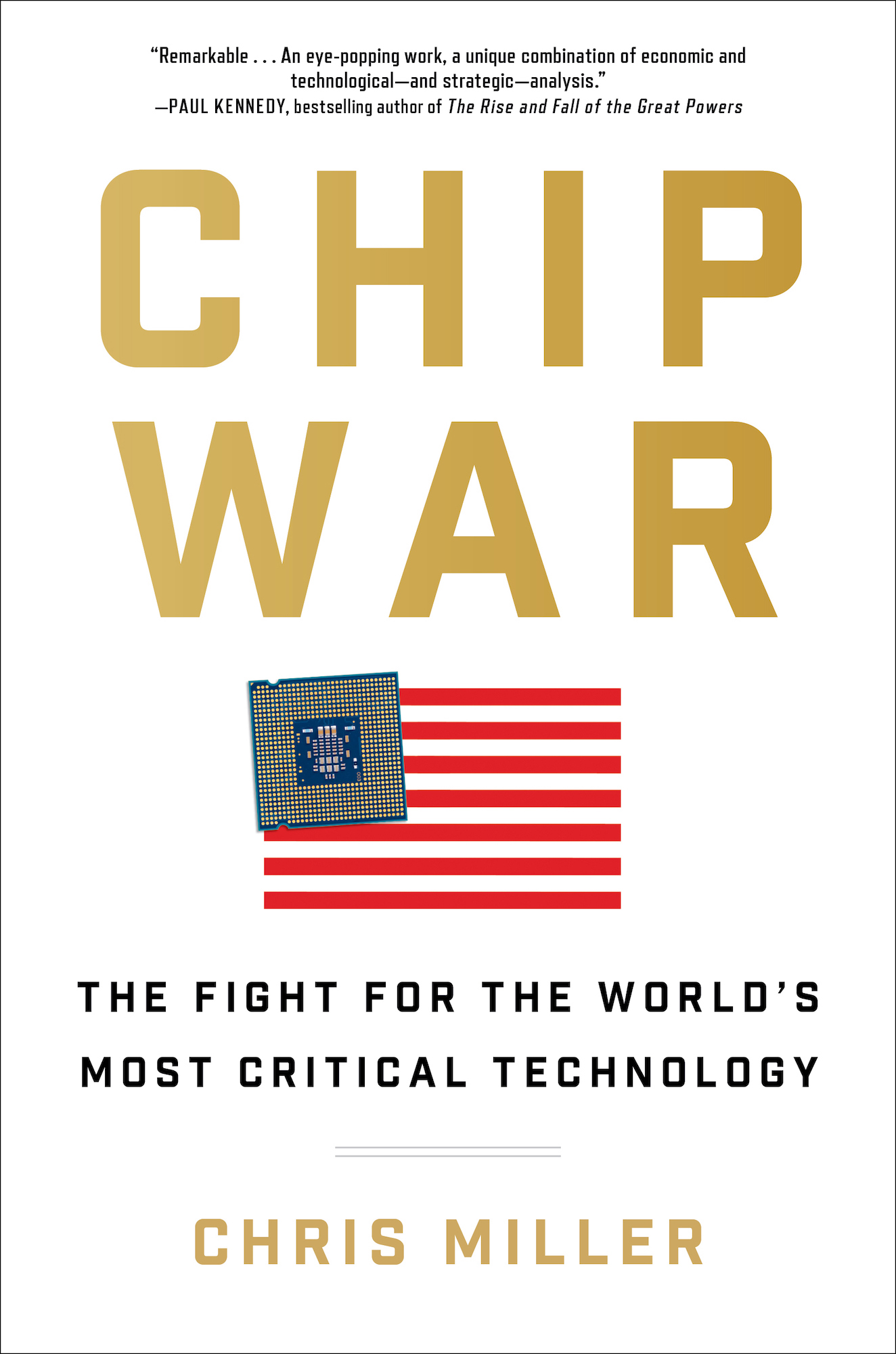
Chip War: The Fight for the World's Most Critical Technology
About this book
Chip War traces the semiconductor from the first practical transistors through integrated circuits, personal computing, smartphones, artificial intelligence, and precision weapons. The technical advances matter because each one changes who can build the machines on which economic and military power depends.
Chris Miller follows engineers, executives, and policymakers across Silicon Valley, Japan, Taiwan, South Korea, Europe, the Soviet Union, and China. The industry's global supply chain did not arise from frictionless markets alone; defense spending, industrial policy, corporate rivalry, and geopolitical alliances shaped every stage.
The resulting system is highly specialized. A small number of companies dominate chip design software, lithography, fabrication, memory, and advanced packaging, with Taiwan Semiconductor Manufacturing Company occupying a particularly consequential position.
Published in 2022, Chip War explains why export controls and fabrication capacity have become matters of national security. Its central argument is that the digital world looks weightless only because the difficult physical work of making chips is concentrated out of sight.
Read a sample
5,124 words
Plain text
From the opening
Introduction
The destroyer USS Mustin slipped into the northern end of the Taiwan Strait on August 18, 2020, its five-inch gun pointed southward as it began a solo mission to sail through the Strait and reaffirm that these international waters were not controlled by China—at least not yet. A stiff southwestern breeze whipped across the deck as it steamed south. High clouds cast shadows on the water that seemed to stretch all the way to the great port cities of Fuzhou, Xiamen, Hong Kong, and the other harbors that dot the South China coast. To the east, the island of Taiwan rose in the distance, a broad, densely settled coastal plain giving way to tall peaks hidden in clouds. Aboard ship, a sailor wearing a navy baseball cap and a surgical mask lifted his binoculars and scanned the horizon. The waters were filled with commercial freighters shipping goods from Asia’s factories to consumers around the world.
On board the USS Mustin, a row of sailors sat in a dark room in front of an array of brightly colored screens on which were displayed data from planes, drones, ships, and satellites tracking movement across the Indo-Pacific. Atop the Mustin’s bridge, a radar array fed into the ship’s computers. On deck ninety-six launch cells stood ready, each capable of firing missiles that could precisely strike planes, ships, or submarines dozens or even hundreds of miles away. During the crises of the Cold War, the U.S. military had used threats of brute nuclear force to defend Taiwan. Today, it relies on microelectronics and precision strikes.
As the USS Mustin sailed through the Strait, bristling with computerized weaponry, the People’s Liberation Army announced a retaliatory series of live-fire exercises around Taiwan, practicing what one Beijing-controlled newspaper called a “reunification-by-force operation.” But on this particular day, China’s leaders worried less about the U.S. Navy and more about an obscure U.S. Commerce Department regulation called the Entity List, which limits the transfer of American technology abroad. Previously, the Entity List had primarily been used to prevent sales of military systems like missile parts or nuclear materials. Now, though, the U.S. government was dramatically tightening the rules governing computer chips, which had become ubiquitous in both military systems and consumer goods.
The target was Huawei, China’s tech giant, which sells smartphones, telecom equipment, cloud computing services, and other advanced technologies. The U.S. feared that Huawei’s products were now priced so attractively, partly owing to Chinese government subsidies, that they’d shortly form the backbone of next-generation telecom networks. America’s dominance of the world’s tech infrastructure would be undermined. China’s geopolitical clout would grow. To counter this threat, the U.S. barred Huawei from buying advanced computer chips made with U.S. technology.
Soon, the company’s global expansion ground to a halt. Entire product lines became impossible to produce. Revenue slumped. A corporate giant faced technological asphyxiation. Huawei discovered that, like all other Chinese companies, it was fatally dependent on foreigners to make the chips upon which all modern electronics depend.
The United States still has a stranglehold on the silicon chips that gave Silicon Valley its name, though its position has weakened dangerously. China now spends more money each year importing chips than it spends on oil. These semiconductors are plugged into all manner of devices, from smartphones to refrigerators, that China consumes at home or exports worldwide. Armchair strategists theorize about China’s “Malacca Dilemma”—a reference to the main shipping channel between the Pacific and Indian Oceans—and the country’s ability to access supplies of oil and other commodities amid a crisis. Beijing, however, is more worried about a blockade measured in bytes rather than barrels. China is devoting its best minds and billions of dollars to developing its own semiconductor technology in a bid to free itself from America’s chip choke.
If Beijing succeeds, it will remake the global economy and reset the balance of military power. World War II was decided by steel and aluminum, and followed shortly thereafter by the Cold War, which was defined by atomic weapons. The rivalry between the United States and China may well be determined by computing power. Strategists in Beijing and Washington now realize that all advanced tech—from machine learning to missile systems, from automated vehicles to armed drones—requires cutting-edge chips, known more formally as semiconductors or integrated circuits. A tiny number of companies control their production.
We rarely think about chips, yet they’ve created the modern world. The fate of nations has turned on their ability to harness computing power. Globalization as we know it wouldn’t exist without the trade in semiconductors and the electronic products they make possible. America’s military primacy stems largely from its ability to apply chips to military uses. Asia’s tremendous rise over the past half century has been built on a foundation of silicon as its growing economies have come to specialize in fabricating chips and assembling the computers and smartphones that these integrated circuits make possible.
At the core of computing is the need for many millions of 1s and 0s. The entire digital universe consists of these two numbers. Every button on your iPhone, every email, photograph, and YouTube video—all of these are coded, ultimately, in vast strings of 1s and 0s. But these numbers don’t actually exist. They’re expressions of electrical currents, which are either on (1) or off (0). A chip is a grid of millions or billions of transistors, tiny electrical switches that flip on and off to process these digits, to remember them, and to convert real world sensations like images, sound, and radio waves into millions and millions of 1s and 0s.
Continue reading the sampleClose the sample
As the USS Mustin sailed southward, factories and assembly facilities on both sides of the Strait were churning out components for the iPhone 12, which was only two months away from its October 2020 launch. Around a quarter of the chip industry’s revenue comes from phones; much of the price of a new phone pays for the semiconductors inside. For the past decade, each generation of iPhone has been powered by one of the world’s most advanced processor chips. In total, it takes over a dozen semiconductors to make a smartphone work, with different chips managing the battery, Bluetooth, Wi-Fi, cellular network connections, audio, the camera, and more.
Apple makes precisely none of these chips. It buys most off-the-shelf: memory chips from Japan’s Kioxia, radio frequency chips from California’s Skyworks, audio chips from Cirrus Logic, based in Austin, Texas. Apple designs in-house the ultra-complex processors that run an iPhone’s operating system. But the Cupertino, California, colossus can’t manufacture these chips. Nor can any company in the United States, Europe, Japan, or China. Today, Apple’s most advanced processors—which are arguably the world’s most advanced semiconductors—can only be produced by a single company in a single building, the most expensive factory in human history, which on the morning of August 18, 2020, was only a couple dozen miles off the USS Mustin’s starboard bow.
Fabricating and miniaturizing semiconductors has been the greatest engineering challenge of our time. Today, no firm fabricates chips with more precision than the Taiwan Semiconductor Manufacturing Company, better known as TSMC. In 2020, as the world lurched between lockdowns driven by a virus whose diameter measured around one hundred nanometers—billionths of a meter—TSMC’s most advanced facility, Fab 18, was carving microscopic mazes of tiny transistors, etching shapes smaller than half the size of a coronavirus, a hundredth the size of a mitochondria. TSMC replicated this process at a scale previously unparalleled in human history. Apple sold over 100 million iPhone 12s, each powered by an A14 processor chip with 11.8 billion tiny transistors carved into its silicon. In a matter of months, in other words, for just one of the dozen chips in an iPhone, TSMC’s Fab 18 fabricated well over 1 quintillion transistors—that is, a number with eighteen zeros behind it. Last year, the chip industry produced more transistors than the combined quantity of all goods produced by all other companies, in all other industries, in all human history. Nothing else comes close.
It was only sixty years ago that the number of transistors on a cutting-edge chip wasn’t 11.8 billion, but 4. In 1961, south of San Francisco, a small firm called Fairchild Semiconductor announced a new product called the Micrologic, a silicon chip with four transistors embedded in it. Soon the company devised ways to put a dozen transistors on a chip, then a hundred. Fairchild cofounder Gordon Moore noticed in 1965 that the number of components that could be fit on each chip was doubling annually as engineers learned to fabricate ever smaller transistors. This prediction—that the computing power of chips would grow exponentially—came to be called “Moore’s Law” and led Moore to predict the invention of devices that in 1965 seemed impossibly futuristic, like an “electronic wristwatch,” “home computers,” and even “personal portable communications equipment.” Looking forward from 1965, Moore predicted a decade of exponential growth—but this staggering rate of progress has continued for over half a century. In 1970, the second company Moore founded, Intel, unveiled a memory chip that could remember 1,024 pieces of information (“bits”). It cost around $20, roughly two cents per bit. Today, $20 can buy a thumb drive that can remember well over a billion bits.
When we think of Silicon Valley today, our minds conjure social networks and software companies rather than the material after which the valley was named. Yet the internet, the cloud, social media, and the entire digital world only exist because engineers have learned to control the most minute movement of electrons as they race across slabs of silicon. “Big tech” wouldn’t exist if the cost of processing and remembering 1s and 0s hadn’t fallen by a billionfold in the past half century.
This incredible ascent is partly thanks to brilliant scientists and Nobel Prize−winning physicists. But not every invention creates a successful startup, and not every startup sparks a new industry that transforms the world. Semiconductors spread across society because companies devised new techniques to manufacture them by the millions, because hard-charging managers relentlessly drove down their cost, and because creative entrepreneurs imagined new ways to use them. The making of Moore’s Law is as much a story of manufacturing experts, supply chain specialists, and marketing managers as it is about physicists or electrical engineers.
The towns to the south of San Francisco—which weren’t called Silicon Valley until the 1970s—were the epicenter of this revolution because they combined scientific expertise, manufacturing know-how, and visionary business thinking. California had plenty of engineers trained in aviation or radio industries who’d graduated from Stanford or Berkeley, each of which was flush with defense dollars as the U.S. military sought to solidify its technological advantage. California’s culture mattered just as much as any economic structure, however. The people who left America’s East Coast, Europe, and Asia to build the chip industry often cited a sense of boundless opportunity in their decision to move to Silicon Valley. For the world’s smartest engineers and most creative entrepreneurs, there was simply no more exciting place to be.
Once the chip industry took shape, it proved impossible to dislodge from Silicon Valley. Today’s semiconductor supply chain requires components from many cities and countries, but almost every chip made still has a Silicon Valley connection or is produced with tools designed and built in California. America’s vast reserve of scientific expertise, nurtured by government research funding and strengthened by the ability to poach the best scientists from other countries, has provided the core knowledge driving technological advances forward. The country’s network of venture capital firms and its stock markets have provided the startup capital new firms need to grow—and have ruthlessly forced out failing companies. Meanwhile, the world’s largest consumer market in the U.S. has driven the growth that’s funded decades of R&D on new types of chips.
Other countries have found it impossible to keep up on their own but have succeeded when they’ve deeply integrated themselves into Silicon Valley’s supply chains. Europe has isolated islands of semiconductor expertise, notably in producing the machine tools needed to make chips and in designing chip architectures. Asian governments, in Taiwan, South Korea, and Japan, have elbowed their way into the chip industry by subsidizing firms, funding training programs, keeping their exchange rates undervalued, and imposing tariffs on imported chips. This strategy has yielded certain capabilities that no other countries can replicate—but they’ve achieved what they have in partnership with Silicon Valley, continuing to rely fundamentally on U.S. tools, software, and customers. Meanwhile, America’s most successful chip firms have built supply chains that stretch across the world, driving down costs and producing the expertise that has made Moore’s Law possible.
Today, thanks to Moore’s Law, semiconductors are embedded in every device that requires computing power—and in the age of the Internet of Things, this means pretty much every device. Even hundred-year-old products like automobiles now often include a thousand dollars worth of chips. Most of the world’s GDP is produced with devices that rely on semiconductors. For a product that didn’t exist seventy-five years ago, this is an extraordinary ascent.
As the USS Mustin steamed southward in August 2020, the world was just beginning to reckon with our reliance on semiconductors—and our dependence on Taiwan, which fabricates the chips that produce a third of the new computing power we use each year. Taiwan’s TSMC builds almost all the world’s most advanced processor chips. When COVID slammed into the world in 2020, it disrupted the chip industry, too. Some factories were temporarily shuttered. Purchases of chips for autos slumped. Demand for PC and data center chips spiked higher, as much of the world prepared to work from home. Then, over 2021, a series of accidents—a fire in a Japanese semiconductor facility; ice storms in Texas, a center of U.S. chipmaking; and a new round of COVID lockdowns in Malaysia, where many chips are assembled and tested—intensified these disruptions. Suddenly, many industries far from Silicon Valley faced debilitating chip shortages. Big carmakers from Toyota to General Motors had to shut factories for weeks because they couldn’t acquire the semiconductors they needed. Shortages of even the simplest chips caused factory closures on the opposite side of the world. It seemed like a perfect image of globalization gone wrong.
Political leaders in the U.S., Europe, and Japan hadn’t thought much about semiconductors in decades. Like the rest of us, they thought “tech” meant search engines or social media, not silicon wafers. When Joe Biden and Angela Merkel asked why their country’s car factories were shuttered, the answer was shrouded behind semiconductor supply chains of bewildering complexity. A typical chip might be designed with blueprints from the Japanese-owned, UK-based company called Arm, by a team of engineers in California and Israel, using design software from the United States. When a design is complete, it’s sent to a facility in Taiwan, which buys ultra-pure silicon wafers and specialized gases from Japan. The design is carved into silicon using some of the world’s most precise machinery, which can etch, deposit, and measure layers of materials a few atoms thick. These tools are produced primarily by five companies, one Dutch, one Japanese, and three Californian, without which advanced chips are basically impossible to make. Then the chip is packaged and tested, often in Southeast Asia, before being sent to China for assembly into a phone or computer.
If any one of the steps in the semiconductor production process is interrupted, the world’s supply of new computing power is imperiled. In the age of AI, it’s often said that data is the new oil. Yet the real limitation we face isn’t the availability of data but of processing power. There’s a finite number of semiconductors that can store and process data. Producing them is mind-bogglingly complex and horrendously expensive. Unlike oil, which can be bought from many countries, our production of computing power depends fundamentally on a series of choke points: tools, chemicals, and software that often are produced by a handful of companies—and sometimes only by one. No other facet of the economy is so dependent on so few firms. Chips from Taiwan provide 37 percent of the world’s new computing power each year. Two Korean companies produce 44 percent of the world’s memory chips. The Dutch company ASML builds 100 percent of the world’s extreme ultraviolet lithography machines, without which cutting-edge chips are simply impossible to make. OPEC’s 40 percent share of world oil production looks unimpressive by comparison.
The global network of companies that annually produces a trillion chips at nanometer scale is a triumph of efficiency. It’s also a staggering vulnerability. The disruptions of the pandemic provide just a glimpse of what a single well-placed earthquake could do to the global economy. Taiwan sits atop a fault line that as recently as 1999 produced an earthquake measuring 7.3 on the Richter scale. Thankfully, this only knocked chip production offline for a couple of days. But it’s only a matter of time before a stronger quake strikes Taiwan. A devastating quake could also hit Japan, an earthquake-prone country that produces 17 percent of the world’s chips, or Silicon Valley, which today produces few chips but builds crucial chipmaking machinery in facilities sitting atop the San Andreas Fault.
Yet the seismic shift that most imperils semiconductor supply today isn’t the crash of tectonic plates but the clash of great powers. As China and the United States struggle for supremacy, both Washington and Beijing are fixated on controlling the future of computing—and, to a frightening degree, that future is dependent on a small island that Beijing considers a renegade province and America has committed to defend by force.
The interconnections between the chip industries in the U.S., China, and Taiwan are dizzyingly complex. There’s no better illustration of this than the individual who founded TSMC, a company that until 2020 counted America’s Apple and China’s Huawei as its two biggest customers. Morris Chang was born in mainland China; grew up in World War II−era Hong Kong; was educated at Harvard, MIT, and Stanford; helped build America’s early chip industry while working for Texas Instruments in Dallas; held a top secret U.S. security clearance to develop electronics for the American military; and made Taiwan the epicenter of world semiconductor manufacturing. Some foreign policy strategists in Beijing and Washington dream of decoupling the two countries’ tech sectors, but the ultra-efficient international network of chip designers, chemical suppliers, and machine-tool makers that people like Chang helped build can’t be easily unwound.
Unless, of course, something explodes. Beijing has pointedly refused to rule out the prospect that it might invade Taiwan to “reunify” it with the mainland. But it wouldn’t take anything as dramatic as an amphibious assault to send semiconductor-induced shock waves careening through the global economy. Even a partial blockade by Chinese forces would trigger devastating disruptions. A single missile strike on TSMC’s most advanced chip fabrication facility could easily cause hundreds of billions of dollars of damage once delays to the production of phones, data centers, autos, telecom networks, and other technology are added up.
Holding the global economy hostage to one of the world’s most dangerous political disputes might seem like an error of historic proportions. However, the concentration of advanced chip manufacturing in Taiwan, South Korea, and elsewhere in East Asia isn’t an accident. A series of deliberate decisions by government officials and corporate executives created the far-flung supply chains we rely on today. Asia’s vast pool of cheap labor attracted chipmakers looking for low-cost factory workers. The region’s governments and corporations used offshored chip assembly facilities to learn about, and eventually domesticate, more advanced technologies. Washington’s foreign policy strategists embraced complex semiconductor supply chains as a tool to bind Asia to an American-led world. Capitalism’s inexorable demand for economic efficiency drove a constant push for cost cuts and corporate consolidation. The steady tempo of technological innovation that underwrote Moore’s Law required ever more complex materials, machinery, and processes that could only be supplied or funded via global markets. And our gargantuan demand for computing power only continues to grow.
Drawing on research in historical archives on three continents, from Taipei to Moscow, and over a hundred interviews with scientists, engineers, CEOs, and government officials, this book contends that semiconductors have defined the world we live in, determining the shape of international politics, the structure of the world economy, and the balance of military power. Yet this most modern of devices has a complex and contested history. Its development has been shaped not only by corporations and consumers but also by ambitious governments and the imperatives of war. To understand how our world came to be defined by quintillions of transistors and a tiny number of irreplaceable companies, we must begin by looking back to the origins of the silicon age.
PART I COLD WAR CHIPS
CHAPTER 1 From Steel to Silicon
Japanese soldiers described World War II as a “typhoon of steel.” It certainly felt that way to Akio Morita, a studious young engineer from a family of prosperous sake merchants. Morita only barely avoided the front lines by getting assigned to a Japanese navy engineering lab. But the typhoon of steel crashed through Morita’s homeland, too, as American B-29 Superfortress bombers pummeled Japan’s cities, destroying much of Tokyo and other urban centers. Adding to the devastation, an American blockade created widespread hunger and drove the country toward desperate measures. Morita’s brothers were being trained as kamikaze pilots when the war ended.
Across the East China Sea, Morris Chang’s childhood was punctuated by the sound of gunfire and air-raid sirens warning of imminent attack. Chang spent his teenage years fleeing the Japanese armies that swept across China, moving to Guangzhou; the British colony of Hong Kong; China’s wartime capital of Chongqing; and then back to Shanghai after the Japanese were defeated. Even then, the war didn’t really end, because Communist guerillas relaunched their struggle against the Chinese government. Soon Mao Zedong’s forces were marching on Shanghai. Morris Chang was once again a refugee, forced to flee to Hong Kong for the second time.
Budapest was on the opposite side of the world, but Andy Grove lived through the same typhoon of steel that swept across Asia. Andy (or Andras Grof, as he was then known) survived multiple invasions of Budapest. Hungary’s far-right government treated Jews like the Groves as second-class citizens, but when war broke out in Europe, his father was nevertheless drafted and sent to fight alongside Hungary’s Nazi allies against the Soviet Union, where he was reported missing in action at Stalingrad. Then, in 1944, the Nazis invaded Hungary, their ostensible ally, sending tank columns rolling through Budapest and announcing plans to ship Jews like Grove to industrial-scale death camps. Still a child, Grove heard the thud of artillery again months later as Red Army troops marched into Hungary’s capital, “liberating” the country, raping Grove’s mother, and installing a brutal puppet regime in the Nazis’ place.
Endless tank columns; waves of airplanes; thousands of tons of bombs dropped from the skies; convoys of ships delivering trucks, combat vehicles, petroleum products, locomotives, rail cars, artillery, ammunition, coal, and steel—World War II was a conflict of industrial attrition. The United States wanted it that way: an industrial war was a struggle America would win. In Washington, the economists at the War Production Board measured success in terms of copper and iron, rubber and oil, aluminum and tin as America converted manufacturing might into military power.
The United States built more tanks than all the Axis powers combined, more ships, more planes, and twice the Axis production of artillery and machine guns. Convoys of industrial goods streamed from American ports across the Atlantic and Pacific Oceans, supplying Britain, the Soviet Union, China, and other allies with key materiel. The war was waged by soldiers at Stalingrad and sailors at Midway. But the fighting power was produced by America’s Kaiser shipyards and the assembly lines at River Rouge.
In 1945, radio broadcasts across the world announced that the war was finally over. Outside of Tokyo, Akio Morita, the young engineer, donned his full uniform to hear Emperor Hirohito’s surrender address, though he listened to the speech alone rather than in the company of other naval officers, so he wouldn’t be pressured to commit ritual suicide. Across the East China Sea, Morris Chang celebrated the war’s end and Japan’s defeat with a prompt return to a leisurely teenaged life of tennis, movies, and card games with friends. In Hungary, Andy Grove and his mother slowly crept out of their bomb shelter, though they suffered as much during the Soviet occupation as during the war itself.
World War II’s outcome was determined by industrial output, but it was clear already that new technologies were transforming military power. The great powers had manufactured planes and tanks by the thousands, but they’d also built research labs that developed new devices like rockets and radars. The two atomic bombs that destroyed Hiroshima and Nagasaki brought forth much speculation that a nascent Atomic Age might replace an era defined by coal and steel.
Morris Chang and Andy Grove were schoolboys in 1945, too young to have thought seriously about technology or politics. Akio Morita, however, was in his early twenties and had spent the final months of the war developing heat-seeking missiles. Japan was far from fielding workable guided missiles, but the project gave Morita a glimpse of the future. It was becoming possible to envision wars won not by riveters on assembly lines but by weapons that could identify targets and maneuver themselves automatically. The idea seemed like science fiction, but Morita was vaguely aware of new developments in electronic computation that might make it possible for machines to “think” by solving math problems like adding, multiplying, or finding a square root.
Of course, the idea of using devices to compute wasn’t new. People have flipped their fingers up and down since Homo sapiens first learned to count. The ancient Babylonians invented the abacus to manipulate large numbers, and for centuries people multiplied and divided by moving wooden beads back and forth across these wooden grids. During the late 1800s and early 1900s, the growth of big bureaucracies in government and business required armies of human “computers,” office workers armed with pen, paper, and occasionally simple mechanical calculators—gearboxes that could add, subtract, multiply, divide, and calculate basic square roots.
These living, breathing computers could tabulate payrolls, track sales, collect census results, and sift through the data on fires and droughts that were needed to price insurance policies. During the Great Depression, America’s Works Progress Administration, looking to employ jobless office workers, set up the Mathematical Tables Project. Several hundred human “computers” sat at rows of desks in a Manhattan office building and tabulated logarithms and exponential functions. The project published twenty-eight volumes of the results of complex functions, with titles such as Tables of Reciprocals of the Integers from 100,000 Through 200,009, presenting 201 pages covered in tables of numbers.
Organized groups of human calculators showed the promise of computation, but also the limits of using brains to compute. Even when brains were enhanced by using mechanical calculators, humans worked slowly. A person looking to use the results of the Mathematical Tables Project had to flip through the pages of one of the twenty-eight volumes to find the result of a specific logarithm or exponent. The more calculations that were needed, the more pages had to be flipped through.
Meanwhile, the demand for calculations kept growing. Even before World War II, money was flowing into projects to produce more capable mechanical computers, but the war accelerated the hunt for computing power. Several countries’ air forces developed mechanical bombsights to help aviators hit their targets. Bomber crews entered the wind speed and altitude by turning knobs, which moved metal levers that adjusted glass mirrors. These knobs and levers “computed” altitudes and angles more exactly than any pilot could, focusing the sight as the plane homed in on its target. However, the limitations were obvious. Such bombsights only considered a few inputs and provided a single output: when to drop the bomb. In perfect test conditions, America’s bombsights were more accurate than pilots’ guesswork. When deployed in the skies above Germany, though, only 20 percent of American bombs fell within one thousand feet of their target. The war was decided by the quantity of bombs dropped and artillery shells fired, not by the knobs on the mechanical computers that tried and usually failed to guide them.
More accuracy required more calculations. Engineers eventually began replacing mechanical gears in early computers with electrical charges. Early electric computers used the vacuum tube, a lightbulb-like metal filament enclosed in glass. The electric current running through the tube could be switched on and off, performing a function not unlike an abacus bead moving back and forth across a wooden rod. A tube turned on was coded as a 1 while a vacuum tube turned off was a 0. These two digits could produce any number using a system of binary counting—and therefore could theoretically execute many types of computation.
Moreover, vacuum tubes made it possible for these digital computers to be reprogrammed. Mechanical gears such as those in a bombsight could only perform a single type of calculation because each knob was physically attached to levers and gears. The beads on an abacus were constrained by the rods on which they moved back and forth. However, the connections between vacuum tubes could be reorganized, enabling the computer to run different calculations.
This was a leap forward in computing—or it would have been, if not for the moths. Because vacuum tubes glowed like lightbulbs, they attracted insects, requiring regular “debugging” by their engineers. Also like lightbulbs, vacuum tubes often burned out. A state-of-the-art computer called ENIAC, built for the U.S. Army at the University of Pennsylvania in 1945 to calculate artillery trajectories, had eighteen thousand vacuum tubes. On average, one tube malfunctioned every two days, bringing the entire machine to a halt and sending technicians scrambling to find and replace the broken part. ENIAC could multiply hundreds of numbers per second, faster than any mathematician. Yet it took up an entire room because each of its eighteen thousand tubes was the size of a fist. Clearly, vacuum tube technology was too cumbersome, too slow, and too unreliable. So long as computers were moth-ridden monstrosities, they’d only be useful for niche applications like code breaking, unless scientists could find a smaller, faster, cheaper switch.