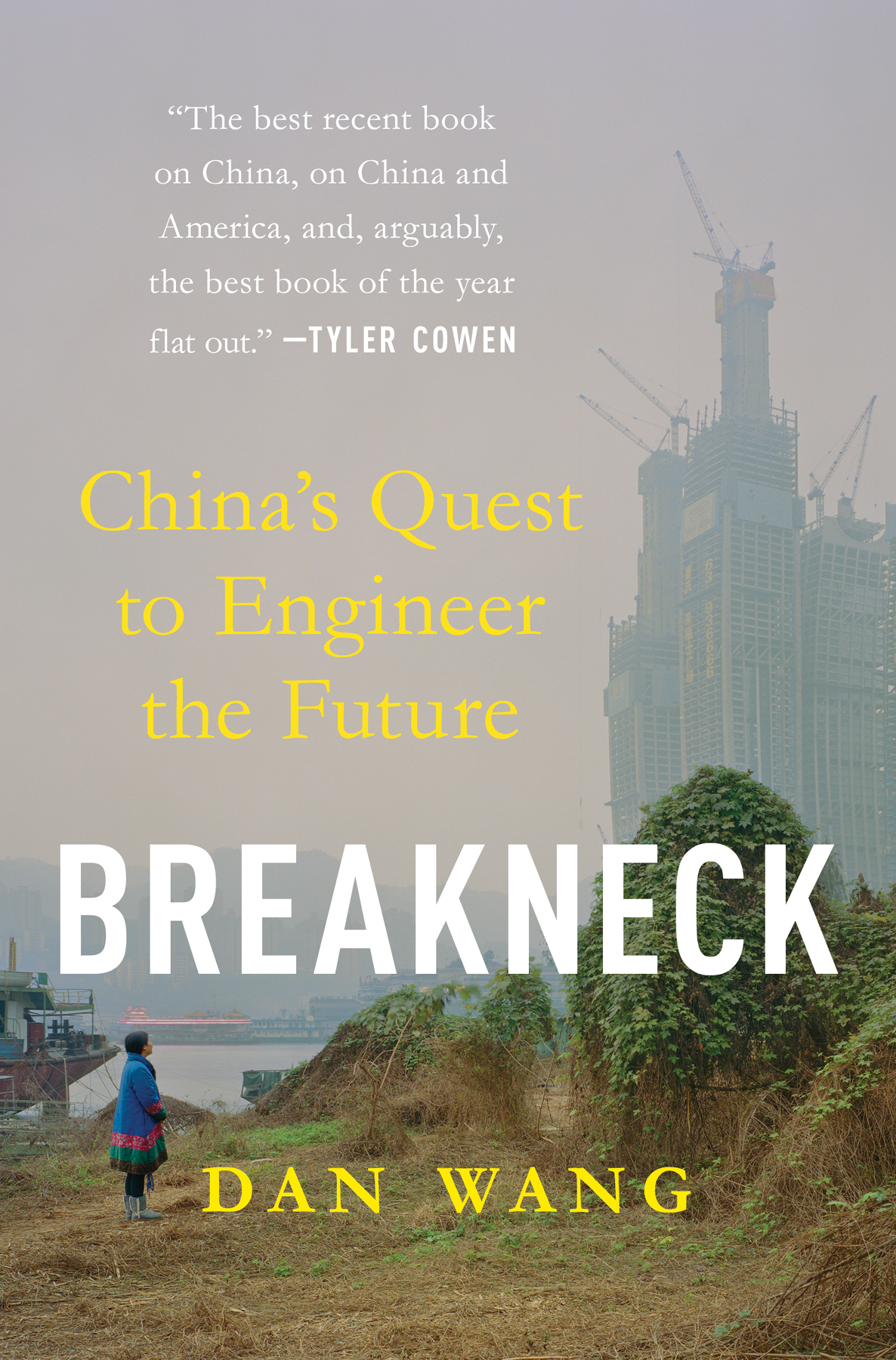
Breakneck: China's Quest to Engineer the Future
About this book
Dan Wang begins with a blunt contrast. China behaves like an engineering state, confident that problems can be solved by building, reorganizing, and acting at scale. The United States has become a lawyerly society, skilled at argument and restraint but often unable to turn an agreed goal into a railway, a power line, or enough homes.
The comparison is not a simple contest with a winner. China's physical achievements sit beside the damage caused when the same administrative machinery is applied to human lives. Wang follows that logic through the one-child policy and zero-Covid, while asking why American procedural safeguards so often harden into paralysis.
Part reporting, part memoir, and part institutional history, the book moves between Beijing, Shenzhen, Silicon Valley, and Wang's own experience of living in both countries. Factories, infrastructure, technology policy, migration, and family history all become evidence for how each system understands progress.
Published in 2025, Breakneck is most useful when its central distinction is treated as a diagnostic rather than a slogan. It shows the capacity and the danger of an engineering state, then asks whether the United States can recover the ability to build without giving up the limits that law is meant to provide.
Read a sample
5,010 words
Plain text
From the opening
Introduction
Each time I see a headline announcing that officials from the United States and China are once more butting heads, I feel that the state of affairs is more than just tragic; it is comical, too, because I am sure that no two peoples are more alike than Americans and Chinese.
A strain of materialism, often crass, runs through both countries, sometimes producing veneration of successful entrepreneurs, sometimes creating displays of extraordinary tastelessness, overall contributing to a spirit of vigorous competition. Chinese and Americans are pragmatic: They have a get-it-done attitude that occasionally produces hurried work. Both countries are full of hustlers peddling shortcuts, especially to health and to wealth. Their peoples have an appreciation for the technological sublime: the awe of grand projects pushing physical limits. American and Chinese elites are often uneasy with the political views of the broader populace. But masses and elites are united in the faith that theirs is a uniquely powerful nation that ought to throw its weight around if smaller countries don’t get in line.
I came to this view as a Canadian who has spent almost equal amounts of time living in the United States and China. To me, these two countries are thrilling, maddening, and, most of all, deeply bizarre. Canada is tidy. I sometimes find myself relaxing as soon as I cross into its borders. Drive around America and China, on the other hand, and you’ll see people and places that are utterly deranged. That’s not a reproach. These two countries are messy in part because they are both engines for global change. Europeans have a sense of optimism only about the past, stuck in their mausoleum economy because they are too sniffy to embrace American or Chinese practices. And the rest of the world is either too mature or too young to match the impact of these two superpowers. It is Americans and Chinese—Silicon Valley, Shenzhen, Wall Street, and Beijing—that will determine what people everywhere will think and what they will buy.
They are not the only two countries in the world that matter. Far from it. But if we don’t understand how the United States and China function and interact, then in large part we won’t quite understand many of the biggest changes in the world. The two countries are reconfiguring the international order and each other too. Seeing China more clearly—its dazzling strengths, appalling weaknesses, and everything in between—also helps us to see America more clearly.
To understand China, we must start in the country’s most riveting city: Beijing.
Beijing enthralls not because it is nice but because it isn’t. By most measures, life in Beijing is dreary. It is in China’s arid north, where dust storms descend every so often upon the city’s twisting alley homes, dating from imperial times, or gray apartment blocks, built in the Soviet style. In the last decade or so, the state has bricked up many of its liveliest sites, including its many bars and roadside barbecues, turning the city into a no-fun zone. Want to take your life into your hands? Try braving the cars that speed through Beijing’s gigantic roads. Much like Moscow or Pyongyang, its avenues feel like they were built for army parades rather than for normal life. Really, everything that can go wrong in urban design has gone wrong in Beijing.
But the capital is also a city of gravity and substance. Beijing attracts many of China’s smartest people, including scientists, technology leaders, and those seeking to advance in the Communist Party. The po-faced members of the Politburo don’t fool around. Greatness isn’t only a slogan for them: It’s a full-on, life-or-death pursuit. Beijing, for the rest of this book, stands in as the Communist Party and the central government. China’s leaders are driven by intense paranoia, doing everything they can to control the future.
My parents and I emigrated from China to Canada when I was seven. During high school, we moved to the woodsy suburbs of Philadelphia (where my mom and dad still live). After going to New York for college and Silicon Valley for work, I returned to China to investigate its technology developments. I learned to appreciate something vital: The country is always in motion. Living in Hong Kong, Beijing, and then Shanghai was a good education not only because these were China’s most prosperous economic zones. For six years, I lived through a period of economic dynamism that gave way to smothering political repressiveness. I experienced top leader Xi Jinping’s ongoing mobilization of the country for great-power competition. I tracked the expanding web of US restrictions on Chinese tech companies, as well as their struggle to escape from American restraints. And I endured all three years of Xi’s pursuit of zero-Covid, which started impressively until it plunged the country into broad misery.
The Chinese state builds gleaming public works and doesn’t flinch from locking up ethnic minorities or locking down whole cities. Too many outsiders see only the enrichment or the repression. Living there puts you face to face with both a sustained rise in living standards and the authoritarian pulses emanating out of Beijing. It became no contradiction for me to appreciate that things are getting better and getting worse. I saw how China is made up of both strong entrepreneurs and a strong government, with a state that both moves fast and breaks things and moves fast and breaks people.
Continue reading the sampleClose the sample
I was the technology analyst at Gavekal Dragonomics, an investment research firm serving a financial audience. We were a small team of analysts managed by editors who used to be economics journalists. My task consisted of writing research notes for hedge funds, endowments, and other asset managers hungry for China analysis. Dragonomics research wasn’t focused on particular companies but rather on more ambitious macro questions about the direction China was heading and what it means for the world. Portfolio managers aren’t shy about getting to the heart of the matter, asking me: Can China’s political system really breed tech giants? Will advanced manufacturing succeed when the rest of the world is throwing up trade barriers? How does a faltering economy affect Beijing’s designs on Taiwan?
If I didn’t offer good answers, the conversations could feel like a Socratic beating rather than a collegial chat. Though hedge fund managers can be obnoxious, I found conversing with them to be valuable. Folks in finance easily turn philosophical, pushing me to sharpen my views on important questions. I worked hard to decipher where Xi was taking China, which meant reading party texts, no matter how arcane, and visiting different regions, no matter how obscure.
By traveling as often as possible to smaller cities—some that are little more than urbanized industrial parks—I grasped something that most Americans, and even many Chinese, do not: Going to little-known cities in China is fun. Wherever I went I found amazing food, bizarre sights, and memorable people. I saw that China had greater dynamism than acknowledged by most headlines about the country, which fixate on Beijing’s political machinations. Just imagine what the rest of the world would miss if they understood the United States exclusively through developments from Washington, DC.
Everywhere I felt China’s breathless and, at times, reckless speed. I tried to capture the country’s shifts and tussles, buffeted by a pandemic and a darkening international environment, by writing an annual letter. These were a journal of sorts to record everything I observed and felt. In 2020, I wrote about reading every Xi Jinping speech in Seeking Truth, the Communist Party’s flagship theory magazine; in 2021, the differences between Hong Kong, Beijing, and Shanghai; and in 2022, what it was like to wander through the mountains of Yunnan province—whose north is historic Tibet and whose south feels like Thailand—during the worst period of zero-Covid.
I thought constantly about the United States. It wasn’t only that the Trump administration was prosecuting a trade and technology war; Beijing holds America steadfastly in its gaze. China’s leaders are ready to learn from Europe, Japan, Singapore, and many others, sure. But they have looked up to the United States more than any other country, benchmarking themselves against the world’s preeminent power.
It is almost uncanny how much the United States and China have been complementary of each other. It was no accident that the two countries established, for a few decades, an economic partnership that worked tremendously well for American consumers and Chinese workers. But on a political level, these two systems are a study in contrasts. While the United States reflects the virtues of pluralism and protection of individuals, China revealed the advantages and perils that come from moving quickly to achieve rapid physical improvements.
Over the past four decades, China has grown richer, more technologically capable, and more diplomatically assertive abroad. China learned so well from the United States that it started to beat America at its own game: capitalism, industry, and harnessing its people’s restless ambitions. If you want to appreciate what Detroit felt like at its peak, it’s probably better to experience that in Shenzhen than anywhere in the United States.
As China emulated America’s past successes, the US government got busy undermining its own strengths. A procedure-obsessed left conspired with a thoughtlessly destructive right to constrain the government. Neither the left nor the right allows the state to deliver essential goods expected by the public. The Biden administration may have ushered through historic bills on industrial policy, but executive agencies were so obsessed with procedural concerns that little building actually took place before voters reelected Donald Trump, who has threatened to cancel many of these projects. The United States is still a superpower that is able to outclass China on many dimensions. But it is also in the grips of an ineffectual state where people are increasingly concerned with safeguarding a comfortable way of life.
Americans used to love the great opportunity that China represented. Nearly a century ago, they were wartime allies, with ties cemented by cultural connections and business relationships. Today, natural amity is being crowded out by mutual mistrust. Beijing and Washington are competing with each other economically, technologically, and diplomatically, casting a pall on those of us connected to both countries. In 2022, Beijing’s censors blocked the personal website where I publish my annual letters. The Great Firewall tends to block access to big platforms like the New York Times, not little sites like mine. That week, I had to seek out the Canadian consul general to ask whether I needed to organize my departure from China. Beijing had already detained two Canadians in response to Canada’s arrest of a prominent Chinese businesswoman. Many Americans who previously traveled to China for business and pleasure have lost their enthusiasm for visits.
We are now in an era where the two countries regard each other with suspicion, and often animosity. Like China, the United States is able to move fast and break people, dealing tremendous brutality at home and abroad when it feels threatened. A paramount question of our times is whether hostility between China and the United States can stay at a manageable simmer. Because if it boils over, they will devastate not only each other but also the world.
The best hedge I know against heightening tensions between the two superpowers is mutual curiosity. The more informed Americans are about Chinese, and vice versa, the more likely we are to stay out of trouble. The starkest contrast between the two countries is the competition that will define the twenty-first century: an American elite, made up of mostly lawyers, excelling at obstruction, versus a Chinese technocratic class, made up of mostly engineers, that excels at construction. That’s the big idea behind this book. It’s time for a new lens to understand the two superpowers: China is an engineering state, building big at breakneck speed, in contrast to the United States’ lawyerly society, blocking everything it can, good and bad.
Breakneck is the story of the Chinese state that yanked its people into modernity—an action rightfully envied by much of the world—using means that ran roughshod over many—an approach rightfully disdained by much of the world. It is also a reminder that the United States once knew the virtues of speed and ambitious construction. Traversing dazzling metropolises and gigantic factories, Breakneck will illuminate the astounding progress and the dark underbelly of the engineering state. The lawyerly society has virtues, too, to teach China. Each superpower offers a vision of how the other can be better, if only their leaders and peoples care to take more than a fleeting glance.
Chapter 1 Engineers vs. Lawyers
Silicon Valley can be an amazingly drab place. The peninsula south of San Francisco has natural beauty, with rolling hills and coastal views, but you strain to see them beyond so many corporate parking lots. Mountain View and Menlo Park are bizarrely full of rug shops, so when I walk through the towns that host the headquarters of AI leaders and some of the richest companies in the world, I often find myself wondering, “This is the beating heart of our technologically accelerating civilization?”
Each time I flew from California to Hong Kong or Shanghai, I felt almost unnerved to encounter functional infrastructure. Going from the airport into a subway (rather than an Uber) is an outstanding way to be welcomed to Asia. I would take a moment to savor a clean station, brightly lit, with trains running every few minutes, which would drop me off at a downtown filled with vibrant commercial areas—another feature that San Francisco lacks. Life in the Bay Area, an economic dynamo in America’s richest state, can feel awfully dysfunctional. San Francisco has been unable to serve its homeless population, and even many wealthy people have to keep a generator for their extraordinarily expensive houses because the state can’t keep the lights on.
The contradiction of the Bay Area, this red-hot center of corporate value creation that is surrounded by dysfunction, fuels the inquiry of this book. When I departed from Silicon Valley for China in 2017, it felt clear that the United States had lost something special over the past four decades. While China was building the future, America had become physically static, its innovations mostly bound up in the virtual and financial worlds.
Looking at these two countries, I came to realize the inadequacy of twentieth-century labels like capitalist, socialist, or, worst of all, neoliberal. They are no longer up to the task of helping us understand the world, if they ever were. Capitalist America intrudes upon the free market with a dense program of regulation and taxation while providing substantial (albeit imperfect) redistributive policies. Socialist China detains union organizers, levies light taxes, and provides a threadbare social safety net. The greatest trick that the Communist Party ever pulled off is masquerading as leftist. While Xi Jinping and the rest of the Politburo mouth Marxist pieties, the state is enacting a right-wing agenda that Western conservatives would salivate over: administering limited welfare, erecting enormous barriers to immigration, and enforcing traditional gender roles—where men have to be macho and women have to bear their children.
China is an engineering state, which can’t stop itself from building, facing off against America’s lawyerly society, which blocks everything it can.
Engineers have quite literally ruled modern China. As a corrective to the mayhem of the Mao years, Deng Xiaoping promoted engineers to the top ranks of China’s government throughout the 1980s and 1990s. By 2002, all nine members of the Politburo’s standing committee—the apex of the Communist Party—had trained as engineers. General Secretary Hu Jintao studied hydraulic engineering and spent a decade building dams. His eight other colleagues could have run a Soviet heavy-industry conglomerate: with majors in electron-tube engineering and thermal engineering, from schools like the Beijing Steel and Iron Institute and the Harbin Institute of Technology, and work experience at the First Machine-Building Ministry and the Shanghai Artificial Board Machinery Factory.
Xi Jinping studied chemical engineering at Tsinghua, China’s top science university. For his third term as the Communist Party’s general secretary starting in 2022, Xi filled the Politburo with executives from the country’s aerospace and weapons ministries. In the United States, it would be as if the CEO of Boeing became the governor of Alaska, the chief of Lockheed Martin became the secretary of energy, and the head of NASA was governor of a state as large as Georgia. China’s ruling elites have practical experience managing megaprojects, suggesting that China is doubling down on engineers—and prioritizing defense—more than ever.
What do engineers like to do? Build. Since ancient times, the emperors have tried to tame the mighty rivers that sweep away not only farmland, but also imperial reigns. In modern times, new public works—roads, bridges, tunnels, dams, power plants, entire new cities—are the engineering state’s solution to any number of quandaries. Since 1980, after Deng’s reforms began, China has built an expanse of highways equal to twice the length of the US systems, a high-speed rail network twenty times more extensive than Japan’s, and almost as much solar and wind power capacity as the rest of the world put together. It’s not only the government that is fixated on production; the corporate sector is made up of overactive producers too. A rough rule of thumb is that China produces one-third to one-half of nearly any manufactured product, whether that is structural steel, container ships, solar photovoltaic panels, or anything else.
When Chinese point to new cities that shimmer at night with drone displays, or metropolises connected to each other by a glistening high-speed rail network, their pride is real. Call it propaganda of the deed, but one way to impress a billion-plus people is to pour a lot of concrete.
The United States, by contrast, has a government of the lawyers, by the lawyers, and for the lawyers. Five out of the last ten presidents attended law school. In any given year, at least half the US Congress has law degrees, while at best a handful of members have studied science or engineering. From 1984 to 2020, every single Democratic presidential and vice-presidential nominee went to law school, but they make up many Republican Party elites as well as the top ranks of the civil service too. By contrast, only two American presidents worked as engineers: Herbert Hoover, who built a fortune in mining, and Jimmy Carter, who served as an engineering officer on a nuclear submarine. Hoover and Carter are remembered for many things, especially for their dismal political instincts that produced thumping electoral defeats.
Lawyers have so many tools available to delay or prevent building. You don’t just feel the difference going from the lawyerly society to the engineering state: You saunter, tread, and amble upon its works. Americans no longer manufacture well or build public works on reasonable timelines. US infrastructure is falling into a pitiable state while China is building new systems of subways, bridges, and highways. Over the past three decades, while Chinese manufacturers have been going from strength to strength . . . well, let’s just say that American automakers and chipmakers haven’t exactly covered themselves in glory. China’s political system is geared toward delivering monumental projects, such that the slightest economic tremble is enough to push Beijing to announce a mammoth plan for new public works. That’s one reason that the phrase “housing crisis” has evoked, over the past several years, a collapse of home prices for Chinese and spiraling unaffordability for Americans.
Lawyers enable some of the success of Silicon Valley. You can’t build companies worth trillions without legal protections. But lawyers are also part of the reason that the Bay Area and much of the country are starved of housing and mass transit. The United States used to be, like China, an engineering state. But in the 1960s, the priorities of elite lawyers took a sharp turn. As Americans grew alarmed by the unpleasant by-products of growth—environmental destruction, excessive highway construction, corporate interests above public interests—the focus of lawyers turned to litigation and regulation. The mission became to stop as many things as possible.
As the United States lost its enthusiasm for engineers, China embraced engineering in all its dimensions. Its leaders aren’t only civil or electrical engineers. They are, fundamentally, social engineers. Emperors didn’t hesitate to entirely restructure a person’s relationship to the land, ordering mass migration into newly opened territories and conscripting the people to build great walls or grand canals. Modern rulers are here, too, far more ambitious than the emperors of the past. The Soviet Union inspired many of Beijing’s leaders with a love of heavy industry and an enthusiasm to become engineers of the soul—a phrase from Joseph Stalin repeated by Xi Jinping—heaving China’s population into modernity and then some.
Modern China has many tools of social control. Within living memory, most Chinese residents worked inside a danwei, or work unit, which governed one’s access to essentials like rice, meat, cooking oil, and a bicycle. Many people still live under the strictures of the hukou, or household registration, an aim of which is to prevent rural folks from establishing themselves in cities by restricting education and health care benefits to their hometown. Controls are far worse for ethnoreligious minorities: Tibetans are totally prohibited from worshipping the Dalai Lama, and perhaps over a million Uighurs have spent time in detention camps that attempt to inculcate Chinese values into their Muslim faith.
The engineering state can be awfully literal minded. Sometimes, it feels like China’s leadership is made up entirely of hydraulic engineers, who view the economy and society as liquid flows, as if all human activity—from mass production to reproduction—can be directed, restricted, increased, or blocked with the same ease as turning a series of valves.
Can a government be too efficient? Six years in China taught me that the answer is yes, when it is unbounded by citizen input. There are many self-limiting aspects of a system that makes snap decisions with so little regard for people. This book reveals good things that the engineering state does: running functional cities, building up its manufacturing base, and spreading material benefits pretty widely throughout society. But I also lived through things that no other state would have attempted, like holding on to a zero-Covid strategy until it drove the country mad. The fundamental tenet of the engineering state is to look at people as aggregates, not individuals. The Communist Party envisions itself as a grand master, coordinating unified actions across state and society, able to launch strategic maneuvers beyond the comprehension of its citizens. Its philosophy is to maximize the discretion of the state and minimize the rights of individuals.
Engineers often treat social issues as math exercises. Does the country have too many people? Beijing’s solution was to prohibit families from birthing more than one child—the subject of my fourth chapter—through mass sterilization and abortion campaigns, as the central government ordered in 1980. Is the novel coronavirus spreading too quickly? Build new hospitals at breathtaking speed, yes, but also confine people to their homes, as Wuhan, Xi’an, and Shanghai did to millions of people over weeks, which I cover in the fifth chapter. There is no confusion about the purpose of zero-Covid or the one-child policy: The number is right there in the name.
China’s economy isn’t immune to engineering either. When Beijing grew uncomfortable with the debt levels of real estate developers in 2021, the state forced so many of them into distress that it triggered a prolonged slump in homebuyer confidence. Around the same time, Xi hurled a series of regulatory thunderbolts at China’s high-flying tech companies, including Didi, the country’s largest ride-hailing company, and Ant Financial, the payments company owned by Jack Ma, China’s best-known entrepreneur. Chinese tech founders (and their investors) were astonished to discover that Xi Jinping could erase a trillion dollars from corporate valuations over the course of just a few months. The leadership thought it was straightforward to reorient the nation’s tech priorities away from consumer platforms and toward science-based industries, like semiconductors and aviation, that serve the nation’s strategic needs. Beijing took years to appreciate how its actions had scared the daylights out of entrepreneurs and investors.
When you travel around China, it’s staggering to see how much the engineering approach has accomplished over the past four decades. Then there’s the part you can’t see. As impressive as China’s railways and bridges may be, they carry enormous levels of debt that drag down broader growth. Manufacturers produce so many goods that China’s trade partners are now grumbling for protection. The social-engineering experiment known as the one-child policy has accelerated the country’s demographic decline. And China’s economy would be in better shape if Beijing hadn’t triggered an implosion of its property sector, smothered many of its most dynamic companies, and persisted in trying to push out the coronavirus.
Well-to-do people professionals who thought themselves secure in their jobs in finance or consumer internet faced a rude shock when Xi’s displeasure with these sectors caused rippling job losses. No US president has so much ability to overturn the lives of the rich. By contrast, in China, many pillars of society are liable to blow over when winds from Beijing shift direction, contributing to a sense of precarity among even the country’s elites. Since China doesn’t have many legal protections, not even its rich are well protected.
Engineers go hard in one direction, and if they perceive something isn’t working, they switch with no loss of speed toward another. They don’t suffer criticism from humanist softies. Change in China can be so dramatic because so few voices are part of the political process. To a first approximation, the twenty-four men who make up the Political Bureau (the highest echelon of the Communist Party, usually shortened to Politburo) are the only people permitted to do politics. Once they’ve settled questions of strategy, the only remaining task is for the bureaucracy to sort out the details. But when it makes mistakes, it can drag nearly the entire population into crisis.
To capture both the traumatic aspects of the engineering state and its capacity to produce great pride, I like to think of a hypothetical question: What was the worst year to be born in modern China?
A strong contender, I believe, is 1949, the year Mao Zedong founded the People’s Republic. A person born that year—let’s call her Lu—would live through several of China’s utopian experiments, which curdled into terror campaigns led by the state. Lu would be born into a country torn up by Japan’s invasion and a civil war, but hopeful about Mao’s promise of communism. Around age ten, Lu would suffer some degree of food shortage as she lived through Mao’s scheme to get industrialized quick. That was the Great Leap Forward, when tens of millions perished from agricultural collectivization, quack agronomy, natural disasters, and Mao’s order to melt down household tools for the metal, all leading to the sort of mass starvation that forced people to forage tree bark to survive. At age eighteen, Lu might have just missed her chance to attend college as Mao shut down higher education. “Rebellion is justified,” he told students while launching the Cultural Revolution. “Bombard the headquarters,” he instructed youths while sending them into the countryside.
If Lu decided to have a child after the age of thirty, she would have run into the one-child policy. Over the policy’s three-and-a-half-decade duration, China conducted nearly as many abortions, according to official figures, as the present population of the United States. If Lu had given birth at age twenty, her child might have attended college in 1989. That spring and summer, students led protests throughout the country, most prominently in Beijing. By June, Deng Xiaoping declared martial law and deployed the army to mow down students from the country’s most elite colleges. A few years after the killings around Tiananmen Square, China’s economic boom began in earnest. But as Lu turned seventy and entered the twilight of her life, she would feel one last spasm of a state-led terror campaign: lockdowns in the pursuit of zero-Covid. Depending on whether Lu lived in an unlucky city, she might not have been able to leave her residence for weeks.
But change the year of birth by a decade and outcomes can shift spectacularly.
Someone born in 1959 would have no memory of famine. Call this luckier citizen Yao. By the time he turned eighteen, Mao would have died, and Yao could have earned a spot in university just as Deng was reopening the schools. As he turned forty and entered the prime of his career, he might have established a business that capitalized on China’s entry into the World Trade Organization. Also around then, if he were an urban resident, Yao would catch China’s housing privatization. As the state moved to dismantle socialism, it offered homes to urban workers for a song. It was one of the greatest wealth transfers in history: If Yao was among the elites who owned real estate in Beijing and Shanghai, which grew into two of the world’s most expensive cities, he could have become prodigiously wealthy.
Not everyone born in 1949 suffered terribly and not everyone born in 1959 lived comfortably. But the engineering state is characterized by peculiarly jerky rhythms, in which the decade of birth might determine whether a person stumbles into great wealth or a mass grave.
The generation of Chinese born in the 2000s are somewhere in between these extremes. College graduates have, in recent years, contended with record high youth unemployment while their parents mourn falling property values. For one group of online nationalists, nicknamed “little pinks,” China can’t stop winning. The collapse of the property sector was good and necessary, they contend, because investment is going into manufacturing. And if China’s broader economy is weak, they say that China’s economic woes are caused by the United States.