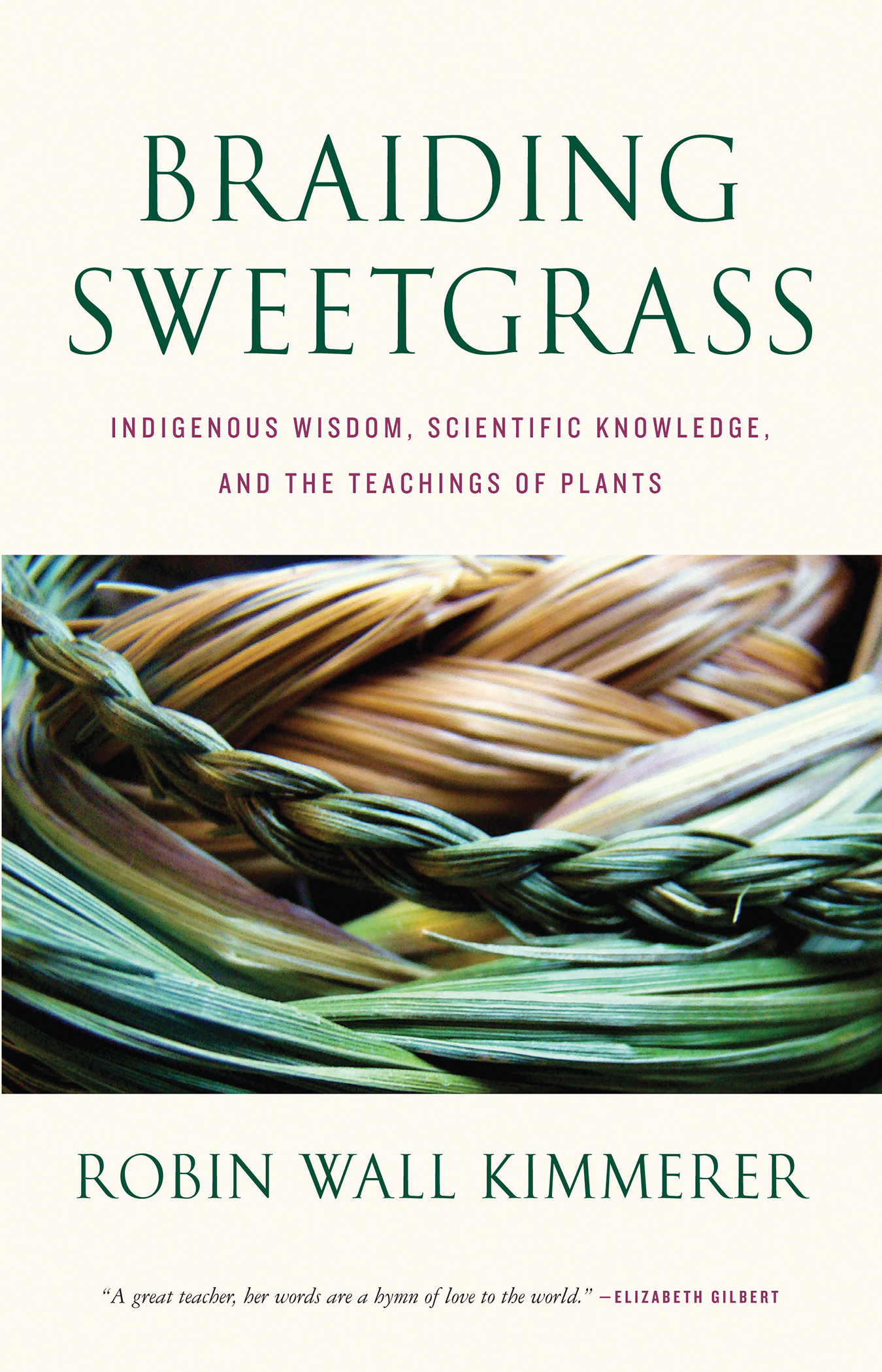
Braiding Sweetgrass
About this book
Robin Wall Kimmerer writes as a botanist, teacher, mother, and enrolled member of the Citizen Potawatomi Nation. Braiding Sweetgrass asks what becomes visible when plants are treated not only as objects of study, but as living participants in relationships of gift and obligation.
The essays move through maple forests, strawberry fields, restoration projects, laboratories, classrooms, and family land. Scientific experiments stand beside the Skywoman creation story, the grammar of animacy, harvesting practices, and ceremonies of gratitude.
Kimmerer does not collapse Indigenous knowledge into Western science or set the two up as simple rivals. She shows where their questions differ, where evidence can meet experience, and how the language used for the living world changes the behavior people consider reasonable.
Published in 2013, Braiding Sweetgrass is organized like its title: separate strands gain strength through relation. Its recurring subject is reciprocity — how receiving food, knowledge, and beauty creates a responsibility to give something back.
Read a sample
5,171 words
Plain text
From the opening
PREFACE
Hold out your hands and let me lay upon them a sheaf of freshly picked sweetgrass, loose and flowing, like newly washed hair. Golden green and glossy above, the stems are banded with purple and white where they meet the ground. Hold the bundle up to your nose. Find the fragrance of honeyed vanilla over the scent of river water and black earth and you understand its scientific name: Hierochloe odorata, meaning the fragrant, holy grass. In our language it is called wiingaashk, the sweet-smelling hair of Mother Earth. Breathe it in and you start to remember things you didn’t know you’d forgotten.
A sheaf of sweetgrass, bound at the end and divided into thirds, is ready to braid. In braiding sweetgrass—so that it is smooth, glossy, and worthy of the gift—a certain amount of tension is needed. As any little girl with tight braids will tell you, you have to pull a bit. Of course you can do it yourself—by tying one end to a chair, or by holding it in your teeth and braiding backward away from yourself—but the sweetest way is to have someone else hold the end so that you pull gently against each other, all the while leaning in, head to head, chatting and laughing, watching each other’s hands, one holding steady while the other shifts the slim bundles over one another, each in its turn. Linked by sweetgrass, there is reciprocity between you, linked by sweetgrass, the holder as vital as the braider. The braid becomes finer and thinner as you near the end, until you’re braiding individual blades of grass, and then you tie it off.
Will you hold the end of the bundle while I braid? Hands joined by grass, can we bend our heads together and make a braid to honor the earth? And then I’ll hold it for you, while you braid, too.
I could hand you a braid of sweetgrass, as thick and shining as the plait that hung down my grandmother’s back. But it is not mine to give, nor yours to take. Wiingaashk belongs to herself. So I offer, in its place, a braid of stories meant to heal our relationship with the world. This braid is woven from three strands: indigenous ways of knowing, scientific knowledge, and the story of an Anishinabekwe scientist trying to bring them together in service to what matters most. It is an intertwining of science, spirit, and story—old stories and new ones that can be medicine for our broken relationship with earth, a pharmacopoeia of healing stories that allow us to imagine a different relationship, in which people and land are good medicine for each other.
BRAIDING SWEETGRASS
PLANTING SWEETGRASS
Sweetgrass is best planted not by seed, but by putting roots directly in the ground. Thus the plant is passed from hand to earth to hand across years and generations. Its favored habitat is sunny, well-watered meadows. It thrives along disturbed edges.
Skywoman Falling
In winter, when the green earth lies resting beneath a blanket of snow, this is the time for storytelling. The storytellers begin by calling upon those who came before who passed the stories down to us, for we are only messengers.
In the beginning there was the Skyworld.
She fell like a maple seed, pirouetting on an autumn breeze.* A column of light streamed from a hole in the Skyworld, marking her path where only darkness had been before. It took her a long time to fall. In fear, or maybe hope, she clutched a bundle tightly in her hand.
*Adapted from oral tradition and Shenandoah and George, 1988.
Hurtling downward, she saw only dark water below. But in that emptiness there were many eyes gazing up at the sudden shaft of light. They saw there a small object, a mere dust mote in the beam. As it grew closer, they could see that it was a woman, arms outstretched, long black hair billowing behind as she spiraled toward them.
The geese nodded at one another and rose together from the water in a wave of goose music. She felt the beat of their wings as they flew beneath to break her fall. Far from the only home she’d ever known, she caught her breath at the warm embrace of soft feathers as they gently carried her downward. And so it began.
The geese could not hold the woman above the water for much longer, so they called a council to decide what to do. Resting on their wings, she saw them all gather: loons, otters, swans, beavers, fish of all kinds. A great turtle floated in their midst and offered his back for her to rest upon. Gratefully, she stepped from the goose wings onto the dome of his shell. The others understood that she needed land for her home and discussed how they might serve her need. The deep divers among them had heard of mud at the bottom of the water and agreed to go find some.
Loon dove first, but the distance was too far and after a long while he surfaced with nothing to show for his efforts. One by one, the other animals offered to help—Otter, Beaver, Sturgeon—but the depth, the darkness, and the pressures were too great for even the strongest of swimmers. They returned gasping for air with their heads ringing. Some did not return at all. Soon only little Muskrat was left, the weakest diver of all. He volunteered to go while the others looked on doubtfully. His small legs flailed as he worked his way downward and he was gone a very long time.
Continue reading the sampleClose the sample
They waited and waited for him to return, fearing the worst for their relative, and, before long, a stream of bubbles rose with the small, limp body of the muskrat. He had given his life to aid this helpless human. But then the others noticed that his paw was tightly clenched and, when they opened it, there was a small handful of mud. Turtle said, “Here, put it on my back and I will hold it.”
Skywoman bent and spread the mud with her hands across the shell of the turtle. Moved by the extraordinary gifts of the animals, she sang in thanksgiving and then began to dance, her feet caressing the earth. The land grew and grew as she danced her thanks, from the dab of mud on Turtle’s back until the whole earth was made. Not by Skywoman alone, but from the alchemy of all the animals’ gifts coupled with her deep gratitude. Together they formed what we know today as Turtle Island, our home.
Like any good guest, Skywoman had not come empty-handed. The bundle was still clutched in her hand. When she toppled from the hole in the Skyworld she had reached out to grab onto the Tree of Life that grew there. In her grasp were branches—fruits and seeds of all kinds of plants. These she scattered onto the new ground and carefully tended each one until the world turned from brown to green. Sunlight streamed through the hole from the Skyworld, allowing the seeds to flourish. Wild grasses, flowers, trees, and medicines spread everywhere. And now that the animals, too, had plenty to eat, many came to live with her on Turtle Island.
Our stories say that of all the plants, wiingaashk, or sweetgrass, was the very first to grow on the earth, its fragrance a sweet memory of Skywoman’s hand. Accordingly, it is honored as one of the four sacred plants of my people. Breathe in its scent and you start to remember things you didn’t know you’d forgotten. Our elders say that ceremonies are the way we “remember to remember,” and so sweetgrass is a powerful ceremonial plant cherished by many indigenous nations. It is also used to make beautiful baskets. Both medicine and a relative, its value is both material and spiritual.
There is such tenderness in braiding the hair of someone you love. Kindness and something more flow between the braider and the braided, the two connected by the cord of the plait. Wiingaashk waves in strands, long and shining like a woman’s freshly washed hair. And so we say it is the flowing hair of Mother Earth. When we braid sweetgrass, we are braiding the hair of Mother Earth, showing her our loving attention, our care for her beauty and well-being, in gratitude for all she has given us. Children hearing the Skywoman story from birth know in their bones the responsibility that flows between humans and the earth.
The story of Skywoman’s journey is so rich and glittering it feels to me like a deep bowl of celestial blue from which I could drink again and again. It holds our beliefs, our history, our relationships. Looking into that starry bowl, I see images swirling so fluidly that the past and the present become as one. Images of Skywoman speak not just of where we came from, but also of how we can go forward.
I have Bruce King’s portrait of Skywoman, Moment in Flight, hanging in my lab. Floating to earth with her handful of seeds and flowers, she looks down on my microscopes and data loggers. It might seem an odd juxtaposition, but to me she belongs there. As a writer, a scientist, and a carrier of Skywoman’s story, I sit at the feet of my elder teachers listening for their songs.
On Mondays, Wednesdays, and Fridays at 9:35 a.m., I am usually in a lecture hall at the university, expounding about botany and ecology—trying, in short, to explain to my students how Skywoman’s gardens, known by some as “global ecosystems,” function. One otherwise unremarkable morning I gave the students in my General Ecology class a survey. Among other things, they were asked to rate their understanding of the negative interactions between humans and the environment. Nearly every one of the two hundred students said confidently that humans and nature are a bad mix. These were third-year students who had selected a career in environmental protection, so the response was, in a way, not very surprising. They were well schooled in the mechanics of climate change, toxins in the land and water, and the crisis of habitat loss. Later in the survey, they were asked to rate their knowledge of positive interactions between people and land. The median response was “none.”
I was stunned. How is it possible that in twenty years of education they cannot think of any beneficial relationships between people and the environment? Perhaps the negative examples they see every day— brownfields, factory farms, suburban sprawl—truncated their ability to see some good between humans and the earth. As the land becomes impoverished, so too does the scope of their vision. When we talked about this after class, I realized that they could not even imagine what beneficial relations between their species and others might look like. How can we begin to move toward ecological and cultural sustainability if we cannot even imagine what the path feels like? If we can’t imagine the generosity of geese? These students were not raised on the story of Skywoman.
On one side of the world were people whose relationship with the living world was shaped by Skywoman, who created a garden for the well-being of all. On the other side was another woman with a garden and a tree. But for tasting its fruit, she was banished from the garden and the gates clanged shut behind her. That mother of men was made to wander in the wilderness and earn her bread by the sweat of her brow, not by filling her mouth with the sweet juicy fruits that bend the branches low. In order to eat, she was instructed to subdue the wilderness into which she was cast.
Same species, same earth, different stories. Like Creation stories everywhere, cosmologies are a source of identity and orientation to the world. They tell us who we are. We are inevitably shaped by them no matter how distant they may be from our consciousness. One story leads to the generous embrace of the living world, the other to banishment. One woman is our ancestral gardener, a cocreator of the good green world that would be the home of her descendants. The other was an exile, just passing through an alien world on a rough road to her real home in heaven.
And then they met—the offspring of Skywoman and the children of Eve—and the land around us bears the scars of that meeting, the echoes of our stories. They say that hell hath no fury like a woman scorned, and I can only imagine the conversation between Eve and Skywoman: “Sister, you got the short end of the stick . . .”
The Skywoman story, shared by the original peoples throughout the Great Lakes, is a constant star in the constellation of teachings we call the Original Instructions. These are not “instructions” like commandments, though, or rules; rather, they are like a compass: they provide an orientation but not a map. The work of living is creating that map for yourself. How to follow the Original Instructions will be different for each of us and different for every era.
In their time, Skywoman’s first people lived by their understanding of the Original Instructions, with ethical prescriptions for respectful hunting, family life, ceremonies that made sense for their world. Those measures for caring might not seem to fit in today’s urban world, where “green” means an advertising slogan, not a meadow. The
buffalo are gone and the world has moved on. I can’t return salmon to the river, and my neighbors would raise the alarm if I set fire to my yard to produce pasture for elk.
The earth was new then, when it welcomed the first human. It’s old now, and some suspect that we have worn out our welcome by casting the Original Instructions aside. From the very beginning of the world, the other species were a lifeboat for the people. Now, we must be theirs. But the stories that might guide us, if they are told at all, grow dim in the memory. What meaning would they have today? How can we translate from the stories at the world’s beginning to this hour so much closer to its end? The landscape has changed, but the story remains. And as I turn it over again and again, Skywoman seems to look me in the eye and ask, in return for this gift of a world on Turtle’s back, what will I give in return?
It is good to remember that the original woman was herself an immigrant. She fell a long way from her home in the Skyworld, leaving behind all who knew her and who held her dear. She could never go back. Since 1492, most here are immigrants as well, perhaps arriving on Ellis Island without even knowing that Turtle Island rested beneath their feet. Some of my ancestors are Skywoman’s people, and I belong to them. Some of my ancestors were the newer kind of immigrants, too: a French fur trader, an Irish carpenter, a Welsh farmer. And here we all are, on Turtle Island, trying to make a home. Their stories, of arrivals with empty pockets and nothing but hope, resonate with Skywoman’s. She came here with nothing but a handful of seeds and the slimmest of instructions to “use your gifts and dreams for good,” the same instructions we all carry. She accepted the gifts from the other beings with open hands and used them honorably. She shared the gifts she brought from Skyworld as she set herself about the business of flourishing, of making a home.
Perhaps the Skywoman story endures because we too are always falling. Our lives, both personal and collective, share her trajectory. Whether we jump or are pushed, or the edge of the known world just crumbles at our feet, we fall, spinning into someplace new and unexpected. Despite our fears of falling, the gifts of the world stand by to catch us.
As we consider these instructions, it is also good to recall that, when Skywoman arrived here, she did not come alone. She was pregnant. Knowing her grandchildren would inherit the world she left behind, she did not work for flourishing in her time only. It was through her actions of reciprocity, the give and take with the land, that the original immigrant became indigenous. For all of us, becoming indigenous to a place means living as if your children’s future mattered, to take care of the land as if our lives, both material and spiritual, depended on it.
In the public arena, I’ve heard the Skywoman story told as a bauble of colorful “folklore.” But, even when it is misunderstood, there is power in the telling. Most of my students have never heard the origin story of this land where they were born, but when I tell them, something begins to kindle behind their eyes. Can they, can we all, understand the Skywoman story not as an artifact from the past but as instructions for the future? Can a nation of immigrants once again follow her example to become native, to make a home?
Look at the legacy of poor Eve’s exile from Eden: the land shows the bruises of an abusive relationship. It’s not just land that is broken, but more importantly, our relationship to land. As Gary Nabhan has written, we can’t meaningfully proceed with healing, with restoration, without “re-story-ation.” In other words, our relationship with land cannot heal until we hear its stories. But who will tell them?
In the Western tradition there is a recognized hierarchy of beings, with, of course, the human being on top—the pinnacle of evolution, the darling of Creation—and the plants at the bottom. But in Native ways of knowing, human people are often referred to as “the younger brothers of Creation.” We say that humans have the least experience with how to live and thus the most to learn—we must look to our teachers among the other species for guidance. Their wisdom is apparent in the way that they live. They teach us by example. They’ve been on the earth far longer than we have been, and have had time to figure things out. They live both above and below ground, joining Skyworld to the earth. Plants know how to make food and medicine from light and water, and then they give it away.
I like to imagine that when Skywoman scattered her handful of seeds across Turtle Island, she was sowing sustenance for the body and also for the mind, emotion, and spirit: she was leaving us teachers. The plants can tell us her story; we need to learn to listen.
The Council of Pecans
Heat waves shimmer above the grasses, the air heavy and white and ringing with the buzz of cicadas. They’ve been shoeless all summer long, but even so the dry September stubble of 1895 pricks their feet as they trot across the sunburned prairie, lifting their heels like grass dancers. Just young willow whips in faded dungarees and nothing else, their ribs showing beneath narrow brown chests as they run. They veer off toward the shady grove where the grass is soft and cool underfoot, flopping in the tall grass with the loose-limbed abandon of boys. They rest for a few moments in the shade and then spring to their feet, palming grasshoppers for bait.
The fishing poles are right where they left them, leaning up against an old cottonwood. They hook the grasshoppers through the back and throw out a line while the silt of the creek bottom oozes up cool between their toes. But the water hardly moves in the paltry channel left by drought. Nothing’s biting but a few mosquitoes. After a bit, the prospect of a fish dinner seem as thin as their bellies, beneath faded denim pants held up with twine. Looks like nothing but biscuits and redeye gravy for supper tonight. Again. They hate to go home empty-handed and disappoint Mama, but even a dry biscuit fills the belly.
The land here, along the Canadian River, smack in the middle of Indian Territory, is a rolling savanna of grass with groves of trees in the bottomlands. Much of it has never been plow broke, as no one has a plow. The boys follow the stream from grove to grove back up toward the home place on the allotment, hoping for a deep pool somewhere, finding nothing. Until one boy stubs his toe on something hard and round hidden in the long grass.
There’s one and then another, and then another—so many he can hardly walk. He takes up a hard green ball from the ground and whips it through the trees at his brother like a fastball as he yells, “Piganek! Let’s bring ’em home!” The nuts have just begun to ripen and fall and blanket the grass. The boys fill their pockets in no time and then pile up a great heap more. Pecans are good eating but hard to carry, like trying to carry a bushel of tennis balls: the more you pick up, the more end up on the ground. They hate to go home empty-handed, and Mama would be glad for these—but you can’t carry more than a handful . . .
The heat eases a little as the sun sinks low and evening air settles in the bottomland, cool enough for them to run home for supper. Mama hollers for them and the boys come running, their skinny legs pumping and their underpants flashing white in the fading light. It looks like they’re each carrying a big forked log, hung like a yoke over their shoulders. They throw them down at her feet with grins of triumph: two pairs of worn-out pants, tied shut with twine at the ankles and bulging with nuts.
One of those skinny little boys was my grandpa, hungry enough to gather up food whenever he found it, living in a shanty on the Oklahoma prairie when it was still “Indian Territory,” just before it all blew away. As unpredictable as life may be, we have even less control over the stories they tell about us after we’re gone. He’d laugh so hard to hear that his great-grandchildren know him not as a decorated World War I veteran, not as a skilled mechanic for newfangled automobiles, but as a barefoot boy on the reservation running home in his underwear with his pants stuffed with pecans.
The word pecan—the fruit of the tree known as the pecan hickory (Carya illinoensis) —comes to English from indigenous languages. Pigan is a nut, any nut. The hickories, black walnuts, and butternuts of our northern homelands have their own specific names. But those trees, like the homelands, were lost to my people. Our lands around Lake Michigan were wanted by settlers, so in long lines, surrounded by soldiers, we were marched at gunpoint along what became known as the Trail of Death. They took us to a new place, far from our lakes and forests. But someone wanted that land too, so the bedrolls were packed again, thinner this time. In the span of a single generation my ancestors were “removed” three times—Wisconsin to Kansas, points in between, and then to Oklahoma. I wonder if they looked back for a last glimpse of the lakes, glimmering like a mirage. Did they touch the trees in remembrance as they became fewer and fewer, until there was only grass?
So much was scattered and left along that trail. Graves of half the people. Language. Knowledge. Names. My great-grandmother Sha-note, “wind blowing through,” was renamed Charlotte. Names the soldiers or the missionaries could not pronounce were not permitted.
When they got to Kansas they must have been relieved to find groves of nut trees along the rivers—a type unknown to them, but delicious and plentiful. Without a name for this new food they just called them nuts—pigan—which became pecan in English.
I only make pecan pie at Thanksgiving, when there are plenty around to eat it all. I don’t even like it especially, but I want to honor that tree. Feeding guests its fruit around the big table recalls the trees’ welcome to our ancestors when they were lonesome and tired and so far from home.
The boys may have come home fishless, but they brought back nearly as much protein as if they’d had a stringer of catfish. Nuts are like the pan fish of the forest, full of protein and especially fat—“poor man’s meat,” and they were poor. Today we eat them daintily, shelled and toasted, but in the old times they’d boil them up in a porridge. The fat floated to the top like a chicken soup and they skimmed it and stored it as nut butter: good winter food. High in calories and vitamins—everything you needed to sustain life. After all, that’s the whole point of nuts: to provide the embryo with all that is needed to start a new life.
. . . .
Butternuts, black walnuts, hickories, and pecans are all closely related members of the same family (Juglandaceae). Our people carried them wherever they migrated, more often in baskets than in pants, though. Pecans today trace the rivers through the prairies, populating fertile bottomlands where people settled. My Haudenosaunee neighbors say that their ancestors were so fond of butternuts that they are a good marker of old village sites today. Sure enough, there is a grove of butternuts, uncommon in “wild” forests, on the hill above the spring at my house. I clear the weeds around the young ones every year and slosh a bucket of water on them when the rains are late. Remembering.
The old family home place on the allotment in Oklahoma has a pecan tree shading what remains of the house. I imagine Grammy pouring nuts out to prepare them and one rolling away to a welcoming spot at the edge of the dooryard. Or maybe she paid her debt to the trees by planting a handful in her garden right then and there.
Thinking back to that old story again, it strikes me that the boys in the pecan grove were very wise to carry home all that they could: nut trees don’t make a crop every year, but rather produce at unpredictable intervals. Some years a feast, most years a famine, a boom and bust cycle known as mast fruiting. Unlike juicy fruits and berries, which invite you to eat them right away before they spoil, nuts protect themselves with a hard, almost stony shell and a green, leathery husk. The tree does not mean for you to eat them right away with juice dripping down your chin. They are designed to be food for winter, when you need fat and protein, heavy calories to keep you warm. They are safety for hard times, the embryo of survival. So rich is the reward that the contents are protected in a vault, double locked, a box inside a box. This protects the embryo within and its food supply, but it also virtually guarantees that the nut will be squirreled away someplace safe.
The only way through the shell is a lot of work, and a squirrel would be unwise to sit gnawing it in the open where a hawk would gladly take advantage of its preoccupation. Nuts are designed to be brought inside, to save for later in a chipmunk’s cache, or in the root cellar of an Oklahoma cabin. In the way of all hoards, some will surely be forgotten—and then a tree is born.
For mast fruiting to succeed in generating new forests, each tree has to make lots and lots of nuts—so many that it overwhelms the would-be seed predators. If a tree just plodded along making a few nuts every year, they’d all get eaten and there would be no next generation of pecans. But given the high caloric value of nuts, the trees can’t afford this outpouring every year—they have to save up for it, as a family saves up for a special event. Mast-fruiting trees spend years making sugar, and rather than spending it little by little, they stick it under the proverbial mattress, banking calories as starch in their roots. When the account has a surplus, only then could my Grandpa bring home pounds of nuts.
This boom and bust cycle remains a playground of hypotheses for tree physiologists and evolutionary biologists. Forest ecologists hypothesize that mast fruiting is the simple outcome of this energetic equation: make fruit only when you can afford it. That makes sense. But trees grow and accumulate calories at different rates depending on their habitats. So, like the settlers who got the fertile farmland, the fortunate ones would get rich quickly and fruit often, while their shaded neighbors would struggle and only rarely have an abundance, waiting for years to reproduce. If this were true, each tree would fruit on its own schedule, predictable by the size of its reserves of stored starch. But they don’t. If one tree fruits, they all fruit—there are no soloists. Not one tree in a grove, but the whole grove; not one grove in the forest, but every grove; all across the county and all across the state. The trees act not as individuals, but somehow as a collective. Exactly how they do this, we don’t yet know. But what we see is the power of unity. What happens to one happens to us all. We can starve together or feast together. All flourishing is mutual.
In the summer of 1895, the root cellars throughout Indian Territory were full of pecans, and so were the bellies of boys and squirrels. For people, the pulse of abundance felt like a gift, a profusion of food to be simply picked up from the ground. That is, if you got there before the squirrels. And if you didn’t, at least there would be lots of squirrel stew that winter. The pecan groves give, and give again. Such communal generosity might seem incompatible with the process of evolution, which invokes the imperative of individual survival. But we make a grave error if we try to separate individual well-being from the health of the whole. The gift of abundance from pecans is also a gift to themselves. By sating squirrels and people, the trees are ensuring their own survival. The genes that translate to mast fruiting flow on evolutionary currents into the next generations, while those that lack the ability to participate will be eaten and reach an evolutionary dead end. Just so, people who know how to read the land for nuts and carry them home to safety will survive the February blizzards and pass on that behavior to their progeny, not by genetic transmission but by cultural practice.