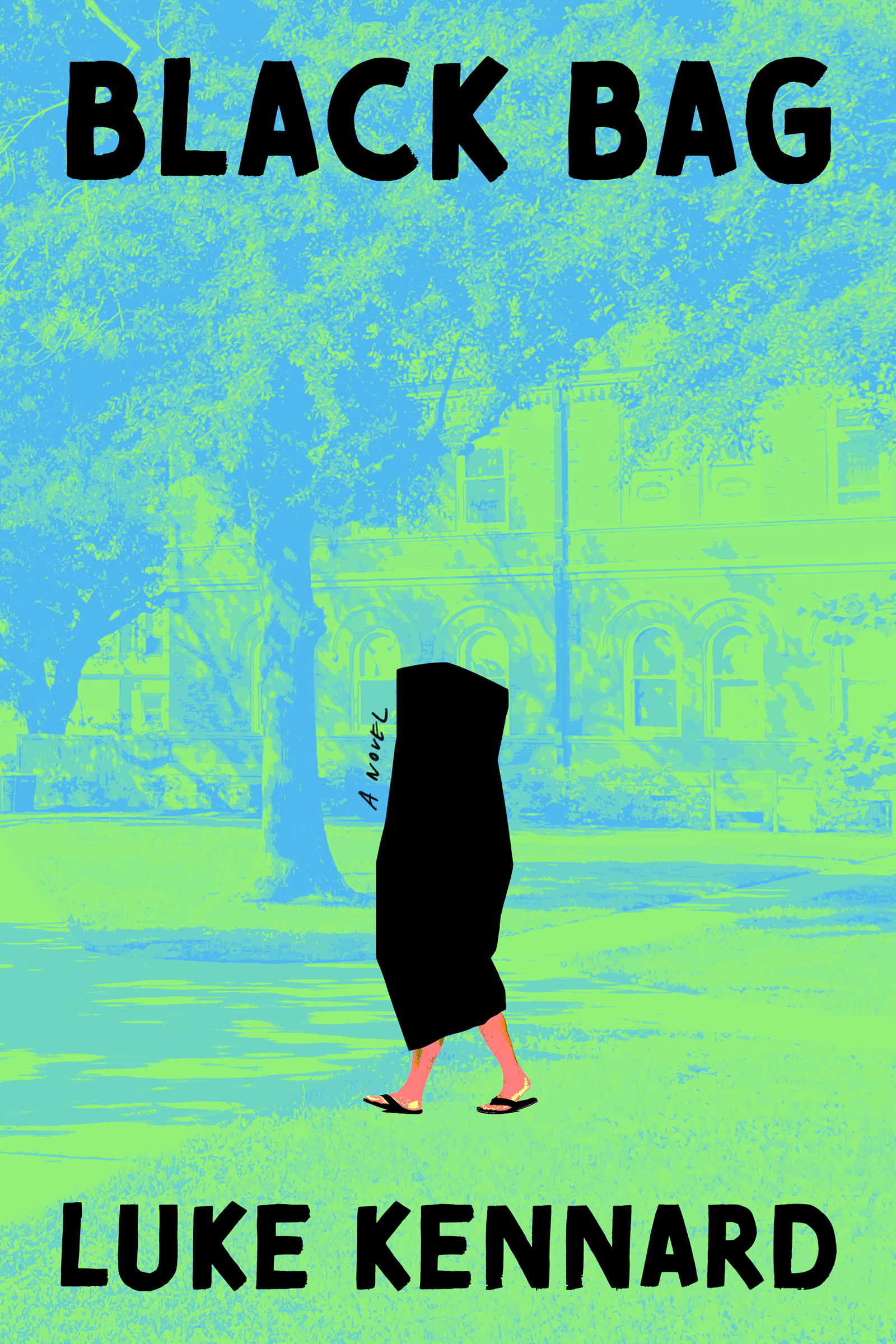
Black Bag
About this book
Short of money and work, an actor agrees to sit silently at the back of Dr Blend's lectures inside an oversized black bag. The professor wants to observe how students respond to an unexplained human presence that cannot return their gaze.
The performance refuses to stay contained within the original study. A professor of post-humanism takes a personal and scholarly interest, while the actor's childhood friend sees a situation that can be packaged, expanded, and sold.
Remaining hidden gives the actor unusual power and unusual passivity. Other people project theories and desires onto the bag, and he must decide whether being needed for what he represents is better than being seen as himself.
Black Bag is a standalone campus novel, off-center love story, and comedy of precarious work. Luke Kennard follows an absurd job seriously enough to expose how institutions turn bodies, ideas, and loneliness into material.
Read a sample
5,005 words
Plain text
From the opening
1
IF YOU MET ANYONE AS WHINY, as disobliging and egocentric as the average narrator of a novel in real life you’d find them unbearable. You’d give them about five minutes before you excused yourself to get another drink, or moved to a different carriage, or asked to be transferred to an alternative department so you didn’t have to work with them anymore.
I’m not like that.
I love life. I love being alive.
Sometimes I don’t. That’s not unusual. You don’t always love being alive. Nobody does.
I’m an actor.
That’s just something I wanted to get out of the way at the beginning.
It is also why I will speak to you in present tense. The silliest tense. And also the closest we come to talking directly to God.
I will have little choice over what I choose to include or omit.
I will be completely known.
At the moment, for instance, I am waiting to cross the road to meet my friend Claudio at a Middle Eastern restaurant called Indigo Mood. I am unable to cross because a double-decker bus has stopped directly in front of me, and I am anxious in case, by the time I have negotiated the length of the bus to slip between it and a black SUV, the traffic will start moving and I will have to hold my hands up in apology as I dash across, possibly into the path of an oncoming van in the next lane. The more I hesitate the more likely this becomes.
To skirt over my present reduced circumstances: I have not had a paid job in three months, and that was a murder-mystery dinner show (jazz age champagne-factory owner). I am a month behind on my rent and while I have found a way to pay this month’s, the month in arrears squats on my shoulder and grins like a gatepost dragon. I am behind on most utility bills. I have measured out my life in coffees I cannot technically afford.
So when Claudio offers to buy me a falafel in Indigo Mood, a restaurant selected for its proximity to his flat, I accept.
He runs a hand through his curly black hair and tells me it’s good to see me. It’s been too long.
I tell him I know what his schedule is like.
Nah, fuck off, says Claudio. That’s no excuse. I don’t want to lose touch like that again. I need you to keep me human.
I’m not sure I’m the best person to do that.
Yeah yeah, he says. You’re the most human guy I know.
Claudio and I get on well because we have known each other since the age of seven, which is to say thirty years, and we have, at some base level, no respect for one another: We do not fall for one another’s hasty renovations of character or revisionist sophistications; we are not convinced by one another’s adult selves. Before he found his place in the world, Claudio was, for me, a point of endlessly reassuring comparison: I may not have made much of my potential, but then there’s Claudio. I may be useless with money, but then there’s Claudio. I may have an addictive personality, but Claudio has literal, bona fide addictions. I imagine he still sees me in exactly the same way: as a seven-year-old. And, being financially if not culturally very secure, he likely sees the very same flaws in me that I do in him. Claudio. The Cloud. His mother was Portuguese.
How much do you think one of those costs? I say.
What?
I point to the chilled counter, dressed salads and swords of raw meat under glass, glistening bottles of fizzy drinks.
How much does a commercial chiller cabinet cost? says Claudio. I don’t know? A couple of grand? Why?
I have found myself obsessed with how much things cost. I have become obsessed with money, I tell him.
Oh man, says Claudio. That’s rough. That’s not for you. You should be focusing on the life of the mind.
How long would it take me to even make the down payment on a chilled sandwich counter? I say. And then several years to pay it off, by which time it would have become obsolete and leaky and wouldn’t keep things at the correct temperature and I’d have to find the deposit to buy another.
The thing is you don’t need to worry about that, says Claudio. You are never going to be in a position to need a commercial chiller cabinet.
That’s probably true.
I take a bite of my wrap. The tahini, the fresh mint leaves, the granular, yielding texture. The wrap has been assembled with such pride it almost brings me to tears.
Look, homes, these random fixations sound to me like generalized anxiety disorder, says Claudio, caused by the conditions inherent to late capitalism. If you’d let me loan you some money—
No.
I could get you through this patch and you could concentrate on your work.
Ha, I say. You’d be like my patron.
I could be your patron, says Claudio. Think about it.
Claudio, at the beginning, had many patrons, but now he makes enough through ad revenue that he’d probably be okay if they abandoned him.
I could be your patron, baby, he sings.
I am not too proud to accept Claudio’s generosity. I have never turned down a drink. But I do not borrow money from friends; it messes things up. Especially when you think it won’t.
Actually, though, I say, I am on my way somewhere.
Work?
Yes.
You got a part?
An audition.
That’s great! Stage?
More site specific. About climate change.
This is really good news, says Claudio, and he means it, god bless him, and takes a bite of his wrap. Things are looking, how you say, up?
Things are looking, how you say, up.
Continue reading the sampleClose the sample
2
THERE WAS A TIME WHEN a genuinely bohemian lifestyle was possible, by which I mean economically feasible. Where it persists now, it is only as cosplay for bored kids with private incomes.
My belly is full of falafel and wet, well-seasoned salads. The traffic parts for me like the Red Sea.
I have a small hoop earring. I keep my hair short because I have strong features. I try to have the utmost contempt for money, but the fact is that I must find £1,400 per month to cover my basic expenses: rent, utility bills, council tax. I could reduce this, negligibly, by taking a room in a shared house, but I am not the type and value my solitude. Anything I make on top of £1,400 (an amount, I should add, that in my youth seemed an unimaginably large sum, an impossible fortune, but that now I must somehow come up with every four weeks) is for food, and I have cultivated an obsession for eating simply and frugally. Dense rye breads, dried fruits, porridge. I currently have a bowl of borlotti beans soaking in the kitchenette.
Clothes I receive twice annually: for my birthday (an end of summer baby, naturally, condemned to spend my entire education small for my age because I was almost a year younger than my immediate peers) and for Christmas (when the dominant are born) from my parents. I favor two pairs of immensely durable black jeans (which take over three years to fade and fray and require replacement) white button-down shirts and the occasional jumper. I have had the same overcoat since 2002. I’m wearing it now. I have learned how to repair pockets and sew on buttons on YouTube.
Holding a needle between my teeth and squinting at a faux-silk lining under lamplight is when I feel closest to some notion of the bohemian ideal.
I never go on holiday and have no interest in doing so, but early in my vocation I had the chance to travel, expenses only, to South America and East Asia, with a street-theater group, long disbanded. In this sense I am very much a man of the world, a seasoned traveler, someone with a broadened mind who has been exposed to other cultures, who knows and is true to himself because he now sees himself with absolute clarity.
An Englishman.
LMFAO, as they say.
You met that Englishman? He’s so English.
What else do people spend money on? I like to drink, I ought to admit that, and cannot imagine any other way of transporting myself from the day into the night. I’m picky. A blended Scotch is perfectly acceptable as long as it’s the right blended Scotch. I buy alcohol on a credit card and it is the only thing I use the credit card for. I pay off my tab whenever I land a part that nets me sufficient funds.
My résumé is in innumerable piles on innumerable desks as we speak.
Little applications for indefinite leave to remain at the gates of heaven.
I stop to pick up a twenty-pence piece at the side of a drain. I flick off a fragment of something black and slip it into my pocket.
I am past caring but I am not past the vision of a future self, as real as any memory, a glass of wine on my veranda, reflecting on this, this now, as the low point of my career; giving an interview, on my veranda, to a quietly anxious journalist about how this was the low point of my career and how close I came to giving up. I’m not over that yet.
All of this is important. I am not important, but what I have to tell you is very important. Something is badly wrong. All hell is about to break loose. I see visions. We all do. I am not a pessimist, but something is very badly wrong and that which we held to be foundational is beginning to liquefy. The bien-pensant opinion is that we have never been more divided; how sad it is that we are more divided than we’ve ever been, so sad. But that’s not it. It’s neither true nor sad and at the very least the things we commit to language ought to be one or the other.
Depending on your perspective I am probably, objectively, quite poorly educated. I sat in silent consternation while my teachers lost their composure with my more boisterous contemporaries, hour after hour, term after term. I developed an elaborate inner world I’ve never really left. You’ll forgive me if I occasionally mispronounce a word. You won’t be able to tell.
I check the walking route on my phone at the pelican crossing. Thirty-three minutes. I will reach the audition with sufficient time to stop sweating but not so much as to start fussing and doubting my worth. Good.
Something I love: plays. I love it when someone—a writer—has written a really good play, with characters and dialogue and a story that may be interpreted and realized by a director and a cast of actors in a theater. Love it. I love all of it: the drawing room farce and the discombobulating three-hour monologue with no fixed speaker. Good plays are probably my favorite thing in all the world.
I have nothing but disdain for the alternative.
Unfortunately the alternative is the most readily available work—my, as it were, bread and butter—and the more time I spend in exploratory movement and stillness, hot seat improv, “researching a stimulus as a team,” collaborative enterprise, reflective logbooks, space / time / weight / flow, “creating a unified vision as an ensemble,” the more I say yes to such joyless and culturally moribund opportunities, the more such opportunities open up to me, like a giant origami flower made of tax returns.
The subject matter is always worthy: modern slavery; the long-term effects of early exposure to extreme pornography; zero-hours contracts. Who among the theater-going public doesn’t want their awareness of these horrors raised? Pried open, if necessary?
I feign enthusiasm, I give it everything, all the while feeling like someone is constantly slapping me in the stomach with an old brown shoe. All the while participating directly in the desecration of the one true art I live for. For subsistence wages.
I’m very cooperative and a good liar. Forty-five days of concerted effort, glorified trust exercises, listening and listening to each other, especially listening when someone says something demonstrably stupid or just plain wrong lest any of us be thought undemocratic; pages and pages that resemble less a play than a module-evaluation form or minutes of a local council meeting, drills and rehearsals, rehearsals and drills. Eventually, and with great collective dedication, to produce, time and time again, a show of such suffocating mediocrity, I could cry thinking about it.
I balance these jobs with murder-mystery dinner theater, which I find slightly less degrading.
3
I AM IN A LOW ROOM of whitewashed brick walls, spider plants in little alcoves, halogens in the ceiling. A man with a big face and a beard sits behind a gray school table between a smart young woman in a voluminous green jumper and a man who has the face of a child, worn out at the crevices; a child who lives on a mountain. The usual plunging feeling that every human being is real, substantial and well-defined except for me. I dismiss this. Inverted vanity. Get over it.
Well, hello, I must be myself, they’re grateful to me for coming in, my experience is impressive, just relax, they’re going to do something a bit different.
When the director talks to his associates I cannot hear it—it dissolves into a mime. It seems important.
They’d like me to improvise.
They’d like me to—
The director seems suddenly perturbed.
I’m sorry.
I look at his ears to see if he is receiving messages from somewhere else. This doesn’t appear to be the case unless his earpiece is very small.
As I know, the theme we’ll be exploring is the climate disaster, the climate catastrophe. This is coming whether we like it or not, you know? What do I think about the links between the communal effort required to face the disaster, the catastrophe, and the communal effort of staging a play?
Central, I say.
Central.
I think the parallels cannot be exaggerated. I think it would be impossible to exaggerate them.
Could I try?
Could I try to exaggerate them?
They laugh. Could I try to describe them?
We need to move as one mechanical arm, I offer. We need to operate like an artificial intelligence trying out several hundred permutations a second until we happen upon the right one.
He takes a note.
That’s just brilliant, thank you.
They’re going to try something new.
The director comes across not so much as a nice man as, for all the world, a man obsessed with how he’ll be described in his obituary. I’ll miss his twinkling wit. He even made coffee for the assistants. The world is a sadder place without him in it. That’s the kind of shit he wants in his obituary. Who wouldn’t? It doesn’t make him special.
They’d like me to break the news of a flood.
A flood?
Right now.
Like Noah?
Whatever flood I like. Try to convince us.
I go completely blank. I stare at the single brown frond of the third spider plant from the left. I’m not sure how one tends spider plants—prunes the leaves or not.
In my own time.
Whenever I’m ready.
I open my mouth. I open it wide. I release a single, undulating note. I alternate between my chest voice and my head voice. I increase the volume in inverse proportion to my uncertainty until I am singing, really singing.
The director and his associates stare at me; maybe they are trying not to laugh, maybe they are trying very hard to take me seriously. The director looks as though he has tasted something sour but wants to like it.
Then the woman brushes something from the shoulder of her green jumper, opens her mouth and begins to sing the same note. Then the child-faced man. And then the director. I look him directly in the eye. I go between the three of them, holding their gaze for several seconds each. We are not harmonizing. We sing the same note—an E, is I think what I have arrived at—and we hold the note.
Then we all stop at exactly the same time.
Thank you.
And now …
Yes?
And now if I could announce the flood.
Ah.
I liked to think I had already done so, organisms vibrating at the same frequency, a nonverbal call to action.
If I could, nonetheless, provide some dialogue.
After such a gamble I’m not sure I have anything left. I have mere seconds to decide between Old Testament prophet and operations manager. I’m not sure whom I’m even supposed to be announcing the flood to. My community? The acting community?
I take a breath to give the impression that I have been composing myself.
Oh god I just can’t be bothered.
I think most of the people who choose to spend their free time seeing a play about climate change are probably already on board with the whole message, I say. And the idea that a devised theater piece could reach anyone outside the customary audience for devised theater pieces is clearly nonsense. So I suppose the real question is: If a theater was gradually filling with water, soon to drown us all, would you rather see this piece of shit or Hedda Gabler?
The assistants both look at the director, one smiling, the other with his lips pursed.
No, this is good, the director says, writing something on his tablet with a little white stick. This is actually the kind of honesty we’re looking for.
Oh, I say, great. Because this, if it isn’t altogether beneath contempt, is a capitulation to the utter impoverishment of our own discourse to the point where we might as well not have developed the capacity for language in the first place. I hope we do all get washed away in a flood.
The director’s stick clicks against the tablet.
We can use that, he says, then smiles.
All of that said, I would still also really like to be in the play, I say.
So how was it?
You don’t need to check in on me, Claudio.
I pause at the entrance to a corner shop. I need a bottle of cooking oil, but I don’t want to carry it.
Concerned about you, honey. I’m taking an interest.
I turn the volume up on my phone. Claudio is always quiet on the phone. I hit the button at the pelican crossing and wait.
I think I gave a good account of myself, I say.
What else can we do?
Right?
Well you let me know when you hear back, okay?
Yeah, I say. Look, Claudio, even if this comes through, it’s not a big thing, it’s not the big time, it’s a small thing, it’s the same old small thing.
Don’t be like that, says Claudio. You’re beautiful and I believe in you.
I’m saying this is a waste of your attention.
You keep that chin up.
I will.
Do it right now. Raise your chin.
I’m doing it.
And hold it.
Holding it.
Everyone else can go to hell.
Okay.
Okay, he says. I’m gonna get back on it.
You do that.
Claudio has a strict schedule of four hours live streaming video games every weekday from 11 a.m. to 3 p.m. or 3 p.m. to 7 p.m. The stream is open to anyone, but subscribers pay two pounds a month. There are roughly 20,000 subscribers and counting, meaning that Claudio is a higher-rate taxpayer. They drop in and out. Many of them are at work, or working from home, and they use Claudio as a kind of background entertainment to compensate for the intolerable tedium of their jobs and life administration. He is their siesta and their carnivalesque, their call to prayer and their break room.
You may think this a charmed life, paid—and handsomely—to play video games and talk about them. But prop your phone up on your desk and try to record yourself for even ten minutes. Do it now. Talk about whatever’s on your mind.
Now play it back.
You suck. You’re not funny and you look like a murderer. What you have just recorded has all the grace and wit of a ransom video. Your voice is awful. You sound like a complete stranger’s most boring in-law. Now imagine doing that for four hours at a time. I don’t think this is for you.
You don’t want to hear it, but doing this well is as rare a gift as being a concert-grade violinist.
As you play and narrate, the messages from your community arrive faster than you can read them, largely dross, always faintly self-absorbed and disrespectful, rarely contributing anything, tens of thousands of words a day. And you have to pick out the least worst to respond to, at a millisecond’s notice, and turn that into relatable content. Let us be quite clear that what we have monetized, what we have rendered a career for a select few—strip away the layers of irony, of brazenness and boredom, just for a moment—is charm, and charm alone. Weaponized charm.
I get back to my ground-floor flat and take off my trainers—the right one has been chafing my heel. I check the bowl of dried borlotti beans soaking on the counter. I hold a single bean between my thumb and finger. I test it with my teeth. Still a little hard.
4
MY INSPECTION OF THE BEANS is interrupted by an incoming video call. A video call means it is Howard.
Howard is one of two men who sometimes call me with offers of murder-mystery dinner roles: spiteful little half-brother, embittered failed actor, semicompetent confidence trickster. His company is called Half a Mind to Kill, catering for audiences from six to two hundred and sixty. These are largely corporate functions, sideshows for cultural sleepwalkers, in which we ply our trade for the people responsible for its degradation.
I take my supper in the kitchen between acts, a piled-up version of the paying guests’ repast. I eat it with my hands and wipe them on a dishcloth then I cram my lines for the next scene. A little ad-libbing is acceptable, within reason.
Howard is a man with a fairly unpleasant temperament and a plain, flat face, but he seems not to know this about himself, hence his penchant for video calls. Just now he is outside and for all the world looks to be in a minimum security prison, standing by a thick chicken wire fence.
Howard.
He wears his hair long, which does nothing for him whatsoever.
All right? Howard says. I’ll cut to the chase ’cause I’m working down a list. My detective has gastric flu, looking for a last-minute filler.
When?
Tonight?
I suck in air like a car mechanic surveying a minor dent. It is important that Howard, of all people, never takes me for granted.
I’d have to move some things around.
Important that he doesn’t know I’d literally be facing eviction without his weird video calls and bullshit dinner shows.
You can do it?
What’s it called?
The Salumist of Avila.
Gosh, that’s bad.
What do you reckon?
Whereabouts is this tour de weakness to be staged?
Tour de … fuck off! Brown’s Hotel. I can’t send a cab, but there’s a bus stop nearby. Four-fifty quid. You’ll do it?
Yeah, okay, Howballs.
Lifesaver, mate, thank you.
His hair dangles over the camera as he hangs up.
Dinner theater had a storied history throughout the twentieth century and you’d likely be surprised how many celebrated names took it as a side hustle. You’d look down the list and be like, Lana Turner? Really? Roddy McDowall? It more or less dried up in the 1980s, but has now reemerged as an option alongside paintball, Laser Quest, team-building CBT.
When they’re not being forced to by their employers, who is it, I wonder, who goes to these things? The same people who go to shopping center art galleries, who own paintings by Bob Dylan, as if that’s what Bob Dylan is for.
I’m being mean.
Everyone needs to have fun and of course I give it my all. They barely register it between mouthfuls of duck three ways, but they get the full Stanislavsky.
Whose fault is this? How have we preserved only the worst things about the end of pier and the opera house?
On my way to the bus I look at my reflection in the smeary-mirrored window of a closed-down model-railway shop. What do those big, gentle, foul-smelling men even do now? I can say, objectively and I hope without vanity, that I look young for my age. At thirty-seven I could probably pass for a man in his mid-twenties. This is a significant genetic advantage for an actor, for all the good it’s done me.
Where are my examples? Whom do I envy?
There was a boy in my year at drama school who went to LA to read for a part on a science fiction pilot and was never heard from again.
Many are called, but few are chosen.
The bus stop is by another abandoned building. Red window frames, iron staircases. It looks like the studio on the record cover of the kids from Fame. I don’t know what it was; a small fire station, maybe, waiting for a better economy and a landlord to carve it into HMOs. I should like to walk past an abandoned theater, all rotten velvet seats, debris from the half-collapsed ceiling, a nuclear-winter dust on racks of moth-eaten Tudor costumes; that would make for pleasing symbolism. But theaters don’t close, they just lapse into total mediocrity and take the audience with them.
When I arrive at Brown’s Hotel I enter a white side door pinned open with a coal scuttle and find myself picking my way through a steaming kitchen, sans chefs.
Sorry, I say to the potwash, who ignores me. I feel a great affinity for the orderly and their repetitive tasks.
In the restaurant I see Howard rearranging pages on his clipboard. He looks up.
Man of the hour, he says.
He hands me a script fastened with brass pins.
We’re just through there.
I have come to hate the sight of these ninety-page scripts fastened with brass pins.
In a wide room with tables on their sides, pacing and muttering inaudibly, or leaning against a pilaster, script in hand, the eight-strong cast are running lines.
At first I don’t recognize anyone—high turnover keeps Howard’s overheads low—but then I see Samantha—oh god—doing her makeup at a vanity table on wheels.
We’ve been doing this for years, comrades in vacuity, while increasingly younger talents passed us on their way up.
Sweetheart, stop, I say. You’re too beautiful already.
Samantha is a broad, attractive woman who sees herself, in any situation, as the mother of the group because she always has ibuprofen and tissues. As a matter of fact that’s all she has, but as long as you let her look after you she’s easy to get on with.
Oh babe, she says, I’ve not seen you in ages!
I must be out of favor, I say.
With Howard? Nah. Especially not now you’ve saved the day. You read your part?
I’ve read nothing.
Quite a lot of jokes about salami.
She caps her pencil and stands. You like my Spanish dress?
She curtsies.
Divine. We’re not expected to do accents, are we?
Oh, no, I don’t think so.
Small mercies.
I’m the murderer, she whispers.
No, I say.
Mmhmm. So what’s new with you? Any leads? she says.
Waiting for the right vehicle. Why?
I give her an exaggerated frown. You?
She mouths the word FILM.
I mouth the word WOW.
It’s not anything but it could be, you know?
Well if anyone deserves it, I say. I should … I tap my script against my head.
You should, she says. Hop to it.
She takes my shoulders and gives me a quick, hard kiss on the lips.
I’m so glad it’s you.
To listen to us you’d think we were ex-lovers who’d separated so maturely we might as well still be together, but I must impress on you that this is the only way Samantha and I can communicate. It’s this or tear each other to shreds. One day we’ll die and God will tell us what we said behind each other’s backs and it will be sufficient to consign us both to the eighth ring of hell, where we’ll say, Gorgeous! Fancy meeting you here!
I watch her talking to a young man with a fake mustache, her head cocked to the left in concern.
On balance, it would be better for both of us if we had slept together, but I don’t know. I’m weird about sex. I’d probably cry and then propose and then take it back while we were putting our clothes on.
I take a sip from my water bottle and skim read the first five pages of The Salumist of Avila. I am a bumbling detective, easily seduced by Samantha, rigid in protocol, essentially incompetent; I am to have rings run around me. Good. I could do this in my sleep.
Over the next hour the car park hums with Audis and BMWs and the occasional gentle robotic chant of an EV. The building fills with an off-kilter wedding ambience as the dinner patrons take their seats.
They may have salmon mousse or pear and pea-sprout salad followed by chicken marsala or a sweet potato curry.