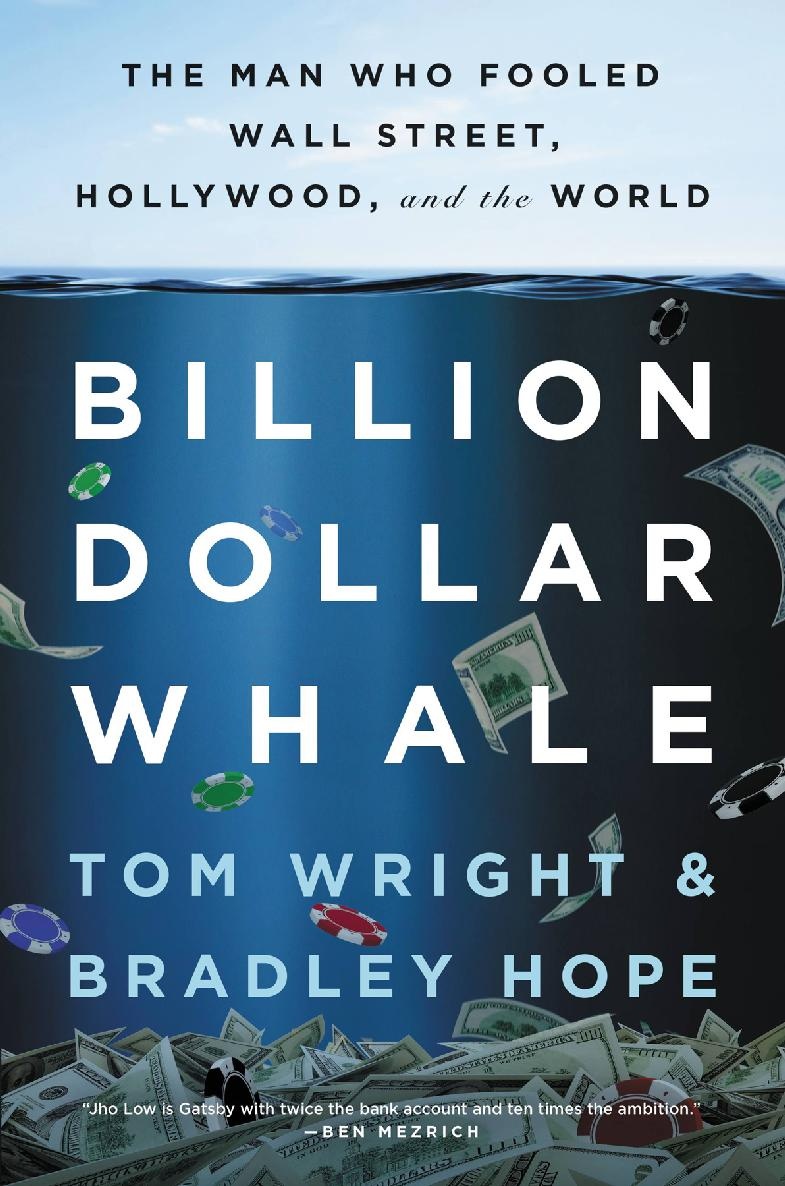
Billion Dollar Whale: The Man Who Fooled Wall Street, Hollywood, and the World
About this book
Jho Low cultivated classmates, Gulf royalty, bankers, and Malaysian political families long before 1MDB existed. He learned to present access as wealth and wealth as access, making each relationship evidence that the next person should trust him.
The fund raised billions for national development while money moved through joint ventures, offshore entities, and accounts controlled by Low's circle. Goldman Sachs bond deals supplied further scale and fees while basic questions about ownership went unanswered.
Stolen funds paid for parties, art, property, jewellery, yachts, political influence, and The Wolf of Wall Street. Journalists, whistleblowers, and investigators in several countries gradually connected the luxury to a Malaysian public balance sheet.
Billion Dollar Whale is reported financial crime by Wall Street Journal reporters Tom Wright and Bradley Hope. Its global cast shows how respectable institutions can make a fraud larger by treating profitable opacity as someone else's due-diligence problem.
Read a sample
5,062 words
Plain text
From the opening
Prologue
Las Vegas, November 3–4, 2012
Around 6 p.m. on a warm, cloudless November night, Pras Michél, a former member of the nineties hip-hop trio the Fugees, approached one of the Chairman Suites on the fifth floor of the Palazzo hotel. Pras knocked and the door opened, revealing a rotund man, dressed in a black tuxedo, who flashed a warm smile. The man, glowing slightly with perspiration, was known to his friends as Jho Low, and he spoke in the soft-voiced lilt common to Malaysians. “Here’s my boy,” Low said, embracing the rapper.
The Chairman Suites, at $25,000 per night, were the most opulent the Palazzo had to offer, with a pool terrace overlooking the Strip, and a modern white interior, including a karaoke room with wraparound sofas and padded walls. But the host didn’t plan to spend much time in the room tonight; Low had a much grander celebration in store for his thirty-first birthday. This was just the preparty for his inner circle, who had jetted in from across the globe. Guzzling champagne, the guests, an eclectic mix of celebrities and hangers-on, buzzed around Low, as more people arrived. Swizz Beatz, the hip-hop producer and husband of Alicia Keys, conversed animatedly with Low. At one point, Leonardo DiCaprio arrived alongside Benicio Del Toro to talk to Low about some film ideas.
What did the guests make of their host? To many at the gathering, Low cut a mysterious figure. Hailing from Malaysia, a small Southeast Asian country that many Westerners would struggle to pinpoint on a map, Low’s round face was still boyish, with glasses, red cheeks, and barely a hint of facial hair. His unremarkable appearance was matched by an awkwardness and lack of ease in conversation, which the beautiful women around Low took to be shyness. Polite and courteous, he never seemed fully in the moment, often cutting short a conversation to take a call on one of his half a dozen cell phones.
But despite Low’s unassuming appearance, word was that he was loaded—maybe a billionaire. Guests murmured to each other that just months earlier, Low’s company had acquired a stake in EMI Music Publishing, and there was speculation that he was the money behind DiCaprio’s latest movie, The Wolf of Wall Street, which was still filming. Low’s bashful manners belied a hard core of ambition the like of which the world rarely sees. Look more closely, and Low was not so much timid as quietly calculating, as if computing every human interaction, sizing up what he could provide for someone and what they, in turn, could do for him. Despite his age, Low had a weird gravitas, allowing him to hold his own in a room of grizzled Wall Street bankers or pampered Hollywood types. For years, he’d methodically cultivated the wealthiest and most powerful people on the planet. The bold strategy had placed him in their orbit and landed him a seat here in the Palazzo. Now, he was the one doling out favors.
The night at the Palazzo marked the apex of Low’s ascendancy. The guest list for his birthday included Hollywood stars, top bankers from Goldman Sachs, and powerful figures from the Middle East. In the aftermath of the U.S. financial crisis, they all wanted a piece of Low. Pras Michél had lost his place in the limelight since the Fugees disbanded, but was hoping to reinvent himself as a private-equity investor, and Low held out the promise of funding. Some celebrities had received hundreds of thousands of dollars in appearance fees from Low just to turn up at his events, and they were keen to keep him happy.
Swizz Beatz called for quiet in the hotel suite, before presenting expensive DJ equipment, emblazoned with images of a panda, to Low as a gift. The group burst into laughter. That was what Low’s closest friends called him—“Panda”—a nod to his plump frame and cuddly demeanor. He’d loved Kung Fu Panda, and when gambling with his close friends from back home they’d each pretend to be a character from the film. But even those stars like Pras and Swizz Beatz, who had received multiple millions of dollars in appearance fees and other business deals from Low, could not really claim to know his story. If you entered “Jho Low” into Google, very little came up. Some people said he was an Asian arms dealer. Others claimed he was close to the prime minister of Malaysia. Or maybe he inherited billions from his Chinese grandfather. Casino operators and nightclubs refer to their highest rollers as “whales,” and one thing was certain about Low: He was the most extravagant whale that Vegas, New York, and St. Tropez had seen in a long time—maybe ever.
A few hours later, just after 9 p.m., Low’s guests began the journey to the evening’s main event. To avoid the paparazzi, they strode through staff-only areas, including a kitchen, before emerging into a concrete tunnel leading to the hotel’s parking garage. A fleet of black limousines stood ready, engines purring. This was a special arrangement the Palazzo permitted for only its most lucrative guests.
Every move felt seamlessly scripted, doors opening at the right moment and young, smiling women gesturing the way. As the limousines drove up the Strip, it was clear they weren’t heading to the desert, as some guests thought, instead pulling up at what looked like a giant aircraft hangar, specially constructed on a vacant parcel of land. Even the VIPs were in the dark. The cars sailed through security checkpoints before stopping at a red carpet entrance, manned by burly security personnel in black suits and the first of scores of young models wearing red dresses, some of whom handed out drinks and food, while others—in the crude language of nightclubs—acted as “ambient” decorations.
Continue reading the sampleClose the sample
This was how the super-VIPs arrived, but most of the three hundred or so guests, some clutching bright red invitations with “Everyday Birthday” stylishly rendered in gold lettering, checked in earlier at LAVO nightclub in the Palazzo or at a security post. There, they signed nondisclosure agreements, binding them to secrecy, and handed in their phones, before getting into minibuses for the short distance to the venue. Among them was Robin Leach, who for decades, as host of the TV show Lifestyles of the Rich and Famous, had chronicled the spending of rappers, Hollywood stars, and old-money dynasties. But that was the 1980s and 1990s, and nothing had prepared him for the intemperance of the night. A gossip columnist for the Las Vegas Sun, Leach was among the few guests who had gleaned some details of what was coming. “Wicked whispers EXCLUSIVE: Britney Spears flying into Vegas tomorrow for secret concert, biggest big bucks private party ever thrown,” he tweeted.
One puzzling requirement of Leach’s invitation was that he could write about the party, but not name the host. He’d made his career from the desire of rich people to brag about their affluence; what made this guy want to spend so much cash in secret? he wondered. A nightlife veteran, Leach was stunned by the audacity of the construction on the site. As he surveyed the arch of the party venue, which was ample enough to house a Ferris wheel, carousel, circus trampoline, cigar lounge, and plush white couches scattered throughout, he did some calculations. One side was circus themed, with the other half transformed into an ultrachic nightclub. With the lighting, and devices that sent explosions of fire into the air periodically, it felt like a major concert, not a private event.
It must have cost millions, Leach estimated. Here were new lovers Kanye West and Kim Kardashian canoodling under a canopy; Paris Hilton and heartthrob River Viiperi whispering by a bar; actors Bradley Cooper and Zach Galifianakis, on a break from filming The Hangover Part III, laughed as they took in the scene. It was rare to get so many top actors and musicians together at a single event outside of a big awards show. “We’re used to extravagant parties in Las Vegas, but this was the ultimate party,” Leach said. “I’ve never been to one like it.”
As the guests chatted, Cirque du Soleil–type entertainers walked among them on stilts, while acrobats in lingerie swung on hoops overhead. There were several monster trucks parked on the fringes and a troupe of about twenty little people dressed as Oompa-Loompas beating a path through the revelers. In a cordoned-off VIP area, Low held court with DiCaprio and Martin Scorsese, who was directing The Wolf of Wall Street. As the night wore on, other guests came by, including Robert De Niro, Tobey Maguire, and Olympic gold medalist Michael Phelps.
Not every guest that night was a celebrity. Low was careful not to overlook his less well-known friends and key business contacts. Among them were Tim Leissner, a German-born banker who was a star dealmaker for Goldman Sachs in Asia, and Mohamed Al Husseiny, the CEO of one of Abu Dhabi’s richest investment funds. There were whispers among Wall Street bankers about the huge profits Goldman had been making in Malaysia, hundreds of millions of dollars arranging bonds for a state investment fund, but they hadn’t reached insular Hollywood. Low’s usual entourage was on hand as well, including “Fat Eric,” whom the Malaysian had gotten to know from the nightclub world in Malaysia, his cousin Howie, and older brother Szen.
Waitresses handed out mini-bottles of champagne with straws. Bartenders, standing behind the twenty-four-foot ice bar, doled out top-shelf liquor and flutes of Cristal. The crowd was already lively when Jamie Foxx started off the show with a video projected on huge screens. It appeared as if friends from around the world had volunteered to help make a surprise birthday video for their good friend Low, each dancing a bit of the hit song “Gangnam Style.” Investment bankers from Low’s Hong Kong–based investment company performed in a conference room. Al Husseiny danced on a jet ski off Abu Dhabi. In truth, the video was partly Low’s idea, and like every aspect of the evening, from the color of the flowers to the drinks at the bar, it had been carefully orchestrated at his direction. Although the clips came as little surprise to him, Low was beaming.
As the video ended, Psy, the South Korean singer who had shot to stardom that year for “Gangnam Style,” played the song live as the crowd erupted. Over the following hour and a half, there were performances from Redfoo and the Party Rock Crew, Busta Rhymes, Q-Tip, Pharrell, and Swizz Beatz, with Ludacris and Chris Brown, who debuted the song “Everyday Birthday.” During Q-Tip’s session, a drunk DiCaprio got on stage and rapped alongside him. Then, a giant faux wedding cake was wheeled on stage. After a few moments, Britney Spears, wearing a skimpy, gold-colored outfit, burst out and, joined by dancers, serenaded Low with “Happy Birthday,” as a troupe of women began doling out slices of real chocolate cake. Each of the performers earned a fat check, with Spears reportedly taking a six-figure sum for her brief cameo.
Then the gifts. The nightlife impresarios who helped set up the party, Noah Tepperberg and Jason Strauss, stopped the music and took a microphone. Low had spent tens of millions of dollars in their clubs Marquee, TAO, and LAVO over the past few years, just as the financial crisis hit and Wall Street high rollers were feeling the pinch. He was their number one client, and they did everything to ensure other nightclub owners didn’t steal him away. As Tepperberg and Strauss motioned to staff, a bright red Lamborghini was driven out into the middle of the marquee. Someone gave not one but three high-end Ducati motorcycles. Finally, a ribbon-wrapped $2.5 million Bugatti Veyron was presented by Szen Low to his brother.
Even the low-end presents were elaborate. A former talent booker whom Low had helped transform into a big movie producer, Joey McFarland, presented Low with a custom wine box with an image of Kung Fu Panda from the animated film, and the words “Vintage 1981” and “Product of Malaysia” engraved in wood. It came with a $1,000 bottle of 1981 Petrus wine, made the year of Low’s birth. Just after 12:20 a.m., the sky lit up with fireworks. Partying went into the early hours, with performances by Usher, DJ Chuckie, and Kanye West. Surrounded by celebrities and friends, Low piled into a limousine and brought the party back to the Palazzo, where he gambled well into the bright light of Sunday afternoon.
This was the world built by Jho Low.
“While you were sleeping, one Chinese billionaire was having the party of the year,” began an article on the website of local radio station KROQ two days later, mistaking Low’s nationality. It referred to him as “Jay Low.” It wasn’t the first time Low’s name seeped into the tabloids or was associated with extravagance—and it wasn’t the last—but the Vegas birthday party was a peak moment in his strange and eventful life.
Many of those who came across Low wrote him off as a big-talking scion of a rich Asian family, a spoiled princeling from the booming region and economy of “Crazy Rich Asians.” Few people asked questions about him, and those who bothered to do so discovered only fragments of the real person. But Low wasn’t the child of wealth, at least not the kind that would finance a celebrity-studded party. His money came from a series of events that are so unlikely, they appear made up. Even today, the scale of what he achieved—the global heists he pulled off, allowing him to pay for that night’s party and much, much more—is hard to fathom.
Low might have hailed from Malaysia, but his was a twenty-first-century global scheme. His conspirators came from the world’s wealthiest 0.1 percent, the richest of the rich, or people who aspired to enter its ranks: young Americans, Europeans, and Asians who studied for MBAs together, took jobs in finance, and partied in New York, Las Vegas, London, Cannes, and Hong Kong. The backdrop was the global financial crisis, which had sent the U.S. economy plummeting into recession, adding to the allure of a spendthrift Asian billionaire like Low.
Armed with more liquid cash than possibly any individual in history, Low infiltrated the very heart of U.S. power. He was enabled by his obscure origins and the fact that people had only a vague notion of Malaysia. If he claimed to be a Malaysian prince, then it was true. The heir to a billion-dollar fortune? Sure, it might be right, but nobody seemed to care. Not Leonardo DiCaprio and Martin Scorsese, who were promised tens of millions of dollars to make films. Not Paris Hilton, Jamie Foxx, and other stars who were paid handsomely to appear at events. Not Jason Strauss and Noah Tepperberg, whose nightclub empire was thriving. Not the supermodels on whom Low lavished multi-million-dollar jewelry. Not the Wall Street bankers who made tens of millions of dollars in bonuses. And certainly not Low’s protector, Malaysian Prime Minister Najib Razak.
Low’s scheme involved the purchase of storied companies, friendships with the world’s most celebrated people, trysts with extraordinarily beautiful women, and even a visit to the White House—most of all, it involved an extraordinary and complex manipulation of global finance. As of this writing, the FBI is still attempting to unravel exactly what occurred. Billions of dollars in Malaysian government money, raised with the help of Goldman Sachs, has disappeared into a byzantine labyrinth of bank accounts, offshore companies, and other complex financial structures. As the scheme began to crash down around them, Malaysia’s prime minister turned his back on democracy in an attempt to cling on to power. Wanted for questioning by the FBI, Low disappeared into thin air.
Jho Low’s story epitomizes the shocking power of those who learn how to master the levers of international finance in the twenty-first century. How he thrived, and what it says about the failure of global capitalism, is the subject of this book.
The story begins on the palm-fringed island of Penang.
PART I
THE INVENTION OF JHO LOW
Chapter 1
Fake Photos
Penang, Malaysia, Summer 1999
As he moved around the Lady Orient, a 160-foot yacht docked at a government marina on Penang island, Jho Low periodically checked he wasn’t being observed. Stashed in his pocket were a handful of photographs of his family: his father, Larry Low, a businessman who had made millions of dollars through his stake in a local garment manufacturer; his mother, Goh Gaik Ewe, a proud housewife who doted on her children; and his two elder siblings. Locating photos of the boat’s owner, a Penang-based billionaire, he eased the snapshots one by one from their frames, replacing them with those of his own family. Later, he did the same at a British colonial-era holiday home on Penang Hill, which he also had borrowed from the billionaire, a friend of Low’s family.
From Penang Hill, covered in rainforest, Low could see down to George Town, the British colonial capital named for George III, a warren of whitewashed mansions and crumbling Chinese shophouses. Beyond, the narrow straits that separated Penang island from continental Asia came into view. Situated at the mouth of the Strait of Malacca, an important sea lane linking Europe and the Middle East to China, Penang had attracted its share of adventurers, from British colonial officers to Chinese traders and other assorted carpetbaggers. The streets bustled with Penangites, mainly Chinese-Malaysians, who loved eating out at the many street-side stalls or walking along the seaside promenade.
Low’s grandfather washed up in Penang in the 1960s from China, by way of Thailand, and the family had built a small fortune. They were a wealthy clan by any standard, but Low recently had begun attending Harrow, the elite boarding school in England, where some of his classmates counted their families’ wealth in billions, not mere millions.
Larry’s shares in the garment company, which he recently had sold, were worth around $15 million—a huge sum in the Southeast Asian nation, where many people lived on $1,000 per month. But Low had begun to mix with members of the royal families of Brunei and Kuwait at Harrow, where he had arrived in 1998 for the last two years of high school. The Low home, a palm-tree-fringed modernist mansion on the north coast of Penang, was impressive and had its own central cooling system, but it was no royal palace.
In a few days, some of Low’s new school pals would be arriving. He had convinced them to spend part of their summer vacation in Malaysia, and he was eager to impress. Just as his father had raised the family’s station in Penang, earning enough to send his son to one of the world’s most expensive boarding schools, so Low harbored ambitions. He was somewhat embarrassed by the backwater of Penang, and he used the boat and holiday home to compensate. His Harrow friends were none the wiser. With his pudgy frame and glasses, Low never found it easy to attract women, so he clamored to be respected in other ways. He told his Harrow friends he was a “prince of Malaysia,” an attempt to keep up with the blue bloods around him.
In reality, the ethnic Chinese of the nation, like the Lows, were not the aristocrats, but traders who came later to the country in big waves during the nineteenth and twentieth centuries. The majority of Malaysia’s 30 million people were Muslim Malays, who typically treated the Chinese as newcomers, even if their families had lived in Malaysia for generations. Some of the older Chinese of Penang began to wonder about this strange kid. After Low’s Harrow friends had come and gone, the story of the photos began to circulate around the island, as did Low’s claims to an aristocratic lineage. People laughed over the sheer chutzpah. Who did this kid think he was?
In the 1960s, Penang island was a ramshackle place. The British granted independence in 1957 to its colony of Malaya—a tropical Southeast Asian territory rich in tin and palm oil—after fighting an inconclusive and sapping war against a Communist insurgency. From their jungle redoubts near the Thai border, Communist rebels bided their time, and soon would start a years-long guerilla war against the untested forces of the newly established nation of Malaysia. This lawless frontier region was an area that Meng Tak, Low’s grandfather, knew well. He’d left his native Guangdong province in China in the 1940s—a time of great upheaval due to the Second World War, Japanese occupation, and a civil war that led millions to flee the country—and settled in southern Thailand, near Malaya. He made some money as a minor investor in an iron ore mine, and married a local woman of Chinese ancestry, before moving on again to Penang in the 1960s.
The Low family lived in a modest bungalow in George Town, the capital of Penang, just a few blocks back from the peeling British-era colonnaded villas and warehouses on the palm-fringed shoreline. Many Chinese had emigrated here during colonial times to trade in commodities like tin and opium, a narcotic whose sale the British had monopolized but which now was illegal. There were dark rumors in George Town’s close-knit community about the origin of Meng Tak’s money. Some old-timers remembered him running a cookware shop in the city. But perhaps the story about iron-ore mining in Thailand was only part of the truth. Others whispered that he’d made money smuggling opium over the border.
For each version of the Low family’s history, there was an alternate recounting. Decades later, Low started telling his own story about Meng Tak, one he fabricated to explain how he was in possession of enormous wealth. The money, he told anyone who would listen, came from his grandfather’s investments in mining, liquor trading, and property. There was only one problem. Few in Malaysia—neither top bankers nor business leaders—had ever heard of this fabulously rich family. With Low’s father, Larry, the family story comes into sharper focus.
Born in Thailand in 1952, Larry Low moved as a young child to Penang and went on to study at the London School of Economics and the University of California, Los Angeles, for an MBA. On returning to Malaysia, he took over Meng Tak’s business. Despite his elite school, Larry made a disastrous investment in the 1980s in cocoa plantations that almost wiped out the family wealth. After commodity prices dropped, he used what was left to buy a minority stake in a company that produced clothes for export to the United States and Europe. This time Larry hit the jackpot.
The 1990s were anything-goes years for Malaysia’s nascent stock market. “Asian Tiger” economies like South Korea and Taiwan had taken off from the 1960s, and now it was the turn of other Asian nations. Malaysia’s economy was growing at over 5 percent annually, powered by the export of commodities like palm oil, as well as garments, computer chips, and electronic devices. Attracted by the hot growth, foreign investors poured money into Malaysian stocks and bonds. But there was no oversight. Insiders regularly broke securities laws, as if taking their cues from the excesses of 1980s figures such as Michael Milken, the U.S. junk bond king, and insider trader Ivan Boesky. Malaysians who knew how to play the system became incredibly rich, while minority shareholders lost out.
People who worked with Larry considered him charming and a wheeler-dealer, albeit with a lazy streak, preferring drinking late in nightclubs to work, but he benefited nevertheless from a run-up in the garment company’s stock. In the early 1990s, he was involved in an acquisition by MWE, the garment company in which he owned a minority stake, of a Canadian technology firm. The deal overvalued the target firm, and Larry arranged for some of the excess cash to go into an offshore bank account he controlled.
Using such accounts, often owned by anonymous shell companies set up in places like the British Virgin Islands, was common for Malaysian companies at the time. The younger Lows learned from their father about this world of secret finance, and May-Lin, Low’s sister, became a lawyer with an expertise in offshore vehicles.
When he uncovered that Larry had funneled off the money, the owner of MWE was furious and, not long after, Larry sold his stake in the company. But there was a silver lining: The increase in MWE’s stock price in the 1990s had made the Low family millionaires many times over.
Flush with cash, Larry, now in his forties, indulged his desire to party. For one celebration on a yacht, he arranged for Swedish models to fly into Penang, the kind of arrangement for which his son later would be known. The family was a big fish in a small pond—and acting the part. Larry drove around town in a Lexus, and was a member of the Penang Club, an exclusive sports club founded by the British in 1868 and whose members included well-known business families and politicians from the island. The younger Low was a keen swimmer, often doing laps on Sundays in the pool by the ocean before eating a Chinese dinner with his family.
But Larry saw all this as parochial, and he had ambitions to raise his family’s social standing. So, in 1994, when Low was thirteen, his father moved him out of the local education system to Uplands, an international school that rich Penangites chose to prepare their children for boarding school in Britain. Many elite Malaysians had gotten their education in the former colonial power, and it was still the country of choice for overseas schooling.
Larry Low opted to put down roots in England. Around this time, developers of a new gated community in London’s posh South Kensington neighborhood began to advertise in Malaysia. Some of the most powerful Malaysian politicians owned homes in the Kensington Green development, and Larry sensed it could only be beneficial for an ambitious family like the Lows to develop friendships with these people. He bought an apartment in the complex, and the family began to vacation there, which gave Low the opportunity to meet the children of Malaysia’s elite.
Larry’s alertness to status seemed to rub off on his sons, who began to forge a friendship with Riza Aziz, a college student whose family also had a place in Kensington Green. Riza’s stepfather was Defense Minister Najib Razak, who was tipped as a future prime minister. A few years older, Riza would be the key to Low’s entry into the upper echelons of Malaysia’s power structure.
Back home, in Penang, Larry ordered a beautiful cream-colored mansion built on a hill outside George Town, which with its sleek steel-and-glass look could have been plucked from the streets of Miami. The modern edifice was a step up from the somewhat modest family house that Meng Tak had constructed.
As Larry acquired the trappings of an upper-class life, the teenage Jho Low was busying himself exploring the nascent online world. Low took to spending hours at his computer, hiding behind the anonymity of the web. He began to fib in an offhand way, offering himself on an online chat site for modeling “in any part of the world.” On the forum, Low described himself as “muscular, well proportioned” but received no modeling offers. A class photo from 1994 shows Low as a slight middle-school student dressed in a white short-sleeved shirt and blue shorts, with a neat but unstylish haircut. His online activities suggested a longing to be cool. He asked people on chat rooms what hard-core techno music they suggested or which haircuts were popular in different countries.
Although he vacationed in England, Low appeared more pulled toward American culture, as was typical among younger Malaysians. One of his favorite shows was The X-Files, and he traded photos of Mulder and Scully with other fans online. Since selling out of MWE, Larry had begun to dabble in property investment and stock trading, and Low showed an interest in this world. He devoured Hollywood films like Wall Street, with its tale of insider trading and corporate raiding, and at Uplands he pooled resources with fellow students to invest in the stock market, even though he was only fifteen years old. Many adults remember Low as smooth and deferential, but adept at using this charm to get what he wanted. On occasion, he would borrow small sums of money from Larry’s friends, many of them wealthy businessmen, and then not pay them back.
Larry was plotting the next phase of the family’s rise. He had the apartment in London and the swish mansion in Penang. Low’s elder brother, Szen, had studied at Sevenoaks, a prestigious school in England. Now, he was about to send his youngest son to one of the world’s premier boarding schools. It was a decision that would catapult Low into the exclusive club of the world’s richest people.
For decades, Harrow, situated on a bucolic hill to the northwest of London, had churned out British prime ministers such as Sir Winston Churchill, but by the late 1990s it was attracting new money from Asia and the Middle East. For wealthy Malaysians, Harrow in the late 1990s had a reputation as easier to get into than Eton, another of Britain’s top boarding schools, but still an effective way to grease entry into Oxford or Cambridge and to make contacts. To reduce costs, Malaysians often would attend only the final two years of high school—to prepare for A-level exams—and that was exactly what Larry chose for his son.
In 1998, sixteen-year-old Jho Low arrived at Harrow, some of whose buildings date to the 1600s. In Penang, the Uplands uniforms consisted of short-sleeved shirts and slacks. At Harrow, pupils were required to don navy blazers and ties, topped with a cream-colored boater hat. The fees were high, more than $20,000 each year, but for the Lows it was an investment worth making.