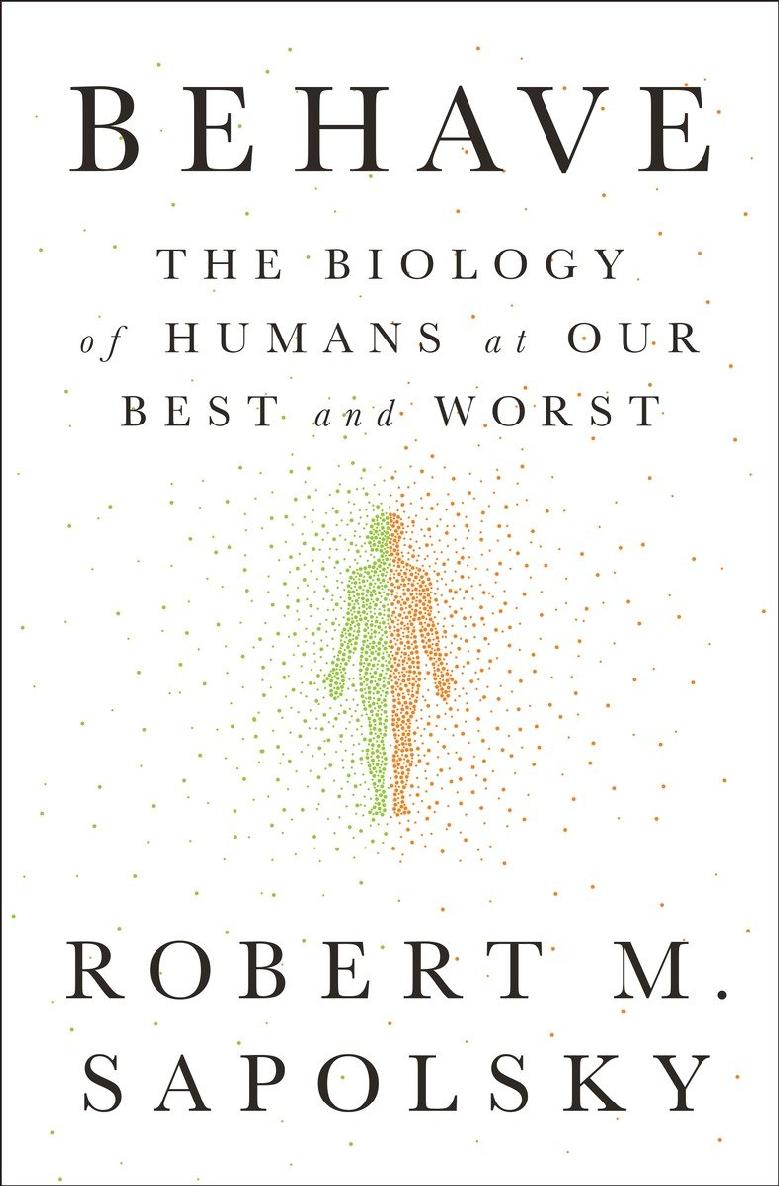
Behave: The Biology of Humans at Our Best and Worst
About this book
Behave begins after an action has occurred — generous, violent, or impossible to classify — and asks why. Robert Sapolsky moves backward through time: what happened in the brain a second before, in the body minutes before, during childhood, across generations, and over evolutionary history.
Neurons, hormones, genes, stress, social learning, and culture each supply part of an explanation. Sapolsky's point is not that biology settles behavior, but that no single level can do so. A factor that matters in one setting may reverse its effect in another.
The account crosses neuroscience, primatology, psychology, anthropology, and history. It examines aggression, empathy, hierarchy, tribalism, punishment, morality, and free will while repeatedly warning against the comfort of one-cause stories.
Published in 2017, Behave is large because its subject resists compression. Sapolsky gives the reader a way to ask a better causal question: not which explanation is the true one, but how explanations operating at different timescales fit together.
Read a sample
5,024 words
Plain text
From the opening
Introduction
The fantasy always runs like this: A team of us has fought our way into his secret bunker. Okay, it’s a fantasy, let’s go whole hog. I’ve single-handedly neutralized his elite guard and have burst into his bunker, my Browning machine gun at the ready. He lunges for his Luger; I knock it out of his hand. He lunges for the cyanide pill he keeps to commit suicide rather than be captured. I knock that out of his hand as well. He snarls in rage, attacks with otherworldly strength. We grapple; I manage to gain the upper hand and pin him down and handcuff him. “Adolf Hitler,” I announce, “I arrest you for crimes against humanity.”
And this is where the medal-of-honor version of the fantasy ends and the imagery darkens. What would I do with Hitler? The viscera become so raw that I switch to passive voice in my mind, to get some distance. What should be done with Hitler? It’s easy to imagine, once I allow myself. Sever his spine at the neck, leave him paralyzed but with sensation. Take out his eyes with a blunt instrument. Puncture his eardrums, rip out his tongue. Keep him alive, tube-fed, on a respirator. Immobile, unable to speak, to see, to hear, only able to feel. Then inject him with something that will give him a cancer that festers and pustulates in every corner of his body, that will grow and grow until every one of his cells shrieks with agony, till every moment feels like an infinity spent in the fires of hell. That’s what should be done with Hitler. That’s what I would want done to Hitler. That’s what I would do to Hitler.
—
I’ve had versions of this fantasy since I was a kid. Still do at times. And when I really immerse myself in it, my heart rate quickens, I flush, my fists clench. All those plans for Hitler, the most evil person in history, the soul most deserving of punishment.
But there is a big problem. I don’t believe in souls or evil, think that the word “wicked” is most pertinent to a musical, and doubt that punishment should be relevant to criminal justice. But there’s a problem with that, in turn—I sure feel like some people should be put to death, yet I oppose the death penalty. I’ve enjoyed plenty of violent, schlocky movies, despite being in favor of strict gun control. And I sure had fun when, at some kid’s birthday party and against various unformed principles in my mind, I played laser tag, shooting at strangers from hiding places (fun, that is, until some pimply kid zapped me, like, a million times and then snickered at me, which made me feel insecure and unmanly). Yet at the same time, I know most of the lyrics to “Down by the Riverside” (“ain’t gonna study war no more”) plus when you’re supposed to clap your hands.
In other words, I have a confused array of feelings and thoughts about violence, aggression, and competition. Just like most humans.
To preach from an obvious soapbox, our species has problems with violence. We have the means to create thousands of mushroom clouds; shower heads and subway ventilation systems have carried poison gas, letters have carried anthrax, passenger planes have become weapons; mass rapes can constitute a military strategy; bombs go off in markets, schoolchildren with guns massacre other children; there are neighborhoods where everyone from pizza delivery guys to firefighters fears for their safety. And there are the subtler versions of violence—say, a childhood of growing up abused, or the effects on a minority people when the symbols of the majority shout domination and menace. We are always shadowed by the threat of other humans harming us.
If that were solely the way things are, violence would be an easy problem to approach intellectually. AIDS—unambiguously bad news—eradicate. Alzheimer’s disease—same thing. Schizophrenia, cancer, malnutrition, flesh-eating bacteria, global warming, comets hitting earth—ditto.
The problem, though, is that violence doesn’t go on that list. Sometimes we have no problem with it at all.
This is a central point of this book—we don’t hate violence. We hate and fear the wrong kind of violence, violence in the wrong context. Because violence in the right context is different. We pay good money to watch it in a stadium, we teach our kids to fight back, we feel proud when, in creaky middle age, we manage a dirty hip-check in a weekend basketball game. Our conversations are filled with military metaphors—we rally the troops after our ideas get shot down. Our sports teams’ names celebrate violence—Warriors, Vikings, Lions, Tigers, and Bears. We even think this way about something as cerebral as chess—“Kasparov kept pressing for a murderous attack. Toward the end, Kasparov had to oppose threats of violence with more of the same.”1 We build theologies around violence, elect leaders who excel at it, and in the case of so many women, preferentially mate with champions of human combat. When it’s the “right” type of aggression, we love it.
It is the ambiguity of violence, that we can pull a trigger as an act of hideous aggression or of self-sacrificing love, that is so challenging. As a result, violence will always be a part of the human experience that is profoundly hard to understand.
This book explores the biology of violence, aggression, and competition—the behaviors and the impulses behind them, the acts of individuals, groups, and states, and when these are bad or good things. It is a book about the ways in which humans harm one another. But it is also a book about the ways in which people do the opposite. What does biology teach us about cooperation, affiliation, reconciliation, empathy, and altruism?
The book has a number of personal roots. One is that, having had blessedly little personal exposure to violence in my life, the entire phenomenon scares the crap out of me. I think like an academic egghead, believing that if I write enough paragraphs about a scary subject, give enough lectures about it, it will give up and go away quietly. And if everyone took enough classes about the biology of violence and studied hard, we’d all be able to take a nap between the snoozing lion and lamb. Such is the delusional sense of efficacy of a professor.
Then there’s the other personal root for this book. I am by nature majorly pessimistic. Give me any topic and I’ll find a way in which things will fall apart. Or turn out wonderfully and somehow, because of that, be poignant and sad. It’s a pain in the butt, especially to people stuck around me. And when I had kids, I realized that I needed to get ahold of this tendency big time. So I looked for evidence that things weren’t quite that bad. I started small, practicing on them—don’t cry, a T. rex would never come and eat you; of course Nemo’s daddy will find him. And as I’ve learned more about the subject of this book, there’s been an unexpected realization—the realms of humans harming one another are neither universal nor inevitable, and we’re getting some scientific insights into how to avoid them. My pessimistic self has a hard time admitting this, but there is room for optimism.
Continue reading the sampleClose the sample
THE APPROACH IN THIS BOOK
I make my living as a combination neurobiologist—someone who studies the brain—and primatologist—someone who studies monkeys and apes. Therefore, this is a book that is rooted in science, specifically biology. And out of that come three key points. First, you can’t begin to understand things like aggression, competition, cooperation, and empathy without biology; I say this for the benefit of a certain breed of social scientist who finds biology to be irrelevant and a bit ideologically suspect when thinking about human social behavior. But just as important, second, you’re just as much up the creek if you rely only on biology; this is said for the benefit of a style of molecular fundamentalist who believes that the social sciences are destined to be consumed by “real” science. And as a third point, by the time you finish this book, you’ll see that it actually makes no sense to distinguish between aspects of a behavior that are “biological” and those that would be described as, say, “psychological” or “cultural.” Utterly intertwined.
Understanding the biology of these human behaviors is obviously important. But unfortunately it is hellishly complicated.2 Now, if you were interested in the biology of, say, how migrating birds navigate, or in the mating reflex that occurs in female hamsters when they’re ovulating, this would be an easier task. But that’s not what we’re interested in. Instead, it’s human behavior, human social behavior, and in many cases abnormal human social behavior. And it is indeed a mess, a subject involving brain chemistry, hormones, sensory cues, prenatal environment, early experience, genes, both biological and cultural evolution, and ecological pressures, among other things.
How are we supposed to make sense of all these factors in thinking about behavior? We tend to use a certain cognitive strategy when dealing with complex, multifaceted phenomena, in that we break down those separate facets into categories, into buckets of explanation. Suppose there’s a rooster standing next to you, and there’s a chicken across the street. The rooster gives a sexually solicitive gesture that is hot by chicken standards, and she promptly runs over to mate with him (I haven’t a clue if this is how it works, but let’s just suppose). And thus we have a key behavioral biological question—why did the chicken cross the road? And if you’re a psychoneuroendocrinologist, your answer would be “Because circulating estrogen levels in that chicken worked in a certain part of her brain to make her responsive to this male signaling,” and if you’re a bioengineer, the answer would be “Because the long bone in the leg of the chicken forms a fulcrum for her pelvis (or some such thing), allowing her to move forward rapidly,” and if you’re an evolutionary biologist, you’d say, “Because over the course of millions of years, chickens that responded to such gestures at a time that they were fertile left more copies of their genes, and thus this is now an innate behavior in chickens,” and so on, thinking in categories, in differing scientific disciplines of explanation.
The goal of this book is to avoid such categorical thinking. Putting facts into nice cleanly demarcated buckets of explanation has its advantages—for example, it can help you remember facts better. But it can wreak havoc on your ability to think about those facts. This is because the boundaries between different categories are often arbitrary, but once some arbitrary boundary exists, we forget that it is arbitrary and get way too impressed with its importance. For example, the visual spectrum is a continuum of wavelengths from violet to red, and it is arbitrary where boundaries are put for different color names (for example, where we see a transition from “blue” to “green”); as proof of this, different languages arbitrarily split up the visual spectrum at different points in coming up with the words for different colors. Show someone two roughly similar colors. If the color-name boundary in that person’s language happens to fall between the two colors, the person will overestimate the difference between the two. If the colors fall in the same category, the opposite happens. In other words, when you think categorically, you have trouble seeing how similar or different two things are. If you pay lots of attention to where boundaries are, you pay less attention to complete pictures.
Thus, the official intellectual goal of this book is to avoid using categorical buckets when thinking about the biology of some of our most complicated behaviors, even more complicated than chickens crossing roads.
What’s the replacement?
A behavior has just occurred. Why did it happen? Your first category of explanation is going to be a neurobiological one. What went on in that person’s brain a second before the behavior happened? Now pull out to a slightly larger field of vision, your next category of explanation, a little earlier in time. What sight, sound, or smell in the previous seconds to minutes triggered the nervous system to produce that behavior? On to the next explanatory category. What hormones acted hours to days earlier to change how responsive that individual was to the sensory stimuli that trigger the nervous system to produce the behavior? And by now you’ve increased your field of vision to be thinking about neurobiology and the sensory world of our environment and short-term endocrinology in trying to explain what happened.
And you just keep expanding. What features of the environment in the prior weeks to years changed the structure and function of that person’s brain and thus changed how it responded to those hormones and environmental stimuli? Then you go further back to the childhood of the individual, their fetal environment, then their genetic makeup. And then you increase the view to encompass factors larger than that one individual—how has culture shaped the behavior of people living in that individual’s group?—what ecological factors helped shape that culture—expanding and expanding until considering events umpteen millennia ago and the evolution of that behavior.
Okay, so this represents an improvement—it seems like instead of trying to explain all of behavior with a single discipline (e.g., “Everything can be explained with knowledge about this particular [take your pick:] hormone/gene/childhood event”), we’ll be thinking about a bunch of disciplinary buckets. But something subtler will be done, and this is the most important idea in the book: when you explain a behavior with one of these disciplines, you are implicitly invoking all the disciplines—any given type of explanation is the end product of the influences that preceded it. It has to work this way. If you say, “The behavior occurred because of the release of neurochemical Y in the brain,” you are also saying, “The behavior occurred because the heavy secretion of hormone X this morning increased the levels of neurochemical Y.” You’re also saying, “The behavior occurred because the environment in which that person was raised made her brain more likely to release neurochemical Y in response to certain types of stimuli.” And you’re also saying, “. . . because of the gene that codes for the particular version of neurochemical Y.” And if you’ve so much as whispered the word “gene,” you’re also saying, “. . . and because of the millennia of factors that shaped the evolution of that particular gene.” And so on.
There are not different disciplinary buckets. Instead, each one is the end product of all the biological influences that came before it and will influence all the factors that follow it. Thus, it is impossible to conclude that a behavior is caused by a gene, a hormone, a childhood trauma, because the second you invoke one type of explanation, you are de facto invoking them all. No buckets. A “neurobiological” or “genetic” or “developmental” explanation for a behavior is just shorthand, an expository convenience for temporarily approaching the whole multifactorial arc from a particular perspective.
Pretty impressive, huh? Actually, maybe not. Maybe I’m just pretentiously saying, “You have to think complexly about complex things.” Wow, what a revelation. And maybe what I’ve been tacitly setting up is this full-of-ourselves straw man of “Ooh, we’re going to think subtly. We won’t get suckered into simplistic answers, not like those chicken-crossing-the-road neurochemists and chicken evolutionary biologists and chicken psychoanalysts, all living in their own limited categorical buckets.”
Obviously, scientists aren’t like that. They’re smart. They understand that they need to take lots of angles into account. Of necessity, their research may focus on a narrow subject, because there are limits to how much one person can obsess over. But of course they know that their particular categorical bucket isn’t the whole story.
Maybe yes, maybe no. Consider the following quotes from some card-carrying scientists. The first:
Give me a dozen healthy infants, well formed, and my own specified world to bring them up in and I’ll guarantee to take any one at random and train him to become any type of specialist I might select—doctor, lawyer, artist, merchant-chief and yes, even beggar-man thief, regardless of his talents, penchants, tendencies, abilities, vocations, and race of his ancestors.3
This was John Watson, a founder of behaviorism, writing around 1925. Behaviorism, with its notion that behavior is completely malleable, that it can be shaped into anything in the right environment, dominated American psychology in the midtwentieth century; we’ll return to behaviorism, and its considerable limitations. The point is that Watson was pathologically caught inside a bucket having to do with the environmental influences on development. “I’ll guarantee . . . to train him to become any type.” Yet we are not all born the same, with the same potential, regardless of how we are trained.*4
The next quote:
Normal psychic life depends upon the good functioning of brain synapses, and mental disorders appear as a result of synaptic derangements. . . . It is necessary to alter these synaptic adjustments and change the paths chosen by the impulses in their constant passage so as to modify the corresponding ideas and force thought into different channels.5
Alter synaptic adjustments. Sounds delicate. Yeah, right. These were the words of the Portuguese neurologist Egas Moniz, around the time he was awarded the Nobel Prize in 1949 for his development of frontal leukotomies. Here was an individual pathologically stuck in a bucket having to do with a crude version of the nervous system. Just tweak those microscopic synapses with a big ol’ ice pick (as was done once leukotomies, later renamed frontal lobotomies, became an assembly line operation).
And a final quote:
The immensely high reproduction rate in the moral imbecile has long been established. . . . Socially inferior human material is enabled . . . to penetrate and finally to annihilate the healthy nation. The selection for toughness, heroism, social utility . . . must be accomplished by some human institution if mankind, in default of selective factors, is not to be ruined by domestication-induced degeneracy. The racial idea as the basis of our state has already accomplished much in this respect. We must—and should—rely on the healthy feelings of our Best and charge them . . . with the extermination of elements of the population loaded with dregs.6
This was Konrad Lorenz, animal behaviorist, Nobel laureate, cofounder of the field of ethology (stay tuned), regular on nature TV programs.7 Grandfatherly Konrad, in his Austrian shorts and suspenders, being followed by his imprinted baby geese, was also a rabid Nazi propagandist. Lorenz joined the Nazi Party the instant Austrians were eligible, and joined the party’s Office of Race Policy, working to psychologically screen Poles of mixed Polish/German parentage, helping to determine which were sufficiently Germanized to be spared death. Here was a man pathologically mired in an imaginary bucket related to gross misinterpretations of what genes do.
These were not obscure scientists producing fifth-rate science at Podunk U. These were among the most influential scientists of the twentieth century. They helped shape who and how we educate and our views on what social ills are fixable and when we shouldn’t bother. They enabled the destruction of the brains of people against their will. And they helped implement final solutions for problems that didn’t exist. It can be far more than a mere academic matter when a scientist thinks that human behavior can be entirely explained from only one perspective.
OUR LIVES AS ANIMALS AND OUR HUMAN VERSATILITY AT BEING AGGRESSIVE
So we have a first intellectual challenge, which is to always think in this interdisciplinary way. The second challenge is to make sense of humans as apes, primates, mammals. Oh, that’s right, we’re a kind of animal. And it will be a challenge to figure out when we’re just like other animals and when we are utterly different.
Some of the time we are indeed just like any other animal. When we’re scared, we secrete the same hormone as would some subordinate fish getting hassled by a bully. The biology of pleasure involves the same brain chemicals in us as in a capybara. Neurons from humans and brine shrimp work the same way. House two female rats together, and over the course of weeks they will synchronize their reproductive cycles so that they wind up ovulating within a few hours of each other. Try the same with two human females (as reported in some but not all studies), and something similar occurs. It’s called the Wellesley effect, first shown with roommates at all-women’s Wellesley College.8 And when it comes to violence, we can be just like some other apes—we pummel, we cudgel, we throw rocks, we kill with our bare hands.
So some of the time an intellectual challenge is to assimilate how similar we can be to other species. In other cases the challenge is to appreciate how, though human physiology resembles that of other species, we use the physiology in novel ways. We activate the classical physiology of vigilance while watching a scary movie. We activate a stress response when thinking about mortality. We secrete hormones related to nurturing and social bonding, but in response to an adorable baby panda. And this certainly applies to aggression—we use the same muscles as does a male chimp attacking a sexual competitor, but we use them to harm someone because of their ideology.
Finally, sometimes the only way to understand our humanness is to consider solely humans, because the things we do are unique. While a few other species have regular nonreproductive sex, we’re the only ones to talk afterward about how it was. We construct cultures premised on beliefs concerning the nature of life and can transmit those beliefs multigenerationally, even between two individuals separated by millennia—just consider that perennial best seller, the Bible. Consonant with that, we can harm by doing things as unprecedented as and no more physically taxing than pulling a trigger, or nodding consent, or looking the other way. We can be passive-aggressive, damn with faint praise, cut with scorn, express contempt with patronizing concern. All species are unique, but we are unique in some pretty unique ways.
Here are two examples of just how strange and unique humans can be when they go about harming one another and caring for one another. The first example involves, well, my wife. So we’re in the minivan, our kids in the back, my wife driving. And this complete jerk cuts us off, almost causing an accident, and in a way that makes it clear that it wasn’t distractedness on his part, just sheer selfishness. My wife honks at him, and he flips us off. We’re livid, incensed. Asshole-where’s-the-cops-when-you-need-them, etc. And suddenly my wife announces that we’re going to follow him, make him a little nervous. I’m still furious, but this doesn’t strike me as the most prudent thing in the world. Nonetheless, my wife starts trailing him, right on his rear.
After a few minutes the guy’s driving evasively, but my wife’s on him. Finally both cars stop at a red light, one that we know is a long one. Another car is stopped in front of the villain. He’s not going anywhere. Suddenly my wife grabs something from the front seat divider, opens her door, and says, “Now he’s going to be sorry.” I rouse myself feebly—“Uh, honey, do you really think this is such a goo—” But she’s out of the car, starts pounding on his window. I hurry over just in time to hear my wife say, “If you could do something that mean to another person, you probably need this,” in a venomous voice. She then flings something in the window. She returns to the car triumphant, just glorious.
“What did you throw in there!?”
She’s not talking yet. The light turns green, there’s no one behind us, and we just sit there. The thug’s car starts to blink a very sensible turn indicator, makes a slow turn, and heads down a side street into the dark at, like, five miles an hour. If it’s possible for a car to look ashamed, this car was doing it.
“Honey, what did you throw in there, tell me?”
She allows herself a small, malicious grin.
“A grape lollipop.” I was awed by her savage passive-aggressiveness—“You’re such a mean, awful human that something must have gone really wrong in your childhood, and maybe this lollipop will help correct that just a little.” That guy was going to think twice before screwing with us again. I swelled with pride and love.
And the second example: In the mid-1960s, a rightist military coup overthrew the government of Indonesia, instituting the thirty-year dictatorship of Suharto known as the New Order. Following the coup, government-sponsored purges of communists, leftists, intellectuals, unionists, and ethnic Chinese left about a half million dead.9 Mass executions, torture, villages torched with inhabitants trapped inside. V. S. Naipaul, in his book Among the Believers: An Islamic Journey, describes hearing rumors while in Indonesia that when a paramilitary group would arrive to exterminate every person in some village, they would, incongruously, bring along a traditional gamelan orchestra. Eventually Naipaul encountered an unrepentant veteran of a massacre, and he asked him about the rumor. Yes, it is true. We would bring along gamelan musicians, singers, flutes, gongs, the whole shebang. Why? Why would you possibly do that? The man looked puzzled and gave what seemed to him a self-evident answer: “Well, to make it more beautiful.”
Bamboo flutes, burning villages, the lollipop ballistics of maternal love. We have our work cut out for us, trying to understand the virtuosity with which we humans harm or care for one another, and how deeply intertwined the biology of the two can be.
One
The Behavior
We have our strategy in place. A behavior has occurred—one that is reprehensible, or wonderful, or floating ambiguously in between. What occurred in the prior second that triggered the behavior? This is the province of the nervous system. What occurred in the prior seconds to minutes that triggered the nervous system to produce that behavior? This is the world of sensory stimuli, much of it sensed unconsciously. What occurred in the prior hours to days to change the sensitivity of the nervous system to such stimuli? Acute actions of hormones. And so on, all the way back to the evolutionary pressures played out over the prior millions of years that started the ball rolling.
So we’re set. Except that when approaching this big sprawling mess of a subject, it is kind of incumbent upon you to first define your terms. Which is an unwelcome prospect.
Here are some words of central importance to this book: aggression, violence, compassion, empathy, sympathy, competition, cooperation, altruism, envy, schadenfreude, spite, forgiveness, reconciliation, revenge, reciprocity, and (why not?) love. Flinging us into definitional quagmires.
Why the difficulty? As emphasized in the introduction, one reason is that so many of these terms are the subject of ideological battles over the appropriation and distortions of their meanings.*1 Words pack power and these definitions are laden with values, often wildly idiosyncratic ones. Here’s an example, namely the ways I think about the word “competition”: (a) “competition”—your lab team races the Cambridge group to a discovery (exhilarating but embarrassing to admit to); (b) “competition”—playing pickup soccer (fine, as long as the best player shifts sides if the score becomes lopsided); (c) “competition”—your child’s teacher announces a prize for the best outlining-your-fingers Thanksgiving turkey drawing (silly and perhaps a red flag—if it keeps happening, maybe complain to the principal); (d) “competition”—whose deity is more worth killing for? (try to avoid).
But the biggest reason for the definitional challenge was emphasized in the introduction—these terms mean different things to scientists living inside different disciplines. Is “aggression” about thought, emotion, or something done with muscles? Is “altruism” something that can be studied mathematically in various species, including bacteria, or are we discussing moral development in kids? And implicit in these different perspectives, disciplines have differing tendencies toward lumping and splitting—these scientists believe that behavior X consists of two different subtypes, whereas those scientists think it comes in seventeen flavors.
Let’s examine this with respect to different types of “aggression.”2 Animal behaviorists dichotomize between offensive and defensive aggression, distinguishing between, say, the intruder and the resident of a territory; the biology underlying these two versions differs. Such scientists also distinguish between conspecific aggression (between members of the same species) and fighting off a predator. Meanwhile, criminologists distinguish between impulsive and premeditated aggression. Anthropologists care about differing levels of organization underlying aggression, distinguishing among warfare, clan vendettas, and homicide.
Moreover, various disciplines distinguish between aggression that occurs reactively (in response to provocation) and spontaneous aggression, as well as between hot-blooded, emotional aggression and cold-blooded, instrumental aggression (e.g., “I want your spot to build my nest, so scram or I’ll peck your eyes out; this isn’t personal, though”).3 Then there’s another version of “This isn’t personal”—targeting someone just because they’re weak and you’re frustrated, stressed, or pained and need to displace some aggression. Such third-party aggression is ubiquitous—shock a rat and it’s likely to bite the smaller guy nearby; a beta-ranking male baboon loses a fight to the alpha, and he chases the omega male;* when unemployment rises, so do rates of domestic violence. Depressingly, as will be discussed in chapter 4, displacement aggression can decrease the perpetrator’s stress hormone levels; giving ulcers can help you avoid getting them. And of course there is the ghastly world of aggression that is neither reactive nor instrumental but is done for pleasure.
Then there are specialized subtypes of aggression—maternal aggression, which often has a distinctive endocrinology. There’s the difference between aggression and ritualistic threats of aggression. For example, many primates have lower rates of actual aggression than of ritualized threats (such as displaying their canines). Similarly, aggression in Siamese fighting fish is mostly ritualistic.*