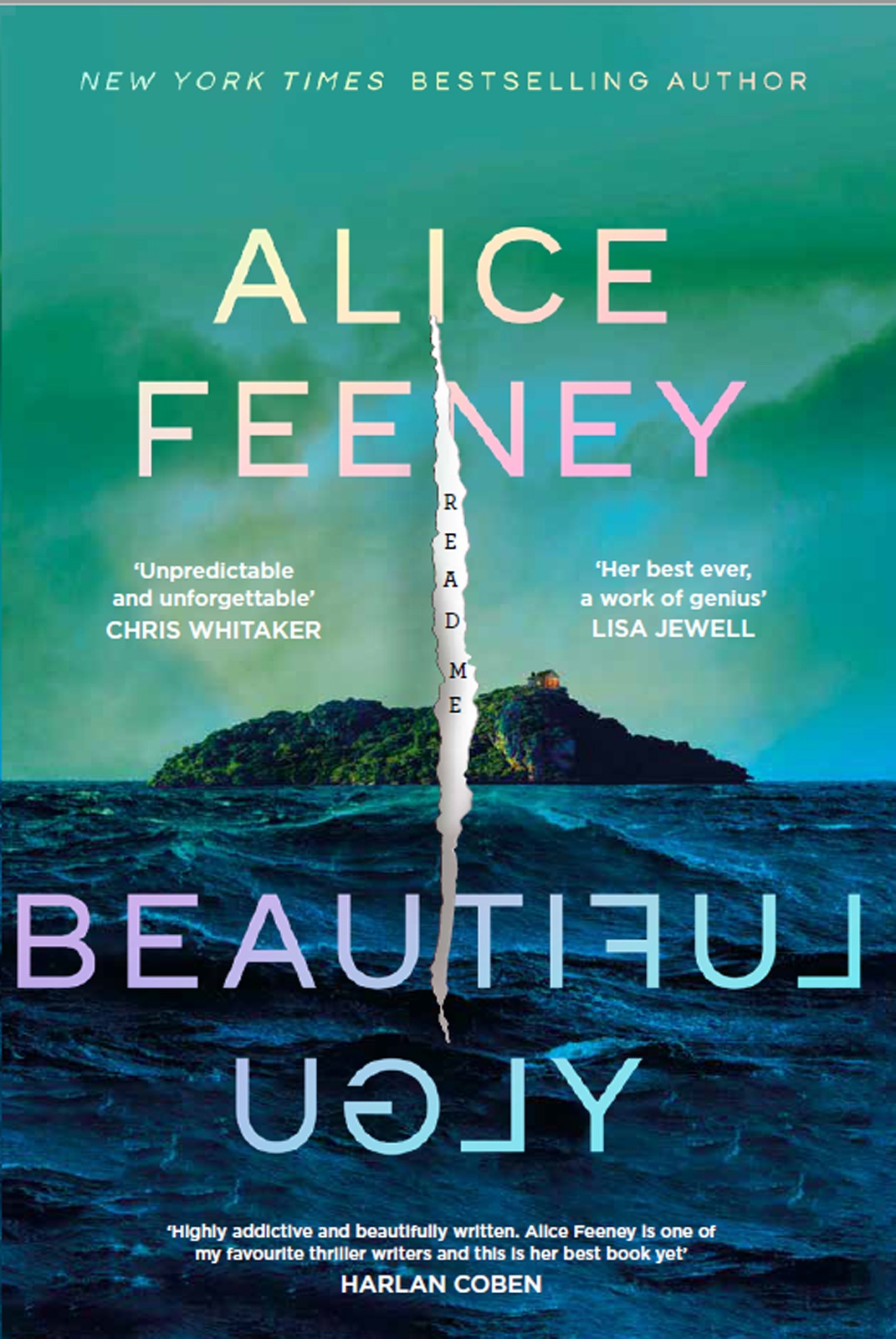
Beautiful Ugly
About this book
Grady Green is on the phone with his wife, Abby, when she stops her car and vanishes. A year later there is still no satisfactory explanation, and grief has left the successful writer unable to produce the book his career requires.
He accepts the use of a small house on Amberly, an isolated island off Scotland whose dwindling community treats outsiders with guarded attention. A woman who resembles Abby appears where she should not, and details Grady hoped distance would quiet begin returning in altered forms.
The island’s closed roads, abandoned buildings, tides, and local histories make uncertainty physical. Alternating perspectives turn marriage and authorship into competing versions of the same mystery: who controls the story when one person is absent and the other makes a living from invention?
Beautiful Ugly is a psychological thriller built around disappearance, creative possession, and the stories couples tell about one another. Alice Feeney keeps the atmosphere uncanny while making the most dangerous distortions recognisably human.
Read a sample
5,012 words
Plain text
From the opening
GOOD GRIEF
“You look bloody terrible. Good grief, I barely recognize you,” my agent says as I enter her office. It seems like such an odd expression. Can grief ever be good?
“It’s nice to see you too,” I tell her.
“I’m not insulting you; I’m describing you.”
Kitty Goldman never sugarcoats her words. She gives me a hug, then sits back down behind her desk where she has always looked most at home. I see that a few more wrinkles have dared to decorate her face since the last time we met, and I like that she doesn’t try to hide her age. What you see is what you get, but not everyone sees her the way I do. Not many people get this close. I’ve never known exactly how old Kitty is—it’s one of many questions I daren’t ask—but if I had to guess, I’d say early seventies. She’s wearing a pink tweed skirt suit and smells of perfume. Chanel, I think. She peers over her designer glasses.
“And I see you brought Columbo with you?” she says, staring down at the black Labrador making himself comfortable on her expensive-looking rug.
“Yes. Sorry. I hope that’s okay. I don’t have anyone who can keep an eye on him, and I can’t leave him alone in the hotel during the day.”
And there it is—the head tilt of sympathy. The pity I’ve become so familiar with makes itself at home on her face and I have to look away. It’s been a year since my wife disappeared. Everyone who knows what happened looks at me this way now, and I can’t bear it. I’ve grown weary of people saying, “I’m sorry for your loss.” I’m sure they are sorry, for a while, until they forget all about it and continue with their lives. And why shouldn’t they? They didn’t lose their reason for living. That would be me.
I stare down at my shoes, unpolished and badly worn at the heel. Kitty speed-dials her latest assistant—sitting right outside the office—and asks her to get us some tea and biscuits. Since Abby disappeared I often forget to eat. I can’t write either and I find it difficult to sleep. My nightmares are always the same, and it feels like I can’t breathe when I wake up. I didn’t just lose my wife. I had everything I ever wanted and I lost it all.
I still don’t know what happened to Abby.
I don’t even know if she’s alive.
It’s that, more than anything, the not knowing, that keeps me awake at night.
I glance around the beautifully decorated office, anything to avoid Kitty’s stare and the questions I know are coming. It doesn’t look like an office. It’s far more stylish, like a mini library or something you might find in a boutique hotel, designed by someone with expensive taste. I take in all the bespoke wooden bookcases crammed full of her clients’ books—including mine. I was Kitty’s biggest client for a while. She has newer, younger, hungrier, frankly better writers on her list these days. Ones who can still write.
My eyes wander until they find the framed picture of Abby on Kitty’s desk. I wondered if it would still be here or if she might have hidden it in a drawer. Some people think hiding their grief will make it go away, but in my experience it only makes it hurt more. Grief is only ever yours; it’s not something you can share, but at least there is someone else who thinks about Abby as often as I do. Kitty is my wife’s godmother, and I sometimes think I only have an agent because Abby begged her to represent me.
Kitty Goldman is one of the biggest literary agents in the country. She took me on ten years ago when I was still a youngish author. My career was going nowhere except a series of dead ends, but she saw something in my writing that nobody else had and took a chance on me. The result was five bestsellers in the UK and several awards. Kitty sold the translation rights to my books in forty countries, then last year I had my first New York Times bestseller in America. It all feels like it might have been a dream now. Being unable to write for so long, and with all my belongings in storage, it is surreal to see a book with the name Grady Green on the cover again. I wonder if there will ever be another. The problem with reaching the top is that there is only one direction left to go: down.
“How are you?” Kitty asks, snapping me out of my self-pity. It’s a simple question but I’m unsure how to answer.
The police gave up looking for Abby a few weeks after her car was found abandoned, despite finding the red coat she had been wearing. A dog walker discovered it half a mile along the coast the day after she vanished. It was soaking wet and badly torn. My wife has been “missing” for over a year but—according to the law—she cannot be presumed dead until seven years have passed. When other people lose a loved one there is a funeral or a service of some kind. But not for me. And not for Abby. The disappeared are not the same as the departed. People tell me I need to move on, but how can I? Without some form of closure I am trapped inside a sad and lonely limbo, desperate to know the truth but terrified of what it might be.
Continue reading the sampleClose the sample
I’ve never been good with finances—Abby always took care of that side of things—and when I checked our joint account after she disappeared there was a large amount of money missing. According to the statements I’d never bothered to look at before, she’d made several big withdrawals in the months before she vanished. We’d overstretched ourselves when we bought the house, and I couldn’t afford to pay the mortgage on my own. With no new publishing deals, I was forced to sell it for far less than it was worth at a time when the housing market was crashing. Meaning I still owed the bank money. I sold most of our furniture too in an attempt to make ends meet, then rented a flat in London for a few months, paying a frankly extortionate amount to a landlord who knew I was desperate. I thought a change of scenery might help, but it didn’t. Instead, it just drained away what little money I had left. Now I’m living in a one-star hotel, surviving on royalties from my previous books, unable to write another. Unable to do anything much at all except obsess over what happened that night. My life has been unraveling ever since.
“I’m okay,” I lie, attempting a weak smile and sparing us both the truth. The smiling version of myself I used to present to the rest of the world is someone I don’t recognize or remember. Pretending is harder than it used to be. “How are you?” I ask.
Kitty raises an eyebrow as though she sees the real me, despite my best efforts to be someone better. She has played the role of parent in my life more than once, especially in the days after what happened. I didn’t have anyone else I could turn to, and as my wife’s godmother, Kitty was just as devastated by Abby’s disappearance. Agenting is a funny business and far more complex than most people imagine. It requires one person to perform many roles: first reader, editor, manager, therapist, surrogate parent, boss, and friend.
My agent is the only person I still trust.
“You don’t look okay,” she says.
I try to see myself through her eyes; it isn’t a pretty picture.
I shrug, partly in apology, partly in despair. “I’ve been having trouble sleeping since—”
“I can see that. The dark circles beneath your eyes and the vacant expression are a bit of a giveaway. And you’ve lost weight. I’m worried about you, Grady.”
I’d be worried about me too if I wasn’t so goddamn tired. Months of insomnia has turned me into my shadow and I exist in a cloud of foggy slow motion. I don’t remember what it feels like not to be exhausted, confused, lost. I’m in urgent need of a haircut, and my clothes all look like they belong in a charity shop. As if on cue, my jacket button falls off and lands on Kitty’s desk with a sad plink. It’s as though my clothes are trying to say what I can’t: I’m broken. Kitty stares at the button, and her face says what she doesn’t. Then her assistant taps on the glass door before bringing in a tray with some tea.
“I invited you in today because we need to talk,” Kitty says when we are alone again.
We need to talk is never a good start to any conversation.
I think she’s going to drop me from her client list.
I don’t blame her. When she thinks about me she must think of her missing goddaughter, and that can’t be easy. Plus, if I’m not making any money, then she isn’t either. Fifteen percent of nothing is nothing. If I were her, I’d want to cut all ties with me too: A writer who can’t write is one of the saddest creatures in the world.
I clear my throat like a nervous schoolboy. “I know I haven’t written anything you can sell for a while but—”
“Your publisher wants their advance back,” Kitty interrupts. “It was a two-book deal and since we’ve never delivered a second novel—”
“I can’t pay them back. I don’t have anything left.”
“I guessed that much, so I told them to fuck off, but I do think we need to come up with a plan,” she says, and I’m relieved to hear she’s still on my side. Still fighting in my corner. The only one who ever has.
“It’s not easy to write in the worst hotel in the city. I’m kept awake most nights by drunk people walking past my window, and during the day all I can hear is traffic and building works. The walls are paper thin, and there are constant interruptions and noise,” I say, feeling as pathetic as I sound. I have never understood authors who choose to write in cafés or anywhere with other people or distractions. I need quiet.
“What happened to the flat?”
I shrug again. “I couldn’t pay the rent anymore.”
Her forehead folds into a worried frown. “Why didn’t you tell me? I’m scared to ask, but how is the new book coming along?”
I’ve only written one chapter, and I’ve rewritten it at least one hundred times.
“It’s … coming along,” I lie.
“Is there anything you could share with me?”
I only have one thousand words. According to my contract, I need ninety-nine thousand more.
I nod. “Soon, I think.”
“Or even a proposal or synopsis if you have one?”
I have no idea what happens beyond the first chapter, and I think I probably need to delete that and start again.
“Sure,” I say.
Kitty’s mobile rings, and she stares at it as though it has offended her. “Sorry, I have to take this.”
“No problem.”
She composes her face into one of pure displeasure, then picks up the phone. “If that’s your best offer, then let’s not waste any more of my time. I’m seriously jealous of all the people who have never met you. Six figures or fuck off,” she says, then hangs up. Kitty likes telling people to fuck off. I’ve always been scared she might say it to me one day. “Where were we?” she asks, her voice composed and friendly again. She gently nudges the side of her glasses as though they aren’t straight. They are. “Oh, yes. You were pretending that the novel is coming along, while I suspect you haven’t written a word since the last time we spoke.” I try not to smile. Or cry. Someone knowing me so well is still uncomfortable for me. “I think we might require something stronger than tea today,” Kitty says, taking out a bottle of expensive-looking scotch and pouring two glasses. “We’ve been working together for a long time, and I’ve always tried to do what I believe is best for you, for your books and your career.” This is it. Here it comes. The goodbye speech. She’s given up on me and how can I blame her when I’ve given up on myself. Kitty has a reputation for being ruthless and for dumping authors as soon as they stop being successful, as though she fears failure might be contagious and infect the rest of her client list. That said, she’s never been anything but kind to me. Until now. Kitty reaches inside her desk drawer, and I wonder whether she is about to tear up my contract in front of me.
“I’ve given this a lot of thought over the last few weeks and months—”
“I know I can write another book.” I blurt out the words and they sound almost true.
“So do I,” she says. “And I want to help you.” Kitty puts a Polaroid photo on the desk. It’s of an old log cabin surrounded by tall trees. “When a client of mine died a few years ago, he left me this in his will,” she says, tapping the photo with a manicured nail. Pink to match the tweed suit. “It was his writing shed in the Scottish Highlands.”
I fear the correct response is eluding me. “Lucky you?”
“I’ve not had a chance to visit it myself since he left it to me. Scotland is a bit of a trek and I haven’t had a holiday for five years, but I’m told the cabin has beautiful views, and Charlie certainly found it to be a productive place.” I frown. “Charles Whittaker,” she says, as though I might not know who that is when the whole world knows who that is. Charles Whittaker used to be one of the biggest bestsellers in the business, but he hadn’t published a new book for years. I often wondered what happened to him. “Charlie always said that his tenth novel was going to be his best, but he died before writing it, and he was a secretive soul, wouldn’t even tell me the title. He wrote several bestsellers in that cabin when he was at the peak of his career, but now it’s just sitting there, empty. You’d be doing me a favor, really.”
I stare at her. “You want me to go to Scotland?”
“Not if you’d rather stay in that shit show of a hotel. And I should probably point out that this little hideaway isn’t on the mainland. It’s on the Isle of Amberly.”
“Never heard of it.”
“Which is one of many reasons why Charles was so fond of the place—it’s very much off the beaten trail. There’ll be no noise. No interruptions. No distractions. He needed the world to be quiet in order to write, just like you. Couldn’t write a word when life was too loud.”
“I … don’t know what to say.”
“Say yes. The cabin means free accommodation until you get back on your feet.”
“I might just need to think—”
“Of course. Maybe this isn’t a good idea.” She nudges her designer glasses again, peering over them at me, and I fear I might have offended her. “It’s very quiet and very peaceful—apparently—but by all accounts it is a bit isolated. And rural life is not for everyone. There aren’t many people on the island…”
“Sounds perfect. You know I need things to be quiet to write and I just haven’t been able to, with everything—”
“I’m not sure. Perhaps it was wrong of me to suggest it.” She puts the photo back in the desk drawer, slams it shut, and pops a cigarette between her lips. “You don’t mind, do you?” she asks, lighting it before I can answer. I shake my head even though I do and despite the fact smoking in offices has been illegal for several years. “I don’t want to interfere or make matters worse,” Kitty says, exhaling a cloud of smoke. “And I do worry that my other authors might feel jealous if they found out. I haven’t offered the place to anyone else, and you know how some authors can get: Jealous. Paranoid. Crazy.”
“I won’t tell anyone about it. I think it sounds wonderful.”
“Good. That’s settled then.” She taps the ash from the end of her cigarette into a small silver AGENT OF THE YEAR trophy on her desk. “Take three months. Take the dog—he’ll love it up there. Rest, walk, read, sleep … and who knows, maybe you might even be able to write. I’ll tell the publishers to take a hike for now. There are plenty of other publishers out there, you write me a new book and I’ll find you one. I know you can do it.”
“I don’t know if I can write without her.”
Kitty stares at me, then at the picture of Abby on her desk.
The head tilt of sympathy returns and her voice softens.
“You’ve spent long enough grieving, Grady. As much as it breaks my heart to say this, I don’t think Abby is coming back. She’s gone and you need to try to move on. So do I.” Her words hurt us both. I see the tears in her eyes before she blinks them away.
I do want to write another book. I just don’t know if I can after what happened. Grief is a patient thief and steals far more than people who have never known it realize. My wife once said that I was only truly happy when I was writing, and I’m starting to think that might be true because I’ve never felt as broken as I do now. Being an author was the best job in the world until it wasn’t. Maybe this is what I need to be able to write again.
I can’t find the right words so say the simplest ones.
“Thank you.”
Kitty nods then opens her desk drawer again, this time taking out a checkbook. I didn’t know those things still existed. “What are you doing?” I ask.
“What does it look like? I’m writing you a check so you can buy yourself a new coat with buttons that don’t fall off—it can get pretty chilly in the Highlands at this time of year—and I want to know that you have enough money to feed yourself and Columbo.” She signs the check and slides it across the desk. It’s for a very generous amount of her own money. “You can pay me back when we sell the next book. I’ll email you all the details for Amberly and directions on how to find the cabin. Now get out of my office,” she says with a wink.
I am forty years old, but there are tears in my eyes. “Thank you, truly.”
“Success is often the result of a series of failures. Try to remember that. You never learn anything from success, but failure can teach you everything about a person. Especially yourself. I believe in you,” Kitty says.
It makes me so happy to hear her say that.
It also makes me sad because she shouldn’t.
ONLY OPTION
Are there any benefits to losing it all? I think about that a lot. Your thoughts can change shape when you have too much time on your hands. Overthinking the things you think you need to worry about, under-thinking the things you should. The only good thing about losing everything is having nothing left to lose. I check out of the world’s worst hotel, then load up the car with two suitcases filled with clothes, supplies, and books. I pack up my laptop and anything else I might need for a three-month stay on a remote Scottish island. Then I grab Columbo, and we set off toward a new chapter in my life. I hope it might be happier than the last.
It takes ten hours to drive from London to Scotland. Besides essential pit stops, I’m in the fast lane for most of the journey. My Mini is old and battered and has seen better days, but it still functions. Most of the time. Like me. Just past Glasgow, the view beyond my windscreen transforms into something spectacular. Trees in every shade of green, giant glistening lochs, and snowcapped mountains stretch out in every direction. My eyes, which had felt tired, are now wide open. Everything within my field of vision seems to be on a different scale. There is an infinite amount of unspoiled space, and the world seems bigger, or perhaps I am smaller.
A couple of hours later, beyond Glencoe and Fort William and still mesmerized by the spectacular views, I realize I haven’t seen much of the world for years. I have locked myself away from reality, too busy writing—when I still could—but I wasn’t really living. Merely existing inside my own head. Then grieving for everything and everyone I have lost. Not just my wife. Over the last ten years I let my relationships with real people drift while I obsessed over fictional ones. My work became my everything. I ignored invitations, and most calls, texts, and emails, because I was always too busy writing the real world away. Besides, I didn’t need anyone else when I had Abby.
The realization deflates me a little, a new list of regrets writing themselves inside my mind. I drive on through this moment of grief, still in awe of the boundless beauty outside the window. I don’t stop, even though I would like to. There isn’t time. The ferry to the Isle of Amberly operates only twice a week, and I’m anxious not to miss the next sailing. According to what I read online, tickets cannot be booked in advance and can only be purchased on the vessel. From the few pictures I found of the island, it looks even more stunning than everything I have seen on my journey, so hopefully this epic road trip will be worth it.
When we finally arrive, late at night, the moonlit sea mirrors the coal-black sky in an unfamiliar bay. The satnav appears to think it has successfully led us to the “ferry terminal,” which looks more like a bus shelter in front of a rickety wooden jetty. There is literally nothing and nobody else here. I climb out of the car and the cold air feels like a slap. I stretch my tired bones, easing the cramp caused by too many hours of sitting in one position, and let the dog out to do the same. All I can find to confirm that I’m in the right place is a handwritten sign saying AMBERLY FERRY with a list of sailing times scrawled beneath. They are entirely different from the times I found online, and the next ferry isn’t due until tomorrow morning. I check my phone and see that I have no signal. There are no people, or houses, or any buildings at all, just a vast stretch of coast. There isn’t even a vending machine. Columbo looks unimpressed.
“Sorry, boy. It looks like we’re sleeping in the car.”
The following morning, we are woken by the sound of squawking seagulls. I’ve barely slept and feel drunk with tiredness, but when I open my eyes I am greeted by the most spectacular sunrise. The sky is stained the color of crushed cranberries, looking like a painting composed of angry brushstrokes over a picture-postcard white sandy bay. When we arrived last night it was so dark that I was completely unaware of the stunning views, but now I can see rugged countryside dotted with purple heather on one side of the road, and a seemingly endless pristine coast on the other. I spot the outline of a small island in the distance, sitting pretty on the horizon—my first glimpse of Amberly.
We have been joined by two more cars and a black van, which has a quirky Highland cow logo on the side, and they are all parked next to the jetty. There is still no sign of a ferry—despite the handwritten timetable suggesting it is due—and I noticed there were no details for return sailings; all of the specified times are for one way only. Given that there seems to be no danger of an imminent departure I take Columbo for a short walk along the beach. The wind gently pushes me forward and ruffles my hair, the smell of the ocean floods my senses, and a taste of sea salt lingers on my tongue.
The sun is a faster riser than I am. Its golden yellow reflection dances on the surface of the sea, like a shimmering pathway from the mainland to Amberly. With the cloudless blue sky, calm turquoise water, and perfect white sand, this place looks more like the Caribbean than the Scottish Highlands. Only the cold gives our actual location away, stinging my face and creeping beneath my clothes. The air is so cool and fresh and pure compared with London. I greedily gulp it down, filling my lungs, feeling awake, alive, and a little bit excited for what might be a second chance.
The sea’s calming sound is hypnotic and reminds me of where we used to live. Our old “not forever home.” Then I think about that night, the sound of rain and the waves crashing on the rocks below the cliff road, the last time I heard her voice. My wife is always trespassing on my thoughts. Even now.
Memories of when we first met play in my mind like a scene from a favorite film, and I wonder if I might have edited them over time into something more meaningful than it was. I know some people thought she just decided to leave me when she disappeared. But even if she was going to leave me, I know she’d never stage something so dramatic. Abby isn’t like that.
I try to pack my feelings away in a box inside my head. Like I always do.
They tend to let themselves back out.
As I walk, Columbo runs back and forth kicking up clouds of sand, chasing any loitering seagulls. I pick up a smooth dark gray stone and skim it across the surface of the sea. It bounces three times before disappearing and the dog runs into the shallow water. He’s chasing something he’ll never find, but we’re all guilty of that. I turn and spot an old Volvo with a horse trailer pull up to join the other cars in the distance, back where we are parked. A hatch opens, and I see that the horse trailer has been converted into a small food truck. The smell of cooking soon mingles with the scent of the ocean and my stomach rumbles. I haven’t had much of an appetite lately but I am suddenly ravenous.
“Come on, Columbo. Breakfast is served.”
Back in the car, with coffee, a bacon sandwich, and sausages for the dog, I stare out at the sea. It’s not as calm as before, and the once perfect blue sky is now covered in bruises. The ferry was due half an hour ago, but all I can see on the horizon is what looks like an old fishing boat. The other drivers turn on their engines as it approaches the jetty, and I feel a little nauseated as I read the name on the side of the vessel: AMBERLY FERRY. As ferries go, it’s tiny. I’m reminded of a Fisher-Price toy ferry I owned as a child, which only had room for two plastic cars. Admittedly, this is slightly bigger, but it’s old and rusty, and looks so unseaworthy that I’m surprised it floats.
The other drivers—who have clearly done this before—move their vehicles to form an orderly line at the front of the old wooden jetty. The sight of it makes me think of a scene from Jaws. One by one, they drive onto the ferry before I’ve even managed to put on my seat belt or turn on the engine. I see someone up ahead checking the cars before they board, leaning down to peer inside each vehicle before allowing anyone onto the boat as though looking for stowaways. I think it’s a man at first, mainly because of their height and the way they are dressed—faded baggy blue jeans and an enormous yellow jacket that looks like it could double as a life raft. But as she walks toward the Mini, I can see it is a very tall woman. She’s a good twenty years older than me, and has shiny black hair tied off her face in a short ponytail. She leans down and I lower my window.
“Can I help you?” she asks in a thick Scottish accent.
“Hope so. I’m trying to get to Amberly.”
She stares at me for a long time as though she doesn’t understand what I said or thinks I am dangerously stupid. “Sorry, I canny help. It’s out of season.”
I stare back. “What does that mean?”
“It means the Isle of Amberly Trust owns the island. It is home to thousands of protected trees and a community of just twenty-five people. Visitors are permitted on the island only from May to July. Even if I could let you on board—which I can’t—you’d have no way of getting back again for days and nowhere to stay—”
“But I do,” I insist. “I’ve been invited to stay for three months.”