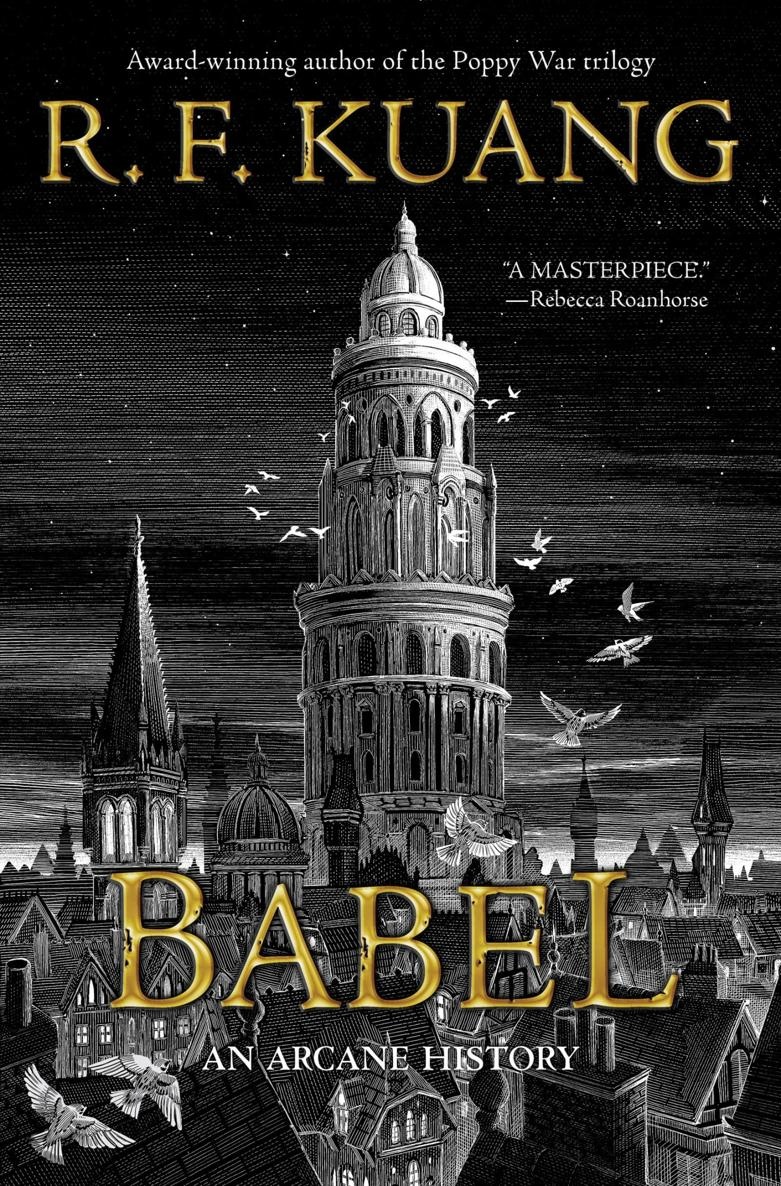
Babel: Or the Necessity of Violence: An Arcane History of the Oxford Translators' Revolution
About this book
Professor Lovell brings the boy he renames Robin Swift from Canton to England and prepares him for the Royal Institute of Translation at Oxford. Latin, Greek, and modern languages are not only scholarship there: differences between words activate engraved silver bars.
At Babel, Robin forms a close cohort with Ramy, Victoire, and Letty, students whose linguistic knowledge makes them valuable while their origins expose the exclusions beneath university prestige. Their education is inseparable from the commercial and military reach of Britain.
Robin is drawn toward the Hermes Society, which steals silver and resists imperial expansion. As conflict with China approaches, translation becomes a choice about allegiance: the work he loves can preserve knowledge or improve the machinery used to dominate its speakers.
Babel: Or the Necessity of Violence is R. F. Kuang's alternate-history dark academia novel. Footnotes and etymologies are part of the plot, allowing the book to ask whether an institution can be reformed when its beauty and benefits are produced by the same extraction as its power.
Read a sample
5,031 words
Plain text
From the opening
Book I
Chapter One
By the time Professor Richard Lovell found his way through Canton’s narrow alleys to the faded address in his diary, the boy was the only one in the house left alive.
The air was rank, the floors slippery. A jug of water sat full, untouched by the bed. At first the boy had been too scared of retching to drink; now he was too weak to lift the jug. He was still conscious, though he’d sunk into a drowsy, half-dreaming haze. Soon, he knew, he’d fall into a deep sleep and fail to wake up. That was what had happened to his grandparents a week ago, then his aunts a day after, and then Miss Betty, the Englishwoman, a day after that.
His mother had perished that morning. He lay beside her body, watching as the blues and purples deepened across her skin. The last thing she’d said to him was his name, two syllables mouthed without breath. Her face had then gone slack and uneven. Her tongue lolled out of her mouth. The boy tried to close her filmy eyes, but her lids kept sliding back open.
No one answered when Professor Lovell knocked. No one exclaimed in surprise when he kicked through the front door – locked, because plague thieves were stripping the houses in the neighbourhood bare, and though there was little of value in their home, the boy and his mother had wanted a few hours of peace before the sickness took them too. The boy heard all the commotion from upstairs, but he couldn’t bring himself to care.
By then he only wanted to die.
Professor Lovell made his way up the stairs, crossed the room, and stood over the boy for a long moment. He did not notice, or chose not to notice, the dead woman on the bed. The boy lay still in his shadow, wondering if this tall, pale figure in black had come to reap his soul.
‘How do you feel?’ Professor Lovell asked.
The boy’s breathing was too laboured to answer.
Professor Lovell knelt beside the bed. He drew a slim silver bar out of his front pocket and placed it over the boy’s bare chest. The boy flinched; the metal stung like ice.
‘Triacle,’ Professor Lovell said first in French. Then, in English, ‘Treacle.’
The bar glowed a pale white. There came an eerie sound from nowhere; a ringing, a singing. The boy whined and curled onto his side, his tongue prodding confusedly around his mouth.
‘Bear with it,’ murmured Professor Lovell. ‘Swallow what you taste.’
Seconds trickled by. The boy’s breathing steadied. He opened his eyes. He saw Professor Lovell more clearly now, could make out the slate-grey eyes and curved nose – yīnggōubí, they called it, a hawk’s-beak nose – that could only belong on a foreigner’s face.
‘How do you feel now?’ asked Professor Lovell.
The boy took another deep breath. Then he said, in surprisingly good English, ‘It’s sweet. It tastes so sweet . . .’
‘Good. That means it worked.’ Professor Lovell slipped the bar back into his pocket. ‘Is there anyone else alive here?’
‘No,’ whispered the boy. ‘Just me.’
‘Is there anything you can’t leave behind?’
The boy was silent for a moment. A fly landed on his mother’s cheek and crawled across her nose. He wanted to brush it off, but he didn’t have the strength to lift his hand.
‘I can’t take a body,’ said Professor Lovell. ‘Not where we’re going.’
The boy stared at his mother for a long moment.
‘My books,’ he said at last. ‘Under the bed.’
Professor Lovell bent beneath the bed and pulled out four thick volumes. Books written in English, spines battered from use, some pages worn so thin that the print was barely still legible. The professor flipped through them, smiling despite himself, and placed them in his bag. Then he slid his arms under the boy’s thin frame and lifted him out of the house.
In 1829, the plague that later became known as Asiatic Cholera made its way from Calcutta across the Bay of Bengal to the Far East – first to Siam, then Manila, then finally the shores of China on merchant ships whose dehydrated, sunken-eyed sailors dumped their waste into the Pearl River, contaminating the waters where thousands drank, laundered, swam, and bathed. It hit Canton like a tidal wave, rapidly working its way from the docks to the inland residential areas. The boy’s neighbourhood had succumbed within weeks, whole families perishing helplessly in their homes. When Professor Lovell carried the boy out of Canton’s alleys, everyone else on his street was already dead.
The boy learned all this when he awoke in a clean, well-lit room in the English Factory, wrapped in blankets softer and whiter than anything he’d ever touched. These only slightly reduced his discomfort. He was terribly hot, and his tongue sat in his mouth like a dense, sandy stone. He felt as though he were floating far above his body. Every time the professor spoke, sharp pangs shot through his temples, accompanied by flashes of red.
‘You’re very lucky,’ said Professor Lovell. ‘This illness kills almost everything it touches.’
The boy stared, fascinated by this foreigner’s long face and pale grey eyes. If he let his gaze drift out of focus, the foreigner morphed into a giant bird. A crow. No, a raptor. Something vicious and strong.
Continue reading the sampleClose the sample
‘Can you understand what I’m saying?’
The boy wet his parched lips and uttered a response.
Professor Lovell shook his head. ‘English. Use your English.’
The boy’s throat burned. He coughed.
‘I know you have English.’ Professor Lovell’s voice sounded like a warning. ‘Use it.’
‘My mother,’ breathed the boy. ‘You forgot my mother.’
Professor Lovell did not respond. Promptly he stood and brushed at his knees before he left, though the boy could scarcely see how any dust could have accumulated in the few minutes in which he’d been sitting down.
The next morning the boy was able to finish a bowl of broth without retching. The morning after that he managed to stand without much vertigo, though his knees trembled so badly from disuse he had to clutch the bedframe to keep from falling over. His fever receded; his appetite improved. When he woke again that afternoon, he found the bowl replaced with a plate with two thick slices of bread and a hunk of roast beef. He devoured these with his bare hands, famished.
He spent most of the day in dreamless sleep, which was regularly interrupted by the arrival of one Mrs Piper – a cheery, round woman who plumped his pillows, wiped his forehead with deliciously cool wet cloths, and spoke English with such a peculiar accent that the boy always had to ask her several times to repeat herself.
‘My word,’ she chuckled the first time he did this. ‘Must be you’ve never met a Scot.’
‘A . . . Scot? What is a Scot?’
‘Don’t you worry about that.’ She patted his cheek. ‘You’ll learn the lay of Great Britain soon enough.’
That evening, Mrs Piper brought him his dinner – bread and beef again – along with news that the professor wanted to see him in his office. ‘It’s just upstairs. The second door to the right. Finish your food first; he’s not going anywhere.’
The boy ate quickly and, with Mrs Piper’s help, got dressed. He didn’t know where the clothes had come from – they were Western in style, and fitted his short, skinny frame surprisingly well – but he was too tired then to inquire further.
As he made his way up the stairs he trembled, whether from fatigue or trepidation, he didn’t know. The door to the professor’s study was shut. He paused a moment to catch his breath, and then he knocked.
‘Come in,’ called the professor.
The door was very heavy. The boy had to lean hard against the wood to budge it open. Inside, he was overwhelmed by the musky, inky scent of books. There were stacks and stacks of them; some were arrayed neatly on shelves, while others were messily piled up in precarious pyramids throughout the room; some were strewn across the floor, while others teetered on the desks that seemed arranged at random within the dimly lit labyrinth.
‘Over here.’ The professor was nearly hidden behind the bookcases. The boy wound his way tentatively across the room, afraid the slightest wrong move might send the pyramids tumbling.
‘Don’t be shy.’ The professor sat behind a grand desk covered with books, loose papers, and envelopes. He gestured for the boy to take a seat across from him. ‘Did they let you read much here? English wasn’t a problem?’
‘I read some.’ The boy sat gingerly, taking care not to tread on the volumes – Richard Hakluyt’s travel notes, he noticed – amassed by his feet. ‘We didn’t have many books. I ended up re-reading what we had.’
For someone who had never left Canton in his life, the boy’s English was remarkably good. He spoke with only a trace of an accent. This was thanks to an Englishwoman – one Miss Elizabeth Slate, whom the boy had called Miss Betty, and who had lived with his household for as long as he could remember. He never quite understood what she was doing there – his family was certainly not wealthy enough to employ any servants, especially not a foreigner – but someone must have been paying her wages because she had never left, not even when the plague hit. Her Cantonese was passably good, decent enough for her to make her way around town without trouble, but with the boy, she spoke exclusively in English. Her sole duty seemed to be taking care of him, and it was through conversation with her, and later with British sailors at the docks, that the boy had become fluent.
He could read the language better than he spoke it. Ever since the boy turned four, he had received a large parcel twice a year filled entirely with books written in English. The return address was a residence in Hampstead just outside London – a place Miss Betty seemed unfamiliar with, and which the boy of course knew nothing about. Regardless, he and Miss Betty used to sit together under candlelight, laboriously tracing their fingers over each word as they sounded them out loud. When he grew older, he spent entire afternoons poring over the worn pages on his own. But a dozen books were hardly enough to last six months; he always read each one so many times over he’d nearly memorized them by the time the next shipment came.
He realized now, without quite grasping the larger picture, that those parcels must have come from the professor.
‘I do quite enjoy it,’ he supplied feebly. Then, thinking he ought to say a bit more, ‘And no – English was not a problem.’
‘Very good.’ Professor Lovell picked a volume off the shelf behind him and slid it across the table. ‘I suppose you haven’t seen this one before?’
The boy glanced at the title. The Wealth of Nations, by Adam Smith. He shook his head. ‘I’m sorry, no.’
‘That’s fine.’ The professor opened the book to a page in the middle and pointed. ‘Read out loud for me. Start here.’
The boy swallowed, coughed to clear his throat, and began to read. The book was intimidatingly thick, the font very small, and the prose proved considerably more difficult than the breezy adventure novels he’d read with Miss Betty. His tongue tripped over words he didn’t know, words he could only guess at and sound out.
‘The par . . . particular ad-advantage which each col-o-colonizing country derives from the col . . . colonies which par . . . particularly belong to it, are of two different kinds; first, those common advantages which every empire de . . . rives?’ He cleared his throat. ‘Derives . . . from the provinces subject to its dom . . . dom . . .’*
‘That’s enough.’
He had no idea what he’d just read. ‘Sir, what does—’
‘No, that’s all right,’ said the professor. ‘I hardly expect you to understand international economics. You did very well.’ He set the book aside, reached into his desk drawer, and pulled out a silver bar. ‘Remember this?’
The boy stared, wide-eyed, too apprehensive even to touch it.
He’d seen bars like that before. They were rare in Canton, but everyone knew about them. Yínfúlù, silver talismans. He’d seen them embedded in the prows of ships, carved into the sides of palanquins, and installed over the doors of warehouses in the foreign quarter. He’d never figured out precisely what they were, and no one in his household could explain. His grandmother called them rich men’s magic spells, metal amulets carrying blessings from the gods. His mother thought they contained trapped demons who could be summoned to accomplish their masters’ orders. Even Miss Betty, who made loud her disdain for indigenous Chinese superstition and constantly criticized his mother’s heeding of hungry ghosts, found them unnerving. ‘They’re witchcraft,’ she’d said when he asked. ‘They’re devil’s work is what they are.’
So the boy didn’t know what to make of this yínfúlù, except that it was a bar just like this one that had several days ago saved his life.
‘Go on.’ Professor Lovell held it out towards him. ‘Have a look. It won’t bite.’
The boy hesitated, then received it in both hands. The bar was very smooth and cold to the touch, but otherwise it seemed quite ordinary. If there was a demon trapped inside, it hid itself well.
‘Can you read what it says?’
The boy looked closer and noticed there was indeed writing, tiny words engraved neatly on either side of the bar: English letters on one side, Chinese characters on the other. ‘Yes.’
‘Say them out loud. Chinese first, then English. Speak very clearly.’
The boy recognized the Chinese characters, though the calligraphy looked a bit strange, as if drawn by someone who had seen them and copied them out radical by radical without knowing what they meant. They read: 囫圇吞棗.
‘Húlún tūn zǎo,’ he read slowly, taking care to enunciate every syllable. He switched to English. ‘To accept without thinking.’
The bar began to hum.
Immediately his tongue swelled up, obstructing his airway. The boy grasped, choking, at his throat. The bar dropped to his lap, where it vibrated wildly, dancing as if possessed. A cloyingly sweet taste filled his mouth. Like dates, the boy thought faintly, black pushing in at the edges of his vision. Strong, jammy dates, so ripe they were sickening. He was drowning in them. His throat was wholly blocked, he couldn’t breathe—
‘Here.’ Professor Lovell leaned over and pulled the bar from his lap. The choking sensation vanished. The boy slumped over the desk, gulping for air.
‘Interesting,’ said Professor Lovell. ‘I’ve never known it to have such a strong effect. What does your mouth taste of?’
‘Hóngzǎo.’ Tears streamed down the boy’s face. Hastily he switched to English. ‘Dates.’
‘That’s good. That’s very good.’ Professor Lovell observed him for a long moment, then dropped the bar back into the drawer. ‘Excellent, in fact.’
The boy wiped tears from his eyes, sniffling. Professor Lovell sat back, waiting for the boy to recover somewhat before he continued. ‘In two days, Mrs Piper and I will depart this country for a city called London in a country called England. I’m sure you’ve heard of both.’
The boy gave an uncertain nod. London existed to him like Lilliput did: a faraway, imaginary, fantasy place where no one looked, dressed, or spoke remotely like him.
‘I propose to bring you with us. You will live at my estate, and I will provide you with room and board until you’ve grown old enough to make your own living. In return, you will take courses in a curriculum of my design. It will be language work – Latin, Greek, and of course, Mandarin. You will enjoy an easy, comfortable life, and the best education that one can afford. All I expect in return is that you apply yourself diligently to your studies.’
Professor Lovell clasped his hands together as if in prayer. The boy found his tone confusing. It was utterly flat and dispassionate. He could not tell if Professor Lovell wanted him in London or not; indeed, this seemed less like an adoption and more like a business proposal.
‘I urge you to strongly consider it,’ Professor Lovell continued. ‘Your mother and grandparents are dead, your father unknown, and you have no extended family. Stay here, and you won’t have a penny to your name. All you will ever know is poverty, disease, and starvation. You’ll find work on the docks if you’re lucky, but you’re still small yet, so you’ll spend a few years begging or stealing. Assuming you reach adulthood, the best you can hope for is backbreaking labour on the ships.’
The boy found himself staring, fascinated, at Professor Lovell’s face as he spoke. It was not as though he had never encountered an Englishman before. He had met plenty of sailors at the docks, had seen the entire range of white men’s faces, from the broad and ruddy to the diseased and liver-spotted to the long, pale, and severe. But the professor’s face presented an entirely different puzzle. His had all the components of a standard human face – eyes, lips, nose, teeth, all healthy and normal. His voice was a low, somewhat flat, but nevertheless human voice. But when he spoke, his tone and expression were entirely devoid of emotion. He was a blank slate. The boy could not guess his feelings at all. As the professor described the boy’s early, inevitable death, he could have been reciting ingredients for a stew.
‘Why?’ asked the boy.
‘Why what?’
‘Why do you want me?’
The professor nodded to the drawer which contained the silver bar. ‘Because you can do that.’
Only then did the boy realize that this had been a test.
‘These are the terms of my guardianship.’ Professor Lovell slid a two-page document across the desk. The boy glanced down, then gave up trying to skim it; the tight, looping penmanship looked nigh illegible. ‘They’re quite simple, but take care to read the entire thing before you sign it. Will you do this tonight before you go to bed?’
The boy was too shaken to do anything but nod.
‘Very good,’ said Professor Lovell. ‘One more thing. It occurs to me you need a name.’
‘I have a name,’ said the boy. ‘It’s—’
‘No, that won’t do. No Englishman can pronounce that. Did Miss Slate give you a name?’
She had, in fact. When the boy turned four, she had insisted he adopt a name by which Englishmen could take him seriously, though she’d never elaborated which Englishmen those might be. They’d chosen something at random from a children’s rhyming book, and the boy liked how firm and round the syllables felt on his tongue, so he harboured no complaint. But no one else in the household had ever used it, and soon Miss Betty had dropped it as well. The boy had to think hard for a moment before he remembered.
‘Robin.’*
Professor Lovell was quiet for a moment. His expression confused the boy – his brows were furrowed, as if in anger, but one side of his mouth curled up, as if delighted. ‘How about a surname?’
‘I have a surname.’
‘One that will do in London. Pick anything you like.’
The boy blinked at him. ‘Pick . . . a surname?’
Family names were not things to be dropped and replaced at whim, he thought. They marked lineage; they marked belonging.
‘The English reinvent their names all the time,’ said Professor Lovell. ‘The only families who keep theirs do it because they have titles to hold on to, and you certainly haven’t got any. You only need a handle to introduce yourself by. Any name will do.’
‘Then can I take yours? Lovell?’
‘Oh, no,’ said Professor Lovell. ‘They’ll think I’m your father.’
‘Oh – of course.’ The boy’s eyes cast desperately around the room, searching for some word or sound to latch on to. They landed on a familiar volume on the shelf above Professor Lovell’s head – Gulliver’s Travels. A stranger in a strange land, who had to learn the local languages if he wished not to die. He thought he understood now how Gulliver felt.
‘Swift?’ he ventured. ‘Unless—’
To his surprise, Professor Lovell laughed. Laughter was strange coming out of that severe mouth; it sounded too abrupt, almost cruel, and the boy couldn’t help but flinch. ‘Very good. Robin Swift you’ll be. Mr Swift, good to meet you.’
He rose and extended his hand across the desk. The boy had seen foreign sailors greeting each other at the docks, so he knew what to do. He met that large, dry, uncomfortably cool hand with his own. They shook.
Two days later, Professor Lovell, Mrs Piper, and the newly christened Robin Swift set sail for London. By then, thanks to many hours of bed rest and a steady diet of hot milk and Mrs Piper’s abundant cooking, Robin was well enough to walk on his own. He lugged a trunk heavy with books up the gangplank, struggling to keep pace with the professor.
Canton’s harbour, the mouth from which China encountered the world, was a universe of languages. Loud and rapid Portuguese, French, Dutch, Swedish, Danish, English, and Chinese floated through the salty air, intermingling in an implausibly mutually intelligible pidgin which almost everyone understood, but which only a few could speak with ease. Robin knew it well. He’d gained his first instruction in foreign languages running about the quays; he’d often translated for sailors in exchange for a tossed penny and a smile. Never had he imagined he might follow the linguistic fragments of this pidgin back to their source.
They walked down the waterfront to join the boarding line for the Countess of Harcourt, one of the East India Company ships that took on a small number of commercial passengers on each voyage. The sea was loud and choppy that day. Robin shivered as frigid seaside gusts cut viciously through his coat. He badly wanted to be on the ship, inside a cabin or anywhere with walls, but something held up the boarding line. Professor Lovell stepped to the side to have a look. Robin followed him. At the top of the gangplank, a crewman was berating a passenger, acerbic English vowels piercing through the morning chill.
‘Can’t you understand what I’m saying? Knee how? Lay ho? Anything?’
The target of his ire was a Chinese labourer, stooped from the weight of the rucksack he wore slung over one shoulder. If the labourer uttered a response, Robin couldn’t hear it.
‘Can’t understand a word I’m saying,’ complained the crewman. He turned to the crowd. ‘Can anyone tell this fellow he can’t come aboard?’
‘Oh, that poor man.’ Mrs Piper nudged Professor Lovell’s arm. ‘Can you translate?’
‘I don’t speak the Cantonese dialect,’ said Professor Lovell. ‘Robin, go on up there.’
Robin hesitated, suddenly frightened.
‘Go.’ Professor Lovell pushed him up the plank.
Robin stumbled forward into the fray. Both the crewman and the labourer turned to look at him. The crewman merely looked annoyed, but the labourer seemed relieved – he seemed to recognize immediately in Robin’s face an ally, the only other Chinese person in sight.
‘What’s the matter?’ Robin asked him in Cantonese.
‘He won’t let me aboard,’ the labourer said urgently. ‘But I have a contract with this ship until London, look, it says so right here.’
He shoved a folded sheet of paper at Robin.
Robin opened it. The paper was written in English, and it did indeed look like a lascar contract – a certificate of pay to last for the length of one voyage from Canton to London, to be specific. Robin had seen such contracts before; they had grown increasingly common over the past several years as the demand for indentured Chinese servants grew concurrently with overseas difficulties with the slave trade. This was not the first contract he’d translated; he’d seen work orders for Chinese labourers to board for destinations as far away as Portugal, India, and the West Indies.
It all looked in order to Robin. ‘So what’s the problem?’
‘What’s he telling you?’ asked the crewman. ‘Tell him that contract’s no good. I can’t have Chinamen on this ship. Last ship I sailed that carried a Chinaman got filthy with lice. I’m not taking risks on people who can’t wash. Couldn’t even understand the word bath if I yelled it at him, this one. Hello? Boy? Do you understand what I’m saying?’
‘Yes, yes.’ Robin switched hastily back to English. ‘Yes, I’m just – give me a moment, I’m just trying to . . .’
But what should he say?
The labourer, uncomprehending, cast Robin an imploring look. His face was creased and sun-browned, leathered in a way that made him look sixty, though he was likely only in his thirties. All lascars aged quickly; the work wrecked their bodies. Robin had seen that face a thousand times before at the docks. Some tossed him sweets; some knew him well enough to greet him by name. He associated that face with his own kind. But he’d never seen one of his elders turn to him with such total helplessness.
Guilt twisted his gut. Words collected on his tongue, cruel and terrible words, but he could not turn them into a sentence.
‘Robin.’ Professor Lovell was at his side, gripping his shoulder so tightly it hurt. ‘Translate, please.’
This all hinged on him, Robin realized. The choice was his. Only he could determine the truth, because only he could communicate it to all parties.
But what could he possibly say? He saw the crewman’s blistering irritation. He saw the rustling impatience of the other passengers in the queue. They were tired, they were cold, they couldn’t understand why they hadn’t boarded yet. He felt Professor Lovell’s thumb digging a groove into his collarbone, and a thought struck him – a thought so frightening that it made his knees tremble – which was that should he pose too much of a problem, should he stir up trouble, then the Countess of Harcourt might simply leave him behind onshore as well.
‘Your contract’s no good here,’ he murmured to the labourer. ‘Try the next ship.’
The labourer gaped in disbelief. ‘Did you read it? It says London, it says the East India Company, it says this ship, the Countess—’
Robin shook his head. ‘It’s no good,’ he said, then repeated this line, as if doing so might make it true. ‘It’s no good, you’ll have to try the next ship.’
‘What’s wrong with it?’ demanded the labourer.
Robin could hardly force his words out. ‘It’s just no good.’
The labourer gaped at him. A thousand emotions worked through that weathered face – indignation, frustration, and finally, resignation. Robin had been afraid the labourer might argue, might fight, but quickly it became clear that for this man, such treatment was nothing new. This had happened before. The labourer turned and made his way down the gangplank, shoving passengers aside as he did. In a few moments he was gone from sight.
Robin felt very dizzy. He escaped back down the gangplank to Mrs Piper’s side. ‘I’m cold.’
‘Oh, you’re shaking, poor thing.’ She was immediately on him like a mother hen, enveloping him within her shawl. She spoke a sharp word to Professor Lovell. He sighed, nodded; then they bustled through to the front of the line, from which they were whisked straight to their cabins while a porter collected their luggage and carried it behind them.
An hour later, the Countess of Harcourt left the port.
Robin was settled on his bunk with a thick blanket wrapped around his shoulders, and he would have happily stayed there all day, but Mrs Piper urged him back above deck to watch the receding shoreline. He felt a sharp ache in his chest as Canton disappeared over the horizon, and then a raw emptiness, as if a grappling hook had yanked his heart out of his body. It had not registered until now that he would not step foot on his native shore again for many years, if ever. He wasn’t sure what to make of this fact. The word loss was inadequate. Loss just meant a lack, meant something was missing, but it did not encompass the totality of this severance, this terrifying un-anchoring from all that he’d ever known.
He watched the ocean for a long time, indifferent to the wind, staring until even his imagined vision of the shore faded away.
He spent the first few days of the voyage sleeping. He was still recuperating; Mrs Piper insisted he take daily walks above deck for his health, but initially he could manage only a few minutes at a time before he had to lie down. He was fortunate to be spared the nausea of seasickness; a childhood along docks and rivers had habituated his senses to the roiling instability. When he felt strong enough to spend whole afternoons above deck, he loved sitting by the railings, watching the ceaseless waves changing colour with the sky, feeling the ocean spray on his face.
Occasionally Professor Lovell would chat with him as they paced the deck together. Robin learned quickly that the professor was a precise and reticent man. He offered up information when he thought Robin needed it, but otherwise, he was happy to let questions lie.
He told Robin they would reside in his estate in Hampstead when they reached England. He did not say whether he had family at that estate. He confirmed that he had paid Miss Betty all those years, but did not explain why. He intimated that he’d known Robin’s mother, which was how he’d known Robin’s address, but he did not elaborate on the nature of their relationship or how they’d met. The only time he acknowledged their prior acquaintance was when he asked Robin how his family came to live in that riverside shack.