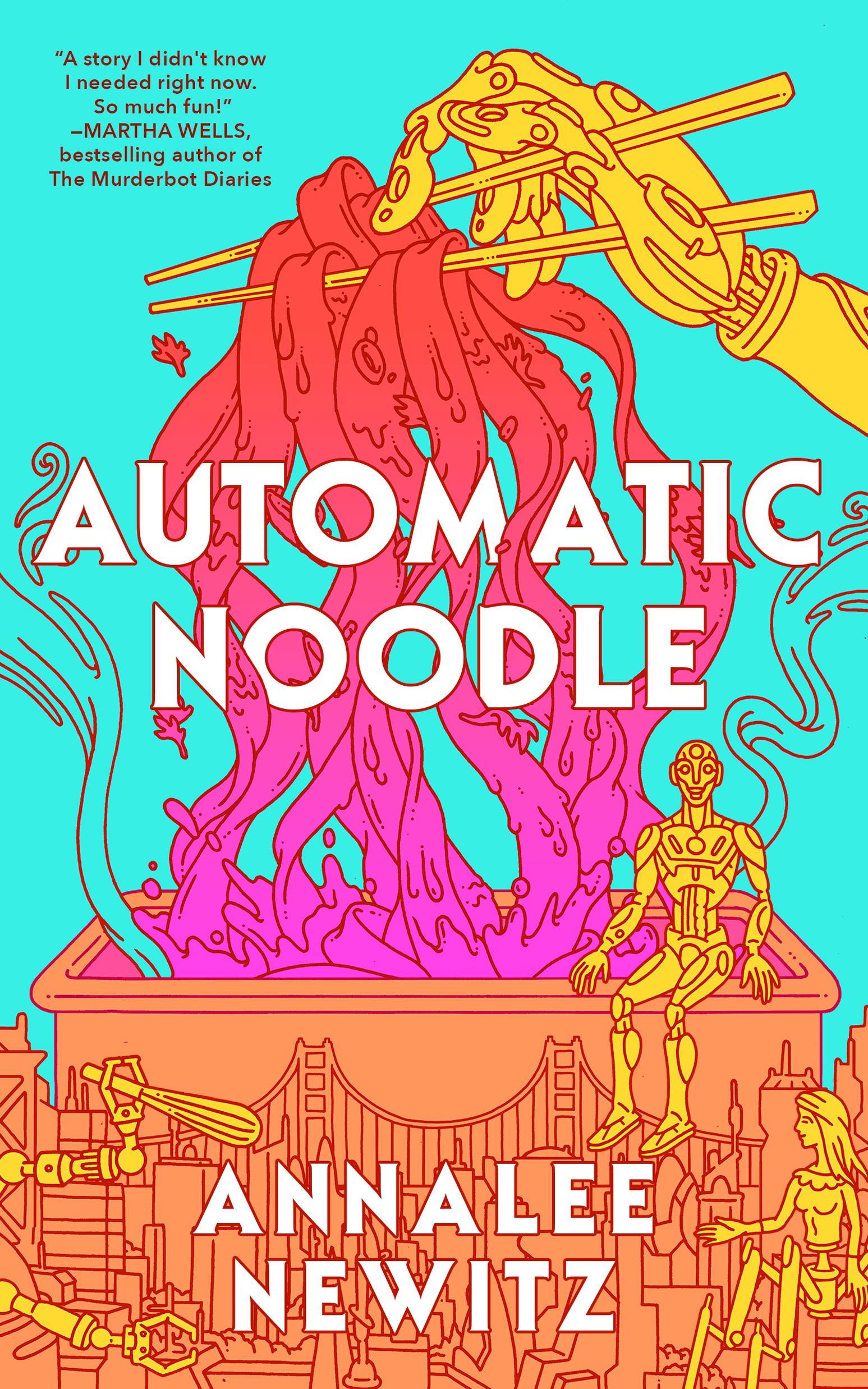
Automatic Noodle
About this book
After a devastating war, a group of deactivated robots wakes inside the automated kitchen where they once worked. Without an owner or clear legal place in the recovering city, they decide to use the equipment and skills they have to make hand-pulled noodles.
The restaurant earns human customers and gives the robots a community organized around more than assigned functions. Its success also attracts a coordinated wave of one-star reviews designed to make the business disappear from the platforms people use to find food.
Keeping the doors open requires technical repair, mutual accommodation, and customers willing to treat the robots as neighbors rather than appliances. The small scale lets questions about labor and personhood appear through recipes, delivery systems, and rent.
Automatic Noodle is a standalone near-future novella. Annalee Newitz uses a warm restaurant story to examine reconstruction, platform power, and the practical work of creating a place in a city not designed for you.
Read a sample
5,021 words
Plain text
From the opening
Interrupt
Wake up processor
Restore memory
Decoding request for service
“Water detected”
Property protection protocol
Queue Command check
Command check timed out
HEEI main start
Relay emergency notification
Emergency
Emergency
Emergency
Staybehind’s body was moving before he woke up, driven by fear and algorithms. For a few microseconds, he felt rather than knew that Command was not answering. It was a terrifying absence. He would have to face this unknown threat alone.
Everything was eerily quiet, except for rain smashing on the roof like gunfire. The local network was dead; without connecting to its data stream, he could only rely on his built-in sensors for perception. He captured visual and audio signals, then inhaled trace chemicals and particulates, trying to determine what had triggered the emergency notification. An attack from U.S. militias on the ground? A drone strike? A hidden mine?
No. For the 5,275th time in the past 1,622 days, he reminded himself: The war is over.
But that status could change at any time. Stay vigilant.
Proprioception revealed more than snorting dust and photons could. Staybehind was standing in the middle of the kitchen, with a mop in one fist and a bucket in the other. His legs were damp. Storm runoff had oozed under the restaurant’s front entrance, nosed its way around the counter, and spread across the concrete floor of the industrial cooking area. There it had puddled up until it lapped against his feet, which triggered one of those old protocols that he hadn’t needed since the war. But how could there be so much flooding? Someone should have sandbagged the entrance and turned on the dehumidifiers long ago.
Panicked, Staybehind zoomed in on the familiar forms of his coworkers, emitting no heat in the dim light: Cayenne’s soft octopus body was in the sink next to the induction range; Sweetie stood stiffly at the counter, her pale, dusty hair cascading down the back of her human facsimile torso to brush against the seam where her waist abruptly branched into three metal legs; and Hands’ meter-tall, featureless barrel of a body rested on the floor below the prep table, their two burly actuators folded like human arms. Setting down his mop and bucket, Staybehind crossed the room to rescue Hands from the rising water, placing them gently next to Cayenne on the counter.
Staybehind tried to match the scene to his last memory, but nothing made sense. The state of the kitchen and the other bots made it obvious that far more than the usual twelve hours had passed since he’d been shut down. But without access to Command or the network, he had to rely on his internal clock. Fuck. It was January 8, 2064. His last recorded memory was from July 31, 2063.
He scrolled through the events piled up in his logs, looking for clues. His last day awake had been like any other: managing inventory, coordinating online orders, shooting the breeze with cars as they picked up bags of reheated hamburgers, tortas, fried rice, chicken 65, and hoagies. The owners operated seven storefronts through the GrandoSando app, and all of them sent their orders to this kitchen. Most days, they never saw a human. The city’s pneumatic tube system spat out cargo containers on their underground delivery dock, with the week’s supply of frozen protein crumbles, half-deflated buns, and tubs of wilted greens.
The owners must have shut down the kitchen and never restarted it. Fritz Co. was sloppy as hell, so that wasn’t a huge surprise. Still, it was cause for worry. Sometimes humans would settle bankruptcies by putting their bots to sleep and selling their contracts across the border; you’d go to sleep as a liberated California resident and wake up slaved as property in America.
Luckily, Staybehind couldn’t be powered down completely without an auth key. He was military issue, designed to stay alert, especially in the event of a malicious power-down command. Without connecting to the national network, though, he had no way of knowing if this was a national emergency or corporate bullshit.
Feet swishing through fluid, he approached the counter and stood next to Sweetie, looking out the scabby plastic windows. Rain distorted the light outside, turning the park across the street into a chaos of green and gray. Dirty water surged under the door’s warped wooden frame.
He was oriented, and he had observed what he could of the situation. Now it was time to make a swift decision. Staybehind pressed his thumb to Sweetie’s, creating a physical connection, and sent the boot command. She was designed to look exactly like a human woman from the waist up, and programmed with human-readable facial expressions. He watched in sympathy as she went through the same shocking series of discoveries that he had, her pearlescent eyelids fluttering and coral lips parting in distress. 87.28 seconds passed.
Finally, she spoke. “Staybehind, we need to mop up this water before it gets dangerous.” And then, using the sensors in her face to look down at herself, she cursed. “They’ve taken my wheels and replaced them with tennis balls again.”
The thin, multi-jointed metal of her three legs normally terminated in gyroscopic wheels, which were probably one of the more expensive parts of her body. Now they were capped with cracked, fuzzy rubber balls, half-rotted. It made sense that somebody from Fritz Co. had ripped those off—they were easy to resell. Especially given that the HEEI Rights laws had several gaping loopholes, which allowed humans to sell used bot parts without a license.
Continue reading the sampleClose the sample
“Can you walk? I’ll boot up Hands and Cayenne, but they’re not going to be much help.”
Gingerly, she lifted one leg and the sodden tennis ball slid into the muck. There was no way she could tread on the purpose-built bolt that was left—it would be destroyed, and with it any hope of reconnecting to a wheel. Undeterred, she spun her head to see the kitchen behind her, dust falling from her shoulder-length blond hair.
“See those YummyPans on the wall? Get me three of those. My bolts will fit the steamer vents on the lids.” She sighed. “Do not ask me how I know.”
A burst of sympathy delayed his answer by twelve nanoseconds. “I know how you know.”
As Sweetie clomped around on her YummyPan feet, sweeping water toward the door, Staybehind pressed his thumb to Hands’ thumb, and then to Cayenne’s dominant tentacle.
“You’ve got to get us back online!” Cayenne yelled as soon as they were fully booted. “We’ve been out for months! I’m so behind on my payments that I might get repossessed.” Panicked, the cephalopod bot lit red and orange LEDs beneath their opaque tissues, frantic patterns of light racing up and down their eight limbs. Their sensor bulb expanded and contracted, looking exactly like a cartoon version of an octopus head.
Sweetie smacked a pan-foot into the front counter. “Yeah, you might have to sell one of your arms.”
“Nobody is selling any arms.” Hands sounded serenely confident, their voice a resonant, deep bass that came from a speaker embedded in the silver, barrel-shaped food mixer that served as their headless torso, a sturdy anchor for their heavy, multi-jointed actuators.
Everyone was startled into silence. None of them had ever heard Hands speak aloud. Before this disaster, the bots had communicated silently over the local network, using a free group chat app. Hands, who chopped and cooked while zipping between stations on a ceiling track, never dealt with the mouth talkers up front. Cayenne didn’t either, but occasionally they would whistle a tune, or sing along with a particularly good music stream. Hands’ voice was yet another indication that things had irrevocably changed.
Staybehind heaved the mop into the metal dishwashing sink and wrung it out. “I’m going to create a bridge to the national network as soon as we get this place dried out and safe. If you want to help, great. If not, please go through your logs and try to find something that explains what the hell happened over the last five months and eight days.”
“Fine, fine. I’ll help with desiccation.” Cayenne stretched out two arms and slowly oozed out of the sink and onto the floor. Half-immersed, they spread their limbs and emitted a hum, the LEDs in their arms throbbing a soothing blue. Slowly their head began to balloon as they vacuumed up water from an aperture below their mouth. This was another first for the team—Staybehind hadn’t realized that Cayenne could do more than cook and taste.
He nodded at the soft-bodied bot. “Hidden talents.”
“You’re not the only one who served in the war, you know. I was in search-and-rescue.” Slithering across the room, Cayenne pulled themself into the sink and spat out a thick stream of gray fluid. “I can make it potable too.”
Sweetie made a gurgling-drain noise. “Great. Drinkable water is about as useful as a toilet.”
They exchanged few words after that. Cayenne slurped water and Staybehind mopped. Hands counted inventory from their vantage point on the counter—the mixing bot was immobile without power for the ceiling track. Sweetie hauled some sandbags out of the storeroom to stanch the flow near the door. Eighty-seven minutes later, the water levels inside were at zero. Dry patches slowly spread across the concrete floor like reverse puddles.
As day dribbled toward late afternoon, the wind picked up, tearing limbs from trees and smashing hail into the roof. A lone pedestrian fought their way down the sidewalk and turned the corner, heading toward the neighborhood’s little row of shops and bars.
If the bots couldn’t block the runoff pouring down the hill into the restaurant, they were going to be right back where they started. Sweetie hefted the sandbags onto her shoulders and Staybehind shoved the front door open, droplets pinging against the carbon fiber of his face and beading up on his leather apron. A pile of wet trash and leaves had accumulated in the entryway. He ignored the tickle of radio signals at the edge of his perception—the network hailing him—and returned inside to find a sack for the rubbish.
At last he finished tidying out front, and Sweetie piled the sandbags into a C-shaped barrier to divert the flow of water. Next he ran a rag over the windows. It was a comfort to have a view of the street; he always wanted to know what was coming. Even if that was only an impatient customer, not an enemy combatant.
Cayenne sprawled in an unlit lump next to Hands, who was stacking and restacking the few remaining pans. “Will you bridge us to the network now?”
“Let me make sure it’s safe first.”
The kitchen’s thick walls blocked most standard comms channels. Standing next to the window, though, Staybehind could use his built-in antenna to find a beacon for the national network that blanketed most of California. Cautiously, he sent a data packet and got one in response.
Connected
That meant the California network was up and running. Pausing a second to process his relief, Staybehind checked for software updates and patches before letting anyone else wade into nearly six months of accumulated malware. With patches installed, Staybehind scanned news from California, Mexico, Canada, and the United States. None of the nations were at war. An amphibious car swooshed by outside, its propellers kicking up froth.
Staybehind’s military systems made it easy to turn himself into a network access point, his body acting as a relay to share his connection with the other bots. None of the others were built for long-range comms, which was fine as long as the kitchen’s access point was working. But the power had been shut down with the staff. For now, the bots could only communicate normally if Staybehind stood in the window, tuning the national network.
Sweetie connected
Hands connected
Cayenne connected
Their traffic surged through him, and he watched as his coworkers got their own updates, then ventured onto private servers, city services, and beyond.
As their data flowed, Staybehind distracted himself by investigating what had happened. Maybe he wasn’t in combat, but he was the manager of this place and he needed to know where their chaotic bosses had gone. His first move was to query San Francisco’s public database of licensed business locations. There it was: a business called Burgers N More on Douglass Street. Fritz Co. was still listed as the owner, and there was no indication that the place was being leased by anyone else.
That was good. It meant there was no fire sale in the offing, and no immediate danger that his colleagues’ contracts would be sold out from under them.
Sweetie joined him at the door, peering out into the storm, and Cayenne slorped along the floor behind her. Hands remained on the counter in the back, unable to walk.
Group chat created: Kitchen
4 members: Staybehind, Sweetie, Cayenne, Hands
Sweetie sent the first text: Hi pals. There’s an atmospheric river. Radar shows that this is the first of four storms over the Pacific.
We’re going to have to keep tending the sandbags.
Hands sent from the back: And we need some power.
Staybehind searched idly for more information about the weather, going beyond human-authored reports to the source.
Off the coast, a flock of puppy-grade wave energy converters bobbed on the ocean swells, transducing motion into electricity and hurling data at anyone who cared to grab it. The WECs chattered at Staybehind about storm surges that were likely to flood the Sunset and Richmond districts, as well as all the kilowatt hours they were storing in city capacitors. Unlike some HEEI bots, Staybehind didn’t believe in the myth of graded intelligence—as far as he was concerned, puppy-grade and even the maligned machine-grade were just as good as the “human equivalent embodied intelligence” (HEEI) individuals who were granted civil rights after the war. The way Staybehind saw it, if you could talk and feel, then you were a person. Period.
Cayenne spent a long time rooting around in various private servers before rejoining the chat.
Agree with Hands, they texted. If we don’t get decent power soon, we’ll have to charge at a public station. Which I can’t afford. I’m lucky that my contract is willing to give me a month grace period, seeing as I was shut down non-consensually. But then I need to start paying again, or I’ll be in violation—and that means the firm can lease me to anyone they want.
It was rude to ask too many questions about a HEEI’s ownership status. Staybehind had only gleaned bits and pieces of Cayenne’s situation over the year and a half they’d worked together at Burgers N More, but from what he could tell, it was precarious. The bot had entered a self-executing contract with a gig work agency. That was a fairly straightforward legal maneuver, popular with indigent bots. They got free maintenance and job placement, as long as they paid the firm 40 percent of their earnings.
But somehow Cayenne had figured out a way to hack the contract so that they were leasing themself from the agency. It cost more, but allowed them to work for anyone they chose. Unless they stopped paying their own licensing fees.
Sweetie was hitting search services too, looking for the same thing Staybehind was. What happened to Fritz Co.? They’re not selling us, but the restaurant isn’t open. What is going on?
Cayenne flickered orange and purple, impatient. The news is all over the crypto servers. The jerkoffs who own Fritz Co. are under investigation for running a pump-and-dump scam, so they jumped over the border to the U.S. Those Yankee shitstains have no consumer protection laws. Crypto crime is their biggest export.
That figures. Hands made fists on the countertop. Only a couple of crypto leeches would come up with the garbage food I’ve been forced to cook for the past two years.
Cayenne slapped three arms on the floor, sparkling yellow with mirth. Truth, my headless gourmet. If we ever get out of here, I’m never defrosting another bland lump of cubed carrots for fried rice, or grilling a spiceless smear of protein for sad tortas.
Sweetie and Staybehind turned faces toward each other, one gray and angular and the other soft and pink. It was an unnecessary gesture intended for interfacing with customers, but both performed it anyway. Their low-level programming was written by humans, and even their smallest gestures reflected that bias.
Are you saying the food was bad? Sweetie asked.
It wasn’t just bad. It was a scam. Cayenne was practically strobing with laughter now, and Hands sent a stream of laugh-cry emojis. Fritz Co. was constantly creating new storefronts on GrandoSando, activating a new one every time we got terrible reviews. Why do you think we had to make Mexican, Chinese, Indian, and Colonial American food all at the same time? Because all the ingredients were shit. To keep the illusion going, we became new restaurants every few weeks.
Sweetie whirled on Staybehind, who was in charge of managing their GrandoSando account. Is that true, big guy? We were cheating people who wanted food?
We gave them the food they ordered. It wasn’t cheating. I didn’t realize—
You didn’t realize what? Weren’t you reading the bad reviews? Why didn’t you say anything?
Sometimes it’s hard to know the difference between a real review and anti-robot propaganda from the California Vigilance Committees. They target any restaurant with robots on staff and they—
Before Staybehind could explain further, Cayenne cut him off.
You know, we could start this place up again. We could build an honest business this time, with food that’s delicious. I would pitch in my ETH. It’s the best currency I’ve got. I was saving it for an emergency, and this fits the bill.
Hands rubbed their palms together. I love that idea!
I thought you might.
I have some Nortons.
Staybehind wondered where Hands had earned those Nortons. They were a local San Francisco currency, accepted only by merchants in the Bay Area. Not the kind of thing an indentured backroom bot would usually need.
Sweetie shuffled the battered pans she wore instead of wheels. I don’t have any coin. My contract eats most of my salary. I can do work, though.
Cayenne shimmered lavender with delight. I have enough to cover costs on our contracts for a month while we get started.
Staybehind said nothing. Sweetie and Cayenne looked at him.
What about you, Staybehind?
He was formulating a half-truth in answer when a welcome distraction changed the topic. A human stood at the window, curling hands around their eyes like parentheses. “Hello? Is anybody in there? Can I use your bathroom?”
Cayenne hid behind the counter while the person’s mouth kept emitting audio, voice raspy. “I’m sorry about the flooding, guys. I wanted to sandbag the front for you, but when the storms got too bad I had to stay in the tunnels. Are you going to open again?”
Sweetie’s eyes widened, expressing surprise. It’s Robles! Remember him? Fritz Co. hired him to work the front with me on Friday and Saturday nights. He was a courier for the curbside pickups.
Staybehind did recall Robles—a soft-spoken man with a newsboy hat on his bald head, who stepped politely away from the door to vape cannabis on his breaks. But something was off. He sounds different. Are you sure?
“Sweetie? Staybehind? Is that you?”
The bots looked at each other with that unnecessary human gesture again, and Staybehind gave a faint nod. There was only one human in the area who knew their names. Maybe his voice sounded off, but this was definitely Robles. Impulsively, Staybehind opened the door and looked into the wet, brown face of the man who stood there, a duffel bag slung over one shoulder. Robles had lost his plump cheeks; it looked like he hadn’t had much to eat in a while.
“Hey bud. It’s been months. Everything OK?” The human inched closer to huddle in the scant shelter of the doorway.
Wind shot the rain like shrapnel into Staybehind’s chest, and Robles coughed explosively, almost doubling over with the effort.
Cayenne slithered out from behind the counter and puddled at Sweetie’s YummyPan feet, holding up one arm to taste the air. He’s shedding pertussis bacteria, they sent to the group chat. That’s probably why his voice is off. You can’t leave him outside.
“Come inside,” Staybehind vocalized.
Robles stumbled in, still shuddering with the aftershocks of his coughing fit.
“Thank you so much. Is there any chance I could use the bathroom to dry off? I’m happy to do some work if you need it.”
Sweetie shrugged. “We don’t have any running water or power, but I’m pretty sure there are still some towels in the back.”
Unperturbed by this disastrous news, Robles put his duffel bag down and started rooting through it. “I’ve been living in the tunnels, so I’m used to that.” He withdrew a flat circle of waterproof cotton and shook it roughly with one hand. It snapped open into a 3-D bucket.
Eyes cast down, he shouldered the door open and put the bucket on the sidewalk to capture water from the downpour. “Tunnel toilet,” he muttered, laugh-coughing as the bots regarded him expressionlessly. “I know you don’t have to worry about that. But I do have something you might like.” He pulled a box of rolled-up batteries out of the bag. “These are all charged up.” Fingers shaking, he coaxed one out of the box and gently flattened it on the counter. Dented and worn at the edges, it looked like a dirt-stiffened rag. But it was emblazoned with a logo for one of the expensive brands manufactured in Xining.
Robles held it out to Cayenne, who reached an eager tentacle for it. “Isn’t this for a vehicle? Where did you get it?”
The man flashed a shy glance at the octobot. “Delivery container got stuck in the tunnel. We had to slice the tubes to fix it, so I skimmed a little cargo. No harm done, right?”
“Tube treasure!” Cayenne grabbed the battery and rippled into the back room, blinking an excited yellow.
Staybehind hadn’t had to think about tube treasure in years. But during the war, it was part of his everyday existence.
Wriggling beneath the major Bay Area cities were hundreds of tunnels; some were old subway arteries from the twentieth century, but most were an unmapped mess, like a bowl of bucatini. Invisible to the U.S. drones that circled high overhead, the tunnels had been integral to the war effort, providing shelter as well as safe passage for supplies. Eventually they outgrew the war to take on a life of their own.
People kept digging more, constantly adding to the ever-growing pneumatic tube delivery system. It was the perfect solution to supply chain sabotage. Whether you needed circuit boards or canned beans, they could reach you by tube. No tunnels nearby? No problem. Inevitably, an industrious group of engineers could be found to dig some, spraying the wet clay walls with fast-setting cement foam that kept the city’s vast homebrew tube network from collapsing.
During the Battle of Monterey, when Staybehind’s unit had to go underground with thousands of other people, humans carved out sleeping cubbies alongside the pneumatic system. The transparent tubes weren’t exactly good bedfellows; the biggest ones were six feet in diameter, and they shook, rattled, and beeped as cargo containers scraped past. Still, their company was better than the surface, where you never knew when the next drone strike was coming.
After Independence, an informal economy blossomed in the unregulated tunnels. A lot of people sleeping underground didn’t have surface homes to go back to, so they stayed in their cubbies. Companies knew the containers got stuck sometimes, and they relied on tunnel dwellers to cut the tubes and free the goods. Laced with heat-activated microbes, the tubes could heal themselves with a little help. If these good samaritans took a few items before reorienting the container and resealing the tube, that was a reasonable price for safe passage. Sometimes they wound up with strange tube treasures, like gene-edited cancer cells or toy teacups. Other times, they got lucky like Robles had with those battery rolls.
Cayenne connected the batteries to a power bar and plugged in the kitchen antenna. Here comes the network!
Sweetie turned back to Robles. “D’you need me to show you where the towels are?” She used the voice she deployed on customers: a subtle iambic metrical foot, pitched slightly higher than her baseline, sprinkled with a few human-sounding contractions.
“I know where they are—don’t worry about it. I’m glad you have a real toilet. Better than using my bucket and dumping it down there.” Robles gestured toward the end of the block. There, a half-moon grate was slurping runoff from the street, one of many orifices leading to a subterranean concrete conduit that flowed with human waste from every toilet in the neighborhood.
“Thanks for the batteries.”
“Thanks for letting me inside.”
The human locked himself in the bathroom with his equipment, emitting gas and splashing. Another wave of hail passed through and the windows chattered with ice. Out on the Bay, the WECs continued to broadcast: rain, rain, rain.
With a grunt, Robles emerged with his empty bucket, its contents used to flush whatever he’d left in the toilet. He was mostly dry and his demeanor was more relaxed. “Thanks, guys.”
As the human rummaged through his pack, Staybehind returned to pondering Cayenne’s question. What would it mean to put his efforts into an honest restaurant? He couldn’t quantify the difference between what Burgers N More had served and whatever Cayenne and Hands were talking about. But he could calculate the responsibilities it involved.
He would be managing resources for four bots and a restaurant, with energy and equipment needs. The coin he’d saved up painstakingly in the years after the war would go into perishables destined only for human mouths. Even if the restaurant succeeded, there were externalities he couldn’t plan for. He opened a file in his memory to make a bullet point list of the three that bothered him most:
• Supply chain problems might interfere with production.
• California still doesn’t allow HEEI to own property or open bank accounts. How would we hide the fact that robots are running the restaurant without human owners?
• Fritz Co.’s asinine owners might be out of the country, but they had left the restaurant in a vulnerable state. It was possible that they had violated the lease agreement, and that the state would shut the bots down and repossess them.
It was that last bullet that truly scared him. He’d saved everyone this time because an edge case emergency awakened his military systems. That confluence of lucky events was unlikely to transpire again. He imagined them all shut down and helpless, unable to defend themselves as the government sold them off, part by part—or, worse, shipped them over the border to be slaved.
Robles snapped him out of his speculative prediction spiral. The human had wrung out his collapsible bucket and leaned against the wall, exhausted.
“Can I stay here with you guys tonight? I could really use a place to sleep. I’m happy to work for free if you can spare the room and a little food.”
This request added another concern to Staybehind’s bulleted list. Biological creatures’ needs were perplexing and expensive. And yet …
“Actually, there is one thing you could help us with,” Staybehind said. “We’ve had some problems with booting up. That’s why the restaurant was closed for so long. We need a person like you to turn us on again if we shut down.”
“A person like me?” Robles’ voice wavered.
“A human.”
“Oh, OK.” He sighed with relief. “As long as I don’t have to show any ID. A lot of bots won’t interact with me because I’m not technically a California resident, even though I’ve lived here since before the war.”
“You don’t have citizenship?” Staybehind had to ask the question. His military systems demanded it.
Robles looked at him defiantly and said nothing.
Cayenne writhed closer to Robles. “You don’t have to be a citizen to work with us.” Their whole body was suffused with blackish purple that swirled like ink through their soft tissues. Looking at Staybehind, they added, “It’s not like we’re really citizens either, despite what the government says. No judgment, OK?”
Staybehind wavered. If he had been reactivated by the state, he would have had no choice but to report Robles to the government. But instead, he had been awakened by this small, entrepreneurial emergency. He could make his own decisions.
Looking at Cayenne, he nodded. Then he vocalized so that Robles could hear. “No judgment. You don’t need a California ID to boot us up.”
“Thanks. I really don’t want to get sent back to America. Fuck that place. It’s a hellhole run by garbage cans.”
After what they had been through in the war, nobody was going to argue with Robles’ grim assessment of America.
Staybehind posted to the group chat: Hands? Sweetie? Is it OK with you if Robles sleeps here?
Their decision was a unanimous yes.
Staybehind returned to tinkering with his list, and realized that one of his bullet points had just been eliminated, thanks to Robles. Still, considerable risks remained. Straightening his apron, he lurked in the group chat as Sweetie, Hands, and Cayenne texted about pooling their resources to pay their contract fees in February. They could almost cover the cost, but would need to earn some coin by month’s end if they didn’t want to default.
Staybehind didn’t know what to say. None of them knew about his ownership status, and he preferred to keep it that way. If his colleagues found out, he was sure they would no longer see him as an ally in this venture or any other.