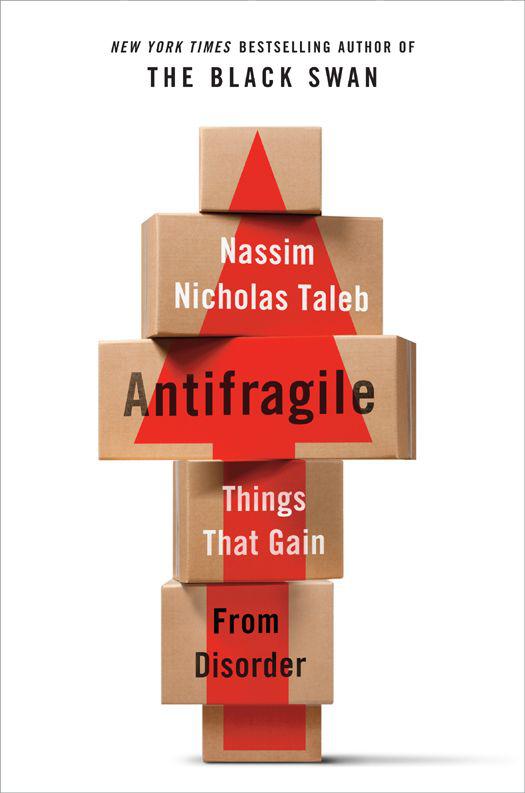
Antifragile: Things That Gain from Disorder
About this book
Antifragility names a property beyond resilience. A resilient object resists a shock and stays the same; an antifragile system uses volatility to discover, adapt, or strengthen. Taleb applies the distinction to biology, finance, medicine, organisations, and personal decisions.
The practical argument favours optionality, redundancy, decentralisation, trial and error, and small reversible exposures over forecasts that hide their uncertainty. It also attacks situations in which decision-makers keep the gains while transferring the downside to others.
The book proceeds through essays, examples, aphorisms, and technical asides rather than a step-by-step programme. Its strongest use is diagnostic: ask who benefits from variation, where fragility is concentrated, and whether an elegant intervention removes information carried by natural fluctuation.
Antifragile is part of Taleb’s Incerto and builds on The Black Swan. It offers a broad framework rather than evidence that every traditional, decentralised, or volatile practice is automatically beneficial; the mechanism and scale still have to be examined.
Read a sample
5,167 words
Plain text
From the opening
I. HOW TO LOVE THE WIND
Wind extinguishes a candle and energizes fire.
Likewise with randomness, uncertainty, chaos: you want to use them, not hide from them. You want to be the fire and wish for the wind. This summarizes this author’s nonmeek attitude to randomness and uncertainty.
We just don’t want to just survive uncertainty, to just about make it. We want to survive uncertainty and, in addition—like a certain class of aggressive Roman Stoics—have the last word. The mission is how to domesticate, even dominate, even conquer, the unseen, the opaque, and the inexplicable.
How?
II. THE ANTIFRAGILE
Some things benefit from shocks; they thrive and grow when exposed to volatility, randomness, disorder, and stressors and love adventure, risk, and uncertainty. Yet, in spite of the ubiquity of the phenomenon, there is no word for the exact opposite of fragile. Let us call it antifragile.
Antifragility is beyond resilience or robustness. The resilient resists shocks and stays the same; the antifragile gets better. This property is behind everything that has changed with time: evolution, culture, ideas, revolutions, political systems, technological innovation, cultural and economic success, corporate survival, good recipes (say, chicken soup or steak tartare with a drop of cognac), the rise of cities, cultures, legal systems, equatorial forests, bacterial resistance … even our own existence as a species on this planet. And antifragility determines the boundary between what is living and organic (or complex), say, the human body, and what is inert, say, a physical object like the stapler on your desk.
The antifragile loves randomness and uncertainty, which also means—crucially—a love of errors, a certain class of errors. Antifragility has a singular property of allowing us to deal with the unknown, to do things without understanding them—and do them well. Let me be more aggressive: we are largely better at doing than we are at thinking, thanks to antifragility. I’d rather be dumb and antifragile than extremely smart and fragile, any time.
It is easy to see things around us that like a measure of stressors and volatility: economic systems, your body, your nutrition (diabetes and many similar modern ailments seem to be associated with a lack of randomness in feeding and the absence of the stressor of occasional starvation), your psyche. There are even financial contracts that are antifragile: they are explicitly designed to benefit from market volatility.
Antifragility makes us understand fragility better. Just as we cannot improve health without reducing disease, or increase wealth without first decreasing losses, antifragility and fragility are degrees on a spectrum.
Nonprediction
By grasping the mechanisms of antifragility we can build a systematic and broad guide to nonpredictive decision making under uncertainty in business, politics, medicine, and life in general—anywhere the unknown preponderates, any situation in which there is randomness, unpredictability, opacity, or incomplete understanding of things.
It is far easier to figure out if something is fragile than to predict the occurrence of an event that may harm it. Fragility can be measured; risk is not measurable (outside of casinos or the minds of people who call themselves “risk experts”). This provides a solution to what I’ve called the Black Swan problem—the impossibility of calculating the risks of consequential rare events and predicting their occurrence. Sensitivity to harm from volatility is tractable, more so than forecasting the event that would cause the harm. So we propose to stand our current approaches to prediction, prognostication, and risk management on their heads.
In every domain or area of application, we propose rules for moving from the fragile toward the antifragile, through reduction of fragility or harnessing antifragility. And we can almost always detect antifragility (and fragility) using a simple test of asymmetry: anything that has more upside than downside from random events (or certain shocks) is antifragile; the reverse is fragile.
Deprivation of Antifragility
Crucially, if antifragility is the property of all those natural (and complex) systems that have survived, depriving these systems of volatility, randomness, and stressors will harm them. They will weaken, die, or blow up. We have been fragilizing the economy, our health, political life, education, almost everything … by suppressing randomness and volatility. Just as spending a month in bed (preferably with an unabridged version of War and Peace and access to The Sopranos’ entire eighty-six episodes) leads to muscle atrophy, complex systems are weakened, even killed, when deprived of stressors. Much of our modern, structured, world has been harming us with top-down policies and contraptions (dubbed “Soviet-Harvard delusions” in the book) which do precisely this: an insult to the antifragility of systems.
This is the tragedy of modernity: as with neurotically overprotective parents, those trying to help are often hurting us the most.
If about everything top-down fragilizes and blocks antifragility and growth, everything bottom-up thrives under the right amount of stress and disorder. The process of discovery (or innovation, or technological progress) itself depends on antifragile tinkering, aggressive risk bearing rather than formal education.
Upside at the Expense of Others
Which brings us to the largest fragilizer of society, and greatest generator of crises, absence of “skin in the game.” Some become antifragile at the expense of others by getting the upside (or gains) from volatility, variations, and disorder and exposing others to the downside risks of losses or harm. And such antifragility-at-the-cost-of-fragility-of-others is hidden—given the blindness to antifragility by the Soviet-Harvard intellectual circles, this asymmetry is rarely identified and (so far) never taught. Further, as we discovered during the financial crisis that started in 2008, these blowup risks-to-others are easily concealed owing to the growing complexity of modern institutions and political affairs. While in the past people of rank or status were those and only those who took risks, who had the downside for their actions, and heroes were those who did so for the sake of others, today the exact reverse is taking place. We are witnessing the rise of a new class of inverse heroes, that is, bureaucrats, bankers, Davos-attending members of the I.A.N.D. (International Association of Name Droppers), and academics with too much power and no real downside and/or accountability. They game the system while citizens pay the price.
Continue reading the sampleClose the sample
At no point in history have so many non-risk-takers, that is, those with no personal exposure, exerted so much control.
The chief ethical rule is the following: Thou shalt not have antifragility at the expense of the fragility of others.
III. THE ANTIDOTE TO THE BLACK SWAN
I want to live happily in a world I don’t understand.
Black Swans (capitalized) are large-scale unpredictable and irregular events of massive consequence—unpredicted by a certain observer, and such unpredictor is generally called the “turkey” when he is both surprised and harmed by these events. I have made the claim that most of history comes from Black Swan events, while we worry about fine-tuning our understanding of the ordinary, and hence develop models, theories, or representations that cannot possibly track them or measure the possibility of these shocks.
Black Swans hijack our brains, making us feel we “sort of” or “almost” predicted them, because they are retrospectively explainable. We don’t realize the role of these Swans in life because of this illusion of predictability. Life is more, a lot more, labyrinthine than shown in our memory—our minds are in the business of turning history into something smooth and linear, which makes us underestimate randomness. But when we see it, we fear it and overreact. Because of this fear and thirst for order, some human systems, by disrupting the invisible or not so visible logic of things, tend to be exposed to harm from Black Swans and almost never get any benefit. You get pseudo-order when you seek order; you only get a measure of order and control when you embrace randomness.
Complex systems are full of interdependencies—hard to detect—and nonlinear responses. “Nonlinear” means that when you double the dose of, say, a medication, or when you double the number of employees in a factory, you don’t get twice the initial effect, but rather a lot more or a lot less. Two weekends in Philadelphia are not twice as pleasant as a single one—I’ve tried. When the response is plotted on a graph, it does not show as a straight line (“linear”), rather as a curve. In such environment, simple causal associations are misplaced; it is hard to see how things work by looking at single parts.
Man-made complex systems tend to develop cascades and runaway chains of reactions that decrease, even eliminate, predictability and cause outsized events. So the modern world may be increasing in technological knowledge, but, paradoxically, it is making things a lot more unpredictable. Now for reasons that have to do with the increase of the artificial, the move away from ancestral and natural models, and the loss in robustness owing to complications in the design of everything, the role of Black Swans in increasing. Further, we are victims to a new disease, called in this book neomania, that makes us build Black Swan–vulnerable systems—“progress.”
An annoying aspect of the Black Swan problem—in fact the central, and largely missed, point—is that the odds of rare events are simply not computable. We know a lot less about hundred-year floods than five-year floods—model error swells when it comes to small probabilities. The rarer the event, the less tractable, and the less we know about how frequent its occurrence—yet the rarer the event, the more confident these “scientists” involved in predicting, modeling, and using PowerPoint in conferences with equations in multicolor background have become.
It is of great help that Mother Nature—thanks to its antifragility—is the best expert at rare events, and the best manager of Black Swans; in its billions of years it succeeded in getting here without much command-and-control instruction from an Ivy League–educated director nominated by a search committee. Antifragility is not just the antidote to the Black Swan; understanding it makes us less intellectually fearful in accepting the role of these events as necessary for history, technology, knowledge, everything.
Robust Is Not Robust Enough
Consider that Mother Nature is not just “safe.” It is aggressive in destroying and replacing, in selecting and reshuffling. When it comes to random events, “robust” is certainly not good enough. In the long run everything with the most minute vulnerability breaks, given the ruthlessness of time—yet our planet has been around for perhaps four billion years and, convincingly, robustness can’t just be it: you need perfect robustness for a crack not to end up crashing the system. Given the unattainability of perfect robustness, we need a mechanism by which the system regenerates itself continuously by using, rather than suffering from, random events, unpredictable shocks, stressors, and volatility.
The antifragile gains from prediction errors, in the long run. If you follow this idea to its conclusion, then many things that gain from randomness should be dominating the world today—and things that are hurt by it should be gone. Well, this turns out to be the case. We have the illusion that the world functions thanks to programmed design, university research, and bureaucratic funding, but there is compelling—very compelling—evidence to show that this is an illusion, the illusion I call lecturing birds how to fly. Technology is the result of antifragility, exploited by risk-takers in the form of tinkering and trial and error, with nerd-driven design confined to the backstage. Engineers and tinkerers develop things while history books are written by academics; we will have to refine historical interpretations of growth, innovation, and many such things.
On the Measurability of (Some) Things
Fragility is quite measurable, risk not so at all, particularly risk associated with rare events.1
I said that we can estimate, even measure, fragility and antifragility, while we cannot calculate risks and probabilities of shocks and rare events, no matter how sophisticated we get. Risk management as practiced is the study of an event taking place in the future, and only some economists and other lunatics can claim—against experience—to “measure” the future incidence of these rare events, with suckers listening to them—against experience and the track record of such claims. But fragility and antifragility are part of the current property of an object, a coffee table, a company, an industry, a country, a political system. We can detect fragility, see it, even in many cases measure it, or at least measure comparative fragility with a small error while comparisons of risk have been (so far) unreliable. You cannot say with any reliability that a certain remote event or shock is more likely than another (unless you enjoy deceiving yourself), but you can state with a lot more confidence that an object or a structure is more fragile than another should a certain event happen. You can easily tell that your grandmother is more fragile to abrupt changes in temperature than you, that some military dictatorship is more fragile than Switzerland should political change happen, that a bank is more fragile than another should a crisis occur, or that a poorly built modern building is more fragile than the Cathedral of Chartres should an earthquake happen. And—centrally—you can even make the prediction of which one will last longer.
Instead of a discussion of risk (which is both predictive and sissy) I advocate the notion of fragility, which is not predictive—and, unlike risk, has an interesting word that can describe its functional opposite, the nonsissy concept of antifragility.
To measure antifragility, there is a philosopher’s-stone-like recipe using a compact and simplified rule that allows us to identify it across domains, from health to the construction of societies.
We have been unconsciously exploiting antifragility in practical life and, consciously, rejecting it—particularly in intellectual life.
The Fragilista
Our idea is to avoid interference with things we don’t understand. Well, some people are prone to the opposite. The fragilista belongs to that category of persons who are usually in suit and tie, often on Fridays; he faces your jokes with icy solemnity, and tends to develop back problems early in life from sitting at a desk, riding airplanes, and studying newspapers. He is often involved in a strange ritual, something commonly called “a meeting.” Now, in addition to these traits, he defaults to thinking that what he doesn’t see is not there, or what he does not understand does not exist. At the core, he tends to mistake the unknown for the nonexistent.
The fragilista falls for the Soviet-Harvard delusion, the (unscientific) overestimation of the reach of scientific knowledge. Because of such delusion, he is what is called a naive rationalist, a rationalizer, or sometimes just a rationalist, in the sense that he believes that the reasons behind things are automatically accessible to him. And let us not confuse rationalizing with rational—the two are almost always exact opposites. Outside of physics, and generally in complex domains, the reasons behind things have had a tendency to make themselves less obvious to us, and even less to the fragilista. This property of natural things not to advertise themselves in a user’s manual is, alas, not much of a hindrance: some fragilistas will get together to write the user’s manual themselves, thanks to their definition of “science.”
So thanks to the fragilista, modern culture has been increasingly building blindness to the mysterious, the impenetrable, what Nietzsche called the Dionysian, in life.
Or to translate Nietzsche into the less poetic but no less insightful Brooklyn vernacular, this is what our character Fat Tony calls a “sucker game.”
In short, the fragilista (medical, economic, social planning) is one who makes you engage in policies and actions, all artificial, in which the benefits are small and visible, and the side effects potentially severe and invisible.
There is the medical fragilista who overintervenes in denying the body’s natural ability to heal and gives you medications with potentially very severe side effects; the policy fragilista (the interventionist social planner) who mistakes the economy for a washing machine that continuously needs fixing (by him) and blows it up; the psychiatric fragilista who medicates children to “improve” their intellectual and emotional life; the soccer-mom fragilista; the financial fragilista who makes people use “risk” models that destroy the banking system (then uses them again); the military fragilista who disturbs complex systems; the predictor fragilista who encourages you to take more risks; and many more.2
Indeed, the political discourse is lacking a concept. Politicians in their speeches, goals, and promises aim at the timid concepts of “resilience,” “solidity,” not antifragility, and in the process are stifling the mechanisms of growth and evolution. We didn’t get where we are thanks to the sissy notion of resilience. And, what’s worse, we didn’t get where we are today thanks to policy makers—but thanks to the appetite for risks and errors of a certain class of people we need to encourage, protect, and respect.
Where Simple Is More Sophisticated
A complex system, contrary to what people believe, does not require complicated systems and regulations and intricate policies. The simpler, the better. Complications lead to multiplicative chains of unanticipated effects. Because of opacity, an intervention leads to unforeseen consequences, followed by apologies about the “unforeseen” aspect of the consequences, then to another intervention to correct the secondary effects, leading to an explosive series of branching “unforeseen” responses, each one worse than the preceding one.
Yet simplicity has been difficult to implement in modern life because it is against the spirit of a certain brand of people who seek sophistication so they can justify their profession.
Less is more and usually more effective. Thus I will produce a small number of tricks, directives, and interdicts—how to live in a world we don’t understand, or, rather, how to not be afraid to work with things we patently don’t understand, and, more principally, in what manner we should work with these. Or, even better, how to dare to look our ignorance in the face and not be ashamed of being human—be aggressively and proudly human. But that may require some structural changes.
What I propose is a road map to modify our man-made systems to let the simple—and natural—take their course.
But simplicity is not so simple to attain. Steve Jobs figured out that “you have to work hard to get your thinking clean to make it simple.” The Arabs have an expression for trenchant prose: no skill to understand it, mastery to write it.
Heuristics are simplified rules of thumb that make things simple and easy to implement. But their main advantage is that the user knows that they are not perfect, just expedient, and is therefore less fooled by their powers. They become dangerous when we forget that.
IV. THIS BOOK
The journey to this idea of antifragility was, if anything, nonlinear.
I suddenly realized one day that fragility—which had been lacking a technical definition—could be expressed as what does not like volatility, and that what does not like volatility does not like randomness, uncertainty, disorder, errors, stressors, etc. Think of anything fragile, say, objects in your living room such as the glass frame, the television set, or, even better, the china in the cupboards. If you label them “fragile,” then you necessarily want them to be left alone in peace, quiet, order, and predictability. A fragile object would not possibly benefit from an earthquake or the visit of your hyperactive nephew. Further, everything that does not like volatility does not like stressors, harm, chaos, events, disorder, “unforeseen” consequences, uncertainty, and, critically, time.
And antifragility flows—sort of—from this explicit definition of fragility. It likes volatility et al. It also likes time. And there is a powerful and helpful link to nonlinearity: everything nonlinear in response is either fragile or antifragile to a certain source of randomness.
The strangest thing is that this obvious property that anything fragile hates volatility, and vice versa, has been sitting completely outside the scientific and philosophical discourse. Completely. And the study of the sensitivity of things to volatility is the strange business specialty in which I spent most of my adult life, two decades—I know it is a strange specialty, I promise to explain later. My focus in that profession has been on identifying items that “love volatility” or “hate volatility”; so all I had to do was expand the ideas from the financial domain in which I had been focused to the broader notion of decision making under uncertainty across various fields, from political science to medicine to dinner plans.3
And in that strange profession of people who work with volatility, there were two types. First category, academics, report-writers, and commentators who study future events and write books and papers; and, second category, practitioners who, instead of studying future events, try to understand how things react to volatility (but practitioners are usually too busy practitioning to write books, articles, papers, speeches, equations, theories and get honored by Highly Constipated and Honorable Members of Academies). The difference between the two categories is central: as we saw, it is much easier to understand if something is harmed by volatility—hence fragile—than try to forecast harmful events, such as these oversized Black Swans. But only practitioners (or people who do things) tend to spontaneously get the point.
The (Rather Happy) Disorder Family
One technical comment. We keep saying that fragility and antifragility mean potential gain or harm from exposure to something related to volatility. What is that something? Simply, membership in the extended disorder family.
The Extended Disorder Family (or Cluster): (i) uncertainty, (ii) variability, (iii) imperfect, incomplete knowledge, (iv) chance, (v) chaos, (vi) volatility, (vii) disorder, (viii) entropy, (ix) time, (x) the unknown, (xi) randomness, (xii) turmoil, (xiii) stressor, (xiv) error, (xv) dispersion of outcomes, (xvi) unknowledge.
It happens that uncertainty, disorder, and the unknown are completely equivalent in their effect: antifragile systems benefit (to some degree) from, and the fragile is penalized by, almost all of them—even if you have to find them in separate buildings of the university campuses and some philosophaster who has never taken real risks in his life, or, worse, never had a life, would inform you that “they are clearly not the same thing.”
Why item (ix), time? Time is functionally similar to volatility: the more time, the more events, the more disorder. Consider that if you can suffer limited harm and are antifragile to small errors, time brings the kind of errors or reverse errors that end up benefiting you. This is simply what your grandmother calls experience. The fragile breaks with time.
Only One Book
This makes this book my central work. I’ve had only one master idea, each time taken to its next step, the last step—this book—being more like a big jump. I am reconnected to my “practical self,” my soul of a practitioner, as this is a merger of my entire history as practitioner and “volatility specialist” combined with my intellectual and philosophical interests in randomness and uncertainty, which had previously taken separate paths.
My writings are not stand-alone essays on specific topics, with beginnings, ends, and expiration dates; rather, they are nonoverlapping chapters from that central idea, a main corpus focused on uncertainty, randomness, probability, disorder, and what to do in a world we don’t understand, a world with unseen elements and properties, the random and the complex; that is, decision making under opacity. The corpus is called Incerto and is constituted (so far) of a trilogy plus philosophical and technical addenda. The rule is that the distance between a random chapter of one book, say, Antifragile, and another random chapter of another, say, Fooled by Randomness, should be similar to the one between chapters of a long book. The rule allows the corpus to cross domains (by shifting across science, philosophy, business, psychology, literature, and autobiographical segments) without lapsing into promiscuity.
So the relationship of this book to The Black Swan would be as follows: in spite of the chronology (and the fact that this book takes the Black Swan idea to its natural and prescriptive conclusion), Antifragile would be the main volume and The Black Swan its backup of sorts, and a theoretical one, perhaps even its junior appendix. Why? Because The Black Swan (and its predecessor, Fooled by Randomness) were written to convince us of a dire situation, and worked hard at it; this one starts from the position that one does not need convincing that (a) Black Swans dominate society and history (and people, because of ex post rationalization, think themselves capable of understanding them); (b) as a consequence, we don’t quite know what’s going on, particularly under severe nonlinearities; so we can get to practical business right away.
No Guts, No Belief
To accord with the practitioner’s ethos, the rule in this book is as follows: I eat my own cooking.
I have only written, in every line I have composed in my professional life, about things I have done, and the risks I have recommended that others take or avoid were risks I have been taking or avoiding myself. I will be the first to be hurt if I am wrong. When I warned about the fragility of the banking system in The Black Swan, I was betting on its collapse (particularly when my message went unheeded); otherwise I felt it would not have been ethical to write about it. That personal stricture applies to every domain, including medicine, technical innovation, and simple matters in life. It does not mean that one’s personal experiences constitute a sufficient sample to derive a conclusion about an idea; it is just that one’s personal experience gives the stamp of authenticity and sincerity of opinion. Experience is devoid of the cherry-picking that we find in studies, particularly those called “observational,” ones in which the researcher finds past patterns, and, thanks to the sheer amount of data, can therefore fall into the trap of an invented narrative.
Further, in writing, I feel corrupt and unethical if I have to look up a subject in a library as part of the writing itself. This acts as a filter—it is the only filter. If the subject is not interesting enough for me to look it up independently, for my own curiosity or purposes, and I have not done so before, then I should not be writing about it at all, period. It does not mean that libraries (physical and virtual) are not acceptable; it means that they should not be the source of any idea. Students pay to write essays on topics for which they have to derive knowledge from a library as a self-enhancement exercise; a professional who is compensated to write and is taken seriously by others should use a more potent filter. Only distilled ideas, ones that sit in us for a long time, are acceptable—and those that come from reality.
It is time to revive the not well-known philosophical notion of doxastic commitment, a class of beliefs that go beyond talk, and to which we are committed enough to take personal risks.
If You See Something
Modernity has replaced ethics with legalese, and the law can be gamed with a good lawyer.
So I will expose the transfer of fragility, or rather the theft of antifragility, by people “arbitraging” the system. These people will be named by name. Poets and painters are free, liberi poetae et pictores, and there are severe moral imperatives that come with such freedom. First ethical rule:
If you see fraud and do not say fraud, you are a fraud.
Just as being nice to the arrogant is no better than being arrogant toward the nice, being accommodating toward anyone committing a nefarious action condones it.
Further, many writers and scholars speak in private, say, after half a bottle of wine, differently from the way they do in print. Their writing is certifiably fake, fake. And many of the problems of society come from the argument “other people are doing it.” So if I call someone a dangerous ethically challenged fragilista in private after the third glass of Lebanese wine (white), I will be obligated to do so here.
Calling people and institutions fraudulent in print when they are not (yet) called so by others carries a cost, but is too small to be a deterrent. After the mathematical scientist Benoît Mandelbrot read the galleys of The Black Swan, a book dedicated to him, he called me and quietly said: “In what language should I say ‘good luck’ to you?” I did not need any luck, it turned out; I was antifragile to all manner of attacks: the more attacks I got from the Central Fragilista Delegation, the more my message spread as it drove people to examine my arguments. I am now ashamed of not having gone further in calling a spade a spade.
Compromising is condoning. The only modern dictum I follow is one by George Santayana: A man is morally free when … he judges the world, and judges other men, with uncompromising sincerity. This is not just an aim but an obligation.
Defossilizing Things
Second ethical point.
I am obligated to submit myself to the scientific process simply because I require it from others, but no more than that. When I read empirical claims in medicine or other sciences, I like these claims to go through the peer-review mechanism, a fact-checking of sorts, an examination of the rigor of the approach. Logical statements, or those backed by mathematical reasoning, on the other hand, do not require such a mechanism: they can and must stand on their own legs. So I publish technical footnotes for these books in specialized and academic outlets, and nothing more (and limit them to statements that require proofs or more elaborate technical arguments). But for the sake of authenticity and to avoid careerism (the debasing of knowledge by turning it into a competitive sport), I ban myself from publishing anything outside of these footnotes.
After more than twenty years as a transactional trader and businessman in what I called the “strange profession,” I tried what one calls an academic career. And I have something to report—actually that was the driver behind this idea of antifragility in life and the dichotomy between the natural and the alienation of the unnatural. Commerce is fun, thrilling, lively, and natural; academia as currently professionalized is none of these. And for those who think that academia is “quieter” and an emotionally relaxing transition after the volatile and risk-taking business life, a surprise: when in action, new problems and scares emerge every day to displace and eliminate the previous day’s headaches, resentments, and conflicts. A nail displaces another nail, with astonishing variety. But academics (particularly in social science) seem to distrust each other; they live in petty obsessions, envy, and icy-cold hatreds, with small snubs developing into grudges, fossilized over time in the loneliness of the transaction with a computer screen and the immutability of their environment. Not to mention a level of envy I have almost never seen in business.… My experience is that money and transactions purify relations; ideas and abstract matters like “recognition” and “credit” warp them, creating an atmosphere of perpetual rivalry. I grew to find people greedy for credentials nauseating, repulsive, and untrustworthy.