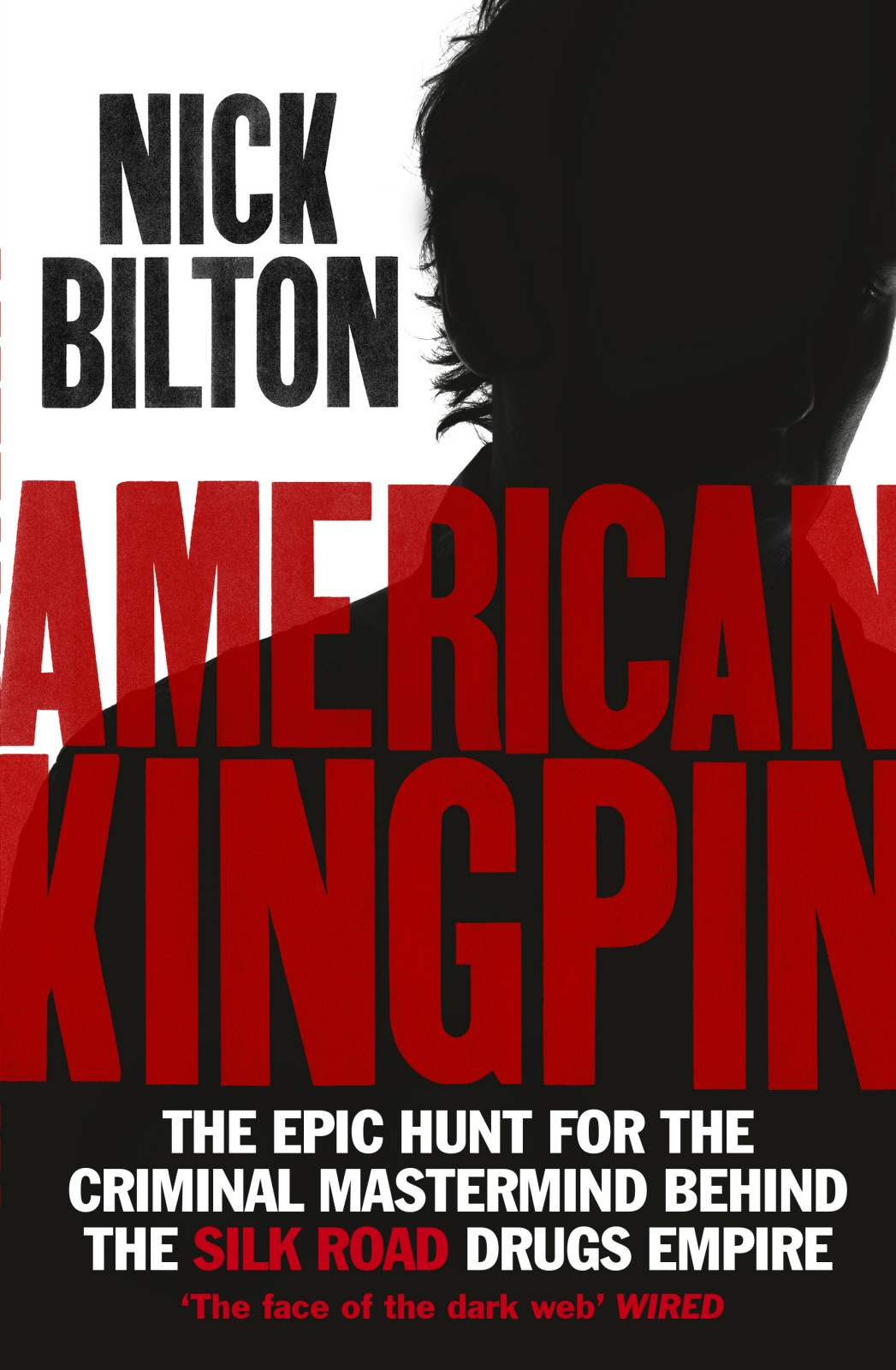
American Kingpin: The Epic Hunt for the Criminal Mastermind Behind the Silk Road Drugs Empire
About this book
Silk Road combined Tor, bitcoin, and marketplace software to let strangers trade illegal drugs through the mail. Its founder presented the site as a libertarian experiment and administered it under the name Dread Pirate Roberts.
Nick Bilton follows Ulbricht's transformation from an idealistic young man into the operator of a large criminal enterprise. In parallel, postal inspectors, IRS agents, Homeland Security investigators, and the FBI pursue fragments of evidence that rarely fit one agency's normal work.
American Kingpin is a narrative account of invention, surveillance, and pursuit. The technology is important, but the case ultimately turns on human habits, records, and the difficulty of maintaining two lives at once.
Read a sample
5,029 words
Plain text
From the opening
Chapter 1
THE PINK PILL
PINK.
A tiny pink pill with an etching of a squirrel on either side. Jared Der-Yeghiayan couldn’t take his eyes off it.
He stood in a windowless mail room, the Department of Homeland Security badge hanging from his neck illuminated by pulsing halogen lights above. Every thirty seconds, the sound of airplanes rumbled through the air outside. Jared looked like an adolescent with his oversize clothes, buzz cut, and guileless hazel eyes. “We’ve started to get a couple of them a week,” his colleague Mike, a burly Customs and Border Protection officer, said as he handed Jared the envelope that the pill had arrived in.
The envelope was white and square, with a single perforated stamp affixed to the top right corner. HIER ÖFFNEN, read the inside flap. Below those two words was the English translation, OPEN HERE. The recipient’s name, typed in black, read DAVID. The package was on its way to a house on West Newport Avenue in Chicago.
It was exactly what Jared had been waiting for since June.
The plane carrying the envelope, KLM flight 611, had landed at Chicago O’Hare International Airport a few hours earlier after a four-thousand-mile journey from the Netherlands. As weary passengers stood up and stretched their arms and legs, baggage handlers twenty feet below them unloaded cargo from the belly of the Boeing 747. Suitcases of all shapes and sizes were ushered in one direction; forty or so blue buckets filled with international mail were sent in another.
Those blue tubs—nicknamed “scrubs” by airport employees—were driven across the tarmac to a prodigious mail storage and sorting facility fifteen minutes away. Their contents—letters to loved ones, business documents, and that white square envelope containing the peculiar pink pill—would pass through that building, past customs, and into the vast logistical arteries of the United States Postal Service. If everything went according to plan, as it did most of the time, that small envelope of drugs, and many like it, would just slip by unnoticed.
But not today. Not on October 5, 2011.
By late afternoon, Mike Weinthaler, a Customs and Border Protection officer, had begun his daily ritual of clocking in for work, pouring an atrocious cup of coffee, and popping open the blue scrubs to look for anything out of the ordinary: a package with a small bulge; return addresses that looked fake; the sound of plastic wrap inside a paper envelope; anything fishy at all. There was nothing scientific about it. There were no high-tech scanners or swabs testing for residue. After a decade in which e-mail had largely outmoded physical mail, the postal service’s budgets had been decimated. Fancy technology was a rare treat allocated to the investigation of large packages. And Chicago’s mail-sniffing dogs—Shadow and Rogue—came through only a couple of times a month. Instead, whoever was hunting through the scrubs simply reached a hand inside and followed their instincts.
Thirty minutes into his rummaging routine, the white square envelope caught Mike’s eye.
He held it up to the lights overhead. The address on the front had been typed, not written by hand. That was generally a telltale sign for customs agents that something was amiss. As Mike knew, addresses are usually typed only for business mail, not personal. The package also had a slight bump, which was suspicious, considering it came from the Netherlands. Mike grabbed an evidence folder and a 6051S seizure form that would allow him to legally open the envelope. Placing a knife in its belly, he gutted it like a fish, dumping out a plastic baggie with a tiny pink pill of ecstasy inside.
Mike had been working in the customs unit for two years and was fully aware that under normal circumstances no one in the federal government would give a flying fuck about one lousy pill. There was, as every government employee in Chicago knew, an unspoken rule that drug agents didn’t take on cases that involved fewer than a thousand pills. The U.S. Attorney’s Office would scoff at such an investigation. There were bigger busts to pursue.
But Mike had been given clear instructions by someone who was waiting for a pill just like this: Homeland Security agent Jared Der-Yeghiayan.
A few months prior, Mike had come across a similar piece of illicit mail on its way to Minneapolis. He had picked up the phone and called the U.S. Immigration and Customs Enforcement’s Homeland Security Investigations office at the airport, half expecting that he would be laughed at or hung up on, as usual. But the HSI agent who answered was surprisingly receptive. At the time, Jared had been on the job for only two months and frankly didn’t know any better. “I can’t fly to Minneapolis to talk to a guy about one single pill,” Jared said. “So call me if you get something in my area, in Chicago. Then I can go over there and do a knock-and-talk.”
Four months later, when Mike found a pill destined for Chicago, Jared rushed over to see it. “Why do you want this?” Mike asked Jared. “All the other agents say no; people have been saying no to meth and heroin for years. And yet you want this one little pill?”
Jared knew very well that this could be nothing. Maybe an idiot kid in the Netherlands was sending a few friends some MDMA. But he also wondered why one single pill had been sent on such a long journey and how the people who mailed such small packages of drugs knew the recipients they were sending them to. Something about it felt peculiar. “There may be something else to this,” Jared told Mike as he took the envelope. He would need it to show his “babysitter.”
Continue reading the sampleClose the sample
Every newbie agent in HSI was assigned one—a training officer—during their first year. A more seasoned officer who knew the drill, made sure you didn’t get into too much trouble, and often made you feel like a total piece of shit. Every morning Jared had to call his chaperone and tell him what he was working on that day. The only thing that made it different from preschool was that you got to carry a gun.
Unsurprisingly, Jared’s training officer saw no urgency to a single pill, and it was a week before he even consented to accompany his younger colleague on the “knock-and-talk”—to knock on the door of the person who was supposed to receive the pill and, hopefully, talk with them.
That day, as Jared’s government-issued Crown Victoria zigzagged through the North Side of Chicago, the small Rubik’s Cube that hung from his key chain swung back and forth in the opposite direction. His car radio was dialed into sports: the Cubs and White Sox had been eliminated from contention, but the Bears were preparing for an in-division contest against the Lions. Amid the crackle of the radio, he turned onto West Newport Avenue, a long row of two-story limestone buildings split into a dyad of top-and bottom-floor apartments. Jared knew this working-class neighborhood well. He’d followed the baseball games at nearby Wrigley Field when he was a kid. But now this was Hipsterville, full of fancy coffee shops, chic restaurants, and, as Jared was now learning, people who had drugs mailed to their houses from the Netherlands.
He was fully aware how ridiculous he might look in the eyes of his grizzled training officer. They were in one of the city’s safest precincts to question someone about a single pill of ecstasy. But Jared didn’t care what his supervisor thought; he had a hunch that this was bigger than one little pill. He just didn’t know how big—yet.
He found the address and pulled over, his chaperone close behind. They wandered up the steps and Jared tapped on the glass door of apartment number 1. This was the easy part, knocking. Getting someone to talk would be a whole different challenge. The recipient of the envelope could easily deny that the package was his. Then it was game over.
After twenty seconds the door lock clicked open and a young, skinny man dressed in jeans and a T-shirt peered outside. Jared flashed his badge, introduced himself as an HSI agent, and asked if David, the man whose name was typed on the white envelope, was home.
“He’s at work right now,” the young man replied, opening the door further. “But I’m his roommate.”
“Can we come inside?” Jared asked. “We’d just like to ask you a few questions.” The roommate obliged, stepping to the side as they walked toward the kitchen. As Jared took a seat he pulled out a pen and notepad and asked, “Does your roommate get a lot of packages in the mail?”
“Yeah, from time to time.”
“Well,” Jared said as he glanced at his training officer, who sat silently in the corner with his arms crossed, “we found this package that was addressed to him and it had some drugs inside.”
“Yeah, I know about that,” the roommate replied nonchalantly. Jared was taken aback by how casually the young man admitted to receiving drugs in the mail, but he continued with the questions, asking where they got these drugs from.
“From a Web site.”
“What’s the Web site?”
“The Silk Road,” the roommate said.
Jared stared back, confused. The Silk Road? He had never heard of it before. In fact, Jared had never heard of any Web site where you could buy drugs online, and he wondered if he was just being a clueless newbie, or if this was how you bought drugs in Hipsterville these days.
“What’s the Silk Road?” Jared asked, trying not to sound too oblivious but sounding completely oblivious.
And with the velocity of those descending airliners at O’Hare, the skinny roommate began a fast-paced explanation of the Silk Road Web site. “You can buy any drug imaginable on the site,” he said, some of which he had tried with his roommate—including marijuana, meth, and the little pink ecstasy pills that had been arriving, week after week, on KLM flight 611. As Jared scribbled in his notepad, the roommate continued to talk at a swift clip. You paid for the drugs with this online digital currency called Bitcoin, and you shopped using an anonymous Web browser called Tor. Anyone could go onto the Silk Road Web site, select from the hundreds of different kinds of drugs they offered and pay for them, and a few days later the United States Postal Service would drop them into your mailbox. Then you sniffed, inhaled, swallowed, drank, or injected whatever came your way. “It’s like Amazon.com,” the roommate said, “but for drugs.”
Jared was amazed and slightly skeptical that this virtual marketplace existed in the darkest recesses of the Web. It will be shut down within a week, he thought. After a few more questions, he thanked the roommate for his time and left with his colleague, who hadn’t said a word.
“Have you ever heard of this Silk Road?” Jared asked his training officer as they walked back to their respective cruisers.
“Oh yeah,” he replied dispassionately. “Everyone’s heard of Silk Road. There must be hundreds of open cases on it.”
Jared, somewhat embarrassed at having admitted he knew nothing about it, wasn’t deterred. “I’m going to look into it anyway and see what I can find out,” he said. The older man shrugged and drove off.
An hour later Jared bounded into his windowless office, where he waited for what seemed an eternity for his archaic Dell government computer to load up. He began searching the Department of Homeland Security database for open investigations on the Silk Road. But to his surprise, there were no results. He tried other key words and variations on the spelling of the site. Nothing. What about a different input box? Still nothing. He was confused. There were not “hundreds of open cases” on the Silk Road, as his training officer had claimed. There were none.
Jared thought for a moment and then decided to go to the next-best technology that any seasoned government official uses to search for something important: Google. The first few results were historical Web sites referencing the ancient trade route between China and the Mediterranean. But halfway down the page he saw a link to an article from early June of that year on Gawker, a news and gossip blog, proclaiming that the Silk Road was “the underground website where you can buy any drug imaginable.” The blog post showed screenshots of a Web page with a green camel logo in the corner. It also displayed pictures of a cornucopia of drugs, 340 “items” in all, including Afghan hash, Sour 13 weed, LSD, ecstasy, eight-balls of cocaine, and black tar heroin. Sellers were located all over the world; buyers too. You’ve got to be fucking kidding me, Jared thought. It’s this easy to buy drugs online? He then spent the entire rest of the day, and most of the evening, reading anything he could about the Silk Road.
Over the weekend, as he drove between antique fairs (his weekly ritual) near Chicago with his wife and young son, he was almost catatonically consumed with the drug Web site. Jared realized that if anyone could buy drugs on the Silk Road, anyone would: from middle-aged yuppies who lived on the North Side of Chicago to young kids growing up in the heartland. And if drugs were being sold on the site now, why not other contraband next? Maybe it would be guns, bombs, or poisons. Maybe, he imagined, terrorists could use it to create another 9/11. As he looked at his sleeping son in the rearview mirror, these thoughts petrified him.
But where do you even start on the Internet, in a world of complete anonymity?
Finally, as the weekend came to a close, Jared started to formulate an idea for how he could approach the case. He knew it would be laborious and tedious, but there was a chance that it could also eventually lead him to the creator of the Silk Road Web site.
But finding the drugs and the drug dealers, and even the founder of the Silk Road, would be easy compared with the challenge of persuading his supervisor to let him work this case based on a single tiny pink pill. Even if he could convince his boss, Jared would also have to cajole the U.S. Attorney’s Office into supporting him in this pursuit. And there wasn’t a U.S. attorney in all of America who would take on a case that involved one measly pill of anything. Exacerbating all of this was the fact that thirty-year-old Jared was as green as they came. And no one ever—ever!—took a newbie seriously.
He would need a way to convince them all that this was bigger than a single pink pill.
By Monday morning he had come up with a scheme that he hoped his boss would not be able to ignore. He took a deep breath, walked into his supervisor’s office, and sat down. “You got a minute?” he said as he threw the white envelope on the desk. “I have something important I need to show you.”
Chapter 2
ROSS ULBRICHT
“ROSS, JUMP OFF a cliff.”
Ross Ulbricht stood there with a slightly dumbfounded look on his face as he peered over the edge of the bluff. Below him, Austin’s Pace Bend Lake curled into and around itself, leaving a forty-five-foot drop into the frigid water below.
“What?” Ross said with a goofy smile as he lifted his hands and pointed to his wide chest. “Why me?”
“Juuust do it,” his sister, Cally, replied, pointing at the rocks. Twenty-four-year-old Ross was a foot taller than her, so he bent his neck downward as he considered her command. Without warning, he shrugged, yelled “Okay,” and ran off the ledge and into the air, shrieking before plunging into the lake with a thundering splash.
The video camera clicked off.
It was just the beginning of a long day of filming a reality TV show audition tape that the brother-and-sister duo had been scripting for weeks, with help from their mother, Lyn. The plan was to start with the cliff scene and go from there. Ross’s older sister would take the lead, introducing the Ulbricht siblings by noting that they were “willing to do anything to win The Amazing Race, even jump off a cliff.” After blithely doing just that, the plan was to traipse around Austin putting on an over-the-top act for the camera to try to convince the producers of the show that Ross and Cally Ulbricht would be the perfect contestants.
As Ross looked up from the water to his sister and the rocks he had just leaped off, it was clear that this wasn’t the way he had imagined spending this summer off from college.
There was a movie in Ross’s head of an altogether different summer. In that film he had saved up for a ring and proposed to his perfect Texas girlfriend. In the script in his mind, she said yes (of course). Then the two lovebirds would graduate from the University of Texas at Dallas, him with a physics degree, and spend the next few months planning their wedding. They’d land good jobs, Ross as a researcher or theoretical physicist. They’d pop out a couple of babies, go to birthday parties and weddings. Grow old together. Live a happy life. The end.
But that version of Ross Ulbricht’s life never made it past the opening credits. While Ross had saved up for the perfect ring with which to propose, when he romantically asked his girlfriend for her hand in marriage (Say yes, please say yes), she instead said she had to tell Ross something (Well, this doesn’t sound good). At which point she admitted that during the past year or so she had cheated on him with several different men. (Several? As in more than one? Yes. Several.) To make matters worse, one of them was one of Ross’s best friends.
Fade to black.
At the base of the cliff, Ross scrambled out of the water and the Ulbricht family set off to their next shooting location. When the camera clicked back on, Ross and his sister stood in front of Austin’s skyline, taking turns explaining who they both were. Ross was “the brains” of their operation, his sister explained, and went on to say that he had studied physics and material science and even won a world record for creating the clearest crystal formation on earth.
As his sister spoke, Ross stared into the distance, a million thoughts climbing around in his mind like an animal lost in an elaborate maze searching for something. It was evident that there was something about this moment where Ross found himself that didn’t seem right. And yet it was unclear what it was or how this had happened.
He had been born in that very city, and even before he could utter the words “Mama” or “Dada,” it was instantly apparent to Lyn and her husband, Kirk, that there was something different about their son. As a toddler he was contemplative and understood things way beyond his years. He was never told, “Don’t run out into traffic!”; he just somehow knew not to, as if he came into the world with an instruction manual that other people didn’t have access to. At a young age he knew answers to mathematics questions his parents didn’t even understand. And while, as a teen, he engaged in normal kidlike activities—sports in the park, board game marathons, and ogling pretty girls—he often preferred to read about political theory, existentialism, or quantum mechanics.
But it wasn’t just that he was smart. He was genuinely kind too. As a boy he rescued animals. As an adult he opted for people. Yes, Ross was the person who would stop midsentence in a conversation and rush off to help an old lady cross the street, carrying her bags and stopping traffic as she slowly dawdled through an intersection.
Some who met him thought his overly altruistic attitude was a bit of an act. “How can anyone be that nice?” they’d say. But it was real, and it didn’t take long for the people to learn just how magnanimous he was. This was evident simply from the way he spoke, often sounding painfully folksy, using words like “golly,” “jeez,” and “heck.” If he had to curse, he would always say “fudge” in lieu of “fuck.”
He had his vices too. As a teenager he had discovered a penchant for mind-altering experiences, at least mild ones. He loved heading into the nearby woods with his pals, lighting up a joint, taking his shirt off, and climbing trees. At a house party after his high school prom, he drank so much beer that his date found him floating on an inflatable raft in the homeowner’s pool, still wearing his tuxedo, sneakers (he didn’t own dress shoes and had worn old tennis shoes to prom), and a pair of sunglasses.
Still, the smartest guy in every room was now standing there next to his sister in a park in Austin, competing to be on a reality TV show.
But what choice did he have? It wasn’t like he could go out west to Silicon Valley and get a job at a start-up. After the bubble had popped a few years earlier, companies that had been built on a wing and a prayer had siphoned people’s retirements into thin air and collapsed, leaving San Francisco a metaphorical no-fly zone. What about going east? Wasn’t there opportunity on Wall Street for someone as clever as Ross? No way. The banks were collapsing from the housing market crash. And he certainly couldn’t settle down and live happily ever after with his girlfriend; his dream of marriage and a white picket fence had been bulldozed by several other men.
That left graduate school, or jumping off a cliff.
He imagined reality TV fame and a pile of money as a slight detour on the way to some larger accomplishment. Ross was sure he had a grander purpose in life, though he wasn’t sure exactly what it would be. Maybe one day he’d figure out what that purpose was.
Just not today.
As the daylight faded and the Amazing Race shoot came to an end, Ross and his sister stood in front of the camera along the streets of Austin. He had slipped on some dark sweatpants and a thick black sweater to keep the evening cold at bay.
“Ross,” his sister asked, “what are you going to do with your half a million dollars when we win?”
He pretended to think for a moment and then said, “Oh, I think I’ll just throw it on the ground and roll around in it for a little while.”
“Well,” Cally replied as she lifted her hand to give her brother a high five, “we have to win The Amazing Race first.”
The camera clicked off again. While Ross stuffed the equipment from the shoot into the family car, he daydreamed about the opportunity that lay ahead and about the half a million dollars that he would surely win. He didn’t know that chance would never arrive. Ross would not be chosen to compete on the reality TV show—the first of many failures to come. And yet, as he hopped into the car next to his sister, he also didn’t know that in just five years he would be making that amount of money in a single day.
Chapter 3
JULIA VIE
JULIA VIE’S FIRST week of college was probably the most difficult seven days of her life—at least up until that point. She had arrived at Penn State a timid eighteen-year-old with no friends and even less direction. Yet before she had the opportunity to fit in, her life was shaken to its core. She was unpacking her suitcases in her dorm room, stuffing her clothes into drawers and stacking her favorite novels onto shelves, when she got the phone call. Her mother had died of cancer.
After the funeral, still in shock, Julia returned to Penn State in search of normalcy. Maybe, she reasoned, that would come in the form of a boyfriend. She pined for someone who would take care of her. Pamper her with affection and maybe spoil her with a few lavish dinners.
Instead she met Ross Ulbricht.
It was all one big accident. Julia had been aimlessly wandering around campus, thinking about her mother, when she found herself in one of the large buildings on Shortlidge Road. As she strolled through the old halls, she could hear the sound of bongos. Loud, thudding African instruments. She followed the beats and pushed open a door to find a group of men sitting in a semicircle thumping out tunes on djembe drums. Around them, half a dozen girls bounced to and fro.
Julia crept to the back of the room, mesmerized by her discovery, and soon learned that this was the Penn State NOMMO Club, an African drumming group. As she watched them play, out of the corner of her eye she noticed a disheveled young man confidently approaching her. He reached out a hand and introduced himself as Ross. Julia looked him up and down and, noticing he wasn’t wearing shoes, and that his shirt and shorts were torn and stained, thought he might be homeless. He looked like he hadn’t shaved in months.
As the music thudded around them, there was no hiding from Julia that this young homeless-looking man was attracted to her. And how could he not be? This lithe, pretty thing was stunning, with light brown skin, freckles sprinkled across her checks, and big eyes with fluttering lashes. She was exotic-looking too—half African American, half something else. She politely introduced herself as Julia and then quickly brushed him off, uninterested in a conversation with someone who looked like he hadn’t showered in weeks.
Julia assumed that was the end of it. But a week later she bumped into this Ross character again. Though this time something was different. Now he had shaved and was wearing pants—real pants—and shoes.
As they spoke, she was intrigued. He was funny, cute, and smart—so, so smart. He told her he was a graduate student at Penn State in the Department of Materials Science and Engineering. When she asked what that entailed, Ross explained that he was working on research to verify rare properties in crystalline materials and worked in spintronics and ferroic materials. The school even paid him a few hundred dollars a week for his research.
Within a week this freshman found herself going to dinner with Ross at a sushi restaurant off Route 35 and then, a few days later, heading back to his apartment. As he slipped off her shirt on the couch, and as she did the same in return, Julia didn’t know a lot about the man she was about to fool around with, but she would soon learn. As he lay almost naked on top of her, there was a click at the front door and Ross’s roommates walked in. “Let’s go to my room,” Ross said as they giggled and ran out of the living room.
He led her down a stairway into a basement that was dim, with slivers of light leaking inside from the tiny windows.
To Julia it smelled almost like wet cement, mildew, or both. “This is your bedroom?” she asked in disbelief as her bare feet stepped on the cold concrete floor.
“Yes,” Ross replied proudly. “I live down here for free.” Julia raised her eyebrows as she stood in the middle of the basement, surveying the bizarre setting. There was a bed next to a space heater. Cardboard boxes were strewn about like a kids’ fortress. It looked like a prison cell.
She had figured Ross was relatively frugal on their first date at the sushi restaurant when he picked her up in a doddering pickup truck older than she was. On the second date she had learned that he didn’t care for material things either, when he arrived looking like a bass player in a Seattle grunge band. (Ragged shorts, a dirty shirt, and shoes that had previously belonged to someone from a geriatric home.) But as she sat on his bed in the basement, looking at walls of chipped, unpainted Sheetrock, it crystallized for Julia that Ross really, really didn’t have much money and really, really didn’t care for the objects most people lust after in life.
“Wait, why do you live down here?” she asked as they lay on the bed, Ross trying to pick up where they had left off on the couch.
He paused to explain that he liked to live economically to prove to himself that he could. Why pay for an apartment when you could live in this mildew-ridden castle for free? Julia scowled as he spoke. It wasn’t just about saving money, he explained. His lifestyle was also part of an internal experiment to see how far he could push himself to extremes without any wants or needs. For example, he had recently chosen not to shower with hot water for a month, just to test his own resilience. (“You get used to the cold after a while,” he bragged.) That wasn’t all. Over the summer, Ross proudly told Julia, he had survived off a can of beans and a bag of rice for an entire week.
“What about coffee?” she asked.
“I don’t drink it.”
“You’re so cheap,” she joked.
The shower and basement tests were only the beginning of Ross’s peculiarities. At the foot of his bed there were two garbage bags, which he casually confessed were his “closet.” One bag was for clean clothes, the other for dirty. Every item of clothing he owned—every sock, every shirt, and those geriatric shoes—was a hand-me-down from a friend.