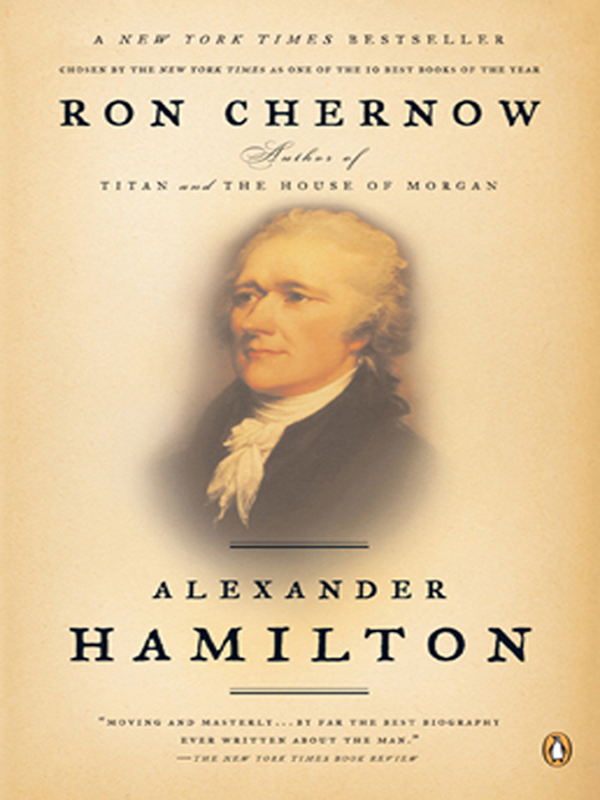
Alexander Hamilton
About this book
Ron Chernow follows Hamilton from the Caribbean through revolution, military service, the Constitutional struggle, and his years as the first secretary of the Treasury. The institutions attached to his name emerge from arguments conducted under immediate political pressure.
The biography also traces his marriage to Eliza Schuyler, the Reynolds scandal, party warfare, conflict with John Adams, and the long rivalry with Aaron Burr. Hamilton's speed and confidence repeatedly create both achievement and danger.
Alexander Hamilton is a large narrative biography grounded in correspondence and the politics of the early republic. It restores the financial and administrative work behind a life often reduced to the final duel.
Read a sample
5,009 words
Plain text
From the opening
PROLOGUE
THE OLDEST REVOLUTIONARY WAR WIDOW
In the early 1850s, few pedestrians strolling past the house on H Street in Washington, near the White House, realized that the ancient widow seated by the window, knitting and arranging flowers, was the last surviving link to the glory days of the early republic. Fifty years earlier, on a rocky, secluded ledge overlooking the Hudson River in Weehawken, New Jersey, Aaron Burr, the vice president of the United States, had fired a mortal shot at her husband, Alexander Hamilton, in a misbegotten effort to remove the man Burr regarded as the main impediment to the advancement of his career. Hamilton was then forty-nine years old. Was it a benign or a cruel destiny that had compelled the widow to outlive her husband by half a century, struggling to raise seven children and surviving almost until the eve of the Civil War?
Elizabeth Schuyler Hamilton—purblind and deaf but gallant to the end—was a stoic woman who never yielded to self-pity. With her gentle manner, Dutch tenacity, and quiet humor, she clung to the deeply rooted religious beliefs that had abetted her reconciliation to the extraordinary misfortunes she had endured. Even in her early nineties, she still dropped to her knees for family prayers. Wrapped in shawls and garbed in the black bombazine dresses that were de rigueur for widows, she wore a starched white ruff and frilly white cap that bespoke a simpler era in American life. The dark eyes that gleamed behind large metal-rimmed glasses—those same dark eyes that had once enchanted a young officer on General George Washington’s staff—betokened a sharp intelligence, a fiercely indomitable spirit, and a memory that refused to surrender the past.
In the front parlor of the house she now shared with her daughter, Eliza Hamilton had crammed the faded memorabilia of her now distant marriage. When visitors called, the tiny, erect, white-haired lady would grab her cane, rise gamely from a black sofa embroidered with a floral pattern of her own design, and escort them to a Gilbert Stuart painting of George Washington. She motioned with pride to a silver wine cooler, tucked discreetly beneath the center table, that had been given to the Hamiltons by Washington himself. This treasured gift retained a secret meaning for Eliza, for it had been a tacit gesture of solidarity from Washington when her husband was ensnared in the first major sex scandal in American history. The tour’s highlight stood enshrined in the corner: a marble bust of her dead hero, carved by an Italian sculptor, Giuseppe Ceracchi, during Hamilton’s heyday as the first treasury secretary. Portrayed in the classical style of a noble Roman senator, a toga draped across one shoulder, Hamilton exuded a brisk energy and a massive intelligence in his wide brow, his face illumined by the half smile that often played about his features. This was how Eliza wished to recall him: ardent, hopeful, and eternally young. “That bust I can never forget,” one young visitor remembered, “for the old lady always paused before it in her tour of the rooms and, leaning on her cane, gazed and gazed, as if she could never be satisfied.”
For the select few, Eliza unearthed documents written by Hamilton that qualified as her sacred scripture: an early hymn he had composed or a letter he had drafted during his impoverished boyhood on St. Croix. She frequently grew melancholy and longed for a reunion with “her Hamilton,” as she invariably referred to him. “One night, I remember, she seemed sad and absent-minded and could not go to the parlor where there were visitors, but sat near the fire and played backgammon for a while,” said one caller. “When the game was done, she leaned back in her chair a long time with closed eyes, as if lost to all around her. There was a long silence, broken by the murmured words, ‘I am so tired. It is so long. I want to see Hamilton.’”1
Eliza Hamilton was committed to one holy quest above all others: to rescue her husband’s historical reputation from the gross slanders that had tarnished it. For many years after the duel, Thomas Jefferson, John Adams, and other political enemies had taken full advantage of their eloquence and longevity to spread defamatory anecdotes about Hamilton, who had been condemned to everlasting silence. Determined to preserve her husband’s legacy, Eliza enlisted as many as thirty assistants to sift through his tall stacks of papers. Unfortunately, she was so self-effacing and so reverential toward her husband that, though she salvaged every scrap of his writing, she apparently destroyed her own letters. The capstone of her monumental labor, her life’s “dearest object,” was the publication of a mammoth authorized biography that would secure Hamilton’s niche in the pantheon of the early republic. It was a long, exasperating wait as one biographer after another discarded the project or expired before its completion. Almost by default, the giant enterprise fell to her fourth son, John Church Hamilton, who belatedly disgorged a seven-volume history of his father’s exploits. Before this hagiographic tribute was completed, however, Eliza Hamilton died at ninety-seven on November 9, 1854.
Distraught that their mother had waited vainly for decades to see her husband’s life immortalized, Eliza Hamilton Holly scolded her brother for his overdue biography. “Lately in my hours of sadness, recurring to such interests as most deeply affected our blessed Mother…I could recall none more frequent or more absorbent than her devotion to our Father. When blessed memory shows her gentle countenance and her untiring spirit before me, in this one great and beautiful aspiration after duty, I feel the same spark ignite and bid me…to seek the fulfillment of her words: ‘Justice shall be done to the memory of my Hamilton.’”2 It was, Eliza Hamilton Holly noted pointedly, the imperative duty that Eliza had bequeathed to all her children: Justice shall be done to the memory of my Hamilton.
Continue reading the sampleClose the sample
Well, has justice been done? Few figures in American history have aroused such visceral love or loathing as Alexander Hamilton. To this day, he seems trapped in a crude historical cartoon that pits “Jeffersonian democracy” against “Hamiltonian aristocracy.” For Jefferson and his followers, wedded to their vision of an agrarian Eden, Hamilton was the American Mephistopheles, the proponent of such devilish contrivances as banks, factories, and stock exchanges. They demonized him as a slavish pawn of the British Crown, a closet monarchist, a Machiavellian intriguer, a would-be Caesar. Noah Webster contended that Hamilton’s “ambition, pride, and overbearing temper” had destined him “to be the evil genius of this country.”3 Hamilton’s powerful vision of American nationalism, with states subordinate to a strong central government and led by a vigorous executive branch, aroused fears of a reversion to royal British ways. His seeming solicitude for the rich caused critics to portray him as a snobbish tool of plutocrats who was contemptuous of the masses. For another group of naysayers, Hamilton’s unswerving faith in a professional military converted him into a potential despot. “From the first to the last words he wrote,” concluded historian Henry Adams, “I read always the same Napoleonic kind of adventuredom.”4 Even some Hamilton admirers have been unsettled by a faint tincture of something foreign in this West Indian transplant; Woodrow Wilson grudgingly praised Hamilton as “a very great man, but not a great American.”5
Yet many distinguished commentators have echoed Eliza Hamilton’s lament that justice has not been done to her Hamilton. He has tended to lack the glittering multivolumed biographies that have burnished the fame of other founders. The British statesman Lord Bryce singled out Hamilton as the one founding father who had not received his due from posterity. In The American Commonwealth, he observed, “One cannot note the disappearance of this brilliant figure, to Europeans the most interesting in the early history of the Republic, without the remark that his countrymen seem to have never, either in his lifetime or afterwards, duly recognized his splendid gifts.”6 During the robust era of Progressive Republicanism, marked by brawny nationalism and energetic government, Theodore Roosevelt took up the cudgels and declared Hamilton “the most brilliant American statesman who ever lived, possessing the loftiest and keenest intellect of his time.”7 His White House successor, William Howard Taft, likewise embraced Hamilton as “our greatest constructive statesman.”8 In all probability, Alexander Hamilton is the foremost political figure in American history who never attained the presidency, yet he probably had a much deeper and more lasting impact than many who did.
Hamilton was the supreme double threat among the founding fathers, at once thinker and doer, sparkling theoretician and masterful executive. He and James Madison were the prime movers behind the summoning of the Constitutional Convention and the chief authors of that classic gloss on the national charter, The Federalist, which Hamilton supervised. As the first treasury secretary and principal architect of the new government, Hamilton took constitutional principles and infused them with expansive life, turning abstractions into institutional realities. He had a pragmatic mind that minted comprehensive programs. In contriving the smoothly running machinery of a modern nation-state—including a budget system, a funded debt, a tax system, a central bank, a customs service, and a coast guard—and justifying them in some of America’s most influential state papers, he set a high-water mark for administrative competence that has never been equaled. If Jefferson provided the essential poetry of American political discourse, Hamilton established the prose of American statecraft. No other founder articulated such a clear and prescient vision of America’s future political, military, and economic strength or crafted such ingenious mechanisms to bind the nation together.
Hamilton’s crowded years as treasury secretary scarcely exhaust the epic story of his short life, which was stuffed with high drama. From his illegitimate birth on Nevis to his bloody downfall in Weehawken, Hamilton’s life was so tumultuous that only an audacious novelist could have dreamed it up. He embodied an enduring archetype: the obscure immigrant who comes to America, re-creates himself, and succeeds despite a lack of proper birth and breeding. The saga of his metamorphosis from an anguished clerk on St. Croix to the reigning presence in George Washington’s cabinet offers both a gripping personal story and a panoramic view of the formative years of the republic. Except for Washington, nobody stood closer to the center of American politics from 1776 to 1800 or cropped up at more turning points. More than anyone else, the omnipresent Hamilton galvanized, inspired, and scandalized the newborn nation, serving as the flash point for pent-up conflicts of class, geography, race, religion, and ideology. His contemporaries often seemed defined by how they reacted to the political gauntlets that he threw down repeatedly with such defiant panache.
Hamilton was an exuberant genius who performed at a fiendish pace and must have produced the maximum number of words that a human being can scratch out in forty-nine years. If promiscuous with his political opinions, however, he was famously reticent about his private life, especially his squalid Caribbean boyhood. No other founder had to grapple with such shame and misery, and his early years have remained wrapped in more mystery than those of any other major American statesman. While not scanting his vibrant intellectual life, I have tried to gather anecdotal material that will bring this cerebral man to life as both a public and a private figure. Charming and impetuous, romantic and witty, dashing and headstrong, Hamilton offers the biographer an irresistible psychological study. For all his superlative mental gifts, he was afflicted with a touchy ego that made him querulous and fatally combative. He never outgrew the stigma of his illegitimacy, and his exquisite tact often gave way to egregious failures of judgment that left even his keenest admirers aghast. If capable of numerous close friendships, he also entered into titanic feuds with Jefferson, Madison, Adams, Monroe, and Burr.
The magnitude of Hamilton’s feats as treasury secretary has overshadowed many other facets of his life: clerk, college student, youthful poet, essayist, artillery captain, wartime adjutant to Washington, battlefield hero, congressman, abolitionist, Bank of New York founder, state assemblyman, member of the Constitutional Convention and New York Ratifying Convention, orator, lawyer, polemicist, educator, patron saint of the New-York Evening Post, foreign-policy theorist, and major general in the army. Boldly uncompromising, he served as catalyst for the emergence of the first political parties and as the intellectual fountainhead for one of them, the Federalists. He was a pivotal force in four consecutive presidential elections and defined much of America’s political agenda during the Washington and Adams administrations, leaving copious commentary on virtually every salient issue of the day.
Earlier generations of biographers had to rely on only a meager portion of his voluminous output. Between 1961 and 1987, Harold C. Syrett and his doughty editorial team at Columbia University Press published twenty-seven thick volumes of Hamilton’s personal and political papers. Julius Goebel, Jr., and his staff added five volumes of legal and business papers to the groaning shelf, bringing the total haul to twenty-two thousand pages. These meticulous editions are much more than exhaustive compilations of Hamilton’s writings: they are a scholar’s feast, enriched with expert commentary as well as contemporary newspaper extracts, letters, and diary entries. No biographer has fully harvested these riches. I have supplemented this research with extensive archival work that has uncovered, among other things, nearly fifty previously undiscovered essays written by Hamilton himself. To retrieve his early life from its often impenetrable obscurity, I have also scoured records in Scotland, England, Denmark, and eight Caribbean islands, not to mention many domestic archives. The resulting portrait, I hope, will seem fresh and surprising even to those best versed in the literature of the period.
It is an auspicious time to reexamine the life of Hamilton, who was the prophet of the capitalist revolution in America. If Jefferson enunciated the more ample view of political democracy, Hamilton possessed the finer sense of economic opportunity. He was the messenger from a future that we now inhabit. We have left behind the rosy agrarian rhetoric and slaveholding reality of Jeffersonian democracy and reside in the bustling world of trade, industry, stock markets, and banks that Hamilton envisioned. (Hamilton’s staunch abolitionism formed an integral feature of this economic vision.) He has also emerged as the uncontested visionary in anticipating the shape and powers of the federal government. At a time when Jefferson and Madison celebrated legislative power as the purest expression of the popular will, Hamilton argued for a dynamic executive branch and an independent judiciary, along with a professional military, a central bank, and an advanced financial system. Today, we are indisputably the heirs to Hamilton’s America, and to repudiate his legacy is, in many ways, to repudiate the modern world.
ONE
THE CASTAWAYS
Alexander Hamilton claimed Nevis in the British West Indies as his birthplace, although no surviving records substantiate this. Today, the tiny island seems little more than a colorful speck in the Caribbean, an exotic tourist hideaway. One million years ago, the land that is now Nevis Peak thrust up from the seafloor to form the island, and the extinct volcanic cone still intercepts the trade winds at an altitude of 3,200 feet, its jagged peak often obscured behind a thick swirl of clouds. This omnipresent mountain, looming over jungles, plunging gorges, and verdant foothills that sweep down to sandy beaches, made the island a natural fortress for the British. It abounded in both natural wonders and horrors: in 1690, the first capital, Jamestown, was swallowed whole by the sea during an earthquake and tidal wave.
To modern eyes, Nevis may seem like a sleepy backwater to which Hamilton was confined before his momentous escape to St. Croix and North America. But if we adjust our vision to eighteenth-century realities, we see that this West Indian setting was far from marginal, the crossroads of a bitter maritime rivalry among European powers vying for mastery of the lucrative sugar trade. A small revolution in consumer tastes had turned the Caribbean into prized acreage for growing sugarcane to sweeten the coffee, tea, and cocoa imbibed in fashionable European capitals. As a result, the small, scattered islands generated more wealth for Britain than all of her North American colonies combined. “The West Indians vastly outweigh us of the northern colonies,” Benjamin Franklin grumbled in the 1760s.1 After the French and Indian War, the British vacillated about whether to swap all of Canada for the island of Guadeloupe; in the event the French toasted their own diplomatic cunning in retaining the sugar island. The sudden popularity of sugar, dubbed “white gold,” engendered a brutal world of overnight fortunes in which slavery proved indispensable. Since indigenous Caribbeans and Europeans balked at toiling in the sweltering canebrakes, thousands of blacks were shipped from slave-trading forts in West Africa to cultivate Nevis and the neighboring islands.
British authorities colonized Nevis with vagabonds, criminals, and other riffraff swept from the London streets to work as indentured servants or overseers. In 1727, the minister of a local Anglican church, aching for some glimmer of spirituality, regretted that the slaves were inclined to “laziness, stealing, stubbornness, murmuring, treachery, lying, drunkenness and the like.” But he reserved his most scathing strictures for a rowdy white populace composed of “whole shiploads of pickpockets, whores, rogues, vagrants, thieves, sodomites, and other filth and cutthroats of society.”2 Trapped in this beautiful but godless spot, the minister bemoaned that the British imports “were not bad enough for the gallows and yet too bad to live among their virtuous countrymen at home.”3 While other founding fathers were reared in tidy New England villages or cosseted on baronial Virginia estates, Hamilton grew up in a tropical hellhole of dissipated whites and fractious slaves, all framed by a backdrop of luxuriant natural beauty.
On both his maternal and paternal sides, Hamilton’s family clung to the insecure middle rung of West Indian life, squeezed between plantation aristocrats above and street rabble and unruly slaves below. Taunted as a bastard throughout his life, Hamilton was understandably reluctant to chat about his childhood—“my birth is the subject of the most humiliating criticism,” he wrote in one pained confession—and he turned his early family history into a taboo topic, alluded to in only a couple of cryptic letters.4 He described his maternal grandfather, the physician John Faucette, as “a French Huguenot who emigrated to the West Indies in consequence of the revocation of the Edict of Nantes and settled in the island of Nevis and there acquired a pretty fortune. [Revoked in 1685 by Louis XIV, the Edict of Nantes had guaranteed religious toleration for French Protestants.] I have been assured by persons who knew him that he was a man of letters and much of a gentleman.”5 Born ten years after his grandfather’s death, Hamilton may have embellished the sketch with a touch of gentility. In the slave-based economy, physicians often attended the auctions, checking the teeth of the human chattel and making them run, leap, and jump to test whatever strength remained after the grueling middle passage. No white in the sugar islands was entirely exempt from the pervasive taint of slavery.
The archives of St. George’s Parish in the fertile, mountainous Gingerland section of Nevis record the marriage of John Faucette to a British woman, Mary Uppington, on August 21, 1718. By that point, they already had two children: a daughter, Ann, and a son, John, the latter arriving two months before the wedding. In all likelihood, lulled by the casual mores of the tropics, the Faucettes decided to formalize their link after the birth of their second child, having lived until then as a common-law couple—an expedient adopted by Hamilton’s own parents. In all, the Faucettes produced seven children, Hamilton’s mother, Rachel, being the second youngest, born circa 1729.
A persistent mythology in the Caribbean asserts that Rachel was partly black, making Alexander Hamilton a quadroon or an octoroon. In this obsessively race-conscious society, however, Rachel was invariably listed among the whites on local tax rolls. Her identification as someone of mixed race has no basis in verifiable fact. (See pages 734–35.) The folklore that Hamilton was mulatto probably arose from the incontestable truth that many, if not most, illegitimate children in the West Indies bore mixed blood. At the time of Rachel’s birth, the four thousand slaves on Nevis outnumbered whites by a ratio of four to one, making inequitable carnal relations between black slaves and white masters a dreadful commonplace.
Occupying a house in the southern Nevis foothills, the Faucettes owned a small sugar plantation and had at least seven slaves—pretty typical for the petite bourgeoisie. That Nevis later had a small black village named Fawcett, an anglicized version of the family name, confirms their ownership of slaves who later assumed their surname. The sugar islands were visited so regularly by epidemics of almost biblical proportions—malaria, dysentery, and yellow fever being the worst offenders—that five Faucette children perished in infancy or childhood, leaving only Rachel and her much older sister, Ann, as survivors. Even aided by slaves, small planters found it a tough existence. Skirting the volcanic cone, the Nevis hills were so steep and rocky that, even when terraced, they proved troublesome for sugar cultivation. The island steadily lost its economic eminence, especially after a mysterious plant disease, aggravated by drought, slowly crept across Nevis in 1737 and denuded it of much of its lush vegetation. This prompted a mass exodus of refugees, including Ann Faucette, who had married a well-to-do planter named James Lytton. They decamped to the Danish island of St. Croix, charting an escape route that Hamilton’s parents were to follow.
Evidence indicates that the Faucette marriage was marred by perpetual squabbling, perhaps compounded by the back-to-back deaths of two of their children in 1736 and the blight that parched the island the next year. Mary Faucette was a pretty, socially ambitious woman and probably not content to dawdle on a stagnant island. Determined and resourceful, with a clear knack for cultivating powerful men, she appealed to the chancellor of the Leeward Islands for a legal separation from her husband. In the 1740 settlement, the Faucettes agreed to “live separately and apart for the rest of their lives,” and Mary renounced all rights to her husband’s property in exchange for an inadequate annuity of fifty-three pounds.6 It is possible that she and Rachel traversed the narrow two-mile strait to St. Kitts, where they may even have first encountered a young Scottish nobleman named James Hamilton. Because her mother had surrendered all claims to John Faucette’s money, sixteen-year-old Rachel Faucette achieved the sudden glow of a minor heiress in 1745 when her father died and left her all his property. Since Rachel was bright, beautiful, and strong willed—traits we can deduce from subsequent events—she must have been hotly pursued in a world chronically deficient in well-heeled, educated European women.
Rachel and her mother decided to start anew on St. Croix, where James and Ann Lytton had prospered, building a substantial estate outside the capital, Christiansted, called the Grange. The Lyttons likely introduced them to another newcomer from Nevis, a Dane named Johann Michael Lavien, who had peddled household goods and now aspired to planter status. The name Lavien can be a Sephardic variant of Levine, but if he was Jewish he managed to conceal his origins. Had he presented himself as a Jew, the snobbish Mary Faucette would certainly have squelched the match in a world that frowned on religious no less than interracial marriage.
From fragmentary evidence, Lavien emerges as a man who dreamed of plucking sudden riches from the New World but stumbled, like others, into multiple disappointments. The year before he met Rachel, he squandered much of his paltry capital on a minor St. Croix sugar plantation. On this island of grand estates, a profitable operation required fifty to one hundred slaves, something beyond the reveries of the thinly capitalized Lavien. He then lowered his sights appreciably and, trying to become a planter on the cheap, acquired a 50 percent stake in a small cotton plantation. He ended up deeply in hock to the Danish West India and Guinea Company. Beyond her apparent physical allure, Rachel Faucette must have represented a fresh source of ready cash for Lavien.
For Alexander Hamilton, Johann Michael Lavien was the certified ogre of his family saga. He wrote, “A Dane, a fortune hunter of the name of Lavine [Hamilton’s spelling], came to Nevis bedizzened with gold and paid his addresses to my mother, then a handsome young woman having a snug fortune.” In the eighteenth century, a “snug” fortune signified one sufficient for a comparatively easy life. Partial to black silk gowns and blue vests with bright gold buttons, Lavien was a flashy dresser and must have splurged on such finery to hide his threadbare budget and palm himself off on Mary Faucette as an affluent suitor. Hamilton rued the day that his grandmother was “captivated by the glitter” of Lavien’s appearance and auctioned her daughter off, as it were, to the highest bidder. “In compliance with the wishes of her mother…but against her own inclination,” Hamilton stated, the sixteen-year-old Rachel agreed to marry the older Lavien, her senior by at least a dozen years.7 In Hamilton’s blunt estimation, it was “a hated marriage,” as the daughter of one unhappy union was rushed straight into another.8
In 1745, the ill-fated wedding took place at the Grange. The newlyweds set up house on their own modest plantation, which was named, with macabre irony, Contentment. The following year, the teenage bride gave birth to a son, Peter, destined to be her one legitimate child. One wonders if Rachel ever submitted to further conjugal relations with Lavien. Even if Lavien was not the “coarse man of repulsive personality” evoked by Hamilton’s grandson, it seems clear that Rachel felt stifled by her older husband, finding him crude and insufferable.9 In 1748, Lavien bought a half share in another small sugar plantation, enlarging his debt and frittering away Rachel’s fast dwindling inheritance. The marriage deteriorated to the point where the headstrong wife simply abandoned the house around 1750. A vindictive Lavien ranted in a subsequent divorce decree that while Rachel had lived with him she had “committed such errors which as between husband and wife were indecent and very suspicious.”10 In his severe judgment she was “shameless, coarse, and ungodly.”11
Enraged, his pride bruised, Lavien was determined to humiliate his unruly bride. Seizing on a Danish law that allowed a husband to jail his wife if she was twice found guilty of adultery and no longer resided with him, he had Rachel clapped into the dreaded Christiansvaern, the Christiansted fort, which did double duty as the town jail.12 Rachel has sometimes been portrayed as a “prostitute”—one of Hamilton’s journalistic nemeses branded him “the son of a camp-girl”—but such insinuations are absurd.13 On the other hand, that Lavien broadcast his accusations against her and met no outright refutation suggests that Rachel had indeed flouted social convention and found solace in the arms of other men.
Perched on the edge of Gallows Bay, Fort Christiansvaern had cannon that could be trained on pirates or enemy ships crossing the coral reef, as well as smaller artillery that could be swiveled landward and used to suppress slave insurrections. In this ghastly place, unspeakable punishments were meted out to rebellious blacks who had committed heinous crimes: striking whites, torching cane fields, or dashing off to freedom. They could be whipped, branded, and castrated, shackled with heavy leg irons, and entombed in filthy dungeons. The remaining cells tended to be populated by town drunks, petty thieves, and the other dregs of white society. It seems that no woman other than Rachel Lavien was ever imprisoned there for adultery. Rachel spent several months in a dank, cramped cell that measured ten by thirteen feet, and she must have gone through infernal torments of fear and loneliness. Through a small, deeply inset window, she could stare across sharpened spikes that encircled the outer wall and gaze at blue-green water that sparkled in fierce tropical sunlight. She could also eavesdrop on the busy wharf, stacked with hogsheads of sugar, which her son Alexander would someday frequent as a young clerk in a trading firm. All the while, she had to choke down a nauseating diet of salted herring, codfish, and boiled yellow cornmeal mush.
As an amateur psychologist, Lavien left something to be desired, for he imagined that when Rachel was released after three to five months this broken woman would now tamely submit to his autocratic rule—that “everything would be better and that she like a true wife would have changed her ungodly mode of life and would live with him as was meet and fitting,” as the divorce decree later proclaimed.14 He had not reckoned on her invincible spirit. Solitude had only stiffened her resolve to expel Lavien from her life. As Hamilton later philosophized in another context, “Tis only to consult our own hearts to be convinced that nations like individuals revolt at the idea of being guided by external compulsion.”15 After Rachel left the fort, she spent a week with her mother, who was living with one of St. Croix’s overlords, Town Captain Bertram Pieter de Nully, and supporting herself by sewing and renting out her three slaves.
Then Rachel did something brave but reckless that sealed her future status as a pariah: she fled the island, abandoning both Lavien and her sole son, Peter. In doing so, she relinquished the future benefits of a legal separation and inadvertently doomed the unborn Alexander to illegitimacy. In her proud defiance of persecution, her mental toughness, and her willingness to court controversy, it is hard not to see a startling preview of her son’s passionately willful behavior.