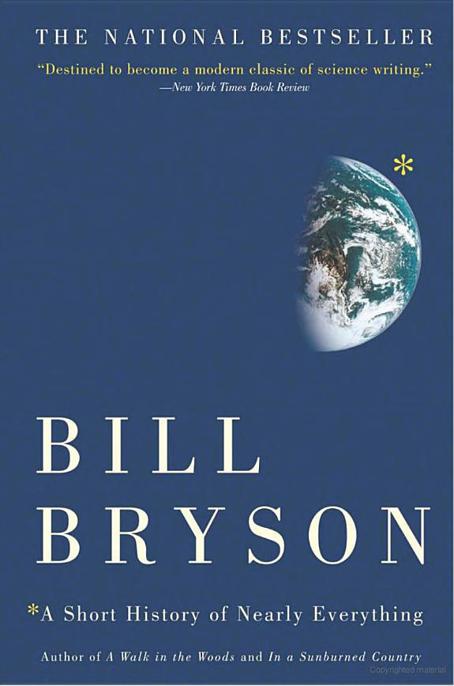
A Short History of Nearly Everything
About this book
Bill Bryson starts with an ordinary frustration: school had taught him the names of scientific facts without explaining how anyone had discovered them. A Short History of Nearly Everything is his attempt to recover the experiments, mistakes, rivalries, and lucky observations behind the account.
The scale moves from protons and the Big Bang to planets, rocks, cells, oceans, dinosaurs, and early humans. Bryson is especially interested in measurement — how scientists learned the age of Earth, the size of an atom, the motion of continents, and the dates of extinctions that no person had witnessed.
The scientists remain as visible as their theories. Some are patient observers, some reckless collectors, and some difficult people who happened to be right. Their disagreements give the book its momentum and make clear how often accepted knowledge began as an unfashionable claim.
Published in 2003, A Short History of Nearly Everything is broad by design. It offers a connected map of modern science, with enough explanation to show why the parts belong together and enough uncertainty to mark what is still unknown.
Read a sample
5,132 words
Plain text
From the opening
INTRODUCTION
Welcome. And congratulations. I am delighted that you could make it. Getting here wasn't easy, I know. In fact, I suspect it was a little tougher than you realize.
To begin with, for you to be here now trillions of drifting atoms had somehow to assemble in an intricate and intriguingly obliging manner to create you. It's an arrangement so specialized and particular that it has never been tried before and will only exist this once. For the next many years (we hope) these tiny particles will uncomplainingly engage in all the billions of deft, cooperative efforts necessary to keep you intact and let you experience the supremely agreeable but generally underappreciated state known as existence.
Why atoms take this trouble is a bit of a puzzle. Being you is not a gratifying experience at the atomic level. For all their devoted attention, your atoms don't actually care about you—indeed, don't even know that you are there. They don't even know that they are there. They are mindless particles, after all, and not even themselves alive. (It is a slightly arresting notion that if you were to pick yourself apart with tweezers, one atom at a time, you would produce a mound of fine atomic dust, none of which had ever been alive but all of which had once been you.) Yet somehow for the period of your existence they will answer to a single overarching impulse: to keep you you.
The bad news is that atoms are fickle and their time of devotion is fleeting—fleeting indeed. Even a long human life adds up to only about 650,000 hours. And when that modest milestone flashes past, or at some other point thereabouts, for reasons unknown your atoms will shut you down, silently disassemble, and go off to be other things. And that's it for you.
Still, you may rejoice that it happens at all. Generally speaking in the universe it doesn't, so far as we can tell. This is decidedly odd because the atoms that so liberally and congenially flock together to form living things on Earth are exactly the same atoms that decline to do it elsewhere. Whatever else it may be, at the level of chemistry life is curiously mundane: carbon, hydrogen, oxygen, and nitrogen, a little calcium, a dash of sulfur, a light dusting of other very ordinary elements—nothing you wouldn't find in any ordinary drugstore—and that's all you need. The only thing special about the atoms that make you is that they make you. That is of course the miracle of life.
Whether or not atoms make life in other corners of the universe, they make plenty else; indeed, they make everything else. Without them there would be no water or air or rocks, no stars and planets, no distant gassy clouds or swirling nebulae or any of the other things that make the universe so usefully material. Atoms are so numerous and necessary that we easily overlook that they needn't actually exist at all. There is no law that requires the universe to fill itself with small particles of matter or to produce light and gravity and the other physical properties on which our existence hinges. There needn't actually be a universe at all. For the longest time there wasn't. There were no atoms and no universe for them to float about in. There was nothing—nothing at all anywhere.
So thank goodness for atoms. But the fact that you have atoms and that they assemble in such a willing manner is only part of what got you here. To be here now, alive in the twenty-first century and smart enough to know it, you also had to be the beneficiary of an extraordinary string of biological good fortune. Survival on Earth is a surprisingly tricky business. Of the billions and billions of species of living thing that have existed since the dawn of time, most—99.99 percent—are no longer around. Life on Earth, you see, is not only brief but dismayingly tenuous. It is a curious feature of our existence that we come from a planet that is very good at promoting life but even better at extinguishing it.
The average species on Earth lasts for only about four million years, so if you wish to be around for billions of years, you must be as fickle as the atoms that made you. You must be prepared to change everything about yourself—shape, size, color, species affiliation, everything—and to do so repeatedly. That's much easier said than done, because the process of change is random. To get from “protoplasmal primordial atomic globule” (as the Gilbert and Sullivan song put it) to sentient upright modern human has required you to mutate new traits over and over in a precisely timely manner for an exceedingly long while. So at various periods over the last 3.8 billion years you have abhorred oxygen and then doted on it, grown fins and limbs and jaunty sails, laid eggs, flicked the air with a forked tongue, been sleek, been furry, lived underground, lived in trees, been as big as a deer and as small as a mouse, and a million things more. The tiniest deviation from any of these evolutionary shifts, and you might now be licking algae from cave walls or lolling walruslike on some stony shore or disgorging air through a blowhole in the top of your head before diving sixty feet for a mouthful of delicious sandworms.
Continue reading the sampleClose the sample
Not only have you been lucky enough to be attached since time immemorial to a favored evolutionary line, but you have also been extremely—make that miraculously—fortunate in your personal ancestry. Consider the fact that for 3.8 billion years, a period of time older than the Earth's mountains and rivers and oceans, every one of your forebears on both sides has been attractive enough to find a mate, healthy enough to reproduce, and sufficiently blessed by fate and circumstances to live long enough to do so. Not one of your pertinent ancestors was squashed, devoured, drowned, starved, stranded, stuck fast, untimely wounded, or otherwise deflected from its life's quest of delivering a tiny charge of genetic material to the right partner at the right moment in order to perpetuate the only possible sequence of hereditary combinations that could result—eventually, astoundingly, and all too briefly—in you.
This is a book about how it happened—in particular how we went from there being nothing at all to there being something, and then how a little of that something turned into us, and also some of what happened in between and since. That's a great deal to cover, of course, which is why the book is called A Short History of Nearly Everything, even though it isn't really. It couldn't be. But with luck by the time we finish it will feel as if it is.
My own starting point, for what it's worth, was an illustrated science book that I had as a classroom text when I was in fourth or fifth grade. The book was a standard-issue 1950s schoolbook—battered, unloved, grimly hefty—but near the front it had an illustration that just captivated me: a cutaway diagram showing the Earth's interior as it would look if you cut into the planet with a large knife and carefully withdrew a wedge representing about a quarter of its bulk.
It's hard to believe that there was ever a time when I had not seen such an illustration before, but evidently I had not for I clearly remember being transfixed. I suspect, in honesty, my initial interest was based on a private image of streams of unsuspecting eastbound motorists in the American plains states plunging over the edge of a sudden 4,000-mile-high cliff running between Central America and the North Pole, but gradually my attention did turn in a more scholarly manner to the scientific import of the drawing and the realization that the Earth consisted of discrete layers, ending in the center with a glowing sphere of iron and nickel, which was as hot as the surface of the Sun, according to the caption, and I remember thinking with real wonder: “How do they know that?”
I didn't doubt the correctness of the information for an instant—I still tend to trust the pronouncements of scientists in the way I trust those of surgeons, plumbers, and other possessors of arcane and privileged information—but I couldn't for the life of me conceive how any human mind could work out what spaces thousands of miles below us, that no eye had ever seen and no X ray could penetrate, could look like and be made of. To me that was just a miracle. That has been my position with science ever since.
Excited, I took the book home that night and opened it before dinner—an action that I expect prompted my mother to feel my forehead and ask if I was all right—and, starting with the first page, I read.
And here's the thing. It wasn't exciting at all. It wasn't actually altogether comprehensible. Above all, it didn't answer any of the questions that the illustration stirred up in a normal inquiring mind: How did we end up with a Sun in the middle of our planet? And if it is burning away down there, why isn't the ground under our feet hot to the touch? And why isn't the rest of the interior melting—or is it? And when the core at last burns itself out, will some of the Earth slump into the void, leaving a giant sinkhole on the surface? And how do you know this? How did you figure it out?
But the author was strangely silent on such details—indeed, silent on everything but anticlines, synclines, axial faults, and the like. It was as if he wanted to keep the good stuff secret by making all of it soberly unfathomable. As the years passed, I began to suspect that this was not altogether a private impulse. There seemed to be a mystifying universal conspiracy among textbook authors to make certain the material they dealt with never strayed too near the realm of the mildly interesting and was always at least a long-distance phone call from the frankly interesting.
I now know that there is a happy abundance of science writers who pen the most lucid and thrilling prose—Timothy Ferris, Richard Fortey, and Tim Flannery are three that jump out from a single station of the alphabet (and that's not even to mention the late but godlike Richard Feynman)—but sadly none of them wrote any textbook I ever used. All mine were written by men (it was always men) who held the interesting notion that everything became clear when expressed as a formula and the amusingly deluded belief that the children of America would appreciate having chapters end with a section of questions they could mull over in their own time. So I grew up convinced that science was supremely dull, but suspecting that it needn't be, and not really thinking about it at all if I could help it. This, too, became my position for a long time.
Then much later—about four or five years ago—I was on a long flight across the Pacific, staring idly out the window at moonlit ocean, when it occurred to me with a certain uncomfortable forcefulness that I didn't know the first thing about the only planet I was ever going to live on. I had no idea, for example, why the oceans were salty but the Great Lakes weren't. Didn't have the faintest idea. I didn't know if the oceans were growing more salty with time or less, and whether ocean salinity levels was something I should be concerned about or not. (I am very pleased to tell you that until the late 1970s scientists didn't know the answers to these questions either. They just didn't talk about it very audibly.)
And ocean salinity of course represented only the merest sliver of my ignorance. I didn't know what a proton was, or a protein, didn't know a quark from a quasar, didn't understand how geologists could look at a layer of rock on a canyon wall and tell you how old it was, didn't know anything really. I became gripped by a quiet, unwonted urge to know a little about these matters and to understand how people figured them out. That to me remained the greatest of all amazements—how scientists work things out. How does anybody know how much the Earth weighs or how old its rocks are or what really is way down there in the center? How can they know how and when the universe started and what it was like when it did? How do they know what goes on inside an atom? And how, come to that—or perhaps above all—can scientists so often seem to know nearly everything but then still can't predict an earthquake or even tell us whether we should take an umbrella with us to the races next Wednesday?
So I decided that I would devote a portion of my life—three years, as it now turns out—to reading books and journals and finding saintly, patient experts prepared to answer a lot of outstandingly dumb questions. The idea was to see if it isn't possible to understand and appreciate—marvel at, enjoy even—the wonder and accomplishments of science at a level that isn't too technical or demanding, but isn't entirely superficial either.
That was my idea and my hope, and that is what the book that follows is intended to be. Anyway, we have a great deal of ground to cover and much less than 650,000 hours in which to do it, so let's begin.
PART I LOST IN THE COSMOS
1 HOW TO BUILD A UNIVERSE
NO MATTER HOW hard you try you will never be able to grasp just how tiny, how spatially unassuming, is a proton. It is just way too small.
A proton is an infinitesimal part of an atom, which is itself of course an insubstantial thing. Protons are so small that a little dib of ink like the dot on this i can hold something in the region of 500,000,000,000 of them, rather more than the number of seconds contained in half a million years. So protons are exceedingly microscopic, to say the very least.
Now imagine if you can (and of course you can't) shrinking one of those protons down to a billionth of its normal size into a space so small that it would make a proton look enormous. Now pack into that tiny, tiny space about an ounce of matter. Excellent. You are ready to start a universe.
I'm assuming of course that you wish to build an inflationary universe. If you'd prefer instead to build a more old-fashioned, standard Big Bang universe, you'll need additional materials. In fact, you will need to gather up everything there is—every last mote and particle of matter between here and the edge of creation—and squeeze it into a spot so infinitesimally compact that it has no dimensions at all. It is known as a singularity.
In either case, get ready for a really big bang. Naturally, you will wish to retire to a safe place to observe the spectacle. Unfortunately, there is nowhere to retire to because outside the singularity there is no where. When the universe begins to expand, it won't be spreading out to fill a larger emptiness. The only space that exists is the space it creates as it goes.
It is natural but wrong to visualize the singularity as a kind of pregnant dot hanging in a dark, boundless void. But there is no space, no darkness. The singularity has no “around” around it. There is no space for it to occupy, no place for it to be. We can't even ask how long it has been there—whether it has just lately popped into being, like a good idea, or whether it has been there forever, quietly awaiting the right moment. Time doesn't exist. There is no past for it to emerge from.
And so, from nothing, our universe begins.
In a single blinding pulse, a moment of glory much too swift and expansive for any form of words, the singularity assumes heavenly dimensions, space beyond conception. In the first lively second (a second that many cosmologists will devote careers to shaving into ever-finer wafers) is produced gravity and the other forces that govern physics. In less than a minute the universe is a million billion miles across and growing fast. There is a lot of heat now, ten billion degrees of it, enough to begin the nuclear reactions that create the lighter elements—principally hydrogen and helium, with a dash (about one atom in a hundred million) of lithium. In three minutes, 98 percent of all the matter there is or will ever be has been produced. We have a universe. It is a place of the most wondrous and gratifying possibility, and beautiful, too. And it was all done in about the time it takes to make a sandwich.
When this moment happened is a matter of some debate. Cosmologists have long argued over whether the moment of creation was 10 billion years ago or twice that or something in between. The consensus seems to be heading for a figure of about 13.7 billion years, but these things are notoriously difficult to measure, as we shall see further on. All that can really be said is that at some indeterminate point in the very distant past, for reasons unknown, there came the moment known to science as t = 0. We were on our way.
There is of course a great deal we don't know, and much of what we think we know we haven't known, or thought we've known, for long. Even the notion of the Big Bang is quite a recent one. The idea had been kicking around since the 1920s, when Georges Lemaître, a Belgian priest-scholar, first tentatively proposed it, but it didn't really become an active notion in cosmology until the mid-1960s when two young radio astronomers made an extraordinary and inadvertent discovery.
Their names were Arno Penzias and Robert Wilson. In 1965, they were trying to make use of a large communications antenna owned by Bell Laboratories at Holmdel, New Jersey, but they were troubled by a persistent background noise—a steady, steamy hiss that made any experimental work impossible. The noise was unrelenting and unfocused. It came from every point in the sky, day and night, through every season. For a year the young astronomers did everything they could think of to track down and eliminate the noise. They tested every electrical system. They rebuilt instruments, checked circuits, wiggled wires, dusted plugs. They climbed into the dish and placed duct tape over every seam and rivet. They climbed back into the dish with brooms and scrubbing brushes and carefully swept it clean of what they referred to in a later paper as “white dielectric material,” or what is known more commonly as bird shit. Nothing they tried worked.
Unknown to them, just thirty miles away at Princeton University, a team of scientists led by Robert Dicke was working on how to find the very thing they were trying so diligently to get rid of. The Princeton researchers were pursuing an idea that had been suggested in the 1940s by the Russian-born astrophysicist George Gamow that if you looked deep enough into space you should find some cosmic background radiation left over from the Big Bang. Gamow calculated that by the time it crossed the vastness of the cosmos, the radiation would reach Earth in the form of microwaves. In a more recent paper he had even suggested an instrument that might do the job: the Bell antenna at Holmdel. Unfortunately, neither Penzias and Wilson, nor any of the Princeton team, had read Gamow's paper.
The noise that Penzias and Wilson were hearing was, of course, the noise that Gamow had postulated. They had found the edge of the universe, or at least the visible part of it, 90 billion trillion miles away. They were “seeing” the first photons—the most ancient light in the universe—though time and distance had converted them to microwaves, just as Gamow had predicted. In his book The Inflationary Universe, Alan Guth provides an analogy that helps to put this finding in perspective. If you think of peering into the depths of the universe as like looking down from the hundredth floor of the Empire State Building (with the hundredth floor representing now and street level representing the moment of the Big Bang), at the time of Wilson and Penzias's discovery the most distant galaxies anyone had ever detected were on about the sixtieth floor, and the most distant things—quasars—were on about the twentieth. Penzias and Wilson's finding pushed our acquaintance with the visible universe to within half an inch of the sidewalk.
Still unaware of what caused the noise, Wilson and Penzias phoned Dicke at Princeton and described their problem to him in the hope that he might suggest a solution. Dicke realized at once what the two young men had found. “Well, boys, we've just been scooped,” he told his colleagues as he hung up the phone.
Soon afterward the Astrophysical Journal published two articles: one by Penzias and Wilson describing their experience with the hiss, the other by Dicke's team explaining its nature. Although Penzias and Wilson had not been looking for cosmic background radiation, didn't know what it was when they had found it, and hadn't described or interpreted its character in any paper, they received the 1978 Nobel Prize in physics. The Princeton researchers got only sympathy. According to Dennis Overbye in Lonely Hearts of the Cosmos, neither Penzias nor Wilson altogether understood the significance of what they had found until they read about it in the New York Times.
Incidentally, disturbance from cosmic background radiation is something we have all experienced. Tune your television to any channel it doesn't receive, and about 1 percent of the dancing static you see is accounted for by this ancient remnant of the Big Bang. The next time you complain that there is nothing on, remember that you can always watch the birth of the universe.
Although everyone calls it the Big Bang, many books caution us not to think of it as an explosion in the conventional sense. It was, rather, a vast, sudden expansion on a whopping scale. So what caused it?
One notion is that perhaps the singularity was the relic of an earlier, collapsed universe—that we're just one of an eternal cycle of expanding and collapsing universes, like the bladder on an oxygen machine. Others attribute the Big Bang to what they call “a false vacuum” or “a scalar field” or “vacuum energy”—some quality or thing, at any rate, that introduced a measure of instability into the nothingness that was. It seems impossible that you could get something from nothing, but the fact that once there was nothing and now there is a universe is evident proof that you can. It may be that our universe is merely part of many larger universes, some in different dimensions, and that Big Bangs are going on all the time all over the place. Or it may be that space and time had some other forms altogether before the Big Bang—forms too alien for us to imagine—and that the Big Bang represents some sort of transition phase, where the universe went from a form we can't understand to one we almost can. “These are very close to religious questions,” Dr. Andrei Linde, a cosmologist at Stanford, told the New York Times in 2001.
The Big Bang theory isn't about the bang itself but about what happened after the bang. Not long after, mind you. By doing a lot of math and watching carefully what goes on in particle accelerators, scientists believe they can look back to 10-43 seconds after the moment of creation, when the universe was still so small that you would have needed a microscope to find it. We mustn't swoon over every extraordinary number that comes before us, but it is perhaps worth latching on to one from time to time just to be reminded of their ungraspable and amazing breadth. Thus 10-43 is 0.0000000000000000000000000000000000000000001, or one 10 million trillion trillion trillionths of a second.*1
Most of what we know, or believe we know, about the early moments of the universe is thanks to an idea called inflation theory first propounded in 1979 by a junior particle physicist, then at Stanford, now at MIT, named Alan Guth. He was thirty-two years old and, by his own admission, had never done anything much before. He would probably never have had his great theory except that he happened to attend a lecture on the Big Bang given by none other than Robert Dicke. The lecture inspired Guth to take an interest in cosmology, and in particular in the birth of the universe.
The eventual result was the inflation theory, which holds that a fraction of a moment after the dawn of creation, the universe underwent a sudden dramatic expansion. It inflated—in effect ran away with itself, doubling in size every 10-34 seconds. The whole episode may have lasted no more than 10-30 seconds—that's one million million million million millionths of a second—but it changed the universe from something you could hold in your hand to something at least 10,000,000,000,000,000,000,000,000 times bigger. Inflation theory explains the ripples and eddies that make our universe possible. Without it, there would be no clumps of matter and thus no stars, just drifting gas and everlasting darkness.
According to Guth's theory, at one ten-millionth of a trillionth of a trillionth of a trillionth of a second, gravity emerged. After another ludicrously brief interval it was joined by electromagnetism and the strong and weak nuclear forces—the stuff of physics. These were joined an instant later by swarms of elementary particles—the stuff of stuff. From nothing at all, suddenly there were swarms of photons, protons, electrons, neutrons, and much else—between 1079 and 1089 of each, according to the standard Big Bang theory.
Such quantities are of course ungraspable. It is enough to know that in a single cracking instant we were endowed with a universe that was vast—at least a hundred billion light-years across, according to the theory, but possibly any size up to infinite—and perfectly arrayed for the creation of stars, galaxies, and other complex systems.
What is extraordinary from our point of view is how well it turned out for us. If the universe had formed just a tiny bit differently—if gravity were fractionally stronger or weaker, if the expansion had proceeded just a little more slowly or swiftly—then there might never have been stable elements to make you and me and the ground we stand on. Had gravity been a trifle stronger, the universe itself might have collapsed like a badly erected tent, without precisely the right values to give it the right dimensions and density and component parts. Had it been weaker, however, nothing would have coalesced. The universe would have remained forever a dull, scattered void.
This is one reason that some experts believe there may have been many other big bangs, perhaps trillions and trillions of them, spread through the mighty span of eternity, and that the reason we exist in this particular one is that this is one we could exist in. As Edward P. Tryon of Columbia University once put it: “In answer to the question of why it happened, I offer the modest proposal that our Universe is simply one of those things which happen from time to time.” To which adds Guth: “Although the creation of a universe might be very unlikely, Tryon emphasized that no one had counted the failed attempts.”
Martin Rees, Britain's astronomer royal, believes that there are many universes, possibly an infinite number, each with different attributes, in different combinations, and that we simply live in one that combines things in the way that allows us to exist. He makes an analogy with a very large clothing store: “If there is a large stock of clothing, you're not surprised to find a suit that fits. If there are many universes, each governed by a differing set of numbers, there will be one where there is a particular set of numbers suitable to life. We are in that one.”
Rees maintains that six numbers in particular govern our universe, and that if any of these values were changed even very slightly things could not be as they are. For example, for the universe to exist as it does requires that hydrogen be converted to helium in a precise but comparatively stately manner—specifically, in a way that converts seven one-thousandths of its mass to energy. Lower that value very slightly—from 0.007 percent to 0.006 percent, say—and no transformation could take place: the universe would consist of hydrogen and nothing else. Raise the value very slightly—to 0.008 percent—and bonding would be so wildly prolific that the hydrogen would long since have been exhausted. In either case, with the slightest tweaking of the numbers the universe as we know and need it would not be here.
I should say that everything is just right so far. In the long term, gravity may turn out to be a little too strong, and one day it may halt the expansion of the universe and bring it collapsing in upon itself, till it crushes itself down into another singularity, possibly to start the whole process over again. On the other hand it may be too weak and the universe will keep racing away forever until everything is so far apart that there is no chance of material interactions, so that the universe becomes a place that is inert and dead, but very roomy. The third option is that gravity is just right—“critical density” is the cosmologists' term for it—and that it will hold the universe together at just the right dimensions to allow things to go on indefinitely. Cosmologists in their lighter moments sometimes call this the Goldilocks effect—that everything is just right. (For the record, these three possible universes are known respectively as closed, open, and flat.)