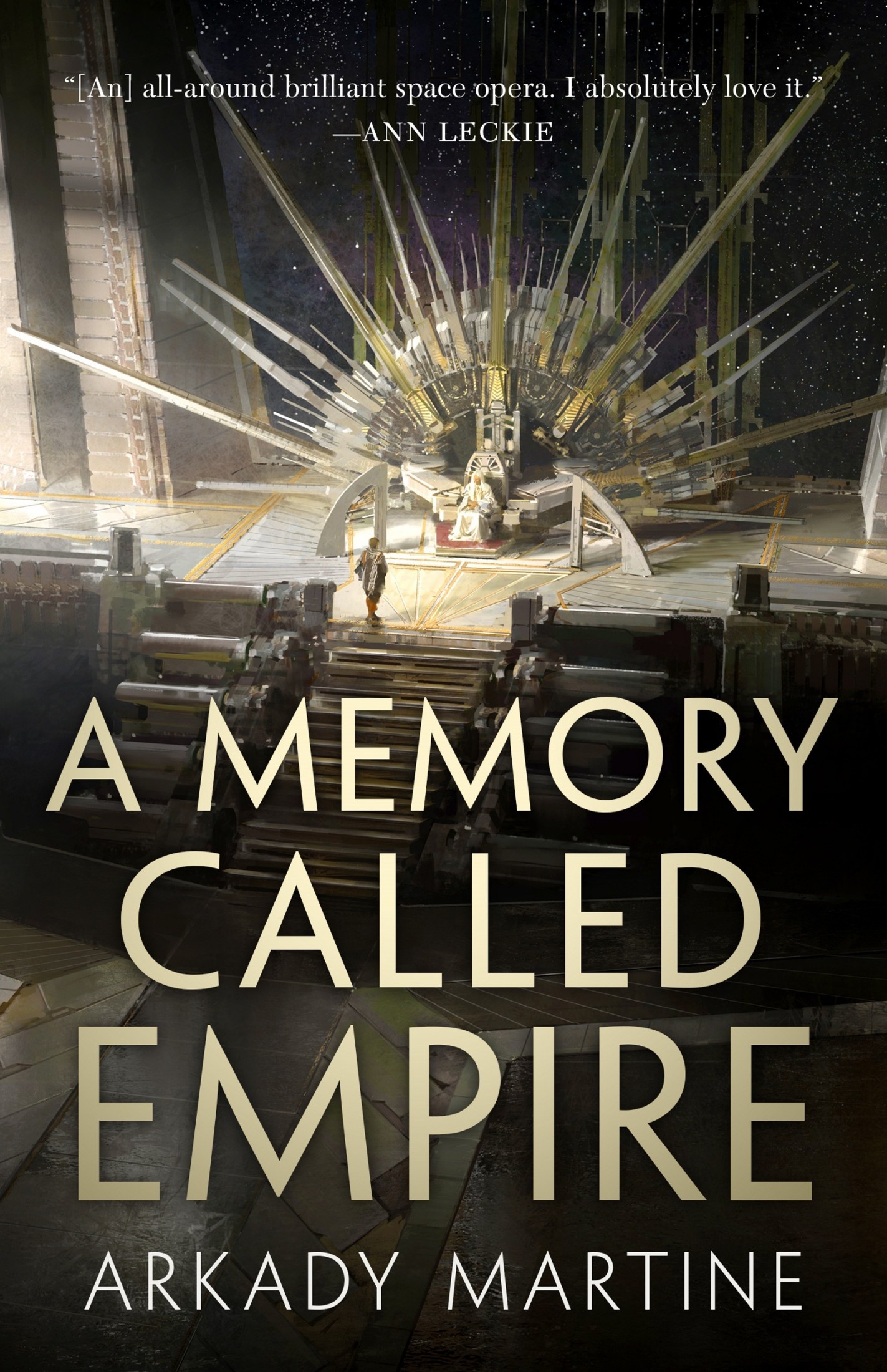
A Memory Called Empire
About this book
Mahit Dzmare is sent from Lsel Station to Teixcalaan after the previous ambassador dies under unclear circumstances. Her imago device should give her access to his experience, but it contains an outdated copy and begins failing when she needs it most.
At court, poetry, etiquette, and naming are instruments of political membership. Mahit admires Teixcalaani culture while representing a community that the empire could absorb, forcing her to investigate the death without letting fascination become surrender.
Arkady Martine makes language and memory operational parts of diplomacy. Alliances depend on interpretation, and the technology meant to preserve Lsel identity raises its own questions about continuity and consent.
A Memory Called Empire begins the Teixcalaan duology. It resolves its immediate succession crisis while establishing Mahit and Three Seagrass for A Desolation Called Peace.
Read a sample
5,022 words
Plain text
From the opening
PRELUDE
IN Teixcalaan, these things are ceaseless: star-charts and disembarkments.
Here is all of Teixcalaanli space spread out in holograph above the strategy table on the warship Ascension’s Red Harvest, five jumpgates and two weeks’ sublight travel away from Teixcalaan’s city-planet capital, about to turn around and come home. The holograph is a cartographer’s version of serenity: all these glitter-pricked lights are planetary systems, and all of them are ours. This scene—some captain staring out at the holograph re-creation of empire, past the demarcated edge of the world—pick a border, pick a spoke of that great wheel that is Teixcalaan’s vision of itself, and find it repeated: a hundred such captains, a hundred such holographs. And each and every one of those captains has led troops down into a new system, carrying all the poison gifts she can muster: trade agreements and poetry, taxes and the promise of protection, black-muzzled energy weapons and the sweeping architecture of a new governor’s palace built around the open many-rayed heart of a sun temple. Each and every one of those captains will do it again, render one more system into a brilliantine dot on a star-chart holograph.
Here is the grand sweep of civilization’s paw, stretched against the black between the stars, a comfort to every ship’s captain when she looks out into the void and hopes not to see anything looking back. Here, in star-charts, the division of the universe into empire and otherwise, into the world and not the world.
Ascension’s Red Harvest and her captain have one last stop before they begin their trip back to the center of their universe. In Parzrawantlak Sector lies Lsel Station: one fragile turning jewel, a toroid twenty miles in diameter rotating around a central spoke, hanging in the balance-point between a handy sun and its nearest useful planet. The largest of a string of mining stations that make up this small region of space, a region touched by the reaching hand of Teixcalaan but not yet subject to the weight of it.
A shuttle spits itself from the station’s spoke, travels a few hours’ distance to the waiting gold-and-grey metallic hulk of the warship, deposits its cargo—one human woman, some luggage, some instructions—and comes back again unharmed. By the time it has returned, Ascension’s Red Harvest has begun ponderously to move on a vector toward the center of Teixcalaan, still subject to sublight physics. It will be visible from Lsel for a day and a half yet, shrinking slowly to a pinpoint of brightness and then winking out.
Darj Tarats, the Lsel Councilor for the Miners, watches that retreating shape: the vast slumbering menace of it, hanging like a weight and eating up half the horizon visible from the viewport of the Lsel Council meeting room. That omnipresent blotting out of familiar stars is to him just the latest evidence of Teixcalaanli hunger for Stationer space. There may soon come a day when such a ship does not retreat, but turns the bright fire of its energy weapons on the fragile metal shell that contains thirty thousand lives, Tarats’s included, and spills them all into the killing chill of space like seeds from a smashed fruit. There is, Tarats believes, a kind of inevitability to empire unchecked.
No star-chart holograph glows above the strategy table around which the Lsel Council sits at meetings: only a bare metal surface, polished by a multitude of elbows. Tarats contemplates again the simplicity of how that retreating ship still feels like such a present threat—and stops looking out the viewport, retaking his seat.
Empire unchecked might be inevitable, but Darj Tarats has within him a quiet, determined, and conniving optimism that unchecked is not the only option available, and has not been for some time.
“Well, that’s done with,” says Aknel Amnardbat, the Councilor for Heritage. “She’s off. Our new Ambassador to the Empire, as requested by said Empire, which I sincerely hope she keeps far away from us.”
Darj Tarats knows better: he’s the man who sent the last ambassador from Lsel to Teixcalaan, twenty years ago when he was still middle-aged and enamored with high-risk projects. There is nothing done with about sending a new ambassador, even if she’s already been packed off in a shuttle, irretrievable. He puts his elbows on that table, as he’s been doing for all of those twenty years, and rests his narrow chin in his narrower palms. “It would have been better,” he says, “if we could have sent her with an imago that wasn’t fifteen years out of date. For her sake, and ours.”
Councilor Amnardbat, whose own imago-machine, a precisely calibrated neurological implant which allows her to carry in her mind the recorded memories of six prior Councilors for Heritage, passed down the imago-line one to the next, cannot imagine standing up to someone like Darj Tarats without the benefit of the most recent fifteen years of experience. If she was a new member of the Council, and fifteen years out of date, she would be crippled. But she shrugs, not precisely minding the idea of the newest Ambassador to the Empire being so deprived of resources. She says, “That’s your problem. You sent Ambassador Aghavn, and Aghavn hasn’t bothered to come back here more than once in his twenty-year tenure to give us an updated imago-recording. And now we’ve sent Ambassador Dzmare with only what he left us fifteen years ago to replace him just because Teixcalaan asked—”
Continue reading the sampleClose the sample
“Aghavn’s done his job,” says Councilor Tarats, and around the table the Councilors for Hydroponics and for the Pilots nod in agreement: the job Ambassador Aghavn has done is keeping Lsel Station, and all the rest of the little stations in their sector, from being easy prey to a Teixcalaanli expansionist agenda, and in return for this they have collectively agreed to ignore his shortcomings. Now that Teixcalaan has abruptly demanded a new ambassador, without explaining what has become of the old one, most of the Council are delaying an accounting of Ambassador Aghavn’s flaws until they know if he is dead, compromised, or simply fallen prey to some internal imperial shakeup of politics. Darj Tarats has always supported him—Aghavn was his protégé. And Tarats, as Councilor for the Miners, is first amongst the six equals on the Lsel Council.
“And Dzmare will do hers,” says Councilor Amnardbat. Mahit Dzmare had been her choice, of the possible new ambassadors: a perfect match, she’d thought, for the out-of-date imago she’d carry. The same aptitudes. The same attitude. The same xenophilic love for a heritage that was not the heritage Amnardbat protected: a documented fascination with Teixcalaanli literature and language. Perfect to be sent away, with the only copy of Ambassador Aghavn’s imago that existed. Perfect to carry that corrupt and corrupting imago-line away from Lsel—perhaps, for good. If Amnardbat herself had done right.
“I’m sure Dzmare will be adequate enough,” says the Councilor for the Pilots, Dekakel Onchu, “and now can we consider the problem currently before the Council, namely what we are going to do about the situation at the Anhamemat Gate?”
Dekakel Onchu is exceptionally concerned about the Anhamemat Gate, the more distant of Lsel Station’s two jumpgates, the one that leads into parts of space unclaimed by Teixcalaanli hands. Lately, she has lost not one scout-ship—which could have been an accident—but two, and both in the same spot of black. She has lost them to something she has no way to talk to. The communiqués sent back before those ships went dark, garbled and staticky with radiation interference, have made no sense; worse, she has lost not only the pilots of those ships, but the long imago-lines of memory that they belonged to. The combined minds of those pilots and their imago-lines cannot be salvaged and placed into new pilot-minds without the recovery of the bodies and imago-machines that had been destroyed—and that is impossible.
The rest of the Council is not so concerned, not yet, but they will be by the end of this meeting, after Onchu has played them the remains of the recordings—all but Darj Tarats. Darj Tarats has a terrible sort of hope instead.
He thinks: At long last, perhaps there is an empire larger than the Empire that has been devouring us by inches. Perhaps now it comes. Perhaps now I will be able to stop waiting.
But this he keeps to himself.
CHAPTER
ONE
And from behind the curve of the large gaseous planet at coordinate B5682.76R1, the Emperor Twelve Solar-Flare arose on the bow of her ship, and she was a radiant blaze flooding all of the void. The rays of her light, reaching outward like the spear-spokes of her throne, struck the metal shells which were the dwelling-places of human beings in Sector B5682, and illuminated them brightly. The sensors of Twelve Solar-Flare’s ship recorded ten of them, each alike to the other, and this number has not increased since. Within the shells the men and women knew not seasons nor growth nor decay, but lived endlessly in orbit without benefit of a planetary home. The largest of these shells called itself Lsel Station, which in the language of its people meant a station that both listened and heard. But the people there had grown strange, and cleaved to themselves, though they were capable of learning language, and immediately began to do so …
—The Expansion History, Book V, lines 72–87, anonymous but attributed to the historian-poet Pseudo-Thirteen River, writing in the reign of the Emperor of All Teixcalaan Three Perigee
In order to expedite your travel into the Imperium, Teixcalaan requests the following as proofs of identity: a) a genetic record stating your sole possession of your own genotype, unshared with clonesibs OR a notarized document stating that your genotype is at least 90 percent unique and that no other individual holds LEGAL claim to it; b) an itemized list of goods, chattels, currencies, and objects of idea commerce which you intend to bring with you; c) a work permit from a registered employer in a Teixcalaanli system, signed and notarized, with salary and maintenance information, OR a record of superlative performance on the Teixcalaanli Imperial Examinations OR an invitation by a person, governmental entity, bureau, ministry, or other authorized individual specifying your entrance and exit dates from Imperium space OR evidence of sufficient self-supporting currency …
—Form 721Q, Visa Application Made from Foreign Sectors ALPHABETIC LANGUAGE VARIANT, page 6
MAHIT came down to the City, heart-planet and capital of the Teixcalaanli Empire, in a seed-skiff, a bubble of a ship hardly big enough for her body and her luggage both. She squirted from the side of the imperial cruiser Ascension’s Red Harvest and burned atmosphere on her planetward trajectory, which distorted the view. Thus the first time she saw the City with her own flesh eyes, not in infofiche or holograph or imago-memory, it was haloed in white fire and shone like an endless glittering sea: an entire planet rendered into an ecumenopolis, palatially urban. Even its dark spots—older metropolises not yet clad in metal, decaying urban blight, the harnessed remains of lakes—looked populated. Only the oceans remained untouched, and they gleamed too, a brilliantine blue-turquoise.
The City was very beautiful and very big. Mahit had been on a fair number of planets, the ones closest to Lsel Station that weren’t completely inimical to human life, and she was nevertheless overcome by awe. Her heart beat faster; her palms went clammy where they gripped her harness. The City appeared exactly as it was always described in Teixcalaanli documents and songs: the jewel at the heart of the Empire. Complete with atmospheric glow.
<That’s what looking at it is meant to make you think,> said her imago. He was a faint staticky taste on the back of her tongue, a flash of grey eyes and sun-dark skin in her peripheral vision. The voice in the back of her head, but not quite her voice: someone around her age, but male, and quicksilver-smug, and as excited to be here as she was. She felt her mouth curve in his smile, a heavier and wider thing than the muscles in her face preferred. They were new to each other. His expressions were very strong.
Get out of my nervous system, Yskandr, she thought at him, gently chiding. An imago—the implanted, integrated memory of one’s predecessor, housed half in her neurology and half in a small ceramic-and-metal machine clasped to her brainstem—wasn’t supposed to take over the host’s nervous system unless the host consented. At the beginning of the partnership, though, consent was complicated. The version of Yskandr inside her mind remembered having a body, and sometimes he used Mahit’s as if it were his own. She worried about it. There was still so much space between them, when they were supposed to be becoming one person.
This time, though, he withdrew easily: sparking prickles, electric laughter. <As you will. Show me, Mahit? I want to see it again.>
When she gazed down at the City again—closer now, the skyport rising to meet her skiff like a flower made of scooping nets—she let the imago look through her eyes and felt his rush of exhilaration as if it were her own.
What’s down there, she thought. For you.
<The world,> said her imago, who had been Ambassador from Lsel in the City when he was still a living person and not part of a long chain of live memory. He said it in the Teixcalaanli language, which made it a tautology: the word for “world” and the word for “the City” were the same, as was the word for “empire.” It was impossible to specify, especially in the high imperial dialect. One had to note the context.
Yskandr’s context was obfuscating, which Mahit had come to expect of him. She coped. Despite all her years of studying Teixcalaanli language and literature, his fluency had a different quality than hers, the sort that only came from immersive practice.
<The world,> he said again, <but also the edges of the world.> The Empire, but also where the Empire stops.
Mahit matched his language and spoke out loud in Teixcalaanli, since there was no one but her in the seed-skiff. “You’ve said something meaningless.”
<Yes,> Yskandr agreed. <When I was ambassador it was my habit to say all sorts of meaningless things. You should try it. It’s quite enjoyable.>
In the privacy of her body, Yskandr used the most intimate forms of address, as if he and Mahit were clonesibs or lovers. Mahit had never spoken them out loud. She had a natural younger brother back on Lsel Station, the closest she would ever get to a clonesib, but her brother only spoke the Stationers’ language, and calling him “you,” intimate-otherself in Teixcalaanli, would have been both pointless and unkind. She could have said “you” to a few people who had been in those language and literature courses with her—her old friend and classmate Shrja Torel would have taken the compliment correctly, for instance, but Mahit and Shrja hadn’t spoken since Mahit had been picked to be the new Ambassador to Teixcalaan and carry the imago of the previous one. The why of that little breakage between them was obvious, and petty, and Mahit regretted it—and it wasn’t something she was going to get a chance to repair, except by apologetic letter from the center of the Empire both she and Shrja had wanted to see. Which almost certainly wouldn’t help.
The City had come closer: it filled up the horizon, a vast curve she was falling into. To Yskandr, she thought, I am the Ambassador now. I might speak meaningfully. If I wanted.
<You speak correctly,> Yskandr said, which was the sort of compliment the Teixcalaanlitzlim gave to a still-crèched child.
Gravity caught at the seed-skiff and sank into the bones in Mahit’s thighs and forearms, giving her the sensation of spin. It was dizzying. Below her the skyport’s nets flared open. For a moment she thought she was falling, that she would fall all the way to the planet’s surface and smear to paste on the ground.
<It was the same for me,> Yskandr said quickly, in that Stationers’ language that was Mahit’s native tongue. <Don’t be afraid, Mahit. You are not falling. It is the planet.>
The skyport caught her with hardly a bump.
She had time to gather herself together. There was some business with the seed-skiff being shunted into a long line of other such vessels, moving along a great conveyor until each one could be identified and come to its assigned gate. Mahit found herself rehearsing what she would say to the imperial citizens on the other side as if she was a first-year student preparing for an oral examination. In the back of her mind, the imago was a watchful, thrumming presence. Every so often he moved her left hand, the fingers tapping along her harness, someone else’s nervous gesture. Mahit wished they’d had longer to get used to each other.
But she hadn’t undergone the normal process of having an imago implanted, complete with a year or more of integration therapy under the precise care of one of Lsel’s psychotherapists: she and Yskandr had had a scant three months together, and now they were approaching the place where they’d need to work together—work as one person, compiled out of a memory-chain and a new host.
When Ascension’s Red Harvest had arrived, hanging in parallel orbit around Lsel Station’s sun, and had demanded a new ambassador to take back to Teixcalaan, they had refused to explain what had happened to the previous one. Mahit was sure there had been a great deal of politics on the Lsel Council as to what—and who—to send back, and with what demands for information. But this she knew was true: she herself had been one of the few Stationers both old enough for the job and young enough not to have already been brought into an imago-line—and one of the fewer still within that group who had any of the appropriate aptitudes or training for diplomacy. Of those, Mahit had been the best. Her scores on the Imperial Examinations in Teixcalaanli language and literature had approached those of an imperial citizen, and she’d been proud of that—spent the half year since the exams imagining that she would come to the City, sometime in her middle age, once she was established, and collect experiences—attending whatever salons were open to noncitizens that season—gathering up information for whoever she’d share her memory with after she died.
Now she’d get to the City, all right: more important than any Teixcalaanli examination, her scores on the imago-aptitudes had come up green, green, green for this match. Her imago would be Yskandr Aghavn, the previous Ambassador to Teixcalaan. Who was now somehow unsuitable to that empire—dead, or disgraced, or held captive if still alive. Mahit’s instructions from her government included determining precisely what had gone so wrong with him—but she still had his imago. He—or, at least, the last version of him available to give her, fifteen years out of date—was the closest thing Lsel could provide to a native guide to the Teixcalaanli court. Not for the first time, Mahit wondered whether or not there would be a Yskandr waiting for her in the flesh when she stepped outside. She was not sure which would be easier, having one—a disgraced ambassador? A competitor for her, but perhaps salvageable?—or not having one, which meant he had died without ever giving to any younger person what he had learned in his lifetime.
The imago-Yskandr in her head was hardly older than she was, which was both helpful in finding commonality and uncomfortable—most imagos were elders or victims of early-death accidents—but the last record of Yskandr’s knowledge and memory had been taken when he’d last returned to Lsel on leave from his post in Teixcalaan, only five years after he had first gone down to the City. It had been another decade and a half since then.
So he was young, and so was she, and whatever advantage to integration that might have granted the two of them was belied by how short a time they’d been together. Two weeks between the courier’s arrival and when Mahit learned that she’d be the next ambassador. Three more weeks for her and Yskandr to learn how to live together in the body that used to belong to her alone, under the supervision of the Station’s psychotherapists. A long, slow time on Ascension’s Red Harvest, traversing the sublight distances between the jumpgates that were scattered like jewels throughout Teixcalaanli space.
The seed-skiff peeled open like a ripe fruit. Mahit’s harness retracted. Taking hold of her luggage in both hands, she stepped onto the gate, and thus into Teixcalaan itself.
The skyport gate had an airy utilitarianism constructed of wear-resistant carpet and clearly marked signage between glass-and-steel-paneled walls. Standing in the center of the gate’s connecting tunnel, a precise halfway between the seed-skiff and the skyport proper, was a single Teixcalaanli imperial official in a perfectly cut cream suit. She was small: narrow at the shoulder and hip, much shorter than Mahit, and she wore her hair in a fishtail-braid queue of black that spilled over her left lapel. Her sleeves, wide like bells, shaded through flame-orange at the upper arm—<Information Ministry coloring,> Yskandr told Mahit—down to the deep red cuffs that were the privilege of the titled members of the court. Over her left eye she wore a cloudhook, a glass eyepiece full of the ceaseless obscuring flow of the imperial information network. Hers was sleekly decorative, much like the rest of her. Her large, dark eyes and thin cheekbones and mouth were more delicate than was fashionable on Teixcalaan, but by Mahit’s Stationer standards she was interesting, if not quite pretty. She touched her fingers together politely in front of her chest and inclined her head to Mahit.
Yskandr lifted Mahit’s own hands to make the same gesture—and Mahit dropped the two bags she’d been carrying on the floor with an embarrassing clatter. She was horrified. They hadn’t slipped like that since the first week they’d been together.
Fuck, she thought, and heard at the same moment Yskandr say <Fuck.> The doubling wasn’t reassuring.
The official’s carefully neutral expression did not change. She said, “Ambassador, I am Three Seagrass, asekreta and patrician second-class. It is my honor to welcome you into the Jewel of the World. I will be serving as your cultural liaison at the command of His Imperial Majesty Six Direction.” There was a long pause, and then the official gave a small sigh and went on: “Do you require some sort of assistance with your belongings?”
“Three Seagrass” was an old-fashioned Teixcalaanli name: the numeral half was low value, and the noun half was the name of a plant, even if it was a plant Mahit hadn’t seen used in a name before. All of the noun parts of Teixcalaanli names were plants or tools or inanimate objects, but most of the plant ones were flowers. “Seagrass” was memorable. Asekreta meant she was not only Information Ministry, as her suit suggested, but a trained agent of rank, as well as holding the court title of patrician second-class: an aristocrat, but not a very important or rich one.
Mahit left her hands where Yskandr had put them, which was where they belonged no matter how angry she was at how they’d gotten there, and bowed over them. “Ambassador Mahit Dzmare of Lsel Station. At your service and that of His Majesty, may his reign be a radiant blaze upon the void.” Since this was her first official contact with a member of the Teixcalaanli court, she used the imperial honorific she’d picked carefully in consultation with Yskandr and the Council government on Lsel: “radiant blaze” was the epithet for the Emperor Twelve Solar-Flare in The Expansion History as Attributed to Pseudo-Thirteen River, the oldest account of imperial presence in Stationer space. Using it now was thus a sign of both Mahit’s erudition and her respect for Six Direction and his office; but “the void” carefully avoided any intimation of Teixcalaanli claim on parts of Stationer space which were not, in fact, space.
Whether Three Seagrass was aware of the implications of reference was somewhat difficult to tell. She waited patiently while Mahit scooped up her luggage again, and then said, “Keep a tight grip on those. You are urgently awaited in the Judiciary concerning the previous ambassador, and you may need to greet all sorts of people along the way.”
Fine. Mahit wouldn’t underestimate Three Seagrass’s capability to be snide, nor her capability to be clever. She nodded, and when the other woman turned smartly and walked up the tunnel, she followed.
<Don’t underestimate any of them,> Yskandr said. <A cultural liaison has been at court for half as long as you’ve been alive. She earned the post.>
Don’t lecture me when you’ve just made me look like a flustered barbarian.
<Do you want me to apologize?>
Are you sorry?
Mahit could imagine his facial expression all too easily: arch, as calm as a Teixcalaanlitzlim, the lusher mouth she remembered from holographs of him dragging her own lips up and askew. <I wouldn’t want you to feel like a barbarian. You’ll get enough of that from them.>
He wasn’t sorry. It was marginally possible that he was embarrassed, but if he was, he wasn’t feeling it with her endocrine system.
Yskandr got her through the next half hour. Mahit couldn’t even resent him for it. He behaved exactly like an imago ought to behave: a repository of instinctive and automatic skill that Mahit hadn’t had time to acquire for herself. He knew when to duck through doorways built for Teixcalaanlitzlim instead of Stationers; when to avert her eyes from the rising glare of the City reflected in the glass of the elevator that crawled down the outside of the skyport; how high to step to climb into Three Seagrass’s groundcar. He performed courtesy ritual like a native. After the incident with the luggage he was careful about actually moving Mahit’s hands, but she let him have charge of how long she maintained eye contact and with whom, the degree to which her head was inclined in greeting, all the little ways of signaling that she was less of an alien, less of a barbarian, something that might belong in the City. Protective coloration. Going native without ever having to be a native. She could feel curious eyes slide off of her and fixate on the far more interesting court dress of Three Seagrass, and wondered how much Yskandr had loved the City, to be this good at being in it.
In the groundcar, Three Seagrass asked, “Have you been within the world long?”
Mahit needed to stop thinking in any language but Teixcalaanli. What Three Seagrass meant was a standard bit of politesse small talk, a have you ever been to my country before, and Mahit had heard it like an existential question.
“No,” she said, “but I have read the classics since I was a very small child, and I have thought often of the City.”
Three Seagrass seemed to approve of this answer. “I wouldn’t want to bore you, Ambassador,” she said, “but if you’d like a brief and verbal tour of what we’re passing by, I’d be pleased to recite an appropriate poem.” She flicked a control button on her side of the car, and the windows faded to transparency.
“I couldn’t be bored,” Mahit said honestly. Outside, the city was a blur of steel and pale stone, neon lights crawling up and down the glass walls of its skyscrapers. They were on one of the central ring roads, spiraling inward through municipal buildings toward the palace itself. Properly, it was more of a city-within-a-city than a palace. By statistics, it had several hundred thousand inhabitants, all of whom were responsible in some minute fashion for the functioning of the Empire, from the gardeners on up to Six Direction himself: each of them plugged into the information network that was guaranteed to imperial citizens, and every last one bathed in a constant flow of data that told them where to be, what to do, how the story of their day and week and epoch would go.
Three Seagrass had an excellent voice. She was reciting The Buildings—a seventeen-thousand-line poem which described the City’s architecture. Mahit didn’t know the precise version she’d picked to declaim, but that might have been Mahit’s own fault. She had her own favorite narrative poems from the Teixcalaanli canon, and she’d memorized as many of them as she could in imitation of Teixcalaanli literati (and to pass the oral portions of the examinations), but The Buildings had always seemed too dull to bother with. It was different now, hearing Three Seagrass recite it as they passed the structures being described. She was a fluent orator, and she had enough command of the metrical scheme to add amusing and relevant original detail where improvisation was appropriate. Mahit folded her hands across her lap and watched the poetry going by through the glass windows of the groundcar.
This was the City, then, the Jewel of the World, the heart of the Empire: a collapse between narrative and perception, Three Seagrass making adjustments on the fly to the canonical Buildings when some building had changed. After some time she realized that Yskandr was reciting along with Three Seagrass, a dim whisper in the back of her mind, and also that she found the whisper reassuring. He knew this poem, and thus she knew it too, if she needed to know it. That was what imago-lines were for, after all: making sure useful memory was preserved, generation to generation.